
You are currently browsing the category archive for the ‘Diabetes’ category.
‘How’s that working for you?’
‘Sorry?’
I’m at Parliament House in Canberra preparing for a type 1 diabetes and technology event being held later today. Walking through security, three security staff honed in on my upper arm.
‘Your patch, is it doing the trick?’
I was confused. ‘I’m sorry. Excuse me?’
‘Are you an ex-smoker?’
‘Oh! This? It’s not a nicotine patch. It’s a continuous glucose monitor. I have diabetes.’
I don’t know if they believed me. I gathered my bag and moved on through the security area. ‘Diabetes,’ I said again. ‘It checks my blood sugar.’
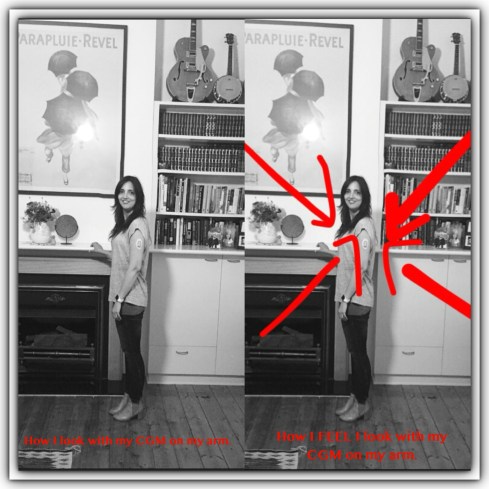
My invisible illness is pretty visible today.
I made the decision yesterday morning to site my sensor on my upper arm rather than my stomach. The last two sensors I have worn left my skin slightly irritated, so I though I would give the skin around my belly a rest. I also haven’t been thrilled with how long the sensors have lasted – the last two survived a mere 10 and 12 days which is not great when I have been known to get closer to three weeks. (I know, I know, they are meant to work for 7 days. But at over $80 a pop, I do everything in my power to make sure they last as long as bloody possible!)
Before I got to work yesterday morning, three different people had asked what the thing on my arm was. Once I got into the office, another couple of people asked (…don’t even want to remind you all that I work for a diabetes organisation…)
Waiting for a coffee at my local this morning, the barista asked about it and yesterday, at the cafe near work, I could see the people around me looking at my arm and heard them guessing what it was.
At the airport today, a security guard asked if it could be removed and then wanted to engage in a conversation about it, and the woman sitting next to me also asked about it.
It’s been very confronting.
I have never hidden my diabetes. I used to inject at the dinner table before starting pump therapy. And since using a pump, I pull it our from under my clothes to bolus, or see my CGM graph without a second thought. I check my BGL whenever and wherever I want.
But while these diabetes chores occasionally attract a comment, it is nothing like the last two days.
I found myself sitting at lunch today with my right arm cupping the transmitter and sensor to hide it from view. I’ve been cursing the beautiful weather that means I don’t need to wear long sleeves to cover the device. And I’m terrified that people think I am wearing it on my arm to attract attention.
I have always been able to see the pros and cons of having an invisible health condition. Sometimes, the fact that there are no obvious signs of diabetes means that people don’t understand how significant a role it plays in day to day life. But the flip side is that it can be neatly packed away; it can be private. I actually love that about it.
But right now, I don’t have that luxury. Right now it is out, loud and proud for all to see. And I am not comfortable with it at all.
It’s day two of the 2015 EASD conference in Stockholm. Sunday and Monday showcased some impressive symposia – including industry announcements – and yesterday the official opening ceremony started the conference proper.
 We arrived in Stockholm around midday on Sunday after 26 hours in transit, so the afternoon was spent settling into our hotel which, bizarrely, has only round windows giving the odd sense that we are in a boat. Seventeen floors above ground level. In the sky. Weird, but gives an incredible view of each morning’s sunrise!
In keeping with EASD tradition, the conference is very science-y. There is little about the psychosocial aspects of diabetes and minimal input from people with diabetes. I have developed a twitch in my right eye because I keep hearing the word ‘diabetic’ and as much as I try to tell myself to get over it, it just doesn’t sit right with me coming out of the mouths of clinicians.
There is much mention of the ‘patient perspective’ and on Monday there was an entire symposium dedicated to it. Unfortunately, there wasn’t an actual ‘patient’ on the panel, which surely is weird. It is, right?
But despite the limited presence of PWD in the official programme, there are a lot of satellite events and activities taking place.
 Yesterday was #DOCDAY, an event organised by Bastian Haulk from he German online community. He had hired a space in downtown Stockholm and invited bloggers, advocates and others with diabetes to come along, network, chat, and talk about what we are all doing in our different communities and the larger DOC. Bastian asked me to say a few words at the introduction and I highlighted for me what is the most important thing when we are talking about the DOC: No one owns this community. No one is more important or more relevant or more powerful.
Sure, some of us are very fortunate that we get to actually meet IRL and attend conferences, but we do it as part of our jobs – whether it be like me (through my work at a diabetes organisation mixed with my online work) or through independent consulting or other work.
But regardless if you are in the room or following along on Twitter, everyone has the same right to be here and to be part of it.
Two separate blogger summits have been organised by industry – I will be attending the Johnson and Johnson DOC Exchange event tomorrow and Friday. These activities showcase just how smooth PWD and industry can work together – disclaimers and all that sort of stuff out in full view!
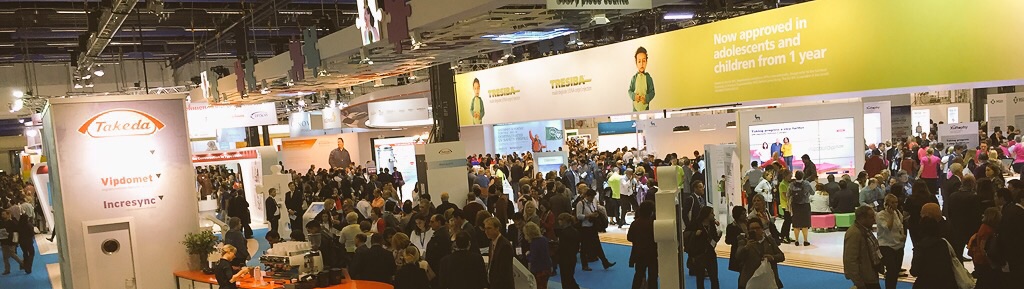
The Exhibition Hall here is, as expected, huge. Whilst the usual suspects are all here in force, there are also a few new faces on the scene. The Keleido pump is something to watch – if, for no other reason, than the gorgeous colour spectrum! More in coming days!
 While we’re talking new stuff, check out this gorgeous range of clothing from Anna PS (Scandinavia). Anna is delightful and started this company to address a gap in the market, producing high quality t-shirts, bathers, underwear and more to accommodate diabetes devices such as pumps, CGM receivers, pens etc. The clothing is of the most beautiful designs – the fabrics are divine. (And yes, she ships to Australia!)
There is a lot on show and a lot being presented and as in previous years, I have found this conference a lot more daunting than other meetings like ADA or our own ADS-ADEA. but there is plenty to write about and share. More in coming days.
I love being able to quote random diabetes-related numbers to people. I get the irony of this considering I am also of the ‘diabetes is not all about numbers’ school, but sometimes, numbers can be really powerful.
I love asking this question:
‘What does 8754 mean?’
After the blank looks and the stares and the SWAGs, (the number of cupcakes you have eaten? The number of pairs of boots in your closet? The number of litres of coffee you consume in a month??), I reply with the answer:
‘That is the number of hours in a year that a person with diabetes manages their diabetes solo. There are 8760 hours in a year, so it works out to an average of about 6 hours per year that we get to work with a healthcare professional. And that’s if we’re lucky! The rest of the time, we do it on our own.’
It’s pretty powerful when you think about it.
Last week at the ADS ADEA meeting, a diabetes educator asked me if I knew what the number 121 referred to. It was my turn to look blank. (The number of pairs of boots in my closet?…)
‘It’s the average number of diabetes-related decisions a person with diabetes makes every day.’
Now, I am not sure where that stat came from (I actually will follow up and ask her) or just how accurate it is.
But regardless of the exact number, it is high – we do make a lot of diabetes decisions each day.
Over the weekend, I started to think about some of the decisions I make.
I thought about it as I was lying in bed in the morning, deciding whether to get up and get my BGL meter and do a check. I thought about it just before I stepped into the shower and examined my cannula after I removed my pump, deciding if I needed to do a line change then or if it could wait until the afternoon. At a local café, I calculated the number of carbs in my breakfast, deciding whether or not to enter the number into my pump and let the wizard do its calculating magic or just enter the units of insulin manually. But before I did that, I needed to decide whether or not to actually give myself any insulin because I was bordering on being low and didn’t want to bolus too soon in case my food was delayed. I thought about going for a walk with the kidlet and the puppy, deciding whether or not I should set a temporary basal rate in case we went to the park, let Sooty off the lead and had to chase her around for 10 minutes before we caught her. I thought about how much insulin I have in the fridge, deciding that I should call the pharmacy and order some so that I don’t run out when we are in Sweden in two weeks. I decided that I really need to schedule an appointment to have my complications screening done and then decided to wait because… because… well there is no good reason. But that is what I decided.
This was all within 70 minutes of waking up.
I am not sure that I would make 121 diabetes-decisions every day, but there would certainly be a lot.
Trying to explain just how diabetes impacts on our every day is difficult, but using numbers to illustrate just how considerably it weasels its way into pretty much every aspect of the day can be pretty effective.
My study at home is one of my favourite places to work. It’s warm and cosy and filled with things that I love.
If someone who knew nothing about me walked into this room (which would be weird and creepy) they would put together a picture of me as someone who loves New York (thanks to the two meter photo hanging on one wall) and books (thanks to the bookshelves wrapped around two other walls).
They would see that I’ve travelled a bit (thanks to the cluster of photos on another wall of the three of us in places all around the world) and they would see a lot of Apple products.
They would know that I like coffee (frequently here are empty take away coffee caps left on the table) and enjoy cooking (cooking magazines and cookbooks are often on the desk, opened to pages showing the next dish I was planning to make).
They could sit at my desk and look at my pin-board and see reminders of favourite galleries and shops I’ve been in overseas and photos of my beautiful sister and drawings by my daughter and my husband.
And they would discover that we’re pretty lousy at putting the clean washing away because there is often a overflowing basket in the corner, its contents waiting to be folded and put away.
They would be able to get a pretty good picture of me – the person that spends a lot of time in here, frantically typing away on here on my (Apple) laptop.
And if they looked carefully, they may notice something else.
They may notice that I have a lot of books on those shelves about diabetes.
And they would see a half empty bottle of something called Glucolift on my desk, which, if they looked more closely would discover to be glucose tablets. They may even notice the chalky residue around the bottle from last time I was low in here and struggled to open the jar, eventually sending its contents over the desk.
If they looked on the floor and on the desk and on the chairs and inside the empty coffee cups and pretty much everywhere else, they would see little white strips with little drops of dry blood on them.
They would see a jar or two of jelly beans.
They might see a small empty glass bottle with a burgundy lid and burgundy writing that says ‘Humalog’.
And then, if they noticed all those things and joined the dots, they would realise that as well as being a person who loves books and travels a lot and drinks a lot of coffee and everything else, that I have diabetes.
Or they wouldn’t. They would have no idea. They would miss all those things or not join the dots. And that would be okay. Sometimes, that is really very okay.
POSTSCRIPT:
I’ve spent a considerable amount of time today catching up with #DOCBurnout2015 posts and reading about the tactics people use to avoid or recover from social media burnout. Even more interesting than what I have been reading is watching how people reach out to support and encourage others sharing their story. I guess I shouldn’t be surprised. As someone who has only been afforded love and support from the DOC, it isn’t a surprise that it has been shown with this initiative.
After pounding the corridors of the Adelaide Convention Centre, it was nice to have a quiet weekend of recovery, coffee and sleep.
And I caught up on lots of World Wide Web happenings. Here are some highlights.
LET’S TALK ABOUT COMPLICATIONS.
I am always saying how lucky I feel to have friends with diabetes both online and IRL. I always get a kick out of meeting people in person who I have connected with on social media. Kim Hislop is one of those people. I met Kim for the first time at the ADA conference in Boston this year and then again at Friends for Life in Orlando.
Last week, Kim guest-blogged for Kerri at Six Until Me about living with complications and her post is required reading for anyone affected by diabetes.
Complications are spoken about as an ‘end point’: if you do this/don’t do this, you will get this. Full stop. Threat, threat; blame, blame; guilt, guilt.
Where is the discussion about what happens next? Actually, what DOES happen next?
Kim’s piece starts to answer those questions and open the dialogue. Thank you for writing it, Kim!
NERD ALERT
THERE IS A PERIOD TABLE OF DIABETES!!!! I am too excited to write anything more. (And busy memorising it….)

(Click on pic for source.)
STICK TO THE FACTS TO COUNTER THE ANTI-VAXX
My heart broke a little last week when one of my favourite artists, cartoonist and poet Michael Leunig, had a cartoon published in The Age newspaper that could only be considered as anti-vaccination propaganda.
I adore Leunig and pretty much all he does – we have a Leunig drawing on our wall and I have barely been able to look at it since I saw the cartoon in the paper.
An article I read today in MJA says that perhaps we need to reframe the way we try to deal with those sprouting anti-vaxx rubbish. The message from this study proposes that instead of shouting about the irrefutable scientific evidence which demonstrates that vaccines are safe we should show parents what vaccine-preventable diseases actually do.
This makes sense. Most people have not seen what diseases such polio or measles actually look like. Thanks to the success of vaccines, most of these infectious diseases are uncommon. Instead of sprouting stats, show pictures
ARTY
I’ve written before about how we love the artwork of Josh ‘SHAG’ Agle and Derek Yaniger. Last week, I was introduced to Cliff Roberts an artist who illustrated the gorgeous (and unfortunately out of print) The First Book of Jazz.
My new project is to find a copy of the book and also some of his prints to adorn our walls.

Artwork by the wonderful Cliff Roberts
ICYMI
Last week was the ADS-ADEA annual scientific meeting. Click back through last week’s posts to see what went on. And read Ashley’s take aways from the conference over at Bittersweet Diagnosis.
COUNTDOWN TO WDD
Somehow, tomorrow is September. Which means that we are a mere two and a half months away from World Diabetes Day 2015. The IDF has launched its campaign for WDD this year and you can read all about it here.
The theme this year is all about healthy eating and its importance in diabetes management. Which it is. Even type 1 diabetes. I can already hear the ‘food has nothing to do with type 1 diabetes’ protests, but how about instead we consider how healthy eating is important to healthy living. And that includes those of us with an under-performing pancreas.
Healthy eating is a right – one that is not afforded to everyone. And this is a campaign that is worth supporting.
PRETTY THINGS
Prikkedief is an originations from The Netherlands making some pretty gorgeous diabetes fashion. You’ll find beautiful buttery leather awareness bracelets, pouches to hold diabetes supplies, cheeky t-shirts and fun wall art. Find them on Facebook here. (Their website seemed to be down at the time of writing this.)

Pretty pastels from Prikkedief.
ONE FOR THE WOMEN AND ONE FOR THE MEN
Diabetes Victoria is holding its annual Women’s Weekend in October. Details are here.
If you are thinking about possibly attending, but are just not sure, I would absolutely urge you to book. The previous two events have been hugely successful with attendees being overwhelmingly going home inspired and armed with new strategies to live well with diabetes.
And men are not forgotten. There is also an event exclusively for men living with type 1 diabetes coming up in information session coming up in October. Details here.
FUN FACT
The plural of pancreas is pancreata. You are welcome.
In the program for the ADS-ADEA conference, there was an unfortunate typo in the title for one of yesterday afternoon’s symposia. It took me a moment to realise that ‘Better Understanding the Needs of YOUR People with Diabetes: A Behavioural Perspective’ was meant to be ‘Better Understanding the Needs of YOUNG People with Diabetes: A Behavioural Perspective’.
It was in this symposium that there was a talk that certainly challenged some long-held ideas.
Dr Jessica Browne from the ACBRD gave a talk with the heading ‘Young adults with type 1 and 2 diabetes: more similar than you may think’. When I saw this in the program, I immediately winced. Not because I disagreed with it. But because I knew that there would possibly be some very unhappy people – predominantly people with type 1 diabetes or parents of kids with type 1 diabetes – who would not like what they were reading.
Controversial? Well, actually, I’m not so sure.
I know Jessica’s work, and I have a very clear understanding about what she is saying. And Jess herself took great pains to makes sure that everyone else in the room understood that she is not saying that type 1 and type 2 diabetes are the same conditions. (Bold, underlines, italics for emphasis all mine.)
Jess’ talk was about how emotional and behavioural attitudes to diabetes are very similar in young people – regardless of the type of diabetes.
This makes perfect sense when you think about it. Young adulthood is an often-challenging period of great change. For some, it involves studying or work or a combination of both. Some are planning families and moving out and buying houses and travelling the globe. Some are in relationships, others are not. It’s a time of a lot of self-discovery and finding one’s identity.
And diabetes adds an extra degree of difficulty – whatever type it might be.
Young people with type 2 diabetes face some considerable barriers to good emotional health. Unfortunately, they are often beginning far behind the start line, having to overcome a lot of social stigma and misconceptions about their health condition.
Yet when they search for information to help them out, much of what they find has been developed with an older adult audience in mind. Little of it is relevant to what a 25 year old is going through or addresses the issues they are facing.
In recent times when I have met young adults with type 2 diabetes, the things they say they need to better manage their condition and the how they say they are feeling about diabetes pretty much equal what young people with type 1 diabetes say they need.
Jessica called for tailored healthcare that is intensive, responsive, non-judgemental and targeted for young people with type 2 diabetes, which, when you think about it, is really not that different to what those of us with type 1 diabetes are asking for when it comes to treating ‘our’ diabetes.
I’m a bit of a goody-two-shoes most of the time. I like rules; I like to play by them. If someone hands me a policies and procedures handbook, I read it and then tick boxes as I make sure I do what is expected of me. Playing by the book is my MO! (You can see why being diagnosed with diabetes is not really in sync with this philosophy…)
So, it pains me greatly when I see a rule that I don’t like – especially one that I can see no reason to be there!
I am in Adelaide from tomorrow for the Australian Diabetes Society – Australian Diabetes Educators Association annual conference. Actually, tomorrow, I am presenting at the Roche Educators Day which is very exciting and also making me a little nervous. Speaking to healthcare professionals about the benefit of using social media is sometimes a terrifying thought. In fact, the people listening are the definition of a tough audience. (So, if anyone who is attending tomorrow is reading this, please be kind and nice and gentle and open to discussing this topic. Please!)
It has been great that the planners of the conference for the last couple of years have actually bothered to consider how social media can be used to talk about what is going on in the presentations. There was some great tweeting last year – admittedly, mainly people from Diabetes Victoria and the Australian Centre for Behavioural Research, but nonetheless, definitely an improvement on previous years. (So maybe, all the talking to healthcare professionals about social media is starting to pay off??)
This is all great. All heading in the right direction! Social media at our premier diabetes healthcare professional conference is here to stay. So I was really disappointed to see this year that the social media guidelines on the conference website state the following:
The use of photographic, video, or other type of recording devices is strictly prohibited in all oral sessions (i.e., platform, plenary, invited, etc.) and poster sessions at the ADS ADEA 2015 ASM. Therefore, it is also strictly prohibited to post photos/images or video recordings from these sessions on any type of online site, including social media platforms, blogs, personal Web pages, etc.
Now, I recently got into trouble for breaking a similar rule. When I attended the ADA meeting in Boston, I was live tweeting Bill Polonsky’s sessions, and tweeted a couple of his slides*. Within minutes, the SoMe boffins from the ADA sprang into action:

I was firmly rapped over the knuckles. There were a few follow up tweets from DOC peeps obviously as pissed off as me about the policy. We all thought it was pretty crazy.
So let me explain why I don’t like this policy.
I completely understand if there is a restriction around photographing unpublished data. That makes sense. But I believe that the people in the room are smart enough to not take photos of anything if they are told that it is unpublished. They would understand why there was such a restriction and, I believe, not publish the data.
But if the data is in the public domain and available for everyone, then what is the harm?
I live tweet conference sessions because it is a great way to capture what is going on in the moment at the meeting. I am also very aware of what a privilege it is to be in the room! Most people with diabetes don’t get the chance, so this is an opportunity to share what is being discussed.
Of course, I quote what the speaker is saying, or highlight key points, but with a 140 character limit, the value of a picture and its thousand words is never truer!
It also means that there is less chance of me misinterpreting what is being said.
Live tweeting from conferences is a fabulous way to reach a far broader audience – frequently an audience that may never actually be in the room – yet is directly affected by what is being discussed! And I have said it before, but one of the reasons that it is so great to have consumer reps in the room is because we share the information. How many of us actually have HCPs who do that when we see them?
I tweet and blog and talk about them – as do my peers – and that is how we find out what is hot, what is new, what is coming up.
This policy is ridiculous. And it needs to be changed.
*For the record, one of the tweets I sent at ADA was a photo of Dr Gregory House. Dr Polonsky was using a photo of him to illustrate a point. It was a good point. It was a good photo. Plus, I love Hugh Laurie and any chance to look at him. It was worth getting told off for!
I rarely step away from my desk at lunch. I may grab some sushi or a salad from a nearby café, but most of the time, I then eat it at my desk, making a mess all over my keyboard and trying not to spill food down my front.
But occasionally, I make my way the city or to Carlton and actually walk around for half an hour, pop into shops or even sit down and eat properly. And when I do this, without fail, I am stopped by fundraisers on the street who offer me a hug or ask me in an overly false voice how I am doing and promise they will ‘Only take a minute’ of my time.
I’ve tried everything to avoid them. I don’t make eye contact; I walk purposely and fast; I pretend to be looking for someone else on the street. Regardless, they still make their way to me, arms outstretched, clipboard knocking out anyone in their way.
Because I don’t like to be rude, I can’t ignore their approach. I get that it’s their job and they are there to engage people and get them to sign over money to a (usually worthwhile) cause. I used to smile and shake my head. And I used to feel apologetic about it.
But after years of this harassment, (okay, perhaps a little too strong a word), I am over being nice. I storm past them, pushing their arms and clipboards out of the way, and mutter in a determined voice, ‘Not today’. If I am in a good mood, I add a ‘thanks’ at the end. Usually, they have beaten the good mood out of me, so they only get two words. (And they should be grateful that the two words are ‘Not today’, because I promise, they are not the two words at the front of my mind.)
It’s a pretty successful tactic. When I was pleasant and smiled at them, they thought it was encouragement and would start to walk alongside me, starting their friendly banter. But my curt response cuts off any idea that we are about to have a chat. It shows that I mean business and my business does not involve them.
This morning, I got out of bed and felt pretty revolting. I sensed that my BGL was high – enough for me to actually notice it before checking. When a nice number in the low twenties showed up, I knew that I was in for a rough morning.
I cursed that after a week of waking up with numbers in the 4s and 5s, today would be the day that I start with high BGLs. I had an important meeting first up, but before that I had promised the kidlet that I would have a quick look around her classroom and chat with her teacher.
I resisted the urge to crawl back into bed and willed the feelings of nausea to get themselves under control.
‘Not today,’ I muttered under my breath. ‘Not. Today.’
I sat back down on the edge of the bed, the plan of managing to bring my BGL back in range being worked out. The tendency to over-bolus is always high, but I rejected that, instead going for a sensible, slow approach.
I firstly changed out my line and cartridge, priming carefully and filling the cannula once it was inserted.
I bolused according to what the wizard on my pump recommended – not (as I frequently do) adding a couple of extra units ‘for luck’.
I set a conservative temporary basal rate – and only for an hour, setting an alarm on my phone to remind me to check again after that length of time and reset if necessary.
And then, I chugged several glasses of cold water before getting ready for work.
By the time we walked out the door an hour later, I was feeling calm and my BGL was falling at a sensible rate. I doubted that there would be a hypo from over treating the high. I had been cool and calm. Determined. Focused.
‘Not today,’ I thought again, directing this at my diabetes. ‘Not today.’
A good music documentary is a great way to spend a night in. We re-watched an old favourite last week – ‘Shut up and Sing’ – which tells the story of what happened after one of the Dixie Chicks made a disparaging comment about then-President George W Bush. Since then, I’ve been listening to the Dixie Chicks on and off and today have had this on repeat in my office.
 ‘Got your lunch?’
‘Yep.’
‘Got your jumper?’
‘Yep.’
‘Got your homework?’
‘Yep.’
‘Okay. Grab your bag and let’s go!’
And that is how we walk out the door in the morning – after eating breakfast, getting dressed for school and brushing hair and teeth.
I then drop the kidlet at school and make my way to work.
I don’t think about what her BGL is doing throughout the day. I don’t think about what time her PE class is and if she ate all her morning tea beforehand. I don’t think about anything to do with numbers – other than knowing that she has her maths homework.
Kids have a lot to think about in their day. Kids with diabetes – and their parents and their teachers – have more to think about.
Jump over to the Diabetes Victoria blog where you can reads about the fabulous new resource launched today. It’s called Mastering Diabetes and it is going to help all children at school and childhood settings in Victoria.
It may have been a while ago, but I do still Remember the Days of the Old Schoolyard!





 Diabetogenic