
You are currently browsing the category archive for the ‘Diabetes’ category.
Today, I just want to follow up a little about one of the points I wrote about yesterday in my post about the event I attended on Tuesday evening about diabetes-related foot complications, specifically this point made my A/Prof Ramon Varcoe:
He explored how we make people with diabetes know this technique for saving limbs is available, and said that it is really, really important to inform PWD about it so that they can ASK for it and not just accept a diagnosis of requiring an amputation. He said that this was the group that could really drive change here, by demanding that they have the best treatment possible.
This had me thinking long and hard. I agree with A/Prof Varcoe here, but that is not really a surprise. I am so much about consumer-led healthcare, that I dream about it (sad, but true).
Mostly, I thought about it in context of my own diabetes care and how it has happened that I am such a DTech nerd. I decided after about two years of living with diabetes that I wanted to use an insulin pump. I really just could not get the hang of the MDI situation I had been put on at diagnosis and was the living embodiment of why Protophane was referred to as Protopain.
I went to an information session and heard a women speaking about how much she loved using an insulin pump and what a difference it had made for her quality of life. Afterwards, I spoke with her and by the end of our chat, was convinced. I wanted one of those! (Impressionable little thing, aren’t I? #MarketersDream) This woman would become my pump trainer and the only diabetes educator I have ever seen.
At my next endo appointment, I marched in with the research I had done, the questions I needed answered and an expectation that by the end of the consultation, I would leave with details of how and when and where I would be getting my pump. Ha, the naivety!
My endo was absolutely not keen for me to take the pump road, ‘You’ve not had diabetes long enough,’ he told me, which confused me no end, because it already felt like a lifetime. ‘I think we should talk about this again after you’ve had diabetes for about 5 years. Yes?’
Well, no. That was the last time I saw him. I spent the next six months endo shopping until I found one that (I was promised) would agree to helping me on a way to a pump. I walked in and made it very clear why I was there and he nodded straight away. ‘Yep – we can do that,’ and picked up the phone. And about three months later, I was a pumper. This particular endo and I parted ways not long after because I needed someone who was far more expert in the diabetes and pregnancy track I wanted to embark, but I have always been grateful that I found him and his open attitude to diabetes technology.
When CGM was launched into Australia, I spoke to my diabetes educator and asked her to fill in the required paperwork to get me sensing. She sent the form off the day we spoke.
And the same has happened when I have wanted to change or upgrade diabetes devices.
What I am trying to say is that this has all been led by me. So when A/Prof Varcoe spoke about the importance and value of connecting with PWD and telling them about these new vascular procedures to save limbs and prevent major amputations, it made perfect sense. He urged that we needed PWD to be the ones who, if told they needed to have an amputation, spoke up and asked for a second or third opinion, specifically asking about the very procedure he had just discussed.
This ground swell of action is what causes change, but we need to know exactly what to ask for. It’s far more effective to ask the question ‘Can my artery be revascularised? I understand there is surgery than can do that and may prevent the need for a major amputation.’ rather than just ‘Is there nothing more than can be done?’
So many of the people with diabetes I know are using particular drugs or devices because they have asked for them – not because they were recommended or suggested by their HCP. And this is why PWD need to have all the information. This is why device companies should be going straight to the consumer to share information, not expecting it to happen through HCPs. (I know that there has been discomfort from some HCPs at Abbott’s direct to consumer promotion of Libre – and the fact that PWD can order themselves without needing to see a HCP, but why would that be the case?)
But it is more than just making sure the information is there for PWD to know and see. It is a complete and utter reshaping of a system that a lot of times actually isn’t about empowerment. There are still too many ‘old school’, patriarchal attitudes that dictate care choices to the PWD instead of accepting and encouraging us to lead the way for our own care. I think things are changing, but I also think they are changing far too slowly.
Last night, I heard the most amazing talk about diabetes-related foot complications. (There are words I never thought I’d write.)
Because actually, the talk was about PREVENTION of amputations. Now, I’m not talking about prevention in the sense of ‘Check your feet daily, see a HCP regularly for a foot check or if you identify problems, and wear sensible shoes’, advice I have always taken selectively. (Happy to check my feet, happy to have a HCP check my feet. But I just bought these boots…so I guess two out of three ain’t bad.) This talk was about prevention of major amputations, thanks to different surgical techniques that can save limbs.
A/Professor Ramon Varcoe, a vascular surgeon from Prince of Wales Hospital in NSW, is my new hero. I listened to his talk absolutely enthralled and amazed. Let me count the ways I adored what he said last night:
- He didn’t show gory pictures. (Thank you. Thank you. Thank.You.)
- He acknowledged that diabetes is a really difficult condition to live with.
- Furthermore, he acknowledged that those who have needed diabetes-related amputations face a really tough future.
- He explained in terms this pinhead could understand the techniques he uses to save legs from needing to be amputated. In VERY basic terms it is a technique similar to the surgery used to open arteries in the heart… a fine wire is inserted into the artery and a ‘balloon’ is used to open the artery. (He concluded his explanation by saying ‘Bob’s your uncle; we can ‘revascularise’ the limb’, making it sound so simple that anyone could do it in their kitchen on a rainy afternoon. For the record, maybe don’t do this in the kitchen on a rainy – or sunny – afternoon.)
- One way he framed his thinking was to say ‘Think of this as a ‘foot attack, the same as a heart attack’.
- He also (almost regretfully) told the audience that very few vascular surgeons perform this surgery and then went on to list the barriers: diabetes foot disease is not sexy; there is limited expertise in the filed now and learning the techniques requires retraining and great skill and there is no kudos (unlike heart surgery which does draw glory!)….Another example of the image problem that diabetes has!
- He explained that this technique is less invasive, far, far cheaper to perform, hospital stays are less, the PWD recovers much quicker, and – GET THIS! – the results are outstanding. In fact, reducing major amputations by 62%.
- He explored how we make people with diabetes know this technique for saving limbs is available, and said that it is really, really important to inform PWD about it so that they can ASK for it and not just accept a diagnosis of requiring an amputation. He said that this was the group that could really drive change here, by demanding that they have the best treatment possible. (I nearly stood up and applauded at that, but glad I didn’t because the event was at Parliament House and there were a lot of MPs and senators in the room and I was trying to behave).
- He called on better training of clinicians and campaigns to raise awareness of the procedure directly to PWD (you know – an amputations prevention initiative?!) which is exactly what we need. EXACTLTY.
- And he finished by saying: ‘My vision is for there to be no more major amputations. I hate this operation. Major amputations destroy people and destroy families. And it’s preventable.’
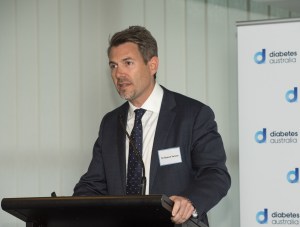
A/Professor Ramon Varcoe
This event was coordinated by Diabetes Australia in association with the Parliamentary Friends of Diabetes Support Group, co-chaired by Rowan Ramsey MP and Graham Perrett MP. I work for Diabetes Australia.
I had a low last week that knocked me for six. It certainly wasn’t the worst hypo I have ever had – far from it actually. But it had been a while since I had one like this. In fact, since I started eating low(er) carb. (I’m still reluctant to call it low carb, because I am really not trying to stick to a certain amount of carbs per day. But to give you an idea, it’s a rare day that I eat more than 80 grams.)
But last week, I did. My usual Japanese food takeaway place was out of sashimi which is my favourite quick lunch. So, I ordered a sushi roll and a cup of miso and off I went.
Now white rice is evil to me. It really is. I love it, but have never managed it! In 18 years of type 1, I have never worked out how to bolus for it. I am better (although not great) with pasta and other carb-heavy foods. But rice? Just hopeless! I would just guess, hope that I was close to right and then kept a close eye on my numbers afterwards, correcting as necessary.
On Friday, I was nowhere near right. No.Where. I watched my CGM line start to rise and rise and rise pretty quickly after I ate, resisting the urge to bolus before I hit the upper limit on my graph. And I am so glad I didn’t because after the spike, came the plummet. Insulin still on board, and two arrows pointing down.
I tried to intervene, but it was too late. Suddenly, my lips starting tingling, I realised I was sweating a lot and my thought process was all over the place. I read the same email five times, started five different responses and had no idea what I was trying to say.
I grabbed a juice box, and drank the lot in one gulp. The desperate low feeling of ‘I.Am.Going.ToDie’ overtook me as I stabbed another straw into another juice box and looked around for what else I could consume that would help, grabbing a handful of jellybeans; spooning honey from the jar and pouring some milk into a bowl with cereal.
And then I stopped. I willed myself to breathe, counting up as I inhaled, down as I exhaled, trying to not get the numbers messed up. I concentrated on my heartrate. I walked away from the food on the kitchen counter and sat at the table, focusing on the artwork above the wood-fire oven that the kidlet and I had done years ago when she was only about 5 years old. I thought about us spreading down a drop sheet on the front veranda of our old house, sitting the large canvas on top of it and emptying tube after tube of paint onto it. ‘It’s like a Jackson Pollock painting,’ she said, signing the finished artwork with her name and then adding ‘and Mummy’ afterwards.
Slowly, my heartbeat returned to normal. I could count my breathing without difficulty. I stopped thinking that I was going to pass out. My clothes were drenched from the sweating, though and now I was shaking because I was cold. I gingerly walked into the bedroom, pulled off my top and put on a thick jumper, wrapping a scarf around my neck for good measure.
I looked at my CGM graph on my iPhone and saw the quick spike and the sudden crash – a sight I’d not seen for some time. I lay down on my bed and closed my eyes for a moment, which became an hour and when I woke, the ‘hit-by-a-bus’ hypo hangover had taken over my body.
All this because of a sushi roll gone wrong. It wasn’t even a delicious doughnut or cupcake, I thought. It took me almost 24 hours to get back on track. The over-treating had to be corrected and I tried to not over correct, but that failed and another low in the middle of the night messed me up a little more.
This was a forgotten low. And I’m not particularly inclined to have another one in the near future to remind me again.

Just gently leaving this here today.
I am very fortunate to have a job that I truly love. But it could not be described as a particularly sexy job. At least, not the regular-day-to-day-this-is-what-I-do-when-I-am-in-the-office side of things.
I worked in recruitment for a while and the constant buzz and thrill of the game was intense. We had an old-fashioned bell in the office that would be rung when we made a particularly lucrative placement. Working on commission meant that there were dollar signs in front my eyes all the time, and I measured success in thousand dollar increments. It was sexy because it was quick, constant and there were constant wins.
Now I have a job that is what I refer to as a slow burn. Things take time, advocacy efforts are often long and drawn out, and the wins are rare. But jeez are they meaningful and worthwhile when they happen! They shoot an injection of momentum right when and where we need it, and it means we very quickly acknowledge the win and then focus on the next issue.
Sometimes people don’t realise just how long things take. When the pre-election announcements about CGM subsidies were made, a number of people commented that we’d had a busy few months to make it happen. I couldn’t help but laugh. And correct them. That particular win had been over four years of hard work.
But we take the wins were we can and this week, we’ve had a win!
The revised Assessing Fitness to Drive guidelines have been released by AustRoads and the National Transport Commission, and it’s a good news story for people with diabetes.
You may recall that there were some real issues with the previous guidelines after the completely misinformed and confusing inclusion of a definition of ‘satisfactory control of diabetes’. An HbA1c of over 9% was defined as ‘unsatisfactory control. Whilst the Commission stated that the A1c value was intended as nothing more than a guide and a trigger to seek professional care, the reality is that many people with diabetes had their licences suspended with their HCPs taking the value as a cut-off point.
As Diabetes Australia consistently argued, there is no evidence to suggest that an elevated A1c makes a person with diabetes more dangerous on the roads. In fact, this focus on an elevated A1c was actually detracting from hypoglycaemia, which is something that does need to be considered.
In the new guidelines, the number has been removed which is an excellent outcome for PWDs. And added to the document is far more focus on impaired hypoglycaemia awareness and keeping safe on the roads.
This change didn’t happen because we asked nicely. In fact, it took four years – from when the last guidelines were launched and we started to hear of people with diabetes having troubles – for the change to be made.
It took a lot of advocacy: letter writing, speaking with people who had been negatively impacted, meetings and teleconferences, and revising documents.
This is what I mean when I say that my job is unsexy. All of the work that was done behind the scenes – the slow burn – is decidedly unsexy! But it has to be done to get the wins.
I’ll admit to doing a very quick victory dance when I heard about this particular win. But the celebrating didn’t last long.
Because there is so much more unsexy work to do. Until people with diabetes are no longer discriminated against; until diabetes stigma is something we only speak about in the past tense; until kids with diabetes in schools are freely given all the same opportunities as their peers who make their own insulin; until access – to drugs, technology, healthcare – is available to all, the unsexy stuff will keep happening. You probably won’t hear about it until there is good news, but the wheels keep turning and the fire keeps burning slowly. As I said in this post here, it’s the reason I do what I do.
The new Assessing Fitness to Drive guidelines can be downloaded here.
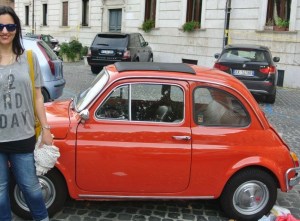
Four years ago in Rome, I made Aaron take a photo of me with just about every old Fiat Cinquecento we saw. There are a lot of photos of me with tiny cars!
Disclosure
I was a representative on the Diabetes Working Group revising the diabetes chapter of the new Guidelines. This was part of my role at Diabetes Australia.
Sometimes, the best diabetes meetups involve a few people with diabetes just sitting around having a chat. Perhaps it’s over dinner, or maybe over a coffee. There’s no formal agenda, there are no official speakers. It’s just people with diabetes catching up and talking.
Now, multiply that by … a lot. In fact, put about 40 diabetes advocates in a room together. Throw in a few HCPs as well. And some people from industry. Hell, there may even be a few people from professional and consumer diabetes organisations in there as too.
Now you have #DOCDAY; a diabetes meetup on steroids!
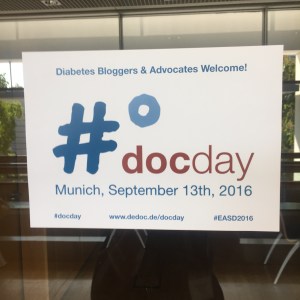
The second annual #DOCDAY event was coordinated and hosted by Bastian Hauck at EASD in Munich. Last year, he had this idea and organised what he thought would be a few people in a café in Stockholm. He underestimated how many people would want to attend, and the room was overflowing with advocates from Europe (and the usual Aussie ring-in).
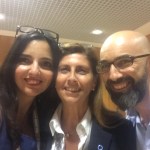
Dr Andrea Orecchio, right, with Danela D’Onfrio from Portale Diabetes (an Italian diabetes peer site).
This year, he got smart. He hired a room at the conference centre which was a genius move because it not only meant it was so simple and convenient to get to, but it also meant a whole heap of HCPs came along too. (Big hat tips to the divine trio from AADE, Hope Warsaw, Deb Greenwood and Nancy D’Houln, Aussie Dr Kevin Lee, and the delightful Dr Andrea Orecchio from Switzerland who impressed me with his ability to speak (and tweet in) four different languages. Perfectly fluently.)
There was no real structure to the meeting, apart from the insistence that all attendees have their photo taken on an old-school Polaroid camera to be placed on the attendee wall. Bastian kicked off the afternoon, saying a few words and he also asked some people to talk about any exciting diabetes initiatives they’ve been involved in. He asked me because he knows that in my jetlagged state I’m likely to say something inappropriate which will lighten the mood.
I was absolutely enthralled and excited to hear of some of the work other diabetes advocates have been up to lately. Here is just a taste:

Cannot wait to see this book published!
I simply cannot wait for the release of this new book from the team at Anna PS. Anna Sjoberg and Sofia Larsson-Stern from Sweden have collected stories from 20 people with diabetes and will share their personal experiences of lives with diabetes. The Swedish version of I Can, Want and Dare will be out in time for World Diabetes Day, and the English-language edition will follow shortly after. You can pre-order here. What a brilliant Xmas stocking filler! (Disclosure – Anna and Sofia invited me to contribute to the book. I have no financial interest in the book.)

Med Angel.
Did you know that 93% of people using temperature-sensitive medications are doing it wrong? Neither did I! Amin Zayani has created a very nifty smart sensor and app to help you know if your insulin is being kept at a safe temperature. This is a super easy device to use and is all about safety. I know I can certainly be accused of being very relaxed about keeping may insulin at optimal temperature and (touch wood) have never had a problem. But just at this conference, I was speaking with someone whose insulin had been affected by temperature and was absolutely not working. At all. This is something that will be very handy for a lot of people! Follow Med Angel on Twitter here.
IDF Europe has introduced a social media prize in diabetes. Quite frankly, the DOCDAY room was full of worthy recipients. Nominate someone now!
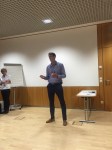
Peer networks in France with Paul-Louis Fouesnant.
I always love hearing about grass-roots diabetes support initiatives, and Paul-Louis Fouesnant from France spoke about Diab’ Mouv peer events he organises regularly.
So what did I speak about?
I spoke about driving and diabetes, specifically the advocacy win we have just had with the launch of the new Australian Assessing Fitness to Drive Guidelines. (More about that later this week.)
I spoke about CGM subsidies, a hot topic everywhere, but particularly in Germany where a reimbursement program had just been announced.
And finally, I spoke about language, because EASD is one of the most challenging conferences when it comes to language. I spoke about why language matters and why the real changes that are being made in this space are driven by people with diabetes. We have been talking about this for years and years now and it is terrific to see it (finally) on the agenda.
By the end of the afternoon, I was overwhelmed by all of these incredibly inspiring folk. For most of them, this is a labour of love with little, if any, financial reward. We blog because we want to share our stories and connect – nothing more. We come together to share our successes and our frustrations because we know that this is a sympathetic group who ‘get it’. Between now and when or if we next get together, we will keep in touch and continue to share our stories because that’s what we do. Thanks to everyone there for being so generous with this bumbling, jet lagged mess.

Just some of the advocates, activists, bloggers and HCPs in the #DOCDAY room!
My disclosures for my attendance to EASD2016 can be found on this post.
Twelve hours after arriving in Munich, I found myself in a beautiful tree-lined side street of the city at a diabetes bloggers event coordinated by Roche Diabetes Care. Fuelled by nothing more than coffee and jet lag, I walked into a beautiful building and found myself surrounded by diabetes advocates from around Europe who were probably trying to work out why an Australian had crashed their meeting.
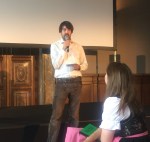
Bastian takes the stage.
Firstly, a little about this group. Roche convened the blogger group a few years ago as a channel to build a relationship with PWD in Europe. (Roche has had a long history of working with consumers. I remember back in 2012 watching the Roche Diabetes Summit in awe and then trying to replicate it here with Australia’s first and only SoMe Summit.) In a very smart move, they engaged DEDOC leader and nice-guy extraordinaire Bastian Hauck to be the liaison between Roche and the community. Bastian has done a stellar job bringing together some absolutely amazing and influential advocates to be part of this work.
The group has now met a few times, and at this year’s EASD, they opened the door to an Australian (slightly less weird now that Australia is part of Eurovision, which, obviously, is the new gold standard measure of inclusiveness. First Eurovision digression.)
The first part of the afternoon session was a demonstration of the yet-to-be-released Roche CGM. A short presentation showed how the device works, with an explanation of the technology. The timeline for release of the product is later this year with launch markets being Sweden, Norway, Netherlands and Denmark.
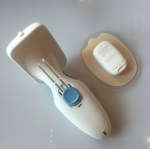
The soon-to-be-released Roche Insight CGM system.
We were then able to have a play with the device, inserting sensors into ‘fake’ skin pads and just getting an idea of the feel, size and look of it. The CGM app is completely customisable. It looks great – super clean and easy to use.
In a room of generally tech-savvy folk, you can imagine that there were a lot of opinions and feedback about the device. Most, if not all, of the participants were wearing at least one medical device – whether that be a pump, CGM or flash GM (and the slightly OTT Aussie who was wearing all three). We are obviously not the norm, but given our knowledge and experience with diabetes tech, we certainly did have a lot to say.

Dexcom and Insight side-by-side comparison.
There were some things that people really liked about the product. Accuracy was outstanding with MARD being comparable to Dex G5. The profile of the sensor was good – about the same as – maybe slightly lower than – the G5 on my arm when compared side by side. Insertion was super-easy and definitely doable with one hand. And the tape holding the sensor in tape is, apparently, better for people with skin allergies.
But as a first generation CGM, there were some limitations that people felt would frustrate them. The lack of integration with the Roche pump, for example, was of concern – however, this will be remedied with future generations. The first gen will only be compatible with an HTC phone (in a room full of very pro-Apple people, this was not particularly well-received) but, again, this will be addressed with future releases.
Also most unwelcome was the factory-set sensor life. Seven days without the possible of restarting is very surprising. There were some murmurings in the room about this setting a new precedent that other sensor makers would follow. Given that I am currently on day 18 of my sensor and the accuracy is spot on, I’d be bloody furious if I’d had to bin it 11 days ago!
Many of us frequently complain about the waste produced with all our device consumables, and there was some concern that the single-use sensor applicator contained a lot of plastic. Look, this is something that I personally struggle with. Every time I change my Dex sensor, or put in a new pump line or cartridge, I look at what needs to go in the bin and wince. It frustrates me each time I rip open the packaging for a new Medtronic Quickset (my preferred line), a bloody little cap falls out, usually to the floor. I have been using these sets since they first were released (maybe eight or ten years?) and never – not once – have I used the cap.
I get it – we need these consumables to be sterile. And safety and avoiding infection is paramount. But still, some of us are very concerned at the landfill we are contributing to!

Crowd sourcing opinion – What does CGM mean to you?
This discussion was very open. We were welcome to tweet, Instagram, Facebook (and blog) everything that we saw in the room, sharing it with the world. Following the demonstration, we all participated in real-time online feedback, where we commented on what we liked and disliked about the device. Our results and remarks were then shared on a screen for all to see.
Can we, for a moment, just consider how novel and out of character this is? Here is a company talking about a device that has not been released yet. And they are talking about it with a room full of over-sharers who all had screens open to various social media platforms ready to tweet, photograph and provide personal commentary. I have never seen such an open and transparent way to get feedback on a diabetes product, and the team from Roche should be absolutely commended on this approach. More please from more companies!
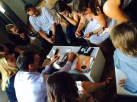
App making. (Photo credit: @Tadorna)
For the second half of the meeting we spent a most fun couple of hours where we played around with app development. My group – obviously the best – created an app that linked our CGM app with a juice machine to respond to low glucose levels. It also turned on bedroom lights if we were low overnight, to help wake us up. And if the wailing alarms of the app were not cancelled within 15 minutes, an ambulance was called to come and make sure we were okay. I know! Brilliant, right?!
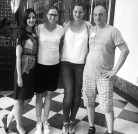
Go team! Anna, Steffi, Sascha
Overall, this was definitely a valuable afternoon learning about new product and also being given the opportunity to meet with some very smart and active diabetes advocates. You bet we were there to be told about Roche’s new CGM, but that was only part of the event and no one in the room is so naïve they don’t know it. But the chance to share ideas and projects and plan for truly global work together outside the device company space was also achieved.
POSTSCRIPT and DISCLOSURES
I’m going to ignore the online discussions that seem to pop up at any conference where PWD manage to score an invite…. Actually, who am I kidding, I’m not. Because I am a little sick and tired of the inevitable complaining and suspicion and passive aggressive comments. I’m a huge advocate for PWD being invited to HCP conferences (I may have written about it once or twice here). For us to get here, we need financial assistance because travel is expensive as is conference registration. So when pharma or device companies offer to bring PWD together to engage in a session they are running – and also provide us with access to the conference, then you bet I am going to think it’s a great idea.
Transparency is important and on this little blog, I will always disclose any arrangements, support, funding or product in place with any company.
So…my disclosures? Well in regard to Roche, none really. I don’t use any Roche products at the moment. I have in the past used their meters, which I have funded myself. I have been an invited speaker at the Roche Educators Day at the ADS-ADEA conference two years running now. And I wrote and disclosed all about that at the time here and here.
Roche did not contribute to my travel or accommodation costs at all to attend EASD this year. They did provide me with press registration, but I had already organised my own, as I do for all conferences I attend. Oh – and they did invite me to a dinner after the blogger event, but jet lag had kicked in so I politely declined. There was no expectation from Roche that I would write about the event (or comment during it). They don’t own my words, I do. But I am incredibly grateful that they are engaging consumers in this way. So thank you to Ute and the team so very much!
As for my disclosures for attending EASD? For the third time, they are all here.
The first message came at 7.58pm. I was finishing up a meal of dumplings in the city and about to head into Carlton to see a movie. There on my phone was a call for help from an Aussie friend on holiday in Europe. She had forgotten to pack reservoirs (cartridges) for her insulin pump and she was the first week into a six-week trip.
Help!!
Of course, she had called the local branch of the pump company and, (of course), she had been told that it would take time (as in three days!) to set up an account, before any product could even be sent out. This was not the easy resolution my friend needed in order to simply continue enjoying her holiday.
HELP!!
We sprang into action. As we waited for our bill to arrive, I messaged Annie straight away because if anyone can hook someone up with pump supplies within the UK, she’s the person to do it. She immediately took to Facebook and put out the call, all the while messaging me for details of where and how to get the cartridges to my friend.
As my friend would be leaving the UK and heading to France over the weekend, I also send a couple of Facebook messages to a couple of friends in Paris to see if they could help out. In the car on the way to the movie, I fired out messages and replies.
And finally, I took to Twitter, with a call out to friends in the #GBDOC, with a tweet that was retweeted to reach as many people as possible
My phone was in meltdown with messages (text, Facebook, Twitter) flying in from across the globe.
And then, at 8.25pm, it was resolved, before the movie started. Annie had found someone who had the right cartridges and would pop them in the post to be delivered to London, arriving on Thursday. Plus, back up in France has been organised too – just in case!
It was sorted in 27 minutes. All with a few messages, clicks and tweets. We didn’t worry about setting up accounts or timezones or working within business hours (it was after-hours here and early in the day in the UK!). Continents and business zones didn’t matter either. The only consideration was getting the cartridges in the hands of my friend so her pump would continue to deliver insulin and she could focus on enjoying her holiday.
So, there is no sequel to the Pumpless in Vienna story to be told here, I am pleased to say. Because the DOC did what it does best in these situations. It delivered like a well-oiled machine!
Some more snapshots from this year’s EASD meeting in Munich.
Juvenile no more
All over the internet last week was Miriam E Tucker’s piece for Medscape about the age of diagnosis of type 1 diabetes. Data presented at the meeting suggested that fifty per cent of type 1 diabetes is diagnosed in people older than thirty years of age.
Flying High
I know a couple of commercial pilots who were forced to give up their careers when they were diagnosed with type 1 diabetes (and a few kids who had to give up their dreams of ever becoming a commercial pilot). A new study out of the UK gives hope for a change to the blanket ban found in many countries. Read all about it.
Afternoon naps and type 2 diabetes
I’m a big fan of a power nap, but a new study suggests that long afternoon napping is associated with an increased risk of type 2 diabetes. More here.
MySugr announcements at EASD
The uber-cool team from MySugr keep kicking goals and taming monsters. Two announcements at EASD which further enhance the MySugr app.
Firstly, this: the integration of MySugr with the Abbott Freestyle Libre app (LibreLink, currently not available in Australia)
And this: MySugr now offers live diabetes coaching, working with diabetes educator and author of ‘Think Like a Pancreas’
Also from MySugr is their terrific take on diabetes and language – specifically, writing about diabetes. This was shared by Ilka at one of the DOC satellite events. Love it, love it, love it!
Virtual EASD
Brilliant to see the EASD meeting embracing technology to bring sessions throughout the conference into anyone and everyone’s screen through their virtual EASD platform. This does a couple of things. Obviously, it means that those unable to attend the conference can see what is being presented. But more than that; it allows those people to engage in online discussions. Many were commenting on twitter and joining the dialogue with those actually in the room.
Well done – would love to see this used more widely at more conferences.
Oh, hey again Kaleido!
 Once again, it was the Kaleido stand at EASD that stole the show with sheer colour and cheekiness.
It was great to reconnect with the team and chat about what has happened since I first met them all at least year’s EASD in Stockholm. There was much excitement as they now have CE mark which means they are almost ready to launch.
Most pleasing was to see that their pump now includes a bolus calculator, an addition made after feedback from people with diabetes. (Nice engagement, folks!) It is still a no-frills pump – there is no integration with CGM and none planned. And that is fine. It really is.
Launch details are getting close. Unfortunately, no plans to launch here in Australia straight away, but apparently we are on their radar. (In the meantime, I’ll keep hassling them to come here and colour our world!)
(The Kaleido stand also had a very cool interactive wall asking all about the people visiting. This was the (almost) final product.)

DISCLOSURES
Absolutely none for the things I’ve written about here.
I want to try something new and I need your help. I am trying to work out just how different it is around the world when it comes to paying for a vial of insulin. Here in Australia, a 10ml vial of Humolog costs me just under eight Aussie dollars. What about you?
So, I’m asking for you to post a photo of yourself, with whichever insulin you use (penfill or vial) and tell me how much your out of pocket cost is in whichever currency you use. For some, it will be nothing. For others, a lot more.
Post your photo on the Diabetogenic Facebook page, or tweet it using the hashtag #InsulinPlayingField. And on World Diabetes Day, I’ll share the results.
So go! And share this around. Let’s see how far we can get this going and how different the playing field is across the globe.





 Diabetogenic