
You are currently browsing the category archive for the ‘Diabetes’ category.
The day before ADA kicked off, I managed to catch a glimpse – my only glimpse this visit to San Francisco – of the Golden Gate Bridge from the back of an Uber on the way to the Diabetes Mine Summer DData Exchange (#DData19).
This is the third DData I’ve attended, and it always delivers. The speakers are brilliant and the topics on the agenda push some of the boundaries we’re used to seeing as part of the ADA conference that runs alongside. Amy Tenderich expertly emceed the day, and Mike Hoskins’ rapid fire tweeting made sure that those not in attendance had a birds eye view of the event.
This year, there was one session that really stood out for me and it was a panel session moderated by Adam Browne from diaTribe and included JDRF International CEO, Aaron Kowalksi and Alain Silk from the FDA.
For some time now, there have been efforts to move away from the idea of HbA1c being the be all and end when it comes to assessing the outcomes of diabetes management.
This doesn’t only mean in terms of the way we measure our own personal diabetes management, or the success or effectiveness of the devices, drugs or treatments on offer, it also is directed to researchers, clinicians and regulators who continue to use A1c as THE measure to determine the value of whatever they are talking about.
The push has been towards time in range (TIR) because with tools such as CGM and Flash glucose monitoring, this is something that can be easily measured and demonstrated.
The A1c is flawed – we all know that. Anyone with diabetes will have tales of A1cs going down, despite their diabetes management being more erratic, or conversely, their A1c increasing despite having fewer roller-coaster episodes. As a one-off number, it tells very little.
But while TIR is certainly one different way of having a look at just how we are tracking, with so few people actually using CGM or Flash (due to access and affordibilty), we can’t throw out other options. The A1c is not dead yet (just ask the queues of HCPs in the Exhibition hall at ADA waiting to get theirs done. Another blog post for another time…)
Also, TIR cannot be the only other measure we look towards as a substitute for A1c, and this session at DData explored more than the idea of a simple like for like between the two.
Aaron Kowalski highlighted how one of the first things people speak about when using an automated insulin delivery device is how their sleep improves. It was indeed the first thing that I noticed, and it was life changing for me. I noted that I slept like I did before diabetes!
Yet, this is not considered as part of regulatory decisions. Neither is how our diabetes experiences can be transformed. Aaron told the story of a young woman who rarely attended to diabetes tasks when around friends because she didn’t want to pull out her pump to check her CGM trace, or bolus insulin. She didn’t want to draw attention to herself or her diabetes. But being able to do those tasks by simply looking at her phone, or her smart watch meant that she felt so much better – and she did what she needed to do when she needed to do it. How are those improved experiences being documented and considered as part of why something is valuable?
In his earlier talk, Alain Silk from the FDA noted that one of the challenges when it comes to technology regulation is too much regulatory and contractual burden and not enough innovative devices getting into the hands of people with diabetes. The DIY movement manages to sidestep that first part and that means that we do have get to have those devices – those transformative devices – in our hands a lot sooner. Our experiences – which all seem to be positive – and our diabetes outcomes – which all seem to report improvements – really should count for something.
Surely one of the goals we are all seeking (and when I say all, I mean everyone involved in any aspect of diabetes) is to increase the time we DO NOT spend on diabetes anymore. At DData last year, DIY-er Justin Walker said that he believes he has gained back an hour a day since using an automated system. That’s seven hours a week. Over a year, that’s more than a total of fifteen days we get back from diabetes. Add that up over a lifetime of diabetes. It’s significant.
Aaron said that one of his goals as CEO of JDRF is to ‘…take diabetes out of our lives as much as is humanly possible.’ When devices allow us to do that – even if it’s just one little bit – that should be assessed as meaningful.
I have been thinking about this session a lot. In fact, anyone who has asked me about ADA has received a lecture on it. My poor boss got an earful when I returned to work on Monday. I’m pretty sure he regretted asking how I’d gone in San Francisco after I launched into a tirade about how we are simply not listening enough to people with diabetes when it comes to just what we are measuring as being valuable to us.
The problem with adding TIR to A1c as a way to assess devices, drugs or other therapies is that we still are focusing on nothing more than numbers. Sure TIR may be more robust and not simply a snapshot average, but it still attributes our success to a number.
When I talk about why Loop has been so transformative to me, I do mention TIR. But the biggest bangs for my buck – the things that really ring true – is not how much time I spend between two number goal posts.
No.
It’s about how much better I feel about my diabetes. It’s about how much less time, less worry, less stress I am forced to dedicate to diabetes. It’s about how the hypos I have these days take three minutes to deal with rather than three hours. It’s about how less stubborn, and how less frequent those highs are. It’s about the much lighter shadow diabetes casts over my family. It’s about sleep – oh dear god, it’s about sleep! It’s about how easy it is to carry out those required tasks and how little they interfere with my day. And it’s about the time I have been able to claim back as my own.
The footprint of diabetes is so far smaller these days than ever before. THAT is what is meaningful. THAT is what I measure. THAT is what it means to truly go beyond A1c.

DISLCOSURES
I attended ADA as part of my role at Diabetes Australia. My economy flights and accommodation have been covered by the organisation.
Thanks to the team at Diabetes Mine, who kindly provide diabetes advocates with the opportunity to attend their DData Exchange at a significantly reduce cost.
Spending time surrounded by diabetes can be overwhelming and that is never more so than at a conference like ADA. It is huge – there are thousands and thousands of people, an exhibition hall with stands from device and pharma companies that messages about diabetes that are all tied up in statistics and words (and not really about people), and for every talk that shares hope and promise, others that focus on despair.
But it’s easy to step away from that – even if just for a moment – and turn to a member of your tribe. Because then…
…not once did I feel despair.
…not once did anyone pass judgement about another’s diabetes.
…not once did anyone make me feel afraid.
…not once did anyone attribute blame or shame.
…not once was anyone expected to explain themselves.
…not once did I feel stigma.
…not once were the words spoken anything other than real and authentic.
…not once did someone ask another person about their glucose level or A1c.
…not once did someone suggest that anything to do with diabetes was someone’s fault.
…not once did I feel overwhelmed or overcome.
…not once did someone make me feel that I was not enough.
…not once did someone look at another PWD to suggest that they were failing.
…not once was fear used as a motivator.
…not once were we made to feel sorry for ourselves.
…not once did my life feel like it should be measured in nothing more than numbers.
…not once did we call each other inspirational for just living with diabetes.
…not once did anyone do anything other than cheer another’s efforts.
…not once did anyone overreact if they noticed another PWD was low.
…not one did I feel that I was a burden.
…not once did I feel that I had to be a superhero.
…not once did I feel alone.
…not once did anyone demand that their way of doing diabetes was the better way.
…not once was diabetes the overall focus.
There are times that diabetes does its best to make me feel a burden, or that I am simply not enough. But not once – not ever – when I am around people like this do I feel anything other than whole.

Find your tribe
Find your tribe…
More musings from ADA, this time following yesterday’s diabetes-related complications session.
DISCLOSURES
I am attending ADA as part of my role at Diabetes Australia. My economy flights and accommodation have been covered by the organisation.
Whoa – fast jet lag and iced coffee-fuelled talking….
DISCLOSURES
I am attending ADA as part of my role at Diabetes Australia. My economy flights and accommodation have been covered by the organisation.
I had my annual eye screening today. If you want to get an idea of how I was feeling in the lead up, you can read this, or this, or this. Because it’s always the same.
The orthoptist called me from the waiting room, and as I followed her in, she said ‘We’ve been seeing you for eighteen years now.’
‘That’s right,’I said. ‘Obviously, we were both twelve years old when I first started coming here.’
She laughed and agreed with that assessment.
‘You know there’s a reason for that, right?’I asked her. ‘You and Prof Ophthalmologist know how I feel about my eye screening. And you have always been so kind and lovely about it. I have never been made to feel foolish. If I have been late with a screening check – as I often was back in those early years – I never felt shamed or told off. You have always been kind to me. Kindness in care is so underestimated.’
We chatted some more about that and then she did the usual checks and delivered the news as she always does. Diabetes-wise everything was exactly as it was last time I was there, and I let out half a sigh of relief. I still had to see the ophthalmologist, so the other half would have to wait a little more.
Finished with me, she escorted me to the second waiting room where I kept myself occupied trying to read things as my vision blurred more and more, and convincing myself that I was not having some sort of heart event, despite my racing heartbeat.
The rest of my visit was as unadventurous as the beginning of it. My ophthalmologist was his usual self – he made some cheeky comments about my aversion to seeing him, asked me how I was, commended me on living with diabetes for 21 years, and then looked at my eyes. After announcing them to be ‘pristine’ (I asked if that as a technical term and he said in this instance, yes), we spoke a bit about how flying seemed to flare up the blepharitis I had been recently diagnosed with. (That’s all for another blog post, but basically, it’s inflammation of the eye lids.) I noted down how to best manage those flares and what I needed to watch for in the future. My heartrate had returned to normal and I was breathing easily again.
As I put on my coat, I mentioned the eighteen years I’ve been attending his clinic. ‘I really don’t like the fact that I have to come and see you. I don’t look forward to it – in fact I pretty much dread it,’ I said. I watched him smile and shake his head slightly. He is more than used to my melodramatic tendencies.
‘But I am eternally grateful for how generous you and your staff have always been. I love that I have never felt anything other than safe here, and that says a lot when the thought of someone so much as looking at my eye makes me want to cry. The fact that you touch my eyeball to check the pressure of my eye – or whatever you do – is just beyond terrifying. But I would never think to miss an eye screening now – never. I know when it is due, and I am completely dialled in to it all. A lot of that has to do with knowing how this whole experience will play out.’
I picked up my bag and he handed me some samples to help my eyes when I am stuck on aeroplanes for days on end. ‘I’ll see you in a year, He said.‘But earlier, of course, if you have any concerns or notice any changes. You are really doing an incredible job living with diabetes, Renza.’
I thanked him and before I walked out the door said, ‘I don’t really have a choice. I live with diabetes. I don’t really have any other choice than to make the best of it. But having kind healthcare professionals like you around makes it infinitely easier. I really hope you know that you make it easy for me to show up.’

Instagram stories keeping me occupied in the second waiting room.
I was reminded of this post from a couple of years ago when I was recently speaking about hypo simulators. I understand that there is some merit in trying to help people not living with diabetes understand some of the day to day issues and challenges we face. The idea is that this can create empathy, and a greater insight into how we feel about living with diabetes.
I also am very critical of these ideas when they are given more weight than they should. When we simulate something to do with diabetes, the focus is in the physical and practical. Wearing a pump (as described in this piece) or CGM will provide experience of feeling the device on one’s body, and learning how to drive it. It gives little more.
When I first published this piece, a GP friend who lives with type 1, said that he likened this experiment to him shoving a pillow up his jumper and walking around for a few days and then claiming to know what it is like to be a pregnant woman. Another friend said that sitting in a wheelchair for a few days may give her an idea about how hard it can be to manouever a wheelchair around, she would have no understanding of what her friend who lives with quadriplegia deal with day in, day out, our how she truly feels.
I am interested to know how others feel. I did receive some criticism when I first wrote this. When I shared in on Facebook, a friend said that I should at least credit the doctor for trying. Perhaps I was too critical – it wouldn’t have been the first time.
When we reduce diabetes to being about nothing more than the daily tasks and devices, we seriously undermine the effort it takes to live with diabetes each and every day.
I would love to know what others think….
I was recently sent an article from Medscape that was written by Svetlana Katsnelson MD, endocrinology fellow at Stony Brook University Medical Center in New York.
The gist of the piece is that for a week as part of her endocrine fellowship training, Dr Katsnelson wore an insulin pump and checked her BGLs, and now believes she knows about living with diabetes. She also considers herself non-compliant because she didn’t bolus for an apple.
This may be oversimplifying the article a little and I honestly do believe that the intention here is good. But a little perspective is needed, I think. It was this comment that really upset me:
‘The experience provided me with a better understanding of how to use the devices that many of our patients use every day, but it gave me much more than that. I truly began to understand how difficult it is to live with diabetes.’
No, Dr Katsnelson, no. You do not truly understand how difficult it is to live with diabetes.
What you have is an idea of what it is like to walk around with a device delivering non-life saving saline into your system. You also have an idea of how it sometimes hurts when a sharp object pierces the skin on your finger. You probably could have deduced that anyway because, you know, sharp object, skin, nerve endings etc. You know how the buttons of these devices feel under your fingers and the weight of the devices in your hands.
You may have an idea of how tricky it can be to accommodate a pager-like device if you are wearing a pretty, flowing dress to work (if that is your want). You may now understand how annoying it is to have to stop what you are doing because it’s time to do a BGL check.
But what you don’t understand is that diabetes is about so very much more than that.
Here is what you don’t have any idea about.
You don’t understand the feeling of ‘this is forever’ or ‘I never get a holiday from this crap’. I know that this was acknowledged in the article, but really, you don’t know how it feels to never be able to escape diabetes.
You have no concept of the boredom of living with a chronic health condition, or the monotony of doing the same tasks each and every day over and over and over again!
You don’t understand the fear that overtakes your whole being as you imagine all the terrible complications that have been threatened and promised as result of diabetes.
You have no notion of the frustration of living with a condition that doesn’t have a rule book – and in fact changes the rules all the time!
You haven’t any perception of the fear I sometimes feel that I’ve passed my faulty genetic matter onto my beautiful daughter; or that I am a burden to my family and friends.
You will never feel the judgement from healthcare professionals because numbers are too high or too low – or that there are not enough of them.
You will never be called non-compliant by a doctor or made to feel guilty because you are eating a cupcake – all because your beta cells decided to go AWOL.
While I really do commend the notion of HCPs trying the ‘day in the life’ (or ‘week in the life’) idea, I think that being realistic about what this experience provides is important. It does not give any insight into the emotional aspects of living with a chronic health condition. It doesn’t explain the dark place we sometimes go when we are feeling particularly vulnerable or ‘over it’.
I have to say that all in all, this article left a sour taste in my mouth and I don’t like to feel that way because it sounds like I am being Grouchy McGrouch. I’m not. And as I said, I think that the intention here is good.
I just don’t want Dr Katsnelson to think that she now knows what is going on in my head when I wake up at 4am and every terrible scenario plays out leaves me feeling a pressure on my chest and a blackness in my mind that threatens to overtake me.
But I also want Dr Katsnelson to know that I really don’t expect healthcare professionals to know and understand all of these things. I expect them to treat me with respect and dignity. If this exercise has helped that, then great, but please, call it for what it is.
The article discussed in this post (Svetlana Katsnelson. Becoming the Patient: Not as Easy as It Looks. Medscape. May 12, 2014.) can be accessed here by first creating a free login.
Last Thursday morning, still wracked (and wrecked) with jet lag from having just returned from ten days in Europe, I boarded a flight to Manila. I would be co-facilitating a workshop for people with diabetes from across the Philippines about how advocacy, community and engagement. If I’m completely honest, I had no idea what was in store for me.
I knew that the PWD who would be attending had all been through a diabetes camps program in the Philippines. They were all young and very eager to step up as advocates. They were the reason the workshop was happening – they realised it was time to elevate the PWD voice in advocacy efforts in their country and they wanted some help in doing just that.
And so, the idea of a workshop was conceived, and the two facilitators were flown in from opposite sides of the planet to pull it all together. Enter me and the Grumpy Pumper (who for once had to travel further than me and was more jet lagged than me).
As the facilitators, we were there to talk about some examples of effective grass roots advocacy, talk about how engagement with other stakeholders is important, and highlight just why the voice of those living with diabetes is critical when it comes to lobbying. We had an vague outline of just how we thought the workshop would run, but we really wanted to ensure that the attendees could shape it the way they wanted, asking relevant questions and walking away with information that would help them.

Once the workshop started, it was very, very quickly apparent that we already had a thriving, dynamic and enthusiastic community in the room. They just weren’t seeing themselves that way. Over the course of the workshop, we saw the ten PWD realise that their own stories and voices are important and have real currency, and they are an unstoppable force when they came together. If ever I needed a reminder of the power of community, I’d have found it there in that room in Manila!
There will be a lot more about the weekend workshop in coming days. I’m still getting my head around it all and am not really sure what to write just yet. It may take me some time. What I do know is that the DOC now has some new voices. Their perspectives will be different to those we often hear about, and that diversity is always good in a community.
So, while I’m getting my words together, get to know these amazing young advocates. They’re on Facebook here; Twitter here; and Instagram here.
DISCLOSURES
Novo Nordisk covered costs for the advocacy workshop. Grumps and I were invited to facilitate the workshop as part of our involvement in the Novo Nordisk DEEP Program. Novo covered by flights, accommodation and ground transfers.
I’m back on deck at work today after a whirlwind ten days in Europe for meetings and a conference. I started in Amsterdam, then flew to Florence and finally flew to Copenhagen (via Pisa). Those ten days were busy, long and interesting. And, perhaps best of all, packed full of others from the diabetes community.
Spending time with others living with or around diabetes is restorative. I know I get jaded at times, and burnout – in all its forms – takes its toll. I’ve been feeling a little advocacy burnout lately, and that has the tendency to make me feel that I need to step away from diabetes for a bit. Plus, I wasn’t sure if I could be bothered with the inevitable onslaught that comes when these sorts of activities happen.
Instead of hiding away (which is what I half wanted to do), I got on a crowded plane to Europe to spend almost two weeks ‘doing’ diabetes advocacy in different forms. By the time I got to Nijmegen – an hour and a half out of Amsterdam – for HypoRESOLVE I was already feeling better. I felt the darkness of burnout slip away as I sat in meetings, speaking up and providing PWD input into the project. And there, alongside me, were others living with diabetes. We leaned into each other, stepped back so another could take their turn, and supported each other to feel comfortable and relaxed. We reminded each other that there was a reason we were there – because people with diabetes must have a seat at the table and that we must be heard. We lived, breathed and ate ‘Nothing about us without us’ throughout that meeting and by the time I boarded a hideously early flight to Florence for the next meeting, I was raring to go – further boosted by a diabetes in the wild encounter.
Two days of meeting in Florence with friends and peers from the diabetes community talking about our experiences in the diabetes community continued to see my mojo return. We spoke about difficult topics, how the community works best and the place everyone has in there. I was reminded that the community ebbs and flows, and that it is not static. Sometimes, that rut that I find myself in means I forget that all communities change and grow and develop. This is actually a positive, because as it shifts, more people come in, some people step away (for good or just a bit), we reconfigure how it fits us, and diabetes makes sense in new ways.
Some much needed downtime meant that I could reconnect with peers and feel myself being completely and utterly filled up in a way that only comes when surrounded by people who get diabetes and this weird diabetes space. We don’t all have diabetes – we represent different corners of the community, but we know diabetes in a way that is particular to those who live close to or with it. Our dinner after the second day of the meeting saw us finally able to breathe and take some time out of diabetes speak, and instead revert to a steady flow of laughs (shrieks, actually).
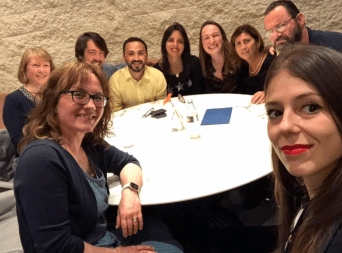
The next day, a friend from Italy just happened to be in Florence. We met up and I met her family, including her son who has diabetes. As we drank coffee just over the Ponte Vecchio, diabetes was spoken about a bit, but mostly, I got to learn about this young man who is clearly going to take on the world. He is smart, funny, delightful and inquisitive. His questions about Loop were intelligent – far more so than anything I would have thought to ask before I started using the tech! I hugged his mum as we said good bye, noting that she had just introduced someone else to our tribe.
By the time I arrived in Copenhagen (at 2.30am thanks to high winds in Florence, a bus ride to Pisa to take a diverted flight and some first-rate Italian disorganisation), I was exhausted, but at the same time felt more enthusiastic about the diabetes space than I had in some time. The next morning when I arrived at the conference venue, I was ready for a packed day of speakers, and to do my own presentation in the afternoon. I looked around and saw that there were a number of people living with and around diabetes that I knew, as well as a whole lot of new faces in there. The event was for HCPs, but as always, those of us with a truly personal connection to diabetes searched each other out. I met members of a support group known as ‘Diabetes Dads’ who meet regularly to speak about their kids with diabetes. They were there to support their friend who was speaking about his Looping son.
At lunch, I sat at a table with two PWD I knew. Two other people joined us and we quickly found out they too have type 1 diabetes. The conversation flowed – we understood each other, and our shorthand of diabetes speak easily fitted into our stories. We nodded as we heard stories that sounded familiar, even though they were being told by someone from another country who, until we sat down with our overflowing lunch plates, we had never met before. One of the women at the table had asked during an earlier session about how to wear the devices required for Loop, and I pulled out my RileyLink and showed it to her. She held it and weighed it in her hands. She’d wanted to know how to wear it with a fitted dress and I was able to show just how easily I could tuck away everything, even with the straight dress I was wearing for the day.
We may have all been there because of an interest or curiosity in DIY diabetes, but there is far more than that to draw us together. Just like as at the earlier meetings. As always, diabetes brings us together, but it’s far more that keeps us that way.
By the time I boarded the Dreamliner at Heathrow, all traces of burnout, and questions about how to manage in the sometimes tricky maze of diabetes community had completely subsided and were replaced with the reminder that when we find out tribe and surround ourselves with them, the burnout is replaced by feeling supported. And that’s how and why we show up. We do what we do, we show up, we speak up and we try to get stuff done. Ten days of that and I feel so much better. Which is good. Because as it turns out, those ten days are just the start …
DISCLOSURES
My flights to Amsterdam and accommodation while in the Netherlands was covered by HypoRESOLVE. I am on the Patient Advisory Committee for this project. My flight to Florence and two nights’ accommodation were covered by Lilly. I was in Florence for a DOCLab Advisory Meeting. My accommodation in, and flight home from Copenhagen was covered by the Danish Diabetes Academy. The Academy invited me to speak at their Diabetes DIY Movement conference.
‘I like your phone case.’
I looked up from my laptop and over at the woman sitting next to me in the crowded Qantas Business Lounge.
‘Oh. Thank you!’ I said to her. We were sitting at one of the high desks, both charging different devices before our flights.
‘I could do with one of those,’ she said to me. ‘I don’t like the word non-compliant, but to be deliberately compliant sounds like a lot of fun. Where did you get the case?’
‘A friend designed it for me and started to sell it on his online shop after I spoke at a conference for healthcare professionals. I’m with you on not liking the word. I’m a diabetes advocate and to me, non-compliant is a dirty word.’
I saw the woman sit up a little straighter. ‘You have diabetes?’ she asked.
‘Yep. I’ve had type 1 for twenty-one years.’
‘My daughter was diagnosed three years ago. She’s eighteen now. She just started at Uni this year. She’s doing really well.’
I smiled. ‘That’s great to hear. What is she studying?’
‘Music. She’s a singer.’ There was undeniable pride in her voice. Now it was my turn to sit up a little straighter.
‘Really? I did too. I was a classically trained flute player in a former life, studying at Melbourne Uni. I don’t play anymore, but I certainly loved it at the time. I thought it was going to be my forever ‘thing’. Then I kind of got side-tracked!’
We sat there and chatted more about music and having daughters and watching them grow up. We talked about raising strong and challenging girls, reminding each other that it was good that they were like that, even though we wished they would challenge others more than their own mothers! She told me about her job which takes her all over the world and we compared notes on coping with too much long-haul travel and far too much time away from our families. We complained about coffee in airports and on planes and how ridiculous our first world problems are. She asked me a little about my job and how long I had been doing it. Our conversation was peppered with expletives and laughter.
I heard my flight being called and started gathering all my things, tucking them back into my overstuffed bag.
‘Lovely to chat with you,’ I said as I stood up to leave. ‘Good luck to your daughter with her music studies.’ I began to walk away, but quickly turned back. ‘Oh, and her diabetes, too.’
‘I can’t wait to tell her that I met someone who has diabetes and studied music.’ She paused for a second. ‘I think she’ll be happier when I tell her that we hardly spoke about diabetes though. She hates it when that is all people ask about her.’
‘She is so much more than diabetes. We all are. And there are far more interesting things about those of us with messed up beta cells. She sounds like an absolute gem, ready to take on the world.’
I walked to the gate and as I was boarding my flight, I noticed the woman in front of me had a Libre sensor stuck to her arm. And that she was wearing the most fabulous red, high-heeled boots. I smiled to myself. So much more than diabetes.




 Diabetogenic