
You are currently browsing the category archive for the ‘Diabetes’ category.
Do your diabetes appointments take on an eerily familiar routine? When I was first diagnosed, each appointment would open with the words ‘Let me see your book’. My endo was referring to my BGL record, an oblong-shaped book that I was meant to diligently record my minimum of four daily BGL checks, what I ate, what I thought, who I’d prayed to, what TV shows I’d watched and how much I exercised.
I did that for about the first two and a half months, I mean weeks, okay, days and after that the novelty wore off and I stopped.
I’m not ashamed to admit that I did that thing that pretty much every single person with diabetes does at one point or another – I made up stuff. I was especially creative, making sure I used different coloured pens and splotched coffee stains across some of the pages here and there, little blood speckles for proof of bleeding fingers, and, for a particularly authentic take, OJ, to reflect the made-up numbers that suggested I’d been having a few lows.
I’d show those creative as fuck pages – honestly, they were works of art – when requested, roll my sleeve up for a BP cuff to be attached, and step on the scales for my weight to be scrutinised. Simply because I was told that was what these appointments should look like, and I knew no better.
And then, I’d walk out of those appointments either frustrated, because I’d not talked about anything important to me; in tears, because I’d been told off because my A1c was out of range; furious, because I hated diabetes and simply wasn’t getting a chance to say that. And anxious, because looking at the number of kilograms I weighed has always made me feel anxious.
The numbers in my book, on the BP machine or the scales meant nothing to me in terms of what was important in my diabetes life. They stressed me out, they made me feel sad and hopeless, and they reduced me to a bunch of metrics that did not in any way reflect the troubles I was having just trying to do diabetes.
These days, not a single data point is shared or collected unless I say so. I choose when to get my A1c done; I choose when to share CGM data; I choose to get my BP done, something I choose to do at every appointment.
I choose to not step on the scales.
I don’t know what I weigh. I might have a general idea, but it’s an estimation. I don’t weigh myself at home, and I don’t weigh myself at the doctor’s office. I think the last time I stepped on a set of scales was in January 2014 before I had cataract surgery and that was because the anaesthetist explained that it was needed to ensure the correct dose of sleepy drugs were given so I wouldn’t wake up mid scalpel in my eye. Excellent motivator, Dr Sleep, excellent motivator.
Last month, I tweeted that PWD do not need to step on the scales at diabetes appointments unless they want to, and that it was okay to ask for why they were being asked to do so.
There were comments about how refusing to be weighed (or refusing anything, for that matter) can be interpreted. I’ve seen that happen. Language matters, and there are labels attributed to people who don’t simply follow the instructions of their HCP. We could get called non-compliant for not compliantly stepping on the scales and compliantly being weighed and then compliantly dealing with the response from our healthcare professional and compliantly engaging in a discussion about it. Or it can be documented as ‘refusal to participate’ which makes us sound wilfully recalcitrant and disobedient. It’s what you’d expect to see on a school report card next to a student who doesn’t want to sing during choir practise or participate in groups sports.
What surprised me (although perhaps it shouldn’t) was the number of people who replied to that tweet saying they didn’t realise they could say no. it seems that we have a long way to go before we truly find ourselves enjoying real person-centred care.
Being weighed comes with concerns for a lot of people, and people with diabetes often have layers of extra concerns thanks to the intermingling of diabetes and weight. Disordered eating behaviours and eating disorders are more common in people with diabetes. Weight is one of those things that determines just how ‘good’ we are being. For many of us, weight is inextricably linked with every single part of our diabetes existence. My story is that of many – I lost weight before diagnosis and people commented on it favourably, even though I was a healthy weight beforehand. This reinforced that reduced weight = good girl, and that was my introduction to living with diabetes.
From there, it’s the reality of diabetes: insulin can, for some, mean weight gain, high glucose levels often result in weight loss, changes to therapy and different drugs affect our weight – it’s no wonder that many, many of us have very fraught feelings when it comes to weight and the condition we live with. Stepping on the scales brings that to the fore every three months (or however frequently we have a diabetes healthcare appointment).
Is it always necessary, or is it more of a routine thing that has just become part and parcel of diabetes care? And are people routinely given the option to opt out, or is there the assumption that we’ll happily (compliantly!) jump on the scales and just deal with whatever we see on the read out and the ensuing conversation? And if we say no, will that be respected – and accepted – without question? Perhaps another positive outcome is that it could encourage dialogue about why we feel that way and start and exploration if there is something that can be done?
It shouldn’t be seen as an act of defiance to say no, especially when what we are saying no to comes with a whole host of different emotions – some of them quite negative. Actually, it doesn’t matter if there are negative connotations or not. We should not be forced to do something as part of our diabetes care that does not make sense to us or meet our needs. When we talk about centring us in our care, surely that means we decide, without fearing the response from our HCPs, what we want to do. Having a checklist of things we are expected to do is not centring us or providing us the way forward to get what we want.
How do we go about making that happen?
Seventeen years ago, I had a decision to make. Would I enrol our soon-to-be-born baby in research that would tell us if she had any of the antibodies for type 1 diabetes?
I thought about it long and hard. Aaron and I spoke about it a lot. He wanted to support me with whatever I thought would be best. In the end, we decided not to do it. Even before our daughter was born there was a dread that I could barely give word to – I was terrified that I would be responsible for passing on my diabetes to my baby. That feeling hasn’t gone, by the way. I have spent a lot of hours working through it with a psychologist to try to understand the source of the anxiety and learn to manage the fear in a way that doesn’t become all encompassing. Because there were times that I felt paralysed with that fear. I knew I needed to get through that.
I felt horribly guilty about not signing her up straight away and registering her in research. When I returned to work after maternity leave, there was a trial that was in full recruitment mode, and I once again faced the decision. I was actively promoting this study through my work, and speaking to the researchers a lot. A couple of times, I asked if I could speak with them in a personal rather than professional capacity and explain my reticence to enrol my daughter, even though I could understand why the work was so important. I asked for their advice and guidance, and they were always so wonderfully kind and understanding when I said that I simply didn’t feel that I could proceed. I think that part of the reason was that there wasn’t really all that much that could be done if it was identified that she did indeed have one or more of the islet autoantibodies.
Over the last couple of years, there has been a lot of interest and excitement in research into prevention and delay of type 1 diabetes. That ‘p’ word that has only ever been attached to type 2 diabetes now very firmly has a place when it comes to type 1 diabetes. At the ADC earlier this month, I listened to a couple of hours of talks from researchers who were talking all about screening for type 1 diabetes, and interventions that are taking place around the world with remarkable results.
The Type 1 Screen program has been running in Australia since 2018. It is open to relatives of someone with type 1 diabetes, aged 2 – 30 years. After initial screening, people without antibodies are screened every five years; people with antibodies are screened annually. Up until now, screening has been by doing a pathology blood test. However, home collection is being developed and, at the time of the presentation, was about to be launched. Home collection will be done by using blood from a finger prick.
So, what are the benefits of screening for type 1 diabetes? Well, there are many!
Early diagnosis (of anything) is a good thing! In a perfect world, early diagnosis means early treatment which means better outcomes. It also helps people and families prepare for progression to diabetes.
Screening reduces the risk of DKA at diagnosis. While that may make for a less traumatic diagnosis experience, there are also linger term benefits for this. DKA at diagnosis increases the risk of recurrent DKA, a higher A1c and increases the risk of diabetes-related complications.
Prevention is on the horizon! Knowing people who are at risk of type 1 diabetes means employing interventions that have the potential to delay, and may one day prevent, type 1 diabetes. Research using the drug Teplizumab delayed the onset of type 1 diabetes by two years.
Researchers and clinicians are talking about stages of type 1 diabetes and this is where it gets super interesting. Stage three type 1 diabetes I diagnosis and, typically, that’s where treatment starts. But in the future, it’s possible that treatment, including glucose monitoring, could be routine for stages one and two.
I listened to all this carefully and one thing that was clear to me: even seventeen years later, the emotional impact of this is significant. Thankfully, Dr Christel Hendrieckxs from the ACBRD is part of the project team for this work here in Australia. It goes without saying that this is about a lot more than just early diagnosis of type 1 diabetes. There is also the impact on the family, especially if someone in that family already has type 1 diabetes. The mother guilt I have at the thought of passing on diabetes to my daughter is by no means a small thing. I know a number of other parents with diabetes who have similar thoughts.
After that session, I asked my sixteen, almost seventeen, year old how she would feel about enrolling in Type 1 Screen. It’s completely up to her now – I am happy to chat about it, and tell her all about the program, but ultimately, it’s her decision. She understands why I was reluctant to enrol her when she was tiny, but now, I am giving her the option to get involved, and she needs to make her own decision which we’ll fully support. I don’t know what she will decide, but the seed has been planted, and I am here to chat with her about it, and organise times to meet with the researchers too if she’d like.
Watch my Q&A with A/Professor John Wentworth from Type 1 Screen about getting involved in this research.
I probably should stop thinking of my job as ‘my new job’. I’ve been at Diabetes Australia now for well over five years. But for some reason, I still think of it that way. And so do a lot of other people who often will ask ‘How’s the new job?’
Well, the new job is great, and I’ve enjoyed the last five years immensely. It’s a very different role to the one I had previously, even though both have been in diabetes organisations.
One thing that is very different is that in my (not) new job I don’t have the day-to-day contact with people with diabetes that I used to have. That’s not to say that I am removed from the lived experience – in fact, in a lot of ways I’m probably more connected now simply because I speak to a far more diverse group of people affected by diabetes. But in my last job, I would often really get to know people because I’d see them at the events my team was running, year in, year out.
Today, I got a call from one of those people. (I have their permission to tell this story now.) They found my contact details through the organisation and gave me a call because they needed a chat. After a long time with diabetes (longer than the 23 years I’ve had diabetes as an annoying companion), they have recently been diagnosed with a diabetes-related complication. The specific complication is irrelevant to this post.
They’ve been struggling with this diagnosis because along with it came a whole lot more. They told me about the stigma they were feeling, to begin with primarily from themselves. ‘Renza,’ they said to me. ‘I feel like a failure. I’ve always been led to believe that diabetes complications happen when we fail our diabetes management. I know it’s not true, but it’s how I feel, and I’ve given myself a hard time because of it.’
That internalised stigma is B.I.G. I hear about it a lot. I’ve spent a long time learning to unpack it and try to not impact how I feel about myself and my diabetes.
The next bit was also all too common. ‘And my diabetes health professionals are disappointed in me. I know they are by the way they are now speaking to me.’
We chatted for a long time, and I suggested some things they might like to look at. I asked if they were still connected to the peer support group they’d once been an integral part of, but after moving suburbs, they’d lost contact with diabetes mates. I pointed out some online resources, and, knowing that they often are involved in online discussions, asked if they’d checked out the #TalkAboutComplications hashtag. They were not familiar with it, and I pointed out just how much information there was on there – especially from others living with diabetes and diabetes-related complications. ‘It’s not completely stigma free,’ I said. ‘But I think you’ll find that it is a really good way to connect with others who might just be able to offer some support.’
They said they’d have a look.
We chatted a bit more and I told them they could call me any time for a chat. I hope they do.
A couple of hours later, my phone beeped with a new text message. It was from this person. They’d read through dozens and dozens of tweets and clicked on links and had even sent a few messages to some people. ‘Why didn’t I know about this before?’, they asked me.
Our community is a treasure trove of support and information, and sometimes I think we forget just how valuable different things are. The #TalkAboutComplications ‘campaign’ was everywhere a couple of years ago, and I heard from so many people that it helped them greatly. I spoke about it – particularly the language aspect of it – in different settings around the world and wrote about it a lot.
While the hashtag may not get used all that much these days, everything is still there. I sent out a tweet today with it, just as a little reminder. All the support, the connections, the advice from people with diabetes is still available. I hope that people who need it today can find it and learn from it. And share it. That’s one of the things this community does well – shares the good stuff, and this is definitely some of the good stuff!
Want more?
Check out the hashtag on Twitter here.
You can watch a presentation from ATTD 2019 here.
Read this article from BMJ.

There are two boxes on my desk today because I am recording a little video for a new series at work. In my diabetes store cupboard, there are lots of boxes from currently using and past diabetes devices and products.
These boxes all contain promises and hope – promises to make diabetes easier and the hope that some of the significant time dedicated to something that no one really wants to dedicate time to is gained back.
Burden is very personal. One person’s significant diabetes burden is another’s mild inconvenience. Some look at a CGM and see life changing and lifesaving technology and others see a nagging device of torture. I vacillate between the two trains of thought.
No diabetes device is perfect and does all things. Most rarely even do what they promise on the box.
And yet when we look online often all we see is the perfect stuff. With diabetes tech companies getting smart and becoming all social media savvy, they have looked to the community to see how we communicate and share. It’s not a silly thing to do. Many of the decisions I’ve made about diabetes tech choices have been based on what my peers have to say. But I’m selective about who I search for when looking for those personal experiences and testimonials. I look either for people I kind of know, or people who have a history of being open and honest and real about their experience.
I’d make a lousy ambassador, even though I am asked almost daily to either become an ambassador for a company or promote their product, with lots of free stuff thrown in. Some offer payments. Sometimes I agree to try something, but there are never any strings attached, and while I will accept the product, I will never be paid for using it, or for writing about it. (You can see that in my disclaimers when talking about product. I always say that I’m sharing because I want, not because it’s part of the arrangement for me to use gifted or discounted product. I’ve never done that.) That’s not to say that I have not had arrangements with different companies and been paid an honorarium for my time and expertise, but that is always in the capacity of being an advisor, or consultant.
I’m too honest about the challenges of different diabetes technologies – you bet I love Dtech, but not everything about all of it! It’s why I am always wary of anyone spruiking any diabetes product who has only positive things to say. In the last 20 years, I’ve used or tried pumps from Medtronic, Cozmo, Animas, Roche and Ypsomed. I have loved them all. And hated them all. I’ve never had only good things to say about any of them – even the Cozmo which remains my favourite ever pump, and anytime I see one, I have strong happy feelings of nostalgia…but despite that, it still had its failings that I spoke about often when I used it.
I’ve used CGM products from Medtronic, Dexcom and Libre and had few good things to say about some generations, better things to say about others, but never loved every single aspect of any of them. Because there is always something that isn’t perfect, or even almost perfect.
And finally, I’ve used countless blood glucose monitors from every brand in Australia and some I’ve picked up on travels, and it’s the same deal: love some things, drop the f bomb about others.
The times I have been gifted products, I have always been honest when talking about them, highlighting the pros and cons. Even though I always write about the positives and negatives, I’ve always urged people to read or listen to whatever I have to say understanding that there is a lens of bias with which I see them through. Of course there is, and others should consider that. I also know I have never consented to having anything I’ve said or written reviewed or amended by the company who has kindly gifted product, or have I promised to do a certain number of posts or tweets or Insta pics about them. The sharing I do is always on my terms as are the words in those shares.
I have, however seen many contracts these days that are very prescriptive when it comes to the expectations and commitments of the people being given product. I don’t have an issue with that; I couldn’t care less really. But I don’t think that simply putting the words #Ad on a post gives people the true picture behind the arrangement in place, which is important for the reader if they are to consider just what bias could be at play when reading someone’s opinions.
I am always pleased when I see that industry is engaging with PWD. There should be clear lines of communication, and hearing what PWD say is critical – far more so, in my mind, than what the shiny brochures have to say. But just as I read what the company’s PR messaging has to say with some scepticism, I do the same when I am not clear of the pact between the company and the PWD.
Diabetes devices rarely, in fact, I’d go so far as to say NEVER, do all that they promise on the box. I think I’ve known that all along, but it wasn’t until I started using something that doesn’t come boxed up in sparkly, fancy packaging that I truly realised just how much that wasn’t true.
Those promises to do less diabetes – to reduce that burden – was only ever true to a small degree. And sometimes, there was added burden that you could only truly learn about if you knew where and how to access others with diabetes, in particular those that didn’t sound as though they were simply regurgitating what the brochures said.
Using an out of the box diabetes tech solution isn’t all perfect. There are somethings about DIYAPS that annoy me. A red loop on my Loop app can be frustrating – even if it’s a simple fix. Needing to carry around an OrangeLink and making sure it’s in range gets irritating. Not having a dedicated 1800 number that I can call 24/7 and handing over any concerns to someone else means that the troubleshooting burden falls squarely on my shoulders – even if there is a community out there to help me through.
And yet, even with all that, it is the first time ever that I have been able to say that I do less diabetes. How much less? Well, I think that Justin Walker’s assessment from a presentation at Diabetes Mine’s DData event back in 2018 is right. He said that using a DIYAPS has given him back an hour a day where he no longer needs to think about diabetes.
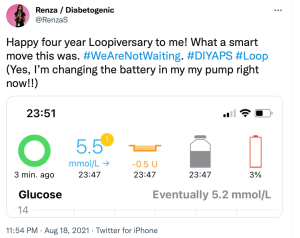
Last week, I hit four years of Looping. That’s 1,460 hours I’ve clawed back. Or over 60 days. If DIYAPS came in a box (and with a PR machine and marketing materials) and it promised me that, I wouldn’t believe it based on previous experience. But I guess that’s the thing. There is no box, there is no marketing juggernaut. It’s just the stories of people with diabetes who have worked through this and worked it out for themselves.
An out of the box marketing solution for an out of the box diabetes technology solution. I’ve never trusted anything more.
At the last IDF Congress, I was invited to be part of the first panel on the opening morning of the meeting. It was all about diabetes and technology. Before the questions, the moderator, my friend Kyle Jacques Rose, asked everyone to introduce themselves. When it got to my turn, I said who I was and then shamelessly and unapologetically said I was the most important person the stage (along with Kyle and Manny Hernandez, who also live with diabetes). I remember looking steadily out into the audience as I made my claim to see the response. There was some who looked taken aback. And then some who cheered (thanks to the other PWD in the room!).
Last week, I was in a two-hour workshop. I knew maybe half the people there. I also knew that I was the only person there to provide the ‘user’ experience. This isn’t uncommon, but it still drives me nuts when it happens, especially in a session that was about finding the right person-centred model of care in the age of telehealth. When it came to introducing myself, I thanked the organiser for inviting me, and said that it was great to be there…as the most important person in the (Zoom) room. One of the researchers I know well and who I have worked with quite a lot in recent years, smiled widely. At least I had one person in the room who got me. I watched again to see how others responded. Some certainly did look a little shocked.
I explained that having people like me to feed into the work is critical, and that it was great that they wanted to hear from someone with lived experience to (and it would have been great to have seen a few other folks doing the same).
So, how do I manage to be ‘the voice’ of lived experience when it comes to these sorts of things? When the meeting is diabetes-specific what do I say that captures the needs and wishes of every single person with diabetes? And, as in this meeting, when it’s about designing a system that is for all people with a variety of health conditions, how do I effectively and adequately tell the HCPs and researchers in the room just what it is that those people want?
The answer is, I don’t. Of course I don’t.
I can’t speak to anyone else’s experience other than my own. I can’t say ‘I need this’ and assume that is what everyone else wants, and I would never make that assumption. Nor do I try to convince anyone that my needs and experiences are representative of anyone’s other than me.
I will advocate until I am blue in the face that there needs to be many different people consulted and engaged in the design, delivery and dissemination of healthcare services, activities, and resources. Sometimes, that does happen. But if it is only me, I am never there to provide specifics of what needs to be done. In fact, I spend most of my time urging (begging and pleading) for assurances that there will be far more, far better, far meaningful engagement from this moment forward.
I see my role is to pointedly, deliberately, unambiguously, and often, bolshily, make sure that the others in the room embed the idea of co-design in everything they do. And do it with wide representation.
I honestly don’t believe that there can ever be too much lived experience representation. But in the cases when there is only very little, I have rarely met anyone who claims to be the oracle of all things to do with lived experience or believe that their ideas are the only one worth listening to. In fact, anytime that has happened that person never is asked back.
When I am asked to help find people for an advisory board, or to be involved in consultation, I always search for people who I know can look beyond their own experience. Again, it’s not because they are expected to speak for others. Rather it’s to know that there are others with different experiences and that, while they are the one at the table in that moment, they will do everything possible to make sure that those others are invited next time.
And THAT, is why, at times like this, people like me are the most important people in the room – those of us who are banging a very loud drum to make sure that our cohort grows and grows. If you are working in healthcare and don’t have people with lived experience as part of the discussion, you’ve forgotten the most important people.
Stop what you’re doing, RIGHT NOW, and go find them.

Often when we talk or read about technology it is very much about the latest, newest, shiniest devices. And yes, I wrote about those last week. There’s nothing wrong with learning about latest tech releases, or desperately wanting to get your hands on them.
But the devices are only ever half the story. And that’s why it was so great to see that in amongst all the data and the new things, was a presentation that reminded everyone watching the technology symposium at ADC that the data belongs to people and the devices are worn on the bodies of those people.
This is the whole warm hands, cool tech concept that is often missing when we hear about technology. The devices are not inanimate, they need human interaction to make them work for … well … for humans.
I despair at some of the stories we hear about technology and people with diabetes. Some talk experiences that have left them feeling like a failure when the tech has simply not been right for them. Because that is the way it is posed. If we decide the tech doesn’t suit us, hasn’t worked for us, hasn’t helped us achieve our goals, we’ve failed it.
The truth is, it’s more likely that the failure – if we need to frame it that way – is not the PWD at all. It’s more likely that the tech is not right for the person, and there wasn’t enough assistance to help navigate through to choose the right tech. Or the education was insufficient, or not tailored for the PWD, or not interesting, or not relevant (more on that soon, from Dr Bill Polonsky’s opening plenary from the conference). It is possible that the timing wasn’t right, the circumstances were not optimal, not enough conversations about cost or effort required … whatever it is, none of the blame for something not being right should be placed on the PWD.
When we look at diabetes education, or engagement with healthcare professionals, the stories that are celebrations or considered successes (from the perspective of the PWD and, hopefully, the HCP) show the right recipe. The ingredients will all be different, but the method seems to be the same: the person with diabetes is listened too, time is taken to understand what is important for them, the PWD’s priorities are clear, and goals are realistic and checked along the way. The end results are not necessarily based on numbers or data points, but rather, just how well the person with diabetes is feeling about their diabetes, and if anything new has added to their daily burden. Reviews are focused on successes more than anything else.
My favourite ever diabetes educator, Cheryl Steele, gave an outstanding presentation on how HCPs can best work with people with diabetes to ensure we get the most from our technology.
I spoke with Cheryl after her talk (you can watch the video of our chat for Diabetes Australia at the end of today’s post), and she laughingly said that she could have said the most important things she wanted to say in 2 minutes, and with one slide that basically just said that HCPs need to be truly person-centred and listen to PWD.
But thankfully, she spoke a lot more than that and covered a number of different topics. But the thing that got to me – and the thing that I hope the predominantly HCP audience would take home and remember – was Chery urging her colleagues to focus on the positives.
Cheryl said, ‘The emphasis has to be on what you’re doing well’ and I feel that is a wonderful place to start and end healthcare consultations. I think about experiences where that has happened to me. Such as the time I went to my ophthalmologist after a few years of missing appointments and his reaction to seeing me was not to tell me off for not showing up previously, but instead to welcome me and say it was great I was there. I’ve never missed an appointment since.

How many PWD reading this have stories to share of times when they went into an appointment with data and all that was focused on was the out-of-range numbers? There are countless stories in online diabetes groups where HCPs have concentrated on the 10% out of range numbers rather than the 90% in range. Actually, even if only 10% of numbers were in range, that is 10% that are bang where they need to be!
Perhaps that’s what’s missing from diabetes appointments. Gold stars and elephant stamps!
There is something devastating about walking into an appointment and the first, and sometimes only, thing that is on the HCPs radar is numbers that are below or above the PWD’s target glucose range. I’ve sat in those appointments. I know the feeling of walking in and feeling that I’m tracking okay, only to have none of the hard work I’ve managed acknowledged and instead, only the difficulties addressed.
But then, I think about one of the first experiences with the endocrinologist I have been seeing for twenty years. Without judgement, she acknowledged that I wasn’t checking my glucose much, and asked if I felt that I could start to do one check every Wednesday morning when I woke up. I said that it seemed like such a pathetic goal to set, but she gently said, ‘One is more than none’. The focus was not on what I wasn’t achieving. It was on what I could.
What a wonderful motivator that is.
Disclosures
Thanks to the Australian Diabetes Society and Australian Diabetes Educators Association, organisers of the Australasian Diabetes Congress for complimentary registration to attend the conference. This gave me access to all the sessions.
I work for Diabetes Australia and the video shared is part of the organisations Facebook Live series. I am sharing here because is relevant to this post, not because I have been asked to.
As usual, no one has reviewed this piece before I hit publish (which is unfortunate because I could really do with an editor).
This week, I’ve been at the Australasian Diabetes Congress. By ‘at’ I mean ‘sitting in my home office in lockdown, watching sessions on my MacBook’, because that is what ‘at a conference’ means in the time of COVID.
Today is the final day, and I spent a couple of hours in the technology session, listening to news about the latest and greatest in diabetes technologies, as well as the best way to work with people with diabetes who are using these technologies. I’ll be writing about the latter next week.
Today is all about shiny new stuff!
Big tech news from the Congress was the announcement from Insulet Australia that Omnipod DASH will be available this month, which is fabulous because it means that there is another choice added to the pump market for Aussies with diabetes – and a tubeless pump at that!
The not-so-great news is that Insulet has been unable to successfully negotiate a reimbursement model with the Department of Health. Pumps in Australia are generally covered through private health insurance, and pump consumables subsidised through the NDSS.
This has worked perfectly well to date because pump products have been easily divided into devices (the actual pump) and consumables (infusion sets and reservoirs/cartridges). The Omnipod system is different – it comprises a tubeless pod which is, essentially the pump and consumables. The pod is worn for three days before being discarded. There is a touchscreen ‘personal diabetes manager’ which is used to drive the device. This system simply doesn’t easily slide into the funding model that has worked for the last thirty odd years.
The latest notice from Insulet Australia is that they will now have to go through another submission process, and that will take a further 8 – 12 months. There is no guarantee of reimbursement at the end of this process, but Insulet – and Aussie PWD – are hopeful there will be good news.
Frustratingly, this means that anyone who decides that they really want an Omnipod and want it now needs to purchase it out of pocket, with no subsidy scheme on offer. The price that was announced at the Congress is AUD$400 for a one-month supply. There will be discounts for two- or three-month orders.
In other new tech news, Abbot’s new flash glucose monitor, Libre 2, is very much now available in Australia, and the positive here is that it is already listed on the NDSS for those eligible for the CGM Initiative. Those of us who need to pay out of pocket, the price is the same as for the first-generation Libre. It’s a small win.
Libre 2 has been out and about in Europe for some time now (and Libre 3 is out in limited release in some markets), and has recently received approval for use in the US.
The main difference with Libre 2 is that it alarms when glucose levels are out of range. The wearer will still need to scan over the sensor (either with a mobile phone or reader device0 to see the actual reading, but they will have been alerted to any numbers that are either too high or too low. The great thing is that the alarms are optional, which is great for PWD who prefer their diabetes to be silent.
It’s been described as an evolution rather than a revolution, which is not a negative. We don’t necessarily need every new generation to be a complete and utter overhaul with all new bells and whistles, but it’s always great to see improvements – especially when they are improvements PWD have recommended! I haven’t tried the Libre 2 yet, but will be doing so in the next week or so.
You can find more information about these two new technologies by clicking on the images below.
Omnipod (there is currently very limited information on the site, however that should change in coming weeks.)
Disclosures
Thanks to the Australian Diabetes Society and Australian Diabetes Educators Association, organisers of the Australasian Diabetes Congress for complimentary registration to attend the conference. This gave me access to all the sessions.
I hosted the Australian launch of the Omnipod DASH for diabetes advocates back in May this year, and was paid an honoraria for my time.
Abbott Diabetes Australia has provided me with a Libre 2 sensor to use.
All words here are mine and I have not been asked or paid to write anything you’ve just read.
This oldie from the archives is making an appearance (with a few changes from the original) because today in my inbox I received an email suggesting that I could do a three week online course to become a diabetes expert. For the low price of US$799 (plus tax), I could have access to modules that are a veritable treasure trove of diabetes details. So, I thought about it for a bit, and was just about to hit ‘add to cart’ when I remembered this post.
Turns out, there is already a simple way to find out if you are an expert in your diabetes. You can take it here for free. You’re welcome.
_______________________________________________
Take this quiz to find out if you are an expert in your diabetes.
| 1. How long have you had diabetes? |
| Long enough. |
| Too long. |
| No idea. I’m drinking to forget. |
| 3,456 days; 22 hours; 3 minutes; 14 seconds….15 seconds….16 seconds…. |
2. Complete this sentence: Diabetes is like…. |
| A rainbow. All bright colours and a pot of gold at the end. |
| Disneyland. The happiest place on earth! |
| The best thing that has ever happened to me! |
| It sucks. It just plain sucks. |
| 3. A unicorn walks into a diabetes support group meeting. You… |
| Call it Pricker and make it the group’s mascot. |
| Collect tears from it and cure your diabetes. That will work, right? |
| Find out if it knows anyone from the Forbidden Forest in Harry Potter. |
| Check my BGL. |
4. Can you eat that? |
| F*ck off |
| No; I hate tripe. |
| Yep; pass me a spoon. |
| Should you be asking that? |
| 5. Water is to sieve as XX is to diabetes? |
| Money |
| Money |
| Money |
| Money |
6. How many people with diabetes does it take to change a light globe? |
| Get over yourself. I use the word ‘diabetic’. |
| I use candlelight. I can’t afford a light globe; my CGM costs are too high. |
| Fifteen. Any excuse for a diabetes support group get-together! |
| Not sure. Let me call my endo and I’ll get back to you. |
| 7. You see another PWD in a café. What do you do? |
| Enough with the PWD crap! |
| Squeal, leap across the table, tell that you will be friends forever – whether they like it or not! (Wait…that could just be me….) |
| Nothing, but keep a close eye on them to check out their gear. |
| Make a big deal of pulling out your pump/meter/pens hoping they will notice and start talking to you. |
8. Complete this sentence: An insulin pump is…. |
| A little device that delivers insulin. |
| A nightmare to try to accommodate when wearing a tight frock. |
| More demanding that a new puppy – all the beeping & alarms drive me crazy. |
| No idea? What is it? |
| 9. Do you know other people with diabetes |
| No; I avoid them like the plague. |
| Yes. |
| There are other people with diabetes? |
| Yes. I moved house so I could have one as a neighbour. (Wait – that could just be me….) |
10. Complete this sentence: Nutella is…. |
| A chocolate, hazelnut spread |
| The work of the devil. (FYI – If you select this, we can never be friends.) |
| The. Greatest. Thing. Ever. |
| The solution to all the world’s problems. RESULTS Well done – you are an expert in your diabetes. All answers are correct. Or incorrect! Frustrating right? Just like diabetes. |
Yesterday, the Australian vaccine rollout was expanded to include children. This follows the TGA approving the use of the Pfizer COVID-19 vaccine for children in the 12 – 15 year age group. ATAGI responded by including children with diabetes in that age group into Phase 1B, meaning they are eligible right now for a jab (provided, of course, they can find one…!).
Already I’m seeing in diabetes online discussions some parents of kids with type 1 diabetes saying their child will not be getting the vaccine, stating that the reason for that decision is because their type 1 diagnosis came shortly after one of their childhood vaccines.
And so it seems a good time to revisit this post that I wrote back in 2017. It has a very long title that could have been much more simply: correlation ≠ causation.
It is understandable to want to find a reason for a health issue. Being able to blame something means that we can, perhaps, stop blaming ourselves. I imagine that for parents kids with diabetes that desire to find something – anything – to point to would come as somewhat of a relief. But there is absolutely no evidence to suggest that vaccines are that reason.
Unfortunately, the idea that vaccines are the root of all evil and cause everything under the sun is a myth that is perpetuated over and over in antivax groups; groups where science, evidence and logic goes to die. Vaccines save lives and they are safe. Anyone who says otherwise is lying.
My sixteen year old is not in a priority group and cannot be vaccinated just yet, but she is ready to go as soon as her phase has the green light. All the adults nearest and dearest to her – her parents, grandparents, aunts and uncle, friends’ parents – are fully vaccinated now, and she knows what a privilege it is to be in that situation. She understands that with that privilege comes responsibility to do what you can to protect vulnerable cohorts in the community. And she also understands that vaccines are safe and they save lives.
If you are feeling unsure about getting a COVID vaccine – for you or your child – please speak with your GP. Don’t listen to someone in a Facebook group. And that may come as a surprise to anyone who knows how important I consider peer support and learning from others in our community, but to them I say this: I listen to and learn from people in the diabetes community because they don’t suggest anti-science approaches. They talk about support, and provide tips and tricks for living with diabetes. If anyone tells me to ignore doctors (because all they care about is getting rich), or to stop taking my insulin (because there is a natural supplement that will do the trick), I would block them as quickly as I could. Science works. Science is why people with diabetes are alive today. Science is why we have vaccines. Trust science. THAT’S what makes sense.
__________________________________________________________________________
In the next couple of weeks, our kid gets to line up for her next round of immunisations. At twelve years of age, that means that she can look forward to chickenpox and Diphtheria-Tetanus-Pertussis boosters, and a three-dose course of the HPV vaccine.
When the consent form was sent home, she begrudgingly pulled it out of her school bag and handed it to me. ‘I have to be immunised,’ she said employing the same facial expressions reserved for Brussels sprouts.
She took one look at me and then, slightly sheepishly, said, ‘I don’t get to complain about it, do I?’
‘Nope,’ I said to her. ‘You don’t get to complain about needles because…well because…suck it up princess. No sympathy about needles from your mean mamma! And you have to be vaccinated because that’s what we do. Immunisation is safe and is a really good way to stop the spread of infectious diseases that not too long ago people died from. And herd immunity only works if…’
‘….if most people are immunised so diseases are not spread,’ she cut me off, finishing my sentence. I nodded at her proudly, signed the form and handed it back to her. ‘In your bag. Be grateful that you are being vaccinated. It’s a gift.’ (She mumbled something about it being a crappy gift, and that it would be better if she got a Readings gift voucher instead, but I ignored that.)
Over the weekend, the vaccination debate was fired up again with One Nationidiot leader, Pauline Hanson, sharing her half-brained thoughts on the issue.
I hate that I am even writing about Pauling Hanson. I despise what she stands for. Her unenlightened, racist, xenophobic, mean, ill-informed rhetoric, which is somehow interpreted as ‘she just says what many of us are thinking’, is disgusting. But her latest remarks go to show, once again, what an ignorant and dangerous fool she is.
Her comments coincided with a discussion on a type 1 diabetes Facebook page about vaccinations preceding T1D. Thankfully, smart people reminded anyone suggesting that their diabetes was a direct result of a recent vaccination that correlation does not equal causation.
I get really anxious when there is discussion about vaccinations, because the idea that this is something that can and should be debated is dangerous. There is no evidence to suggest that vaccines cause diabetes (or autism or anything else). There is, however, a lot of evidence to show that they do a shed-load of good. And if you don’t believe me, ask yourself how many cases of polio you’ve seen lately. People of my parents’ generation seemed to all know kids and adults with polio and talk about just how debilitating a condition it was. And they know first-hand of children who died of diseases such as measles or whooping cough.
This is not an ‘I have my opinion, you have yours. Let’s agree to disagree’ issue. It is, in fact, very black and white.
A number of people in the Facebook conversation commented that their (or their child’s) diagnosis coincided with a recent vaccination. But here’s the thing: type 1 diabetes doesn’t just happen. We know that it is a long and slow process.

What this shows is that even if onset of diabetes occurs at (correlates with) the time of a vaccination, it cannot possibly be the cause.
When we have people in the public sphere coming out and saying irresponsible things about vaccinations, it is damaging. People will listen to Pauline Hanson rather than listen to a doctor or a researcher with decades of experience, mountains of evidence and bucket-loads (technical term) of science to support their position.
The idea that ‘everyone should do their own research’ is flawed because there is far too much pseudo-science rubbish out there and sometimes it’s hard to work out what is a relevant and respectable source and what is gobbledygook (highly technical term).
Plus, those trying to refute the benefit of vaccinations employ the age-old tactic of conspiracy theories to have people who are not particularly well informed to start to question real experts. If you have ever heard anyone suggesting: government is in the pockets of Big Pharma / the aliens are controlling us / if we just ate well and danced in the sunshine / any other hare-brained suggestion, run – don’t walk – away from them. And don’t look back.
I have been thinking about this a lot in the last couple of days. I have what I describe as an irrational fear that my kid is going to develop diabetes. It keeps me awake at night, makes me burst into tears at time and scares me like nothing else. If I, for a second, thought for just a tiny second that vaccinating my daughter increased her chances of developing diabetes, she would be unvaccinated. If I thought there was any truth at all in the rubbish that vaccines cause diabetes, I wouldn’t have let her anywhere near a vaccination needle.
But there is no evidence to support that. None at all.
I know diabetes, and not much else. I have a few other health conditions that are no more than niggling, requiring minimal effort and engagement with healthcare professional. But they still do need some sort of attention and treatment. The stark difference between that treatment and the treatment for diabetes is that I never have to jump through hoops to get treatment for them.
The other day, I had to go and have imaging on my elbow because said elbow hurts, the doctor thinks it’s tennis elbow which is now being referred to as latte elbow around here because the last time I picked up a tennis racket, Yannick Noah was ranked in the top 10.
I went to the GP, told him what was wrong, and he wrote a referral straight away for an ultrasound and Xray and sent me on my way. Three days later, I had the scans done and today I’m waiting for a telehealth appointment to discuss treatment. There was no ‘let’s wait and see’ if it gets worse.
Diabetes seems to be a lot about waiting and seeing. Or use of arbitrary numbers to determine if something can be used. Or bargaining: you may have <x device/treatment>, but you must do <y intervention> first, even if <y intervention> is not want the PWD is remotely interested in.
When I wanted to start on a pump twenty years ago, I had to go doctor shopping until I could find a doctor who would agree to filling out the requisite forms so my private health insurance would cover the cost of the pump. This was twenty years ago, and while pumps had already been around for a number of years by then, there really weren’t all that many Australians using them, so finding an endo comfortable with the whole thing was not easy.
My first endo told me I hadn’t had diabetes long enough to consider using a pump. Subsequent shopped doctors told me a) my diabetes wasn’t serious enough to warrant a pump, b) my A1c wasn’t high enough to use a pump, and c) my A1c was too low to use a pump.
It took a while before I found a doctor whose response to my ‘I want to use an insulin pump’ was ‘Sure, where do I sign?’.
When CGM came out I’d already found myself the sort of doctor who was more than happy to be guided by what I wanted, because she understood that I knew my diabetes best and therefore was the best person to decide what I wanted in my management arsenal. She’s still my doctor. There’s a reason for that!
Last week, I tweeted this:

The replies and discussion that this tweet started are really not a great snapshot of person-led care. In fact, it’s more like example after example of PWD being told no for not especially great reasons.
It seems that there are two main barriers which are intertwined in some ways.
The first is that HCPs continue to act as gatekeepers of diabetes technologies, deciding who is allowed to access what particular devices and when that can happen. This is problematic and harks back to a time when people with diabetes were mere patients, gratefully accepting what care was doled out to us without question.
Some might think that this sort of archaic attitude is no longer around, but a glance through the replies shows that, sadly, that isn’t the case.
The other barrier seems to be a whole heap of rules that seem to have no purpose other than expecting the person with diabetes meet them before they are deemed worthy of whatever it is they want.
Some of the rules seems arbitrary, others probably come from a sensible place, but are not what person-centred care is about. Many don’t seem to be based in any kind of evidence at all. Regardless, all they do is promote a one size fits all process that must be met before a PWD can proceed, verifying our merit along the way.
The very idea that we need to prove ourselves worthy of a diabetes treatment is offensive. We didn’t need to prove ourselves worthy to be diagnosed with diabetes, so why should we need to do so to have access to the technologies that are there to help us manage it? Why should we need to have diabetes for a certain about of time first, or do an education course that is not necessarily directly related to what we are searching for, or reach a certain A1c to earn our right to access and utilise a piece of diabetes tech?
(There is a third barrier unique to US DOC friends, and that is insurance requirements…. I don’t know all that much about insurance in the US, but I guess it is HCPs employed by, or advising the insurance who set up the ridiculous hurdles and hoops people with diabetes are expected to navigate.)
Now, obviously, there is the (not by any means insignificant) issue of cost. I understand that there is never an endless pot of cash to support people with diabetes. But even in places where there is funding available, or cost is to the individual – not the health system – there are still barriers in place.
Living with diabetes is a constant, tough gig. If we are searching for something to help us through, and we have made the decision that we want to try something new, surely the role of our HCPs is to work with us rather than stand in our way. The holy grail for so many people with diabetes that I speak to is to make diabetes easier. And yet, all these barriers just make it more difficult. That hardly seems fair.





 Diabetogenic