You are currently browsing the category archive for the ‘Devices’ category.
On Saturday, I had the pleasure of attending the Australia Diabetes Society’s (ADS) annual Insulin Pump and CGM Workshop. I’d been invited along another ten or so people with diabetes who already wear CGM or Libre to share our insights into living with and wearing sensing devices.
(Quick shout out to the ADS. For those who don’t know, the ADS is the professional body for endos in Australia. Over the last few years, their leadership team has been absolutely instrumental in finding ways to better include PWD in what they are doing. As an organisation, they have been innovative, and responsible for ground-breaking initiatives such as the Enhancing Consulting Skills resource. We need our professional bodies to be like this. And we need them to work with us so that we can provide our perspective to the work they are doing.)
The idea of the workshop is for endocrinologists to have hands on experience of the technology rather than just what they see and are taught at industry events. (For the record, the industry events are super important because they are an opportunity to learn about the shiny technical side of things. And get branded pens. Pens are awesome.)
Discussion was the focus of this session. There was no long presentation with people taking notes. Instead, we were asked to sit at tables with endocrinologists, and encouraged to share our the real life experience of wearing the technology.
Now, I don’t know about you, but this is always the way I want to learn and to share information. I seem to get annoyed at sessions when I have someone speaking at me for ages, telling me what they think I need to know. I much prefer to have discussions and watch conversations go off on tangents, providing attendees with the details and information that is relevant to them; that they will be able to take home with them and put into practise.
The thing about having PWD in the room is that we have a tendency to hold little back. My friend Jodie and I were at the same table. We both wear Dexcom, but our experiences are quite different. (Or as I put it: ‘She does what she’s meant to. I don’t’.) This was actually a master stroke, because it showed the endos just how varied our experiences can be. And that while what works for one person may not necessarily work for another, there really may not be a ‘right’ way to do things.
Jodie and I demonstrated putting in new sensors so that the endos could see how the actual insertion works. We talked about using an alcohol swab where we were about to site our sensor (in this case, I was the one following the instructions I’d been taught when I first started using CGM. ‘ Yeah…I can’t be bothered,’ said Jodie and I wanted to high five her and welcome her to the dark side of non-compliance.)
There was one endo at our table who was pressing every single one of my ‘OH-YES-LET’S-TALK-ABOUT-THAT’ buttons, and the first thing she said when we removed the sensor from the packaging was ‘Why is there so much waste in there?’
We spoke about the fact that current Dex sensors don’t have reusable inserting devices and that really, the companies could perhaps do a little more to find ways to reduce waste, while continuing to produce a sterile product. (The G6 apparently has addressed this…)
At one point, the Dexcom rep. mentioned the share function on the G5, and as if by magic, my new favourite endo jumped in with ‘Who makes the decision as to whether or not their data is shared.’ I wanted to hug her, but it was the first time we’d met and I thought that might be a little creepy. But yes; oh yes! We were going to talk about consent.
The absolute best thing for me was that not once as I shared by clearly (and absolutely owned) deliberately non-compliant CGM existence, did one of the endos look at me with disdain, shake their head, raise an eyebrow or tut tut. They asked how what I did made things better for me.
Some examples of questions and my answers:
Why do you wear the sensor on your arm and not your stomach?
I find it more comfortable and it reads more accurately. Plus, it lasts longer there than on my tummy.
Why do you restart the sensor?
Because I’m frugal and don’t want to fork out $90 every seven days when I know it works perfectly well for me still at 21 days
Look, the Dex reps should turn away right now, block their ears and pretend that they don’t understand me, because I am going to be really candid about this. Firstly, I am going to say that I adore this product. I would say that no matter who is in the room – I’m not sucking up to the AMSL reps because I’m hoping they’ll throw some free product my way. They don’t and that’s fine. I mean it. This is a brilliant product that I literally trust with my life. But there are some things that piss me off…
Sensors are around the $90 mark. They are approved for use for seven days. But at the end of those seven days, the sensor is still working perfectly. In fact, many people report that it works even better after the first week. Why should I throw out a perfectly good, working product if it is still doing what it says on the box?
I know the risks. I am choosing to do this myself and I am more than happy to own it.
But while we’re on this topic. The transmitter is AUD$540 every three months. That’s right, after three months, it stops working. The batteries are still good to go for a couple of months, but the device is factory set to stop working. Now, this has been done with a whole lot of safety considerations in mind and I understand those. But again, a device that is not rechargeable and still has some use in it has to be thrown out.
So, I don’t really have any qualms about using all sorts of DIY solutions that allow for the transmitter life to be extended.
I’ll say it again – I know the risks. This is about me and no one else. I am happy to take those risks.
So, you don’t calibrate it as recommended. Why?
Because sometimes, stopping whatever I am doing to calibrate is not something I want to do. Plus I’ve been wearing this for over 2 years now and I’ve learnt what to trust and what not to trust and how to use it safely. I have set my own boundaries that I feel are acceptable and perfectly safe.
Do the alarms bother you?
They used to. But now I’ve managed to customise them to a way that works for me. I have all the alarms on now, but in the past, I had all the high alerts and alarms disabled because they pissed me off so much. But the predictability of Loop means that the alarms are rare and I generally I have the headspace to respond to them as they happen. (Although the please calibrate one can drive me nuts sometimes.)
Do you share your CGM data?
I have in the past, but I don’t these days. As an adult with diabetes, I make that decision and there have been times when I’ve liked the idea of someone having my back – usually when I’ve been travelling solo. But since I’ve been looping there has been no need.
What’s Loop?
Um…we’re going to need a longer session… Here’s the address to my blog. Sorry for all the swearing.
After the event, the event organiser sent me a lovely text message, thanking me for my time and for speaking at the Workshop. She said that the CGM session was a highlight for many of the attendees. ‘People with diabetes make the best teachers,’ she added. And she’s right. When we are talking about what it’s like to actually live with these device on our bodies and in our everyday life, we really are the best people to talk about it! HCPs are great at talking about the science and the clinical side of things. But we make diabetes real because we are living it. You can only get that when you go straight to the source. And yes; we’re the source.
Disclosure
The ADS provided me with a $50 gift voucher to thank me for my time on Saturday. I was also given one Dexcom sensor to insert at the Workshop which I am still wearing. (And will do so for the next three weeks or so…)
I’m a little late to the whole Black Mirror thing. Aaron has watched through all four series and has repeatedly told me that I should get onto it, but I’ve just not been in the right mood to start and work through a new sci-fi series. (For anyone equally behind the times, Black Mirror is a Netflix series.)
However, there was one episode in particular that Aaron, and a couple of other people, suggested I watch. It is called Arkangel. The Netflix description for this episode is:
Worried about her daughter’s safety, Marie signs up for a cutting-edge device that will monitor the girl’s whereabouts – and much more.
The device (called Arkangel), an implantable chip, allows Marie to see her three year old daughter, Sara’s, location and vitals – blood pressure, heart rate, cortisol levels etc. – in real time. But more than that, the chip allows Marie to actually see exactly what Sara is seeing – not to watch her child as if there were CCTV cameras everywhere, but to see the world precisely as her daughter is seeing the world. There are parental controls that allow Marie to change what her daughter sees, effectively, blocking out (by pixilating) anything not PG-rated. The device was completely controlled via an iPad-type device and would alert if Sara was in any distress.
Arkangel was sold as a way for parents to know that their children were safe at all times. And what could possibly be wrong with that? It’s what all parents want. Right?

About ten minutes into the episode, I looked over at Aaron. ‘This is making me really uncomfortable,’ I said to him. Watching Marie getting on with her life, with the Arkangel tablet device next to her for easy access to what her daughter is experiencing at that moment, made me feel very uneasy. Every single thing her little daughter saw was replicated on the tablet.
As the episode progressed, Sara got older and Marie continued to monitor her daughter’s every move. But by the time she gets to about ten years old, Sara starts to question her mother’s use of Arkangel. Sara has come to realise that the parental controls mean she had never seen, and therefore could not understand – a lot of things her friends were talking about. Marie decided it was time to put Arkangel away. The tablet was switched off and stored in the attic, and Marie and Sara got on with their lives.
Until Sara hit teenage-hood…!
One night, after discovering Sara lied about her whereabouts, Marie reactivated the Arkangel tablet to locate her daughter, and see what Sara was up to.
My neighbour, Jo, was one of the people who urged me to watch this episode. She knew that I would see what she had seen when she watched the episode. And I did, immediately recognising the parallels between sharing of CGM data and Arkangel. And the issue of consent, or rather, the absence of it.
At the Roche Diabetes MeetUp at ATTD this year, I joined in a very robust conversation about the whole idea of sharing CGM data. There were adults with diabetes and parents of children with diabetes in the discussion, each with their own idea about the value of the technology.
A number of adults were appalled at the idea of sharing data, claiming it was simply a way for others to spy on them.
Personally, I am very apprehensive about sharing my data. Of course, this is a highly personal way to feel about the technology and there are other adults who absolutely love the idea that there is someone else keeping an eye on what’s going on with their glucose levels, and able to make sure they are okay if there is a problem. It makes them feel safer and more confident – and if that’s what people get from the technology, it’s only a good thing. But I am not sure just how comfortable I am at having someone see every high or low.
But we are adults – fully formed and grown and making decisions about ourselves and our diabetes, forourselves and our diabetes.
I also completely understand that as a tool, CGM sharing is one of, if not THE, most valuable and essential tool for parents to feel confident that their children with diabetes are safe at school, or other places, when they cannot be with their child. I know that CGMs with share capabilities have, in many cases, completely changed family dynamics for the better.
So when I question the technology and what it can do, I’m not in any way searching for answers about the value of the tech – that is indisputable in my mind. But I am questioning the issue of consent.
While it may make perfect sense for an infant in day care, or a primary school-aged child to have data share activated, what happens when the child starts high school. Or begins university? Or moves out of home? At what age does the idea of having the ability to remotely monitor someone’s CGM data become the decision of the person whose data it is?
I don’t think we have had these discussions, or thought through the long-term implications of CGM data sharing. And I worry that we still seem to not be having those conversations.
When the episode of Black Mirror ended, I felt unsettled. I actually noticed that my heart rate was elevated. I was rattled and had trouble sleeping that night, and I couldn’t help but see Arkangel as a cautionary tale.
Where are the conversations about consent? Where is the line in the sand when it comes to who makes the decision about data sharing? Obviously it will be different for every family, but where are the guidelines or conversation starters to equip people to make those decisions? If this is not being discussed at the time that children and adolescents are commencing CGM, why not?
These are not easy conversations to have – and, quite frankly, as an adult with diabetes, one diagnosed as an adult and not the parent of a child with diabetes, I am not sure that I am the right person to be even talking about it. Some might (and undoubtedly will) say that I should pull my head back in because I don’t understand the situation at all, and simply stop talk about it.
But someone does need to. And I think that it needs to start happening right now.
Last Friday, as I was getting ready to fly home from Copenhagen, I realised that the beautiful city was being inundated with some of my favourite European diabetes bloggers and advocates.
I was lucky enough to manage to meet up with the truly wonderful Tine who I have come to know and love through my involvement in the Roche Blogger program. When it comes to dynamic, sassy, smart and downright wonderful advocates, Tine is at the top of the list. We caught up briefly, talked about diabetes and language, and drank iced coffees and I am so glad that I got to see her gorgeous face.

Tine. She is so wonderful!
Unfortunately the rest of us were ships in the night and probably standing right near each other on opposite sides of the departure/arrival gates divide at Copenhagen airport. Brutal!
My friends were in Copenhagen to meet with the team from YpsoMed, which they do a couple of times a year, to talk about the YpsoPump and other YpsoMed products, advances in diabetes technologies and come together for some peer support. Some of them are using the YpsoPump, but certainly not all of them.
I’ve had a play with the YpsoPump a few times in recent years. My good mate Finn, who blogs here, (in German; Google Tanslate is your friend) stayed with us a couple of years ago when he visited Australia, and I tried bribing him with Tim Tams in exchange for his YpsoPump. Alas, my tactics didn’t work. (Apparently he needs it to infuse insulin into his body or something.)
And each year at EASD, I would annoy the team on the YpsoMed stand by demanding to know when they were bringing their pump to Australia. (This is standard line of questioning for me at international conferences when I see technology I like the look of and thing we should have access to. I am probably known as the annoying woman from Australia, a badge I am willing to wear and a cross I am willing to bear.)
Yesterday, the YpsoPump was launched in Australia. I’d like to think it was my pestering, but the reality is that it is a smart move by a company that has been around the diabetes world for some time now and saw a market that is truly crying out for some choice.
Lucky us!
So, here are a couple of things of note about the YpsoPump
- Undeniably, the first thing that is abundantly clear is the size of the pump. It is teeny-tiny compared with other offerings. The Medtronic 640G, in a side by side comparison, looks like a monster. (This was one of my criticisms when I trailed that 640G a couple of years ago. It felt bulky, clumsy and huge!) The YpsoPump is streamlined and sleek, and sits comfortably down my bra. (First thing I did with it. I know; all class.)
- The touchscreen and icons are a departure from the buttons we have come to expect on insulin pumps. When the pump is ‘sleeping’ it is completely black and blank. This adds to the sleek look of the device.
- It is pretty easy and intuitive to use. We got to have a play and set up the pump yesterday and it was simple and logical. Loading and priming the glass cartridge was quick. The cartridge holds 1.6ml of insulin – this is not a pump for people on huge daily doses of insulin.
- The pump uses and is integrated with a smart phone app (search MyLife from the App Store to download for free). At this stage it is uni-directional, so the pump cannot be driven from your phone. (i.e. The pump speaks to the phone/app; the phone/app doesn’t speak to the pump.) However, this is something that will, in the future, happen. (‘In the future’ apparently means a couple of years.) For those of us Looping, we shake our heads, because we are currently doing this and it makes no sense that regulatory processes are holding up something that is already available and perfectly safe. It also negates the whole thing about discretion when it comes to the pump. If you still need to pull it out from under your clothes, it doesn’t matter how small the thing is – you still need to pull it out from under your clothes!
- Really pleasingly, customer service is all being run out of Australia which means that whoever you speak with has a really good understanding of the Aussie health system. This is especially useful for ironing out any potential glitches with getting approval through PHI.
- Consumables are already on the NDSS. Want this pump? It’s ready to go. Talk to your HCP!
Two other things I asked about were a little broader than simply the use, design and practicalities of the pump.
Firstly, I wanted to know what was going to be done to protect us from coming to love this device, only to see it disappear from the market in four or six or eight years’ time. I have lived through the loss of the beloved Cosmo pump (I LOVED that pump!) and now Animas. While for some this can be seen as just an evolving market, I think it is much more than that. We are intimately connected with these devices. We see pumps come and go from the market. We invest in them, we become attached to them (literally and figuratively). To have them disappear from the market is heartbreaking for some people. I was grateful that Eberhard from YposMed acknowledged our disappointment. He told us that the company has been around for a long time and is very invested in continuing to provide new, innovative and cutting edge technologies to the diabetes market. I hope he is right, because I can see people falling in love with this pump very easily.
And secondly, I wanted to know what sort of engagement YpsoMed were doing to ensure that what they are delivering (they have a lot of things in the pipeline, including a patch pump due for release in 2012/22) really aligned with what people with diabetes want and need. Their engagement with the community is strong and they seem committed to it. The European blogger group has been meeting regularly and provide feedback on design and development. The launch of the product into Australia was with consumers (the HCP launch is today). There is definitely a desire to work and link closely with people in the community and that should be commended.

Just some of the advocates and bloggers at the YpsoPump launch yesterday.
With the YpsoPump ready to go in Australia, we are seeing increased choice in the pump market. No longer should we feel pushed into a pump that we don’t really want because that’s all there is, or all that is supported. This is only a good thing for people with diabetes.
You can find out more about the YpsoPump by going here.
DISCLOSURES
You bet! YpsoMed flew me to Sydney, put me up in a hotel, and fed and watered me. They did not pay me for my time, nor for my words. They did not pay me to ask annoying questions – or to not ask annoying questions for that matter. You can and should consider this when reading what I have written today.
We have a beautiful tree over the back laneway at our place. Usually at this time of the year, it is in full autumn brilliance. The red and gold leaves catch the gorgeous afternoon sunlight, and where the leaves have already littered to the ground, the branches are bare.
But this year, things have been a little different. Our tree brought out its autumn clothes a much later than usual, but sure enough a couple of weeks ago, we noticed that the leaves were beginning to turn. Every day, I’d look over the fence to see a deeper red, a more golden glow. Sure, we hadn’t needed to turn the heating on inside the house yet, and my really warm knits were still tucked away in the cupboard, but the tree was promising winter and cooler days.

Blossom buds. In May…
Over the weekend, as I sat in the kitchen, the back door open letting in a lovely breeze, I looked up at our tree. And there, on the bare branches, I could see something shooting. I went outside to have a closer look and realised that what I could see was the start of the blossom that comes out in the middle of springtime.
Our poor tree was looking mighty confused. I was confused. This isn’t how things go. The seasons are meant to be somewhat regulated and ordered. I like order. Order makes sense. This didn’t make sense at all to my brain, which likes things to be as they should be!
This wasn’t the only confusion I dealt with this week. Last Friday, I spoke about DIY diabetes technology at a health professional event and there was a lot of confusion.
I only had ten minutes (seriously not long enough to talk about something that is a completely novel concept to most of the audience), so I spoke fast, waved my hands around faster and tried to simplify the whole idea of looping into about 8 slides. ‘Renza will be around afterwards if you have questions,’ the emcee announced to the audience who all looked slightly bamboozled and winded after I finished.
There were questions. Lots of them about how Loop works, what it really is and who can use it.
But the one thing that seems to garner the most confusion is the cost. ‘You didn’t say how much has cost you,’ a few people said to me once the event was finished. Actually, I did. (Admittedly, very quickly, because: 10 minutes!) ‘Well, you need to source a pump that works, so that may be costly. And if the person using it is over 21, they will need to fund CGM themselves. Plus, the Riley Link is about $150 and there is a cost associated with becoming an Apple developer,’ I repeated what I’d said in my talk. (Obviously, I was talking Loop, but there was an OpenAPS user in the room too and I think he may have answered a couple of questions about the cost of his set up.) ‘No, no…what about the actual cost to use the app? How much does that cost?’
I have had this question asked probably more than any other. For some reason, people don’t seem to understand the concept of open source information sharing. No one is making money through this. The clever people who have developed DIY diabetes solutions place the details online for anyone to see and use. For free.
But this seems to be a confusing concept for a number of people.‘Wait. So no one is making in money from this? What about the people who worked it out in the first place? They are. Right?’
‘Nope,’I always reply, wondering how many ways I need to say it (along with wondering why I am so lousy at communicating things and also, if my hands waving around are distracting people).
Inevitably, the next comment is ‘Well, I’m not sure why someone doesn’t try to commercialise it. That would get it through regulations, wouldn’t it?’
At that point, it’s my turn to look confused. Why is it so difficult for people to understand that there are actually people in the world who genuinely want to do something good for others? Or that the WHOLE point of the #WeAreNotWaiting ‘movement’ is the fact that there is no waiting for regulations that are inevitable with commercialisation?
I guess that unless you are part of this community, it could be difficult to understand. But the generosity of those in the community is on show all the time. Whether that be the people doing the grunt work behind the scenes to make the dreams of DIY diabetes a reality, or the people who are then writing the step by step instructions so even fools such as me can follow those instructions, or the incredible community members who are ready to jump in any time to answer SOS calls for help when something doesn’t seem to be working, these people are doing it all for nothing more than the gratitude of those of us who are reaping the rewards of their cleverness and kindness.
The confusion – and disbelief – about this community is confusing to me, because every day I see how incredible it is. I only wish I was smart enough to give back even a fraction of what I have received from those brilliant folks who are there for the rest of us. And I really wish I was able to do a better job explaining what a marvellous bunch of people they are!

In what has possibly been the worst kept secret in diabetes in Australia, AMSL today announced their partnership with Tandem Diabetes Care, officially revealing that the much anticipated TSlim pump is on its way to Australia. You can read all about it here, but please note that at this time there is no official launch date available. AMSL is still going through registration and subsidy processes, and this will take some time. (But we’re told we can expect it on the market some time later this year.)
This is the latest development in changes to the Australian pump market which, to be honest, was looking a little dire.
With the announcement that Animas was leaving the market completely (the Australian departure was declared a few months after our North American friends were told; no one particularly surprised), Australians were left with a choice of pump offerings from Medtronic and Roche. Cellnovo had just launched, but there were supply issues. Really, it was slim pickings for us!
Fast forward three months and the Aussie pump landscape is looking a little different, which is great news if you are thinking about starting on a pump, or are due for an update soon. If you’re in the market for a new pump, you can now consider:
- Medtronic 640G or MiniMed Veo
- Roche Accu-Chek Combo
- Cellnovo
- Ypospump (registered and available soon)
And now, Tandem will be AMSL’s pump offering. For updates, check the AMSL socials.
So what does this mean for me? Well, twelve months ago, I would have been beside myself with excitement at today’s announcement. My pump’s warranty would have been about to expire and I was in the market for a new pump. I was extraordinarily frustrated at the ‘pump limbo‘ I found myself in with the limited options available to me not giving me any joy at all. I would have been hassling the gorgeous AMSL team for more details, desperate to get my grubby paws on a TSlim the second it was on the market.
Today I am indeed thrilled by the announcement. I am all about choice and this provides people with diabetes who want to pump another option. This is nothing but a great thing! But for me personally, I am actually happy with my old loopable pump and won’t be making any moves away from what I am doing.
A shiny, sexy new TSlim pump would be lovely shoved down my bra. But unless I can loop with it, it’s not for me. But I will certainly be keeping a very, very close eye on developments, because I do know that with its Dexcom integration, it will have hybrid-closed loop capabilities available in the not too distant future…

I really love a good list. And twenty is such a lovely round number. Plus, I’m going to milk the twentieth diaversary thing for as long as I can. Or at least until I bore everyone. And myself.
On the day I was diagnosed, I was given a meter. It came in a padded navy bag and had a cream-coloured lancet device. The meter looked quite similar to a basic BGL meter today. And it took twenty seconds once the drop of blood was placed on the strip to countdown to give me my reading. I know, twenty seconds! Barbaric!
There have been a lot of advances in DTech in the last twenty years. Some of it has been incredible (CGM, Flash, advances in pumps, better insulins); some…not so much (hello GlucoWatch!). But either way, I’ve always been interested in the latest technologies and have wanted to get my hands on it as soon as possible. It’s not all been great. But I’ve always learnt something when I’ve tried something new.
So, here are twenty things I’ve learnt about diabetes technology.
- There is no one way to do diabetes technology. This fits into the My Diabetes, My Rules thing again.
- Diabetes technology does not only refer to the latest and greatest! It includes your BGL meter (even if you are using one from a few years ago!), your insulin pen, the app you use to track your glucose levels and food intake…
- And MedAngel!
- You don’t need to use the latest and greatest if you don’t want. If you are happy with using a BGL meter and MDI, keep going. AKA: If it ain’t broke, don’t fix it. Unless you want to. And then knock yourself out.
- An insulin pump is just a way to deliver insulin. That’s all it is! It’s a fancy way to do it, but it’s just an insulin delivery device. There are other ways to deliver insulin, so if you don’t want to pump, that’s perfectly okay.
- But if you do want a pump, learn to use it properly. I spent the first three years pumping not having a clue with what I was doing because I was trained by a rep from the pump company who just wanted to get in and out as quickly as possible. I learnt what the buttons did, but had no idea about anything else. I learnt nothing about carb counting, or how to make adjustments. My basal rates were wrong, but I couldn’t fix them because I’d never understood how to.
- That actually goes for any sort of technology. You won’t get the most out of anything if you don’t know how it works.
- So…find HCPs who know DTech, will support whatever you want to use, are up to date with the latest technology and are okay with you customising your devices to suit your needs.
- Once you find those awesome HCPs, listen to them. Learn the rules for your Dtech devices. And then break them to suit you. Being deliberately non-compliant only works if you know what you’re being deliberately non-compliant about!
- And further to that, after listening to your HCPs and reading all the official information and documentation, find out the truth about diabetes technology! Turn to your peers and learn how to use it in real life. I can honestly say that every single tip and trick I have learnt when it comes to DTech came from other people with diabetes. Peer support for the win!
- Worrying about how and where you will site wearable technology is not a frivolous thing to worry about. It makes perfect sense and it’s okay if that is something you are concerned about or if it’s the reason you’re wary about getting a pump, CGM or Flash glucose monitor. (But do ask around for tips in online groups to hear about how others manage – you’ll get some great ideas!)
- Just because you have decided to try something doesn’t mean you have to use it forever. If you decide that tech isn’t for you, put it away in a drawer, or pass it onto someone who wants to use it, and go back to what you were doing before. Or switch between the two. DTech is not like a puppy – it can actually be just for Xmas!
- Dtech may not necessarily make your diabetes easier to manage. Sometimes, it can feel like (and may be) more work – especially at first. Those of us who have been using different devices for some time can forget that.
- Just because one brand is the market leader and has the flashiest flyers, or your HPC wants you to use it, doesn’t mean that’s the one to go with. Look at all on offer and work out which one works best for you.
- And if colour is important (or anything else about the way it looks), and you’re using that as a factor when making a decision with which device to choose, that is perfectly fine!
- Diabetes technology is not a luxury item and don’t let anyone tell you otherwise. I once had a politician ask me when I was giving a presentation at Parliament House why it should be up to the Government to fund my ‘Mercedes Benz DTech’ when there was a perfectly suitable Hyundai option available. We had such a fun conversation after that…?!
- The playing field is not even. Some diabetes technology is expensive to use and out of reach of a lot of people. This is unfair. And sometimes, it’s really hard to talk about DTech access when people can’t access insulin.
- Going old school and analogue is perfectly fine if that’s what works for you. Sure, there are brilliant tracking apps (hello mySugr!), but if you really want to use a record book and pen, knock yourself out.
- DTech can be overwhelming at times. There can be a lot of data available all of a sudden and it is perfectly understandable if you find that it’s a little bit too much to manage.
- Don’t compare your glucose graphs to someone else’s. Their diabetes is not your diabetes.
Extra tip for good luck:
Just as you don’t need to use the latest in DTech, you don’t need to know all about everything new or emerging. But it makes sense to keep an eye out if you can. Find a trusted source that gives sensible information that is up to date. Some great places to start include diaTribe, Diabetes Mine and A SweetLife.

Any time there is something even remotely new in diabetes – from a new-fangled device, new education program, new research study, new funding model – it is referred to as a ‘game changer’. The so-called game of diabetes has transformed so many bloody times that just as you think you are on top of the latest and greatest, sure enough it all gets changed up again once someone releases a new app or data management system.
I kind of wish we would stop using the term ‘game changer’ because diabetes isn’t a game. At least, it’s not one that I particularly want to play. Games are meant to be fun and entertaining. Diabetes is not fun. And it is certainly not entertaining.
Also, what is referred to as a game changer is rarely anything that makes any real impact. In fact, in most cases, it’s just a matter of moving pieces around a board without anyone actually advancing towards the finish line. Are these alleged game changers really just a matter of doing the same things in a slightly different, perhaps more technologically-advanced, way?
CGM or Flash glucose monitoring aren’t game changers – they’re just different ways of monitoring glucose, in the same way that home blood glucose monitors were just a different way of monitoring glucose. The aim is the same: monitor glucose levels.
Insulin pumps aren’t game changers – they’re just a different way of delivering insulin, in the same way that pens and disposable syringes were. The aim is the same: deliver insulin into body.
New education programs aren’t game changers – they’re just different ways of delivering the same information in a slightly different way. The aim is the same: provide education to people with diabetes, often education that is not necessarily what people want, or in a way they want it.
And the result of all these so-called game changers also seems the same. Not necessarily optimal results most of the time. Do not pass go; do not collect $200.
We’re moving around the pieces and changing the rules, but what has really and truly changed? Is it that we have better outcomes? Perhaps it’s that there are more ladders than snakes on the board now?
I’m guilty of using the term. I have referred to Loop as a game changer because although the aims are the same, the result has been to somewhat lessen my diabetes burden and that shouldn’t be minimised.
But I still have diabetes. I still have to do a lot to manage it. The way I manage it may be simplified now, but a lot of it is still the same.
Games are meant to end. There is a winner and a loser, and I really don’t like to look at diabetes in those terms.
Surely the only true game changer in diabetes is going to be when there is a cure. But until then, it’s the same board, just with ever changing pieces, ever changing design, and ever, ever, ever changing rules.

Look at this! Googling ‘Diabetes Games’ I came across this from Jamie Naessens on her blog ‘Flying Furballs’. I love that rather than there being a ‘jail’ square, you get a free cupcake instead! Click on image to be taken to the original source.
Step right this way for some diabetes snapshots, information, and inspiration.
URGENT REQUEST TO PEOPLE IN AUSTRALIA FROM INSULIN FOR LIFE
Insulin for Life Australia is in urgent need of Lantus insulin. If you have any no longer needed Lantus (or any other insulin, but Lantus is the priority right now), please consider sending it to Insulin for Life, Australia. More information available here. (If you are not in Australia, please use the same link and request information about where you may be able to send your donated insulin.)
Women’s work
International Women’s Day may have been a couple of weeks ago, but I loved this piece from the Diabetes Mine team paying tribute to women in diabetes.
Researching DIYPS
While we’re talking women in diabetes, this wonderful profile of Dana Lewis showcases not only her trailblazing work in DIYPS, but also how she has moved into researching the technology.
Diabetes devices overview
KQED Science ran this great overview of diabetes devices, including a well-balanced summary of current sensor-based glucose monitors. The piece features another legendary woman in diabetes, Melissa Lee.
Diabetes UK Conference wrap up
Last week, Diabetes UK held their diabetes professional conference in London. They extended the conference by as day to host the Diabetes UK Insider event for people with diabetes which provided a summary of some of the sessions from earlier in the week. (You can catch up on twitter by checking out #DUKPC and #DUKPCInsider tags.)
There was some stellar tweeting from both events from a few twitter stars and the blog posts are trickling through now.
You can read this one from Ros at Type 1 Adventures.
And Ascensia smartly engaged Grumpy Pumper once again to write updates for them, and you can find them here.
Four years
Kim Hislop is a pretty cool woman and recently she wrote a beautiful piece about the last sixth months, which she says have been some of the most difficult times of her life. Four years ago, Kim received a kidney transplant from her mother-in-law and, unfortunately, in September last year, the transplanted kidney was rejected.
Read Kim’s story, including how she is feeling about starting dialysis and what she hopes for her future. She is a truly wonderful person and has been such a wonderful advocate for sharing stories about living with diabetes complications. I really hope she keeps writing.
Please, if you are not already an organ donor, please consider becoming one. Information about becoming an organ and tissue donor in Australia is available here.
Pre-pregnancy planning study
Are you a woman with either type 1 or 2 diabetes aged between 18 and 40 years of age living in Australia? Then Helen Edwards wants to hear from you!
As part of her PhD research, Helen is developing a tool to determine how prepared women with diabetes are for pregnancy. The idea is for the tool to be used by diabetes HCPs working with women with diabetes contemplating pregnancy.
If you are interested in participating, please get in touch with Helen at helen.edwards@adelaide.edu.au.
Just Talking
 Last month, I sat down with Christopher Snider and had a chat for his Just Talking podcast. By ‘sit down’, I mean that I was at home in Australia and it was the weekend and I was drinking coffee because it was crazy early, and he was at home in the US and it was … well, who knows when it was – I’m not got at time zones.
We chatted about weird accents (I think we were referring to mine), the Hemsworths and Nicole Kidman, #LanguageMatters (because it does) and other diabetes stuff too.
#GBDOC
I’ve been given the keys to the GBDOC tweetchat bus for this week. I’m talking about including people with diabetes in … well … everything to do with diabetes. I suspect the #NothingAboutUsWithoutUs hashtag might get a bit of a run alongside the #GBDOC tag. Please join me at (UK time) Wednesday at 9pm (which is Thursday at 8am AEDT, because we are the future).
Aims for the chat: don’t use too much Australian slang; limit swearing. I should be right about not using slang…
Spare a Rose wrap up
In case you missed it, the final tally for this year’s Spare a Rose, Save a Child campaign is in!

Thanks to everyone who donated and shared information about the campaign.
I wrote a piece last week about how nervous I was about a talk I was giving at the Victorian ADEA Branch Conference about my personal Loop experience. The conference was held on Saturday, and I did my talk and escaped unscathed. It’s a good news story!
Thanks to everyone who encouraged and sent me words of support before my talk. I decided that I’d come clean before starting and admit to the audience that I was feeling a little nervous because I understood just how contentious many may consider what I was about to say.
Having legendary CDE Cheryl Steele share the stage with me – and her story with the audience – certainly helped!
Here are my and Cheryl’s talks.
A reminder – I am not recommending using Loop. This is my personal story and my personal experience. If you would like more information, please search ‘Loop’ on the blog. (There’s lots here because I keep banging on and won’t shut up about it!)
Since my talk last at ADATS year about my journey to Loop, I have had many HCPs want to talk to me about my experience using a DIY system. When I was ATTD two weeks ago, several Aussie HCPs also at the conference cornered me, and, in almost hushed tones, asked if they could pick my brains about the whole DIY thing.
I have to keep reminding people that all I can talk about is my own experience – I’m certainly not an expert, my involvement has been following the brilliantly clear step-by-step how to guides developed by a brains trusts of brains far, far smarter than mine could ever hope to be. But I am always happy to talk about my own decision to try Loop, and experiences since.
DIY is not going anywhere and I’m pleased to say that over the next few month I’m giving a number of talks at HCP conferences where I have been asked to speak about how my diabetes management – and attitude to diabetes – has changed since I started Looping. It great to see this on the agenda of diabetes HCP meetings (including the ADEA Victorian Branch conference later this month and the ADS ADEA ASM – or whatever it’s being called now – in August this year. I hope that ADATS will give it more airtime when that come around in October.)
Naturally, and I suppose somewhat reassuringly, the first part of any conversation about Loop is about how safe it is, or rather, questions including varieties of: ‘But the safety! There’s no regulation! There are no RCTs! Where’s the evidence?’ These are often the same things held up by device companies when talking about their products: ‘We are ALL about safety! We have jumped through all the regulatory hoops and come out the other end with flying colours! Here are our RCTs! Here is the evidence!’
When I began reading up about Loop, the thing that would make me close my computer, shake my head and pack all thoughts of it away, was not that I didn’t think it safe. It was that I didn’t think I had the technical aptitude to make it happen.
From the very first reading of the documents and listening to others speaking about it, I realised that this was something that had been built from the foundations of safety. Unlike the health condition that moved in almost 20 years ago.
Type 1 diabetes is not no-risk. At the point of diagnosis, we are handed a supply of a potentially lethal drug. I know I don’t like to think of it in those terms– insulin is my lifeline – but anyone who has even an ounce of knowledge about the treatment of type 1 diabetes knows how potent insulin is.
We know that too much insulin – even a tiny bit too much – can be problematic. And that problem spectrum can be from ‘Shit, I need jelly beans’ to … well, to death. We are faced with this reality every day. I have enough insulin in my pump at any time for it to be extraordinarily problematic if overdosed.
With this knowledge on board – alongside that theoretically lethal drug on board – we mitigate risks with every single thing we do. We over treat lows; we err on the side of caution when we bolus – under dosing for fear of overdosing.
We live safety, we breathe safety – all the time – because if we don’t the risks are high. All too terrifyingly high.
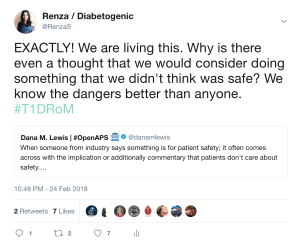
I say this without an ounce of disrespect, but when a device company or HCP implies – intentionally or otherwise – that those of us using a DIY system are being reckless and being unsafe, I find it insulting, and a little disingenuous, because any conceivable hazard is highest to those of us who have the devices stuck to our bodies, and using an algorithm that decides how much insulin to push into our bodies.
I feel much safer Looping that I did pre-Loop. Scary hypos are a thing of the past. My glucose levels sit in a straight, tight line for most of the day instead of the rollercoaster I was used to that would send my mind into a permanent state of fuzziness. I am not running low overnight, only finding out for just how long when I finally wake in the morning and see my Dex trace below the red line for hours and hours and hours without my knowledge. My A1c is in the range that means (allegedly) I am least at risk for developing diabetes complications.
I honestly don’t know how I can be any safer while living with a health condition that throws so many unsafe things at me!