
You are currently browsing the category archive for the ‘Community’ category.
Happy Diabetes Awareness Month! We don’t really celebrate it in Australia, reserving our energies and efforts and enthusiasm for World Diabetes Day. I always thought it was a US thing (where it’s called National Diabetes Awareness month or #NDAM), but it seems that more and more countries around the world are celebrating, and who am I to not jump on a bandwagon? Plus, as I write this, I’m in a café in SoHo New York, so joining the NDAM party makes perfect sense to me!
The concept of awareness raising of health conditions is a really interesting one and has puzzled me a little for some time. Plus, it can be fraught with a lot of potential landmines. When it comes to the huge issue of diabetes, we get into criticisms of awareness initiatives being too niche and ‘exclusive’ (such as this one and this one) or too broad.
In my role at Diabetes Australia, we do awareness raising all the time. Our main efforts are around National Diabetes week, and perhaps the campaign of which I’m most proud is the three-year drive highlighting the importance of diagnosing diabetes early for both T1 and T2 diabetes. I like that our campaigns have calls to action – they’re not airy-fairy ‘tell the world about how hard my life is with diabetes’, but campaigns that have meat on their bones, with a strong ‘why’ behind them.
Why do I think that is important? Because I honestly don’t think that there is appetite from people outside the diabetes world to truly understand the intricacies of day-to-day diabetes. I don’t have a clue what the day of a person living with a chronic condition such as MS or Parkinson’s is like. And I don’t think it is all that necessary for people not living with diabetes to understand what it feels like when my glucose levels are 25mmol/l.
With the month all of a few hours old, social media pages are already awash in blue. The enthusiasm on day one is a powerful force. But I wonder how far outside the diabetes echo chamber that force extends. Are we reaching people who don’t know anything about diabetes? And will it compel them to find out more? Or do they scroll by and not even really clock what they have seen, because perhaps the topic is not really all that relevant?
I am sure that this blog is primarily read by people who are in some way connected to diabetes, and I would expect more skewed towards people affected by type 1 diabetes. I guess that makes sense – when I read diabetes blogs, I want to hear and read about people whose experiences mirror my own.
I would never, ever regard what I am doing as awareness raising. I’m telling my story to people whose awareness of diabetes is already incredibly heightened.
So, it surprises me when events, activities and campaigns generally consumed by people already affected by diabetes are seen as awareness raising. How aware do we need to be? If you’re at an event where the people on stage are all people with diabetes telling their life story, I think you can be pretty sure that most, if not all, of the people in the audience with you either also have diabetes, have a loved one with diabetes or are a healthcare professional working in diabetes.
Diabetes tweetchat contributors are always people affected by diabetes; webinar viewers are too. Sure, participants may learn something new, but has the cause of diabetes been elevated to new people?
I am all for events and activities that celebrate people with diabetes and give us a platform to share our stories. But I think we have to be sensible when we think of what they are actually achieving. I listen to diabetes podcasts and read diabetes blogs. I see all of this as a form of peer support – a way to connect with my tribe. It makes sense to me to use the limited time and mental bandwidth I have to enhance my own diabetes.
I think that awareness raising initiatives – whether it be awareness months or weeks or days, or smaller events – usually serve the community that they are speaking about. There is nothing wrong with that. In fact, there are huge benefits. Learning from others as they offer up wisdom of their tips and tricks for navigating the difficult, mundane or even amusing aspects of diabetes is brilliant. It can be validating (‘Oh, I’m not the only one who does <enter non-compliant behaviour>’) and it can help us remember that we don’t walk this diabetes path alone.
This is how I have come to see these sorts of social-based activities. Awareness raising – to those unaware of diabetes? Maybe not. But I still believe that any opportunity to hear the voice of people living with diabetes is a good one. And any change to connect with our tribe, to feel like something bigger than our own diabetes world, is great.
So, this November, as my socials continued to be flooded in blue, I’ll be thinking of it as diabetes connections month and am looking forward to seeing how my diabetes tribe around the globe is talking about their own diabetes. We’re already diabetes aware enough!
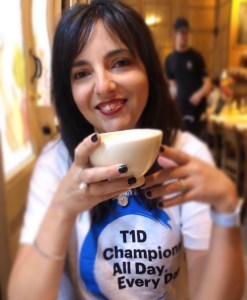
More than happy just raising a cup of coffee!
One of the many highlights for me at last week’s EASD meeting was the satellite event about DIYAPS. It was a Hacking Health event, co-organised by the OPEN Project consortium and promised to highlight the perspective of the #WeAreNotWaiting movement through the eyes of people with diabetes, researchers and clinicians.
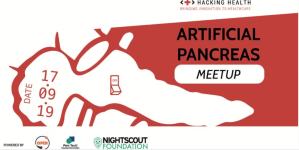
It was standing room only, with the event having sold out a few days earlier. I was a little late (I had to present at an event involving early researchers and PWD) so unfortunately missed the always brilliant Dana Lewis kick off the event.
If you ever need someone to warm up an audience and set the scene about the DIYAPS movement, Dana is your person! I have seen her present a number of times now, and always pity anyone who shares the stage with her. Her presentations are always enthusiastic, articulate and engaging, and leave the audience wanting more.
I followed her talk on Twitter as I was in the cab from the EASD conference centre to the Centre Cívic Sagrada Família (bonus of offsite events is actually seeing some of the tourist attractions the city has to offer!) and could see that the audience was enchanted and galvanised with her talk.
The program was packed – and provided a balanced view of not only people using the tech (because honestly, sometimes it can sound like we have all drunk the Kool-Aid!), but also about DIYAPS in clinical practice, and research settings, as well as a session on medical ethics.
There were many stand out moments for me, but perhaps the one that stands out the most was from paediatric endo, and fellow Looper, Katarina Braune where she was able to distil DIYAPS into this single sentence (as tweeted by another Looper, Andrea Limbourg):
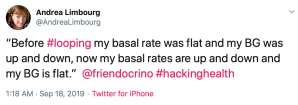
Perfect, perfect summary of looping!
We also heard from Roman Hovorka who presented on the experience of developing the Cambridge closed loop system (CamAPS). Anyone who has been following artificial pancreas technologies and research would know of Roman. I’ve heard him speak a number of times at conferences around the world and have always been grateful for his passion and dedication to advancing technologies to benefit people living with diabetes. So, it was a little surprising that I found his talk a little challenging.
One of the things that I have always admired about the DIYAPS movement is that there is a strong sense that our chosen DIY path sits neatly alongside commercial systems and regulatory bodies. While we may not choose or want to use a commercial system (and, of course, are not waiting for them), that doesn’t mean that there is disdain or derision of other options. In fact, there is admiration and gratitude for industry working to provide this technology to a broader audience. We know that not everyone wants to build their own system, and many ARE happy to wait for a system that will be in warranty, and comes straight out of a box, rather than cobbled together.
I say this knowing that same courtesy is not always afforded to the DIY world from industry, and I can point to every single time someone from a company developing a commercial automated system claims their systems are safe – implying that those of us in the #WeAreNotWaiting world are all cowboys not concerned with safety.
I would so have loved to have heard Roman really highlight all that his system has to offer, and what sets it apart from DIY systems, and how it is one more choice that will be available to PWD, rather than put down the DIY movement. I am all – ALL – about choice and love the idea that with this choice comes a better chance for us to find the tech that works best for our personal circumstances.
We don’t need to be defensive about ‘the other’ in diabetes technology. We need to acknowledge that there is no one right, perfect choice. DIY is certainly one of those choices, and as we heard sprinkled throughout the day, has been life changing for many people. But it is not the only option out there, and few people in the DIYAPS world would even suggest that it is. I guess perhaps that is what challenged me about Roman’s talk – he did seem to throw DIYAPS under the bus a little when it would have been far better to suggest it was just another bus route people may like to take.
So how could this event have been better? Well, I wish it had been part of the official EASD program. There is a lot of opportunity for HCPs to learn from the user-led tech community, and this extends to technologies and treatment options beyond DIYAPS. Reinforcing what is an overarching fact of life with diabetes – that all diabetes is DIY – is important for all working in diabetes to remember.
While DIYAPS technology may be at a far spectrum of the whole DIY diabetes idea, having HCPs and researchers listen to just how diabetes impacts on daily life, and the decisions we need to make is critical in their approach working with us.

Panel session to finish the day.
DISCLOSURES
My airfare and part of my accommodation to attend EASD was covered by Lilly Diabetes so that I could participate in the DOCLab advisory group meeting which took place all of Monday. Another night’s accommodation was covered by Novo Nordisk as I attended their advocate meeting on Digital Health Technologies.
I am part of the OPEN Project Consortium. I did not receive payment for my involvement in the Hacking Health event.
While my travel and some of my accommodation costs have been covered, my words remain all my own and I have not been asked to write or speak about any of the activities I attended, or anything I have seen at the conference. As ever, profanities are also all mine.
The other day, I was standing in a noisy café, waiting for my take away coffee to be ready, not really paying attention to anything, other than a tree I could see that had what must have been Melbourne’s first promise-of-spring blossoms. Suddenly, a loud noise dragged me from thoughts of warmer weather and not needing to wear fifty layers of black to leave the house. The man standing next to me turned his head and I caught him looking at my phone.
‘Your Dexcom is wailing,’ he said to me.
‘Indeed it is, needy little shit,’ I replied, after I got over my surprise at his comment. Usually people just look annoyed at the disturbance.
‘So…you’re one of us?’ I asked him, pointing to the pump I’d just noticed on his waist band.
‘Yep. Hi! I’ve never, ever just come across another person with diabetes in a café or just out and about,’ he said. ‘Have you?’
‘Ridiculously regularly in the last few of months,’ I replied, and told him about the mum of a young woman with diabetes at the airport lounge, the security guard at the airport in Amsterdam who referred to me and my travelling companions as a ‘diabetes club’, the woman talking about Libre in my favourite local café, and now him in this café near work.
‘Maybe stay away from airports and cafes. That seems to be where PWD congregate,’ he helpfully suggested.
At that exact moment, my pump beeped its on-the-hour alert that it was sitting on a temp basal rate.
My diabetes-in-the-wild mate looked at me, his eyes narrowing. ‘Now your pump is beeping. Oh – are you looping?’
I was more than a little startled at that one. The noise my ancient Medtronic makes on the hour is not loud at all – three little beeps to gently remind me that a temp basal rate has been activated by Loop. ‘Wow,’ I said. ‘Your hearing is next level. And yes. I am.’
We did the usual diabetes stat check: length of time with diabetes; age of diagnosis; things that drive us nuts; inventory of our diabetes devices; a couple of amusing diabetes anecdotes. ‘I pulled my pump line out on the door handle of my office today,’ he said. ‘Have you ever done that?’ I laughed. ‘No – don’t be ridiculous! I am a smart and clever and always paying attention person with diabetes. Of course I’ve never done that… And by never, I mean once every couple of months for the eighteen and a half years I’ve been pumping.’
My Dexcom fall rate alert wailed again. ‘I’m ignoring it. Hoping it will go away,’ I sighed. ‘Yeah,’ he said. ‘I’ve been doing that with diabetes for the last 32 years.’
We looked at each other and mirrored in his face was the same expression I knew I was wearing – slight defeat, but also defiance. It’s the default expression that so many of us living with diabetes wear when we are feeling a little over it all.
The barista handed me my coffee, and juggling my phone and coffee and umbrella, I turned back to friend. ‘Lovely to chat,’ I said to him. ‘Always nice meeting one of my tribe.’
‘Tribe? Is that what you said?’ he asked.
‘Yep,’ I said, a familiar feeling washing over me: The ease and comfort of talking with someone who absolutely understands. In the place of making our own insulin, we make connections. And I was reminded, once again, how these chance encounters, along with the time I get to spend with my friends who have diabetes, sustain me.
‘Find your tribe. Love them hard,’ he said. ‘Isn’t that how it goes?’
I nodded and took a deep breath, raising my coffee up to him as I started to leave the café.
‘Yes. That’s exactly how it goes.’

Blossom…
One thing that is somewhat of a consolation while dealing with jet lag, is that while I’m not sleeping in the middle of the night, Twitter is right there keeping me company! There is always someone from the DOC up and ready for a chat. And if I don’t feel like chatting (because honestly, at 3am when I’ve not had enough sleep, stringing words together is a challenge), there are always things to read.
And that is great.
Also great is when people jump on board to support each other, or cheer when others are involved in an exciting initiative. (Seeing people in the DOC welcome and embrace the amazing young advocates from the Philippines as they have launched their online activities is one such example.) There is comfort in the reliability of the way people respond in those situations.
But then there is frustration in the reliability of how people react and complain about being left out when it seems some folks in the DOC are doing something. It may be an event, a conference, or people just doing stuff like starting peer support campaigns. It could be people giving talks, writing pieces or coming together on advisory committees.
I wrote a whole thing about this at 3am. Words were strung together, and I started getting strung out, so I deleted it after wise counsel from a Twitter friend who reminded me that sometimes just writing stuff down is therapy enough. (Thank you to that wise person.)
She is right.
What is also right is that there is an Effin’ Birds moment for everything in life. Even when you don’t think there is and you put a call out, the nice folk at Effin’ Birds direct you and then deliver. And it’s perfect.

Spending time surrounded by diabetes can be overwhelming and that is never more so than at a conference like ADA. It is huge – there are thousands and thousands of people, an exhibition hall with stands from device and pharma companies that messages about diabetes that are all tied up in statistics and words (and not really about people), and for every talk that shares hope and promise, others that focus on despair.
But it’s easy to step away from that – even if just for a moment – and turn to a member of your tribe. Because then…
…not once did I feel despair.
…not once did anyone pass judgement about another’s diabetes.
…not once did anyone make me feel afraid.
…not once did anyone attribute blame or shame.
…not once was anyone expected to explain themselves.
…not once did I feel stigma.
…not once were the words spoken anything other than real and authentic.
…not once did someone ask another person about their glucose level or A1c.
…not once did someone suggest that anything to do with diabetes was someone’s fault.
…not once did I feel overwhelmed or overcome.
…not once did someone make me feel that I was not enough.
…not once did someone look at another PWD to suggest that they were failing.
…not once was fear used as a motivator.
…not once were we made to feel sorry for ourselves.
…not once did my life feel like it should be measured in nothing more than numbers.
…not once did we call each other inspirational for just living with diabetes.
…not once did anyone do anything other than cheer another’s efforts.
…not once did anyone overreact if they noticed another PWD was low.
…not one did I feel that I was a burden.
…not once did I feel that I had to be a superhero.
…not once did I feel alone.
…not once did anyone demand that their way of doing diabetes was the better way.
…not once was diabetes the overall focus.
There are times that diabetes does its best to make me feel a burden, or that I am simply not enough. But not once – not ever – when I am around people like this do I feel anything other than whole.

Find your tribe
Find your tribe…
Last Thursday morning, still wracked (and wrecked) with jet lag from having just returned from ten days in Europe, I boarded a flight to Manila. I would be co-facilitating a workshop for people with diabetes from across the Philippines about how advocacy, community and engagement. If I’m completely honest, I had no idea what was in store for me.
I knew that the PWD who would be attending had all been through a diabetes camps program in the Philippines. They were all young and very eager to step up as advocates. They were the reason the workshop was happening – they realised it was time to elevate the PWD voice in advocacy efforts in their country and they wanted some help in doing just that.
And so, the idea of a workshop was conceived, and the two facilitators were flown in from opposite sides of the planet to pull it all together. Enter me and the Grumpy Pumper (who for once had to travel further than me and was more jet lagged than me).
As the facilitators, we were there to talk about some examples of effective grass roots advocacy, talk about how engagement with other stakeholders is important, and highlight just why the voice of those living with diabetes is critical when it comes to lobbying. We had an vague outline of just how we thought the workshop would run, but we really wanted to ensure that the attendees could shape it the way they wanted, asking relevant questions and walking away with information that would help them.

Once the workshop started, it was very, very quickly apparent that we already had a thriving, dynamic and enthusiastic community in the room. They just weren’t seeing themselves that way. Over the course of the workshop, we saw the ten PWD realise that their own stories and voices are important and have real currency, and they are an unstoppable force when they came together. If ever I needed a reminder of the power of community, I’d have found it there in that room in Manila!
There will be a lot more about the weekend workshop in coming days. I’m still getting my head around it all and am not really sure what to write just yet. It may take me some time. What I do know is that the DOC now has some new voices. Their perspectives will be different to those we often hear about, and that diversity is always good in a community.
So, while I’m getting my words together, get to know these amazing young advocates. They’re on Facebook here; Twitter here; and Instagram here.
DISCLOSURES
Novo Nordisk covered costs for the advocacy workshop. Grumps and I were invited to facilitate the workshop as part of our involvement in the Novo Nordisk DEEP Program. Novo covered by flights, accommodation and ground transfers.





 Diabetogenic