
You are currently browsing the category archive for the ‘Community’ category.
For more information (all Australian sites):
Diabetes conferences and scientific meetings in 2020 have looked very different than in previous years. It looked as though we were off to a flying start with a successful ATTD in Spain back in February. But not long after all the attendees returned to their corners of the globe, the world turned upside down and decided that, along with everything else, in-person meetings were done.
Major professional conferences such as those run by ADA, DUK, EASD, ISPAD, ADS & ADEA and IDF have all either happened, or will be happening, virtually, with a Zoom (or other) platform being where we meet, rather than a massive conference centre in a major city.
As ever, I search for a silver lining and if there is one it is this: the pivot to virtual conferences means that some of the main barriers in the way preventing PWD attending diabetes conferences are somewhat reduced. With travel, accommodation and a lot of the other expenses out of the way, it may be easier for advocates who would like to attend to find their way in. Let’s look at that as the disruption we needed to have to get PWD flocking to meetings in droves.
There is still the matter of registration passes, and we know that is not always the easiest thing to overcome. The registration fee is significant, and some conferences only allow HCPs and researchers in. Usually, press passes provide a way to get passed security, but they require letters of assignment (sometimes from diabetes organisations who ask PWD to act as ‘on the ground’ reporters), or other criteria be met. And, of course, there are invitations to attend satellite events extended from device and drug companies to some advocates. While there is often criticism at these methods, they have meant that there are PWD at conferences, many of whom provide information back to the community.
At ATTD, there was a new way in. Advocacy group #dedoc° launched a new program, #dedoc° voices, which you can read all about here. For the pilot of the program in Madrid, the diabetes advocates whose applications were successful had access to all parts of the meeting.
#dedoc° voices is happening again for EASD (coming up next month), and it’s not too late to apply. And as an added bonus, successful applicants will also receive registration to the ISPAD conference in October. ISPAD is the International Society for Pediatric and Adolescent Diabetes, so if you are a parent of a kid with diabetes involved in advocacy and peer support, you may be super keen to attend this one.
To apply, go here. #dedoc° voices is open to PWD now, so if you have always wanted to attend a major diabetes conference, there is nothing stopping you from applying, right now. Any one from anywhere around the world can apply – the only consideration is how you’ll manage time zone horrors if you don’t live in the same zone as the conference. (But please don’t come crying to me about that – I’ve spent the last six months settling in for hour long meetings hosted out of Europe of the US which begin long after sunset and involve perky people just waking up while I yawn and struggle not to fall asleep in my Zoom square!)
What are you waiting for? Apply now and come be a part of one of the biggest diabetes meetings in the world. I promise there will be lots of other PWD there for you to (virtually) meet up, and share ideas with. Come say hi!
Disclosure
I am an advisor to the #dedoc° voices program. I do not receive any payment for this role. 
At the best of times, I’ll celebrate any kind of anniversary, but it seemed even more important to acknowledge my ‘loopiversary’ this year in what can really only be termed as the most fucked of times. Last week, I clicked over three years of looping, a decision that remains the smartest and most sensible I have ever made when it comes to my own diabetes management.
In reflecting just how Loop has affected my diabetes over the last three years, I’ve learnt a few things and here are some of them:
- The words I wrote in this post not long after I’d started looping are still true today: ‘…this technology has revolutionised every aspect of my diabetes, from the way I sleep, eat and live. I finish [the year] far less burdened by diabetes than I was at the beginning of the year.’
- The #WeAreNotWaiting community is but one part of the DOC, but it has provided the way forward for a lot of PWD to be able to manage their diabetes in ways we never thought possible.
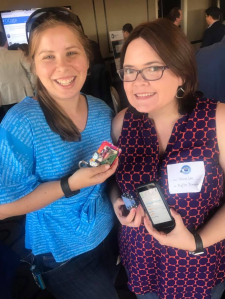
- Even before I began to Loop, the kindness and generosity of people in that community was clear. I took this photo of Dana and Melissa, two women I am now lucky to count amongst my dearest friends, at an event at ADA, just after they had given me a morale boosting pep talk, promising that not only could I build loop for myself, but they would be there to answer any questions I may have. I bet they’re sorry they made that offer!
- Loop’s benefits are far, far beyond just diabetes. Sure, my diabetes is easier to manage, and any clinical measurement will show how much ‘better’ I am doing , but the fact that diabetes intrudes so much less in my life is, for me, the real advantage of using it.
- That, and sleep!
- I get ridiculously excited when other people make the leap to looping! I have watched friends’ loops turn green for the very first time and have wanted to cry with joy because only now will they understand what I’ve been ranting about. And experience the same benefits I keep bleating on about.

- It’s not for everyone. (But then, no one said it was.)
- You get out what you put in. The more effort and time and analysis you put into any aspect of diabetes will yield results. But with Loop, even minimal effort (I call the way I do loop ‘Loop lite’) means far better diabetes management than I could ever achieve without it.
- It took an out of the box solution to do, and excel at, what every piece of commercial diabetes tech promises to do on the box – and almost always falls short.
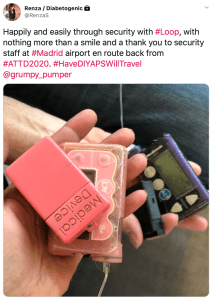
- It’s amazing how quickly I adapted to walking around all the time with another but of diabetes tech. My trusty pink RL has just been added to the phone/pump/keys/ wallet (and, of course, mask) checklist that runs through my head before I leave the house.
- Travelling with an external pancreas (even one with extra bits) is no big deal.
- I was by no means an early adopter of DIY tech, but I was way ahead pretty much any HCPs (except, of course, those living with diabetes). The first talk I gave about Loop still scars me. But it is pleasing to see that HCPs are becoming much more aware and accepting of the tech, and willing to support PWD who make the choice to use it.
- The lack of understanding about just what this tech does is astonishing. I surprised to still see people claiming that it is dangerous because users are ‘hacking’ devices. Language matters and you bet that this sort of terminology makes us sound like cowboys rather than having been thoughtful and considered before going down the DIY path.
- The lengths detractors (usually HCPs and industry) will go to when trying to discredit DIYAPS shouldn’t, but does, surprise me. The repeated claims that it is not safe and that people using the tech (for themselves or their kids) are being reckless still get my shackles up.
- Perhaps worst of all are those that claim to be on the side of those using tech, but under the guise of playing ‘devil’s advocate’ do more damage than those who outwardly refuse to support the use of the technology.
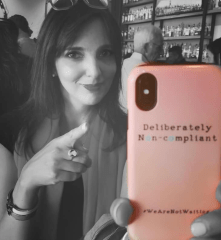
- The irony of being considered deliberately non-compliant when my diabetes is the most compliant it ever has been hurts my pea-sized brain. regularly.
- There is data out there showing the benefits and safety of looping. Hours and hours and hours of it.
- My privilege is on show each and every single time I look at the Loop app on my phone. I am aware every day that the benefits of this sort of technology are not available to most people and that is simply not good enough.
- Despite all the positives, diabetes is still there. And that means that diabetes burnout is still real. But now, I feel guilty when feeling burnt out because honestly, what do I have to complain about?
But perhaps the most startling thing I learnt on this: The most variable – and dangerous – aspect of my diabetes management has always been … me! Loop takes away a lot of what I need to do – and a lot of the mistakes I could, and frequently did, make. Loop for me is safer and so, so much smarter and better at diabetes than I could ever hope to be. I suspect that as better commercial hybrid closed loop systems come onto the market, those who have been wary to try a DIY solution will understand why some people chose to not wait.
And finally, perfect numbers are never going to happen with diabetes. But that’s not the goal, really is it? For me, it’s about diabetes demanding and being given as little physical and emotional time and space in my life. With Loop, sure numbers are better – but not perfect – and I do a lot less to make them that way. It took a system that did more for me, keeps me in range for most of my day, and has reduced the daily impact of diabetes in my life to truly understand that numbers don’t matter.
This blog has been quiet for the last couple of weeks because, honestly, there is nothing that I had to say that was of any value. Instead, I’ve been listening, learning, talking with friends and family, crying with friends, having difficult conversations with people. And feeling uncomfortable. I’m learning to not fight that discomfort, but instead examine it and work out how I can be involved in change.
Today, I’m dipping a toe back in slowly, and sharing this from New Yorker Cartoons (maybe this blog really is going to become nothing more than an appreciation page of New Yorker Cartoons and Effin’ Birds). This cartoon spoke to me. Because: tone policing.

Recent New Yorker Cartoon by Jason Adam Katzenstein. (Click for source)
I write about being tone policed in the healthcare space, and that is what I am writing about today. It’s happened for as long as I’ve spoken up about my experiences of diabetes and my thoughts and ideas about healthcare. I’ve been called aggressive so many times by HCPs who have not liked it when a mere ‘patient’ has suggested that they are being damaging to people with diabetes in the words they are using to talk to and about us.
The bolshie nuns who taught me at secondary school taught me that when women are accused of being aggressive (or strident), it is usually because we are being assertive. I’ve come to learn that it’s not just women. It’s anyone who has, for too long, been expected to just take what is dished up – and to accept it with gratitude.
Being assertive, being aggressive, being challenging and saying enough is enough should not result in being told to tone down. Or to be excluded from discussions unless we agree to be more moderate. Or more respectful. When that respect is truly a two-way street, then let’s talk about that. But for as long as power imbalances are at play, and HCPs insist on speaking on behalf of us, or only agreeing to speak with us if they like what we are going to say; or when HPCs feature more in diabetes campaigns because they insist on centring themselves rather than actual people living with the condition…well, then we don’t have true two-way respect.
Our diabetes community is not immune from tone policing each other. It’s happened to me. I continue to listen to type 2 diabetes voices because I can never expect to understand what they are experiencing in our community unless they tell me. It may be uncomfortable for me to hear – but that discomfort comes from a place of my complicity. It is not my place to tell them to moderate the way they are speaking about their experiences, just because it makes me feel prickly. But it does happen. In the timeline of my involvement in the diabetes world, I know that when I was first diagnosed, I contributed to the stigma many people with type 2 talk about, and then, as I learnt more, I moved to being quiet about it when I saw and heard it – even though I disagreed with it. Now I am trying to be a better ally and calling it out when I see it. And shutting up and listening and accepting what people with type 2 say.
We learn when we listen. We learn when we are open to accepting that we do not have all the answers. We learn when we stop being so centred on our own experience and try to turn the spotlight onto ourselves when instead we should be shining it on others.
We learn when we don’t tell people how they should feel or how they should speak.
One of the things the diabetes community does best is come together in tough times, and this new initiative from JDRF and Beyond Type 1 is a stellar example of how it can be done. JDRF and Beyond Type 1 formed an alliance last year, and have put together a terrific site providing important, up-to-date information and advise about coronavirus and diabetes.
But this is initiative goes way beyond just two diabetes organisations. In fact, over one hundred diabetes organisations, charities, and companies are helping to spread the word and share the information via their networks
Charities and diabetes organisations from Australia, USA, Canada, Italy, Chile, Portugal, Mexico, Bulgaria, Germany, India, Cyprus, New Zealand, Spain and other countries too are represented. I’m thrilled that Diabetes Australia is one of the community partners on the ever-growing list!
International organisations such as Life for a Child, ISPAD, IDF, NCD Alliance as well as industry partners have also rallied together, joining the other groups. This is big. Big! Huge!
The information on this new site is simple and clear. And it’s available in English, Spanish and Portuguese.
Plus, the advice is all practical and sensible. We might, in ordinary times, think that practical and sensible is boring, but I know it’s something I’m craving at the moment. And I’m also craving information that cuts through all the overwhelming noise and tells me exactly what I need to know.
This site does that.
Massive, massive kudos to JDRF and Beyond Type 1 for getting this initiative up and running. And well done to all the organisations who have happily supported and shared it. This isn’t about ownership and needing to be the holders of all information. It’s about ensuring people with diabetes have access to what we need to know, and what can help and support us. That’s only a good thing, right?
Click on the image below to be taken straight to the site. And stay safe. That’s really what we all want and are hoping for.

DISCLOSURE
I am employed by Diabetes Australia. I am on the Beyond Type 1 Leadership Council.
Until about three weeks ago, I’d never seen the words ‘social’ and ‘distancing’ in the same sentence. And then, suddenly, we were all being urged to practise this new form of keeping away from people.
What became apparent very quickly, however, was that social distancing could very easily lead to social isolation and that is not what the aim of keeping away from others was all about. Rather, it was about being physically distant from others. No more physical hugging, or cheek kissing. No more pats on the back or hand shaking.
But stopping physical contact doesn’t mean becoming disconnected to people. In fact, if there was ever a time that we need to feel connected to people, it’s now. And for me, I have never needed my diabetes tribe more. I think that a number of others might just be in the same boat.
I can’t begin to count the number of times I’ve spoken or written about how much I need my friends living with diabetes to help support my daily life with diabetes, or how they are an essential part of my diabetes management tool kit. In fact, I use this tweet so frequently when I am taking about diabetes peer support because it perfectly illustrates just how essential it is to me.

At the moment, as were locked in our homes, maintaining connections to others is far more difficult. My sister has just returned to Melbourne after over a year living on the west coast and apart from sitting in her garden while she stood at her front door, I’ve not seen been able to welcome her home. I’ve not hugged my parents for weeks, again seeing them only from out the front of their house as they stood on their veranda.
But when it comes to our diabetes peers, I’ve found it a little easier. Our DOC lives over the interwebs. We are physically distant pretty much all the time because most of the people that I spend my time talking to are literally in another country! I may not get to see my friends at conferences and meetings much in coming months, but that hasn’t stopped the messages and photos and videos and video calls.
Each night, before I turn my light out, I message friends to check in to see how they are. It takes nothing to send a quick message but the reassurance that there are others in the same boat, feeling the same fears and frustrations seems to calm and alleviate some of my stresses. And when I wake up there are always messages from friends who were awake while I slept checking back in on me. There are group chats with discussions that range from the incredibly serious to the (thankfully and much needed) absurd. Memes fly around and eyes are virtually rolled at some of what we are seeing online. And sometimes, but only sometimes, we talk diabetes…
I know that pretty much everyone around the world right now has some sort of concerns about COVID-19. Diabetes adds extra to that (because diabetes is a shit and just makes everything more difficult!). And that means that we want to unite with those who understand the extra bit of stress or pressure or anxiety. Find your tribe. And love them so, so hard. (Just do it from a distance at the moment….)

The other day, I went to a local pharmacy to buy some pump lines. There is one pharmacy in my neighbourhood that usually has insulin pump consumables on the shelf, so I don’t need to order them in. I just pop in when it’s time to top up my supplies and get what I need. I asked for a box of the lines I use. ‘There are two on the shelf,’ said the sales assistant. ‘Do you want both? You probably should stock up.’
‘No thanks,’ I said to her. I only ever buy one box at a time, usually when I am down to my last three or four lines. With the new box, I would easily have a six to eight-week supply.
‘Oh,’ I said to her. ‘You really don’t need to encourage people to buy more than their usual order. We don’t have shortages – that has been confirmed by Diabetes Australia and the Department of Health. Suggesting people stockpile is not a good idea at all.’
Are you stockpiling, or thinking about it? If so, I’m ask you to please reconsider.
I get that these are confusing and stressful times. I haven’t seen a roll of loo paper on the shelves at my local Woolies for weeks now. Other pantry staples are in high demand. And since the weekend, fresh fruit and meat sections have been almost stripped bare. Despite being told that we don’t need to panic buy, we’re seeing this behaviour and it is causing a great deal of distress to a huge number of people.
The last thing we need is for there to be the same situation when it comes to diabetes meds and supplies.
Here’s the deal: we are okay. There are no shortages. We don’t need to panic and stress. That has come directly from the Department of Health who has oversight of all drugs and NDSS supplies. It has also been communicated from Diabetes Australia*.
Where things have the potential to go the way of loo paper is if people suddenly start changing their buying behaviours. Then we have problems.
Think about it this way: before coronavirus, when was the last time you couldn’t find loo paper if you needed it? Never, right? And now, because there was some weird idea that toilet rolls were going to run out, people bought packs and packs of it. I know people who have hundreds of rolls of loo paper stocked up in their houses at the moment. I also know people who have been down to their last roll and are desperately trying to find kindly neighbours who will happily and readily spare a square (or two).
This is what happens when people change their buying behaviour and we really don’t want that to happen with diabetes medications and supplies.
WHAT YOU CAN DO
Be sensible! And don’t change from what you usually do.
What is your usual buying pattern? For me, I have always called in my insulin prescription when I open my second to last vial of insulin. That has been my pattern for years.
I buy pump consumables when I am down to the last few of each. A box of lines lasts me around six weeks; cannulas longer because I tend to reuse them a couple of times. I top up blood glucose strips when I’m down to half a box. (A box lasts me forever because I really only use them to calibrate, and I am rather lax at that).
The only, only thing I have a ridiculous stockpile of is lancets. Because: who changes lancets? And the only reason I have that stockpile is because every new meter comes with about ten of them. Plus, I think I still have the same box I bought 22 years ago at diagnosis…
I am making no changes to my buying pattern and behaviour and I would urge everyone to do the same. If people just keep on keeping on, we will not have shortages. If people start to make changes and panic buy, we could be in situation loo paper.
OTHER CONSIDERATIONS
We do have limits on our NDSS usage. I know I rarely think about this, because I never reach mine. I remember needing a special exemption when I was pregnant because I was doing a heap more BGL checks each day, but other than during that time, I have never needed to worry about getting to my limit.
ALL drugs and diabetes supplies have ‘use-by’ dates. The shelf life on some items (such as sensors) is shorter that on others. If you stockpile, there is a good chance that what you have hoarded will be out of date by the time you get through your supply. That will mean that when you eventually go to use them, they are not covered if something goes wrong (such as sensors not lasting their full time etc).
Also, if you reach your limit, that could mean that you are no longer able to access subsidised product, and you may be required to pay the full amount for them. For those of us who remember the days before pump consumables were on the NDSS, it suddenly makes running a pump VERY expensive…
PLEASE THINK OF OTHERS
When I left the second box of lines of the shelf at my pharmacy last week, I did that knowing it was likely that someone else would be in soon after needing the same lines. If you order two or three times more than usual, someone downstream is going to potentially have trouble accessing what they need when they need it.
Some people can only afford their diabetes supplies on pay day, or when they are running really low on supplies. They rely on being able to access things WHEN they need them and cannot stock up beforehand. Please be considerate of people in all situations.
If we all are sensible about this, we can completely avoid supply problems.
WHAT TO DO IF YOU ARE ALREADY STRUGGLING TO GET WHAT YOU NEED
Contact the NDSS (1800 637 700) with every single detail of what is going on in your situation. Provide details of the access point (usually a pharmacy) that has not been able to provide you with what you need. How long has this been the case? What are you trying to purchase? Have you tried somewhere else locally? (Remember that most pharmacies do not keep insulin or NDSS products in stock and they need to be ordered in.)
Also, please, please, please do not engage in online speculation of shortages online. This is what causes panic! If you have a personal experience, contact the NDSS!
TWO FINAL THINGS
- Keep washing your hands!
- IF YOU ARE STOCKPILING LANCETS, STOP IT. STOP IT NOW!! You KNOW you will never use them! And no one else will either, so they will haunt and mock you from your diabetes supplies cupboard/drawer for the rest of your days.
*DISCLOSURE
Yes, I work for Diabetes Australia, however I am not writing this because of that and have not been asked by anyone at Diabetes Australia or the NDSS to write this.
I am writing it because I am a person with diabetes who does not want to find herself struggling to access the meds and supplies that I need to stay alive, nor do I want any of my diabetes brothers or sisters to find themselves in the same situation.
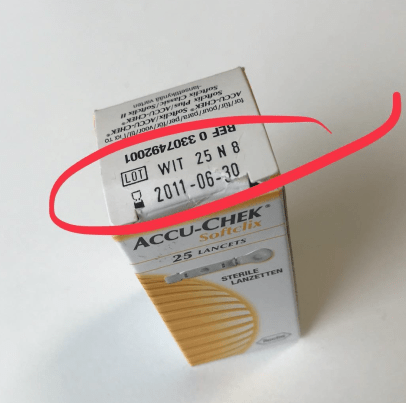
No need to stockpile lancets. Or anything else!
I’m not in lockdown, but I am spending more time at home, and definitely avoiding crowded spaces where possible.
Cabin fever is going to be something that many of us have to deal with – more rapidly for some. I don’t really like being cooped up, and need to have things to keep me busy and entertained. So here are just a few things I’m doing to keep me occupied:
- Baking…lots and lots and lots of baking (So, if I can be selfish, I would ask people in my local area to please not stockpile all the flour, sugar and other baking necessities, because one of my coping mechanisms is getting into the kitchen and creating cakes, biscuits and slices!!)
- Homemade bread – this is new for me, but it is such a lovely and relaxing and rewarding thing to do
- Reading books that I have already read and love – comforting and familiar is good at the moment, but I’m keen for suggestions
- Netflix binges (Anyone watched Cheer?)
- Watching Nigella re-runs and getting cooking ideas
- Going for walks in the park with the dogs, and just hanging out with the pups. (They’re fun and don’t keep telling me how at risk I am)
- Cleaned out the pantry. (I know: odd, but it was therapeutic and very satisfying!)
- Effin’ Birds. Just do it – it will make you feel better!
I know this seems somewhat frivolous considering what is going on in the world, but sometimes, a distraction from the constant stream of bad news, and increasing numbers on a graph is a good idea.
And so, with that in mind, I’ll keep adding to this list, or do separate posts for recommendations. Help me out with book, and tv and movie suggestions. And recipes! Let’s see how people in our diabetes community are keeping distracted in the time of coronavirus.

Baking therapy.
Look what our community did! Here is the just released #SpareARose total for 2020. What a remarkable effort from a remarkable community!
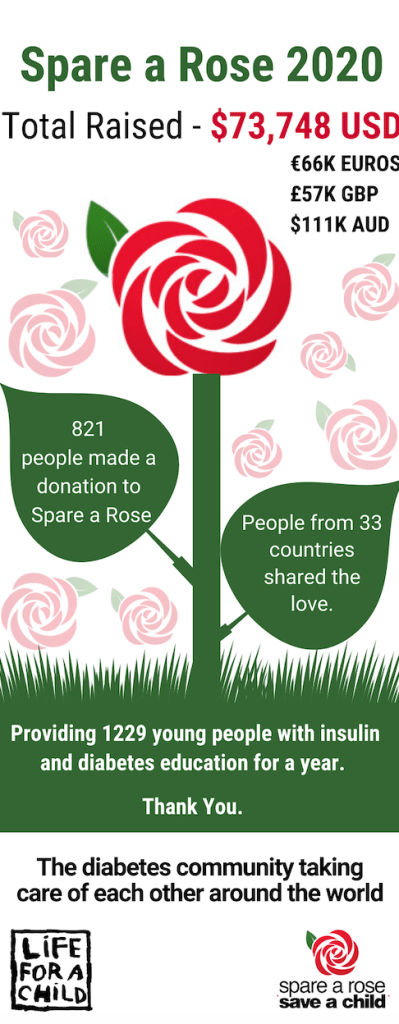
The grand total of USD$73,748 will mean that, through Life for a Child, 1229 children with diabetes in under-resourced countries will have access to insulin for the next year. Amazing!
I guess there’s nothing more to say for this year, other than thank you, thank you, THANK YOU to all who contributed – whether that be through a donation or sharing the campaign.
Spare a Rose, Spare a Child will be back next year. Each year, we promise it will be bigger and better, and I’m sure that will be the case for 2021. Just watch us all go!





 Diabetogenic