
You are currently browsing the category archive for the ‘Awareness’ category.
I’ve just returned from Berlin, where I attended the ATTD Conference for a week of super busy meetings, information gathering, collaborations and advocacy. At every turn, people with diabetes (many attending after being awarded a #dedoc° voices scholarship) were discussing how community advocacy is key to driving change. I heard about remarkable efforts from people across the globe who are genuinely improving the lives of people with diabetes in their part of the world. And when anyone had a question, or asked for advice, people were only too happy to offer and share.
Right now, if you’re in Australia and live with diabetes, especially type 1 diabetes, you may have heard the kerfuffle about Novo Nordisk’s Fiasp being withdrawn from the PBS after Novo Nordisk made the decision to withdraw Fiasp. The Government can’t compel them to keep it listed.
So what now? Well, now is the time to rally the troops. Already, grassroots advocacy efforts by people in the Australian diabetes community (and friends across the globe thanks to the #dedoc° network) are making a lot of noise. There’s a petition (with over 6,000 signatures) and there have been blog posts. Social media groups are lighting up with comments and questions. This is how a groundswell starts.
You can also get political by reaching out to your local MP. I know that many people think that this is a daunting task, or believe that nothing will come of it. I counter that suggestion by pointing to any significant change in diabetes access in Australia. I’ve been in these trenches for decades now and know the effectiveness of people power. Community advocacy is often the starting point of rumblings that, combined with strong advocacy from diabetes organisations, leads to policy change. I can’t tell you how many letters I wrote back in the early 2000s before insulin pump consumables were on the NDSS. (I thought that the PM and health minister were going to take out restraining orders after I wrote to them both a couple of times each week for three years!) At one point, back in around 2002, I was invited to a meeting with Julia Gillard (in opposition at the time) who asked to speak with a group of diabetes advocates (did we even use that word then?) who had been regularly writing about the cost of pump therapy.
I also think of the incredible community efforts that lead to the Carers’ Allowance being changed back in 2010 so that the parents and carers of children continued to receive payments until their child was 16 years old, rather than being cut off when their child turned ten. Or the numerous letters I wrote, along with thousands of other people, to have CGM added to the Scheme. There have been other issues too – diabetes seems to mean one after another that needs attention.
Right now, the issue is Fiasp and you may be thinking about sending an email, but wondering where to start. Start with your story. Because only you can do that.
You can tell your story and write whatever you feel comfortable – your diabetes may vary and the way you advocate will too. I have some ideas I’m going to share below and I think they are worth considering when you are writing to your local MP. My philosophy is always to keep things short and sweet. I bring the heart with my story and add limited data to win over minds. Hearts and minds remains a central basis to my advocacy ideas. So, if you’re wondering where to start, here are some ideas that may help:
- They don’t know diabetes and don’t know details, so start with the basics and keep it to the point: I am writing about an issue affecting me as a person with diabetes and that issue is the withdrawal of Fiasp from the PBS. Fiasp is the only ultra-rapid insulin available in Australia and there is no comparable and easy swap to be made.
- Be clear about the issue: Fiasp is being withdrawn from the PBS. While it may be available on a private prescription this will make it too expensive for many people with diabetes, meaning a management option is being removed.
- Explain how that impacts you: As a person living with type 1 diabetes, I am required to take insulin every day. Fiasp is the insulin that works best for me and if I am no longer able to afford to use it due to it being removed from the PBS, my diabetes management will be negatively impacted.
- Be clear about your ask: I am asking for you to advise what the Government is doing to address this matter, and how it is working with Novo Nordisk to resolve the concerns of many people with diabetes who are worried we will no longer be able to afford the best treatment option for our diabetes.
Don’t ever believe that you are not going to be part of the movement that makes change. Just a minute in the Australian diabetes community right now is enough to see how a movement has already started. It’s organised and collaborative and the noise is already beyond a rumble. And you can add your voice.
Disclosure
I have worked in diabetes organisation for the last twenty-one years. Recently I joined the Global Advocacy Team at JDRF International as Director of Community Engagement and Communications and until earlier this year I was Head of Community and International Affairs at Diabetes Australia. My words on this blog are always my own and independent of my work and the organisations where I am working. My individual local and global advocacy efforts are in addition to my ‘day job’. I am also Global Head of Advocacy for ##dedoc°°.
Like clockwork, the beginning of February heralded a sea of red in every retail store, with cutesy cupid motives and love hearts adorning shop windows. Valentine’s Day was the next big merchandising opportunity and, friends, it’s time to buy up.
At the same time, the diabetes community also starts to be sprinkled with red – this time red roses. Because once again, it’s time for Spare a Rose, Save a Life. It’s the complete opposite of consumer culture. And it’s something that is very close to my heart.
This year marks ten years since Spare a Rose was first launched by a group of diabetes advocates from the US. The story has been told many times but it’s worth repeating, because it says a lot about this community. These advocates wanted to do something that supported others living with diabetes, specifically those in under-resourced counties. And so, Spare a Rose, Save a Child (now Spare a Rose, Save a Life) was created, with a vision to bring together the diabetes community, uniting in the collaborative goal of supporting those who need it.
The simple equation of ‘sparing’ one rose and donating the $5 saving to a diabetes charity was tangible. That face dollars provides insulin for a month. That’s how it has worked for ten years now. Close to one million dollars has been raised in that time, which is truly remarkable when you think about it. It’s people in the community reaching into our pockets to help make a change.
This year, donations are once again going directly to Insulin for Life, a charity that continues to support people with diabetes in countries where there is most need. Insulin for Life has been running for many years and their work is significant. Last year, as war broke out in Ukraine, the charity was able to rally their networks within days, getting critical diabetes supplies where they were most needed. That support continues, and a big part of that is due to the generosity of the diabetes community getting behind Spare a Rose for Ukraine.
As soon as the war started, the diabetes community were desperately looking at how to help and almost immediately, people dug deep. With $400,000 raised in months, so many in the community showed just how committed we are to focusing on others. That’s the diabetes community I know and love!
And so, this year – the tenth anniversary of Spare a Rose – we’re asking again for people to dig deep and help if they can. Leave egos at the door and do the simple thing of supporting community efforts by sharing links, encouraging others to learn about Spare a Rose and, where possible, donate. The only people who benefit from this campaign are people with diabetes who need it. By the community, for the community. Truly the best way to celebrate Valentine’s Day.
Here’s your Spare a Rose, Save a Life refresher for how it works. It’s super easy, and if you click on the image, it will take you directly to the donation page. (Donations are made directly to Insulin for Life.)

Postscript and disclaimer
I have been a community volunteer for the Spare a Rose campaign for a number of years, involved in promotion and communications. I’ve taken a step back this year (for a bucketload of reasons, including this), but am no less involved behind the scenes. I have just started a new job and much of the focus is supporting people with diabetes in low to middle income countries which means I’ll be supporting efforts of many different diabetes charities, including Insulin for Life and Life for a Child (previous charity partner of Spare a Rose), A4D, CDIC and others, as well as the brilliant community groups lead by advocates on the ground.
Manhattan’s East 41st Street is Library Way. Patience and Fortitude, the grand lions that stand guard outside the New York Public Library gaze down the street, keeping an eye on people hurrying by, and those who stop to admire the beautiful and imposing building.
Library Way is paved with bronze plaques engraved with literary quotes. I’ve walked the street between 5th and Park avenues a number of times, just to read the inscriptions.
The other day, as I hurried home to our apartment, this plaque caught my eye:
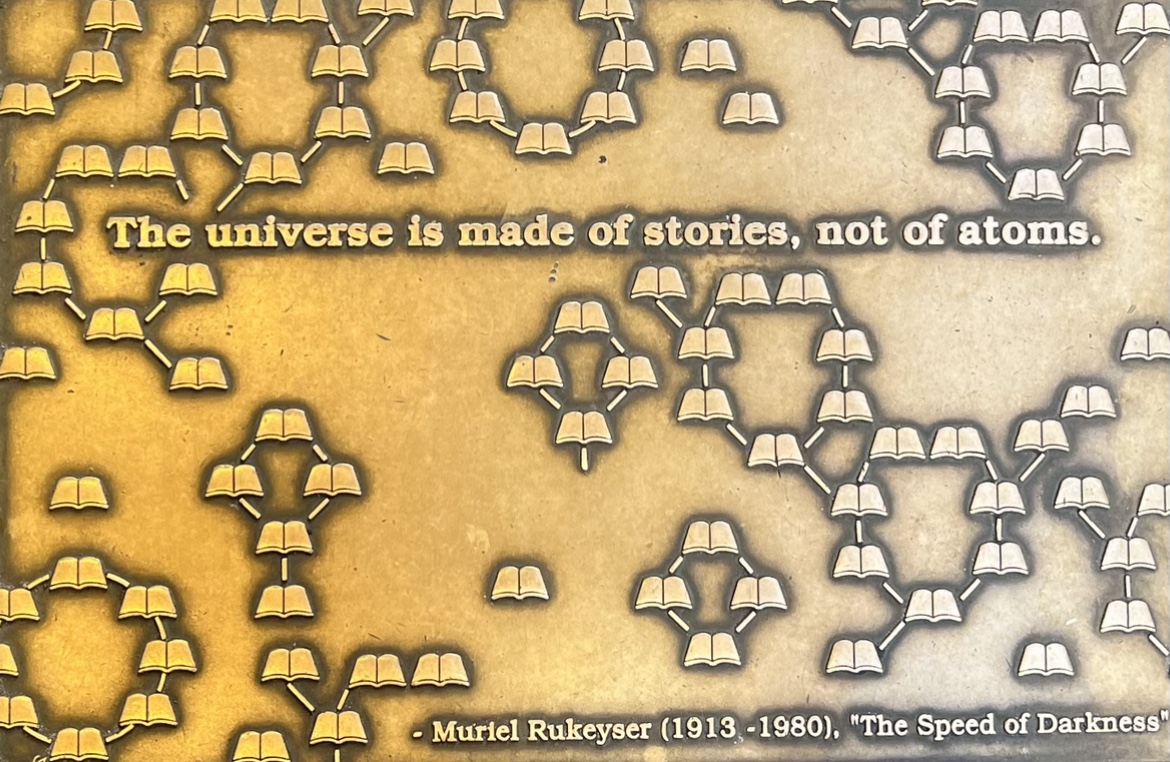
I stopped, made sure I wasn’t blocking any one’s way (lest I attract the wrath of Fran Lebowitz who is living rent free in my mind after I watched ‘Pretend it’s a City’), and I snapped a quick photo with my phone.
‘Isn’t that true,’ I muttered under my breath as I picked up speed and walked at the only pace I’ve come to accept in this gorgeous city – ultra fast.
This blog has always been about stories. Mostly mine, sometimes mine intersected with others. My advocacy life is about sharing stories and encouraging others to understand the power and value of those stories. It’s stories we connect with because we connect with the people behind them.
My time in New York is wrapping up and I’ll be back in Melbourne soon. I’ll be home, starting a new job and I’m so excited. And part of the reason for that excitement is that I will still be working with people with diabetes and their stories.
In the world of advocacy – in my advocacy life – lived experience is everything. I can’t wait to hear more stories, meet more people and learn more. And keep centring lived experience stories. Because, after all, that’s what the universe – and the diabetes world – is truly made of. Just like the plaque says.
This week, my socials have been flooded with a topic that rarely gets much of a look in: menopause, and in particular diabetes and menopause.
It’s a welcome change! It was World Menopause Day on Tuesday, and with it came an avalanche of great content shining a light on this particular aspect of diabetes – something that really doesn’t get much coverage at all.

I shouldn’t be surprised that a lot of what I saw was people with diabetes sharing their own stories. These are the trail blazers who could see that there needed to be more awareness, more recognition, more attention to the issue and took matters into their own hands and shared their stories. (I’m looking at you Dawn Adams, you amazing woman!)
Here are just a couple of things that I’ve seen this week:
Dawn’s story at Diabetes UK about managing diabetes with menopausal hormone therapy (MHT, also known as HRT).
And Dawn again here at JDRF – UK with this gorgeous piece about how there are peer networks offering support for others going through perimenopause and menopause.
This Twitter thread from Diabetes UK, highlighting just how they’ve listened to the diabetes community and calls for more research and information about diabetes and menopause. Their Diabetes Research Steering Groups have made the topic a research priority in coming years. That’s what I call being led by the folks you’re representing!
Twitter has joined the chat with a new account focused exclusively on diabetes and menopause with this neat bio: Peer support for those with diabetes going through the menopause – all types of diabetes, all stages of menopause – we’re in it together. You can follow Menopause Mithers here.
Not diabetes specific, but worth a share, is this brilliant Instagram video from Dr Jen Gunter which looks at the origin of the word ‘menopause’ (of course I love this!). Oh, and there’s a whole chapter in her book The Menopause Manifesto about language.

I’ll be linking all of these to The Diabetes Menopause Project post as a one stop easy place for links about menopause and diabetes.
If you google the words ‘diabetes public health campaign’, you will find myriad offerings from around the world. There are the good, the bad and the outright ugly. (Click on links at your own peril.) And many of these campaigns are the foundation of broader messaging about diabetes.
Why is it so hard to get messaging about diabetes right, and how do we fix years of getting it wrong?
The vast majority of type 2 diabetes messaging focuses on personal responsibility. It could be about losing weight, losing centimetres off your waist circumference, eating more fresh fruits and vegetables, being more active … you name it, it’s up to YOU.
It’s not just type 2 diabetes. Messaging aimed at addressing specific diabetes-related complications for all brands of diabetes also has a strong focus on personal responsibility: get screened/talk to your HCP/don’t miss appointments/don’t bury your head in the sand/look after yourself. The implication is that all accountability lies at the hands of the person with diabetes.
There are so many assumptions and that is one reason the messaging really hasn’t worked. There are more reasons, of course, and these are complex, multifaceted, and convoluted. You can almost understand why going with the easy ‘fix yourself’ messages are the ones that have been used.
The thinking behind so much of what we think and do about diabetes is misguided because too often we look to apply solutions that are medical in nature when we need to be considering social solutions. In a recently published New York Times article, writer Roni Caryn Rabin suggested a need to reframe (type 2 ) diabetes ‘…as a social, economic and environmental problem, and offer[s] a series of detailed fixes, ranging from improving access to healthy food and clean water to rethinking the designs of communities, housing and transportation networks.’
Telling people to eat better without establishing if there is affordable fresh food available and affordable, and the knowledge for what to do with a box from a farmers’ market, or to walk for half an hour a day without first asking about safe and accessible walking paths, leaves out a very big part of the equation. Assuming people have those structures in place is naïve, and yet that is what is assumed time and time again.
And telling people to not miss screening appointments lest they develop a diabetes complication is perfectly sound advice. Provided there are health professionals available, accessible, and affordable within decent timeframes. It takes only a cursory glance on Twitter to see that people with diabetes have difficulties when it comes to making those important appointments – and, for many, that’s been even worse with COVID.
Individual responsibility goes only so far when there aren’t the social and system structures around to support individuals. And it doesn’t go anywhere when generic messaging is the only messaging employed with the expectation that everyone will respond, and act as directed. Because there’s no time for nuance in a snappy campaign message.
We see time and time again that vulnerable people are disproportionately affected when it comes to health outcomes. In diabetes, we talk about high-risk groups, but what is the point of that if there are no solutions that are targeted for specific cohorts? Plus, if the at-risk messaging is thrown into the mix of the ‘fix yourself’ messaging, it gets very murky. Are people also now meant to be personally responsible for their backgrounds, age, family history…?
Messaging doesn’t only live on the websites and socials of those creating them. There is often a PR machine behind them that does its dark PR arts magic to get the message out there beyond those confines. News outlets pick them up and run, run, run with the messaging, dumbing it down to soundbites that often focus on anything that will get cut through. And often that’s the ‘fix yourself’ messaging.
And of course, the flow on effect of that is more blame, more shame, more stigma, more misinformation, more judgement, more discrimination. More people in the community not familiar and intimately connected with diabetes believing they’ve learnt something new, but really, they’ve probably only added more about how lacking people with diabetes are when it comes to personal responsibility. And on they go to perpetuate the myths about diabetes and personal responsibility.
The times the messaging is right is when people with diabetes are directly involved in developing and finessing it. We can predict the ramifications of messaging gone wrong because we’ve been on the receiving end of it. There’s never not a good time to engage people with diabetes, and I’ll always, always advocate that. It’s good policy because #NothingAboutUsWithoutUs.
But in the case of developing messages about diabetes, engaging people with diabetes can reduce harm to us. And surely that should be the starting (and middle and end) point for anyone doing anything about diabetes.
It’s World Mental Health Day and that seems as a good as any a day to speak about diabetes and mental health. Actually, every day is a good day for that, but with every health organisation’s social media manager’s attention turned to today’s health promotion day, I’m jumping on that bandwagon and adding this post to the myriad on Diabetogenic that address the very significant issue of diabetes and mental health.
I don’t think it’s fair to say that we don’t speak about diabetes and mental health these days. We do. As is so often the case, the conversations started in the community, led by people with diabetes and then were slowly, but surely picked up by other stakeholders. Many health professionals are tuned into mental healthcare being part of diabetes care. And in recent years, diabetes organisations have followed the lead of the community by running public health campaigns aimed at raising awareness of diabetes and mental health. Thanks to peer-reviewed research, we have evidence to show that diabetes impacts mental health and that mental health impacts diabetes.
But even if we say confidently say that diabetes mental health is on the agenda, there is still good reason to believe that more light be shed on the topic, and more attention be given to it. And to really advocate for mental health care to be seen as part and parcel of diabetes care. I really do believe that would make a huge difference.
When we talk mental health in diabetes, there’s a lot to consider. Of course, there are the diabetes-specific things like diabetes burnout and diabetes distress. Plus, eating disorders can take on a particularly diabetes-focus with conditions such as diabulimia (which really, really needs to be listed in the Diagnostic and Statistical Manual of Mental Disorders – it’s such a difficult, under-researched, misunderstood, yet very present reality for so many people living with diabetes).
But there are also ‘every day’ mental health conditions that are increased when someone lives with diabetes, such as depression and anxiety. Just how much of that is linked to diabetes?
And for those of us who dabble in the advocacy world, there is advocacy-related burnout to contend with too and that can and does start to impact our own diabetes management and mental health.
I couldn’t even try to estimate the number of times I’ve given talks about diabetes and mental health from a lived experience perspective. But I am always happy to be asked, and always willing to talk about it, even if it means being quite vulnerable and exposed when I do so.
I remember when my work in diabetes organisations started to focus more on mental health, and I also remember when those discussions were accompanied by a change in narrative. Suddenly, a lot of what we spoke about – from diabetes-related complications to risk reduction – came with a side serve of mental health commentary. It helped to show the undeniable link between the two. And the community responded to that favourably.
Diabetes has never just been about glucose levels, or carbohydrates. And there are healthcare professionals and researchers and organisation leaders that understand that – probably because they have spent time really listening to people with diabetes, rather than just churning out the old tropes about the ticking time bomb of diabetes. Actually, those tropes have probably contributed to a lot of diabetes-related distress.
Starting conversations about diabetes and mental health can be difficult. I like to think that all HCPs these days are aware of the intersection between diabetes care and mental health care, but sadly, I don’t think that is necessarily the case. If the stories I frequently see on social media are anything to go by, there is still a way to go when it comes to having frank, open, honest discussions that recognise that the mental health of people with diabetes needs attention.
These days, I know that my mental health is really not that great. While I know that may seem alarming, I actually see it as progress. Being able to identify that I am feeling this way means I can do something about it. In years gone by, I had no awareness about my mental state. I didn’t know what to do about it.
When I talk about how my mental health is faring – especially when feeling as I do now – there is often surprise. I am not backwards in coming forwards and I know that many people see me as confident, assertive, and self-assured. And I am that way. I’m also pretty bubbly and positive about life in general. But with it comes some dark times and dark thoughts and dark days that are really not especially easy to manage.
I don’t know about others, but when things are dark, everything seems bigger and scarier. I had a low the other night that hit below 2.0mmol/l, and ordinarily I’d deal with it and move on. But during the hypo and since then I’ve not been able to stop thinking about it and worrying about it. It never pays to play ‘what if’ in diabetes, and yet most of my thoughts when remembering the other night have started that way. The constant crap that I’ve been dealing with in the advocacy space for far too long now feels unbearable, and seems so, so nasty that I feel a wave of anxiety just being online. The burden of simply doing diabetes feels massive. The other day, I cried when my insulin pump demanded a battery change. And I can’t shake this overwhelming feeling that I have no idea what I am doing with my own diabetes management and am so anxious about complications, even though there is no good reason for it. These are the dark feelings. The reason sleep gets disturbed. The reason that my heart beats faster.
If I could wave a wand and make one thing come true this World Mental Health Day, it would be that everyone with diabetes has access to mental health care as part of routine diabetes care. And if I could wave that wand for a second time, I’d want my own mental health to build back up and become a little more robust than it is right now. That would be really, really great.
C/W This post contains content about diabetes and suicide and intended self-injury.
If you need help, this Wikipedia page has a list of mental health crisis lines around the world. And for a list of contacts actively updated and maintained by the Wikimedia Foundation, go here.
We talk a lot about taboo topics in diabetes. For years, there have been concerted efforts to shine a light on many of the issues and topics that have not received enough attention but are very important to people with diabetes. Often it is people in the diabetes community who find ways to delicately begin conversations, and that is then followed by an interest from researchers and clinicians.
But there are still some topics that are often seen as just too difficult, just too fraught, just too scary.
Suicide and intended self-injury (ISI) fall into that group.
At EASD this year, I was invited to join a meeting for the RESCUE Collaborative Community, a project that is lifting the veil on one of the most difficult issues in diabetes mental health. The name of this project is a clue to what it is trying to achieve: RESCUE (REducing SuiCide rates amongst individUals with diabetes).
The mission of this project is:
To reduce rates of intended self-injury (ISI) and suicidal acts by people with diabetes through improved understanding of the risk factors and implementing strategies to address them. In support of this mission, RESCUE works with stakeholders across the health spectrum including patients and care partners, academia, healthcare professionals, advocacy groups, industry, payers, federal and state agencies and regulatory bodies.
This is a big issue and a difficult one. There is a lot to think about, a lot of unknowns and a lot of questions to be asked. To work out how to help people with diabetes who are at risk, there needs to be a better informed workforce, with evidence to develop strategies that are going to help. And we also need to know how to approach the very basics when talking about suicide and ISI in relation to diabetes.
When it comes to diabetes and mental health something comes up frequently: there is limited dialogue and understanding between diabetes HCPs and mental health HCPs. I remember hearing Georgie Peters speak at the IDF World Diabetes Congress in 2017 about living with diabulimia. She said that she would be told to ‘go home and take your insulin’ – a completely inadequate approach. In her talk, Georgie said that is the same as telling someone with anorexia to ‘go home and eat’. But when trying to navigate care from two highly specialised health areas, that sort of response is rife.
And so, how to we make sure that when looking at diabetes and suicide and ISI, we are mindful of the specific diabetes issues that need to be considered?
At the meeting last week, we spoke about trying to identify people with diabetes who may need attention. Contemplating how insulin may be used as a way to self-harm is one consideration, so people being admitted to hospital with frequent DKA, and people admitted for a serious hypo could be a starting point to investigate. Of course, not everyone who has DKA or a serious hypo is self-harming. Diabetes gonna diabetes and sometimes, things just happen. But it certainly does seem a good place to begin, with targeted approaches to ask questions in an appropriate way that might help identify people who need mental health support, in particular about ISI and suicide, with an aim of reducing risks.
One of the other discussion points was asking about the role of peer support and the community when talking about suicide and diabetes? Is peer mentorship an idea? How can peers support each other? In the way that #TalkAboutComplications kickstarted meaningful community discussions about the taboo topic of diabetes-related complications and helped people with diabetes feel safe to first open up and speak about their own experiences of living with diabetes-related complications, could there be a way to signpost discussions about serious mental health conditions. And would this break down stigmas, help people realise they are not alone, and seek help, or at least ask where to seek help? Or, is this a burden too big for peer support?
There’s a lot to unpack here, and there really are no simple answers. But this work spearheaded by Professor Kath Barnard-Kelly with a team of dynamic health professionals, with input from diabetes advocates is lifting a veil to start to look for those answers.
MORE
#dedoc° voice, the brilliant Niki (@WhatNikiDidNext) live tweeted a symposium on suicide and ISI at EASD, and you can see her tweets here. Presenters at this session were Kath Barnard-Kelly, Marissa Town, Tadej Battelino and Simon O’Neil.
Disclosure
My travel and accommodation were covered by #dedoc°, where I am employed as Head of Advocacy. Thanks to EASD for the press pass.
I was invited to attend the RESCUE Collaborative Community meeting. I was not paid for my time to attend.
Let’s talk about perimenopause, periods, and diabetes. I’ll just wait a moment while a heap of people log off right now.
.
.
.
.
If you’re still here, hi! Shall we go on?
For the first, I don’t know, maybe 12 years I had my period, I had absolutely no regularity to it at all. I could never understand people who told me they got their period like clockwork, because for me the clock worked intermittently. It was less ‘that time of the month’ and more ‘that time of whenever’. Sometimes it came every three months. Sometimes every four and a half. It was a little surprise that showed up without warting when it felt like it, stayed for a few days, was minimally annoying (never particularly heavy and hardly any cramps at all), and then disappeared again, only to appear when it next felt like it. I spoke with my GP, and they weren’t concerned, and told me to celebrate the fact that I didn’t need to deal with period palaver each and every month.
This was all good and well until I was ready to have a baby. A regular period suggests that ovulation is happening regularly and that is kind of important if you need an egg to be fertilised. That wasn’t happening for me. Some fun fertility treatment (‘fun’, in this instance, means ‘frustrating, lots of tears, desperation and wondering why my body wasn’t doing what it was meant to do’), and I managed to get pregnant and have a baby.
And then, from six months or so after I had our daughter, my periods started happening regularly. Like clockwork. It was as though pregnancy had rebooted the reproductive bits of my body and for the last 18 years, I’ve been paying GST on period products every month.
During this time, I learnt that periods and diabetes don’t play nice. I’ve struggle to find patterns in my cycle so as to run different temp basal rates on my pump to accommodate. Anytime I’ve thought I’d nailed it and settled into a neat routine, the next month everything would go haywire. I guess I settled into another routine: a routine of no routine, where I just had to wing it at whatever time in my cycle things started to look a little sketchy. Loop certainly helped. I could see there were days each month when it was working overtime for no apparent reason, but those days didn’t correspond with the days the previous month. Or subsequent month…
And so, that brings us to present day when it’s time for another life transition or whatever euphemism you want to use to avoid using words that distract attention from hormones, uteruses, blood, and vaginas.
The pretty regular cycles have stopped. I’m not back to three or four (and a half) monthly, it’s more like six weeks or three weeks or some other weird timeframe. My period is on the most bizarre schedule now that is, quite frankly, bloody (yes, I know) annoying. And when it does deign to stop by, it either stays around longer (as in days…) or pops in for just a day or two. Or, even worse, seems to be done after a few days, only to return a day afterwards. Truly, it sucks!
I have made an appointment with my gynaecologist to check-in (it’s probably cervical screening time again) and for a check-up. I know that my experiences are in line with what heaps of other diabetes friends have experienced (yeah, we turn to each other because where else is there to go?), but I have a heap of questions to ask, and accept that there may not be answers.
And I’ve spoken with my endocrinologist. I think that I only ever think of my endo as my ‘diabetes doctor’ but really, her expertise in hormones is pretty bloody useful right now. And the fact that she does some work in a menopause clinic is hugely useful!
But here’s the thing. There are not pages and pages of information out there about diabetes and menstruation or diabetes and menopause. Or how diabetes affects your period during perimenopause. In fact, as with so many things that affect those of us dealing with periods (when they start, when they happen and when they stop), there is a dearth of information and very little research. I mean, it’s no surprise, because the patriarchy in health (as everywhere else) is all powerful. (Don’t believe me? Look at the number of resources about, and treatments for, diabetes and erectile dysfunction as compared with diabetes and menstruation or diabetes and menopause…)
Meanwhile, I just keeping trying to work it out, and speak with friends with diabetes to listen, learn and laugh as they share their stories. And watch as we start to open up more and write more and talk more in our own communities and advocate for more attention. Because that’s the story of diabetes community – we start the conversations that need to be had and that sets off a chain reaction where others get on board. So…get on board!

I recently was invited to run a workshop for health advocates (not just diabetes) who are affiliated with health and community organisations either as employees or volunteers. I was asked to primarily focus on safety in advocacy communities – both online and in person. All participants were women. This was interesting to me because the workshop was open to anyone who was a health advocate – not just women. I could see why, after a few short minutes in, it was women who were keen to come together for this topic and talk about it in a safe space, with other women.
I was delighted to be involved for a couple of reasons: 1. It’s important and 2. I know that when I run a workshop properly, I walk away learning a lot. And this was a topic I wanted to learn about. I set about developing a very vague program that would leave a lot of time for experience sharing and co-developing ideas that could be used by everyone in the room. I had a few discussion starters and things that I think have worked for me, so they formed the basis of the workshop, but most of the suggestions came from the day and with permission, I’m sharing some of the ideas here.
Before I do that, though, I want to highlight the overarching message was that health communities and groups are really important and really valuable. I know I frequently talk about not needing to love everyone in the diabetes community, and how critical it is to find the people you want to be around, who are supportive, who build you up, who you build up and who make you feel safe. That squad becomes sacred. Everyone else spoke of the same thing. One woman mentioned that it had taken her years to find the right people in her health community before truly understanding how peer support can be so beneficial. Many mentioned that it took time to work out exactly what they were looking for – was it friendship, solidarity, advocacy mates, opportunities to grow professionally? There are as many reasons to ‘do’ peer support as peer support models!
But even knowing that, it came as no surprise that every single one of the dozen or so women participating in the workshop had examples of where they had felt unsafe, vulnerable, targeted, or exposed in their own health communities. As stories were shared, there were frequent looks of recognition and heads nodding. Many said it was the first time they had ever spoken about these experiences. And others took time to warm up, asking several times if anyone would know what they had said – worried that they may be identified. This reminded me a little of the Ascensia Women’s Diabetes Social Media Summit I facilitated last year. I’d probably done close to a dozen of those before and each one involved a lot of social media outreach while the event was taking place. But this event was different. This one, was not quite as open. As facilitator, it’s my job to read a room, and the reading I got was that there were a group of women who wanted to share in private. And so, we did. As happened again at this recent workshop.
None of the ideas I’m sharing will identify anyone, and this post has been reviewed by the people who attended. Safety of the women is my primary concern. So, here are some ideas that may or may not be of use to folks out there:
- You are not alone. Feeling unsafe in a community group can feel isolating, especially if there are cliques and groups that seem to form alliances. But there will be others you can turn to – often outside the group. I know I have turned to people outside the diabetes world at times to learn about how they have managed certain circumstances. It’s fascinating just how transferable things can be and how universal others are!
- There are reasons that functions such as block and mute are available on all social media platforms. But go one further. By blocking certain accounts, you may still see people you would prefer to distance yourself from. Mute their name, their account handle and, if they are associated with any specific words, terms or hashtags, mute those too. (So, want to not see my stuff? Block #LanguageMatters and mentions of coffee, stripes, bookstores, baking and red lipstick.)
- Keep records. Even of things that seem irrelevant. I have an online folder where I collate anything that has ever made me feel unsafe or helpless. It’s shared with others, so they know what’s going on.
- Talk to your workplace or associated organisation. This was one of the points that I wanted to raise. As all participants were either employed by, or volunteers for, health organisations, they have access to several services to support them if they feel unsafe. Perhaps they can use the organisation’s EAP which can be a terrifically helpful resource. It’s also important that those records you keep are seen elsewhere and there is a timeline of when things happen, and they are reported in real time. I do this a lot, mostly because it helps to talk to someone. Sometimes it’s done proactively. Other times, it’s after something happens. For example, the first time I spoke about DIYAPS and a slew of HCPs made formal complaints about me daring to talk about something so dangerously off label. Or the time a diabetes educator wrote to my employer after I called them out for tone policing me. There have been the multiple times people in the low carb community have become aggressive and threatening. Or just weird. There have been times when I’ve spoken with the CEO or other senior managers about situations and as well as being great sources of advice and comfort, it also means that they have an idea of how things started and are going. Oh, and it means there are few surprises!
- Walk away – for a bit or a lot. No one is obliged to continue to be involved in advocacy spaces or being part of a community if it is not working or if it is feeling unsafe.
- Go incognito. My name and face have always been associated with the advocacy work I do because that is what I have chosen. But there are times that I wish I’d come up with a nifty pseudonym (Blossom?) and a cute meerkat picture. I know that probably wouldn’t have been possible considering the number of quite public facing things I do means there’s limited anonymity. But there are lots of super effective advocates who are anonymous when doing any online work, and that is absolutely an option. It doesn’t mean that you don’t need to do any media or presentations. It just means not linking the public stuff to your socials. A couple of women at the workshop do that, and I somewhat embarrassingly squealed when I realised that they were amazing anonymous campaigners I’ve learnt so much from over the years!
- Learn the anatomy of gaslighting. It’s an artform, but it’s a predictable one. And expect to be gaslit if anyone ever takes objection to what you do – especially if the source of that objection is from a group that is used to not being challenged. Don’t believe me? I present exhibit a: #AllLivesMatter and exhibit b: #NotAllMen. The term gaslighting was coined to refer to misogynistic abuse and manipulation and it often presents that way these days. Learn how it works and you’ll be astonished at how frequently it is used to disempower women.
- Be prepared for your work to be challenged; to be told you’re not good enough; to be told that you are not worthy; to be told that your work is irrelevant and insignificant; to be criticised for your successes and to be diminished. The first time that happened to me, I was crushed. Now, it’s only mildly soul-destroying. (This isn’t to say that people can’t disagree with your work. Of course, they can, and they will. And that’s perfectly fine. It’s when your work is dismissed and disparaged, and you are personally targeted that it can be especially challenging.)
- Cry. This was my suggestion. I know it sounds ridiculous, but it really helps. I think it just comes from the idea of giving myself permission to not have to be confident all the time and to admit when I am feeling especially vulnerable. When there were weird emails coming to me about fundraising activities, I spent a lot of time bawling.
- Be public about how you are feeling and your experiences. This is a tough one, because it can add being vulnerable onto an already vulnerable situation. But if you are able to assess if it is going to help you get through it, go ahead.
- Ignore it. That sounds naïve considering some of the points I’ve shared, but we all agreed that in some instances, this does work and is the best way forward (albeit with keeping notes).
It is undeniably true that women face a lot of rubbish online and a lot of that is from men. Women who dare to be strident, vocal and stand up and are confident often get it more. We see it everywhere. But I will add that as a straight, white cis woman, I know that the lousy behaviour I’ve experienced is nothing compared to women of colour and people from the LGBTQIA+ community. I’m so grateful to people from those groups who are bravely sharing the horrible attacks they receive and absolutely feel that doing what I can to support them, listen to them and believe them is essential.
The women in the workshop are so committed in their advocacy efforts. It seems unfair that they have had periods where they’ve felt unsafe or targeted. I know how hard it is. Maybe the tips in this post might help others and if they do, great! And if you are reading this and prickling because you object to what you’re seeing, please remember that these experiences are from women who have had a tough time. That doesn’t in any way delegitimise what you have experienced. But I hope that everyone does understand and accept that in living with the patriarchy and with internalised misogyny pretty much part and parcel of everyday life, women do face an unfair share of rubbish, including in advocacy communities.





 Diabetogenic