
You are currently browsing the category archive for the ‘Awareness’ category.
I’m a sucker for a man with a beard. So when Jimmy Niggles was introduced as the second speaker at last weekend’s HealtheVoicesAU conference, I snapped to attention to hear what he had to say.
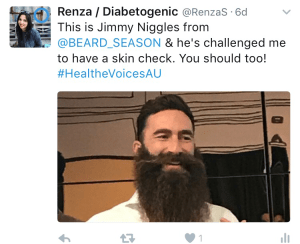
Jimmy Niggles (not his real name) started Beard Season at the wake of his 26-year-old mate, Wes, who died of melanoma. Each year, 46,000 people lose their life to melanoma making it one of the most lethal cancers globally.
Jimmy wanted to do something to encourage people to have regular skin checks, because (as is often the case) early detection of melanoma is critical to survival. The idea was for blokes to grow a beard in Winter (apparently the season for beards!) and then use their hirsuteness to start a conversation and challenge their friends and family to have a skin check.
One of the great things about this charity is that any bloke can become an ambassador. Grow a beard. Start a conversation. Encourage people to have a skin check. It’s simple, scalable and easily translatable. (And there is something on their website here about how women can get involved too.)
Jimmy is a reluctant advocate in some ways. He says he made himself an expert speaker by starting with one on one conversations, with the belief that every conversation can make a difference. That grass roots approach has grown to him (and his beard) being the face and voice of Beard Season and he has really kicked some major goals!
It was easy to draw parallels between what Jimmy is doing with Beard Season and how it could be adopted for diabetes awareness – both in terms of screening for type 2 diabetes and also complications screening. Those conversations at an individual level have so much potential, and tied together with public health campaigns and media promotions, there is an opportunity to reach lots of people.
Jimmy’s beard is there permanently for now and will be until someone offers him a cool million bucks to shave it off. He’s open to offers, so if you have a spare million under the mattress or in the freezer, he’ll put it to good use.
Want to do something to support Beard Season RIGHT NOW? Check out these beyond fabulous playing cards with some incredibly impressive beards. Be still my beating heart! Each deck of cards contains a lucky card. The idea is that you read the card, do as it says and spread the word. It’s another simple and effective way of getting the word out.
DISCLOSURE
Thanks to Janssen (the pharma arm of Johnson and Johnson) for covering my travel and accommodation costs to attend the #HealtheVoicesAU conference. There was no expectation by Janssen that I would write about the event and everything expressed here (and on Twitter Facebook and other social feeds) is mine and mine-alone! To read more, check out the conference hashtag, #HealtheVoicesAU, on the socials.
Last Friday, I flew to Sydney to take part in the first Australia HealtheVoices Conference coordinated and run by Janssen (disclosure at the end of this post).
 I’d followed along the US versions of this event, which have been running now for a couple of years, always with diabetes health advocates attending. So I was thrilled when I received an invitation to take part.
The event was run on Saturday with a dinner on Friday evening featuring Turia Pitt as the keynote speaker. I’m going to write something about that another time. Today I want to focus on some of the actual conference. This is just the first post – the rest will come over the next week or so.
I was extraordinarily excited about being in a room with advocates from outside the diabetes space. (But also pleased for the safety of the diabetes advocate bubble! We were well represented – four of us seated at the same table, occasionally nodding at each other as we recognised the stories others were sharing, even if their health condition was different to the one we navigate.)
Anytime I am surrounded by health advocates (diabetes and other) I have a weird contraction of feelings: surprise and absolute no surprise. Surprise that experiences are so similar and yet absolutely no surprise that our experiences are different! I read this article from the SMH (written as a follow up to the event) and so much resonated about Luke Escombe’s story, despite his peers not living with diabetes.
The speakers at the conference were diverse and covered a lot of different issues. And holding it all together was journalist and TV presenter Shelly Horton, whose fabulousness I cannot even start to describe! As well as making sure everything ran to time, Shelly shared stories of her own health experiences of living with PCOS.
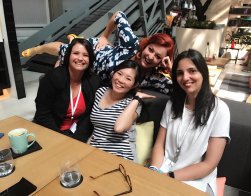
HealtheVoices emcee, Shelly Horton, hamming it up with some diabetes advocates.
We started with Samantha Jockel from Aldi Mum. She was a terrific speaker, however I found that not everything she said sat easily with me, mostly because at times I struggled to see the parallels between what I do (write a rambling little blog about about my own experiences of my health condition) and what Sam is doing (building a community which generates income).
I also realised I’m a crap blogger! As Sam eschewed the benefits of knowing your analytics and stats – she is an analytics ninja! – I realised that I rarely if ever look at the stats on my blog or other social accounts. Facebook sends me a weekly roundup and I categorically ignore the email; Twitter wants me to check the activity of different tweets, but I don’t; Facebook also tells me when I a post is doing better than usual and I get annoyed at the alert thinking that it was someone posting a cute cat meme: LinkedIn tells me how many people are looking at my profile, urging me to go and see who they are, but I’m seldom interested.
I know these are tools that can help me grow my audience and build my following, but I still have this idea that the only people reading are my mum and the guy from Romania who used to message me every day. (Perhaps if I looked at my stats, I’d know that’s not the case…)
Sam also spoke about boosting posts and ‘throwing some money’ at them if they could do better. I’ve never spent a cent on promotion of my blog and can’t see that I ever will. Once I hit publish and share what I have written on my social feeds, I don’t do anything any further. Occasionally I repost the link on Twitter, but only when I remember that there are people living in different hemispheres and were probably asleep when I posted it the first time so may have not seen it.
I guess the difference for me personally is this: My blog is not my job. I make no money from it and I have no intention of it ever becoming a money maker for me. I have a job – this is not it, despite the significant time and energy I spend writing. I blog for very selfish reasons – to find my tribe!
But there was much that did resonate with Sam’s talk and the overarching message that I took away was this: be authentic. As she spoke about the importance of finding our own voice online, she kept coming back to the need to be relatable, honest and real.
That did make sense to me, because I know that the only reason that I write is to tell my story about living with diabetes – the good, the bad, the ugly, the real. I know that when I read about people living with diabetes, I want to read the genuine experience. The blogs I read – and keep going back to – are the ones that are undoubtedly honest and authentic. Real life. Real stories. Real people.
DISCLOSURE
Thanks to Janssen (the pharma arm of Johnson and Johnson) for covering my travel and accommodation costs to attend the #HealtheVoicesAU conference. There was no expectation by Janssen that I would write about the event and everything expressed here (and on Twitter Facebook and other social feeds) is mine and mine-alone! To read more, check out the conference hashtag, #HealtheVoicesAU, on the socials.
Happy International Women’s Day!
This year, more than ever, it feels like we need this day. In fact, sometimes, it seems that the world is not a great place for women and that rather than advancing and continuing in our quest for equality, we are actually going backwards.
When we have governments – usually led by men – still thinking that they have a say with what women do to and with our bodies, making decisions about, and placing restrictions on our reproductive options and confusing health reform with the limiting of choices, we know that we’re not even close to things being fair for women.
My world is very shaped by women. Exhibit A: just a few of the women and girls who I’m lucky enough to call friends, family and colleagues, many of whom I’ve met through my diabetes life.
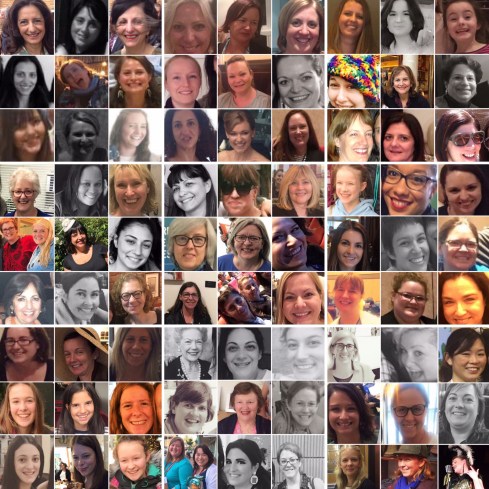
Exhibit A
But for me, International Women’s Day is about far more than my own world.
This year, the International Diabetes Federation has decided that the theme for November’s World Diabetes Day will be Women and Diabetes. In an effort to draw attention to the specific challenges faced by women with diabetes across the globe, the IDF will develop a range of materials to support women. There will be an entire stream at the IDF Congress in Abu Dhabi at the end of this year dedicated to women and children’s health.
Currently, there are almost 200 million women across the world living with diabetes and 40% of them are of reproductive age. That is a lot of pregnancies potentially impacted by diabetes. The need for safe, evidence-based, pre-pregnancy care for women with pre-existing diabetes is essential to improve outcomes for women and their babies. And this needs to start early. With half of cases of hyperglycaemia in pregnancy occurring in women under 30 years, girls and young women with diabetes need to have access to education and information about the importance of pregnancy planning.
Women’s health and diabetes has always been a special interest area of mine. My first big project when I started working in diabetes organisations was to help develop a diabetes and pregnancy booklet.
But pregnancy is not the only health issue for women with diabetes. There are a lot of other concerns and issues that need to be addressed, and I am looking forward to what the IDF do later in the year.
So today I’m celebrating – and saluting – women around the world – especially my own daughter who sent me a clip of the women teachers from her school performing ‘I am Woman’. And checking out some really important women’s health-related sites (some links below). Go get your green, purple and white on and celebrate the day!
Diabetes Sisters is a fabulous organisation based in the US and run by two of the women who appear in the collage above. It’s led by Anna Norton (CEO) and Sarah Mart (Director of Operations) who are exactly the kind of women you want on your team. I’m lucky to call them friends.
T1 International has this piece about the Sonia Nabeta Foundation.
And, today is the perfect day to do the The Jean Hailes annual Women’s Health Survey and help shape women’s health in Australia.
In the next couple of weeks, our kid gets to line up for her next round of immunisations. At twelve years of age, that means that she can look forward to chickenpox and Diphtheria-Tetanus-Pertussis boosters, and a three-dose course of the HPV vaccine.
When the consent form was sent home, she begrudgingly pulled it out of her school bag and handed it to me. ‘I have to be immunised,’ she said employing the same facial expressions reserved for Brussels sprouts.
She took one look at me and then, slightly sheepishly, said, ‘I don’t get to complain about it, do I?’
‘Nope,’ I said to her. ‘You don’t get to complain about needles because…well because…suck it up princess. No sympathy about needles from your mean mamma! And you have to be vaccinated because that’s what we do. Immunisation is safe and is a really good way to stop the spread of infectious diseases that not too long ago people died from. And herd immunity only works if…’
‘….if most people are immunised so diseases are not spread,’ she cut me off, finishing my sentence. I nodded at her proudly, signed the form and handed it back to her. ‘In your bag. Be grateful that you are being vaccinated. It’s a gift.’ (She mumbled something about it being a crappy gift, and that it would be better if she got a Readings gift voucher instead, but I ignored that.)
Over the weekend, the vaccination debate was fired up again with One Nation idiot leader, Pauline Hanson, sharing her half-brained thoughts on the issue.
I hate that I am even writing about Pauling Hanson. I despise what she stands for. Her unenlightened, racist, xenophobic, mean, ill-informed rhetoric, which is somehow interpreted as ‘she just says what many of us are thinking’, is disgusting. But her latest remarks go to show, once again, what an ignorant and dangerous fool she is.
Her comments coincided with a discussion on a type 1 diabetes Facebook page about vaccinations preceding T1D. Thankfully, smart people reminded anyone suggesting that their diabetes was a direct result of a recent vaccination that correlation does not equal causation.
I get really anxious when there is discussion about vaccinations, because the idea that this is something that can and should be debated is dangerous. There is no evidence to suggest that vaccines cause diabetes (or autism or anything else). There is, however, a lot of evidence to show that they do a shed-load of good. And if you don’t believe me, ask yourself how many cases of polio you’ve seen lately. People of my parents’ generation seemed to all know kids and adults with polio and talk about just how debilitating a condition it was. And they know first-hand of children who died of diseases such as measles or whooping cough.
This is not an ‘I have my opinion, you have yours. Let’s agree to disagree’ issue. It is, in fact, very black and white.
A number of people in the Facebook conversation commented that their (or their child’s) diagnosis coincided with a recent vaccination. But here’s the thing: type 1 diabetes doesn’t just happen. We know that it is a long and slow process.

Click for reference.
What this shows is that even if onset of diabetes occurs at (correlates with) the time of a vaccination, it cannot possibly be the cause.
When we have people in the public sphere coming out and saying irresponsible things about vaccinations, it is damaging. People will listen to Pauline Hanson rather than listen to a doctor or a researcher with decades of experience, mountains of evidence and bucket-loads (technical term) of science to support their position.
The idea that ‘everyone should do their own research’ is flawed because there is far too much pseudo-science rubbish out there and sometimes it’s hard to work out what is a relevant and respectable source and what is gobbledygook (highly technical term).
Plus, those trying to refute the benefit of vaccinations employ the age-old tactic of conspiracy theories to have people who are not particularly well informed to start to question real experts. If you have ever heard anyone suggesting: government is in the pockets of Big Pharma / the aliens are controlling us / if we just ate well and danced in the sunshine / any other hare-brained suggestion, run – don’t walk – away from them. And don’t look back.
I have been thinking about this a lot in the last couple of days. I have what I describe as an irrational fear that my kid is going to develop diabetes. It keeps me awake at night, makes me burst into tears at time and scares me like nothing else. If I, for a second, thought for just a tiny second that vaccinating my daughter increased her chances of developing diabetes, she would be unvaccinated. If I thought there was any truth at all in the rubbish that vaccines cause diabetes, I wouldn’t have let her anywhere near a vaccination needle.
But there is no evidence to support that. None at all.
The ATTD conference is, by its nature, very technology-centric. This is absolutely not a negative; in fact, it was one of the reasons that I had always wanted to attend because I am such a DTech junkie.
However, as it turns out, it wasn’t the promise of hearing about, or seeing, the latest devices that had me most excited as I perused the program, setting out my schedule for my busy days in Paris.
No, it was this session on the afternoon of the Thursday that really piqued my interest:
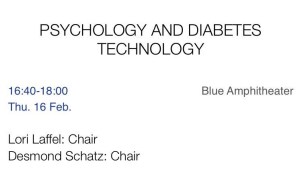
I knew we were off to a good start when session co-chair and first speaker, Dr Lori Laffel, flashed this slide up, announcing ‘Diabetes is Stressful’.

Sometimes, there is an assumption that diabetes technology automatically reduces stress. To a degree – and for some – that may be true. For me, the thought of wearing CGM all the time reduces the stress of not being aware of hypos. But it also adds stress with the never-ending, pervasive data data-feed.
There was also this dichotomy that so many of us face:

Acknowledgement of the terminology we use was a welcome addition to this talk. I think that at times our expectations are not being particularly well managed with the way technology is named.
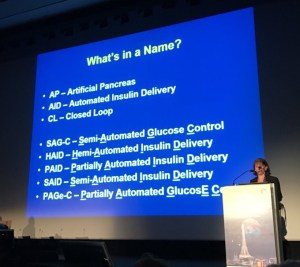
Expectations were covered again when Dr Kath Barnard took the stage.
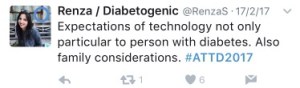
I love that Kath discussed the responsibilities of health psychology researchers when it comes to improving the outcomes of tech. She mentioned the importance of developing and using device-specific measures to assess psychosocial impacts on both people with diabetes as well as their carers. Most important was the point of ensuring robust and consistent psychological assessments in clinical trials to better understand participant experiences. This often seems to be a missing component when it comes to researching technology.
This is a recurring theme from Kath: that the juggernaut of diabetes technology advances needs to stop being only about button pushing and changes to clinical outcomes if their full potential is to be realised.
It’s important to note Kath is not anti-tech – in fact she frequently acknowledged the ground-breaking nature and significant potential of diabetes technologies. But her dedication to individualising technology use for each person with diabetes is her over-riding message.
Overall, the take-home from this whole session was this comment from Kath, which became a mantra for me for the remainder of the meeting: 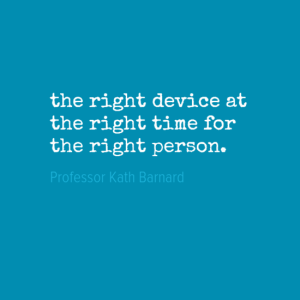
Next up, Dr Andrea Scraramuzza from Italy explored the human factor in technology in paediatric diabetes, however his talk was relevant to adults too. Human Factor brings together information from psychology, education, engineering and design to focus on the individual and their interaction with products, technology and their environments with the aim of better understanding the connection between human and technology.
I really loved this presentation because it brought home the idea that it doesn’t matter how whiz-bang the tech is, if the education is not right, if human limitations are not considered and if people with diabetes are not willing to learn – or clinicians are not willing to teach – the potential of that tech will never be reached.
The session closed with the always brilliant Professor Stephanie Amiel who spoke about hypoglycaemia – specifically, where to go when the technology hasn’t worked. I thought this was a really sensible way to round out the session because it reminded us all that technology is never a silver bullet that will fix all situations. Sometimes, we need to revert to other ideas (possibly alongside the technology) to search for solutions.
I was really grateful for this session at the conference. All too often psychology is ignored when we talk and think tech. The focus is on advances – and the speed of these advances – all of which are, of course, super important.
But it is undeniable that alongside currently available and still-in-development technology is the fact that there is a very personal aspect to it all. Whether it be considerations of actually attaching the tech to our bodies (unfortunately this wasn’t really discussed) or tech fatigue and burnout, or simply not wanting to use the tech, this is the side of diabetes and technology that needs to be researched and understood because how we feel about using the tech absolutely impacts on the results we get from it.
Well done to Professor Tadej Battelino and the ATTD organising committee for including this session in the ATTD program. It really was most useful and hopefully the HCPs and researchers in the room walked out thinking a little differently. I know that there were a lot of advocates in the room who really appreciated the session – because we always are thinking about this side of diabetes!
I do, however, have a challenge for the organising committee. As excellent as this session was, it could have been even better if they had dedicated some of it to hearing from people with diabetes talk about this issues being discussed by the clinicians and researchers. That would have really brought home the message. Perhaps next year…?
Disclosures
My flights and accommodation costs to attend the Roche Blogger #DiabetesMeetUp were covered by Roche Diabetes Care (Global). They also provided me with press registration to attend ATTD. My agreement to attend their blogger day did not include any commitment from me, or expectation from them, to write about the day or their products, however I have shared my thoughts on the event here. Plus, you can read my live tweets from the event via my Twitter stream.
Last week, I spent three and a half days in Paris at the Advanced Technologies and Treatments for Diabetes (ATTD) international conference. It was the 10th ATTD meeting, and the first that I had attended. I have been to my fair share of diabetes conferences both here and around the world, but this one was definitely different. The narrow focus on technology meant that most of the attendees shared an affinity for tech-geekiness.
I was there as part of the Roche Blogger Networking #DiabetesMeetup event, (my disclosures are at the end of this post), which was a remarkable day with about 40 bloggers from across Europe. Lots more about that in coming days.
As I sat in sessions and wandered around the exhibition hall, I found myself becoming increasingly uncomfortable. The combination of being enthused, enthralled and excited (alliteration!!) at new tech and treatment advances sat trickily alongside nagging and constant reflection about the categorically un-level playing field that is diabetes around the world.
How could I happily be sitting there, hearing about automated insulin delivery devices, the value of CGM use, implantable CGM sensors that last for 90 days and big data when I had just spent weeks imploring people to donate to Spare a Rose, Save a Child? I am an ambassador for Insulin for Life Global and despair at the thought that people are dying because they can’t access insulin. And even in first world countries, access to insulin is, for some, not a given, and the thought of accessing the sorts of technologies I was hearing about may as well be a fairy-tale.
The divide between those of us in the room – those able to use the technology – and those for whom access to any sort of diabetes tech was gaping and seems to be getting bigger by the minute.
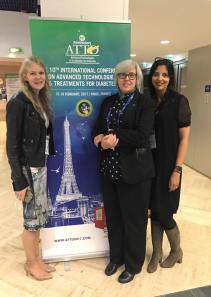
Fabulous Professor Alicia Jenkins with Annie Astle and me.
I walked out of a brilliant session about automated clinical decision support systems. It was morning tea time, so there was a break in sessions and I thought I’d find a quiet corner to try to get my head straight about how I was feeling. I looked up and there was Professor Alicia Jenkins. I knew that she was just the person to help me sort myself out!
Alicia is an Australian endocrinologist. She is a remarkable clinician, researcher and one of the best presenters on diabetes I have ever heard. Plus, she is a lovely, lovely person. Alicia is also the President of Insulin for Life Global.
I mentioned to her how uneasy I was feeling and she agreed, but with typical (and welcome) Alicia reflection, she helped me find some perspective. She reminded me that most people at the conference are very conscious of the divide, and that even while talking about the latest advances, there was still a lot of talk about access and reimbursement. There was acknowledgement that the divide is real and needs to be addressed. I looked at her – someone who is such a huge advocate for, and expert in, technology and new treatments – and realised that, actually, we can be across both aspects of diabetes care; that just because we are excited about the latest (and expensive) technologies doesn’t mean we don’t care and want to do something to help improve access of basic diabetes supplies.
By the end of the conference, on the very long trip home, I kept thinking back to our conversation. I realised that as much as it would make things simpler, I just can’t compartmentalise my own diabetes situation and how I feel about access for others. I struggle with this, because one of the really important things for me to have done all the time I’ve worked in the diabetes space has been to separate my own experience from others’.
But in this instance I can’t just leave it at ‘this is my experience and this is someone else’s’ and I think that may actually be a positive. I do find it uncomfortable. I feel guilty that I can afford and access whatever I need when so many cannot. I feel it in Australia amongst my peers and I feel it when I read about those in other countries. (Really, you should read the brilliant profiles T1 International are sharing at the moment, which give a beautifully (and sometimes harsh) personal perspective to access issues.)
I struggle with my privilege and have a constant feeling that I am not doing enough. But these feelings are a good thing. Because I can always do more. I SHOULD always do more.
I will never stop writing about these issues here and elsewhere, or talking about them. I will keep putting my money where my mouth is, because words are not enough. And I will keep advocating, using my voice and working with people trying to make a difference, until there is no difference at all between what we can all access.
Because it’s still February, I would like to urge you again to please, if you can, make a donation to the Spare a Rose campaign. For the cost of one rose (about AUD$6), you can provide insulin for a month to a child in a developing country. (Also, I should mention that last week, I was invited to join the Spare a Rose, Save a Child team; an invitation I accepted immediately.)
Disclosures
My flights and accommodation costs to attend the Roche Blogger #DiabetesMeetUp were covered by Roche Diabetes Care (Global). They also provided me with press registration to attend ATTD. My agreement to attend their blogger day did not include any commitment from me, or expectation from them, to write about the day or their products, however I will be sharing my thoughts on the event here. Plus, you can read my live tweets from the event via my Twitter stream.
Last Friday night, I was at a work dinner. The event followed a very full day of meetings and as we sat down for our meal, I was concerned that my brain was so drained I wouldn’t be able to focus on the guest speaker.
However, when he started, the speaker (one of Australia’s leading diabetes health professional experts) gave an eloquent and articulate talk about the state of diabetes in Australia and the world.
He spoke for a relatively short time – about 15 minutes – and then sat back, continuing to chat with other people seated around him.
He noticed my CGM on my arm, but didn’t say anything. However, later on as he was speaking about realities of living with diabetes, he stopped and said directly to me: ‘You know this better than anyone else. Why am I talking?’
I was grateful for the acknowledgement, but I did want to hear more from him. One of the things he focussed on in his talk was about how HCPs often don’t truly understand diabetes or how to speak to people with diabetes. He identified stigma as a real issue for people living with diabetes – and how the way diabetes is presented and spoken about in the media is damaging. But several times, he came back to his concerns about healthcare professionals and their approach to dealing with people with diabetes.
‘You are so right,’ I said, agreeing with him. ‘I’ve found – and have heard from many others – that often HCPs don’t get diabetes at all. There is this weird concept that diabetes is a matter of insulin (or other meds) – food – check BGL – adjust accordingly. And go! It’s not that easy. It’s really not.’
He nodded at me. ‘You know; I think we made a really big mistake about 30 years ago when we started saying that people with diabetes can live a normal life…It’s not true.’
I’ve not been able to stop thinking about that comment all weekend. It was startling to hear the words, but I think that was because I realised straight away that it was true.
When I was diagnosed, I was told that diabetes would not prohibit me from living a normal life. Sixteen years ago when I started using a pump, I was told that it would make me feel normal again. When I started on CGM, I was told that I would feel normal when I could easily see and adjust my glucose levels. When I’ve started any sort of new eating plan, I’ve done it because I’ve heard that it makes people feel more normal.
I spend so much time convincing people – convincing MYSELF – that diabetes hasn’t prevented me from living a normal life. I check off on my fingers the things I’ve done, one at a time proving that I can do anything, I have done everything. I am normal! Look!! I work; I travel; I have a kid; I eat what I want; I stand up in front of people and talk; I write and get published. Look how normal my life is!
But the truth is – it’s not normal. My life is not normal. And it’s disingenuous to suggest otherwise.
It’s not normal to for my body to not produce insulin. It’s not normal to have to think about every piece of food I put in my mouth, (how many carbs are in there? Are there too many? Are there not enough? What is my BGL right now and do I need more/fewer carbs?) It’s not normal to be terrified that I am going to develop complications that will be debilitating, limiting, scary. It’s not normal to be so worried about my health all the time – to be so focused on my health all the time. It’s not normal to have sensors and pumps and devices stuck to my body as I try to mimic a human organ. And it’s not normal to think this is normal
Humans are incredibly adaptable. We modify and make changes to suit to new environments, circumstances, challenges.
And when we are diagnosed with a chronic health condition that impacts on pretty much every part of our life, we adapt. It may become our new normal. But it’s not normal.
I agree with the esteemed professor from the other night. It was a huge error to start saying that we can live a normal life with diabetes. It undermines, and negates, the constant effort we need to put in to appear normal and to be healthy; it makes us feel guilty – and incompetent – when diabetes does stand in the way. It makes us fell less than we should when we need to seek special consideration or dispensation to help manage situations.
I have diabetes. My life is not normal. And it doesn’t diminish me in any way to admit that.

P.S. Tomorrow is Valentine’s Day and time to donate to the Spare a Rose Campaign so you can Save a Child. Click on the pretty flower.
‘Why do you even care what’s happening in America? It doesn’t affect you, does it?’
I’ve been astounded to hear a few people ask me this question after finding out that the kidlet and I participated in the Women’s March a few weeks ago, or after hearing me speak about the current situation in the US with the Trump Administration threatening to repeal the Affordable Care Act, and allowing insurers to discriminate against those with pre-existing health conditions.
I care a lot about what is happening in America at the moment. Without a doubt, my main focus is what is going on with healthcare and insurance, (however today, I am stunned, dismayed at Betsy DeVos’ confirmation as Education Secretary, but that is mostly because I cannot believe that someone who thinks guns have a place in schools ‘because of, you know, grizzlies’ is in charge of education).
Does it affect me directly? Well, probably not. But it is incredibly naïve of us to think that what happens in the US is completely irrelevant here in Australia. We know our politicians look to the US for policy direction. Our new Health Minister, in his maiden speech to Parliament, put forward the case for the adoption of a healthcare system more in-line with the US-system.
Of course what is going on in America affects us, but, actually, that’s not the point.
The real point is that I care because it’s about people. Not only that, it’s about the most vulnerable people. And like it or not, people with chronic health conditions are vulnerable. We are high-level users of healthcare, we face more discrimination and we cost more to the system. We can be hit where it hurts: easily and unfairly.
Of course, within this group there are some more vulnerable than others.
In the same way, I’ve had people ask me why I care so much about insulin access around the world, which seems like such a callous thing to even think, much less say out loud, when you remember that the life expectancy for a child diagnosed with type 1 diabetes in sub-Sahara Africa is 12 months. I actually still struggle to get my head around that really.
I care because I am a global citizen and I care because my social responsibility is to those less fortunate. I care because when my brothers and sisters around the world are struggling because they can’t access diabetes care, it hurts us all. I care because when I hear that instead of protecting the most vulnerable – as they should – governments are building walls (no pun intended) to make it more difficult, more frustrating and more tiring, the response should never be ‘oh well’, it should be ‘What.Can.I.Do?’ I care because diabetes is hard enough without having to fear being turned away from A&E or from other treatment. I care because no one should die because they can’t easily and affordably access a drug that has been around for 95 fucking years.
Of course I marched last month and you can bet that I will be doing it again. And you bet that I will be standing alongside my friends in the US as they fight one of the hardest battles they’ve ever faced just to be able to access healthcare, and my friends from around the world too as they fight access issues. And I will continue to make donations to charities helping those who cannot access insulin and be an Ambassador for Insulin For Life Global as they continue their excellent and necessary work.
But if you really think that it’s all too far away, so it won’t touch us, then perhaps you might like to do something to help people closer to home. As someone delicately reminded me last week, it is not only people in developing countries who struggle to access diabetes healthcare and drugs, and whose outcomes are far, far poorer than those of us living firmly inside a privilege bubble.
Get involved with or make a donation to an Australian-based charity if you would prefer to do something to help those closer to home.
We should all care because when others are disempowered, it means they are not able to get the best care or expect the best outcomes. And we do something because we can; and if we can, we should. That is what being socially responsible is all about.

Flowers die; children shouldn’t. Make a donation to Spare a Rose, Save a Child, and Life for a Child today. Click on the rose to take you straight to the donation page. Simples!
Yesterday, on her first day of school, the kidlet’s English class was about autobiographies. So, we had a long chat about some biographies and autobiographies we’d read – and ones we wanted to read – and why they are a really important way for people to share the stories of their life.
Story telling is one of the most powerful ways to record events, emotions and life experiences. Others who may be going through similar experiences can feel great comfort knowing that others have not only lived through certain situations, but stuck around to tell the story! And it is also a fabulous way to share stories with those not familiar with different places, circumstances or surroundings.
Our stories have the ability to inspire, offer an opportunity to learn, and help make sense of things around us.
So, it took me no time at all to respond with a resounding ‘YES!!’ when I was contacted by Anna Sjöberg from Anna PS and Sofia Larsson-Stern from Diabetesia, asking me to be in their book about people living with type 1 diabetes.
The e nd result of their hard work is a fabulous book – ‘We can, want and dare …and we have type 1 diabetes!’ – and it features people from all over the world telling their stories of life with type 1 diabetes.
When putting together the book, Anna and Sofia wanted to provide real-life stories from people with type 1 diabetes from all walks of life: from kids and teens
(such as this one who is, quite simply, AMAZING!) to adults doing all sorts of amazing extraordinary, and every-day things. There is a Brooklyn-based chef, an incredible young advocate from Sweden and another Swede whose Instagram profile describes him as a Multisport Team Ninja Warrior! Oh, and a Melbourne blogger and activist.
The books was launched it its original Swedish-language version last year on World Diabetes Day and the English-language version has just been launched and is now available.
This book is not just for people with type 1 diabetes, although, with its stories of hope it certainly would be a wonderful thing to give someone newly diagnosed! It is also for friends and families of those living with type 1, and people who really have no significant connection to type 1 diabetes, because it provides an understanding of the complexities of the condition that we live with and offers a very personal insight into life with type 1.
You can order your copy of the book here.
GIVEAWAY GIVEAWAY GIVEAWAY
I have three copies of ‘We can, want and dare …and we have type 1 diabetes!’ to give away to Aussie-based readers of Diabetogenic, thanks to the team at Anna PS. Just click here and send me a message telling my why you would like a copy. Keep it short – brevity is key here!
DISCLOSURE
I was invited to provide my profile for the book and received no payment for my contribution. I will receive a signed copy of the book for my bookshelf, though, and can’t wait to see it!
Our daughter starts back at school today. It’s her first day at secondary school – a significant day, and as I waved good bye to her this morning, watching her walk into the school theatre for morning briefing, I realised that this is one of those really big transitions in a person’s life. And a parent’s life too…
I managed to wait until after the Principal’s address to parents, and after leaving school grounds to get a little teary, so I’m calling the morning a win all around!
As I drove into work, I thought about all the things we’d done to get ready for the day. We’d attended information sessions, gone on school tours, enrolled in cello lessons, decided which language to learn, ordered and collected text books and stationery, organised a public transport pass, learnt how to use the school’s intranet, done a few practice school runs on the tram and many other things that we did as we thought of them.
The check list we were working from seemed endless and we kept adding tasks to it. But we made it, and by last night, her schoolbag was packed and she was ready for her first day.
But our story is common and all families with children starting at (or back at) school have done similar things. However, there are some families who have a whole lot more to do than just make sure they have the right coloured pencils and appropriate snacks in the lunchbox.
There are over 11,000 preschool and school-aged children here in Australia with diabetes, and they – along with their parents – face different and extra challenges preparing for their first days of school. In addition to the things I’ve mentioned above, they have another checklist that needed to be dealt with. The diabetes at school checklist.
While they are packing school bags with books and pencils and lunch for the day, they are also building hypo kits to be delivered throughout their child’s school. They will probably have spent some – maybe considerable – time with teachers explaining some diabetes basics and what to do in the case of a diabetes emergency.
It’s likely that their child’s healthcare team will have been involved in preparing some sort of management plan for the school, outlining how to support the child during the school day, with extra attention given to activities such as sports days, PE lessons, camps and excursions.
Possibly, their school will have undertaken some formal training, such as the School Seminars offered by Diabetes Victoria. They should have received a copy of Mastering Diabetes and hopefully shared the school-relevant information with their child’s teachers and other school staff.
It’s a lot to think about. And it’s understandable why many parents feel a lot of concern, especially when you consider that there is no standard requirement by schools when it comes to supporting children and adolescents with diabetes.
And, quite frankly, that’s not good enough.
Since returning from holidays this year, the majority of my work has centred around diabetes and schools, and today Diabetes Australia launched a new report calling for a systematic, nationally consistent approach to supporting children and young people with diabetes in the school setting. Children and adolescents with diabetes have a right to fully participate in all school activities, but to do so does require training and commitment.
It’s time to move away from the mixed-bag, approach that is in place now, where it seems that luck determines if a school is well prepared and teachers are well trained. Kids with diabetes deserve much, much better.
You can read the report here and the media release here.

DISLCOSURE
I work for Diabetes Australia and have been involved in the preparation of this work and the media release. I have also been involved in some media interviews about this issue.




 Diabetogenic