
You are currently browsing the category archive for the ‘Awareness’ category.
Catching the end of Women’s Health Week, revisiting this post from last year about all things girls, women and diabetes. Today, on the final day of the campaign, Jean Hailes for Women’s Health is suggesting that we take some time to think about our mental health. That sounds like a good idea anytime, but I’m really pleased to see that the organisation is highlighting this important, under-researched and misunderstood health issue. Check it out at their Women’s Health Week website.
I’ve really appreciate today’s messages – they couldn’t have come at a more opportune moment! But that’s not to say that the rest of the week wasn’t just as terrific. Have a look at each day’s theme – there is lots of important information to read through.
And have a read (or re-read) through this post which was all about a lot of the things we don’t talk about enough. When I published it last year, a number of women reached out and said they used this as a conversation starter with loved ones and HCPs. That might just work for you too…
It’s Women’s Health Week here in Australia and once again, Jean Hailes for Women’s Health has been doing a stellar job of talking about women’s health issues that are rarely (if ever) spoken about in the public sphere. As usual, this year’s campaign is presented in a clear, no-nonsense way. Just as it should be.
Shining a light on women’s health issues is critical for a number of reasons. There is still too much stigma associated with women’s sexual and reproductive health, so finding a way to easily speak about the realities of women’s health just makes sense.
Not all women’s health issues necessarily seem relevant to diabetes. But, as ever, diabetes has a way of complicating things, so it makes sense that they are on the list of things covered when speaking with our HCPs.
I honestly can’t remember the last time my GP spoke with me about any sexual or reproductive health issues. Some women see gynaecologists regularly (I see mine every couple of years for a pap smear), but that may not be the case for most women. Surely conversations about contraception, periods and other things should be part of a regular check-up alongside other ‘tick the box’ issues such as blood pressure, cholesterol and weight.
I wish that I had seen an endo from the beginning who had spoken to me about women’s health stuff. I know that it wasn’t until I found the endo I see now – one who I sought out specifically for her expertise in women’s health and pregnancy – that issues such as contraception were even mentioned.
So, here is a (non-exhaustive) list of things that women with diabetes may want to consider chatting to their HCP about – and that HCPs may want to consider speaking with PWD about. (There are links at the end of the post for where to go for further information.)
Periods. To be honest until I was trying to get pregnant, I really didn’t think much about my period. I thought of my lack of regular periods (as in, I would get my period sporadically maybe four or five times a year) as a blessing, rather than something to be concerned about. Of course, once I was trying to get pregnant, I was desperate for a monthly period that I could set a clock to.
No HCP had ever spoken to me about how diabetes would impact on my period – or, probably more importantly, vice versa. I had no idea about how different times in my cycle might affect my glucose levels. In fact, I think it wasn’t until I started wearing CGM and could really see what was going on that I learnt how to manage my insulin doses at different times throughout the month. (And it also explained the two days each cycle I was so freaking low I pretty much took no insulin. Apparently that’s how MY body deals with ovulation..)
If I was diagnosed today, I would be asking a lot of questions about diabetes and menstrual cycles and the best way to adjust my management methods depending where I am in my cycle.
Sex. When I’ve written about diabetes, women and sex before, I’ve noted how at diagnosis no one spoke with me about how diabetes could impact on my sex life. It wasn’t until I started speaking to other women about it that I realised that this is an issue for a number of us.
We need to start talking about women with diabetes and sex in a non-threatening way that normalises the discussion.
UPDATE for this revisited post: Check out this brilliant resource that came out of the research led by UK health psychologist, Professor Kath Barnard. This is one of those projects that I was just so damn pleased to be involved in!
Contraception. No one mentioned contraception to me when I was diagnosed. I was twenty four, engaged to be married. Surely both the endo and CDE I saw the day I was diagnosed realised that I was having sex, or considering it after I was married. (I really, really hope that they didn’t think that they didn’t need to speak about it with me because we weren’t married yet…because it was only 20 years ago and there’s no place for puritan attitudes in healthcare. Plus, that ship had sailed. A long time before.)
At the time, I was on the pill, but there was no discussion about the best form of contraception for me relating to diabetes, (was there a better pill to be on?), and I didn’t know to ask. Surely, all women of child-bearing age should be asked regularly about contraception, especially as women with diabetes are so often told about the importance of avoiding unplanned pregnancies.
Pregnancy. Thankfully, these days finding information about diabetes and pregnancy is relatively simple. If you know where to look.
But twenty years ago, when I was diagnosed, the only thing I was told about diabetes and pregnancy (and I think it was only because I asked) was ‘You need to have all your kids by the time you’re thirty’. (Not sure if just scraping in three days before I turned 31 counts there. Probably not. Looks like this deliberately non-compliant palaver has been happening for a while….)
Talking pregnancy and diabetes needs to be done delicately, but it needs to happen. And, ideally, it needs to happen long before pregnancy is even being considered.
Back in 2003 when I was at Diabetes Vic, I coordinated the first diabetes and pregnancy info evening. Over 100 people were squashed into an overheated room in the basement of the old Royal Women’s Hospital. At the end of the night, I was walking around speaking with as many of the people who had come along as possible to see if they had found the evening useful. I walked up to one woman and thanked her for coming. ‘I hope that you found tonight helpful,’ I said to her. She nodded at me, and I noticed she was holding onto a copy of the ‘Can I Have a Healthy Baby?’ booklet that Diabetes Victoria had published with Realty Check and ADIPS the previous year. ‘My daughter has T1D,’ she said to me. ‘She’s only 8, so obviously this isn’t something that is relevant now. But I wanted to know so that when she asks questions I can answer them. I feel really reassured that she can have a baby if she wants one if it’s planned.’ I remember reaching out to her and hugging her (I have no boundaries). ‘Your daughter is so lucky to have you in her corner,’ I said to her. ‘Thank you for coming!’
Fertility. This isn’t the same as pregnancy. It’s not an easy subject – ever – but it is one that needs to be discussed openly and safely. I can honestly say that no healthcare professional has ever discussed fertility with me unless I have raised the issue.
My experiences around fertility have been complex, emotional and quite painful. It took me a while to get pregnant the first time. My irregular periods needed to be addressed (fortunately, that was easy enough with only Chlomid needed), but even once I was having monthly cycles, and apparently ovulating regularly, I could not get pregnant.
When finally did, I miscarried. Miscarriages are common. I know that. But it still sent my spiralling into a really difficult period which took a lot of time and effort to emerge from. I got pregnant and had a baby, and thought that from there, fertility issues would be a thing of the past.
But I think that because miscarriages are so common that sometimes it can be forgotten just how traumatic they can be. My first miscarriage ended my first pregnancy, and the two other miscarriages I had ended those ones. It’s clear that while I seem to be able to get pregnant, keeping those babies growing, safe and alive is not something my body does well. I wanted that explained to me – or at least for someone to speak with me about it.
Diabetes and fertility was never, ever discussed with me, except that I was reassured after each of my miscarriages that I could not blame diabetes for losing the baby. That was a double edged sword because I wanted to know what it was that was stopping me from being able to continue my pregnancies. I would have liked to be able to point at something. Because the alternative is that it’s just another thing my body can’t do properly.
PCOS. I was diagnosed with polycystic ovarian syndrome when I was about 26. I’d been referred to an OB/GYN by my endo because she wanted me to have a gynaecological check-up because we’d started seriously talking babies. My lack of regular periods was flagged as something that needed investigating and an internal ultrasound showed a number of small of cysts all over my ovaries. I had no other symptoms of PCOS, but that was enough for my OB/GYN to speak with me about potential fertility issues once we were ready to start trying for a baby. I had a laparoscopy and they were removed.
Both type 1 and type 2 diabetes can increase the risk of PCOS (more so type 2 diabetes) so this is definitely something to discuss with your healthcare team if you are in any way concerned.
Body image. I don’t even know where to begin with this because body image is such a huge, huge concern for so many women, and I really do believe that diabetes amplifies those concerns. Whether it is the physical signs of diabetes (tech that we wear on our bodies), the psychological side of being diagnosed with a life-long health condition or the emotional toil of having an allegedly invisible condition that we can’t help but see every day, living with diabetes significantly affects how we feel about our bodies.
This is one of the reasons that having a psychologist as part of our HCP team is important, because we need people who are able to ask the right questions and offer support and solutions for dealing with how we see our bodies.
Eating disorders. Diabetes and food; food and diabetes. It’s impossible to separate the two, and for some people, the relationship is complex and very, very difficult. Women with diabetes do have an increased risk of developing an eating disorder, and of course, there are diabetes-specific eating disorders. And, unfortunately, this is another issue that is not spoken about openly.
Menopause. At my last appointment with my endocrinologist, I raised something that I’d not raised yet. ‘What can you tell me about diabetes and menopause?’I asked her.
I’m not going through menopause – I’m not even peri-menopausal yet. But I don’t need a magic mirror into the future to see what lies ahead. And I like to be prepared.
So, there’s something you should know about how I came to see the endo I have been seeing for the last almost-17 years. I was searching for someone who could help with what I really needed, one of them being an expertise in T1D and pregnancy. She was absolutely the right endo for me then. And continues to be now, because recently, she has become an expert in menopause. (I know! It’s like she is a few years ahead of me in her areas of interest and expertise!)
If I’m honest, I’m a little stressed and worried about what menopause has in store for me when it comes to my diabetes, mostly because I know nothing about it. We’ll see how that plays out…
Self-care. Why do women find it so hard to prioritise our own care and take care of our own wellbeing? We do need to get better at fastening our own oxygen masks before making sure that everyone else on the plane has theirs in place.
This might be another reason to consider seeing a psychologist to ask for some tips for how to make sure that we remember to look after ourselves in a way that is healthy, consistent and achievable.
Pelvic floor. Diabetes, as the gift that keeps on giving, can mean our pelvic floor isn’t as strong as it could be. Just as nerves in other parts of our bodies can be affected by our diabetes, so can the ones in our pelvic floor.
(You’re doing your pelvic floor exercises right now, right? Yep. Me too.)

Looking for more info? Have some links…
Here’s the Jean Hailes for Women website for Women’s Health Week.
The rather awesome Mindy from There’s More to the Story has been writing about diabetes and sex over the last couple of months and her posts are a must read. I wish I’d had something like this to read when I was first diagnosed.
Some information about diabetes and PCOS. This article is about type 1 diabetes and PCOS. And this one is about PCOS and types 1 and 2 diabetes.
The NDSS Diabetes and Pregnancy website is an absolute goldmine of information about pregnancy and planning for pregnancy. There are different sections for women with type 1 and type 2 diabetes, HCPs and loved ones of women with diabetes.
The NDSS Type 1 Diabetes and Eating Disorders booklet can be found here.
Lots of valuable information for PWD and HCPs at the Diabetes and Eating Disorders Awareness website.
Last week, Instagram got rid of ‘likes’. The company line was that it wants people to concentrate on content shared, rather than its popularity. Sure, Instagram, let’s go with that.
For the platform that is preferred by ‘lifestyle influencers’ (seriously – can you imagine putting that on your arrivals card?) it all seems a little disingenuous, but if not knowing who is liking content speaks to you, then perhaps this is a good idea.
I have a love/hate relationship with Instagram. I have mine pretty locked down and only share with friends and family. I only follow people who make me feel good, or make me laugh. I don’t follow anyone who makes me feel like I am not enough. Or anyone who drinks kale juice for breakfast. These good folks can namaste themselves elsewhere.
If you are connected with me on there, you’ll know that what you see mostly is photos of my family, the coffee I’m about to drink, the cookies I have just baked, and, depending on the season, blossom trees (hello, promise of spring) or jacaranda trees (hello, promise of summer). Plus, there’s diabetes spam…so much diabetes spam.
You won’t see me telling you about my perfect diabetes life though, because my diabetes life is not perfect. And you won’t hear me going on about how grateful I am that diabetes has given me so much, because really, I’m not. And you won’t hear me saying that others have it worse and that I am #SoBlessed, because … well … because #FuckThat.
I wrote once that I despise the concept of ‘At least…’ or ‘It could be worse’. Could it worse? Of course it could! But having a body that does what it is meant to would be a shed-load better!
Positive affirmations are great if they give us hope or something to hold on to. They’re not great if they start to make us feel like we are failing, or feel bad for not always being optimistic and upbeat. Sometimes, diabetes makes it really hard to walk on the sunny side of the street.
I frequently say diabetes sucks (because honestly, I am yet to hear someone tell me how it doesn’t), or that there are days that I truly hate diabetes (because I really, really do). This doesn’t mean that I am looking for someone to throw me a pity party. It doesn’t mean that I think my life is hopeless.
But some days, diabetes is especially challenging, and no number of positive memes or positive self-talk is going to change that.
I am a positive person by nature – annoyingly so at times. I see the good in people and in situations. But I refuse to believe that it is not okay to sometimes admit that my arse has been beaten that day by the health condition that is so difficult to live with, or to privately and publicly say that I truly, honestly, totally, absolutely despise diabetes.
I need the space to have those down days and the bad days and the days where I admit that I am not a superhero. I need the time to snuggle under a quilt on the sofa and watch some trash and not feel all positive or like I can conquer the world.
It is easy to believe that a lot of Instagram diabetes folks are all happy and accepting or grateful to have diabetes. Truly – if they are and are able to maintain that positive attitude all the time, that is wonderful. I’m not those people. I don’t resent them in any way. I just believe it is important to understand that not everyone is able to have that sort of outlook.
Sometimes, it’s not possible to ‘positive’ your way out of a bad diabetes day or try to convince yourself that you don’t hate diabetes, but really do love your body when it feels just so damn broken. And that is okay.
Really – it is okay to not be okay. It is okay for us to not be shiny, happy people* all the time.
What I will say is this: If your hard days are outnumbering the good days, please do see if there is someone who can help. It truly is okay to feel down about diabetes, but when you are feeling that way all the time and it’s affecting your day-to-day life, there is help.
When I find that the scales are definitely tipping that direction, my first port of call is my friends with diabetes. They never make me feel crap for not being positive. They certainly don’t feed my misery, but they do remind me that this is hard and that it is perfectly understandable and acceptable to have negative days. And closer to home, my husband knows that I don’t need a pep talk, or to be told to snap out of it, or a reminder that life could be worse. He tells me that diabetes sucks while passing me some chocolate. Smart, smart man.
I have come to learn the signs of when I need more help than that, and have a great psychologist I can link in with when I need to. I can’t tell you how much this has helped me. One of the first things my psych said to me was that it was okay to grieve my old life, and to feel that diabetes sucked. Being given permission to feel down at times felt like being able to breathe again.
And here’s the rub: knowing I don’t have to be Ms Positivity all the time – and saying just how hard things can be sometimes – actually has made me far more positive in the long run.
*I was talking about this with my beautiful friend Georgie yesterday. She is one of the first people I turn to when I am having a shitty diabetes day and we spend a lot of time just talking about how hard it can be. Her advice is always spot on. Or there is no advice – just an ear and a shoulder and a coffee date. As we were chatting, I said the thing about it being okay to not be shiny, happy people all the time, when I realised (and told her) that REM reference was from before she was born. Oh, how we laughed and laughed. And then I felt old.
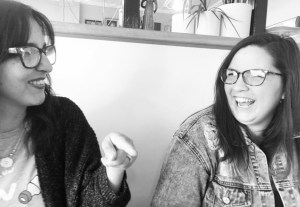
Right here, Georgie and I ARE being shiny, happy people.
At the beginning of National Diabetes Week, I often think we should create some sort of drinking game for every time the tabloid news churns out diabetes myths and misconceptions. I realise the flaw in this idea – we’d all be drunk by 9am on launch day and stay that way for the remainder of the week.
Diabetes myth busting is exhausting. Honestly, sometimes I feel like we need a cape and some sort of auto-reply weapon because we are fired the same comments from every angle and it gets boring: No – diabetes isn’t contagious. Yes – I still have diabetes. No – it’s not only kids that are diagnosed with type 1 diabetes. No – there is not one type of diabetes that worse/better than another type. Yes – I can eat that. No – I can’t cure my diabetes with a diet of kale, kombucha and positive affirmations to the fairy god of keto diets.
As we fire back our response with accompanying eye rolls, muttering things under our breath and wondering when the stupidity is going to stop. (Spoiler – it’s not.) It is tiring and it seems never ending. Sometimes, we just can’t muster up the energy to respond, so we don’t. And that’s absolutely okay.
My level of frustration about diabetes misconceptions varies depending on where it is coming from. I kind of expect it from commercial television; I expect better from the ABC and SBS (as I wrote here about kale-kombucha-gate).
Where I find my frustration levels hit fever pitch is when those misconceptions and myths are perpetuated amongst the diabetes community.
This week, there was an article circulating about what type 1 diabetes is really about. I’m not sure if it was a new piece or if it resurfaced because it was NDW. I am all for using this week to set the record straight and ensure that what is written is factual.
What I am not for is when people try to explain type 1 diabetes by stigmatising type 2 diabetes. That makes me really, really mad. Explaining what type 1 diabetes is and how it works can be done without making type 2 diabetes sound like it is the fault of the people living with it. But time and time again, I see people with type 1 (and parents of kids with type 1) use phrases like ‘My/My child’s diabetes is the one they didn’t bring on themselves’ or ‘My/My child’s diabetes can’t be reversed – I/they have it for life’.
Type 1 diabetes is serious, and it is seriously misunderstood. But so is type 2 diabetes. As people living with type 1 diabetes, we know how frustrating it is when people get it wrong; we know how awful we can feel when people say things that make us feel bad. And we know how maddening it can be when people say things that make us feel blamed and shamed for having type 1.
So why is it the default position of many living with (or affected by) type 1 to throw people with type 2 under the bus as if they don’t have the same response we do when people get it wrong. Those feelings of stigma and shame we feel? People with type 2 have them as well.
I have type 1 diabetes, and for a long time, all the work I did centred around type 1 diabetes. I make no apologies for that. In fact, I built my career by growing from the ground up an unapologetically and exclusively type 1 diabetes program. There was a huge gap that needed filling, and the diabetes organisation I was working for at the time was prepared to throw resources at making that happen.
I wrote the other day that I know I will be focusing a lot on the National Diabetes Week 4Ts campaign which focuses on the symptoms of type 1 diabetes. This isn’t only because I have type 1 diabetes. It’s because so many of my friends diagnosed with type 1 – especially those diagnosed as adults – have horror stories to tell and I truly believe that a smooth, boring type 1 diabetes is far, far better than a traumatic one.
It is absolutely okay to have a focus for your own advocacy – no one should be made to feel that they have to fight for everyone or every single issue. I know a lot of people who fundraise exclusively for type 1 diabetes research because improved treatments and finding a cure is the most important thing to them. All the power to them, I say.
But there is no need to build up one cause by pushing down another. It’s not okay to fight the stigma of type 1 diabetes by contributing to the stigma felt by people with type 2 diabetes. And it’s not okay to correct people for not getting the facts about type 1 diabetes right by getting the facts about type 2 diabetes wrong.
For me, it all comes back to this: all diabetes sucks and no one asks to get diabetes. We’re all doing the best we can with whichever diabetes has been served up to us. Saying something so others feel bad makes no sense at all.
This is an edited version of the first post I ever wrote about my experiences attending the Kellion Victory Medal Award Ceremony. I wrote it back in 2011 (for the old Diabetes Victoria WordPress blog), ten years into working for a diabetes organisation, and already had attended a number of these award ceremonies.
Since this post, I’ve written about other ceremonies I’ve been lucky to attend, and shared the stories of the medal recipients. I love hearing their tips and tricks, and tuck away their words of advice for when I need them. Peer support, I think, as I hear them talking. Their stories are our stories are my stories…
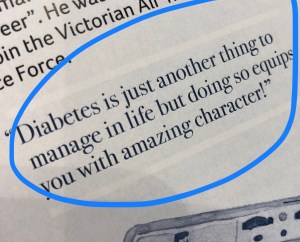
Today, I’m back for this year’s Victorian medal ceremony. I flipped through the program and read the stories of the people receiving their medals. This was my favourite quote for the day. It’s so, so true.
Today is my favourite day of the work year. It’s the Kellion Victory Medal award celebrations where we acknowledge people who have lived with diabetes for 50, 60, 70 and even 75 years. Just stop for a minute and think about that. Seventy-five years with type 1 diabetes. Now think about what diabetes was like back then: urine was boiled, needles were sharpened. Home blood glucose testing was still about forty years away, modern insulins hadn’t been considered. Insulin pumps, of course, were things of the future.
When I started working at Diabetes Victoria, I had lived with diabetes for just under four years, and in that time I hadn’t met anyone else with type 1. I was still getting used to the new reality that had opened up the day I was told that I had type 1 diabetes. My 27 year-old self had re-written my future, and instead of the life I had imagined, I had reshaped that into one that involved terrifying diabetes complications, probably no children and a reduced life expectancy. I pictured myself unable to take care of myself at a time in my life where I wanted to be travelling and seeing the world. And I saw a life where my still-new husband would have the burden that is a wife with diabetes.
Because that was the picture of diabetes that had been presented to me in the four years since my diagnosis. Time after time, the health professionals I saw delivered news of doom and gloom. And inevitability. Hope was not discussed. Except, strangely, the promise of a cure in five years – although I could tell that even the medicos telling me this didn’t believe it. I felt devoid of hope. Hopeless.
And then I was invited to the Kellion Medal ceremony. I can still remember clearly my apprehension about attending the awards, but I went along to Parliament House to see what it was all about.
It was the best thing I could have done. It wasn’t about living with diabetes for decades. It was about LIVING. I heard tales of travels, raising families, busy and successful working lives. Stories of being pioneers to make sure people with diabetes were not discriminated against. I heard stories of hope.
Kellion medallists are in every way remarkable – not because they are inspirations for living with diabetes. That’s just what they have to do as part of their life. They’re remarkable because they’ve made diabetes just something they do. In learnt that I needed to stop holding them up as some sort of magical unicorns – they were just playing with the cards they’d been dealt. The same way I do.
Each year I walk away from the awards ceremony with an ‘injection’ of motivation and determination. And a booster shot of hope. That’s my response to the day and the medalists – but not their responsibility.
We have a duty to be honest to people newly diagnosed with type 1 diabetes. Promising a life that is full of puppy dogs and bowls of cherries does not accurately paint the picture of what life with diabetes is all about. But neither does scaring people senseless. When people are in that initial fog, where they can’t see beyond the end of the week and they are starting to rewrite their future, that is when they need stories. The positive and real ones. The stories of hope.
If I could find a way for every person newly diagnosed with diabetes; for every parent of a child newly diagnosed; every partner, loved one, sister, brother of someone newly diagnosed with diabetes to attend the Kellion Medal awards, I would.
There is no promise of a cure, no threat of nasty complications, no dread of being a burden. But there is laughing and sharing and amusing stories. And hope. To meet a Kellion Medallist leaves people feeling one way: filled with hope.
More musings from ADA, this time following yesterday’s diabetes-related complications session.
DISCLOSURES
I am attending ADA as part of my role at Diabetes Australia. My economy flights and accommodation have been covered by the organisation.
I was reminded of this post from a couple of years ago when I was recently speaking about hypo simulators. I understand that there is some merit in trying to help people not living with diabetes understand some of the day to day issues and challenges we face. The idea is that this can create empathy, and a greater insight into how we feel about living with diabetes.
I also am very critical of these ideas when they are given more weight than they should. When we simulate something to do with diabetes, the focus is in the physical and practical. Wearing a pump (as described in this piece) or CGM will provide experience of feeling the device on one’s body, and learning how to drive it. It gives little more.
When I first published this piece, a GP friend who lives with type 1, said that he likened this experiment to him shoving a pillow up his jumper and walking around for a few days and then claiming to know what it is like to be a pregnant woman. Another friend said that sitting in a wheelchair for a few days may give her an idea about how hard it can be to manouever a wheelchair around, she would have no understanding of what her friend who lives with quadriplegia deal with day in, day out, our how she truly feels.
I am interested to know how others feel. I did receive some criticism when I first wrote this. When I shared in on Facebook, a friend said that I should at least credit the doctor for trying. Perhaps I was too critical – it wouldn’t have been the first time.
When we reduce diabetes to being about nothing more than the daily tasks and devices, we seriously undermine the effort it takes to live with diabetes each and every day.
I would love to know what others think….
I was recently sent an article from Medscape that was written by Svetlana Katsnelson MD, endocrinology fellow at Stony Brook University Medical Center in New York.
The gist of the piece is that for a week as part of her endocrine fellowship training, Dr Katsnelson wore an insulin pump and checked her BGLs, and now believes she knows about living with diabetes. She also considers herself non-compliant because she didn’t bolus for an apple.
This may be oversimplifying the article a little and I honestly do believe that the intention here is good. But a little perspective is needed, I think. It was this comment that really upset me:
‘The experience provided me with a better understanding of how to use the devices that many of our patients use every day, but it gave me much more than that. I truly began to understand how difficult it is to live with diabetes.’
No, Dr Katsnelson, no. You do not truly understand how difficult it is to live with diabetes.
What you have is an idea of what it is like to walk around with a device delivering non-life saving saline into your system. You also have an idea of how it sometimes hurts when a sharp object pierces the skin on your finger. You probably could have deduced that anyway because, you know, sharp object, skin, nerve endings etc. You know how the buttons of these devices feel under your fingers and the weight of the devices in your hands.
You may have an idea of how tricky it can be to accommodate a pager-like device if you are wearing a pretty, flowing dress to work (if that is your want). You may now understand how annoying it is to have to stop what you are doing because it’s time to do a BGL check.
But what you don’t understand is that diabetes is about so very much more than that.
Here is what you don’t have any idea about.
You don’t understand the feeling of ‘this is forever’ or ‘I never get a holiday from this crap’. I know that this was acknowledged in the article, but really, you don’t know how it feels to never be able to escape diabetes.
You have no concept of the boredom of living with a chronic health condition, or the monotony of doing the same tasks each and every day over and over and over again!
You don’t understand the fear that overtakes your whole being as you imagine all the terrible complications that have been threatened and promised as result of diabetes.
You have no notion of the frustration of living with a condition that doesn’t have a rule book – and in fact changes the rules all the time!
You haven’t any perception of the fear I sometimes feel that I’ve passed my faulty genetic matter onto my beautiful daughter; or that I am a burden to my family and friends.
You will never feel the judgement from healthcare professionals because numbers are too high or too low – or that there are not enough of them.
You will never be called non-compliant by a doctor or made to feel guilty because you are eating a cupcake – all because your beta cells decided to go AWOL.
While I really do commend the notion of HCPs trying the ‘day in the life’ (or ‘week in the life’) idea, I think that being realistic about what this experience provides is important. It does not give any insight into the emotional aspects of living with a chronic health condition. It doesn’t explain the dark place we sometimes go when we are feeling particularly vulnerable or ‘over it’.
I have to say that all in all, this article left a sour taste in my mouth and I don’t like to feel that way because it sounds like I am being Grouchy McGrouch. I’m not. And as I said, I think that the intention here is good.
I just don’t want Dr Katsnelson to think that she now knows what is going on in my head when I wake up at 4am and every terrible scenario plays out leaves me feeling a pressure on my chest and a blackness in my mind that threatens to overtake me.
But I also want Dr Katsnelson to know that I really don’t expect healthcare professionals to know and understand all of these things. I expect them to treat me with respect and dignity. If this exercise has helped that, then great, but please, call it for what it is.
The article discussed in this post (Svetlana Katsnelson. Becoming the Patient: Not as Easy as It Looks. Medscape. May 12, 2014.) can be accessed here by first creating a free login.
Last Thursday morning, still wracked (and wrecked) with jet lag from having just returned from ten days in Europe, I boarded a flight to Manila. I would be co-facilitating a workshop for people with diabetes from across the Philippines about how advocacy, community and engagement. If I’m completely honest, I had no idea what was in store for me.
I knew that the PWD who would be attending had all been through a diabetes camps program in the Philippines. They were all young and very eager to step up as advocates. They were the reason the workshop was happening – they realised it was time to elevate the PWD voice in advocacy efforts in their country and they wanted some help in doing just that.
And so, the idea of a workshop was conceived, and the two facilitators were flown in from opposite sides of the planet to pull it all together. Enter me and the Grumpy Pumper (who for once had to travel further than me and was more jet lagged than me).
As the facilitators, we were there to talk about some examples of effective grass roots advocacy, talk about how engagement with other stakeholders is important, and highlight just why the voice of those living with diabetes is critical when it comes to lobbying. We had an vague outline of just how we thought the workshop would run, but we really wanted to ensure that the attendees could shape it the way they wanted, asking relevant questions and walking away with information that would help them.

Once the workshop started, it was very, very quickly apparent that we already had a thriving, dynamic and enthusiastic community in the room. They just weren’t seeing themselves that way. Over the course of the workshop, we saw the ten PWD realise that their own stories and voices are important and have real currency, and they are an unstoppable force when they came together. If ever I needed a reminder of the power of community, I’d have found it there in that room in Manila!
There will be a lot more about the weekend workshop in coming days. I’m still getting my head around it all and am not really sure what to write just yet. It may take me some time. What I do know is that the DOC now has some new voices. Their perspectives will be different to those we often hear about, and that diversity is always good in a community.
So, while I’m getting my words together, get to know these amazing young advocates. They’re on Facebook here; Twitter here; and Instagram here.
DISCLOSURES
Novo Nordisk covered costs for the advocacy workshop. Grumps and I were invited to facilitate the workshop as part of our involvement in the Novo Nordisk DEEP Program. Novo covered by flights, accommodation and ground transfers.
Language matters. I feel I’ve said it so many times, and yet I still have people asking me why it is so important. So, I’m revisiting this post from just over twelve months ago which explains just how the words we use to talk about diabetes has an incredible flow on effect. Read on…
I had a great conversation the other day with someone who was interested to talk about diabetes and language with me. ‘I’m trying to get a better grasp of why it’s something so important to you, because, quite frankly, I couldn’t care less what people say about diabetes.’
This isn’t the first time people have asked me this. And it’s certainly not the first time I’ve been asked why I spend so much time speaking about diabetes language matters.
I know the reasons, but to be perfectly honest, I’m not sure that I have them especially well mapped out when I need to explain them. So, let me try here.
There is a tangled and complicated link between the words used when talking about diabetes, and how we feel about it and how diabetes is perceived by others. That link then goes off on all sorts of LA-freeway-like tangents to include diabetes and stigma, and discrimination.
The effects of how we frame diabetes can be felt by us individually. But they can also be far reaching and affect how others feel about diabetes.
We know that language has the potential to make people with diabetes feel judged and stigmatised. In fact, most PWD I know have at some time or another faced someone speaking to them using Judgey McJudgeface words. Of course, we all respond differently to this. For some people, it’s water off a duck’s back. They couldn’t care less what people say and just ignore it. For others, it’s almost a challenge – they use it as motivation to prove that they ‘won’t be beaten’.
But that’s not the case for everyone. For some people, it can be absolutely paralysing.
Fear of being judged and shamed may lead to some PWD to not wanting to attend HCP appointments and, as a consequence, falling behind on complication screening. Some PWD may not even tell their loved ones they have diabetes for fear of being judged. I have met PWD who made the decision to keep their diabetes a secret and for years, not telling another person. This can add to feelings of terrible isolation.
When diabetes is spoken about in stigmatising and demeaning ways, this leads to the spreading of misinformation. And this can have far reaching consequences.
We know that kids with diabetes may be teased by their schoolmates. Their teachers may not respond appropriately to diabetes because of the way diabetes is framed in the media or by others. We can’t really blame teachers. If diabetes is punchline fodder for every B-grade comedian, or an excuse to point fingers at those living with it by every tabloid news outlet, how can we expect anyone to take it seriously?
(And if right now you are thinking ‘This is why we need to change the name of type 1 diabetes’, stop it! People with type 1 diabetes shouldn’t be teased or mocked or judged, but neither should people with type 2 diabetes. This isn’t about people understanding the differences between type 1 and type 2 – this about understanding diabetes.)
The language we use when talking about prevention in diabetes – whether it be preventing type 2 diabetes or preventing diabetes-related complications – means that there is an underlying idea that developing type 2, or complications must be the fault of the individual. ‘If you can prevent it and haven’t, it’s your fault. You obviously lived an unhealthy lifestyle/are lazy/didn’t listen to your doctor/failed to follow instructions/refused to do what you were told etc.’.Can you imagine hearing that, or feeling that is what people think about you – all the time? This is the language – these are the words – used to talk about diabetes.
A couple of weeks ago in the UK, it was Prevent Diabetes Week. I saw countless tweets from people urging, begging, pleading with others to remember that type 1 diabetes can’t be prevented and the week refers only to type 2 diabetes. I wonder if those tweeting realised that comments such as these actually contribute to the stigma associated with type 2 diabetes? Of course type 1 diabetes can’t be prevented. But in many cases, neither can type 2 diabetes. There are so many non-modifiable factors associated with a type 2 diagnosis – factors beyond the control of the individual.
But let’s look beyond individuals, the health system and the education system for a moment. What else happens in other settings when diabetes is spoken about in stigmatising ways?
Health organisations, including diabetes organisations, frequently seek donations from the public to continue the important work they do. There is only so much money in the donation pie, and yet there are more and more competing organisations representing people with different health conditions wanting a piece of that pie.
Donations are harder to come by from the general community when there is the idea – the wrong idea – that diabetes is a largely preventable lifestyle condition that is the fault of those diagnosed. There is not the idea that people who have developed cancer brought it on themselves, even though we know that some of the risk factors associated with a breast cancer diagnosis are the same as for type 2 diabetes.
Research dollars for diabetes are far less than for other health conditions. We see that every year when successful NHMRC grants are announced. Diabetes is the poor cousin to cancer research and CVD research.
Diabetes is just as serious as any other condition that is worthy of research dollars and fundraising dollars. Yet because of the way we speak about it and the way diabetes as a condition has been framed, there is a perception that perhaps it isn’t.
Words matter. Language matters.
So, what I want to say to people who think that talking about language and words is a first world problem that only occupies the minds of the privileged is this: I acknowledge my privilege. But this isn’t simply about words. It’s about perception.
Until diabetes is considered the same way as other conditions that are taken seriously and thought of as blameless, the trickle-down effect is people with diabetes will continue to feel stigma. Diabetes will continue to be the poor cousin of other health conditions and diseases because there is the misconception it is not as serious. People will not as readily make donations towards fundraising initiatives. Research dollars will continue to fall short, instead going towards ‘more worthy’ conditions.
That’s why I care so much about diabetes language. Because, language matters… so much.





 Diabetogenic
