
You are currently browsing the category archive for the ‘Advocacy’ category.
At last year’s World Diabetes Congress (WDC), it was terrific to see a significant number of ‘consumers’ attending. For the first time in Australia, people with diabetes were directly encouraged to attend a scientific conference.
However, there was much disappointment that people living with diabetes who had registered to attend were unable to access the Exhibition Hall.
Expo Halls at conferences are an endless source of interest and excitement. I am usually registered as a speaker so I have full access to conference Expo Halls and it is during my wanderings that I find out about the latest and greatest in technology and treatment therapies. I get to speak with reps from the companies and ask questions that are usually not addressed in the glossy brochures, and, most importantly, I get to pick up and handle new devices to see how they feel in my hands, fit in my handbag (always returned!) or sit in my bra (it’s where I wear my pump; not trying to steal anything!).
The frustration at WDC was that as well as hosting the displays for pharma companies, the Expo Hall also accommodated device companies. Consumers couldn’t get in there to see the latest meters or pumps.
And here is the problem. In Australia, we have the Therapeutic Goods Act 1989 (the Act) which states that advertising of prescription-only medications to consumers is prohibited. However, it is okay for devices to be promoted directly to patients.
The Act is out-dated and it’s time that we revisit the current ban on promotion of drugs to people with health conditions. Why, as a person living with diabetes, can I not speak with the pharma company releasing a new insulin? Why can I not ask their reps about side effects and drug profiles and why the new medication is better or how it is different to what is already on the market?
The truth of the matter is I can find this information anywhere I want. A quick visit to Professor Google will provide me with the answers to any questions; patient blogs will explain the consumer perspective and an image search will even show me the packaging of the medication. When the Act was written, it was 1989 and the internet was not in the palm of everybody’s hand.
But today? Today such restrictions are ridiculous and only promote the idea that the people actually living with whatever health condition the medication has been designed to treat are too stupid/too ignorant/can’t be trusted with this hallowed information.
The ridiculous thing is that even if I can see and read about and ask questions to do with drugs and new therapies, I can’t simply go and buy them. I can’t rock up to Mae, my gorgeous pharmacist, and ask her for the large pack of whatever new drug I’ve just read about.
There is still the ‘middle (wo)man’, the doctor. But what is so terrible about me going to see my doctor and asking about a certain therapy? How is saying ‘I’ve read about this newly listed medication and I was wondering if it is something that would work for me?’ going to do anything other than empower me and encourage a balanced and consultative relationship with my HCP?
The current system reinforces all the things that patient advocates are trying to break down: out-dated ideas that the keepers of knowledge must only be healthcare professionals and that patients will be told what to do. And then do it. It forgets who is actually driving the bus that is my healthcare. Me!
Additionally, the Act as it stands now only serves to hold back real consumer involvement and engagement at scientific conferences. I don’t subscribe to the archaic ‘conferences aren’t a place for patients’ attitude held by many out-dated HCPs. We should be looking to events such as Doctors 2.0 and You for how to bring together patients and HCPs. We should be looking to the ADA conference which has a significant number of consumers in attendance – all of whom are freely permitted to wander the Expo Hall. We should be moving away from the ‘us and them’ approach so entrenched in Australia.
Last week, I attended a workshop given by Rosie Walker who is a UK-based diabetes and education specialist. You can read more about Rosie and her independent company Successful Diabetes here. The focus of the session was diabetes consultations and I was eager to go along as the ‘consultee’ as opposed to the consultant (most of the other participants).
One of the topics was how consulting rooms can be more ‘patient-friendly’. After this discussion, I asked if we could, for a moment, steer the conversation to waiting rooms.
I see my endo in private rooms and there is nothing particularly offensive about the room I wait in until she calls me in. It’s quiet, there are plenty of chairs and some out of date magazines on the table. I’m always pleased that there are travel mags, so I can do a little armchair travel as I while away the time.
My GP’s waiting room is a little more bustling. It’s larger, the phone doesn’t stop ringing and, because it is a very busy practise, people come and go constantly. There are signs on the walls asking people to not use their mobile phones while waiting to see the doctor in an endeavour to keep some of the noise down. The magazines are about health and wellbeing or home renovation. And golf. Someone in the clinic is a golfer and recycles their mags in the waiting room. Again, pretty innocuous and not an unpleasant way to spend some (often considerable) time waiting for my name to be called.
But I have seen some slightly terrifying things in waiting rooms that have made me want to turn around and walk out. Once, in a presentation I was giving in the waiting room of a diabetes clinic, I did actually draw attention to the horrendous poster which depicted graphic images of amputated toes.
I am not sure who thinks that it is a good idea to put up scary photos of ‘what will happen if you defy me’ in waiting rooms. Is there any logic in showing photos of amputated limbs, eyes with diabetic retinopathy or terrifying slogans of ‘diabetes is deadly serious’? Does this make people skip into see their doctor eagerly, or fear they may be threatened? At its worst, it’s akin to bullying. At best, it’s thoughtless and unnecessary.
Often, people sitting in waiting rooms are already anxious and scared about what is waiting for them. Will there be results from tests that could be bad news? Will the HCP be cross because diabetes hasn’t really been a priority lately? I know that I am often apprehensive about what is waiting for me behind the doctor’s doors and I don’t do HCPs who do judgement.
Waiting rooms need to be a safe haven, free of judgement, nastiness and fear. They need to calm us down and make us feel that we can be open and honest once we get to see the doctor.
For me, my dream waiting room would look like this:
Lots of natural light so I can see outside; not too much noise, but equally not so silent that I’m afraid to speak; details about relevant information events coming up; a barista in the corner making the perfect coffee (I said DREAM waiting room); comfortable chairs; free wi-fi; no TV blaring health messages (although, one of my HCPs does have Bold and the Beautiful on loop, so I get to catch up on that when I’m in their waiting room once every 12 months); gorgeous prints on the walls (absolutely no scary photos); a pin board with research news.
In lieu of perfection, however, I’d just be happy with a comfortable chair, some architecture and house porn and a water station. And a lovely, non-judgemental HCP on the other side of the door.
What do the waiting rooms you’ve spent time in look like? What would you like to see?
When I was growing up, our family GP was a crotchety, tiny man who seemed old to me when I was a kid. Given that he is still working today, he can’t have been much older than I am now (eeek!). The main things I remember about him is that he prescribed antibiotics at pretty much every visit, wore lifts in his clunky shoes to make himself taller and chain smoked during appointments.
As soon as I was old enough to choose my own doctor, I found a GP who I was comfortable with. She was the doctor I saw that April in 1998 when I told her my symptoms and asked to be tested for diabetes. She was the doctor I saw the day after Easter to get my blood test results. And she was the doctor who diagnosed me with type 1 diabetes with the words ‘Fuck. You’ve got diabetes.’ She was a good GP, but had an unhealthy interest in anti-ageing medicine and plastic surgery. I let her go after a consultation where she had to kneel on a seat for the entire visit because she’d just had liposuction and couldn’t sit down. Dealing with my own body image issues, I wasn’t sure that having a GP who was so focused on improving her body using surgery was sending me the right message.
After that, I spent some time drifting from clinic to clinic, rarely seeing the same doctor. It wasn’t ideal, but it did the trick.
A couple of years after I got married and a couple of years into my diabetes journey (the never-ever-ever-ending journey of diabetes) I was living across town and thought it time to find a local GP. Dr H had been recommended by a few people, so struck down with a virus that wouldn’t quit, I called to make an appointment.
‘Dr H is not taking new patients at the moment,’ said his incredibly officious gatekeeper. ‘We’re one doctor down for the next month. He won’t be seeing new patients until then.’
‘Great! I’ll take his first free appointment he has next month,’ I said.
‘And what will you be seeing Dr H about?’
‘Well, probably nothing then. But I want to get my name on the books. Plus, I have an exciting (i.e. senseless and convoluted) medical history. I’ll need some time to explain it to him’.
The next month, with absolutely nothing wrong with me, I sat in the waiting room avoiding the sniffling, coughing masses as I waited to see him.
I was pleasantly surprised to meet a doctor who understood that his role in my diabetes was not to manage it in any way. After providing satisfactory answers to his questions about the HCPs I worked with to help me with my diabetes, he explained that he saw himself as the traffic cop of my general health who could direct me in the right direction if I needed to see someone other than him.
I showed him my insulin pump – it was the first time he’d seen one. (This was 13 years ago now and pumps were still quite uncommon.) He asked me lots of questions about it and my other medical things and I left feeling that I now had a GP who would understand what I needed.
About eight months later, I made an appointment to see him. He called me in and followed me into the waiting room. Before I’d even had a chance to sit down he said ‘Where’s your insulin pump? Don’t you wear it anymore?’ The first time I’d seen him, it was strapped to the belt of my jeans. Since then, I’d started wearing it down my top, hidden from view. ‘Oh, good! I have a lot more questions,’ he said. ‘I’ve done some reading up and I was wondering if you could explain a few things to me.’ At that point, I realised he was a keeper!
I see Dr H only a couple of times a year. He always asks general questions about any correspondence he’s received from my endo or other HCPs. I am sure next time I see him, he will ask me about my recent cataract surgeries. But he knows that in my case, diabetes is not his concern – I have that taken care of.
I frequently hear stories of GPs who simply don’t understand diabetes. I hear of misdiagnosis after misdiagnosis and, quite frighteningly, of GPs who have such minimal understand of type 1 diabetes that it puts their patients in danger. Dr H has enough understanding of type 1 diabetes to know that it’s not his place to manage it. He says he always refers people with type 1 to an endocrinologist as they, along with the PWD, are the ‘content experts’. He doesn’t ‘blame’ diabetes for every medical complaint I present with. As I said, he’s a keeper. If only it wasn’t so bloody hard to get an appointment with him!
I first heard of the International Diabetes Federation’s (IDF) Young Leaders in Diabetes (YLD) Program when I attended the World Diabetes Congress in Dubai in 2011. There, I met some of the young leaders and heard about the program’s aims and intentions.
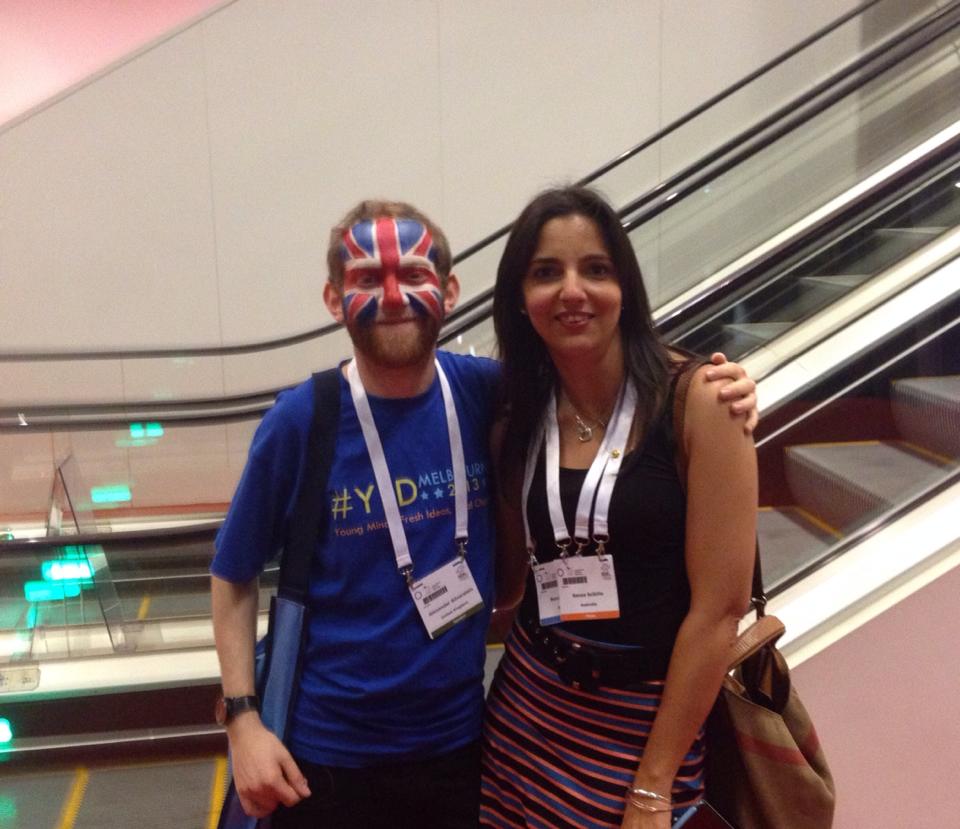
Alex Silverstein at the opening ceremony of the World Diabetes Congress in Melbourne last December. He’s usually less elaborately painted up!
I knew just how valuable and important this program would be when I first met Alex Silverstein in Chicago last year. Alex was the first President of the YLP and I could see why he had been selected to take on this role in the program’s early years. He’s smart, dynamic, passionate about the cause, funny and just a downright nice guy – I’m blessed to call him a mate. I’ve been lucky enough to meet up with him again at other conferences, including in Melbourne where he handed over the presidency to the equally awesome Keegan Hall.
In the lead up to the World Diabetes Congress in Melbourne last year, the YLD representatives spent some time together working with diabetes advocates and HCPs for their Leadership Training. They discussed global diabetes issues, how to effectively communicate and advocate were covered. I was invited to attend the session on social media use and was amazed at the enthusiasm and commitment in the room. The program involves 132 young people from 70 countries around the world, each with a different story about life with diabetes.
We need advocates with strong voices and the IDF should be commended for bringing together this group. Under the direction of Debbie Jones and Paul Madden and a smart and dedicated faculty, this program provides a voice for young people living with diabetes from around the world, many of whom would otherwise not have the opportunity to tell their stories and advocate the needs of their peers. Many are focusing their energies on highlighting issues such as access to insulin in countries where this life-saving drug is considered a luxury and the associated costs prohibitive.
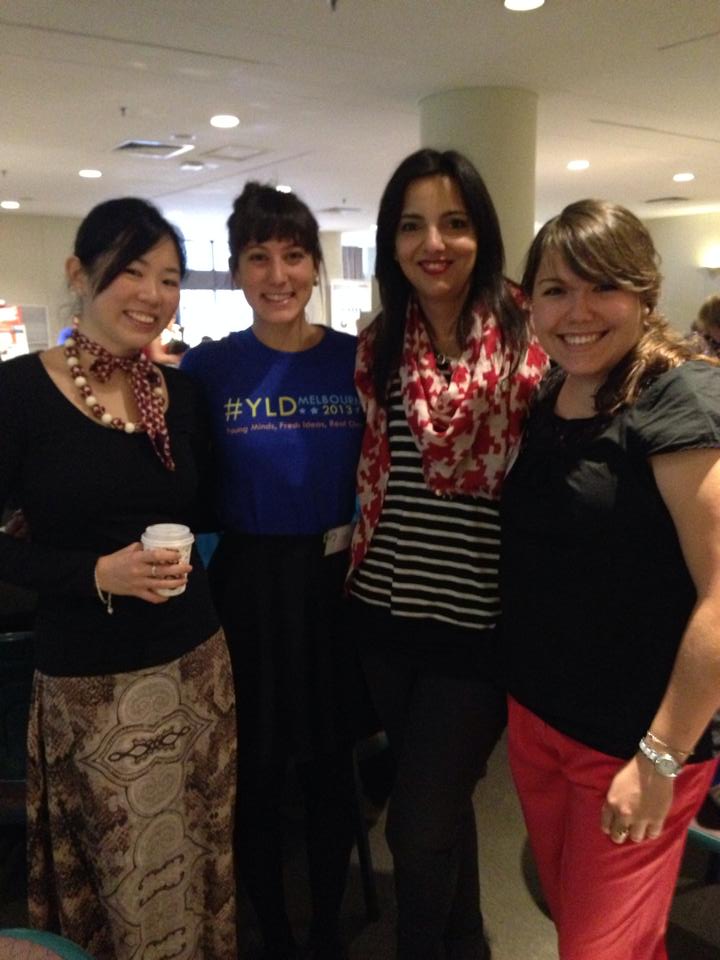
The Aussie YLD contingent (plus an old bag).
Our Australian representatives on the YLD program are three of the most intelligent young women I’ve had the pleasure to meet. Ashley, Stephanie and Rachel did us all proud in Melbourne at the IDF Conference. They continue to be advocates for young people with diabetes in Australia through the YLD Program as well as the Diabetes Australia Young Leaders Program. Ashley is a regular blogger and has recently been involved in setting up a Facebook page to bring together young adults with type 2 diabetes.
See some of the young leaders in action in this great new video.
Yesterday as I skimmed a few news sites and social media sites, I came across endless diets, weight loss fads and a downright disturbing article about ‘bikini bridges’ which, it appears, is the latest in ‘thinspiration’ trends (we’ve moved on from the thigh gap, apparently). I caught up on a piece about ‘diabulemia’ and thought about how diabetes adds an extra degree of difficulty to all things – even eating disorders.
The relationship between weight, food and diabetes is so complex and confusing. We’re told to maintain our weight to remain healthy (or prevent developing type 2 diabetes in the first place); we’re told to manage our cholesterol for heart health; we’re told that certain foods are taboo; we’re told we need to eat at certain times to prevent lows; we’re told we should eat a lot of carbs/not too many carbs (depending on who you listen to today); we’re told to cut sugar (tweet below gives you some indication to how I feel about that one!) and we’re told that our waist circumference is yet another number to think about.

Quitting sugar (or anything else for that matter) will not cure type 1 diabetes.
Now take diabetes away and we’re told a heap of other things.
There are polls about who has the ‘hottest’ body as if it is something that can be measured, and there are ‘half their size’ magazines at the supermarket. Ads for The Biggest Loser are already on our screens. Faux-concern is directed towards celebs who seem to have lost too much weight. Between fat-shaming and skinny-shaming, it appears no one is safe.
We refer to women’s bodies as ‘hot’ as if they are pieces of meat to be graded. There is no consideration for whether they also happen to be intelligent, have a strong social conscience or are good at horticulture. Or knitting or whatever it is that they are good at. Because it doesn’t matter. As long as they look hot.
Women become known as specific body parts (except Elle Macpherson who is known as ‘The Body’ which means that no one cares what’s going on in her brain). Pippa Middleton isn’t known for being Pippa Middleton. She’s known because her arse looked ‘hot’ in a white dress.
Apparently having a certain body shape makes a woman ‘authentic’. Curves, allegedly make a woman ‘real’, whereas being skinny somehow, miraculously, makes her less real. Believe me, as someone who has at times had some decent curves to hold on to and then at other times can see bones protruding, I’ve always been real.
I don’t think much about my weight. It’s never been an issue for me and I’ve never been on a diet. During periods where I’ve tried to eat better, the focus has been health, not weight loss. Also, I love Nutella too much to even contemplate cutting processed foods out of my life. Also, bacon. And cupcakes.
And yet.
Daily, I find myself struggling with how I feel about the dozens and dozens of images that I see. I’m confused at how I should feel about my own body. Today, I look in the mirror and see that I am probably the thinnest I’ve been in some time, meaning I’m closer to the ‘body ideal’ that the fad diets promise. And yet, I look at my collarbones – all sharp angles – and feel slightly ill.
Where in there is the message that to be happy with ourselves we need to – well, be happy with ourselves? Where are the messages of celebrating who we are for more than how we look in a pair of skinny jeans? In fact, can we stop referring to jeans as skinny, please?
The discussion needs to shift. We need to stop talking about weight loss and ways to look ‘hot’. No one can achieve the things being promised. In fact we’re all destined to fail. But health? Health is something we can all work towards achieving. And if each step is measured by our wellbeing – not the size of our thighs – we’re working towards something worthwhile and meaningful. Feeling better inside. And my guess is that will have far longer-reaching consequences than detoxing for a few days.
World Diabetes Day is drawing to a close across the world. The clock is about to turn over into 15 November but it seems that blue lights will burn brightly for some time to come.
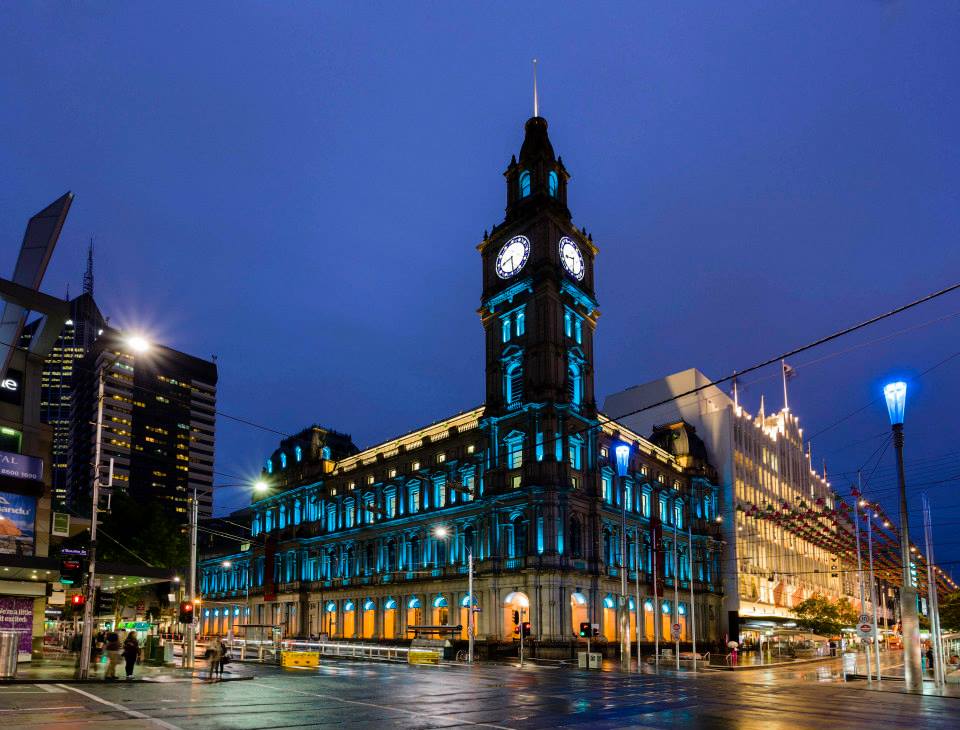
Melbourne’s iconic GPO gets its blue on for WDD13
My WDD started on its eve with an important event for diabetes research. The 2014 Diabetes Australia Research Trust awards presentation gave 22 Victorian researches grants. Many people aren’t aware of the commitment Diabetes Australia makes to research each and every year. This year alone over $3million dollars was given, including the $150,000 Type 1 Millennium Award which is specifically for research into type 1 diabetes.
After the awards, I found myself in the Melbourne drizzle wandering down to the GPO. As I approached, I saw it lit in blue. It looked splendid! Staff from Diabetes Australia – Vic and some of the Diabetes Australia Young Leaders donned blue ponchos and held all manner of lit-up blue things (I got a wand!! I’m just like Hermione!!) and stood in the glow of the GPO. This is part of the IDF’s global light up a monument campaign. You can read here for other iconic buildings and monuments that have been washed with blue. It was some fun for an important awareness-raising activity. And now, I have a blue wand!
On WDD proper, I found myself up just after 4am and on a 6am flight to Sydney to answer some questions about diabetes on a new breakfast television show. Studio 10 ended its morning with a discussion about World Diabetes Day and I was asked about life with type 1 diabetes. It was an opportunity to bust some myths which I’m up for pretty much any time! You can see the interview here.
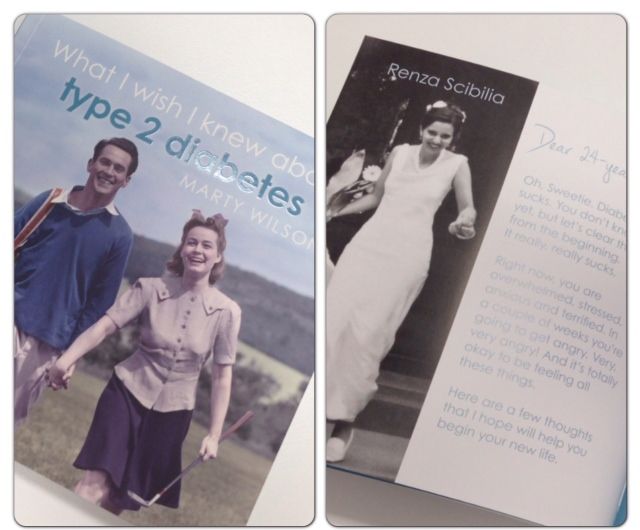
What I wish I knew…..
Next up was the launch of a new book called What I wish I knew about type 2 diabetes which is a collection of stories of people living with diabetes (all types – not just type 2 despite its title) and health professionals working with PWD. This gorgeous little book by Marty Wilson tells wonderful tales of people who have lived with diabetes for many years. It also includes one of my previous blogs. Look out for the book – it’s definitely worth a read.
World Diabetes Day is an important day for the diabetes community. It is our day to talk about diabetes and have others thinking and talking about it too. Whether it be international organisations like the IDF who yesterday released new global diabetes statistics in their Diabetes Atlas, or local and national diabetes organisations like Diabetes Tasmania who attended Government House for an event with some of their Young Leaders, or community events and activities like the global 24-hour diabetes Twitter chat, it’s a day where diabetes is front and centre. My Facebook and Twitter streams were full of blue and family and friends commented on my posts and even posted on their own pages about diabetes. (A shout-out to my sister who got TOTALLY in the WDD-spirit by wearing blue circle earrings and plastering her Facebook wall with WDD messages. Thanks, Toots!) I even pinned blue circles onto our real estate agents’ very suave suits as they came to do an open for inspection for our house sale last night. Everywhere I looked I saw blue.
Diabetes may not be understood by everyone. But yesterday was a day where we could talk about it and hopefully give people a little more understanding about what life with diabetes means.
Of course, it doesn’t end here. The WDC is in just two weeks. Let’s keep the conversation going. And don’t forget the OzDOC get together on 3 December as part of WDC!
Within a two week period, I was dealing with the same issue on opposite ends of the world. Firstly, I ranted wrote about a child being told that his pump would be ‘taken away from him’ because his A1c was too high.
Then the following week at a conference far, far away, I was speaking with someone who can’t access a pump because her A1c is too low.
So apparently, if your A1c is high, you get your pump snatched away from you and if your A1c is in target, you’re not eligible for one.
Can you see what’s wrong with this picture? In both instances the decision as to whether or not a particular treatment option is being advised is based purely on a number. No consideration is given to things like quality of life, a desire for more flexibility, a desire to try something new or a love of gadgets. Or the simple ‘Because. I. Want One. Dammit’.
No – a number that provides nothing more than an average is being deemed the criteria for recommending (or removing) a therapy option.
Also, the decision for which management therapy will be utilised is being made not by the person living with diabetes, but their healthcare professional.
How do we win here?
I will never stop advocating the rights of people with diabetes to be THE person who gets to choose the way they manage their condition. But sometimes I feel the uphill battle gets harder and harder with more and more obstacles being put in the way and more and more hoops for us to jump through (metaphor much?).
There are days I really feel like throwing my hands in the air and admitting defeat. The more stories like this I hear, the more disheartened I become. When and how will the person with diabetes be put front and centre in the decision making process about their own diabetes? When will numbers stop being criteria to assess success or determine appropriate management? When will the threats stop and the judgement end and true collaboration begin?It’s time for us to say: Diabetes – my condition; my rules!
I am very fortunate that my job allows me to do a bit of interstate and international travel. Working for a not-for-profit means that while there are some opportunities for attendance at conferences, finding sponsorship is necessary if I want to attend all the conferences and meetings that are worthwhile and beneficial to my job.
Last month, Johnson and Johnson kindly sponsored my travel to Barcelona for the EASD conference, specifically to attend its second annual European Bloggers Summit. As the only person from Diabetes Australia lucky enough to be given an opportunity to attend the conference, I knew that I would be waving the Australian flag enthusiastically as I spoke about our experiences with diabetes social media and blogging. I searched out all the relevant, social media-focussed sessions and made sure I could get to them.
The day after arriving, I attended an IDF symposium about how social media can improve the lives of people with diabetes. The symposium was on the Sunday before the Tuesday start of the EASD meeting, so unfortunately, it wasn’t as well attended as I fell it should have been.
Given my recent presentation at the ADS/ADEA conference, I was very interested to hear this session – especially the presentation by Claire Pesterfield because as well as being a PWD, she’s also a diabetes nurse. Claire made some really interesting and valid points about how difficult it is for HCPs to jump on the social-media-as-support bandwagon when in most hospitals sites such as Facebook and Twitter are blocked by the hospitals’ IT people. It’s not really all that easy to tell people about great online support networks if the ‘red screen of death’ pops up every time you try to log on to one of them. I’ve been told that this situation is mimicked here in Australia.
We also heard Paul Buchanan (moderator the GBDOC tweet chats) speak about his recent (ridiculous, crazy, lunatic) arrival in Barcelona. From Brussels. On a bicycle. Paul and his group Team Blood Glucose were part of the Mobile Health Grand Tour – made up of a group of people who forgot that there are planes, trains and automobiles available to assist in the 2,400km journey from Brussels to Barcelona. Paul spoke about how social media and new diabetes technologies were employed on the ride. Interesting stuff!
 The Euro Bloggers Summit ran on the Tuesday and Wednesday. It was a couple of days of workshops and presentations which covered how we could improve the numbers of people reading our blogs and ensure that we have the right ‘look and feel’ to them so that they were attractive to readers.
While the formal presentations were interesting and provided me with a lot to the think about, the thing that was the most valuable was the time spent speaking and networking with the other bloggers. There was a common theme in the room. While we like to think that there are people reading our blogs, it’s not really about the numbers. The real reason we all do what we do is because we are trying to connect with others who are going through the same things. We’re hoping that someone will read what we write and say ‘I thought I was the only one. But I’m not. I don’t feel so alone anymore’. We are telling our stories and sharing our fears and hopes while we look out for people who can share their stories with us.
Social media has the ability to remove all the things that get in the way of us feeling connected. We don’t worry about geography and thanks to translating software, language barriers can be broken down. Even pesky time-zones differences seem easily surmountable.
Being in the room with people who are doing the same things as me is an incredible privilege. Getting to hear about their work and their lives is an honour and I am grateful for every opportunity I get to learn from them. We need to start creating more opportunities like this in Australia. The World Diabetes Conference is the perfect chance for that to happen. Please take advantage of the fact that this significant diabetes meeting is being held in Melbourne and that there is discounted registration available to consumers. I’ll be there and I really hope to see some of you too!
Disclaimer
Johnson & Johnson covered my travel and accommodation costs so I could attend the Animas European Bloggers Summit. They were also kind enough to cover registration costs to the EASD meeting. There was no expectation that I would write about the Summit (or them). As part of this arrangement, I will be presenting for them at their booth at the World Diabetes Congress in Melbourne in December. You should come along and heckle me!
Myths to do with diabetes frustrate me as much as the next person. I want people to get it right when they are talking about diabetes; I want the media to report diabetes correctly and I want facts presented in a clear, non-threatening, easy-to-understand way. Of course, this is relevant to all types of diabetes.
What annoys me is people who are furious about one myth, but more than happy to perpetuate others.
Some people in the type 1 diabetes community are outraged if they are lumped in with people with type 2 diabetes. Campaigns and petitions have been developed to change the name of type 1 diabetes to avoid confusion between the two conditions. The thought of being thrown in with people who ‘brought this on themselves’ (that, by the way, would be another myth and completely unhelpful) results in Facebook posts, Tweets and blog after blog after blog.
Me – I couldn’t really care less. I have type 1 diabetes, I know it and I’m happy to educate anyone who has no idea about autoimmune diabetes. I’m also too tired and just plain over this discussion, so I try to avoid it. I do acknowledge that if it wasn’t for the significant number of people with type 2 diabetes, I’m pretty sure that the 120,000 of us with type 1 in Australia would get lost when it comes to funding and media attention.
But, for some it is a real issue and they get angry and do anything they can to make sure that they are seen as different from the majority of people with diabetes in Australia – the type 2 diabetes community. And that’s fine. If that’s what your thing to get angry about is, knock yourself out. (My thing changes every day. Today it was that I didn’t get a cup of coffee in me until after 11.30am.)
There are many other myths about diabetes and they annoy me more. Here are just a selection that I’ve come across in the last couple of days:
- If you use an insulin pump you have diabetes ‘really bad’ (wrong and rotten grammar!)
- If you have diabetes, you can’t eat sugar
- If you weren’t so lazy you wouldn’t have type 2 diabetes (genes anyone)
- Diabetes isn’t really serious
- Cinnamon cures diabetes (okay – it was me banging on about that, but I was just trying to justify in my own head eating an apple cinnamon muffin.)
- You can catch diabetes.
- You grow out of type 1 diabetes (blood. starts. boiling.)
I immensely admire and respect the work done by the Juvenile Diabetes Research Foundation, but using the term ‘juvenile diabetes’ just fuels the myth that this is a condition that only affects kids. Focusing on children who have diabetes is incredibly important, but those kids are going to grow up and hopefully live long, healthy, happy lives. Where is the awareness and focus on adults with diabetes? The reason the term juvenile diabetes isn’t used anymore is because it doesn’t accurately represent the broader type 1 diabetes population.
Of course I’m being somewhat self-serving. I was diagnosed as an adult and my experience of life with diabetes is through the eyes of someone who has lived with it since my mid-twenties. But during that time, I’ve needed information and services and programs that just weren’t there. Information about pregnancy, body image, parenthood, work life balance – things that are relevant to me at this stage of my life – was quite thin on the ground!
I completely agree and believe that there needs to be programs and activities developed specifically for kids with diabetes. Diabetes in day care and school settings is a critical issue to be addressed; camps for kids with diabetes are brilliant. But this is an ages and stages condition. Why is there not as much of a focus on other periods? Whilst some attention is being given to transition from adolescent to adult health care, what about for men and women with diabetes in their thirties and forties? Where is consideration of women going through menopause or for people at retirement age? Why is no organisation focusing on older adults with diabetes in aged care?
If people want to make sure that the world understands that type 1 diabetes is different to type 2 diabetes, then surely they also want to break down other myths about type 1 diabetes. This is not a condition that only affects children. Half of those diagnosed with type 1 are diagnosed as adults. The majority of people in Australia living with type 1 diabetes are adults.
Break down the myths. Educate people about what type 1 is all about. Just don’t do it at the expense of all the facts.
Is there a myth about diabetes that annoys you?
Each and every day I make dozens of diabetes decisions. I decide how many carbs I will eat and how much insulin I need to inject to cover those carbs; I decide how much glucose I need to treat a low BGL; I decide if it’s the day to change my pump line (or try to get an extra day out of it); I decide whether or not to eat something before taking a walk. All of these decisions impact on my BGL and my diabetes management.
And I prick my finger up to 10 times a day and based on the number displayed on my little machine I often decide how much of a potentially lethal drug I will inject into me.
That is the reality of life with diabetes. I say it not to be dramatic. It’s just part of what I do.
And I say it because if you ever think that the numbers displayed on that little machine are not important, think again. Close enough is not good enough.
In talks I give, I often say that how our diabetes paraphernalia looks is important and anyone who thinks that we are being shallow or vacuous because we want a pink pump or a pretty meter case doesn’t understand the monotony of life with diabetes. The fact that my meter case is pink and red and has poppies all over it and is from a Finnish design company makes me less pissed off every time I have to reach for it to stab my finger and check my BGL.
BUT! The most important thing of all is that I can trust what the meter and strips housed in that bright case tells me. Because I make regular decisions based on the number on the screen. I treat low BGLs if the number is below 3.5mmol/l; I decide if I’m happy to go to bed and sleep without any carbs if the number is at or around my bedtime target; I decide if I need to eat some carbs before I exercise; I decide if I’m happy to get behind the wheel of my car and start to drive. I decide if I am going to give myself a correction dose of insulin. All of these things have the potential to go wrong if that number isn’t accurate.
I may want my new meters to come with a gorgeous case or to have a light where the strip goes in for ease of use for night-time testing. I like the idea of meters that tell me of daily BGL patterns or those that use cartridges of strips to help avoid the inevitable strip detritus that decorates every room I’ve been in. I like that it takes only 5 seconds to give me a result and that less and less blood is needed on the strips. All of these things are great, but pointless – completely pointless – if I can’t trust the result. Accuracy. THAT’S what’s important. Most important.
Have a look at what’s going on in the USA with the fabulously named Strip Safely campaign.





 Diabetogenic