
You are currently browsing the category archive for the ‘Advocacy’ category.
It was a lovely morning – a lazy weekend sitting in a local café, drinking fabulous coffee, skimming through the papers and discussing the Amy Winehouse doco we’d seen the night before. The kidlet was still being spoilt by her grandparents, and Aaron and I were making the most of a leisurely breakfast.
We were at one of our favourite cafes in our area. The coffee is consistently excellent, the food is great and the owner is one of the nicest people I have ever met. Being in his café is one of my favourite things to do on the weekend. (Plus they make the most amazing home-made marshmallows. Totally bolus worthy!)
We finished up after sneaking in a second round of coffees, and meandered to the front of the store to pay.
‘They look awesome,’ the guy ahead of us was saying to the barista, pointing at the delicious-looking fudge-y, chocolate brownies on the counter.
‘Yeah; they are really great. So sweet. You get diabetes just looking at them.’
The next noise was the sound of my head spinning and my hair whipping around.
‘No you don’t,’ I said – loudly enough for them both to hear. The customer turned around and the barista looked at me. I was a little terse, but not rude.
‘I mean it. Really, they are so sweet,’ said the barista.
‘Doesn’t matter how sweet they are. You still won’t get diabetes eating them. You really shouldn’t say that. It’s not true.’ I turned to Aaron. ‘I’ll be outside. I’m done here.’
And there it is. Again. The stupid, ignorant, insensitive, offensive, throw away comments about diabetes. Comments that also happen to be untrue.
At Nova the night before, we watched the heartbreakingly sad story of Amy Winehouse in the brilliant, but harrowing, documentary Amy.
This incredibly talented young woman was hounded by the media as she dealt with addiction. And at the moment when she most needed support and help, late-night television show hosts thought it was amusing to make fun of her. They thought it was hilarious to comment on her alcoholism or weight loss or drug abuse. They thought that a vulnerable young woman who was falling apart was a great target for their cheap jokes.
And apparently, diabetes is too.
It is not funny. People who are living with health conditions are not a punch line. Diabetes is not here to use as a material for a cheap joke. The condition that I work so bloody hard to keep in check – every minute of every single day – is not a chance for you to try to be witty (which, incidentally, you are most likely not!).
All of that came flooding to my caffeine-fuelled mind as I stood there, waiting to pay the other morning. ‘Am I overreacting?’ I asked Aaron when he walked out of the cafe. ‘No. Not at all.’
People who are dealing with health issues – no matter what they are – need support. We need people to try to understand what we are doing. We occasionally need to be reminded that we are doing the best we can.
It’s actually quite simple. Diabetes is not a joke. Stop thinking it is.
Amy Winehouse singing The Girl from Ipanema is a thing of beauty. Here it is.
 Some dot point facts:
- It’s National Diabetes Week here in the wonderful land of Oz.
- It’s about all types of diabetes. Every. Single. Last. Type.
- 280 people are diagnosed with diabetes each and every single day in Australia.
- All types of diabetes sucks.
- No one asks to get diabetes.
And now some dot point observations:
- There is no merit in changing the name of the different types of diabetes. None at all.
- I am yet to hear a decent argument about why we should change the name of type 1 diabetes to something else.
- Having said that, if you can incorporate the word ‘unicorn’ into a new name for type 1 diabetes, I might get on board. Although probably not. I just want a unicorn.
- Many health conditions have ‘types’ and ‘sub-types’. There are five different types of lupus. Can you name them? Can you tell me how they are different? If someone said they have lupus, would you be able to engage in a meaningful discussion about their ‘type’ of lupus? I know I certainly couldn’t – and my mum has lupus.
- Quite frankly, I don’t care what type of diabetes the 280 people diagnosed each day have. It is all diabetes and it is all a condition that is significantly underfunded, a condition which carries horrendous stigma and a condition which is crap to live with.
- What I do care about is that there is increased awareness about all types of diabetes. I care that more research dollars are thrown at diabetes. I care that more healthcare professionals know about diabetes and about diagnosing ALL types, quickly. I care that people living with all types of diabetes have access to healthcare and devices and medications and support.
- The whinging and whining and bitching and moaning that is coming from some circles is tedious. Especially considering the whinging and whining and bitching and moaning is being done mostly amongst like-minded people so nothing is actually being achieved.
And finally, a comment:
Last week, I sat in on MasterLab, a two day advocacy workshop run by the wonderful Diabetes Hands Foundation. In the room were some of the most successful, vocal, passionate, smart diabetes advocates in the world. These are people who take their cause to government and make changes for people living with diabetes, who raise awareness about living with diabetes and raise funds to help support people living with diabetes. They do it without fanfare and without accolades. They just do it.
How many times do you think there was a discussion about the different types of diabetes? How many times do you think parents of kids with diabetes in the room tried to say how much tougher they have it than others with diabetes? Or people with type 1 diabetes complaining that no one understands why it is more difficult than type 2? How many times do you think that type 2 diabetes was demonised?
Not once.
Because those smart people in the room – the people who are respected and listened to in the wider diabetes space – know that there is no point in working against each other.
But you know what? I’ve been saying this for some time and there are people far more eloquent than I on the same page.
This is from (US-based) Diabetes Patient Advocacy Coalition (DPAC):
How will you share a unified patient voice for a disease as diverse as diabetes? (Type 1 vs. type 2, parent vs. child, etc.?)
DPAC has committed to the idea that diabetes doesn’t discriminate. We have no interest in promoting cross-type discord. There are benefits of numbers, passion, and reach in various parts of the diabetes community. We all benefit from all those skills. If an individual has an interest in raising their voice to help people with diabetes get access to safe and quality products and services in the United States, then we welcome them with open arms.
Divided we can be ignored. Together we make a difference.
And in her wrap-up of last week’s MasterLab, my friend Alanna wrote this brilliant blog post. And this closing paragraph:
We as a community need to stop putting our walls up. Nobody, not you, not me, not the president of the USA can advocate for change in diabetes care and treatment until we educate effectively. Defending your “type” and throwing the other under the bus is unacceptable behaviour, and is counter productive to creating positive change and a world without the financial, physical and emotional burden of diabetes.
I am calling on all of my readers, old and new to commit to never trying to defend your type, and only defending the human beings who are living with mal-functioning pancreases so we can really get to work.
Another friend, Kerri Sparling wrote this last year, speaking about the wonderful Walk with D initiative.
The diseases are different in their origin but so similar in how they map out physically, and more importantly, emotionally, and I wish I had known that earlier. I wish I had been more supportive of my type 2 peers. I wish I had known how they felt.
I have lost friends because of my stand on this issue. I have had arguments with people who think that I should be using this blog and my voice to advocate for changing the name of type 1 diabetes or rallying against people not understanding the differences between the types of diabetes. I have had people challenge me and ask me what I stand for – what my diabetes advocacy is all about.
The answer is simple. I am against diabetes stigma. I am against building up one type of diabetes at the expense of another. I am for access to healthcare and devices and medications for all people with diabetes. I am for a unified community. I am for the wonderful #OzDOC community which is a beacon in Australia of unity within the diabetes world, and congratulate Kim Henshaw in promoting an inclusive, supportive and downright fun platform for all people with diabetes to connect.
It doesn’t mean we have to agree on everything or all be focusing on the same issues. It just means that we work together and are kind to each other. #TypeAll
Gorgeous new James Taylor CD made its way into our home yesterday. Angels of Fenway is a favourite given that I was there just a few weeks ago.
We got here. Thirty-two hours, four plane legs (thanks to an unexpected stop in Tampa due to thunderstorms closing Orlando airport), a kid who vomited her way through pretty much all thirty-two hours of the four plane legs, and hour and hours of low blood sugar somewhere over the ocean.
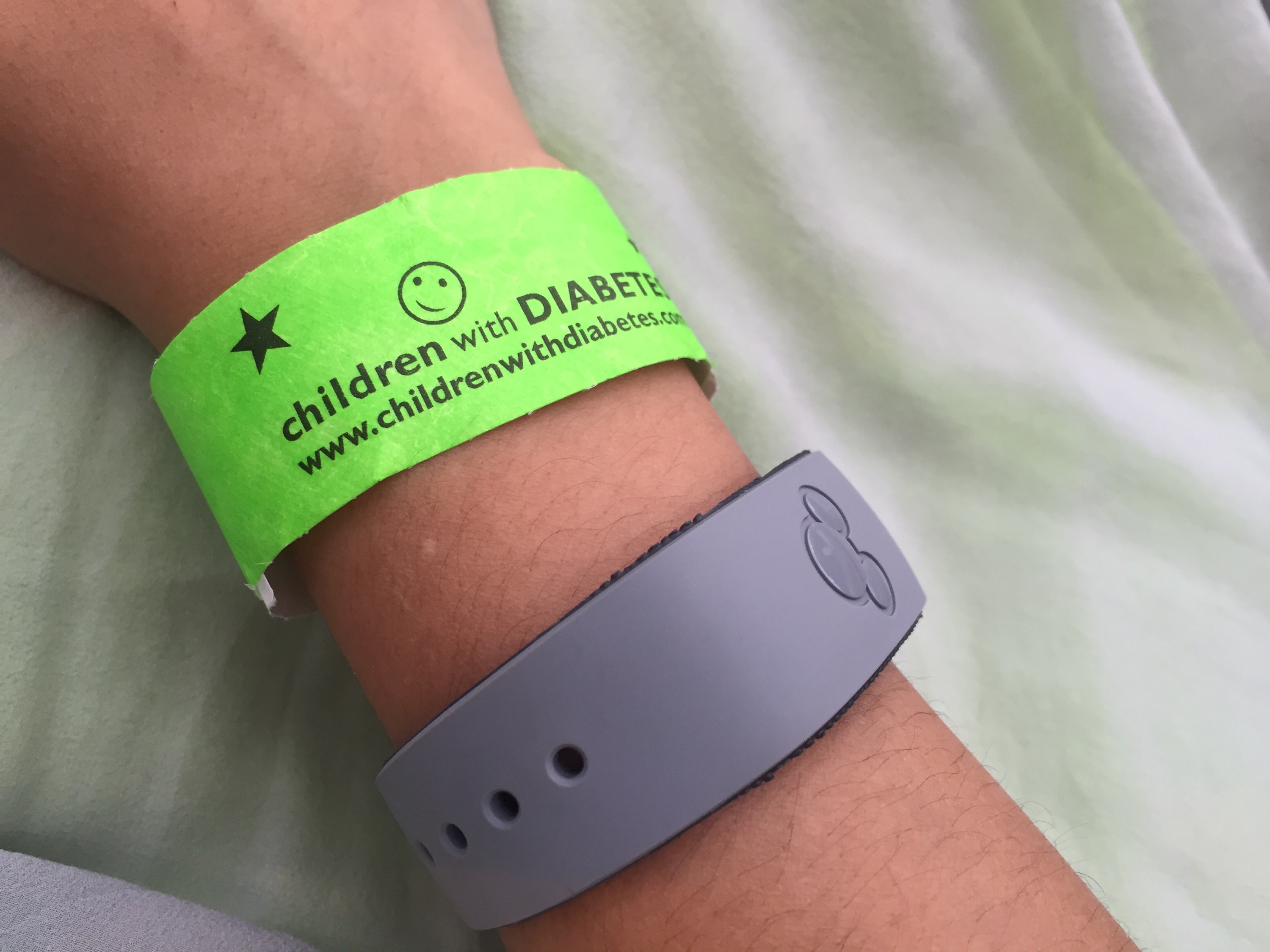
And now on my wrist is a bright green band. I’ve reconnected with friends I’ve known for years here and made new ones. And there are strangers by the pool with matching green bands and matching pumps hanging from their bathers.
My family are getting to know the Friends for Life family, being welcomed as warmly as I was when I first met everyone.
‘They look like diabetes people,’ said Aaron as we were walking around the lake the other evening.
‘How do you know?’ I asked him, wondering if he had developed a diabetes-detecting superpower.
‘She has a pump attached to her pocket,’ he said, nonchalantly.
And she was. I hadn’t even noticed.
It’s going to be a big, big week!
Follow ow along at home:
The Diabetes Hands Foundation MasterLab Summit – “A More Effective Summit’ is using #MasterLab and Friends for Life is at #CWDFFL15
Yesterday was Social Media Day. Actually, it’s still going in the northern hemisphere.
And here is an example of how to be a dick on social media:

Now, after being a dick on social media, here is what you should do. (It’s actually quite easy.)

Instead here is how you keep being a dick:

(The Nick Jonas reference was in response to this tweet.)
Seriously CrossFit, shut up!
Also, if you want to insult all people with diabetes, how about trying something original? This has been done to death. Jamie Oliver did it earlier this year; Aussie comedian Dave Hughes did it a few years ago. And a pathetic little café in Sydney did something similar exactly 12 months ago today. It’s old…really old.
Making fun of health conditions is not clever. It shows ignorance and it is just plain nasty. How about you show some kindness and talk about how your program can actually help people living with (all types) of diabetes? Wouldn’t that be inclusive rather than divisive? Novel, I know.
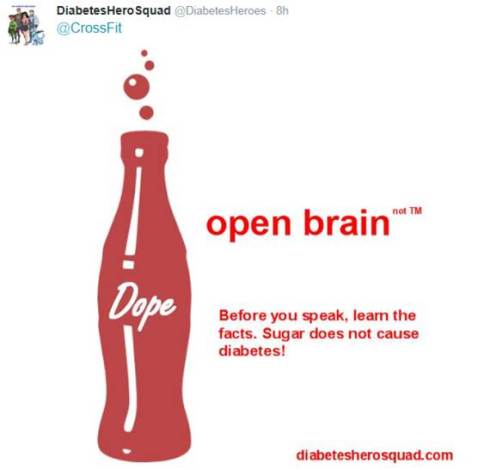
Last word goes to the Diabetes Hero Squad (who makes me laugh daily!) with this.
Consumer engagement. There are a couple of buzz words if I’ve ever heard them.
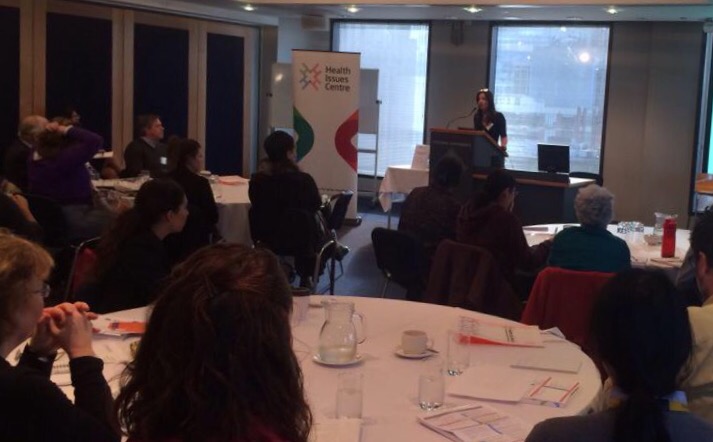
Today, I am attending the Health Issues Centre Forum, ‘Listening to the Consumer Voice: what does healthy dialogue look like in 2015?‘ I was the opening presenter where I spoke about the role of the consumer in healthcRe.
My position is clear – consumers have a place at every conversation taking place about healthcare. Whether it be at a governance, strategic or operational level, the voice of the consumer should be the loudest and proudest in the room.
All too often, this representation is tokenistic. It is an all-too-simple ‘tick-the-box’ requirement of health services. And it’s the same in the broader health community.
Most of what I have heard today I have heard before. This discussion has been going on for a long time, and as one of the speakers said ‘Why are we even having this conversation anymore?‘ And he is right. Why do we need to be defending the right of the consumer voice? Why is it not a given?
My talk was followed by palliative care physician, A/Professor Natasha Michael who gave a fabulous talk about the challenges faced by clinicians for finding the balance between ‘benevolent paternalism’ and patient autonomy.
Her analogy was simple – if she contracts an electrician to do some work for her, the last thing she wants is the electrician to stand in her house and ask ‘Where would you like me to put the green wire? And the red one? And the blue one?‘ They are the expert – that’s why she called them.
At face value, that sounds reasonable. But actually, I don’t think I really am comfortable with it because it completely minimises the expertise I have gathered in the 17 years I have lived with diabetes.
When I expect to engage in a dialogue with my HCP it is not discrediting their expertise; it is acknowledging that I have something to bring to the table.
At a higher level, consumer involvement can emote difficult. How are consumers included in strategic decisions, on boards and at a governance level? And how does that work?
Possibly my favourite take-home message from today came from Damian Ferrie who is the CEO of Inner South Community Health. Damian said that measuring if consumers are participating in a meaningful way is quite easy: ‘If consumers have no power to influence in your organisation, it’s tokenistic.’
I wish I could say that I am seeing more examples of consumers having power to influence, but that isn’t the case. Our involvement is still tokenistic. It is largely unpaid which further reduces our worth.
And yet, health services and health organisations claim frequently that they are listening to the consumer voice, that consumers are critically important, that consumers are the basis of their work.
By and large, I think it is lip service, with primarily examples of organisations talking the talk, but not walking the walk. And that is why we are still having these conversations. We need to be. I wish we didn’t. But we do.
Tomorrow, I am flying to Boston to attend the American Diabetes Association 75th Scientific Sessions. (Play along from home by following #2015ADA!)
There will be a strong consumer (reminder to self – use ‘patient’) contingent, which is always terrific. I get to catch up with old friends from the DOC and hear what they have been up to. I learn about new consumer patient-led advocacy efforts that manage to cut through in a way that only people living with diabetes can. I am reminded that conferences ARE the place for people living with the health condition that is being spoken about at that conference.
I attend conferences with my eyes wide open and leave with great excitement. I see new technologies yet to be released here, or still in development. I hear from people on trials of new drugs and devices. And I see the potential and possibilities for making diabetes easier, more streamlined, more user-focused and feel inspired and hopeful. This is good.
But, I am approaching this conference with a slightly different attitude. With some of the recently announced changes to diabetes supplies in Australia (as I wrote about here and here), I really want to speak with some of my US DOC friends about what it means to be reliant on a health system that limits choice. We have never really had that to date.
Whilst we may not have access to every pump or meter on the market, the consumables for the devices that are here have been available to all. Distribution has been overseen by Diabetes Australia (please read the disclaimer in this post!!) – an organisation representing people with diabetes, not big business or shareholders.
Last night, I attended a dinner at Parliament House in Canberra for the Parliamentary Friends of Diabetes Group. It was a grand occasion, attended by many influential politicians. Health Minister, Sussan Ley made this comment:

This is, indeed a noble pursuit.
Diabetes Australia President, Judi Moylan stated:

I would ask that in amidst all of those politically-charged reviews, reports and cost-cutting measures that seem to be the focus of diabetes in Australia at the moment, the human aspect is identified. It is hard to find amongst all the facts and figures.
But it is absolutely critical for our leaders to consider if they want to do best by people living with diabetes. Extraordinary leaders would search for it, find it – and make sure they listen to it. And remember that those extraordinary leaders include people living with diabetes.
There is much inequality with the health system here in Australia. I know that we have it better than a lot of other countries, but unfortunately, it’s not fair for all. However, there are some things that are, indeed, great.
I have always been exceptionally proud of our National Diabetes Services Scheme. I love telling people about it when I am travelling, explaining how it makes the lives of people with diabetes considerably easier. We don’t need to get our health insurance providers involved; no one is forcing us to use one particular make of meter or strips because that is all that is covered; registering on the NDSS is not all that difficult.
The NDSS has been around since 1987, and in a health system of oft-quoted disparity, it is a shining light in its fairness. (I say this with full knowledge and understanding that people with type 2 diabetes do not have access to insulin pump consumables, but this therapy is primarily used by people with type 1 diabetes – even before the NDSS subsidy came into effect back in 2004.)
However, when it has come to needles, BGL strips and other consumables required in the management of diabetes there has been no discrimination; it has been available to all.
Until now.
Last week, Commonwealth Health Minister, Sussan Ley, announced that following the findings of the Post-Market Reviews of Products Used in the Management of Diabetes, BGL strips would no longer be available to people with non-insulin-treated type 2 diabetes as they have been to date, questioning the effectiveness of self-monitoring of blood glucose (SMBG) for this group.
The report (Part 1 – Blood Glucose Test Strips) announced that people with non-insulin-treated type 2 diabetes will have limited access to BGL strips. That is, access will be provided for up to 12 months’ supply of strips – initially six months and then an additional six months if it is determined the person with diabetes will benefit from further monitoring. The decision is in the hands of the healthcare professional – not the person with diabetes.
The Minister claims these findings to be in line with the Choose Wisely campaign, which, when it comes to type 2 diabetes, I also consider to be flawed.
When the PBAC reviews were first announced (back at the end of 2012), I wrote this piece for the Diabetes Victoria blog about why limiting access to diabetes consumables for any group of people with diabetes is potentially damaging – especially when it relates to taking ownership of managing diabetes – and short sighted. I actually think it is downright irresponsible policy making.
The findings of this review concern me – they worry me greatly. This is the first step in removing control of the tools we need to manage our diabetes in the way we choose. The removal of choice is destructive and limits our ability to tailor our healthcare to our needs.
I don’t have type 2 diabetes, so this in no way affects what I am able to access through the NDSS. But I know many people with non-insulin-treated type 2 diabetes who rely on regular BGL monitoring to assist them to live well with diabetes. They use it as a tool to make better food choices, noting how certain foods affect their BGLs. They use it to monitor the effectiveness of exercise as part of their diabetes management. And they use it because it gives them a sense of control, piece of mind and ownership over their health.
This is sending the message that non-insulin-treated type 2 diabetes is not serious. And that is a very, very dangerous statement to be making.
Disclaimer – I was involved in Diabetes Australia’s submission to the PBAC on all aspects of the Post-Market Reviews of Products Used in the Management of Diabetes. Diabetes Australia strongly supported SMBG for people with non-insulin-treated type 2 diabetes in Part 1 of the reviews.
If you have diabetes and live in Australia, it is highly likely that at some point you would have received some information, support and/or education from Diabetes Australia.
These services range from the provision of information via websites, blogs, magazines, information sessions and webinars. They also involve activities such as camps for children with type 1 diabetes, peer support groups, targeted information sessions which look at issues including men’s health, women’s health (including the very important topic of pre-conception planning and care), programs for young people with diabetes, programs for older people with diabetes, including those in nursing homes, working with culturally and linguistically diverse groups, delivering programs to Aboriginal and Torres Strait Islander communities and the training of health professional training.
More? Well, there is also a huge body of advocacy work – both at an individual and policy level – that takes place, as well as representation on expert panels and working groups.
Yesterday, it was announced that the Government has signed the 6th Community Pharmacy Agreement (6CPA). This agreement covers the supply of PBS medicines and, more broadly, pharmacy remuneration for dispensing subsidised medicines.
A significant change in 6CPA from previous agreements is that from July 2016, NDSS products will be distributed through the pharmacy wholesaler distribution network. This is where it starts to affect people living with diabetes.
Basically, the NDSS is broken into two parts. There is the product supply and delivery component and then the support services component. The latter is where all those things I listed earlier in this post fall.
Okay – let me get the disclaimer palaver out of the way. I work for Diabetes Victoria (formerly Diabetes Australia – Vic). I also have a national role where I work for Diabetes Australia. I am a long standing member of the Diabetes Australia family – something of which I am incredibly proud. My work involves providing information and support services to people living with diabetes in Victoria, and managing a national project about young people and diabetes. I am a spokesperson for the organisation – especially about diabetes technology and social media. I do all these things backed by a team of health professional and consumer experts.
Right – with that out of the way, I will also say that I have no more information than what is available in the public domain, so this is not an opportunity for me to be sneaky in trying to get people talking about this to promote Diabetes Australia’s work. That’s not what this is about. This is about what it means to people with diabetes living in Australia. Because I am one of those people.
The 6CPA clearly outlines that product supply and delivery (that is, all the consumables we use to help manage our diabetes) will now be distributed through the pharmacy network. As a person with diabetes, I am confident that this means that the supply of these products is protected (along with the subsidised prices) and that I won’t be expected to pay more for my strips or pump supplies.
But what about ongoing education and support services? Diabetes Australia has a long history of providing evidence-based information. In recent years, there has been a very strong focus on patient-centred care, and most programs now have some sort of consumer input. Engaging people living with diabetes is considered just as important as engagement with healthcare professionals. I know this is true – I am frequently asked to either be a consumer rep, or (perhaps most pleasingly) assist with finding someone to be a consumer rep.
The provision of diabetes information needs to be done by people who ‘get’ diabetes. I am a really strong believer of this. I believe it to be true of all health conditions – there need to be experts (and that doesn’t only include clinical experts) at the helm. And there needs to be a strong link to the community.
These services Diabetes Australia provides change lives – I hear that every time I speak with a parent whose kid has been to a camp. I heard that – repeatedly – on Saturday at the Diabetes Expo where I was emcee. I hope this carries on.
I’m back on the bandwagon today. Or back on my high horse. Or back on my soap box. Whatever analogy you want to use, I’m on something. But I’m always on message!
Last week we heard a story of the tragic and just so very sad death of a beautiful little boy with type 1 diabetes. According to media reports, seven year old Aiden Fenton, who had type 1 diabetes, was taken, by his parents, to a hotel in Sydney, where he was denied food and insulin and slapped repeatedly as part of a barbaric treatment meant to cure him of his type 1 diabetes.
This is a tragedy. There is no other word for it.
The theory behind this brutal treatment is that repeatedly slapping the body builds heat, which will allow ‘chi’ to flow which results in toxins to be released. This will, apparently, cure what ails you.
And while this may be the extreme, what we have here is yet another example of ridiculous assertions by people claiming to have an understanding of health and wellbeing. But there is no understanding. There is no science behind these claims. There is no evidence to suggest that they work.
There’s that word again: ‘toxin’. It’s a favourite with many wellness experts and Instagram diet and fitness frauds who seem to have forgotten that the body has a fabulously powerful and clever organ called the liver. They should Google it – they’ll get pictures to go with explanations of the role this organ plays in the body and its connection to ‘toxins’. Pictures like this one:

You’re welcome.
Thankfully, there are others – many others – much smarter and with much better reach than I asking questions and calling out these dangerous cults.
Yesterday, the CSIRO (I think we can pretty much bet they are all about science) tweeted this.

Yes please; I’ll take one in a 10.
Helen Razer wrote a fabulous (and very swear-y) piece a few weeks ago about the stupidity of the paleo movement and other dangerous messages being regularly expounded by equally dangerous idiots wellness experts. You should read it (language warning again in case those sorts of things offend you.) My favourite line is the caption used under a photo of Pete Evans: ‘Stupid is the new science’. Yes – I want that on a t-shirt, too.
And take a few minutes – well ten and a half – and watch the brilliance of Tim Minchin with this fabulous animated short of his poem ‘Storm’.
Minchin first wrote this as a jazz-backed beat poem for a live show. From there, it was the animated short was made and, most recently, a graphic novel which I’ll be purchasing next time I head to my favourite books store, Readings. You can read how the poem came about in this piece Minchin wrote for The Guardian.
Yes, I know. I keep harping on about the same things. But alternative therapies and the ‘wellness movement’ are responsible for a little boy’s death. They fuel eating disorders, they confuse people, they deliberately and intentionally target the vulnerable who are desperate for answers and cures. And there is no evidence to support that they work in any way. In fact, they harm. A little boy is dead. Just keep thinking about that.
I spend a lot of time dealing with the consequences of my actions when it comes to diabetes. Here are three examples:
Action 1: forget to bolus
Consequence: stupid high BGL
Action 2: Bolus too much
Consequence: stupid low BGL
Action 3: eat Nutella straight from the jar
Consequence: much happiness. (Although if I forget to bolus for it, see Action 1.)
Sometimes, my actions are deliberate (see: Nutella). Other times, they are not (see: forgetting things).
There needs to be a little more consideration when talking about consequences because a lot of time, I see discussions about diabetes consequences that are very unkind. Just because you know what will happen when you do something, doesn’t necessarily mean you deserve for it to happen. And a lot of the time, we don’t know – there is no controlling the outcome of our actions anyway.
But the thing that I am really conscious of is that even if we know what happens – even if we know that the consequence may not be pleasant – we rarely wish for the consequence to happen.
This is particularly the case when talking about the diagnosis of diabetes. No one at any time of their life thinks they would like to be diagnosed with diabetes. At least, I’ve not met anyone who feels that way. I know of no one who has been thrilled and excited at the prospect of a life forever affected by a chronic health condition. There is no high fiving someone who has just told you that you have diabetes. There may be tears and anger and distress. Rarely would there be joy though.
The same goes when considering people diagnosed with diabetes complications. Whatever they do; whatever they don’t do. However they have managed their diabetes. Or not managed their diabetes. No one chooses complications.
I think that we need to remember this. We need to remember that anytime we say words suggesting people ‘deserve’ what happens to them, we are being unkind and we are being judgemental. And these are both things that have no place in diabetes.
I wrote these words a while ago, and thought that it was a good day to post them.
My heart today is with the families of Myuran Sukumaran and Andrew Chan. These were young men who ten years ago did something stupid, stupid, stupid. No one is saying they are angels and no one is saying that they should not have been punished for their crimes. But the consequence of those stupid actions is not proportionate. They did something stupid. They did not deserve to die for it. #IStandForMercy






 Diabetogenic