
You are currently browsing the monthly archive for November 2021.
The very first time I ever saw or heard anyone speaking of an insulin pump was about 14 months after I was diagnosed. It was National Diabetes Week in July 1999, and I attended an event organised by Reality Check, and supported by Diabetes Vic. Reality Check was a support group of young adults with type 1 diabetes. I don’t remember much from the program at the event, but I do remember a woman called Cheryl Steele. Cheryl was living with type 1 diabetes, and she was sharing her story of using an insulin pump and how it had completely revolutionised her type 1 diabetes management. Three moments from Cheryl’s talk stood out for me: the first was that she was able to be more flexible with what she was eating, the second was that a pump gave her more flexibility with being able to sleep in. And the third was that she loved her pump so much that she threatened to cut the arms off anyone who tried to take it away from her.
The first time I heard about CGM was years before we had the devices here in Australia. I read about them in online blogs and in support groups led by PWD in the US. I read stories about how this technology was changing the way the managed their diabetes in ways I could only imagine. I heard about Libre for the first time a number of years later when I met Claudio Pelizzeni at EASD, and he shared his experience of using the device as he travelled the world (without taking planes).
The first time I heard about DIYAPS was at an informal lunch thrown by Medtronic (I think) in 2015 (I think) in Boston (I think). I’m sketchy about the details, but I do remember with great clarity that at the other end of the table was a woman called Dana Lewis who I had seen online and read about, and knew to be amazing, but not yet met in person. She was talking about…well, to be honest, at the time I had no idea what she was talking about. All I could see and understand was that she was doing something that sounded like science fiction. She had a number of devices linked together and there was something totally magical happening.
The first time I heard about Loop (the DIYAPS I went on to use) was on a rainy New York night in January 2017 at a pub in the financial district. I was having a drink with a friend and just as he was taking the first mouthful of his stout he said, ‘Hang on, I need to bolus’, and he pulled his phone from his pocket and pressed some buttons. ‘What the what?’ I asked and he proceeded to explain Loop, how it worked, how he’d woken at between 80 and 100 (4 & 5) every single morning for the three months he’d been using it, and how he was sleeping better than he ever had.
When it comes to technology, it has always been up to me to first raise discussions about different devices or options. After seeing Cheryl talking about her pump, I asked my endocrinologist about getting one and his opening line (and closing line, as it turned out) was ‘They kill people; I’ll never allow one of my patients to use one’. That was the last time I saw him, and I went on the hunt to find an endocrinologist who would support my choice. I started on CGM because I enrolled myself in a trial. I was given my first Libre at a blogger event. I cobbled together my DIYAPS after sourcing what I needed. As brilliant as my HCP team is, they have not been especially proactive about suggesting, or even introducing the idea of, different diabetes technologies. It’s been learning through others with diabetes that has set me on that road.
When I talk about what peer support means to me, it goes beyond moral support and shared experience. It has been the driving force behind much of the way I choose to manage my diabetes. It has been the impetus for investigating if something new might be right for me. It has paved the way for me to start conversations with healthcare professionals to make access happen.
Peer support is absolutely essential for the mutual understanding and the tips and tricks for making day-to-day diabetes easier. And I’ve always said that hearing others’ stories help make sense of my own. But it is about much, much more. I’ve detailed the ‘first times’ when it comes to tech, but there have been so many more moments – moments that have helped make that tech work for me in ways I’d not thought, and certainly not had discussed with me by HCPs.
When I speak with newly diagnosed PWD I ask if they know others. I gently suggest that it may be a good thing to think about – not necessarily straight away, but certainly at some point. I can never repay the debt of gratitude I have for people who steered me in the direction to the tools that make my diabetes life that little bit easier, but I can do all I can to give back and try to do that every day.

Why does everyone want to cure diabetes? I mean, I think it would be GREAT if someone truly managed to cure it PROPERLY. But in lieu of that, everyone with internet access, a Canva account, and their finger on the pulse of the latest superfood (which, when said superfood is a legume it actually is a pulse), is out there busily curing diabetes with whatever snake oil concoction they can come up with. (At this point in time, I am going to take a MASSIVE diversion and say that Snake Oil is a thing and it is sold by a woman named Caroline Calloway who is a scammer and all that is wrong with the idea that we need ‘influencers’ in our life, and I would urge you to NOT pop her name into a Google search right now, lest you want to lose the next five hours of your life, and destroy a few brain cells while you are at it.)
Anyway, where was I? Yes, scam diabetes cures. Scamabetes cures.
Lucky for me, I get at least half a dozen diabetes cures delivered directly to my inbox each week. By lucky, I mean, I wish the fuckers would all leave me alone, but that’s not happening.
On days where I don’t get cures in my inbox, I get invitations to conferences that aren’t real, or asked to write for imaginary medical journals. The positive is that it makes me feel as though I am highly sought after, and people desperately want to hear from me. The negative is that they’re all a con, and that rather than thinking I’m somewhat brilliant, these scammers are hoping that I’m somewhat gullible.
The scamming is real in the cure diabetes world, and it never ends. Just at the point where you think it’s been rather quiet in the dodgy-cure entrepreneur corner of the globe, there is suddenly a concerted effort to get you to drop some coin on a turmeric and kale chai teatox for the low monthly price of $39.99 plus tax. What have you got to lose?
How the fuck are we meant to navigate our way through it? Twenty-three years in and being a sceptic with a healthy dose of mistrust in strangers approaching me online asking for money and promising me the world has served me well. I start from a position of disbelieving pretty much everything, which has been super useful in the last two years if you think about the rubbish that people (looking at you Clive Palmer) have claimed to be cure-alls. When future Lin-Manuel Miranda writes a musical about the COVID years, there will be a song dedicated to Ivermectin, drinking bleach, and that weird light thing that Pete Evans was trying to sell us for a cool $15K, and a story of vax-crossed lovers where an AZ and Pfizer jabbed couple try to overcome their differences, succeeding only when they are both boosted with Moderna.
Promises of diabetes cures prey on the vulnerable and the scared. It’s abusive and mean. If diabetes could easily be cured, WE ALL WOULD BE CURED, because I’m yet to meet anyone who wants to live with a lifelong chronic health condition, no matter how much they seem to have their shit together.
If it were as simple as eating a cucumber (looking at you, whichever Kardashian made that outrageous claim), I’d be living on cucumber granola for breakfast, cucumber sandwiches for lunch and having a liquid dinner of cucumber mojitos, and snacking on cucumber dipped into tzatziki. All. Day. Long. And I bet everyone else with diabetes would be too, because even if we all got sick and tired of cucumbers by day three, it would still be a shedload better than dealing with diabetes. Wouldn’t it? Yes. Yes, it would.
In times where it is so easy to spread misinformation as gospel, people with diabetes are taxed with even more. On top of doing the task of one of our organs, do impressive maths calculations throughout the day, act as a multidisciplinary medical team for ourselves, employ some damn impressive detective techniques, and be the most efficient executive assistance in the known universe (all before lunchtime), we also need to sort through the constant stream of information, picking out the trash, and staying on heightened alert. Even though we would probably really like some of those pseudo-science promises to work…even just a little bit.
As I was writing this today, my email pinged and there waiting for me was some ‘research’ (a term here used to mean ‘made up stuff’) suggesting that my diabetes could be cured by taking a daily supplement in a convenient, once-a-day tablet. But wait! There’s more. I could take advantage of the cyber-Monday special and get an extra 23% (random number) discount, if I locked in a twelve-month subscription contract. For the record, even with the discount, I’d be out of pocket for this scam product USD$647 per year. Each ‘film-coated’ tablet contains, cinnamomum cassia, garcinia gummi-gutta, chromium hexahydrate, zinc citrate, glutamine, gymnema sylvestre and citrus extract.
I hit the unsubscribe button, blocked the sender. And instead of ordering that veritable shit salad of ingredients, decided that a better way to ingest citrus extract would be to make some lemon bars, and cinnamon via an apple cake. The rest of the stuff sounds made up and absolutely not likely to make my beta cells start making insulin again.
And so, I donated some of the USD$647 I just saved my not getting swept up in this scam to Insulin for Life. Because you know what? The stuff IFL is giving to people with diabetes in under-resourced countries is something that really works and is really essential. And absolutely, completely and utterly not a scam.

You owe no one.
You owe no one involvement in diabetes awareness activities.
You owe no one Twitter fury and outrage when diabetes is misrepresented.
You owe no one a decision to jump on a bandwagon just because everyone else is.
You owe no one your loud voice, your quiet voice, your whispered voice.
You own no one involvement in their diabetes advocacy efforts.
You owe no one blue eye shadow, blue nail polish or blue hairspray.
You owe no one reminders that diabetes doesn’t stop you.
You owe no one explanations for how you choose to advocate or the causes you choose to support.
You owe no one for the type of advocate you are.
You owe no one reasons for who you decide to work with; and who you decide not to work with.
You owe no one.
You owe no one hope.
You owe no one justifications for the technology you choose, or don’t choose.
You owe no one a podium.
You owe no one details for why you are at a conference, a dinner, a meeting, talking diabetes.
You owe no one the right to uses your diabetes as a teaching moment.
You owe no one marathons or mountain climbs or channel swims in defiance of diabetes.
You owe no one your time to just read their blog post, join their support group, sign their petition.
You owe no one a cheer squad.
You owe no one the words and language you choose to use to help make sense of your diabetes.
You owe no one an insight into your diabetes management, your HbA1c, your CGM curve.
You owe no one.
Except.
Maybe…
You owe yourself love and kindness and reminders that on days when diabetes feels too hard, too big, too sad, too … everything … that doing what you can is enough. You owe yourself room to breathe. You owe yourself space to step back and space to step up. You owe yourself pats on the back and high fives. You owe yourself flowers. You owe yourself the freedom to do diabetes your way and in your own time.
You owe yourself. And no one – no one – else.
Over the last two days (or last two middles of the night if you’re perpetually in the wrong part of the world as it seems I am), I participated in the excellent first World Health Organisation Global Diabetes Compact Forum. (You can read the Compact which was launched earlier this year here.)
Once again, the WHO team had brought together stakeholders, including diabetes advocates, from across the world to talk about some critically important challenges facing people living with diabetes. These included access to insulin, research and innovation and prevention, health promotion and health literacy. The Forum was definitely not a ‘sit and be lectured to’ event. It was interactive, with everyone having the opportunity to participate and share their experiences and perspectives. The chat function was open and there was a constant stream of engaging, energetic discussion and sharing.
The final session was about prevention and in his introduction, James Elliot, who expertly moderated the event, laid the foundation for the discussion. As with the previous sessions, there were no pre-conceived ideas or narrow focus about the topic.
Prevention isn’t just about prevention of type 2 diabetes. There is a lot of work also going on looking at prevention of type 1 diabetes. And also, once living with diabetes, looking to do what we can to prevent diabetes-related complications.
When I spoke, the first thing I wanted to highlight was the problem I feel with the word prevention, and I revisited previous discussions in which I’ve been involved which highlight the struggle I feel with the word prevention. For too many people it is a word that offers a promise – a promise which guarantees that we can prevent aspects of diabetes that are often well beyond our control. I presented my case for instead focusing on how reducing risk is a far more accurate description of what efforts are truly about, a perspective that I have noticed is being used more and more.
The discussion pivoted to being about complications and associated stigma. Thankfully, this is not the start of the conversation about diabetes-related complications and the way people see them. When I wrote this piece back in 2013, I wrote about the way complications were presented to people with diabetes and how non-modifiable factors such as genetics, are rarely part of the conversation. There seemed to be a very one-dimensional presentation of diabetes-related complications: ‘take care’ of yourself, and you won’t get them.
With communication around complications starting to be included in the language matters movement, I could see that too many people had been told that over-simplistic tale.
It all got taken up a very significant notch when there was a concerted effort in the DOC to encourage dialogue about diabetes-related complications in a non-judgemental and safe way. Suddenly, we were seeing the hashtag #TalkAboutComplications accompany people’s stories, or questions others might have. This led to a real shift, as more and more people shared their experiences, with many saying that it was the first time they had seen others being so open about what was often considered a taboo topic. Starting to peel away the shame and secrecy of what can be a scary part of life with diabetes allowed many people to seek support from peers and help from health professionals.
The legacy of the #TalkAboutComplications idea is that is that there are far more conversations today about diabetes-related complications. There is also a plethora of blog posts, podcasts, journal articles and conference presentations about the topic. I know that there is still significant stigma that we need to chip away at, but actually being able to easily find places online where conversations about complications are normalised and being part of those conversations is contributing to reducing that stigma.
The session at the Global Diabetes Compact Forum was terrific because it tied together diabetes-related complications and stigma. With the theme of access this World Diabetes Day, perhaps we need to think about what that means when it comes to diabetes-related complications. While we absolutely do need to think about all factors at play when it comes to the development of complications, we also need to acknowledge that access is a factor when it comes to outcomes. Access to the right information, including information about risk reduction, access to insulin, access to glucose monitoring devices, access to complications screening, access to early diagnosis and treatment, access to peer support, access to stigma-free treatment, access to mental health support…all these have the very real potential to influence outcomes.
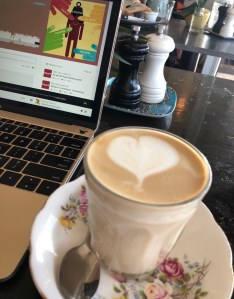
It’s been a while since my last diabetes in the wild encounter. It makes sense. I’ve barely left my house for the last 20 months and I’ve not really been frequenting the places where I would usually have those happenstance meetings – cafés and airports. Gosh, remember airports? Remember the queuing and the waiting and the frustrations and the delays and the cancellations? Anyway, I digress…
It shouldn’t surprise me that it was a café that provided the setting for my accidental encounter with another person with diabetes. I was working away, happy to not be in my house, even happier that someone kept bringing me outstanding caffeine. Happiest because I knew that every single other person sitting there was fully vaccinated.
I was doing the sort of work I do best in a café – editing. I get into a zone, concentrate on the task, and just read and edit in a super-efficient and fixated way. I don’t get distracted by anyone around me, and the noise becomes a reassuring beat that I work to. I completely block out anything on around me.
Including the fall rate alert on my Dexcom app. Anyone who uses Dexcom knows that this is a particularly urgent, loud and unforgiving wail. It cuts through absolutely everything. I absentmindedly nodded in the general direction of my phone when I heard it, but didn’t make a move as I was totally focused on rewriting a particularly sticky sentence. (Probably like every bloody sentence in this post…)
And so, I didn’t notice a woman sitting nearby get up from her chair and walk in my direction. I didn’t notice her stop right at my table. In fact, it wasn’t until she cleared her throat and said ‘Excuse me’ that I looked up, realising there was someone right there. She was fixing her mask behind their ears at the moment I looked up at her, my eyes focusing away from my MacBook. I blinked a few times and smiled, and then reached for my own mask before realising it was already on my face. I exaggerated my smile, so I was smiling with my eyes.
There was a slightly awkward moment as I waited, because, look, I’ve forgotten how to engage with people. I probably should have said ‘hi’, but I’ve really lost the art of chatting with people. How do conversations start? So, I was thankful when she introduced herself. And then she asked, ‘Are you okay? I heard your Dexcom a couple of times. I just wanted to check you are okay.’
And that was how I broke my streak of having conversations about diabetes with other people with diabetes I’ve never met before.
Turns out, I’ve missed it. Really, missed it.
We spoke for a while, sharing the usual things, comparing notes about which HCPs we see, and talking about which tech we are using. She is about to start looping, so I answered a heap of questions, remembering that I need to not be too evangelical and gushy about it. I toned down my ‘It’s the best thing I’ve ever done for my diabetes’ (because it is) by adding ‘But, of course it’s a learning curve and can be tricky.’
We told self-deprecating stories about how crappy our attitudes to diabetes have been at different periods. We shared our Covid-19 vaccination stories and compared when we’d be getting boosters. And we spoke about how we felt every time diabetes was mentioned in connection to Covid-19.
Through it all my Dexcom kept squealing and I ignored it because I just wanted to slurp up a diabetes conversation with someone in real life, where all we really had in common was diabetes. It felt like a therapy session, a confession, and catching up with a long-lost friend all in one fifteen-minute encounter.
When our conversation ended, she turned to return to her seat, and I settled back, searching for the sentence I’d been working on. But before I could do that, she turned back towards me and said, ‘I read your blog. I’ve seen you here before…well, used to see you here before Covid…and I wanted to say something. It’s really lovely knowing that there is someone like me who comes here.’
And then I cried. Because I remembered just what it is to connect. How real it feels. It’s why I started this blog in the first place – because I wanted to meet others just like me. Well over ten years of writing about diabetes, twenty years of diabetes advocacy, and that feeling of connecting never gets old.
Lots more diabetes in the wild stories on this blog post from earlier this year.
Gosh, there’s lots in the #DOC-iverse (#DOC-osphere?) about seeing diabetes, isn’t there? Yes, yes there is. Not sure about you, but I seem to be seeing a lot of bright, shiny, happy people (and a pop star or model or two) talking about diabetes, when usually they are pretty quiet about the whole diabetes thing. Which is fine. No one needs to spend their time advocating all about diabetes every minute of the day.
But I wonder if any of the marketing boffins who threw together their messages of inspiration bothered to check to see what the International Diabetes Federation are up to for World Diabetes Day on 14 November. Afterall, that’s the showstopper event of the month, isn’t it? Celebrating the birthday of the bloke who I give thanks to every day for keeping me alive.
A bit of history about World Diabetes Day to help understand that it’s not just about privileged folks with diabetes showing off their high-tech gadgets strapped to their impossibly beautiful bodies. (And yes, I know I sound like the Grinch who stole World Diabetes Day, but I think that understanding the foundation of this day is kind of important because that all seems to get swallowed up in PR spin.)
World Diabetes Day means something. In 2006, it became an official United Nations Day thanks to United Nations Resolution 61/225. At the time it was one of only two official UN health days. But even before that, World Diabetes Day had been going on for some time. It was in 1991 that the IDF, together with the World Health Organisation, created World Diabetes Day in response to growing concerns about diabetes.
Over the last thirty years, World Diabetes Day themes have aimed to be inclusive of people from around the globe, but perhaps there has been a (necessary) focus on how to improve diabetes outcomes for people in under-resourced countries. Maybe that’s why I find it a little galling when it appears that the day is about showing off your latest diabetes kit or shouting to the globe about how diabetes doesn’t stop people reaching their dreams. I love positivity and I’m often accused of being far too Pollyanna for my own good, but having a good look beyond our own privilege is important if we’re trying to get across a global idea of what is going on in the world of diabetes.
This year the theme is ‘Access to care: if not now, when?’. The World Diabetes Day website is full of resources that explain the theme. There are materials you can share to help explain just what access means to different people.
It all seems to be a little bit of a throwback to community initiatives of the past. The diabetes community has been the creators of some absolutely stellar campaigns – ideas that seem to have been founded in similar frustrations about which I’m smashing on my keyboard today. In 2014 there was a campaign that asked us to ‘Put the World back in WDD’ which was in response to there being a very Western focus on World Diabetes Day. Sometimes it feels that some things never change. The #Insulin4All hashtag that was first used to highlight how people in under-resourced countries struggle to access insulin is now most often linked with insulin pricing in the US.
Access means different things to different people, and the materials the IDF has put together consider this. Even if you live in a well-resourced country, with decent subsidised, tax-payer funded (never free!) healthcare, it’s likely that some part of your diabetes care is still difficult to access. It may not be insulin or diabetes supplies that are your access issue – it could be mental health support or different tech solutions.
Here in Australia, thanks to Medicare, the PBS and the NDSS, we have well-subsidised diabetes care. It’s not perfect, but it is certainly better than I hear from friends in other places around the world. But there definitely are still deficiencies in our care. Mental health care is limited – and almost impossible, it seems, to access. Only 50% of people with type 1 diabetes can access subsidised CGM and Flash GM through the NDSS. People in rural and remote areas of the country have far more difficulty accessing quality, regular diabetes care. The outcomes for Indigenous Australians with diabetes fall far behind. As always, people who are disadvantaged in some way are disproportionately affected, and face more difficulties accessing the care they need.
How you choose to celebrate (or not) this month and World Diabetes Day is entirely up to you. You may choose to ignore the ‘official’ theme of the day and focus more on other initiatives and once again, all perfectly okay. Just as YDMV, so may your diabetes advocacy.
But if you are interested in focusing more on access, have a look at the World Diabetes Day website and pledge your support for greater access to diabetes care. Read about the Resolution that was adopted by United Nations Member States that calls for urgent, coordinated global action on diabetes.
Look, I know. UN Resolutions don’t sound nearly as sexy as a six pack with a CGM plastered to it, but it is pretty cool that the WHO and the UN are talking diabetes.
And while celebrating the centenary of insulin, learn where insulin is not easy to come by, and why that is. Through volunteer work supporting both Life for a Child and Insulin for Life, I have learnt a lot about the challenges faced by people with diabetes in under-resourced countries. If you can, please consider making a donation this month to either, or both, charities.
And if looking to the community, it’s wonderful to know that there will be a docday° event on World Diabetes Day that is dedicated to the theme of access. You can learn more about that event here. It’s free to join, and will be live streamed on Facebook – you don’t even need to sign up.
But perhaps a final thought. How great would it be if those with really, massively high followings, (and followings not-only-in-the-diabetes-community), used this time to talk about making a real difference – a difference to people with diabetes who are struggling to access the basic drugs and supplies to actually live with the condition.
Sure, ‘seeing diabetes’ helps raise awareness, but as ever, I ask how much of that actually cuts through and gets out of the community that is already seeing diabetes every single minute of every single day?

I shared this photo to Twitter the other day:

I couldn’t care less if there are diet books on bookshelves at bookshops. Clearly there is a buck to be made with the latest fad diet, and so, diet scammers gonna scam and publishers gonna publish.
What I do care about is the framing that health is limited to weight loss and dieting.
Living with diabetes has the potential to completely screw up the way food, weight and wellbeing coexist. My own disordered thinking has come from a multitude of different sources. I know that even before diabetes I had some pretty messed up ideas about weight loss and my own weight, but once diagnosed all bets were off and that thinking went haywire! I know it didn’t help when, in the days before diagnosis as I was feeling as though I was slowly dying, someone effusively told me how amazing I looked after having lost some weight that I really didn’t ‘need’ to lose. And look at that! A little weight bias in there already as I talk about ‘not ‘needing’ to lose weight’.
I remember that afternoon very clearly. It was Easter Sunday and my whole family was at my grandmother’s house. I’d had a blood test the morning before because I’d gone to my GP with a list of symptoms that these days I know to be ‘The 4 Ts’. (In hindsight, why she didn’t just do a urine check or, capillary blood check, I don’t know.) I was feeling awful and scared. I knew something was wrong, and suspected it was diabetes.
But there I was, literally slumped on the floor against the heater (at my grandmother’s feet) because it was the only place I could feel any warmth at all. Sitting opposite me was a family member who felt the need to tell me how amazing I looked because I’d dropped a few kilos. I could barely see her across the room because my vision was blurry, but hey, someone told me I looked skinny. Wonderful!
That road to further screwing up my thought processes about weight and diabetes was pretty rocky and I was on it. I learnt that thing that we know, but we don’t talk about anywhere enough routinely, and that is that high glucose levels equal weight loss equals compliments about losing weight. (We don’t talk about it because there’s not enough research, but also because in the past a lot of HCPs have gatekept discussions about it because they think that by talking about insulin omission or reduction for weight loss will make people do it. Sure. And sex education for school-aged kids is a bad thing because by NOT talking about sex, teenagers don’t have sex. End sarcasm font.)
It has taken years of working with psychologists to undo that damage – and the damage that diabetes has piled on. I employed simple measures such as stopping stepping on scales and using that measure as a way to determine how ‘good’ I was being. As social media became a part of everyday life, I curated my feeds to ensure I was not bombarded with photos that showed a body type that generally is only achievable when genetics and privilege line up. I learnt to not focus on my own weight and certainly not on other people’s weight, never commenting if someone changed shape. I did all I could to reframe how I felt about different foods, because demonising foods is part of diabetes management.
I was determined to parent in a way that didn’t plant in my daughter’s head the sorts of seeds that had sewn and grown whole crops in my own. While a noble ambition, I realise I was pretty naïve. Sure, we absolutely never talk weight at home, we never have trashy magazines in the house celebrating celebrities’ weight loss or criticising their weight gain. I’ve never uttered the words ‘I feel fat’ in front of my daughter even when I hate absolutely everything I put on my body. Food is never good or bad, and there is no moral judgement associated with what people eat. But the external messaging is relentless and it’s impossible to shield that from anyone. All I could do is provide shelter from it at home and hope for the best.
But despite doing all I can to change my way of thinking and changing my own attitudes and behaviours, it takes a lot of work…and I find myself slipping back into habits and not especially healthy ways of thinking very easily.
Which brings me to my favourite bookshop over the weekend and standing there in front of the health section. I was looking for something to do with health communications, or rather, the way that we frame life with a chronic health condition like diabetes. I wondered if there was anything that spoke not about ‘how to live with a chronic health condition’ but rather ‘how to think with a chronic health condition’. I didn’t want to read more about what to do to fix my body; I wanted to find out how to help focus my mind and love my body. But there was nothing. Nothing at all.
Instead, there were shelves and shelves of books about losing weight, dieting, fasting, ‘cleansing’ (don’t get me started) and then more on fad diets.
When I tweeted the photo, one of my favourite people on Twitter, Dr Emma Beckett (you should follow her for fab fashion and fantastic, fun food facts), mentioned that it is a similar story in the ‘health food’ aisles of the supermarket, where there seems to be a focus on calorie restriction.
How has the idea of being healthy been hijacked by weight loss and diets? How has the idea that restricting our food, limiting nutrients, and shrinking our bodies equates health?
How did we get so screwed up at the notion that thin means healthy; that health has a certain look? Or that dieting means virtue? How is it that when we see diabetes represented that it so often comes down to being about weight loss and controlling what we eat, as if that will solve all the issues that have to do with living with a chronic condition that seeps into every single aspect of our lives?
It takes nothing for those disordered thoughts that are so fucking destructive, thoughts that I have spent so long trying to control and manage and change, to come out from under the covers and start to roar at me. Diabetes success and ‘healthy with diabetes’ seems to have a look and that look is thin. (It’s also white and young.)
Health will never just be about what someone weighs. And yet, we keep perpetuating that myth. I guess that steering away from the health section of bookstores is selfcare for me now. Because as it stands, it just sends me into a massive spin of stress and thinking in a way that is anything but healthy.





 Diabetogenic