You are currently browsing the monthly archive for September 2015.
I had a lovely message today asking me if I was okay. I haven’t posted for a few days and they were wondering if all was fine. Thank you for checking in, J!  All IS fine. After EASD I have taken a little break and am spending some time in Europe. We’re in Paris, heading back home later this week.
And I’ll be back blogging soon, writing up lots about my time at EASD and the Euro Bloggers Summit. And talking about the food I’ve eaten. And the coffee and wine. And the wonderful DOC friends I’ve seen. And how my diabetes has been behaving. Or otherwise.
See you soon.
‘Oh, it’s beautiful.’ These were the words the followed the sharp intake of breath as I saw the Kaleido pump stand at EASD last week. I didn’t say it to anyone in particular – I was wandering the expansive expo hall alone at the time. It was completely involuntary. The stand was a rainbow – I may have said to someone that it looked like a unicorn had thrown up in there.

You can read all about the Kaleido here. This is where you get to read about the specs and the details all tied up in the usual marketing spin that is inevitable when it comes to diabetes devices.
 My take on it – after a long chat with one of the developers – is that this is a nifty little pump. It is simple – really simple – with far fewer bells and whistles than available on other pumps. There is no CGM compatibility. At this point there is no bolus wizard calculator, however, following feedback from customers, the company is developing one.
The simplicity is actually part of the beauty in a lot of ways. Those of us experiencing data burnout might find some relief in a pump that is loud and proud in its claims to be a delivery device. Full stop.
 Enough about all that. What I want to talk about is how it looks. This could be because I am shallow – let’s start with that – but I think there is more to explore in here.
There was a lot of excitement from diabetes people at the event. There were a number of times that in conversations with fellow PWDs the Kaleido came up. Photos were instagrammed and tweeted, with a lot of attention being given to the gorgeous design and kaleidoscope of colours available. (Get it? Kaleidoscope…)
And inevitably, there were comments from people asking if colour is really something to be getting so excited about.
My answer to that is: actually yes.
At the moment, there are people around the world deciding what colour their next iPhone will be. Apple recently announced a rose gold case to accompany the grey and gold already available. People make decisions based on how it looks, the emotional pull, how it will look with what they are wearing.
 So why is it perfectly acceptable for decisions about other tech to be about how it looks and how it makes us feel, but it’s not okay for us to take this into consideration when thinking about which insulin pump we want to use?
Obviously, we need to feel confident that it will deliver insulin accurately, that it won’t malfunction if you look at it the wrong way, or that, if something does go wrong, there is good customer service. Of course all of these things are important.
But if we can assume that it will pass the accuracy test (approval processes are tough!) and that, being a new company, they will be doing their utmost to get their customer service game right, then how it looks and makes us feel is an absolutely reasonable and rational thing for us to consider when making a decision.
The first time I went to EASD (back in 2012), I met Fredrik Debong from MySugr and he said we need to make diabetes sexy. I agree. This is a condition with a serious image problem. MySugr is all about injecting some appeal and fun into diabetes, while producing a product (a kickass app) that people love and use because the functionality is brilliant.
Funking it up a little is a good thing. And this little pump is a step in the right direction!
No – I am not funded by Kaleido. No I did not receive any product. Yes, I did ask when it is coming to the Australian market. There is no official word on that yet, but we are certainly in their plan. The launch markets will be in Europe.

It’s day two of the 2015 EASD conference in Stockholm. Sunday and Monday showcased some impressive symposia – including industry announcements – and yesterday the official opening ceremony started the conference proper.
 We arrived in Stockholm around midday on Sunday after 26 hours in transit, so the afternoon was spent settling into our hotel which, bizarrely, has only round windows giving the odd sense that we are in a boat. Seventeen floors above ground level. In the sky. Weird, but gives an incredible view of each morning’s sunrise!
In keeping with EASD tradition, the conference is very science-y. There is little about the psychosocial aspects of diabetes and minimal input from people with diabetes. I have developed a twitch in my right eye because I keep hearing the word ‘diabetic’ and as much as I try to tell myself to get over it, it just doesn’t sit right with me coming out of the mouths of clinicians.
There is much mention of the ‘patient perspective’ and on Monday there was an entire symposium dedicated to it. Unfortunately, there wasn’t an actual ‘patient’ on the panel, which surely is weird. It is, right?
But despite the limited presence of PWD in the official programme, there are a lot of satellite events and activities taking place.
 Yesterday was #DOCDAY, an event organised by Bastian Haulk from he German online community. He had hired a space in downtown Stockholm and invited bloggers, advocates and others with diabetes to come along, network, chat, and talk about what we are all doing in our different communities and the larger DOC. Bastian asked me to say a few words at the introduction and I highlighted for me what is the most important thing when we are talking about the DOC: No one owns this community. No one is more important or more relevant or more powerful.
Sure, some of us are very fortunate that we get to actually meet IRL and attend conferences, but we do it as part of our jobs – whether it be like me (through my work at a diabetes organisation mixed with my online work) or through independent consulting or other work.
But regardless if you are in the room or following along on Twitter, everyone has the same right to be here and to be part of it.
Two separate blogger summits have been organised by industry – I will be attending the Johnson and Johnson DOC Exchange event tomorrow and Friday. These activities showcase just how smooth PWD and industry can work together – disclaimers and all that sort of stuff out in full view!
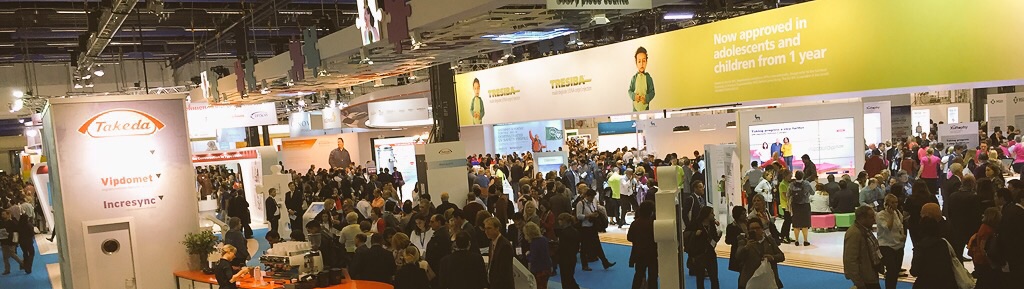
The Exhibition Hall here is, as expected, huge. Whilst the usual suspects are all here in force, there are also a few new faces on the scene. The Keleido pump is something to watch – if, for no other reason, than the gorgeous colour spectrum! More in coming days!
 While we’re talking new stuff, check out this gorgeous range of clothing from Anna PS (Scandinavia). Anna is delightful and started this company to address a gap in the market, producing high quality t-shirts, bathers, underwear and more to accommodate diabetes devices such as pumps, CGM receivers, pens etc. The clothing is of the most beautiful designs – the fabrics are divine. (And yes, she ships to Australia!)
There is a lot on show and a lot being presented and as in previous years, I have found this conference a lot more daunting than other meetings like ADA or our own ADS-ADEA. but there is plenty to write about and share. More in coming days.
The noise in the café was overwhelming, yet just a few minutes earlier it was quiet. I couldn’t hear Aaron who was sitting next to me or my friend, S, who was sitting opposite me. Their words were foggy and unclear. Something clattered to the ground and the noise startled me. I threw back what was left of my coffee.
All of a sudden, one of the café staff was standing next to me, leaning over saying something.
‘What?’ I said, sounding irritated. I stopped myself, realising what was going on. ‘Sorry. My blood sugar is low. I need… Do you have…? Could I have…?’
She looked at me and stood up straight. ‘What can I get you? Juice? Sugar?’
‘Um…yes.’ I said
I heard her call into the kitchen, ‘I’m putting an orange juice through the register, but I need it now. Like right now.’
Within a minute, she had gone into the kitchen and gently placed a large freshly-squeezed orange juice on the table. ‘I’ll be back in a sec.’
And she was. As soon as I had downed the juice. ‘Are you okay? Can I get you something else. I know. I have some cookies.’ And she walked to the counter
The room was still foggy and my brain felt like it was wrapped in cotton wool. Aaron and S were talking to each other, but keeping an eye on me at the same time.
My new friend was back with a small plate of the cafe’s delicious peanut butter choc chip cookies that come on the side of all coffees.
I smiled at her. ‘Thank you. Really. Thanks.’ She brushed my gratitude aside.
We finished up. ‘Feeling okay?’ asked Aaron. I nodded, and stood up, making my way to the counter to pay.
‘Thanks again,’ I said to the waitress.
‘Do you have diabetes?’ she asked.
‘Yes. How did you know?’
‘My dad has diabetes. I could tell straight away. You had the same look he does when he needs sugar. But anyone would know, right.’
‘Ah, no. Most people wouldn’t have a clue. Thanks so much for being so great. I really appreciate it.’
I paid the bill and left a decent tip in the tip jar and we walked out of the cafe. ‘Put it on your blog,’ said my friend. ‘Oh, I will,’ I said. ‘I will.’

Stockholm next week. Here’s some ABBA.

This week is Jean Hailes for Women’s Health Women’s Health Week. (Yes, there’s a lot of women and health in that sentence, but given it’s the focus of the week, let’s work with it.)
I quite love the theme of the week which is Let’s Talk. The idea is that we get rid of the elephants in the room and talk about health issues that we sometimes find tough to discuss. It’s a great concept! Having people opening up – or at least being able to access information – about health issues that are sometimes not discussed is really important. Plus, there are gorgeous pink elephants all over the promotional materials and that can only be considered a good thing!
Now clearly, I don’t have an issue speaking about health issues. I very openly talk about my experiences living with diabetes. I have willingly and candidly spoken about fertility issues and miscarriage. I have also discussed the body image concerns that I have lived with for most of my life. Mental health is frequently discussed on my blog – usually in relation to diabetes.
But while I am happy to bang on about any health concern that I may be dealing with, that isn’t the case for everyone. That’s why this week is an important one.
And it is why we need people who are happy to share their stories out there. We need people to be discussing the things that are a little ‘underground’ or that make people squirm a little.
 Each day of the week has had a different focus. On Monday, the results of an online survey were released. The survey combined responses from 3,300 women aged between 18 and 87 years, and healthcare professionals including nurses, GPs and HCPs.
Yesterday, the attention was directed towards natural therapies, looking at the safety and effectiveness of natural medications and treatments. There was great advice about questions to ask (yourself and your HCPs) before taking any natural therapies.
Today, it’s all about what is not being talked about. Starting with the difficult topic of domestic violence, the website provides advice about the issue and lists placed to go to for help. While there has been quite a bit of attention in the media given to domestic violence this year, the statistics are horrendous and we need to be doing more.
Also on the agenda for today is mental health and there are links to some valuable information about depression, anxiety and emotional health.
The rest of the week is about managing our health and healthy living.
I understand that not everyone is happy to share their story. And that is fine. But even those who prefer to stay silent and keep any health concerns to themselves still may look for information and advice. And shining a light on some of the less talked about health problems faced by Australian women with a bright and bold campaign does just that.
So. Let’s talk!
This Saturday, I will be heading to the European Association for the Study of Diabetes (EASD) annual meeting – and the Euro Bloggers Summit.
Somewhat serendipitously, Saturday is also Diabetes Victoria’s first ever Travel Well with Diabetes event. Hop over to the Diabetes Victoria blog to read all about it.
In the meantime, I’ll be spending the rest of my week ignoring the fact that I’ve left everything to the last minute (as usual) and haven’t even thought about getting my diabetes stuff organised. I’ll also be ignoring the kidlet’s repeated protestations that her parents are abandoning her and swanning around Europe without her for the fourth time. Diabetes guilt and mother guilt – I need a holiday!
I love being able to quote random diabetes-related numbers to people. I get the irony of this considering I am also of the ‘diabetes is not all about numbers’ school, but sometimes, numbers can be really powerful.
I love asking this question:
‘What does 8754 mean?’
After the blank looks and the stares and the SWAGs, (the number of cupcakes you have eaten? The number of pairs of boots in your closet? The number of litres of coffee you consume in a month??), I reply with the answer:
‘That is the number of hours in a year that a person with diabetes manages their diabetes solo. There are 8760 hours in a year, so it works out to an average of about 6 hours per year that we get to work with a healthcare professional. And that’s if we’re lucky! The rest of the time, we do it on our own.’
It’s pretty powerful when you think about it.
Last week at the ADS ADEA meeting, a diabetes educator asked me if I knew what the number 121 referred to. It was my turn to look blank. (The number of pairs of boots in my closet?…)
‘It’s the average number of diabetes-related decisions a person with diabetes makes every day.’
Now, I am not sure where that stat came from (I actually will follow up and ask her) or just how accurate it is.
But regardless of the exact number, it is high – we do make a lot of diabetes decisions each day.
Over the weekend, I started to think about some of the decisions I make.
I thought about it as I was lying in bed in the morning, deciding whether to get up and get my BGL meter and do a check. I thought about it just before I stepped into the shower and examined my cannula after I removed my pump, deciding if I needed to do a line change then or if it could wait until the afternoon. At a local café, I calculated the number of carbs in my breakfast, deciding whether or not to enter the number into my pump and let the wizard do its calculating magic or just enter the units of insulin manually. But before I did that, I needed to decide whether or not to actually give myself any insulin because I was bordering on being low and didn’t want to bolus too soon in case my food was delayed. I thought about going for a walk with the kidlet and the puppy, deciding whether or not I should set a temporary basal rate in case we went to the park, let Sooty off the lead and had to chase her around for 10 minutes before we caught her. I thought about how much insulin I have in the fridge, deciding that I should call the pharmacy and order some so that I don’t run out when we are in Sweden in two weeks. I decided that I really need to schedule an appointment to have my complications screening done and then decided to wait because… because… well there is no good reason. But that is what I decided.
This was all within 70 minutes of waking up.
I am not sure that I would make 121 diabetes-decisions every day, but there would certainly be a lot.
Trying to explain just how diabetes impacts on our every day is difficult, but using numbers to illustrate just how considerably it weasels its way into pretty much every aspect of the day can be pretty effective.
My study at home is one of my favourite places to work. It’s warm and cosy and filled with things that I love.
If someone who knew nothing about me walked into this room (which would be weird and creepy) they would put together a picture of me as someone who loves New York (thanks to the two meter photo hanging on one wall) and books (thanks to the bookshelves wrapped around two other walls).
They would see that I’ve travelled a bit (thanks to the cluster of photos on another wall of the three of us in places all around the world) and they would see a lot of Apple products.
They would know that I like coffee (frequently here are empty take away coffee caps left on the table) and enjoy cooking (cooking magazines and cookbooks are often on the desk, opened to pages showing the next dish I was planning to make).
They could sit at my desk and look at my pin-board and see reminders of favourite galleries and shops I’ve been in overseas and photos of my beautiful sister and drawings by my daughter and my husband.
And they would discover that we’re pretty lousy at putting the clean washing away because there is often a overflowing basket in the corner, its contents waiting to be folded and put away.
They would be able to get a pretty good picture of me – the person that spends a lot of time in here, frantically typing away on here on my (Apple) laptop.
And if they looked carefully, they may notice something else.
They may notice that I have a lot of books on those shelves about diabetes.
And they would see a half empty bottle of something called Glucolift on my desk, which, if they looked more closely would discover to be glucose tablets. They may even notice the chalky residue around the bottle from last time I was low in here and struggled to open the jar, eventually sending its contents over the desk.
If they looked on the floor and on the desk and on the chairs and inside the empty coffee cups and pretty much everywhere else, they would see little white strips with little drops of dry blood on them.
They would see a jar or two of jelly beans.
They might see a small empty glass bottle with a burgundy lid and burgundy writing that says ‘Humalog’.
And then, if they noticed all those things and joined the dots, they would realise that as well as being a person who loves books and travels a lot and drinks a lot of coffee and everything else, that I have diabetes.
Or they wouldn’t. They would have no idea. They would miss all those things or not join the dots. And that would be okay. Sometimes, that is really very okay.
POSTSCRIPT:
I’ve spent a considerable amount of time today catching up with #DOCBurnout2015 posts and reading about the tactics people use to avoid or recover from social media burnout. Even more interesting than what I have been reading is watching how people reach out to support and encourage others sharing their story. I guess I shouldn’t be surprised. As someone who has only been afforded love and support from the DOC, it isn’t a surprise that it has been shown with this initiative.




 Diabetogenic