I rarely step away from my desk at lunch. I may grab some sushi or a salad from a nearby café, but most of the time, I then eat it at my desk, making a mess all over my keyboard and trying not to spill food down my front.

But occasionally, I make my way the city or to Carlton and actually walk around for half an hour, pop into shops or even sit down and eat properly. And when I do this, without fail, I am stopped by fundraisers on the street who offer me a hug or ask me in an overly false voice how I am doing and promise they will ‘Only take a minute’ of my time.

I’ve tried everything to avoid them. I don’t make eye contact; I walk purposely and fast; I pretend to be looking for someone else on the street. Regardless, they still make their way to me, arms outstretched, clipboard knocking out anyone in their way.

Because I don’t like to be rude, I can’t ignore their approach. I get that it’s their job and they are there to engage people and get them to sign over money to a (usually worthwhile) cause. I used to smile and shake my head. And I used to feel apologetic about it.

But after years of this harassment, (okay, perhaps a little too strong a word), I am over being nice. I storm past them, pushing their arms and clipboards out of the way, and mutter in a determined voice, ‘Not today’. If I am in a good mood, I add a ‘thanks’ at the end. Usually, they have beaten the good mood out of me, so they only get two words. (And they should be grateful that the two words are ‘Not today’, because I promise, they are not the two words at the front of my mind.)

It’s a pretty successful tactic. When I was pleasant and smiled at them, they thought it was encouragement and would start to walk alongside me, starting their friendly banter. But my curt response cuts off any idea that we are about to have a chat. It shows that I mean business and my business does not involve them.

This morning, I got out of bed and felt pretty revolting. I sensed that my BGL was high – enough for me to actually notice it before checking. When a nice number in the low twenties showed up, I knew that I was in for a rough morning.

I cursed that after a week of waking up with numbers in the 4s and 5s, today would be the day that I start with high BGLs. I had an important meeting first up, but before that I had promised the kidlet that I would have a quick look around her classroom and chat with her teacher.

I resisted the urge to crawl back into bed and willed the feelings of nausea to get themselves under control.

Not today,’ I muttered under my breath. ‘Not. Today.’

I sat back down on the edge of the bed, the plan of managing to bring my BGL back in range being worked out. The tendency to over-bolus is always high, but I rejected that, instead going for a sensible, slow approach.

I firstly changed out my line and cartridge, priming carefully and filling the cannula once it was inserted.

I bolused according to what the wizard on my pump recommended – not (as I frequently do) adding a couple of extra units ‘for luck’.

I set a conservative temporary basal rate – and only for an hour, setting an alarm on my phone to remind me to check again after that length of time and reset if necessary.

And then, I chugged several glasses of cold water before getting ready for work.

By the time we walked out the door an hour later, I was feeling calm and my BGL was falling at a sensible rate. I doubted that there would be a hypo from over treating the high. I had been cool and calm. Determined. Focused.

Not today,’ I thought again, directing this at my diabetes. ‘Not today.

A good music documentary is a great way to spend a night in. We re-watched an old favourite last week – ‘Shut up and Sing’ – which tells the story of what happened after one of the Dixie Chicks made a disparaging comment about then-President George W Bush. Since then, I’ve been listening to the Dixie Chicks on and off and today have had this on repeat in my office.  

Being fiercely independent about my health is something that I cherish. I have a strong need to own my own health and well-being and direct the course taken to manage my diabetes as best as I possibly can. I do this with full disclosure that the mess ups are mine as much as the successes. The buck starts and stops with me.

But sometimes – always, actually – it helps to know that there is support at hand when needed.

That help might be in the form of someone to accompany me to appointments (thanks dad, who has chauffeured me to almost every single ophthalmologist appointment I have been to in the last 17 years), someone to meet me afterwards over coffee so I can debrief and share what happened, or someone to actually sit alongside me whilst in the consulting room, taking note of what is being said. Having a second set of ears is always a great idea, especially if what is being covered off is challenging in any way.

I usually attend appointments with my endo alone, although sometimes, my mum may be with me to keep my company. We use it as an excuse to then catch up for coffee and cake. Other times, when there has been something ‘big’ to discuss, Aaron comes along and listens intently, rarely commenting unless he can see that I am uncertain about something. And then we go for coffee and cake.

I pretty much always see the GP alone, but truly, my GP appointments are always super quick and about something so specific – and usually simple – that I don’t need to take someone along for the ride.

Most of the time, I am happy to be on my own. I relish the time in the waiting room – all alone, nice and quiet, and usually a trashy mag or two to catch up on.

The day I was diagnosed with diabetes, I was squeezed into an end of day appointment with an endocrinologist. I asked Aaron and my mum to come along to help me understand what was happening. The next day, as I saw the dietitian and diabetes educator and endo again, they were there, and together we took in all the new information, letting it swirl around us and settle uncomfortably. A new health reality that involved needles and numbers and thinking about food in a different way. This needed a team approach.

It was incredibly useful to be able to ask them questions about things I had only half heard or half understood as my mind tried to take in all I was being told. I found myself turning to mum for suggestions around food, and to Aaron about how I was feeling and what I was worried about.

As I got used to ‘having diabetes’ I asked fewer questions and learnt to focus on what I needed to know. These became the things that we would discuss in appointments and afterwards, blocking out the ‘white noise’ of the things we didn’t need to know.

I have people around me who know a great deal about diabetes; people I can call on when I need to for advice and company and a friendly face in the waiting room. Someone on my side; someone by my side. My own personal wingmen.


A friend I’d not seen for many years contacted me the other day. Apart from occasionally seeing her name pop up on my Facebook feed, we have had no contact for over ten years.

Out of the blue, she got in touch because she had recently had a miscarriage and was feeling pretty down. She wanted to speak with someone who had been through the experience and she had seen some of my posts about how I felt immediately after I miscarried a couple of years ago, and some follow up posts since.

As we spoke – well, I mostly listened, because I knew that was what she needed – it struck me that it is always the subjects that are taboo that are the ones we need the most support with.

In diabetes, it is still complications that seem to be a topic we are uncomfortable speaking about. We speak about them in hushed tones, as if by not giving them a name we don’t give them weight.

We are scared to ask questions, because we are afraid we will say the wrong thing. We don’t want to upset people and we don’t want to look like we are prying.

But perhaps that is what we need to do a little. We need to pry.

And we can do that in sensitive, caring ways that can and do help.

I learnt how valuable having someone gently pry could be back in 2003 when I had my first miscarriage. As I was enveloped in grief and trying to work out what to do and get through the days, a friend picked me up and took me out for a coffee. She had her new baby boy with her, which was just what I needed. A gorgeous little smiling poppet, who was happy to sit on my lap and be cuddled and have his chubby cheeks kissed.

‘Renz,’ she said. ‘Tell me what happened.’

It was the first time that someone had actually asked me that. Most people asked if I was okay, which clearly I wasn’t, but that wasn’t the answer they wanted, so I would smile through my tears and nod.

But here was someone actually asking me to tell them exactly what had happened. And I did. She listened, reached out and held my hand when the tears gently started and hugged me at the end. She didn’t offer any advice, didn’t tell me it was ‘for a reason’, (seriously – the worst response ever), or tell me that everything would be okay.

She just listened. And then she said, ‘I am really sorry’. It was just what I needed, and I nodded through that too, thanking her for giving me permission to tell my story, even if it was difficult for her to hear.

I have employed this tactic over the years – not only when I hear about pregnancy loss, but other things too. It is really hard to stay silent sometimes, because we want to reassure people, we want them to know that they will be okay and we want to take away their pain.

However, I have found that that is not what people want. Often, they are just looking for an outlet; a way to tell their story and be heard.

It doesn’t even need to be something really big for this technique to work. When I tell people that I have had a hypo, I don’t want them to look for solutions. I don’t want then to workshop what happened leading up to the low or to talk to me about what I had (or didn’t have) for lunch. I just want them to listen.

I really don’t expect them to fix things. I know for me, I just need someone to legitimise how I am feeling. And acknowledge that it is tough.

My husband has the best response when I tell him I’ve had a crappy diabetes day. ‘Diabetes sucks,’ he says to me, leaving it at that. And he’s right. It absolutely does.

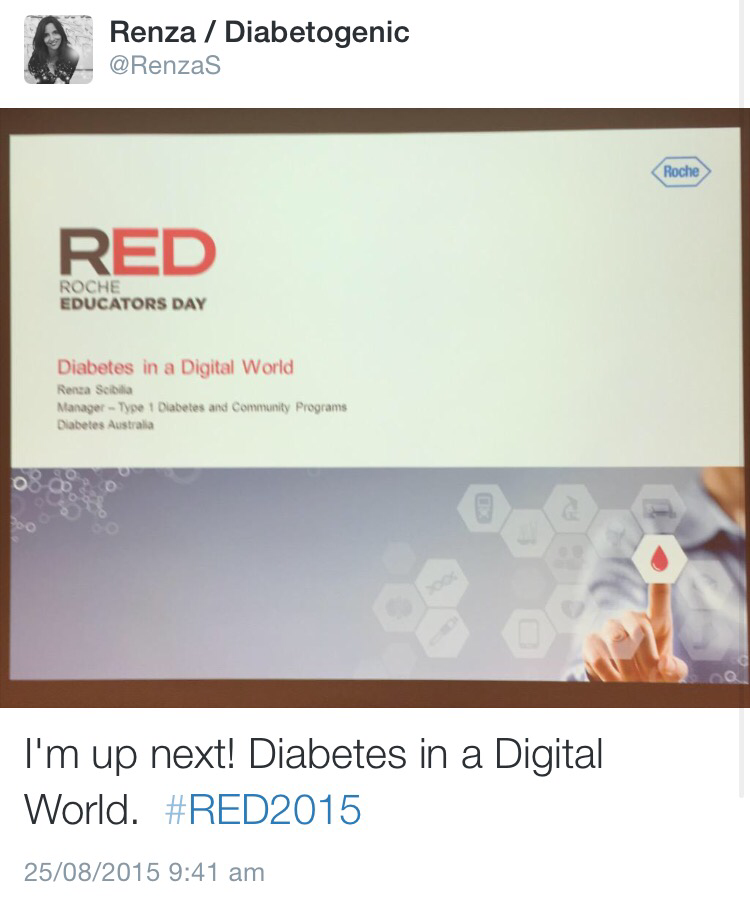
This weekend, I gave a talk about finding good support to a group of people living with type 1 diabetes. I can’t remember the last time I stood up in front of PWD and just chatted about life with diabetes. Recently, all the presentations I have given have been for HCPs and the tiny few I have given to PWD have focused solely on social media and technology. It was kind of nice to go back to basics and talk about supporting each other more broadly.

So, here is my secret admission: I always feel like a fraud when I am about to give a talk. Seriously, who am I? I live with diabetes and all I can do is share my (frequently clumsy) experiences. I always prepare, but my talks rarely, if ever, end up how I planned. I wind up taking weird tangents, sharing far-too personal stories and then when the anecdote comes to end, I stand there a little shocked with nowhere left to go other than to sheepishly say, ‘Right…so where were we?…

Anyway, I was talking about how we can work with our HCPs to get the best support – and finding support outside our HCP team. And how great families and friends can be with their support, but somehow, there is nothing like being around others with diabetes because they just ‘get it’.

There was lots of nodding and chatter and laughter in the room. It was really informal – just a (large) group of people sitting around chatting. These are my people; this is my tribe!

This was my favourite kind of talk. The audience was really engaged and wanted to share their stories. I love that for a number of reasons – one of them being that it means I have to do less work! But mostly, because I always learn something new. Because there before me is a room full of experts!

Someone came up to me afterwards and thanked me for my talk. And I thanked them. Because as much as I love sharing and talking about my  diabetes, I love hearing from others even more.

Every Sunday, in the Life magazine of The Age newspaper, is a column where people (usually B to Z grade celebrities) are asked about what they eat on a given day.

They all seem to follow the same boring, unadventurous, ‘this-is-what-a-dietitian-wants-to-hear’ diet. Usually, they start their day with lemon water (to help kick start their metabolism or help with their bodies pH or boost their antioxidant intake or cleanse their liver – it depends which pseudo-science crap they have been reading up on that week), which I am reliably informed (by, you know, qualified practitioners) does nothing other than potentially erode tooth enamel.

Mostly, the foods consumed by those lying about reporting what they ate include a lot of kale, brown rice, kale, grilled salmon, kale, green tea, kale, organic vegies, and kale. Because, kale.

It was in such an article that I first heard of Pete Evans with his ridiculous claims of activating his nuts.

The dietitian – the very sensible and very lovely Dr Joanna MacMillan – then usually comments that even though the person had lied reported eating well, they should try to incorporate more grains/leafy green vegies/lean meat/low fat dairy etc. in their diet to ensure they are following evidence-based dietary guidelines. There is (thankfully) often a ‘stop believing the crap you are reading’ message in there – and a reminder to stop eroding their tooth enamel first thing in the morning.

So, I thought I would write down everything I consumed on a recent day. And then translate it into the language used in these articles.

Breakfast

Caffe latte

Single origin organic coffee grown by virgins on an Ethiopian hillside, reverse-osmosis filtered organic water, organic milk from cows grazing on organic kale while piped music is played to them, fair-trade, organic, raw sugar grown under the organic sun and picked by night under an organic full moon. 

Avocado toast

Two slices of artisan organic sourdough bread, evenly toasted by hand with a blow torch using organic butane, spread with organic avocado picked that morning, speckled with organic black sea salt from the organic Black sea.

Lunch

750ml pineapple juice (I had just mowed the lawn and was hypo. Really hypo.)

Pure filtered organic pineapple nectar, extracted by hand from an organic pineapple, naturally sweetened by smiling pineapple nectar extractor pixies. 

Afternoon tea

Caffe latte

As above, but this time sweetened with organic agave syrup from Mexico.

Dinner

Homemade pasties.

Ratatouille of organically-grown baby vegetables including organic peas, organic potatoes, organic green beans, organic corn, organic onion, organic celery, organic spinach, organic zucchini, organic eggplant, organic garlic, organic turnip with organic micro-herbs wrapped in organic butter-pastry, gently baked until organically golden brown.  

Salad of avocado, spinach leaves, sesame seeds and dressing

Avocado as above, organic baby spinach leaves picked just before becoming teenage spinach leaves, sprinkled with organic sesame seeds drizzled with a dressing of organic EVOO and organic balsamic vinegar. 

Dessert

Three gluten free chocolate chip cookies (gluten free because the only flour-like product in my house at the time I had a sudden urge to bake was almond meal. Strictly NOT for any health benefits.)

Trio of gluten-removed organic dark chocolate shard biscotti made with gluten-free organic almonds, crushed by hand, baked into organic orbs of goodness.

Basically, my diet that day involved a couple of coffees, three quarters of a litre of pineapple juice, two slices of bread with avocado, a couple of pasties and three chocolate chip cookies. Not great at all. But honest.

And it was a good day, a healthy day. Because with everything I ate, I bolused insulin for it (not the pineapple juice – that hypo was terrible!). I ate what I chose to eat and then did what I needed to do to manage my diabetes. I took insulin. Or rather, sub-cutaneously infused organic insulin made by the delicate hands of Celtic insulin faeries.    

Mastering diabetes‘Got your lunch?’

‘Yep.’

‘Got your jumper?’

‘Yep.’

‘Got your homework?’

‘Yep.’

‘Okay. Grab your bag and let’s go!’

And that is how we walk out the door in the morning – after eating breakfast, getting dressed for school and brushing hair and teeth.

I then drop the kidlet at school and make my way to work.

I don’t think about what her BGL is doing throughout the day. I don’t think about what time her PE class is and if she ate all her morning tea beforehand. I don’t think about anything to do with numbers – other than knowing that she has her maths homework.

Kids have a lot to think about in their day. Kids with diabetes – and their parents and their teachers – have more to think about.

Jump over to the Diabetes Victoria blog where you can reads about the fabulous new resource launched today. It’s called Mastering Diabetes and it is going to help all children at school and childhood settings in Victoria.

It may have been a while ago, but I do still Remember the Days of the Old Schoolyard!

Today I read an interesting article in the Wall Street Journal about patients managing their doctors. The piece was specifically referring to people living with more than one chronic health condition, which, in the case of diabetes, is frequently the case. But even in those of us ‘lucky’ (?) to only have to deal with diabetes, there is still often a requirement of coordinating other healthcare professionals and services into the bundle of diabetes care and making sure that everyone is always on the same page.

I consider my engagement with my healthcare team to be a partnership. We work together for the same outcomes – me being healthy. And happy.  We work as a team.

But I do consider it my job to be the Chairperson and CEO of Renza’s Diabetes Pty. Ltd. It’s my life and my diabetes and I am best placed to decide what goes on the agendas at the meetings. I wrote the vision and mission statements. And designed the logo.Renza's diabetes logo

I know that there are still some healthcare professionals out there who think it is their job to be in the driver’s seat. But I like to think that with changes in education and training of medical students (and ongoing training of existing HCPs), that the ‘God complex’ exhibited by many in the past is diminishing. (Perhaps this is wishful thinking and I just manage to work with HCPs who don’t do this?)

Living with diabetes requires a lot of management. I’m not talking diabetes self-management here, I’m talking about the organisation required to keep things ticking along – regular appointments, making sure the supply cupboard is not bare, complications screening dates, pathology appointments, plus all the other regular checks advised of those with a functioning pancreas – the list seems, at times, to be never ending. I have often thought that I would like a PA to manage my diabetes life. It would be a full time job! Plus, they could get me coffee.

So if we are doing all that management – as well as the self-management which gives us a picture of exactly how our diabetes is going – then who else should be responsible for shaping the direction of our engagement with health professional team?

I adore that when I walk in to see my endo, after the lovely catch up chatter, her question is always ‘How can I help you today?’ There is no jumping in asking me about numbers; she doesn’t tell me what she thinks I want to know; she doesn’t tell me what she things I should know. She asks what my agenda is, and then waits.

And then off we go – sometimes on odd tangents – but at the end of the appointment, I always feel that I have gone in and been able to address what I wanted to. I am sure that in her mind, there are things she would like us to have covered, and she often gently asks about those, but if they are not on my radar she most respectfully packs them away for when they are.

Does this mean I am ‘managing my doctor’? I don’t think so. It means that I am asking for help with what I need and she is able to do that. It means that we work together. And it means that I am getting what I need. There is nothing at all wrong with that.

A few years ago, Diabetes Victoria developed handy checklists for people with diabetes to act as a reminder for health checks. You can access the type 1 diabetes checklist here and the type 2 diabetes checklist here. In lieu of a PA, these are mighty useful. Although they won’t make you coffee.

I see strength everywhere I look.

I see it in myself as I dig, dig, dig deeper to manage diabetes as best I can.

I see it in my friends with diabetes as they face the challenges diabetes throws at them each and every day.

I see it in other people with diabetes as they get up and push on through the stigma and the discrimination and the assumptions and the judgement.

I see it in our lack of sleep and bodies not doing what we would like and our fear and our uncertainty.

I see it in parents of kids with diabetes as they rise again after a night of missed sleep and their fear and their uncertainty.

And I see it in the healthcare professionals working with is, advocating for us and helping us make sense of the labyrinth of our health system.

We are told that we get diabetes because we are fat, because we are lazy, because we ate the wrong food, because we didn’t move enough, because our bodies were feeble.

We are told that we are not doing the best we can, that our numbers are too low, too high, not enough.

We are told that we are not following the rules.

We are told there is no funding, no money, we cannot access what we want, what we need, what we choose. And then we are told that we failing when we don’t achieve unreasonable targets.

We are told we have no willpower, we are not resilient and we have no expertise.

We are told we are sick.

We are told we are weak.

We face all this. All the time. And yet every day we get up. We live a life like everyone else and manage a condition on top of it that would drive most people to distraction.

We become strong, because we have no other choice.

Pricking our fingers, injecting our bodies, watching how what we eat, how much we move, how we feel affects everything –  we manage all of those things with little complaint.

We fight demons, we blame ourselves.

But we get up.

I see strength in every person with diabetes – whatever their numbers, whatever their management.

We get up. We do it. Every. Single. Day.

Tell us again that we are weak. Tell us again.

How are you?

I’m fine. (I’m having a ‘diabetes day’ and I’m a little over it.)

You look tired.

Thanks. But really, I’m okay. (I am tired. I didn’t sleep because my BGL was high all night and I was up every ten minutes peeing and drinking water. Also, stop telling me I look tired!)

How is your diabetes going?

Fine. You know, up and down. Thanks for asking. (Still there. Still a pain in the arse. Still ….)

Did you have a bad night? You look like you haven’t slept much.

It wasn’t a great night. But I’m here! I’m okay. Thanks. (Enough with telling me how shit I look!)

Have you seen the doctor recently? I mean, if you are tired and not feeling great then maybe it’s time to see the doctor.

I’m okay. But thanks. (Seriously, you’re not going to acknowledge the ‘up and down’ comment? And no, I haven’t seen a doctor about the ups and downs, because if I was to do that every time I was low or high or low then high or high then low I would spend all my time in the doctor’s office and I have other far more fun things to do. Such as have this conversation.)

You know, sometimes you just need to take a break from things. Have you thought about that?

That’s a great idea. I’ll see what I can do. (I wish I could take a break from diabetes, but it doesn’t work that way. Instead, it’s about working out how to manage things the best I can.)

Or maybe stay home when you have had a not-so-great night.

Hmmm. That’s tough sometimes, but I will think about it. And I’ll just grab another coffee. (If I was to stay home after every not-so-great night, I would end up with a not-so-great work attendance record. Also, coffee. And more coffee.)

Are you sure you are okay?

Okay. The truth of the matter is that I am exhausted today. I had a lousy night and barely slept. Today, I feel like a bus has hit me, reversed and then hit me again. I would really like to curl up and catch up on the sleep I missed last night, but I had to get up to get the kidlet to school and then get to work because they expect me to show up – regardless of diabetes state – and then get home and parent a little more. But the truth of the matter is that I am tired, emotional and plain over it. Thank you for asking me. (You asked…..)

Um. Okay. Um. Let’s catch up soon.

Yes, let’s.  (And let’s not talk about diabetes anymore!)

Following the announcement at the end of last week from Diabetes UK that a new CEO had been appointed, there was much chatter online about whether or not the best person had been selected for the role. I have no opinion on this. I do not necessarily agree that you need a person with diabetes to be the CEO of a diabetes organisation – there are many other ways that meaningful engagement can take place ensuring that the organisation is representing the needs of people with diabetes.

What I was far more interested in was the direction the discussion took – specifically about the inclusion – or, as was being discussed, not – of consumers/patients/PWD/whatever you want to call us at professional conferences.

I watched on in silence as healthcare professionals, PWD and consumer groups all weighed in on the subject.

I am rarely a fence sitter, and on this issue, my position is very clear. Very, very clear.

I have yet heard a good argument as to why PWD should not attend diabetes conferences. In Australia, just as in the UK, we have the same limitations about people with diabetes having access to drug-branded information. This is archaic because, well, the internet. But whatever. (Read more here.)

Notwithstanding these code regulations, there is no reason that a PWD should not be welcome at a professional meeting about diabetes, hearing about diabetes research, learning about diabetes medications and technology and talking with the healthcare professionals working with people with diabetes. And if it is deemed that we are not fit to see the brand names of drugs, then keep us out of the exhibition spaces, but allow us to attend information and networking sessions. (For the record, I don’t support that idea either, but if that is what is necessary for us to be able to attend the sessions, then so be it.)

I would go one step further. PWD should be involved in the planning of these meetings. Why? Because surely if HCPs working with PWD are hoping to improve their knowledge and understanding of diabetes, a big part of that is gaining a better understanding of people with diabetes. And there is no one who gets that more than those of us living with diabetes.

I absolutely do not subscribe to the ‘why can’t we have a professional conference for health care professionals’ viewpoint. Well, of course you can. But there is no reason that PWD should not be involved in this and attend alongside healthcare professionals.

I’ve been more than a little vocal on this in the past. Search ‘consumer involvement’ or ‘PWD at diabetes conferences’ on this blog and you might just come up with a few things. I’ve given talks both here in Australia and overseas about it. I constantly expound the value of the consumer voice and consumer participation and consumer involvement.

The thing that interested me in the discussion I was following was just how hostile it was at times. With 140 characters or fewer at our disposal, we can’t always be as tactful as we might be in person. Sometimes, being direct is the only way. And knowing a few of the people involved in the discussion, tact is perhaps not a characteristic that they generally employ. I say that without any snippiness at all – it is part of the way they get their point across.  I get it – I am often accused as being like that and I wear it as a badge of honour. As far as I am concerned, the involvement of PWD is non-negotiable and if I sound pissed about it, I probably am!

But being hostile and aggressive is not likely to result in a favourable resolution.

Working for a diabetes organisation puts me in a unique position. As part of my work, I get to attend the very conferences from which other PWD are excluded. Plus I am frequently invited to speak and this privilege is due to a combination of my diabetes org work and also my work as a blogger and diabetes activist that I do outside of paid employment. It’s a sticky situation that I manage as best as possible. There are disclaimers everywhere and even the whiff of a conflict of interest is declared.

However, there is one thing that I have learnt from ‘being on the inside’ and that is working collaboratively is highly likely to produce results more than being combative. There is a lot of negotiating required at times and an understanding that things take time. Sometimes lots of it. It’s taken me a lot of time to understand that!

Call me – and those who are trying for a more collaborative approach – political or bureaucrats. You can think we’re sell-outs. We’re not. At all. We actually have a seat at the table and are working for people with diabetes. And you want us sitting at that table! Come join us.

So, think you want to get involved, but not sure how? There are myriad ways that you can try to work with organisations. If paid employment is not what you are looking for, there are many volunteering opportunities including Boards (some may be paid positions), advisory panels, expert reference groups or simply, pick up the phone and pitch your idea!

Follow Diabetogenic on WordPress.com

Enter your email address to follow this blog and receive notifications of new posts by email.

Read about Renza

Archives