These days, thanks to Loop, I think about diabetes a lot less on a daily basis. I guess it’s to be expected when suddenly my diabetes devices have become far more automated than previously which results in fewer button pushes, fewer reaches down my shirt to find my pump in my bra to make temp basal changes, or even boluses and fewer out of range numbers that need attention.

The downside of this (if there is a downside) is that I lose track of what’s going on.

Because diabetes is rarely front of mind, I’ve found it hard to remember when I did things such as pump line changes. One day during my holidays, as my CGM trace edged up inexplicably one day, I tried to troubleshoot why, but it wasn’t until I was drying myself off after showering that I became aware of how tender the site felt.

I stood there trying to remember when I had last changed the line, counting back the days, before I realised it had been almost a week. After swapping out the line for a new one and examining the site to make sure it wasn’t infected (it wasn’t – just a little red) I started setting a reminder in my phone so that I would remember when it was time for a change.

To be honest, the only times I can rely on thinking about diabetes these days are when that alarm goes off, or another alert reminding me that it’s time to refill my cartridge, restart my CGM sensor or change the battery in my pump. I’m completely dependent on those noisy reminder alarms to make sure I get things done, because my diabetes has become a little bit ‘out of mind, out of sight’.

It’s funny how quickly changes like these become the norm. And other routines have also been given an overhaul.

My waking habits, which always involved reaching for my phone to check the number on my Dex app, is different now. The other day, I came to realise that often I’d be awake, up and moving around for some time before remembering to check my glucose levels. In fact, often it wasn’t until I sat down for a coffee or something to eat that I bothered to glance down at my Apple Watch. I guess that’s what happens when all you see is a number in the 5s every single morning for six months. The novelty wears off and there seems to be little reason to actually check.

Of course, if I felt the gentle haptic of my watch, or vibration of my phone alerting me to an out of range number, I was right on it. But when there was no noise, I simply wasn’t listening to diabetes.

I suppose this is what I meant when I wrote this in my final post for last year: ‘I finish 2017 far less burdened by diabetes than I was at the beginning of the year.’ The burden of diabetes for me has been the monotony of it, the relentlessness of it, the way it permeates every part of my life. I would, quite easily, feel overcome and overwhelmed by these aspects of diabetes.

Without a doubt, that has changed. My new diabetes feels lighter and less encumbering. And with that, my attitude towards my diabetes has become somewhat kinder. I used to say I hated diabetes, but I think what I meant was that I hated how it was so present all the time.

These days, I feel less bitterness about my fucked up beta cells and the resulting long term health condition I have. Perhaps I feel ambivalent – but not in a ‘I’m over it and don’t care’ kind of way. No. Now, for the first time, I feel that diabetes and I are coexisting, if not happily, at least comfortably.

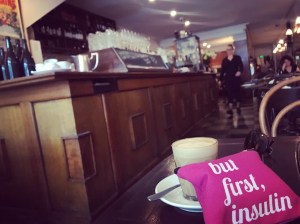
My day’s first though of diabetes is just before my first hit of caffeine. (Click photo for where to buy Casualty Girl pouch.)

My post at the end of last year about me limping to the end of 2017 was spot on. I don’t think I realised just how exhausted I was until the first day of my holidays when I slept until almost midday, not even getting up for a pee in the middle of the night. (Thank you, Loop!)

That pretty much set the tone for the next three weeks.

I’m not good at holiday holidays. You know, the ones where you spend all your time at home and just mooch around, losing track of which day of the week it is, and using public holidays as signposts for gentle reminders of how much time you have left until your return to the grind.

As it turns out, that was exactly the holiday I had and, most obviously, was exactly the holiday I needed. The initial pangs we all felt at not being in New York with friends, as we often are at this time of year, was eased thanks to visits from four different groups of NY mates all here either visiting family, or stopping by for their vacation. The brutal blizzards in that part of the world also made not being there a little easier, as instead, we managed to build up some vitamin D stores with leisurely walks around the neighbourhood, visiting favourite cafes or trying (unsuccessfully) to tire out the littlest dog at the park.

I spent time with my nose in books, scrolling through pointless social media feeds, trying to make sense of Trump (failed), binge watching Suits or just staring aimlessly at the sky.

I felt myself recalibrate, regroup and reboot until I knew that my breathing had slowed. The constant feeling of ‘what next’ gave way to ‘I’ll do it later’ and the most pressing thought was whether or not I really wanted to bake something right there and then. Usually, the answer was yes.

I realised that I started 2018 with a very different diabetes outlook to previous years. The same comfortable state in which I found myself once I started Looping seems to have moved in permanently. Perhaps it was having time to really notice it made me realise just how much my attitude to diabetes has changed.

I thought back to an early 2017 post last year where I decided that instead of making New Year’s resolutions I was going to have a word that became my guiding directive for the year. The word was ‘pause’ and I was going to do just that before taking on or tackling things.

Truthfully, I didn’t do too well with it all. I threw myself back into things with typical fervour, and the thing I’d hoped for by thinking ‘pause’ was that I would come to the end of the year and feel less overcome, exhausted and shattered.

Nothing changed and I think perhaps I’ve just come to the understanding that we all get like that at the end of the year.

Still no resolutions this year. But I do like the idea of having a word that I come back to when I need to feel centred. And it became clear and very obvious that my word for this year will be ‘focus’.

I don’t feel particularly unfocused. But I like the idea of a reminder to rein me back in when the distractions make it hard to concentrate on what’s important. Background noise can become overwhelming and losing the ability to stay focused and determined slips away all too easily.

And it’s a word that can mean lots of things. More focus on the diabetes issues that matter to me. Access and affordability to diabetes technologies, treatments and insulin will always be important to me both in my ‘real job’ and in my own advocacy efforts. Reducing diabetes stigma and ensuring language helps rather than harms people with diabetes. And peer support, because we need to know and feel that we are not alone. Plus, more focus on my family; more focus on ME.

We’ll see how it goes…

I’m back at work now: rejuvenated and ready to go. Happy New Year – it’s great to see you here!

Wearing stripes, carrying stripes, standing in front of stripes. Some things won’t change in 2018…

Is anyone actually sprinting to the finish line of 2017? Or are you all limping, crawling and seriously prepared to default and just sit down where you are now, probably about fifty meters from the end and admit defeat?

That’s where I am. I’m conclusively collapsed somewhere near the end: I can see it – but have decided that, quite frankly, the effort it’s going to take for me to cross the line, get a participation ribbon and high five the finish line referee is just not worth it. And I don’t think I have it in me anyway.

So, here I am. At the end of a super busy year. But then all years are busy, right?

But it’s been a good year. A really good year, when I stop to think about it. (Which is what I am doing as I set up shop here at the not-quite-finish-line.)

Lots of highlights, so here’s a bit of a recap:

Kicking off the year at the ATTD conference and being inundated with diabetes technologies and wondering how and when they would actually make their way into the hands of people living with diabetes.

Learning the importance of reframing our stories to capture the positive, not only the tough parts of them – or rather, understanding that the tough parts of what we have to deal with are often positive. Nick Bowditch at HealtheVoices explained that so beautifully.

Being pulled back into why we do what we do with a chance encounter in a café and, in the same week having a technology reality check at the #DAdvocatesDay.

It certainly wasn’t a highlight, although the way the diabetes community came together to try to address the frustration of a health organisation trying to control information at #2017ADA was pretty damn awesome.

And still at #2017, language! Yes, language was on the agenda and this would probably be one of the all-time highlights of the year.

The 4Ts campaign during National Diabetes Week made a lot of people in the Australian diabetes community happy as Diabetes Australia’s awareness campaign highlighted the importance and urgency of HCPs and the community understanding the symptoms of type 1 diabetes.

Convening and being part of the DAPeoplesVoices at #ASDSADEA2017. Not only was I firmly amongst my tribe, but we provided a fantastic stream of information from the conference to people who couldn’t be there. Thanks to Mel, Frank and Ash for being part of it!

Celebrating 30 years of the NDSS and remembering why we are just so damn lucky here in Australia.

Being involved in the IDF2017 Congress – as Deputy Lead of the Living with Diabetes Stream of the LWD stream, chairing a number of sessions and presenting in the Peer Support Symposium. There could not have been a better way to end the year!

But undoubtedly, for me personally, the most important, impactful and significant thing to have happened to me in 2017 has been starting to Loop. Without a doubt, this technology has revolutionised every aspect of my diabetes, from the way I sleep, eat and live. I finish 2017 far less burdened by diabetes than I was at the beginning of the year. I measure time in range rather than A1c to understand why it is that I feel so much better.

I have claimed the label of deliberately non-compliant as my own, and I wear it proudly, strongly, and most, most appreciatively.

So, thank you to everyone who has dropped by here, commented or emailed me to share your story. I continue to write here because of the support and love I get from people (I know, selfish) and am so grateful to everyone who reads Diabetogenic.

I’m going to take a break and will be back sometime in January. Between now and then, I’ll be baking away all my stresses and exhaustion! Much love – and baked goods – to you all during the festive season.

How’s your Christmas shopping going? Have you managed to get it all done and wrapped everything up in beautiful vintage newspaper with contrasting artisanal twine? Have you hand-addressed all the gifts on mistletoe leaves, and had Christmas elves bless the bounty? Have you stuffed everyone’s stockings with scented candles, socks and undies, and photo frames?

Yeah, me neither!

Starting to panic? About to head to a frantically busy shopping centre with a million other disorganised and stressed shoppers? Or have you already popped into a local chemist to clear them out of their toiletries packs?

Well, put down the bath bomb! I can help. And the best bit – you can do it all from your kitchen table, while lounging on the sofa, or sipping an iced latte at your local café, which is what I am doing as I am writing this little post.

Children and adults are dying because they can’t access insulin. I don’t mean to rain down on your Christmas parade or tangle your tinsel, but this is the cold harsh truth. It is happening every single day. I know I don’t have to remind most people who read this blog that insulin is not a new or experimental treatment. You all know that it’s been around for close to 100 years.

Insulin should be easy to come by for every single person in the world who needs it to treat their diabetes, but unfortunately, that’s not the case.

I don’t know about you, but this fact makes me angry and despair.  The idea that people are dying because they cannot access the very drug that I can easily pick up at any chemist in my neighbourhood actually hurts my brain.

But what if you could make a difference and actually get insulin to those in need AND skip department store queues as you line up to pay for some gift that will probably end up being re-gifted in next year’s office Secret Santa? (Don’t look at me like that – we’ve all done it!)

Well, you can, and it’s as simple as making a donation to a charity that is helping to get insulin into the hands – and bodies – of those who need it most. You can make gifts in the name of any or all of your friends and family, and I bet that they will understand why you have forsaken the novelty cup you usually buy them to do this instead.

When anyone asks me what I want for Christmas – and even if they don’t ask – I say ‘Please make a donation to either Insulin for Life or Life for a Child’.

My parents are doing that for me this year, and truly, it is the best present they could give me – I couldn’t be more pleased.

Click image to donate to Insulin for Life


Click image to donate to Life for a Child.

No one loses here. You avoid screaming kids and whimpering adults at shopping centres, no one gets a pointless gift they have to pretend to have always wanted. And someone is given the gift of insulin, or rather, the gift of life.

Now that’s the spirit of Christmas!

I was thrilled and honoured to speak in the symposium at #IDF2017 all about peer support. I shared the program with Chris Aldred, better known to all as The Grumpy Pumper, and advocate Dr Phylissa Deroze (you can – and should – find her as @not_defeated on Twitter).

Speakers in the peer support symposium at #IDF2017

When we were putting together the program for the symposium, the idea was that it would offer an overview of what peer support can look like, beginning with how diabetes organisations and community health groups can facilitate and offer a variety of peer support options, and rounding up with the perspectives of people with diabetes who provide and participate in peer support.

I spoke about how diabetes organisations in Australia, through the NDSS, offer a suite of peer support choices, urging the audience to think beyond the usual face-to-face or, increasingly, online peer support group. Activities such as camps for children and adolescents with diabetes, information events, education sessions (such as DAFNE) are all avenues for peer support. Peer support need not only take the form of a group of people sitting in a (real or virtual) room talking about diabetes in a structured or unstructured way. It can happen just by putting people with diabetes in the same space.

I’d never met Phylissa before, but I quickly learnt she is the definition of the word determined. She spoke eloquently about her own type 2 diabetes diagnosis which was anything but ideal. Instead of feeling beaten and overcome by how she had been let down by the healthcare system, she turned to her peers, finding a group that not only helped her diabetes management, but also gave her confidence to live well with diabetes.

Phylissa now facilitates an in-person support group for women with diabetes in Al Ain in the UAE, and is a huge supporter of, and believer in, the power and importance of peer to peer engagement and support in diabetes management. You can read more about Phylissa’s work on her website here.

Grumps, in true Grumps style, gave a talk about how his approach to peer support is more organic and certainly not especially structured. Although involved in some more planned peer support, he believes the most effective way he can support others with diabetes is on an individual, more informal way. Kind of like this:

Click image to see tweet.

And as if putting into practise his talk at the Congress, last week he started a conversation on Twitter about his own recent experiences of being diagnosed with an ulcer in his foot opening the door for people to speak about diabetes complications.

Click image to see tweet.

The way we speak about diabetes-related complications is often flawed. The first we hear of them is around diagnosis and they are held over us as a threat of the bad things to come if we don’t do as we are told. They are also presented to us with the equation of: Well-managed-diabetes + doing-what-the-doctors-say = no complications.

Unfortunately, it’s not that easy.

From then on, complications are spoken of in hushed-voices or accusations. Blame is apportioned to those who develop them: obviously, they failed to take care of themselves.

And because of this, for many people, the diagnosis of a diabetes-related complication is accompanied by guilt, shame and feelings of failure when really, the response should be offers of support, the best care possible and links to others going through the same thing. Peer support.

Back to Grumps’ raising diabetes complications on Twitter. After sharing his own story, suggested that we should not be ashamed to talk about complications.

That was the catalyst others needed to begin volunteering their own stories of complications diagnoses. Suddenly, people were openly speaking about diabetes complications in a matter-of-fact, open way – almost as if speaking about the weather. Some offered heartfelt sympathies, others shared tips and tricks that help them. But the overall sentiments were those of support and camaraderie.

The recurring theme of the peer support symposium at the Congress was that we need to find others we can connect with in a safe space so we can speak about the things that matter to us. It’s not the role of any organisation or HCP to set the agenda – the agenda needs to be fluid and follow whatever people with diabetes need.

END NOTE

While we’re talking peer support, how great is it to see that the weekly OzDOC tweetchat is getting a reprise this week, with Bionic Wookiee, David Burren at the helm. Drop by if you are free at the usual time: Tuesday evening at 8.30pm (AEDT). I’ll be there!

Disclosure

I was the Deputy Lead for the Living with Diabetes Stream, and an invited speaker at the 2017 IDF Congress. The International Diabetes Federation covered my travel and accommodation costs and provided me with registration to attend the Congress.

This week has been brutal. I arrived home from the IDF Congress very late on Saturday night after a very long journey from Abu Dhabi and since then, my body clock has had no idea where I am, despite my actual body being very much in the midst of Melbourne’s sometimes sweltering summer. My mind is all over the shop, sleep is something that happens if it wants (which it doesn’t really) and, for some inexplicable reason, I’m off coffee.

So, yes, I am a delight to be around right now. Want to hang out?

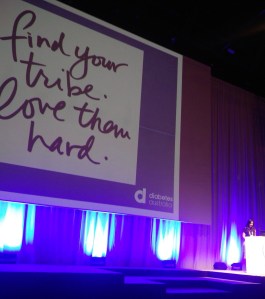
My time at the Congress, however, was one of those weeks that makes me feel so fortunate and privileged to do the job I do and have afforded to me the opportunities that come with it. Apart from a very full schedule of outstanding talks from leaders in the diabetes world, the congress was packed with advocates from around the world. I was totally with my tribe.

That’s me talking about diabetes and peer support!

There is lots to write about the Congress and I’ll do so in bits and pieces over the coming few weeks, but there were some stand out moments that I wanted to touch on and thought I’d try to do that now. (I’ve already started this blog post about four thousand, three hundred and twenty-eight times, so who knows how we’ll go here…)

Dot points – because they seem to take less energy and mental bandwidth…

  • This is the only diabetes conference primarily aimed at healthcare professionals that has a stream completely and utterly dedicated to ‘living with diabetes’ (LWD). This is, in equal measure, brilliant and problematic. It’s brilliant because it means that there is a real opportunity for people with diabetes to be on the speaker program, have their accommodation, travel and registration funded, and be part of the conversation at the actual meeting. But it can be problematic because it means that often, there are not all that many HCPs in attendance at the LWD sessions. I believe that one way to improve this situation is to include PWD in other sessions as well as have an exclusive stream. More on that another time, perhaps.

Click image to see tweet.

  • So with that in mind, if your HCP was at the Congress, I’d be asking them which LWD stream sessions they saw and have a stern talking to them if they reply with ‘not a one…’ Hopefully they will be more like UK Consultant Diabetologist, Reza Zaidi who not only attended a number of the LWD sessions, but also tweeted throughout them and asked questions.

(Click image to see tweet)

  • I patted a falcon (not a euphemism). There were falcons at the Congress. I am not sure why they were there. But obviously, I was terrified. I tried to overcome my fear of birds by being brave and patting one. I am still scared of birds.

  • There was a language session in the LWD stream (of course), but it was clear that a few of the exhibitors, presenters and those putting together posters for presentation could do with a refresher course on not using the word ‘compliant’. Call me, folks. I can help.
  • There was a fascinating discussion during the language session when it was explained by someone asking a question that the word for ‘diabetes’ in Japanese is literally translated as Sugar Urine Disease. And yes – you bet that adds to the stigma of diabetes…
  • And one final language point. There was a lot of talk about needing to ‘battle’, ‘fight’, ‘combat’ and ‘challenge’ diabetes as though this is a war. I’m not sure that this is a particularly useful way to think about it all.

Click image to see tweet.

  • Getting a break from the Congress proved almost impossible. So I was so grateful to the diaTribe Foundation for forcing us out of the conference centre and into an Art Gallery with one of their Art Walk series events. We got a guided tour of the brand new (as in, open for less than a month) Abu Dhabi Louvre. Stunning!

The amazing Abu Dhabi Louvre at sunset

  • For some reason, the IDF put me up in the middle of nowhere on a golf course. Perhaps they were hoping I would take walks. Or improve my swing. I did neither of these things.
  • I am more than used to getting asked about the ‘thing’ on my arm. My Dexcom sensor and transmitter are quite obvious and people are curious. I almost have come to expect it and I am happy to answer questions as long as they are asked respectfully. I don’t, however, expect this at at a diabetes conference. And yet, that happened over a dozen times. But possibly, the most surreal experience was stepping onto the Dexcom stand in the exhibition hall and having a few of the sales reps nearly tripping over themselves to ask what it was, how it worked, what it felt like and why it was on my arm. And then they wanted to see the iPhone and Apple Watch app and ask more questions, suggesting that Congress attendees visiting the stand ask questions of me and another person sporting one of their devices. Obviously, I should be on commission…
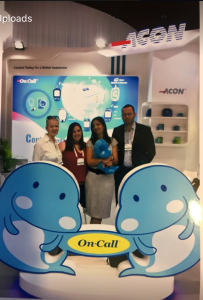
  • Diabetes conference exhibition halls can be confusing places. There are stands offering products that seem to be so far removed from diabetes that surely the exhibitors have accidentally turned up the wrong week for the wrong conference. I’m still confused by what the fluffy dolphin (pictured here with Annie, Georgie, Grumps and me) has to do with diabetes or what was happening on this stand.

Dolphins and diabetes… join the dots.

  • The Abu Dhabi National Exhibition Centre (ADNEC) might look like pretty much every other conference and exhibition centre I’ve ever been to (they all do), but jeez, it was certainly the largest I’ve ever been to. It was, in fact, quite cavernous and a lot of the time seemed quite empty, despite there being over 8,000 attendees. All that space, and still nowhere to get a decent coffee.
  • I chaired a really important session about diabetes complications. It was great to have an open, frank and honest discussion about living with complications and how they impact on the lives of people with diabetes. (Although, I could have done without the clip from Steel Magnolias to introduce the session on complications in pregnancy.)
  • Finally, it was so lovely to see the wonderful Wim Wienjen’s legacy on show during the hypoglycaemia talk. The book he authored alongside Daniela Rojas Jimenez is due for publication soon.

That’s it in dot points for today. I’ll be back soon writing more about the Congress. (I guess four thousand, three hundred and twenty-nine is a charm….)

Disclosure

I was the Deputy Lead for the Living with Diabetes Stream, and an invited speaker at the 2017 IDF Congress. The International Diabetes Federation covered by travel and accommodation costs and provided me with registration to attend the Congress. 

Last week, I received an email informing me that the weekly #OzDOC tweet chats would be coming to a close. Obviously, I thought of it as a sad announcement, but what a fantastic five years and five months of weekly conversations and support!

It takes a lot of dedication to run a diabetes support group, and the regular tweet chat format of #OzDOC meant that it was a once-a-week commitment, requiring a roster of interesting and engaging topics, and someone to direct the conversation and make sure that there was someone welcoming anyone who wanted to participate each and every week.

It takes work, time and effort, and, in most cases, support groups are run by volunteers who already have jobs and busy lives and families. The support group administration and activities are run in someone’s own time.

But despite what it takes – the planning, the commitment and the energy – there has been someone there since the beginning, taking responsibility to make sure that the #OzDOC tweet chat bus kept going. And that person is Kim Henshaw.

Kim talking #OzDOC at last year’s #MayoInOz meeting.

When the #OzDOC tweet chats started, there were three of us involved: Kim, Simon and me. We took it in turns each week to moderate the chat, come up with the questions and run ideas by each other. But circumstances change, and first I, then Simon needed to step back from being part of the moderating team.

Kim stayed on and has been the one responsible for herding the #OzDOC kittens and creating a safe, fun, supportive, reassuring online space for people in the Australian diabetes community to come together on Twitter each week. With a team of moderators, the chats continued.

Kim’s commitment to #OzDOC could never be questioned. In the very first tweet chat, back in July 2012, she was sent to Twitter jail for tweeting and retweeting too many times in the hour! She wanted to share as widely as she could, acknowledge as many comments from others as possible and encourage conversation at every turn. Until she was cut off from Twitter:

Oops…

Kim never wavered from her pledge to build and support the community. I shared the power of #OzDOC every chance I had – any time I was speaking about diabetes peer support, #OzDOC got a mention; I’ve written about it here over and over and over again. And I defended online channels and Twitter as a support platform, using #OzDOC as an example of just how a community could be developed.

But times change, and with Kim stepping aside and no one else available to take on the coordination of the group, next week will be the final time that the @OzDiabetesOC account is used for the #OzDOC hour of power.

I wanted to say a huge thank you to everyone who has been involved in the OzDOC tweet chats for the last (almost) five and a half years. I have met some incredible people through the chats, made some wonderful friends and learnt so, so much.

And mostly, I wanted to say thank you to Kim for delicately, dedicatedly and devotedly running the group. What a wonderful thing you created, Kim. Well done! Enjoy your quiet Tuesday nights – you deserve it!

Towards the end of last week, I got a little rant-y at all the ads from Australian-based and owned companies filling up my social feeds, and my inbox, inviting me to shop up big in the Black Friday sales.

My understanding of Black Friday sales is that they happen the day after Thanksgiving. We don’t have Thanksgiving in Australia. And therefore, we don’t have Black Friday. I actually had to do a bit or reading up to find out the history of the whole Black Friday sale thing, because I’ve always associated the term (as do many Aussies) with bushfires from back in 1939 – not a fire sale of bed linen or mascara.

After Friday was done, it wasn’t over! By Saturday, suddenly, Black Friday ads morphed into Cyber Monday ads. And details of more sales flooded every online channel. Cue more ranting from me (who probably should get a hobby and stop complaining about crap).

Today, with all the consumerism over, it appears that it’s time for another catchy day: Giving Tuesday. But this time, I’m all over it and happy to get involved and will be making a couple of donations to charities supporting people who are unable to access basic diabetes supplies.

Diabetes is just such an un-level playing field. Some of us are in Facebook groups trying to work out how to source equipment for our DIY APS builds, while for others, sourcing insulin is impossible.

This quote from former IDF President, Professor Jean Claude Mbanya provides some much needed perspective, reminding us just how different life with diabetes can be around the world.

If you can, please consider making a donation to a diabetes charity. You can choose to go local, and support a charity that provides services to you and people in your area. Or you can look to charities supporting people with diabetes in less well-resourced countries.

Maybe you could get together with some friends or family or work colleagues and donate to the Life for a Child 1,000 Donors Campaign. Already, 113 generous people have pledged to give $1 a day to help provide insulin to children in need.

Alternatively, you can always donate to the Spare a Rose, Save a Child campaign (also supporting Life for a Child) where just AUD$6 per month is all it takes to provide a child with insulin.

Insulin for Life saves perfectly good insulin from landfill and transports it to people in countries where insulin is difficult to access. Learn more about Insulin for Life by watching this short YouTube clip and then donate here.

Giving Tuesday, while really only a US thing, is something I am more than happy to embrace. As we throw ourselves headfirst into the silly season, I think it’s really important to remember those who can do with some help. And with Xmas spending about to hit frenzy levels, stopping and thinking about how you and your family and family can help those in need. (Read here for a slightly Grinch-esque idea, but one that I still stand by 100 per cent!)

This week, for the first time ever, I had no anxiety at all as I prepared for my visit to my endocrinologist. I always feel that I have to put in a disclaimer here, because I make it sound like my endo is a tyrant. She’s not. She is the kindest, loveliest, smartest, most respectful health professional I have ever seen. My anxieties are my own, not a result of the way she communicates with me.

Anyway, now that the disclaimer is done, I walked into her office with a sense of calm. And excitement. It was my first post-Loop appointment. I’d eagerly trotted off for an A1c the week earlier (another first – this diabetes task is usually undertaken with further feelings of dread) and was keenly awaiting the results.

But equally, I didn’t really care what the results were. I knew that I would have an in-range A1c – there was no doubt in my mind of that. I know how much time I am spending in range – and it’s a lot. And I have felt better that I have in a very, very long time.

The eagerness for the appointment was to discuss the new technology that has, quite honestly, revolutionised by diabetes management.

I sat down, she asked how I was. I marvelled – as I always do at the beginning of my appointments with her – how she immediately sets me at ease and sits back while I talk. She listens. I blabber. She never tries to hurry me along, or interrupts my train of thought.  I have her full attention (although I do wonder what she must think as my mind goes off on weird, sometimes non-diabetes related tangents.)

And then I asked. ‘So…what’s my A1c? I had it checked last Wednesday.’ She told me and I took in a sharp breath. There it was, sitting firmly and happily in what I have come to consider ‘pregnancy range’. Even though that is no longer relevant to me, it frames the number and means something.

I shrugged a little and I think perhaps she was surprised at my lack of bursting into tears, jumping up and down and/or screaming. I wasn’t surprised. I repeated the number back to her – or maybe it was so I could hear it again. ‘And no hypos.’ I said. ‘And minimal effort.’

I’ve had A1cs in this range before. In fact, I managed to maintain them for months – even years – while trying to get pregnant, and then while pregnant. But the lows! I know that while trying to conceive and during pregnancy, I was hypo for up to 30% of the time. Every. Single. Day.

It was hard work. No CGM meant relying on frequent BGL checks – between 15 and 20 a day. Every. Single. Day. And it meant a bazillion adjustments on my pump, basal checking every fortnight and constantly second guessing myself and the technology. Sure, that A1c was tight, but it was the very definition of hard work!

This A1c was not the result of anywhere near as much effort.

Surely the goal – or at least one of them – of improved diabetes tech solutions has to be about easing the load and burden of the daily tasks of diabetes. I’m not sure that I’ve actually ever truly believed that any device that I have taken on has actually made things easier or lessened the burden. Certainly not when I started pumping – in fact, when I think about it, it added a significant load to my daily management. CGM is useful, but the requirement to calibrate and deal with alarms is time and effort consuming. Libre is perhaps the least onerous of all diabetes technologies, yet the lack of alarms means it’s not the right device for me at this time.

These tools have all been beneficial at different times for different purposes. It is undeniable they help with my diabetes management and help me to achieve the targets I set for myself. But do they make it easier to live with diabetes? Do they take about some of the burden and make me think less about it and do less for it? Probably not.

Loop does. It reduces my effort. It makes me think about my own diabetes less. It provides results that mean I don’t have to take action as often. It takes a lot of the thinking out of every day diabetes.

So let me recap:  Loop has delivered the lowest A1c in a long time, I sleep better that I’ve slept in 20 years, I feel better – both physically and emotionally – than I have in forever. And I feel that diabetes is the least intrusive it has ever been.

Basically, being deliberately non-complaint has made me the best PWD I can possibly be.

Oh look! Your phone can now be deliberately non-compliant too, thanks to designer David Burren. Click on the link to buy your own. (Also comes in black and white.)

There is one word – actually an abbreviation of a word – that strikes particular fear through every fibre of my body: ‘Gastro.’ I hate even talking about it. Just typing the word sent a shudder down my spine. (I am nothing if not dramatic…)

A work friend and colleague was telling me about how she had been struck down with gastro a couple of weeks ago – a lovely gift from her kinder-aged daughter. Just the mention of the nausea and vomiting was enough to have me sweating and getting nervous. For the record – and so you understand my irrational fear of the topic – we weren’t sitting next to each other in an office while she was telling me. She was on the other end of the phone. Two states away in Queensland. I was in Melbourne. And yet I was still looking around me wondering what I should disinfect.

A couple of weeks ago, on a Tuesday night I went to bed with my plans for the next couple of days clearly organised and sorted in my head. I had a most-civilised mid-morning flight the next day, and then a couple of days of meetings in Adelaide. I’d booked a cab, checked in online for my flight, half-packed my overnight case and mentally gone through the check list of what needed doing in the morning before I needed to head to the airport.

And then, a couple of hours later I woke up startled, with a very unsettled feeling in my stomach. ‘That doesn’t feel good,’ I said to myself. I lay there for about thirty seconds trying to convince myself that it was all in my head and I was fine and that it would be best to close my eyes and go back to sleep. Before I jumped up and ran to the bathroom, making it there just in time before vomiting. For the first time.

I spent the next few hours alternating between throwing up and being flaked out on the sofa willing myself to not throw up. I was cold and sweaty and hot and clammy all at the same time. My heart rate was racing, and every time I stood up I was dizzy. I gripped onto the walls as I stumbled down the corridor to the bathroom, tripping over nothing but my own two feet.

At about 6am, I sent an email out saying I wouldn’t be getting to Adelaide and cancelled my flight. I crawled back into bed, still nauseous, thinking the worst was behind me. For the most part, it was. I threw up a couple more times before my official alarm went off at 7am.

I feel like death,’ I told Aaron. ‘And I bet I wind up in A&E.’ I used some choice words, mostly words beginning with ‘f’ and ending in ‘uck’, and started to work out how much time I’d lose in an emergency bed having to deal with HCPs wanting to remove my devices from me and ‘look after’ me.

‘Should I stay home?’ asked Aaron. ‘I can take you in that way.’ I told him it wasn’t necessary and that if I really needed to get to hospital my dad could take me. He got ready for work and the kid got ready for school and the two of them left, leaving me in bed, switching between dozing, holding my tender stomach and glaring at my iPhone and my Dex trace. I was hoping if I stared daggers at the trace hard enough it would stay in range.

My Loop was working overtime. I spent most of the morning between 3.5 and 4mmol/l thanks to my Loop cutting off all basal insulin. By about 11am, I could see my CGM trace starting to inch up closer to 5 and then 6, and Loop was making tiny micro adjustments to my basal rates.

I was able to keep water and some dry ginger down, and chewed on small blocks of ice. I didn’t feel dehydrated; I wasn’t going high. I didn’t have ketones. Things were looking good!

By 1pm, I was feeling comfortable enough to call into the meeting I should have been at in Adelaide. My nausea was less pronounced. I felt washed out, achy and tired, but I hoped I was out of woods, and needing to go to A&E was becoming less and less likely. Thankfully.

I have generally been pretty lousy at managing gastro and diabetes. I usually do end up in A&E, needing to be rehydrated and given some anti-nausea meds though an IV as I’m unable to keep them down after taking them orally.

But of course, it ends up being far more of an ordeal than simply lying on a bed with fluids being pumped into me. There is the inevitable request for my insulin pump to be removed so that insulin can be administered via IV – even if it’s clear my pump is working just fine.

Nurses insist on checking my glucose levels, refusing to pay any attention to the CGM spitting out readings every five minutes. My requests (demands?) to self-manage my own glucose levels – and diabetes generally – are ignored. I’ve no idea what would happen if I tried to explain the DIY APS thing I have going on these days, but suspect that wouldn’t go too well.

Usually, it takes me making an emergency call to my endo for things to go the way I really want them to – fluids, dark room, anti-nausea meds and home in about 4 hours (at the most).

By the time I leave I often feel worse for wear – and certainly more battle scarred – than I did when I first walked in there, doubled over and trying to not throw up on anyone.

But I avoided all that the other week. I managed to spend the day in the comfort of my own home, breathing in fresh air from the open windows and generally feeling comfortable and content. The only gastro hangover I had was a little exhaustion and abdomen discomfort. All in all, it was a good outcome. (But I’m still terrified of the word ‘gastro’…)

A much preferred view to a cubicle in A&E!

Follow Diabetogenic on WordPress.com

Enter your email address to follow this blog and receive notifications of new posts by email.

Read about Renza

Archives