When I was in my teens and twenties, I was, just as many women are, dismayed with the way I looked, and susceptible to the claims of beauty products that promised I could be thinner, more toned, more beautiful, smoother, more attractive, more <insert whichever part of me obviously needed improving>.

Of course, all of the things I was desperate to change and refine were measures of my worth, right? Because if I was thinner, more toned, more beautiful, smoother, more attractive, more <insert required improvement> that would make me a better person. Right? Of course.

I didn’t look like one of the supermodels (not just models, mind; these ones were super) that were everywhere I looked. At the time, I was spending all my energies being a flute player, but even the classical musical world wasn’t spared the attention to how women should look, with Jane Rutter suddenly appearing wrapped in nothing more than a bedsheet and a sultry look (impressive with a flute shoved against her bottom lip, while playing Debussy). ‘Great’, I thought. ‘Now not only do I have to look like a fucking model. I have to do it while playing flute. Naked.’

The feelings of inadequacy were strong and I know I spent far too much time desperately wishing I looked different. I probably spent too much money on products that promised to make that happen. And delivered nothing.

When I was twenty-one, someone gave me a copy of Kaz Cooke’s fabulous book Real Gorgeous. I can’t remember who it was, but suspect it was my mother. I read it in one sitting. I already knew of Kaz Cooke (from her brilliant ‘Keep Yourself Nice’ column in the weekend papers), but this book was a revelation. She laid bare all the sneaky tips and tricks and lies the beauty industry used to expose our insecurities, feel as though we needed to be different and, subsequently, buy their products. Of course, I already knew what she was saying. There was nothing in there that, when I had a moment of rational thinking, I didn’t already understand. But to have it set out so practically and emphatically was just what I needed to get over the idea that I needed to look and be different to how I was.

I actually saw Kaz at Marios over the weekend and stopped her she walked past me. I introduced myself and the kid (who was so horrified and embarrassed that she looked as though she wished the ground would swallow her up), and thanked her for all her books, but especially Real Gorgeous. ‘It saved me, in some ways.’ I told her.

And it did. It stopped the self-doubt. And it made me confident enough to admit to myself that I was more than enough. Just the way I was. And that nothing about the way I looked needed improving. (Thankfully, this was before I tried any naked flute playing. At least, any in public…)

As it turns out, I struggled with the same insecurities and feelings of inadequacy and self-doubt when it came to being diagnosed with diabetes. I think it is only in recent years that I have come to understand that the constant second guessing about being good enough achieves nothing other than increasing my anxieties and contributing to burn out.

With time, I came to apply the same cynical filters to diabetes product advertising as I now had permanently in place when looking at health and beauty advertising. In the same way that not every woman looks like Cindy Crawford, not every blood glucose check will be 4.8mmol/l.

‘Real Gorgeous’ wisdom on the left. Real diabetes on the right.

One of the most damaging things that we can do is compare ourselves to others. Because when we do, we often fall short. Our A1c may be higher, our time in range lower, our technology not as advanced, our healthcare professionals not the ones on the TV or on conference stages.

Being around and sharing with others living with diabetes is wonderful (here are twenty reasons why) but it can be damaging if the only thing you are doing is using them as a yardstick for your own diabetes.

It took me many years to stop feeling that I needed to ‘keep up’ with my diabetes peers, or that my diabetes needed to look like someone else’s diabetes. While I may try to align myself with others who have similar ideas about diabetes, I do it on my own terms, using and doing the things that work best for me.

The way I have adopted DIYAPS is not the same as many others. I call it ‘Loop Lite’, using just the absolute basics, without any of the add-ons. I don’t produce pages of graphs to analyse, because that’s not what I need. But what I do is perfect for me.

The same goes for finding the way to an eating plan that works for me. While learning about the details of LCHF, I refused to go ‘all in’ as many seem to. I adapted it for the way I live.

The way I do diabetes and the way my diabetes behaves is enough. It is right for me. It is my Real Diabetes.

Today, I have a brand new copy of Real Gorgeous on my desk, all wrapped up. It’s a gift for the kidlet who is already a huge Kaz Cooke fan (she has had Girls Stuff on her shelf for a few years now).  She already has a very healthy filter when it comes to beauty advertising, but I know that it is possible that she will be susceptible to the same feelings of self-doubt that I was.

I want her to know she is enough. So very much more than enough. We all are.

Click on photo to order your own copy of ‘Real Gorgeous’.

I don’t know where I would be if it wasn’t for the support, love, friendship and sustenance I get from my peers with diabetes. A long time ago, I wrote that the two most powerful words in the English language are ‘me too’. Realising that others understand, have experienced and know what I am going through means that I never feel truly alone. It doesn’t matter what time of the day it is, I know I can always find someone – a diabetes peer – to talk to and help me through.

I wish I knew this from when I was diagnosed. I felt really alone for the first few years I lived with diabetes. To be honest, I don’t think I necessarily wanted to meet anyone with diabetes as soon as I was diagnosed, but I certainly did a short time later, once I realised that diabetes wasn’t just for Easter (when I was diagnosed)…it was for life.

Today, I couldn’t be without those I have come to know because of our shared lazy pancreases. I am so lucky to have them in my life.

  1. What this tweet says:
  2. At diagnosis, being made aware of peer support is a really good idea and I so wish that I had been told how to find other people like me when I was diagnosed and felt so alone.
  3. There is no right way to do peer support. Whatever works for your – that’s your peer support model!
  4. Peer support may be catching up with a mate for a coffee or a beer, or it could be sitting in a room while someone speaks to you. Or a walking group, or a sports group (allegedly). Or a diabetes camp. It can be a formal structure or something more akin to a casual book group. For my money, I’m all about the informal, unstructured model. That is what works best for me. But just as with everything to do with diabetes, there is no one size fits all and it’s important that all options are available so people can find out what works best.
  5. So, yes – this works when it comes to peer support too.
  6. I promise you – what you learn from your peers will be as important, if not more important, than anything you will ever learn from a diabetes healthcare professionals. It will probably be more relevant and practical too.
  7. You don’t need to love everyone you meet – just because they have diabetes. Dodgy beta cells can’t be the only thing you have in common.
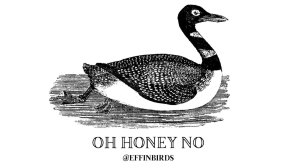
  8. The connection you find with the people you do ‘click’ with and love could be to do with your life stage, personal experiences, philosophy about living with diabetes or mutual love of Effin’ Birds.
  9. AKA: 
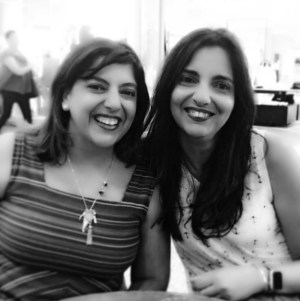
  10. There is an undeniable feeling of luck, love and gratitude when meeting someone that is in your tribe. And that extends to when you introduce their family to yours and you realise that you have made family friends forever. AKA: This time in New York City.
  11. Sometimes, there is no need for words. Support, love and encouragement can all be said in one glance.
  12. I have found some of my closest diabetes friends online. The DOC is a diverse and varied community. You just need to work out the people and activities that work for you!
  13. Online peer support can be just as valuable – and sometimes more so – that face-to-face peer support. There is nothing scary about meeting diabetes friends online.
  14. So with that in mind, be open to meeting new people. You can easily get stuck in a peer support rut with people you once really connected with, but, for whatever reason, are ready to meet new people. That’s okay.
  15. And with THAT in mind, remember that involvement in peer support can be transient. Just because your ideal peer support model looks one way today, doesn’t mean you need to do it the same way forever.
  16. There may be times that really, you’re not interested in speaking with others with diabetes, or feel you don’t need support from other panreatically-challenged folk. That’s okay too. (You can always come back if and when you are ready.
  17. For peer support to work and be truly effective, it needs to be a safe, judgement free environment. (Which is pretty much how everything to do with diabetes needs to be for it to work…)
  18. Linking and connecting with other people with diabetes can be life changing and life saving. Search Simonpalooza in Google to see what I mean. Or read the Pumpless in Vienna story here. 
  19. Peer-led support groups are most successful when the person doing the leading clearly has no agenda other than wanting to build a community. If you want to look at a beacon of someone who is all about community, building people up and being nothing other than inclusive, look no further than Cherise Shockley who started and continues to oversee the first diabetes tweetchat!
  20. Peer support can happen anywhere. Diabetes in the wild moments often provide the most incredible opportunities to connect. Just remember though, not everyone is necessarily open to sharing all their diabetes tales with a complete stranger you meet while waiting for a coffee. (That last point is mostly for me.)

Peers.

I had a great conversation the other day with someone who was interested to talk about diabetes and language with me. ‘I’m trying to get a better grasp of why it’s something so important to you, because, quite frankly, I couldn’t care less what people say about diabetes.’ 

This isn’t the first time people have asked me this. And it’s certainly not the first time I’ve been asked why I spend so much time speaking about diabetes language matters.

I know the reasons, but to be perfectly honest, I’m not sure that I have them especially well mapped out when I need to explain them. So, let me try here.

There is a tangled and complicated link between the words used when talking about diabetes, and how we feel about it and how diabetes is perceived by others. That link then goes off on all sorts of LA-freeway-like tangents to include diabetes and stigma, and discrimination.

The effects of how we frame diabetes can be felt by us individually. But they can also be far reaching and affect how others feel about diabetes.

We know that language has the potential to make people with diabetes feel judged and stigmatised. In fact, most PWD I know have at some time or another faced someone speaking to them using Judgey McJudgeface words. Of course, we all respond differently to this. For some people, it’s water off a duck’s back. They couldn’t care less what people say and just ignore it. For others, it’s almost a challenge – they use it as motivation to prove that they ‘won’t be beaten’.

But that’s not the case for everyone. For some people, it can be absolutely paralysing.

Fear of being judged and shamed may lead to some PWD to not wanting to attend HCP appointments and, as a consequence, falling behind on complication screening. Some PWD may not even tell their loved ones they have diabetes for fear of being judged. I have met PWD who made the decision to keep their diabetes a secret and for years, not telling another person. This can add to feelings of terrible isolation.

When diabetes is spoken about in stigmatising and demeaning ways, this leads to the spreading of misinformation. And this can have far reaching consequences.

We know that kids with diabetes may be teased by their schoolmates. Their teachers may not respond appropriately to diabetes because of the way diabetes is framed in the media or by others. We can’t really blame teachers. If diabetes is punchline fodder for every B-grade comedian, or an excuse to point fingers at those living with it by every tabloid news outlet, how can we expect anyone to take it seriously?

(And if right now you are thinking ‘This is why we need to change the name of type 1 diabetes’, stop it! People with type 1 diabetes shouldn’t be teased or mocked or judged, but neither should people with type 2 diabetes. This isn’t about people understanding the differences between type 1 and type 2 – this about understanding diabetes.)

The language we use when talking about prevention in diabetes – whether it be preventing type 2 diabetes or preventing diabetes-related complications – means that there is an underlying idea that developing type 2, or complications must be the fault of the individual. ‘If you can prevent it and haven’t, it’s your fault. You obviously lived an unhealthy lifestyle/are lazy/didn’t listen to your doctor/failed to follow instructions/refused to do what you were told etc.’.Can you imagine hearing that, or feeling that is what people think about you – all the time? This is the language – these are the words – used to talk about diabetes.

A couple of weeks ago in the UK, it was Prevent Diabetes Week. I saw countless tweets from people urging, begging, pleading with others to remember that type 1 diabetes can’t be prevented and the week refers only to type 2 diabetes. I wonder if those tweeting realised that comments such as these actually contribute to the stigma associated with type 2 diabetes? Of course type 1 diabetes can’t be prevented. But in many cases, neither can type 2 diabetes. There are so many non-modifiable factors associated with a type 2 diagnosis – factors beyond the control of the individual.

But let’s look beyond individuals, the health system and the education system for a moment. What else happens in other settings when diabetes is spoken about in stigmatising ways?

Health organisations, including diabetes organisations, frequently seek donations from the public to continue the important work they do. There is only so much money in the donation pie, and yet there are more and more competing organisations representing people with different health conditions wanting a piece of that pie.

Donations are harder to come by from the general community when there is the idea – the wrong idea – that diabetes is a largely preventable lifestyle condition that is the fault of those diagnosed. There is not the idea that people who have developed cancer brought it on themselves, even though we know that some of the risk factors associated with a breast cancer diagnosis are the same as for type 2 diabetes.

Research dollars for diabetes are far less than for other health conditions. We see that every year when successful NHMRC grants are announced. Diabetes is the poor cousin to cancer research and CVD research.

Diabetes is just as serious as any other condition that is worthy of research dollars and fundraising dollars. Yet because of the way we speak about it and the way diabetes as a condition has been framed, there is a perception that perhaps it isn’t.

Words matter. Language matters.

So, what I want to say to people who think that talking about language and words is a first world problem that only occupies the minds of the privileged is this: I acknowledge my privilege. But this isn’t simply about words. It’s about perception.

Until diabetes is considered the same way as other conditions that are taken seriously and thought of as blameless, the trickle-down effect is people with diabetes will continue to feel stigma. Diabetes will continue to be the poor cousin of other health conditions and diseases because there is the misconception it is not as serious. People will not as readily make donations towards fundraising initiatives. Research dollars will continue to fall short, instead going towards ‘more worthy’ conditions.

That’s why I care so much about diabetes language. Because, language matters… so much.

In what has possibly been the worst kept secret in diabetes in Australia, AMSL today announced their partnership with Tandem Diabetes Care, officially revealing that the much anticipated TSlim pump is on its way to Australia. You can read all about it here, but please note that at this time there is no official launch date available. AMSL is still going through registration and subsidy processes, and this will take some time. (But we’re told we can expect it on the market some time later this year.)

This is the latest development in changes to the Australian pump market which, to be honest, was looking a little dire.

With the announcement that Animas was leaving the market completely (the Australian departure was declared a few months after our North American friends were told; no one particularly surprised), Australians were left with a choice of pump offerings from Medtronic and Roche. Cellnovo had just launched, but there were supply issues. Really, it was slim pickings for us!

Fast forward three months and the Aussie pump landscape is looking a little different, which is great news if you are thinking about starting on a pump, or are due for an update soon. If you’re in the market for a new pump, you can now consider:

And now, Tandem will be AMSL’s pump offering. For updates, check the AMSL socials.

So what does this mean for me? Well, twelve months ago, I would have been beside myself with excitement at today’s announcement. My pump’s warranty would have been about to expire and I was in the market for a new pump. I was extraordinarily frustrated at the ‘pump limbo‘ I found myself in with the limited options available to me not giving me any joy at all. I would have been hassling the gorgeous AMSL team for more details, desperate to get my grubby paws on a TSlim the second it was on the market.

Today I am indeed thrilled by the announcement. I am all about choice and this provides people with diabetes who want to pump another option. This is nothing but a great thing! But for me personally, I am actually happy with my old loopable pump and won’t be making any moves away from what I am doing.

A shiny, sexy new TSlim pump would be lovely shoved down my bra. But unless I can loop with it, it’s not for me. But I will certainly be keeping a very, very close eye on developments, because I do know that with its Dexcom integration, it will have hybrid-closed loop capabilities available in the not too distant future…

I really love a good list. And twenty is such a lovely round number. Plus, I’m going to milk the twentieth diaversary thing for as long as I can. Or at least until I bore everyone. And myself.

On the day I was diagnosed, I was given a meter. It came in a padded navy bag and had a cream-coloured lancet device. The meter looked quite similar to a basic BGL meter today. And it took twenty seconds once the drop of blood was placed on the strip to countdown to give me my reading. I know, twenty seconds! Barbaric!

There have been a lot of advances in DTech in the last twenty years. Some of it has been incredible (CGM, Flash, advances in pumps, better insulins); some…not so much (hello GlucoWatch!). But either way, I’ve always been interested in the latest technologies and have wanted to get my hands on it as soon as possible. It’s not all been great. But I’ve always learnt something when I’ve tried something new.

So, here are twenty things I’ve learnt about diabetes technology.

  1. There is no one way to do diabetes technology. This fits into the My Diabetes, My Rules thing again.
  2. Diabetes technology does not only refer to the latest and greatest! It includes your BGL meter (even if you are using one from a few years ago!), your insulin pen, the app you use to track your glucose levels and food intake…
  3. And MedAngel!
  4. You don’t need to use the latest and greatest if you don’t want. If you are happy with using a BGL meter and MDI, keep going. AKA: If it ain’t broke, don’t fix it. Unless you want to. And then knock yourself out.
  5. An insulin pump is just a way to deliver insulin. That’s all it is! It’s a fancy way to do it, but it’s just an insulin delivery device. There are other ways to deliver insulin, so if you don’t want to pump, that’s perfectly okay.
  6. But if you do want a pump, learn to use it properly. I spent the first three years pumping not having a clue with what I was doing because I was trained by a rep from the pump company who just wanted to get in and out as quickly as possible. I learnt what the buttons did, but had no idea about anything else. I learnt nothing about carb counting, or how to make adjustments. My basal rates were wrong, but I couldn’t fix them because I’d never understood how to.
  7. That actually goes for any sort of technology. You won’t get the most out of anything if you don’t know how it works.
  8. So…find HCPs who know DTech, will support whatever you want to use, are up to date with the latest technology and are okay with you customising your devices to suit your needs.
  9. Once you find those awesome HCPs, listen to them. Learn the rules for your Dtech devices. And then break them to suit you. Being deliberately non-compliant only works if you know what you’re being deliberately non-compliant about!
  10. And further to that, after listening to your HCPs and reading all the official information and documentation, find out the truth about diabetes technology! Turn to your peers and learn how to use it in real life. I can honestly say that every single tip and trick I have learnt when it comes to DTech came from other people with diabetes. Peer support for the win!
  11. Worrying about how and where you will site wearable technology is not a frivolous thing to worry about. It makes perfect sense and it’s okay if that is something you are concerned about or if it’s the reason you’re wary about getting a pump, CGM or Flash glucose monitor. (But do ask around for tips in online groups to hear about how others manage – you’ll get some great ideas!)
  12. Just because you have decided to try something doesn’t mean you have to use it forever. If you decide that tech isn’t for you, put it away in a drawer, or pass it onto someone who wants to use it, and go back to what you were doing before. Or switch between the two. DTech is not like a puppy – it can actually be just for Xmas!
  13. Dtech may not necessarily make your diabetes easier to manage. Sometimes, it can feel like (and may be) more work – especially at first. Those of us who have been using different devices for some time can forget that.
  14. Just because one brand is the market leader and has the flashiest flyers, or your HPC wants you to use it, doesn’t mean that’s the one to go with. Look at all on offer and work out which one works best for you.
  15. And if colour is important (or anything else about the way it looks), and you’re using that as a factor when making a decision with which device to choose, that is perfectly fine!
  16. Diabetes technology is not a luxury item and don’t let anyone tell you otherwise. I once had a politician ask me when I was giving a presentation at Parliament House why it should be up to the Government to fund my ‘Mercedes Benz DTech’ when there was a perfectly suitable Hyundai option available. We had such a fun conversation after that…?!
  17. The playing field is not even. Some diabetes technology is expensive to use and out of reach of a lot of people. This is unfair. And sometimes, it’s really hard to talk about DTech access when people can’t access insulin.
  18. Going old school and analogue is perfectly fine if that’s what works for you. Sure, there are brilliant tracking apps (hello mySugr!), but if you really want to use a record book and pen, knock yourself out.
  19. DTech can be overwhelming at times. There can be a lot of data available all of a sudden and it is perfectly understandable if you find that it’s a little bit too much to manage.
  20. Don’t compare your glucose graphs to someone else’s. Their diabetes is not your diabetes.

Extra tip for good luck:

Just as you don’t need to use the latest in DTech, you don’t need to know all about everything new or emerging. But it makes sense to keep an eye out if you can. Find a trusted source that gives sensible information that is up to date. Some great places to start include diaTribe, Diabetes Mine and A SweetLife.

With my twentieth diaversary in the bag (thanks to my gorgeous husband who organised a surprise breakfast get together with some of our most loved on Sunday morning!), I’ve been thinking about what I wish I’d known when I was first diagnosed.

To be honest, I don’t know that many of these things would necessarily have made sense at that time, but perhaps it would have been a useful little cheat sheet to have to keep coming back to.

Obviously, this isn’t an exhaustive list. I expect that if I wanted to, I could list hundreds of things I wish I’d known. But that would make for a really long blog post, and I need a coffee. So these are the first twenty things that flew out of my head and onto the page.

It’s worth noting that most, if not all, the most meaningful and important things I have learnt have come from others living with diabetes. So with that in mind, please feel free to add your own. Because I know I have a lot more to learn.

  1. Diabetes is not who you are now. It is something you have, but it is not who you are.
  2. Ask for a referral to a psychologist or counsellor. Even if you don’t need it right at this moment, you may in a week, or a month or a year. Or not at all. But know that there is someone available to you to talk about life with a chronic health condition who can help you understand what that means for you. Unfortunately, this is often the one healthcare professional you’re not introduced to at diagnosis.
  3. There is no right way to do diabetes. There is just your way.
  4. Your diabetes; your rules. It may take you a while to learn what that means. You may change the rules. That’s okay. It’s your diabetes.
  5. There are other people just like you. I don’t mean only in the pancreatically-challenged way. I mean they too are dealing with diabetes but with the same attitudes and ideas as you. Seek them out and treasure them. AKA ‘Find your tribe; love them hard.’
  6. The HCPs you meet the first day you are diagnosed do not need to be your HCPs for life. Or even until next time. If you don’t feel comfortable or safe or understood, seek out those who are more aligned with what you need. (This may take you some time to work out. That’s okay. But you should never feel bad when you walk out of an appointment with a healthcare professional.)
  7. You do not need to eat that amount of mashed potato every meal, despite what your first dietitian may tell you. I wish that I had been told that there was not a single eating plan when I was diagnosed. It took me a while to work out that I could still eat the way I wanted while managing my diabetes. (And that will probably change over the years. That’s fine!)
  8. Technology can be your friend if you want it to be. You don’t need to use all the diabetes technology on offer, you can try it and decide it’s not right for you, or you can embrace it all and be a complete diabetes technology geek. Learning and knowing about it, and working out what is right for you is a smart thing to do.
  9. Do not read or watch tabloid news when they are talking diabetes. (And you might need to gently ask those you love to please not send you clippings from the Herald Sun about the latest way mice have been cured. Remind them you are not a mouse.)
  10. People with type 2 diabetes are not the enemy. I wish that I hadn’t been led to believe that there was a great divide between the different types. We have a lot more in common than differences, and together, we have a much louder voice.
  11. A withering glance and an eye roll may become your best defence against the ridiculous things people will say to you.
  12. Shortcuts are your friends. It doesn’t make you lazy. It makes you smart. (AKA – of course you don’t need to change your lancet every time you check your glucose levels!)
  13. It’s okay to hate diabetes sometimes. It’s okay to not be a superhero. It’s okay to feel that diabetes is actually stopping you sometimes. This doesn’t make you a failure. This makes you a person with diabetes.
  14. Control is relative. Diabetes control is elusive. Maybe remove the word control from your lexicon.
  15. Read diabetes blogs. That’s where the honesty is. Some will make you cry; some will make you laugh; some will make you cheer. But mostly, they will make you nod your head and feel like there are others in the world who understand. Really, truly, intrinsically, honestly understand.
  16. This is not your fault. Or your parents’ fault. Or because of anything you did. No one asks to get (any type of) diabetes.
  17. Don’t expect people without diabetes to truly understand what you are going through. They don’t need to (remember how little you knew before you were diagnosed) and it’s not really fair to expect them to truly ‘get it’. It is okay to expect them to be polite and non-judgemental. Feel free to point out people’s lack of manners if they say something ridiculous about diabetes. Or ask if you should be eating something.
  18. Some days, the best way to deal with diabetes is a Netflix binge, your favourite foods and the sofa. You’re not giving up – it’s called self-care.
  19. Learn from those who have gone before you. Find people who have lived with diabetes for one, five, ten, twenty, fifty, seventy years longer. Sit down with them over a cuppa and listen to them tell their stories. It will be the best thing you can do.
  20. Be kind to yourself. Really. Be kind to yourself.

And one final point for good luck – make diabetes as delightful as you possible can. Sometimes, it’s just such an ugly thing to have to deal with and any way to make it more fun or sexier or prettier is just what you need to get you through the day!

Some awesome folks making diabetes more fun to live with:

Casualty Girl on Society 6 for bags, t-shirts, phone cases and more

David Burren’s designs on Red Bubble for t-shirts, phone cases, stickers and more

Pep me up for Freestyle Libre stickers and medical alert bracelets

Rockadex for CGM and pump tapes and more

I Have the Sugars at Teepublic for t-shirts.


Little did I know that on 15 April 1998 my life would change forever.

Little did I know that I would learn just how strong I could be at the times I have felt most vulnerable.

Little did I know that as my beta cells were being destroyed, a fire was stirring up as I readied myself for a career in advocacy.

Little did I know the power of insulin.

Little did I know that what would save me was my peers walking the same path, before me and with me.

Little did I know that I would be able to escape into my head as I tried to make sense of diabetes, and from there I would start to share my story.

Little did I know that while I felt the health I took for granted be swept out from under me,  that I would actually become the healthiest I ever could.

Little did I know that my focus would move from music education to information provision about living well with diabetes

Little did I know that the love and support of strangers would see me through some of my darkest times.

Little did I know how much my family would rally around me, hold me up and get me through.

Little did I know that use-by dates on boxes of lancets are a waste of time!

Little did I know that sometimes, laughter, while not necessarily being the best medicine (insulin gets that award!), it is certainly what helps to make a situation manageable.

Little did I know that my then-boyfriend, now-husband, would be the greatest quiet advocate I could ever hope for.

Little did I know just how fortunate I am to have been diagnosed with diabetes living in Australia, or how uneven the diabetes landscape is for those in some parts of the world.

Little did I understand privilege.

Little did I know that I would learn to wear the badge of deliberately non-compliant defiantly, proudly, loudly.

Little did I know that the combined challenges of diabetes combined pregnancy would almost break me, the reward would be a daughter who has, every day, repaired the hurt, heartache and pain. In spades.

Little did I know that advocating for those of us affected by diabetes to be given the first seat at the table, and a microphone at a conference would be the underlying message of all my work.

Little did I know that the voices that matter are often the ones that don’t get to be heard.

Little did I know that my body would be permanently connected to technology that allows me to do the very best I can.

Little did I know that someone nodding and agreeing that my health condition sucks big time is actually all I need to hear when things are so tough.

Little did I know that while there were times the health system and the healthcare professionals within it seemed to be trying to work against whatever it as that I was achieve, once I found the ones who would listen to me and work alongside me, I have felt nothing but supported.

Little did I know that food was such a source of political angst, or something that others felt they have the right to force upon others.

Little did I know that there are so many cures for diabetes; none of which work.

Little did I know the power that words have – the power they have to build me up and to cut me down, often at the same time.

Little did I know that Twitter and Facebook would be platforms I use to share, to learn, to engage.

Little did I know that the anchors of love, support and friendship I have found in the diabetes world are just as important, if not the most important, aspect to my diabetes care.

…I know all that now. And so much more. My diabetes turns twenty this weekend, and with it, I feel a sense of achievement, relief, triumph. And deep-seated sadness, too.

I feel diabetes has taken a lot from me, but it has also given me some gifts that have shaped me into the person I am today. I feel now that I can stop feeling like a newbie in the diabetes world and perhaps stake some claim to being part of, if not the old school, the middle school.

When I was diagnosed, the idea of living with diabetes for twenty years seemed like a life sentence and I guess in some ways, it kind of is. I still fear what is around the corner; there is so much unknown about diabetes. But I feel I can look back with some pride and complete understanding of how fortunate I am. I managed to get through the first twenty years relatively unscathed – mostly through luck and circumstance.

I can’t say I’m necessary looking forward to the next twenty years of diabetes. But I’m doing all I can to be ready for it.

Things I did know: my mother’s Xmas zippoli will always – ALWAYS – be part of my eating plan!

More diaversary writing:

16 years – Diaversary: Words to 24 year old me

17 years – #DayOfDiabetes

18 years – On this day

19 years – Heart on my sleeve

I recently read an excerpt from a book that I knew would absolutely hook me. Invisible: How Young Women with Serious Health Issues Navigate Work, Relationships, and the Pressure to Seem Just Fine by Michele Lent Hirsch was published just last month and I can’t wait to get my hands on a copy and cover to cover. I really hope that somewhere in there will be the story of a young woman living with diabetes. Because our condition – so invisible to so many – is anything but to those of us living with it.

I have often grappled with the idea that diabetes is invisible, because sometimes I feel that I may as well be walking around with sandwich board advertising to everyone that I have a body that is broken and doesn’t do what it is meant to do. And this confusion was clear from the beginning when I couldn’t believe that my pain and hurt and confusion about my diagnosis couldn’t be seen by everyone.

As I struggled to learn to come to terms with a body that apparently had decided that the right thing to do was destroy perfectly fine bits of itself, I had to learn how to cohabitate with all the paraphernalia that came with it. The silver lining? To this day, I just keep buying handbags and justify the need for them to be designer with cries of ‘MY BODY BROKE MY PANCREAS’. (Also: master of justification!)

I certainly know that I’ve had it easy in some ways. I was diagnosed at twenty-four while in a relationship with the man I married later that same year. He learnt diabetes alongside me. I never needed to try to hide from him, or introduce to him the parts of diabetes that in day-to-day life may be hard to see, only becoming clear when the covers literally and figuratively come off.

He saw needle sights occasionally bleed, then the bruises and lumps that popped up almost immediately. He could see the clusters of tiny black marks on my fingers from the dozens, soon to be hundreds and then thousands, of finger-prick checks I was doing. His first night of there being an insulin pump in the bed was my first night, and the leftover residue from changed sites, recovering scars, and slightly grotty tape never needed to be explained, because we discovered them at the same time.

But even without needing to navigate diabetes while dating,  I still go to great pains to hide diabetes at times. I think about the almost-torture-like contraptions I’ve worn to disguise the pump infusing insulin into me, and the alarms I’ve silenced, pretending it was my mobile phone or the subjects changed to divert from questions about my health.

I wear clothes that I know can conceal evidence of my diabetes. It took a lot of mental coaxing for me to wear the bikini I bought at the beginning of Summer because I didn’t want people to notice the scars from healing sites all over my stomach, or the infusion set stuck firmly to my upper hip.

I’ve worked out the fact that most people think the bright patch on my arm is a nicotine patch means I get asked about it a lot less than I expected, but I spend most of the warmer weather in tops with sleeves that cover up my Dexcom and the Rocktape holding it place.

Of course, it’s not just the physical aspects I try to conceal. I go to great pains to hide the pain, the frustration, the fear, the sadness. Out of sight, may not mean out of my mind. But it may mean it’s out of others’ minds, and really, they’re the ones I want to hide my diabetes from; to shield from my (physical and emotional) pain.

Undoubtedly as women, we need to work harder, be smarter, be faster, jump higher to prove ourselves. And those of us who have a chronic health condition along for the ride have to push even harder: I’m okay! I’m fine! I’ll be perfectly well enough to do this! You can count on me! No, there is nothing wrong at all! (Or in diabetes terms: I’m okay! I’m fine! I’ve no problems dealing with this hypo and still taking the meeting! I’ll just silence that alarm – it’s nothing!)

And while Michele Lent Hirsch’s book may be about young women, (and that ship has sailed for me), the issues are, I believe, the same for women in their 40s. I have the same anxieties and the same frustrations of diabetes I had 20 years ago when I was diagnosed. I still struggle with my brokenness. And I still do all I can to conceal it so everyone thinks I am, indeed, just fine.

Click to be taken to Amazon to purchase a copy.


You can read an excerpt from Invisible: How Young Women with Serious Health Issues Navigate Work, Relationships, and the Pressure to Seem Just Fine here. 

My sister is pretty cool. She actually got all the cool genes in the family, and I’m okay with that. She also got the biting sense of humour, so I’m a little afraid of her at times. Plus, she got the decent cleavage out of the two of us and, since our teen years, has thought it fitting to bring this up any time she feels like it – no matter who is around.

Toots (her nickname because when she was born I couldn’t say Tonya) is ridiculously successful, has travelled more than anyone else I know, and takes crap from absolutely no one. My kid loves her because Toots does cool things with her, swears like a sailor, and is the embodiment of the inappropriate aunt…and perfect role model for a teenage girl.

A loved one of someone Toots knows was recently diagnosed with type 1 diabetes. She messaged me to see if it would be okay for them to contact me if they needed to. ‘Of course, chicken,’ I said to her. She said thanks, and then made some snarky comment about the shoes I was wearing and hung up on me before I had a chance to think of an equally snarky comeback. (And to be honest, there was no way I would have matched hers.)

Anyway. A couple of days later, she called about something completely unrelated – probably to laugh about something one of our parents had said, or threaten to tell dad after I revealed on Facebook that I wagged every single religion class in year 12 – and as she was about to hang up, she said, ‘Oh wait! So, I was asked about what to do at Easter time with diabetes being so new in the family. I suggested that they go and get some really good quality dark chocolate to share so that the newly diagnosed person wouldn’t feel left out. And just to monitor a little more to keep an eye on their glucose levels. That works, right?

Here’s the thing about my sister. We rarely talk about diabetes. I rarely to her about my own diabetes because, quite frankly, we have far more interesting things to talk about. And shopping to do where I boss her around and she resolutely ignores me, while yelling about how bossy I am.

And yet, she would know a shitload more about diabetes – mine and diabetes in general –than almost anyone else I know. Because that’s what she does. She collects information relevant to people around her and files it away for when they need it.

On Easter, she showed up at our place for breakfast and handed me a huge dark chocolate Haigh’s egg. She’s all about the good stuff – and practising what she preaches.

Sisters can be hard going. We have our moments. But even when she wants to push me off the bed and give me concussion (which she did when we were younger, although she will tell you I fell on my own…), and even though she recently threatened to harm me with my new shoes (admittedly, because it was all I spoke to her about for three weeks), she still has my back.

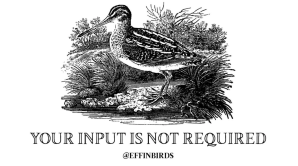
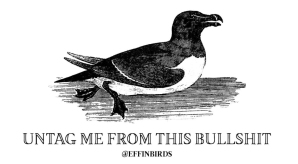
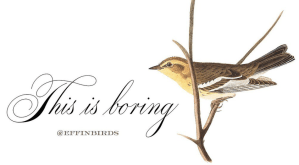
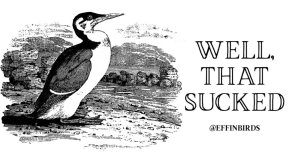
*WARNING – repeated profanities throughout this post. Look away if you are offended by sweary birds. Or sweary words.

I don’t like birds. They terrify me. Everyone who knows me is aware of this because I bang on about it incessantly, even when people couldn’t care less (which, let’s be frank, is most of the time).

And yet, in the last few days, I have found myself absolutely captivated by birds. They are my new favourite things in all the world. Admittedly, the birds of my affection are drawings, so the risk of one of them flying into my eye is pretty slim. (A bird did actually fly into my eye once, because birds are terrible creatures. This was the beginning of my ornithophobia.)

Anyway, let me introduce you to Effin’ Birds….

You’re welcome.

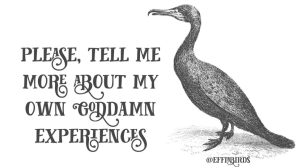
After hours scrolling through the rather gorgeous drawings and laughing loudly, I believe that there is an Effin’ Birds sketch and comment for pretty much every moment in life. And many of them (obviously) are relevant to diabetes…

One for the diabetesplainers:

And another…:

One for Aunty Beryl who thinks you really should drink Okra water:

One for those who believe they know everything about diabetes after 10 mins on WebMD:

Oh, and this one for your well-meaning friend who thinks you should know EVERY TIME diabetes is mentioned anywhere:

‘Cinnamon. I heard it cures diabetes’:

One for daily life with diabetes:

And this one too…:

One for low carb-ers who believe they need to militantly hijack every single post that mentions foods with any carbohydrate:

Every time I see 5.5 on my meter:

To myself, when I see double arrows down on my Dexcom:

Walking out of many, many HCP appointments:

Talking to you, my pancreas:

This one to my CGM trace after a roller-coaster ride of a day:

This one to my phone when my CGM is alarming:I get it, not a bird… but yeah – this works:
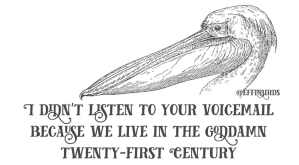
Replace ‘voicemail’ with ‘fax’:

‘Ooh! Can I press this button on your pump?’:

Many of the sketches may not be relevant to diabetes, but that’s okay. They are still more than useful in my every day life:

You can follow Effin’ Birds on Twitter, Instagram and Facebook. And if you are so inclined, support their crowd funding campaign. I have, mostly because I wanted a deck of cards to flash at people who annoy me.

This post is dedicated to my darling friend, Georgie, who is living her very best life all the way over in Paris at the moment. I know loves this as much as I do. Miss you, sweet-cheeks!

Follow Diabetogenic on WordPress.com

Enter your email address to follow this blog and receive notifications of new posts by email.

Read about Renza

Archives