In yesterday’s MJA, there was an article about diabetes apps, written by two Australian endocrinologists, Dr Rahul Barmanray and Dr Esther Briganti. The article is a commentary of concerns of current apps in a highly unregulated system. (Read it here; or read the MJA Insight article here.)

There are currently over 1,500 diabetes apps available online. At the World Diabetes Congress back in 2015, Ellie Strock from Voluntis reported there were 800. The growth here is substantial and will only continue.

Most diabetes apps (in fact, most medical apps) are in no way regulated. In Australia, only a very small number have been through the TGA approval process. (Also at WDC in 2015, Ellie Strock said that of the 165,000 mHealth apps that were available at that time, only 103, or 0.06%, had FDA approval.)

I think that the writers are right: we need to be better at gathering and providing some decent evidence about the efficacy and safety of these apps (just as with any diabetes management tool). And it was great that they highlighted privacy issues: apps collect a lot of data (personal as well as medical), and some if this is shared with third parties. People with diabetes should be aware  of – and have a right to know – just how our data is being used.

However, I found the article to be sightly alarmist, and somewhat out of touch with aspects of day-to-day diabetes, and what PWD are looking for when it comes to digital solutions.

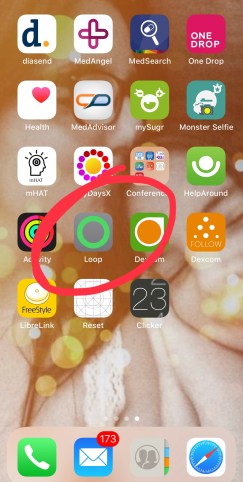
The realities of diabetes mean that every single day, we are making many, many choices and a lot of those are to do with dosing of insulin. We do this by combining the information we’ve been given by our HCPs, what we have come to learn about our own particular brand of diabetes, what we have learnt from our peers, and the technology we choose to employ to help us deliver that insulin. For me, that technology is a highly sophisticated app that provides me with bolus advice after I tell it how many carbs I’m about to eat. Once it has worked out its calculations (clever Loop!) I either agree and tell it to deliver, or override and put in my own number.

The article states:

‘Although apps increasingly advise on insulin doses, there is minimal published information on safety and efficacy, despite these apps effectively providing drug treatment recommendations without health care professional oversight.’

This sentence made me shake my head in disbelief. ‘Drug treatment without HCP oversight’ is my every day with diabetes. In fact, it’s reality for just about every person I know using insulin. Do HCPs really believe that they, and they alone provide oversight into our insulin doses?

There are a number of things we need to think about here. Firstly, as so often, we need to consider education. Apps should never be considered the ‘set and forget’ way to manage diabetes…but then, neither should any diabetes technology. Actually, neither should one-off diabetes education!

Our day one education when using insulin must start to provide an understanding of how it works, and that education must be refreshed and refreshed and REFRESHED. Even as someone in the ‘hand out all the diabetes technology at diagnosis’ camp, I know it is essential that people with diabetes understand insulin to carb ratios, insulin sensitivity factors and how to calculate our bolus insulin doses.

The thing is – we’re not getting that education a lot of the time. And if we don’t know we need it, we don’t know to ask for it. If we’re turning to apps to help us manage our diabetes, we probably do need some guidance about how to stay safe while using them, especially if PWD are diagnosed today when we expect there to be technology – such as apps – to make things more convenient.

Are the apps any less safe than what people are already doing with the limited education that is on offer for most people? I am astounded at the stories I hear of people diagnosed with diabetes being sent home with a syringe and a bottle of insulin and told to come back in a few days. I hear this repeatedly, so perhaps shouldn’t be too astounded.

We can’t blame the technology for not being accurate or smart enough if we haven’t been given the education to know that! Somewhere in there must be some HCP responsibility to educate PWD on what works and what doesn’t. And part of education these days must be about using technology, safely – with acknowledgment that technology is more than just a blood glucose meter, and does indeed include phone apps.

Apps exist because there is a gap in the market. That gap is that people are looking for ways to help make diabetes a little easier, whether that be prompting us to take our drugs at a certain time of the day, log and analyse our glucose levels, collecting and storing carb and other nutrient values for different foods, or helping us to calculate bolus doses.

We look to technology (including apps) to help us, and to work with and augment what we already know through the education we have received or have learnt from our HCPs – or at least, should have received.

While many of the apps claim that they will help lower A1c, I do wonder if that is the main reason that PWD decide to try a diabetes app. Is it that they are looking for improved diabetes management, or is it really just wanting some help in the constant tasks required to manage diabetes effectively?

As always, I look to my own experience as the only one I truly know and understand, and I can say with great confidence that I have never ever taken on any app with that intent. It’s always been about making things easier and reducing the burden of diabetes. Today, I rely on a highly unregulated app to do a lot of my day to day diabetes management. But because I have been fortunate to have the education I need, I am confident in doing that.

Apps are not evil or dangerous. TECHNOLOGY is not evil or dangerous. The real risks to people with diabetes is not having the right education to make informed, educated, confident decisions and choices about our diabetes; that same education that would help us assess the safety of the apps mentioned in the article.

Look, I am not saying that there shouldn’t be concerns about unregulated apps, or that we shouldn’t be having these conversations. Of course we bloody well should (and should have been for a long time; apps are not new).

But in there with the criticism and concern, there needs to be more acknowledgement of why people are turning to apps. Because otherwise, it looks like just another example of HCPs trying to stifle advancements in diabetes technology.

My highly unregulated app of choice, in a highly unregulated world of apps.

Every second Saturday morning, I can be found at my favourite café having a very important date. Aaron has a rehearsal at that time each fortnight, so it’s become habit for me and the kidlet to traipse to the café for coffee, breakfast and a chat. (Judge me all you like – I gave in to the thirteen year old after a coordinated campaign from a number of people, including one of the owners of this café and the kidlet’s grandparents. Apparently it’s a birthright of kids with Italian heritage to be provided with legal stimulants from when they are children. At least, that’s the story they sold me…while they reminded me that I was drinking the dregs from my dad’s evening espresso before I could talk. Anyway, the outcome of their campaign is the kidlet sits there with her latte feeling all grown up while I silently remind myself caffeine is not crack in an effort to not feel like a completely negligent mother. But I digress…)

The kidlet and I spend quite a bit of time alone together. I often drive her to school or collect her afterwards, as her school is halfway between home and work. And we have a lot of evenings together while Aaron is playing a gig somewhere around town. But those car trips are rushed and usually involve checking off what is happening that day/homework requirements after school and those nights at home usually see us snuggled in front of the TV watching a favourite movie. I love these times, but they’re not really built for detailed conversations.

Our Saturday mornings are leisurely and free of screens. Other than greeting the staff at the café (one who has appointed herself as the kidlet’s ‘other mother’ – something our daughter is more than happy to endorse, because Jo is far cooler and more fun than me!) and said hi to the other regulars, we sit down and focus just on each other.

It is these Saturday morning catch ups that are the most revealing, and provide me with great insight into what ‘s going on in her life. With no need to rush and the comfort of being somewhere safe, she shares things that just wouldn’t be shared in the rushed car trip to school in the morning.

My job on these dates is simple. Listen. Nod my head so she knows that I am paying attention. Don’t impose my ideas on to her. Try not to be shocked when she says anything I wasn’t expecting. And when she asks questions, I try to frame my answers in a way that hopefully helps her feel supported and encouraged to make her own decisions, rather than trying to foist my own onto her.

A few weeks ago when I was seeing my endo, I realised that she takes the same approach with me that I do with the kidlet. I always feel that I have her complete and utter attention and I never feel judged by her. While she may want to just tell me what to do and have me follow it to the letter, she doesn’t do that. When I ask questions, she helps guide me to an answer that I feel comfortable with.

I really believe that my endo’s style has meant that I am far more confident about the diabetes decisions I make each day. Knowing that I have been able to troubleshoot, or make a choice after weighing up all the options gives me conviction and assurance that my decision-making skills are sound, all the time knowing that she is there if I need to ask something.

I am sure it’s no accident that I am this way with my kid. I’ve seen how effective it is in helping me do better with diabetes…and it’s certainly translatable to parenting a teen!

Recently when I was preparing a talk for practise nurses about the way for both HCPs and PWD to get the most out of healthcare appointments, I came across this:

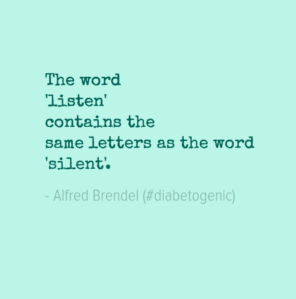
Listening doesn’t seem to come easily or naturally to a lot of us. We want to jump in and interrupt. We want to offer our suggestions (because of course we know best!). We want the person to listen to us and do what we say. And we want to fix things. We so want to fix things!

But the best thing we can do in a lot of cases is to just shut up. I frequently employ the WAIT (WhyAm Talking?) approach as I have found it is the best way to truly gauge what is going on and find out things that are too easily missed.

Those Saturday morning catch ups are illuminating for me. As well as seeing how my daughter is dealing with the sometimes tricky trials and tribulations of teenage-hood, I am being allowed a front row seat to a lot of what is going on in her life – things I may otherwise miss. Most of the time these days, she doesn’t need me to tell her what to do as she is working out stuff. She needs to feel safe, comfortable and not judged as she bounces her ideas off me; and to be given the space to learn how to weigh up options, make errors in judgement and work out what is best for her.

And that sometimes, making a decision that isn’t necessarily the best may not be the worst thing in the world. (At least – that’s what I’m telling myself when I see the look on her face as she takes her first sip of coffee for the day, and I know I have been complicit in her teenage caffeine addiction…)

I’m revisiting this piece I wrote three years ago about why this date – 27 July – is important in the history of diabetes. The original post can be found here. And below is the 2018 (or 97 year) version.

_______________________

There has been lots of discussion about what happened 97 years ago today – on 27 July 1921. University of Toronto scientists Fredrick Banting and Charles Best successfully isolated the hormone insulin. Today, that means that I am alive and kicking, 20 years after my islets stopped making any.

It means that type 1 diabetes treatment moved from being a starvation diet and not much else, to injecting a drug that was life giving and life saving.

It means that I take a drug that while giving me life, is also lethal and if not dosed carefully and with great consideration can cause terrible side effects.

It means that people with diabetes don’t die terrible, agonising deaths simply because they were diagnosed with diabetes.

It means that I need to be able to do crazy calculations to ensure what I put into my body completely and utterly imperfectly mimics what those with functioning islet cells do completely and utterly perfectly.

It means that there is a treatment therapy that gives us hope and life and allows us to live – sometimes very long, long lives.

It means that each and every day I feel fortunate to have been born when I was and not 100 years earlier.

It means I take for granted that I have access to a drug that keeps me going.

It means that there are far too many people around the world who still do not have access to the drug I take for granted. And 97 years later, that is not good enough.

It means that it was 97 years ago – 97 years ago – since the discover of insulin to treat diabetes and we are still without a cure.

And it means that I wonder when there will be the next breakthrough that is as significant and meaningful and life changing and life saving as what those two Canadian scientists discovered 97 years ago.

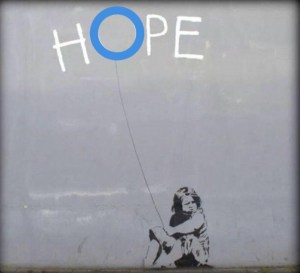
But mostly. It means that I live with hope. Hope that those scientists are somewhere working away, and perhaps – just perhaps – are about to find that next big breakthrough.

I may have mentioned before that I use an app called Timehop. It cleverly collects photos and posts from Facebook, Instagram, Twitter and other social media platforms, and serves them up to me as an account of what I was up to on this day over the last ten or so years.

Mostly, Timehop is a source of great joy. It shows photos of lovely family and friends moments, exciting things happening at work and our travels. Or it shares tweets that make no sense in isolation, but if I click on link, am taken back to long-forgotten discussions that made complete sense at the time. It’s fun and each day, makes me smile a I remember some pretty great moments.

But around this time each year, I am reminded of what was going on a the end of July 2013. And I don’t smile fondly. Because it remains one of the most difficult times of my life, and remembering it so clearly stirs up a lot of sadness.

This time five years ago, I had miscarried a much-wanted baby. The miscarriage (and D & C) happened while we were on holidays in New York, but I needed another surgery once I returned home.

Had the pregnancy gone to plan, there would be a little four year old in our life. I can’t really imagine it, to be honest. I think of everything that has happened since July 2013 and wonder how different life would be today if there was a little one running around. We’d be thinking about a school start in the new year and all that comes with it.

But, life doesn’t always go to plan. This particular derailment can’t really be explained – it was just one of those things. Twenty years of diabetes has taught me that there will be occasions where I will face curve balls. Sometimes over and over again. But even with the understanding that diabetes brings about expecting the unexpected, there is little solace in dealing with pregnancy loss.

It’s five years ago now. It feels as though a lifetime has passed. And at the same time, it feels no more than a baby’s heartbeat ago.

I like to celebrate anniversaries. Diaversaries are given the fanfare they deserve around our place, with high fives and pats on the back as another year of dealing with diabetes is ticked off an imaginary calendar.

This anniversary doesn’t get celebrated. But it does get acknowledged.  This week, I’ve been imagining four year olds who remind me of our darling girl when she was a cheeky four year old. But I know this one would have had a personality all of its own, and been a force to reckon with in different ways. And I am thinking about what life would like with two kids, and how our daughter would have adjusted having a younger sibling following her around. I wonder how our house would breathe differently, reflecting a little one’s existing, picture books that have been put up on high shelves once again scattered around the floor.

These thoughts do make me smile.

But my smile when I think of these things is not a happy smile. It is a smile of regret, loss and grief.

I will buy some white flowers for the kitchen table today, and watch them as they bloom. And remember. Remember the time when I thought that we would be bringing home the baby growing inside me to add to – and complete – our little family. And how sad I am that we never did get to meet.

So after two recent posts about back up plans (one from me about why we should be offered latest technologies at diagnosis, provided we are taught the basics in case the tech fails, and one from Grumpy Pumper about the weight he gives back up plans and basic tech to ensure he’s never left high and dry), you would think that I have this whole fall-back situation thing sorted.

Alas…

‘Hi, I’m Renza and I’m not good at diabetes.’

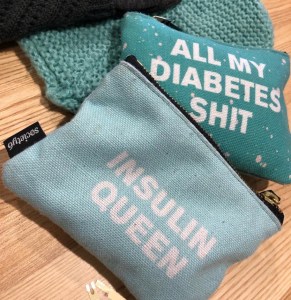
I generally carry around two small purses in my handbag. (I should point out that the purses change because I am addicted to Shop Casualty Girl pouches and keep ordering more.)

Click on image to go to Casualty Girl’s e-shop

Purse one holds my glucose meter, which means that I can calibrate my CGM as required and, if for any reason my CGM stops, I can still keep an eye on my glucose levels.

Purse two is my spares bag and in there I have all I need to completely swap out my pump cannula and cartridge, refill my cartridge with insulin, replace my pump battery and, if for any reason my pump stops, I have a back-up plan for my back-up plan with a baby syringe in there to continue the (manual) infusion of insulin until I get home and hook up my spare pump.

I feel pretty damn supercilious just writing about this, because, honestly, I am so freaking organised that I should be given some sort of organisation badge. (I never did Girl Scouts…is there a badge for this? Can someone make me one?)

And, it means that I confidently feel that whatever happens, I can keep doing diabetes – albeit not my preferred way – until I get home and return to normal broadcasting with the tools I like to use.

There is one thing required for this to all work: actually having those two purses with me at all times.

Today, I have neither of them.

Today, I am the living embodiment of a Robert Burns poem.

Now look, I’m not really panicking because I actually do have a back-up plan for my back-up plan for my back-up plan. I work a grand total of about fifteen minutes from home. If everything completely turned to pot, I could get in my car and head home to fix the situation. Also – I can literally see the Royal Melbourne Hospital from my office window, so if getting home wasn’t an option (not sure why that would be the case, but let’s pretend there was a hurricane, or a pack of wild monkeys suddenly took over the city) I could wander over there and beg someone to give me the supplies to get my external pancreas working again.

So, all in all, apart from feeling a little like a disorganised, shambolic mess, it’s really not going to impact on me all that much. But it has reminded me that complacency isn’t something that we can do with diabetes.

Diabetes doesn’t give us the space to do that. It demands vigilance and attention  at all times. Shame I’m neither vigilant nor attentive.

Final word to Effin’ Birds

Click image to go to Effin’ Birds’ Instagram. You should follow for daily sweary birds updates.

I have always loved shoes. I have a killer collection that ranges from perfectly comfortable and sensible flats, to impractical, not all that sensible – but damn gorgeous – heels. My boot collection is enviable – current faves are the animal print stacked heel ankle boot, and tan coloured knee highs that wouldn’t be out of place in an ABBA revival band. Shoes can be works of art – the elegant black suede pumps with stunning bright coloured embroidered flowers now sit on a bookshelf, too worn to wear anymore, but too beautiful to throw out.

I remember the shoes I was wearing at important times in my life – they mark significant moments, sending memories flooding back to me. My wedding shoes were white satin pumps, comfortable enough to walk in all day long and dance in all night long. They are decorated with beads from my mum’s wedding dress and are still one of the prettiest pairs of shoes I have owned.
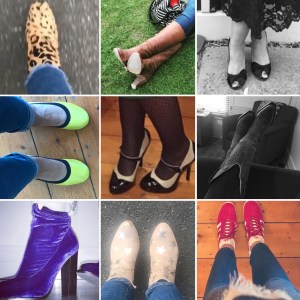
I dread being told by the podiatrist on my not-frequent-enough visits that I need to start to think about wearing more sensible shoes all the time. But so far, that’s not happened. She tells me that I can continue to go about wearing what I have, as long as I remember to regularly check my feet and get anything unusual checked out as soon as I notice anything.

I get to keep walking in my shoes, and not worry that the heel could be lower or less stiletto-y, the base slightly wider and orthotic-friendly.

I frequently hear cries for others to ‘walk a mile in our shoes’ as a way for them to get an idea of what living with diabetes is all about. It often happens after a particularly lousy piece of journalism that just gets diabetes wrong, or when yet another comedian makes yet another lousy diabetes joke. These days, it happens a lot when politicians say ridiculous things about why they won’t fund diabetes products, services or programs.

I guess the idea is that if someone walks in our (diabetes) shoes, they’ll know what diabetes is like.

I have no interest in people walking a mile in my shoes (or boots, more likely at the moment in freezing cold and wet Melbourne) because really, how effective is this idea in getting people to truly know what diabetes is like? What will someone learn in that mile, especially with the knowledge that they can take off my diabetes shoes once they’ve walked that mile…something that those of us living with diabetes can’t do.

Just like puppies, diabetes shoes are for life…not just a mile.

It’s for this reason that I have always questioned the value of hypo simulators. (I wrote contributed to a piece for Diabetes Mine a few years ago after first seeing – and sitting in – a hypo simulator at the first EASD I attended, and pointed out how absurd they are in my talk at the HypoRESOLVE kick off meeting earlier this year.) Anyone using the simulator can get out at the end of the demonstration and they’re done. There isn’t the thought of another simulator hanging over their head forever, or doing whatever is possible to avoid them – which is what living with diabetes and the threat of hypoglycaemia is like. Or suddenly becoming immune to actually seeing a hypo simulator until they find themselves in one, like what happens with impaired hypo awareness.

And it’s why I’ve questioning exercises where people are asked to wear diabetes devices for a few days. (Such as the time I was highly critical of a doctor who, in a piece about wearing a pump for a few days, declared she understood the frustrations of living with diabetes.) I remember standing in a room of first year med students explaining diabetes and as part of the talk, they were asked to do a blood glucose check and inject saline into their stomachs to get an idea of what we go through. Some of them refused, so perhaps the value of that session was explaining to them that those of us required to do such tasks don’t have the privilege of choosing not to because we don’t like needles.

My criticism of these sorts of activities is not to make people feel bad. I’m simply attempting to bring some perspective to what they can actually achieve. Suggesting diabetes is about merely wearing devices (or wonky vision when hypo) is reducing it to a condition that can and should be easily managed, and is easy to live with.

I don’t want anyone to walk in my shoes. I can do that for myself. But I’m always happy to have people walking alongside me. There is always room for that. Especially if we’re going shoe shopping!

Part of my work involves attending diabetes conferences both here and around the world. Sometimes I have a speaking gig, other times I’m there for meetings, and always I’m there to learn as much as I can about the latest in diabetes.

I love this part of my job in equal measure with not loving it. The ‘love it’ part is because I get to meet with and hear from some absolute superstars in diabetes research and get front row preview seats to what they’re working on. And I love it because I get to see other advocates who are there for the same reasons I am.

The ‘not love it’ part is because I spend a lot of time away from my family and ‘real life’. I feel enormous mother guilt (this time I missed the kidlet’s Winter Music Concert) and feel lousy for leaving lists of plans and schedules for people other than me to manage. Plus jet lag. I talk about jet lag so much because these days it is absolutely kicking my arse as it turns me upside down and into a bumbling, confused, unintelligible mess.

I realised when I was at ADA in Orlando that all my overseas DOC friends have only ever seen me at my jet lagged, time-travelling worst. They get exhausted, grumpy, vague, annoyed me. And they get me doing weird things like falling asleep in front of them only to suddenly get a second wind and become almost hyperactive where I speak a lot – and really quickly – about weird things such as Australian-isms that I believe they absolutely must start to use in their day to day vernacular. (Only click on this tweet if the eff word and spiders don’t offend you…)

And then, I reach a point where I abruptly stand up and say ‘That’s it!’and just leave and head to bed, often mid-conversation.  Why they still want to talk and hang out with me is actually a mystery!

But I am glad they do want to spend time with me, because sometimes, being at a diabetes conference is really hard going emotionally.

We sit there listening to some pretty tough stuff; scary stuff. We hear ourselves being spoken about as ‘subjects’ in research which takes away our ‘human-ness’ and makes us sound like rats in a lab.

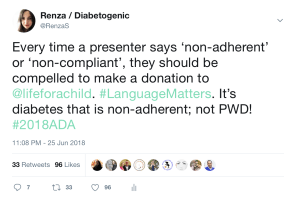
We are referred to with words that make us sound like petulant children (‘non-compliant/non-adherent/failed’ etc.) and all we can do is tweet our frustration (and language positions statements) begging that presenters be considerate in the words they use.

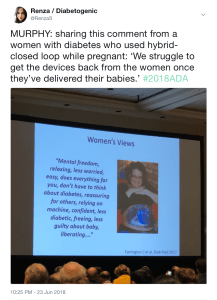
We hear scary, scary tales of all the things that can go wrong with diabetes in a variety of different situations. I reluctantly walked into an 8am session on diabetes and pregnancy, and even though that ship sailed a few years ago for me now, I still brace myself for the research showing that diabetes can and will impact on our developing babies, and children once they are born. That mother guilt I spoke of early is gets turned into mother-with-diabetes guilt which is a monster of proportions all to itself. (Of course, the wonderful Helen Murphy’s talk at 8am was not scary or mother-with-diabetes-guilt-inducing. Instead it was full of interesting facts about how APS impacts positively on diabetes pregnancies. Hurrah!)

Diabetes-related complications are spoken about in matter-of-fact ways that zone in on specific parts of our body and suddenly we stop being whole. ‘The diabetic foot/eye/kidney’ is still attached the rest of us, and yet whole sessions dissect them from our bodies and focus solely on that part of us, forgetting how connected we are to them (literally and figuratively!)

We are told about how diabetes increases the risks of so many, seemingly unrelated problems that can only make me feel as though the cards are stacked so against us that, sometimes, diabetes just isn’t fair. (See also – or maybe don’t – this released today…)

We sit there listening to advice on how things could be improved and sometimes, shake our heads at the disconnect between what is reality to those of us actually living diabetes and the ideas from researchers and clinicians. We wonder what – if any – engagement there has been with the people this advice is meant to serve.

It can be – it is– emotionally draining, exhausting, frustrating.

Those moments when a friend’s sideway glance, or eye roll, or a snarky comment in response to yet another kick in the gut because diabetes is all bad news, is a reprieve from feeling a little shaken. (Of course, it’s not all like this. Often we sit in sessions and feel that those presenting are truly championing our efforts and we do high five through those presentations.)

And those evenings when the sessions have finished, and the official dinners are over and we simply sit together, debrief, refocus and put diabetes back in perspective, make me whole again. It’s the same at every conference. The people may change depending on the location of the conference, but there are always people there. And I’m grateful for that, because I may return home exhausted and jet lagged, but I’m not overwhelmed at what I have seen and heard. Which I fear is how I would be if it wasn’t for the caring, smart, understanding, wonderful people in this tribe .

Tribe at ADA

I don’t get hit for six by diabetes much anymore. (Before we go on, please applaud that sport-ish reference there. I really must be growing as a person.)

Those days that would almost be a write-off thanks to a hypo that moved in, set up house and then wouldn’t clear out for hours, or hypers that made me think my insulin had turned to water and made my head so foggy and cloudy and stormy (all the weather analogies), just don’t seem to happen these days. I don’t have nights spoilt by erratic glucose levels and I don’t feel the hangover of lows and highs the way I once did.

This is all good news.

The daily impact of diabetes – both physically and emotionally – has diminished considerably and for that, I am eternally grateful to the magicians who have made Loop available to technology-fools like myself.

But this week? This week, diabetes has reared its ugliest of heads and I have been hit for six. My post the other day was called ‘Waking the beast’ and I think perhaps that is what has happened here. Except the once familiar beast is different now. It’s mutated into something I don’t recognise, and don’t know how to manage.

I don’t even have a word for what it is that is going on right now and if I’m perfectly honest, I don’t understand it. I thought that after my appointment with my endo and my ‘all is well’ complications screening conversation I’d be back to feeling less burdened and less fraught.

Yeah; about that. I was wrong. I certainly did feel lighter as soon as I left my endocrinologist appointment the other day…at least, I did for a few hours. (I even wrote about it!) And then I didn’t.

This week, I’ve found myself lying awake late into the night, thinking about diabetes and the scary things that I really don’t like to think about. During the day mind wanders to that dark place in my conscience, and I feel my breath catching and my heartbeat quickening for no reason.

As I lie awake at night, or am alone in my car driving to work, or standing in the kitchen preparing dinner, I suddenly feel diabetes in my body, flowing through my veins, being absorbed into my bones, twisting itself into my brain. And it’s been winding itself into my dreams when I finally do fall asleep.

What is this? It’s not burnout. To be honest, I do so few diabetes tasks these days that it’s not about being overwhelmed by daily diabetes. I am not ‘over’ diabetes. I don’t even feel that I hate it.

Perhaps the reason that it doesn’t make sense to me is because I can’t point to something and know what I need to fix. This isn’t a matter of needing to do some basal tweaking, or adjust what I am eating, or pre-bolus a little sooner. This has nothing to do with day-to-day diabetes. This is beyond that. This is deeper than that.

I feel diabetes – in, around and through my body and mind. This is within the very core of my diabetes. And the very core of me.

This photo I took at MONA last month of Pat Brassington’s ‘Cornerstone’ seemed a perfect image to accompany this post. (Click for more details of the artist.)

A few years ago, I wrote this piece about why I am uncomfortable with the term ‘carer’. (I’m sharing it again below.) I often think about the word around Kellion Medal time, because there is a certificate given to ‘carers’ of medallists.

This is a lovely part of the ceremony, and acknowledges that diabetes can indeed take a village. Usually, the ‘carer’ is the partner of the person receiving the medal. Sometimes, it is a parent, sibling or other close relative. Other times, it is a healthcare professional.

Carer is a word with a broad meaning. It encompasses a wide range of situations and responsibilities.

As I said in the original blog post, I don’t believe that I have a carer. Aaron certainly supports all my efforts with my diabetes, is a wonderful cheer squad and knows when to mutter ‘Diabetes Sucks’ when I am feeling a little over the whole thing. I feel very fortunate to have him do that.

But carer? Nope.

It got me thinking to what I would want if (when?) I stand up to receive my Kellion medal. In thirty years’ time, I hope to proudly stand up there and appreciatively receive my medal. And in the room, I would want those near and dear to me, celebrating the milestone. I would certainly want to thank them for having lived alongside me as I lived with diabetes for so long.

But the word carer does not really adequately describe that role. And yet, I don’t know the word that does – or even if there is a word…

Words matter – so what is the right word?

So, please help me out! If you are an adult with diabetes, do you have a word you use to describe the people who support you? Are you comfortable using the word carer? Do you prefer to use something else? Or nothing at all? (Fifth option: Never even thought of it. Get over yourself with your language palaver, Renza!) 

__________________________________________

I am lucky when it comes to my diabetes support network. I know this and I will say it several times in this post. I also know that I am likely to come off as being ungrateful which is not the case at all. Today, I want to explore the idea of how these support people are identified, either by themselves or by people living with diabetes. Specifically, I want to talk about the term carer.

The Oxford Online Dictionary defines carer as:

a family member or paid helper who regularly looks after a child or a sick, elderly, or disabled person.

I don’t have a carer. I am the person responsible for living with my diabetes, but I do not have a disability and I certainly don’t consider myself sick. And, although I’m pushing a ‘significant age’ I am not yet elderly.

I understand and completely believe that there are people who are really and truly carers. There are people who are responsible for feeding, toileting, bathing, communicating for another who is unable to do it themselves. I am not referring to instances like this. I am referring to, I guess, diabetes.

I don’t consider my husband, who is involved in my life with diabetes to be my carer. He’s my husband, my partner.

Living with diabetes is not a solo game for most and this is a truly wonderful thing. We get support and help from people and I for one feel very fortunate to know that I have people (family, friends, healthcare professionals), I can rely on if I need them.

But I don’t consider any of them my carer. I would refer to them as my support network. In the case of my HCPs, they’re paid to help me with the things I need.

My husband would never say that ‘we’ are a family with diabetes. He would say that I (his wife) have diabetes. Not for one moment would he consider himself to be living with this condition even though he regularly is part of it. But as far as ‘ownership’ goes, it’s mine. He will step up as much or as little as I ask and in the few times it’s been necessary, he’s taken over, done what’s needed to be done and then, when safe, stepped back.

My independence and confidence in my ability to self-manage comes from being given the space from those around me to do what it is I need to do. I know there have been times when Aaron would like to sit me down and force feed me glucose because he can see that I am low. As I stand at the open fridge and in my hypo-fog state try to calculate the carbs in a cucumber (yes, I know!) he has had to just step back and let me work it out myself, stepping in if asked.

I see this like watching my daughter do something in a way that is frustrating to me. I would love to jump in, show her how to do it far more effectively (or do it myself) and then move on. But her self-confidence and her ability to trust her decision making process needs to be encouraged, not overshadowed by a parent who insists on taking over all the time which suggests that she cannot do anything herself.

To me, the term carer implies helplessness. I get that diabetes is a lifelong condition and that there are stages in a person’s life when they may need extra care. For example, children with diabetes are reliant on their parents for the day-to-day management tasks. But is that being a carer or is that called parenting albeit with an incredibly extra degree of difficulty? Or what about an adult with diabetes who is having a period of hypo unawareness and their partner is required to, at times, inject them with glucagon? Is this being a carer or is this just doing what partners do – look after each other at a time of illness or need?

What about when I am lying in bed, unable to move because my BGL is high, I have mild ketones and am vomiting? As I decide whether or not I need to take myself off to A&E, my husband is holding a bucket in one hand and my hair in the other.  I don’t consider him to be my carer, any more than I considered myself to be his carer when he hurt his back and I was warming up a heat pack and giving him pain killers every four hours.

I don’t in any way want to undermine the importance, help or value of the support I receive. I don’t for a minute want to say that I don’t need it or resent it. But equally, I don’t want to be considered as being helpless. The relationships I have with people where diabetes is sometimes considered are based on incredible respect – from both parties. They respect that I am the one who is living with this and dealing with it and I respect the way they allow me to do that.

__________________________________________

Thanks to Ash for chatting with me over coffee about this today

I had an endo appointment yesterday. It was my first in over six months, but this was by choice, rather than inattention. Last November, I decided that I really didn’t need a three month follow-up appointment, and my endo agreed. So, after settling my account for the visit, I made an appointment for May this year. A work trip to Copenhagen via London necessitated a reschedule and this was the first appointment time available that worked for me. The six month follow-up timeframe was pushed out to eight months.

Early last week, I called for a pathology request to be sent to me so I could have a blood draw before heading in. While I had a list almost as long as my arm of things I wanted to discuss, I really am trying to stay on top of having regular screenings so that we can compare results year to year.

Clearly, I am in a really good headspace about my diabetes and, in particular, diabetes HCP care, at the moment. I am happy to attend appointments. Even though I needed to cancel the May appointment, I made a follow up and kept it. I had all my bloods done beforehand. This is a far cry from how I was just a couple of years ago … when actually, I was crying just thinking about it all.

So, last Thursday, I made my way to a local pathology clinic, my request slip scrunched tightly in my hand. And I realised that even with my generally low level of worry about all-things-diabetes, I felt my anxiety levels going up in the days leading to, and the day of, the blood test.

I’m nervous about having my A1c done,’ I said to someone last week, and, puzzled, she asked why. It was a sensible question to ask, because truthfully, of all the things I was being checked for, that was the one that I had a pretty good idea what the result would be.

I estimated my A1c and got it right to 0.2 percentage points. The truth is, I am totally ambivalent about A1c. I couldn’t care less about the number because my TIR is where I want it, and I knew this would be reflected by a way-in-range A1c number. (I take no credit for it – it’s all Loop.)

But my kidney function? My cholesterol? My thyroid function? Coeliac screening? Everything else? I have no idea how they are tracking. There is no app on my phone to remind me how I going with those, or helping me guess what they me be. I have no Loop for my kidneys!

I realised that was the source of the anxiety, not my A1c, even though that’s where I was pointing. I guess that makes sense: feeling nervous about A1c results is expected and easy to explain. But the truth is that wasn’t my I was feeling uneasy.

Those complications screenings that I am diligently trying to make sure I have annually still terrify me. Both in the lead up to having the checks done, and then as I wait for the results.

The beast of diabetes that lives within our very core behaves in different ways. Often it is slumbering, lying almost dormant, lulling us into a false sense of all is well. I guess that is how I have felt since I started looping. I say that I am the least burdened I’ve ever been my diabetes because my diabetes is not thrashing around and making itself known so much. But this last week, it has started to wake, reminding me of its presence. I have felt diabetes more in the last week than I have in the last ten months.

I tried to describe this to a close friend the other day – a friend who has seen me live through some pretty horrid diabetes times, and celebrate some damn fine ones. She asks sensible questions and is always listening and learning. She gets it. But she struggled to understand how I could move from saying I’ve felt the best I have ever felt in relation to my diabetes to suddenly speaking of the anxieties that I hold so deep; especially when nothing had changed.

It’s the unknown. It’s the waiting. It’s the fear of what I may be told. That is the beast.

Today, the lightness in my step and in my heart as returned. The appointment went well, the results showed little, if any, change from the last screening checks. I am back to feeling the way I was before last week. After stirring, and stretching, the diabetes beast has curled up and resettled, and is hibernating again. At least, for now…

Waiting with diabetes

Follow Diabetogenic on WordPress.com

Enter your email address to follow this blog and receive notifications of new posts by email.

Read about Renza

Archives