The hydrangeas on our front veranda are starting to shoot. Only three weeks ago, they were bare, and considering my almost perfect record of killing plants, I wondered if I’d pruned them into oblivion a few months ago. ‘Are these dead or just dormant?’ I asked, every time I walked out the front door, or stood there with the key in my hand waiting to go inside. I was almost ready to bring in the big guns (mum and mum-in-law) for advice and rescue.

Turns out they were just doing their cold-weather thing and waiting for some warmth, and now, every single day, there is more bright green foliage unfurling. In just a couple of months they’ll be weighed down by white pom pom flowers.

Over the back fence, the branches on the neighbours’ tree – the tree that heralds the seasons with such grandeur – are covered in cottony white blossom.

Because it’s spring. Finally. It’s really spring.

And I’m ready for it, and for the clutter and sludge that inevitably infiltrates my mind in the cooler months to have a good spring clean!

Diabetes takes up a lot of my headspace. Although, as I explained to friend across the seas the other day, it’s not my diabetes that is doing that. My diabetes is boring. I love my boring diabetes.

But ‘the world of diabetes’ is overwhelming me at the moment. It’s not the first time I’ve felt this way. It happens sporadically. Sometimes it’s because there is just so much going on, other times it’s because I just feel over it all. And then there are the times that my own diabetes combined with ‘work diabetes combined with ‘miscellaneous diabetes’ just gets too much.

And that’s where I’m at. I think that months holed up inside in front of the fire allow too much time to be overtaken by the minutiae of the diabetes world, and I start to take everything on board too much. So it builds up. And up and up, until I am where I am now.

I think perhaps this is my own version of SADS, but instead of seasonal affective depression I have ‘seasonally affected diabetes’. It happens each year – I can chart it alongside a weather, sunlight and heat chart.

So, I know there is light at the end of the tunnel. Melbourne is getting warmer. There are blue skies – the sorts of skies that greet me when I wake up in the morning, hang around all day and melt into beautiful sunsets in the evenings. And there is sunshine.

And with it comes some clarity to sort through the sludge, sweeping out some of the things taking up too much mental space, discarding what I should have let go of months ago.

I’m kickstarting ridding the discontent of winter by heading to warmer climes next week, initially for a holiday and then a conference. I’m hoping that in the two weeks before the conference starts will be spent outside, wandering cobblestone streets, enjoying lighter fare (and gelati) and basking in sunshine- real sunshine that will dance on my skin and penetrate all the way through to my bones.

By the time I get back home, Melbourne will be in full spring glory – the jacarandas will have started to flower, the blossoms on the tree over the fence will have scattered to the ground and given way to a covering of green leaves, dappling sunlight across the garden.

And hopefully, I’ll be lighter and clearer and spring-cleaned, with nothing more than my own (boring) diabetes.

My favourite local serving up my first iced latte of the season!

Yesterday, Melinda Seed wrote a powerful piece about a session at ADC. Please read her post here to get an idea about why she is so angry. (Rightly so, I might add.)

I saw Mel just after the session. I’d not been in there, but it was clear from what Mel was saying, that the centre in question was doing a huge disservice to people with the diabetes they are meant to be helping. (For the record, when I wrote this post about why diabetes conferences can be challenging for PWD and why we really need our tribe around us, I was writing about moments like these.)

The part that really shocked me is that at this centre, HCPs could make the decision to discharge people from the service for ‘non-adherence’. The idea that people with diabetes are thrown out of healthcare because they are perceived to not be ‘adhering’ to a treatment plan (most likely, a generic plan that has not been set up for the individual PWD) is cruel. And it stems from the idea that people not following this plan don’t deserve healthcare.

This has stuck with me, because I had a conversation with someone this week about the whole issue of people with diabetes ‘not looking after ourselves’ after he used that language to describe someone with type 2 diabetes he knows well. ‘He doesn’t care,’ I was told.

I thought back to some of the most difficult times I’ve had since living with diabetes. I know full well that one of the first things to go when the going gets tough is my own diabetes management. When all that stuff was going in, the diabetes management plans were so beyond my comprehension or understanding, or I simply couldn’t see why it was relevant to me or how it was meant to be helping me. At those times, I wasn’t doing what I was expected to do. To outsiders, it may have looked that I didn’t care.

But I hadn’t stopped caring. I never, ever stopped caring.

In fact, the exact times that someone may have looked at me and said ‘You are not looking after yourself’ or thought that I was not following management plans are the times – more than any other – that I have needed someone to be on my side; not to point at me and tell me I was messing up. And certainly not to decide that they would no longer provide me with care.

I don’t know what we need to do to get the point across to others that the realities of diabetes management are relentless. Even when we pare back our management to the mere basics, there is still a lot to do. When things start to slip and slide, we are not being ‘non-adherent’, we haven’t stopped caring. And we certainly don’t deserve to be treated with contempt by being kicked out of a healthcare service.

Still caring…

It’s Women’s Health Week here in Australia and once again, Jean Hailes for Women’s Health has been doing a stellar job of talking about women’s health issues that are rarely (if ever) spoken about in the public sphere. As usual, this year’s campaign is presented in a clear, no-nonsense way. Just as it should be.

Shining a light on women’s health issues is critical for a number of reasons. There is still too much stigma associated with women’s sexual and reproductive health, so finding a way to easily speak about the realities of women’s health just makes sense.

Not all women’s health issues necessarily seem relevant to diabetes. But, as ever, diabetes has a way of complicating things, so it makes sense that they are on the list of things covered when speaking with our HCPs.

I honestly can’t remember the last time my GP spoke with me about any sexual or reproductive health issues. Some women see gynaecologists regularly (I see mine every couple of years for a pap smear), but that may not be the case for most women. Surely conversations about contraception, periods and other things should be part of a regular check-up alongside other ‘tick the box’ issues such as blood pressure, cholesterol and weight.

I wish that I had seen an endo from the beginning who had spoken to me about women’s health stuff. I know that it wasn’t until I found the endo I see now – one who I sought out specifically for her expertise in women’s health and pregnancy – that issues such as contraception were even mentioned.

So, here is a (non-exhaustive) list of things that women with diabetes may want to consider chatting to their HCP about – and that HCPs may want to consider speaking with PWD about. (There are links at the end of the post for where to go for further information.)

Periods. To be honest until I was trying to get pregnant, I really didn’t think much about my period. I thought of my lack of regular periods (as in, I would get my period sporadically maybe four or five times a year) as a blessing, rather than something to be concerned about. Of course, once I was trying to get pregnant, I was desperate for a monthly period that I could set a clock to.

No HCP had ever spoken to me about how diabetes would impact on my period – or, probably more importantly, vice versa. I had no idea about how different times in my cycle might affect my glucose levels. In fact, I think it wasn’t until I started wearing CGM and could really see what was going on that I learnt how to manage my insulin doses at different times throughout the month. (And it also explained the two days each cycle I was so freaking low I pretty much took no insulin. Apparently that’s how MY body deals with ovulation..)

If I was diagnosed today, I would be asking a lot of questions about diabetes and menstrual cycles and the best way to adjust my management methods depending where I am in my cycle.

Sex. When I’ve written about diabetes, women and sex before, I’ve noted how at diagnosis no one spoke with me about how diabetes could impact on my sex life. It wasn’t until I started speaking to other women about it that I realised that this is an issue for a number of us.

We need to start talking about women with diabetes and sex in a non-threatening way that normalises the discussion. (Keep an eye out on the work that started with the Kath Barnard’s survey on this important issue.)

Contraception. No one mentioned contraception to me when I was diagnosed. I was twenty four, engaged to be married. Surely both the endo and CDE I saw the day I was diagnosed realised that I was having sex, or considering it after I was married. (I really, really hope that they didn’t think that they didn’t need to speak about it with me because we weren’t married yet…because it was only 20 years ago and there’s no place for puritan attitudes in healthcare. Plus, that ship had sailed. A long time before.)

At the time, I was on the pill, but there was no discussion about the best form of contraception for me relating to diabetes, (was there a better pill to be on?), and I didn’t know to ask. Surely, all women of child-bearing age should be asked regularly about  contraception, especially as women with diabetes are so often told about the importance of avoiding unplanned pregnancies.

Pregnancy. Thankfully, these days finding information about diabetes and pregnancy is relatively simple. If you know where to look.

But twenty years ago, when I was diagnosed, the only thing I was told about diabetes and pregnancy (and I think it was only because I asked) was ‘You need to have all your kids by the time you’re thirty’. (Not sure if just scraping in three days before I turned 31 counts there. Probably not. Looks like this deliberately non-compliant palaver has been happening for a while….)

Talking pregnancy and diabetes needs to be done delicately, but it needs to happen. And, ideally, it needs to happen long before pregnancy is even being considered.

Back in 2003 when I was at Diabetes Vic, I coordinated the first diabetes and pregnancy info evening. Over 100 people were squashed into an overheated room in the basement of the old Royal Women’s Hospital. At the end of the night, I was walking around speaking with as many of the people who had come along as possible to see if they had found the evening useful. I walked up to one woman and thanked her for coming. ‘I hope that you found tonight helpful,’ I said to her. She nodded at me, and I noticed she was holding onto a copy of the ‘Can I Have a Healthy Baby?’ booklet that Diabetes Victoria had published with Realty Check and ADIPS the previous year. ‘My daughter has T1D,’ she said to me. ‘She’s only 8, so obviously this isn’t something that is relevant now. But I wanted to know so that when she asks questions I can answer them. I feel really reassured that she can have a baby if she wants one if it’s planned.’ I remember reaching out to her and hugging her (I have no boundaries). ‘Your daughter is so lucky to have you in her corner,’ I said to her. ‘Thank you for coming!

Fertility. This isn’t the same as pregnancy. It’s not an easy subject – ever – but it is one that needs to be discussed openly and safely. I can honestly say that no healthcare professional has ever discussed fertility with me unless I have raised the issue.

My experiences around fertility have been complex, emotional and quite painful. It took me a while to get pregnant the first time. My irregular periods needed to be addressed (fortunately, that was easy enough with only Chlomid needed), but even once I was having monthly cycles, and apparently ovulating regularly, I could not get pregnant.

When finally did, I miscarried. Miscarriages are common. I know that. But it still sent my spiralling into a really difficult period which took a lot of time and effort to emerge from. I got pregnant and had a baby, and thought that from there, fertility issues would be a thing of the past.

But I think that because miscarriages are so common that sometimes it can be forgotten just how traumatic they can be. My first miscarriage ended my first pregnancy, and the two other miscarriages I had ended those ones. It’s clear that while I seem to be able to get pregnant, keeping those babies growing, safe and alive is not something my body does well. I wanted that explained to me – or at least for someone to speak with me about it.

Diabetes and fertility was never, ever discussed with me, except that I was reassured after each of my miscarriages that I could not blame diabetes for losing the baby. That was a double edged sword because I wanted to know what it was that was stopping me from being able to continue my pregnancies. I would have liked to be able to point at something. Because the alternative is that it’s just another thing my body can’t do properly.

PCOS. I was diagnosed with polycystic ovarian syndrome when I was about 26. I’d been referred to an OB/GYN by my endo because she wanted me to have a gynaecological check-up because we’d started seriously talking babies. My lack of regular periods was flagged as something that needed investigating and an internal ultrasound showed a number of small of cysts all over my ovaries. I had no other symptoms of PCOS, but that was enough for my OB/GYN to speak with me about potential fertility issues once we were ready to start trying for a baby. I had a laparoscopy and they were removed.

Both type 1 and type 2 diabetes can increase the risk of PCOS (more so type 2 diabetes) so this is definitely something to discuss with your healthcare team if you are in any way concerned.

Body image. I don’t even know where to begin with this because body image is such a huge, huge concern for so many women, and I really do believe that diabetes amplifies those concerns. Whether it is the physical signs of diabetes (tech that we wear on our bodies), the psychological side of being diagnosed with a life-long health condition or the emotional toil of having an allegedly invisible condition that we can’t help but see every day, living with diabetes significantly affects how we feel about our bodies.

This is one of the reasons that having a psychologist as part of our HCP team is important, because we need people who are able to ask the right questions and offer support and solutions for dealing with how we see our bodies.

Eating disorders. Diabetes and food; food and diabetes. It’s impossible to separate the two, and for some people, the relationship is complex and very, very difficult. Women with diabetes do have an increased risk of developing an eating disorder, and of course, there are diabetes-specific eating disorders. And, unfortunately, this is another issue that is not spoken about openly.

Menopause. At my last appointment with my endocrinologist, I raised something that I’d not raised yet. ‘What can you tell me about diabetes and menopause?’I asked her.

I’m not going through menopause – I’m not even peri-menopausal yet. But I don’t need a magic mirror into the future to see what lies ahead. And I like to be prepared.

So, there’s something you should know about how I came to see the endo I have been seeing for the last almost-17 years. I was searching for someone who could help with what I really needed, one of them being an expertise in T1D and pregnancy. She was absolutely the right endo for me then. And continues to be now, because recently, she has become an expert in menopause. (I know! It’s like she is a few years ahead of me in her areas of interest and expertise!)

If I’m honest, I’m a little stressed and worried about what menopause has in store for me when it comes to my diabetes, mostly because I know nothing about it. We’ll see how that plays out…

Self-care. Why do women find it so hard to prioritise our own care and take care of our own wellbeing? We do need to get better at fastening our own oxygen masks before making sure that everyone else on the plane has theirs in place.

This might be another reason to consider seeing a psychologist to ask for some tips for how to make sure that we remember to look after ourselves in a way that is healthy, consistent and achievable.

Pelvic floor. Diabetes, as the gift that keeps on giving, can mean our pelvic floor isn’t as strong as it could be. Just as nerves in other parts of our bodies can be affected by our diabetes, so can the ones in our pelvic floor.

(You’re doing your pelvic floor exercises right now, right? Yep. Me too.)

Looking for more info? Have some links…

Here’s the Jean Hailes for Women website for Women’s Health Week.

The rather awesome Mindy from There’s More to the Story has been writing about diabetes and sex over the last couple of months and her posts are a must read. I wish I’d had something like this to read when I was first diagnosed.

Some information about diabetes and PCOS.  This article is about type 1 diabetes and PCOS. And this one is about PCOS and types 1 and 2 diabetes. 

The NDSS Diabetes and Pregnancy website is an absolute goldmine of information about pregnancy and planning for pregnancy. There are different sections for women with type 1 and type 2 diabetes, HCPs and loved ones of women with diabetes.

The NDSS Type 1 Diabetes and Eating Disorders booklet can be found here.

Lots of valuable information for PWD and HCPs at the Diabetes and Eating Disorders Awareness website.

Not too long ago, I read ‘The Bookseller’ by author Cynthia Swanson. It was an impulse buy and a fabulously easy read. I rushed through it over a lazy weekend back in April, when Melbourne was still enjoying weather warm enough to spend hours sitting out on the front veranda in the sunshine.

The premise of the book is that the main character is living a seemingly normal, happy life. She has a job she loves, friends she adores and parents she is close with. But then she starts having nightly dreams about a different life; a life that is seemingly perfect, but unlike her real life. After a while, the line between which of those lives is truly real begins to blur.

That idea that we dream of one thing that almost becomes an alternate reality stuck with me. Because I realised that in my dreams – at least the ones I can remember – I don’t have diabetes. My good-for-nothing beta cells never feature in my dreams.

I never dream about checking my glucose levels. Insulin pumps, blood glucose meters and CGMs don’t feature as things I carry on or with me, and even when I dream about friends I know because of diabetes, that connection or commonality is never mentioned. I eat with abandon, not having to think of carbohydrate counts, or moderating my food because of low or high glucose levels. I don’t think about diabetes complications or being burnt out from doing diabetes. Because there is no diabetes to do in my dreams.

Diabetes certainly infiltrates my dreams,  but in odd, non-diabetes ways. Alarms on various devices become the soundtrack to whatever I am dreaming about, as sirens or house alarms; when I used to spend nights having lows, I would dream of staring at sugary and cloyingly sweet treats in pastry shop windows; and nights spent high would see me dreaming of the ocean, waves crashing into my feet, or rain gushing down on the tin roof of our house, until I woke and realised I really, really, really needed to use the loo and drink some water; I dream about wrapping presents in string, or rope being tied around posts, and then wake to find the tubing from my pump wrapped around waist, or legs, or wrist. But those references are never specifically about diabetes. They don’t become about diabetes until I wake up and reality kicks in.

It’s odd, because the dreams I remember often do reflect what is actually going on in my life. Yet diabetes is excluded from those dreams, even when they are reliving moments from my day. In the retelling of snapshots of my life in my dreams I am wholly free from the daily grind and thoughts and reminders and fears of diabetes.

As the main character in the book slowly started to lose sight of what was real and what was a dream, she realised she would need to make a decision as to which life she really wanted.  She was torn because both her lives were wonderful in different ways.

But if I had that choice, I think the decision would be easy. In a heartbeat, I would choose the life in my dreams. I know it’s not possible; I know it will never be. But what a wonderful, wonderful thought: for my reality – not just my dreams – to be free of diabetes.

Click to buy your own copy.

I am old enough and smart enough to understand the way women are meant to respond to the lies of advertising. We are constantly told –  and meant to believe –  we are not enough. Our bodies are not slim enough, our skin is not taut enough, our thighs are not firm enough, our hair is not shiny enough, our arms are not toned enough.

At my current age, I’m meant to be trying to erase the signs of ageing, willing wrinkles away with an assortment of lotions, potions and minor (and major!) cosmetic surgery, plus trying somehow to regain the body I had twenty years ago.

Thanks to a mother who pointed out the deception of advertising from when I was a young girl, refusing to allow us to buy into the spin, plus a healthy dose of political and feminist teachers at school, all combined with much reading as a teen of Naomi Wolf, Susie Orbach, Gloria Steinem and Betty Friedan, and then later on, Kaz Cooke’s Real Gorgeous, I manage to not be too overcome with my body image issues and feelings of inadequacy. Mostly

My body is forty-four years old. I’m okay with looking in the mirror and seeing a reflection that reminds of me that.

I see the lines around my eyes and am not too startled because I know they have formed thanks to many years of laughing so hard that I can barely breathe, cried so hard because of loss that has rocked me to my core, walked for miles through cities while the sun has shone brightly (and I didn’t reapply my sunscreen).

I’m okay with my body not looking the way it did when I was twenty. I quite love the evidence that I carried and delivered a healthy baby – there is a lot of evidence of that! My far-less-than taut stomach points to that as much as the scar along my lower abdomen from where she escaped.

Surgery would be the only way to return to the pertness destroyed after twenty months of breastfeeding. But quite frankly, I’m kinda proud of the signs from that, because initially it was such a challenge for me to learn to breastfeed, and then manage the subsequent hypos. There should be some proof of the effort that all took!

I can deal with my skin not glowing as it did when I was younger, and the signs of a late night being far more visible than when I was in my early twenties. Those days I could manage being out until the early hours, and then be up bright and early for work the next day with nothing more than a coffee and a slick of my signature red lipstick to deal with the lack of sleep.

And the occasional grey hairs that appear around my hairline are met with acceptance – and gratitude that I can vainly still pluck them out because they are so intermittent that it’s easy to do.

I once wrote that ageing is a privilege. Not only do I believe that, but each and every additional year I live with diabetes, I believe it even more.

I just wish that while I acknowledge the miracle that is my life today – because had I been diagnosed with diabetes a mere seventy-seven years earlier, I would not be alive today – I could be more comfortable and accepting with how I wear diabetes on my body and in my mind.

It makes no sense that I am still uncomfortable of the visible signs of diabetes on my body. But that is how I react most days. The devices I wear still make me wince at their sight. I try to avoid looking at the scars and marks and signs of those devices on my body – all over my stomach and hips. I notice myself more aggressively washing those parts of my skin, and wonder if I am trying to scrub away the signs of diabetes.

In the mornings when I get dressed, I hide my pump and RileyLink away as fast as I can, tucking them into my bra and throwing on something over the top so they are not in my line of vision as I stand at the mirror applying my makeup. I’m not ever going to be one of those people who wears her pump on her hip, proudly showing it to anyone who asks.

And even though my Dexcom is on my upper arm, I prefer the cooler months when I can hide it away from sight under layers of Melbourne black.

Today, I spoke with a mother of a teenager who wanted to know how she could convince her daughter to agree to wearing her pump again. ‘She hates how it looks on her,’the mum said to me. ‘When will she get over it and just realise it’s the best way for her to manage her diabetes?’And I didn’t know what to say because I am a woman in my mid-forties and I am not ‘over it’, seventeen and a half years after first attaching an insulin pump to my body.

The only thing I could say was that it can be a difficult thing for some people to accept – and that I too struggle with it. But that the compromise for me is that as much as I hate seeing diabetes on my body, I’ve accepted that the devices make me feel and manage my diabetes better with them there. But understanding that takes time. Maybe age helps too.

My ageing body is something I can wear with pride because it tells the story of my life and what my body has managed to do. Whereas my diabetes body points to parts of me that are broken. And can’t be put back together, no matter how hard I try, or how hard I try to convince myself otherwise.

Have you seen Body Posi Betes? It’s the brainchild of my darling friend Georgie Peters who is doing everything she can to promote body positivity in the diabetes space. You can join the Body Posi Betes Facebook page here and follow the Insta feed here. I’m going to binge through all the posts again right now, because truthfully, I need a bit of diabetes body positivity right now.

Usually hidden from (my) sight.

Sometime last week, I marked a year since I started using Loop. Measure for measure my diabetes is a lot nicer to deal with these days and I know that I have settled into the comfort that comes with something that just seems to be working. The predictability of loop seems to fly in the face of all that is diabetes, so I do admit to not getting too comfortable with it all – even after fifty-two weeks of seemingly boring diabetes.

This was startlingly obvious to me when I reflect on my last two very busy weeks. As I ran around the Adelaide Convention Centre last week, not once did I think about Conference Hypo Syndrome. As I flew from Melbourne to Sydney to Adelaide and back home to Melbourne, I didn’t think, even for a moment, about travel lows and highs. And throughout the busy days, and the long busy nights of the two weeks – which involved hours sitting still in sessions and meetings as well as times of a lot more activity – apart from a cursory glance at my Loop app, diabetes didn’t bother me.)

It has been almost 12 months since I first spoke about Loop at a health professional conference, and it’s fair to say that I am still slightly traumatised by the memory of that session. I know that for the vast majority of the people in the room on that rainy day in Sydney, most had never even heard of the world of DIY diabetes, and the idea that a forty-something-year old woman with diabetes was standing before them talking about how I’d built my own pancreas was more than a little terrifying. And they let me know about it.

There was disbelief, horror and alarm that I was telling my story. I repeatedly heard people tell me that this was irresponsible and unsafe. And a number of HCPs were shocked, worried and appalled that the instructions for others to do what I had done were freely, easily and openly available online. (My cheeriness about open source wasn’t mirrored by most at ADATS.)

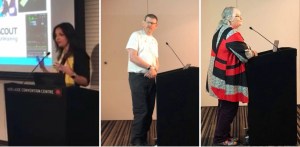
I’m pleased to say that wasn’t the response last week, during or following the DIYAPS symposium ‘The Brave New World of Diabetes Technology’, which featured me sharing about my own personal experience of why I decided to, and my first year of Loop; David Burren speaking about the technical aspects of the DIY technologies, and Cheryl Steele encouraging HCPs to support people using these technologies. The formal presentations were rounded out with Greg Johnson launching the Diabetes Australia DIY Technologies Position Statement.

It was standing room only, and great (and surprising) to see a number of endocrinologists in an ADEA symposium. We deliberately programmed the session to have a lot of time for questions, because we knew there would be lots! And there were.

There were a number of questions from the audience about what the role of HCPs is if someone comes to them and says they are, or they want to start, looping, and I think the consensus is that while we don’t necessarily need our HCPs to understand the intricacies of the specific technologies, and we are very clear that we don’t want, expect or need them to be able to help us build our loop, we need them to acknowledge that DIYAPS is a reality for more and more people with diabetes.

The overall feeling in throughout and following our symposium was of interest and curiosity. But even more, a desire to truly learn and understand more about the #WeAreNotWaiting world and where HCPs fit into it all, and how they can support those of us making the choice to loop.

The shift in the attitudes of health professionals is significant and important, and it extends far beyond DIY diabetes technologies. Because it all comes back to the whole idea of choice. There will never be only one right way for all people with diabetes. It doesn’t matter if we are talking about the foods we choose to eat, the technologies we choose to use, where we decide to see how HCPs, our decision to wait or not wait, or the support and services we choose to link in with. We need to have the space to do what is best for our diabetes. We need the freedom to make the choice. And we need our HCPs to support our decisions.

I have already shared this, but in case you missed it, the three presentations from our symposium can be watched here:

DISCLOSURES

My travel and accommodation to ADC was funded as part of my role at Diabetes Australia. Thanks to the ADS and ADEA for providing me with a media pass to attend the Congress. 

Click to be taken to Daisy Natives store.

I bought a new t-shirt the other day. I saw it on Instagram and decided that I just had to have it. I’m not sure if it was growing up in a mostly female household; or the six years I spent in an all-girls school; or perhaps it’s the friends I am fortunate enough to be around a lot; or maybe the fact that most of the people I work with are dynamic women; or raising a daughter in 2018. Whatever it is, girls supporting girls, and women supporting women is the approach I have always tried to take in both my personal and work lives.

I guess my thinking is that we need to look out for and support each other because we know that outcomes for girls and women around the world are not always that great. And also, when women build each other up, and support and encourage each other, we are unstoppable!

I was thinking about this last night as I followed a Twitter conversation that all started after a somewhat sensationalist article in a newspaper about a bloke (sportsperson?) who, as it turns out, seems to have some diabetes-related neuropathy. As people shared the article and spoke about it, there were a couple of comments from people with diabetes about this person – another person with diabetes – ‘not looking after himself properly’.

When I started reading, I almost pinched myself to make sure that I hadn’t been sucked into some sort of void, and been dragged back to another time. Because this conversation has happened before – countless times. (A search through Twitter and this post pointed me to just a couple of those times.)

Diabetes-related complications and stigma. Diabetes-related complications and language. They go hand in hand. And along for the ride is judgement.

The complexity between diabetes, and developing diabetes-related complications is far too much for my little brain to comprehend. But I do know that there are no guarantees in diabetes. And I know that blaming people for whatever path their diabetes travels is not helpful in any way.

When someone suggests that another person with diabetes is ‘not looking after themselves properly’ there is a lot packed into that. It may not be intended, but that comment is so loaded with blame and shame and judgement that it becomes agonisingly heavy and, quite frankly, terrible.

To suggest that someone’s diabetes-related complications are the result of them ‘not looking after themselves properly’ means that essentially what is being said is that the person intended for this to happen. That they ‘brought it on themselves’. That they deserve to now have to face a future of diabetes-related complications.

To that, I say bullshit!

And, somehow, it is even worse when a comment like that comes from another person with diabetes, because if anyone should understand how harmful judgement can be, surely it is others with diabetes.

Supporting each other doesn’t mean just patting each other on the back and saying ‘good job.’ It is far more than that. It is acknowledging that we are doing the best we can at that moment time with what we have. It’s accepting that there are myriad ways of managing diabetes, and that people should have the right and the ability to choose the way that is right for them – even if we don’t think it is right for us. It is encouraging others’ efforts, cheering their successes and standing alongside them when things are tough. It is being happy for other PWD when they are doing, or being invited to do, great things.

It is not saying ‘You are not doing enough’.

We would be quick to say that it’s not okay for a healthcare professional to suggest that we are not trying hard enough. We don’t accept it when the media make claims that people aren’t looking after ourselves properly. We push back and say it is not okay when those without diabetes suggest that we are not doing our very best.

And in exactly the same way, it is not okay for other PWD to criticise one of our own because, honestly, we should know better. We should be on the same side. We should be building each other up.

It is completely unreasonable to expect that people with diabetes are going to agree on everything, and actually, who would want that anyway? Diversity of opinions is as important as diversity of experience. We all have our own ideas and ways to live with diabetes and there will be times that we completely disagree. That is all fine, as long as it is done with respect.

But even with those differences – differences that we can celebrate – the commonality of messed up beta cells should be what brings us together to be on the same side.

I could be Pollyanna-ish about it all and say that we should just be kind to each other, and that may be a good place to start.

Living with diabetes is fucking hard. We never, ever get a break from it. No matter how manageable our diabetes seems or how cruisy things may be at a particular moment, it is still always there. It doesn’t matter if we are scaling mountains or running marathons. Or living our dreams or travelling the world. Or getting up in the morning and going to work or school. Diabetes does not take a break.

Diabetes doesn’t take a break. But we can give each other one. No blame. No shame. Just an acknowledgement that we are doing the best we can. PWD support PWD. That’s what makes us stronger. That what makes US unstoppable!

P.S. If you really don’t agree with what someone is doing with their diabetes, you can say nothing at all. You don’t have to be critical. 

Before travelling to Adelaide for the Australasian Diabetes Congress, I had a couple of days in Sydney, and on one of those days, Grumps and I had two meetings that I’ve not been able to stop thinking about, because in both cases, they were about people with diabetes who we rarely get to hear from.

The first meeting was with some of the team at Life for a Child (LFAC). It was great to catch up LFAC General Manager, and meet Rachel who is the program’s Marketing Coordinator.

We then jumped in a cab and headed to Canterbury Hospital and met with a diabetes educator who spoke about some of the challenges she faces working in the diabetes clinic.

Since these meetings, I’ve been thinking a lot about the people with diabetes involved in these programs. For LFAC, it is young people unable to afford insulin and other life-saving diabetes supplies, living in developing countries. And at Canterbury Hospital, it is adults with type 2 diabetes from lower socio-economic and CALD backgrounds.

I want to know more about these people and I want to hear their stories. But I don’t want them told by, or from, the perspective of a supporter or a healthcare professional. In the case of LFAC, the story shouldn’t be about someone who supports the program or what they have discovered now they’ve read about it, worked with the staff, or even met with, and perhaps worked with the people supported by the program.

I do understand that there may be a place for hearing from those with a understanding of a program or service. Dr Fran Kaufman’s article after her travels to Ethiopia was enlightening. But honestly, I now want to hear directly from some of the 3,500 children with diabetes in Ethiopia who receive their supplies from LFAC.

And while hearing about the challenges Marita and her team face at Canterbury Hospital has provided me with some level of understanding about the how the hospital systems and structures impact on her ability to work as well as she can with the people with diabetes who use the service, I really want to hear from those people to truly understand their lives with diabetes and how those challenges affect them.

It is too easy for those of us who are comfortable and confident and already have a voice to tell the stories of others. Or, even worse, to eclipse their stories. That’s not okay because they are not our stories to tell. Our words are not their words. And their stories are the ones that matter here.

If we are in a position to support (financially or otherwise) services and charities, that is great, and it’s necessary in many cases for them to exist and carry on their important work. But if then all we are speaking about is how that contribution or involvement is affecting us, how has the person with diabetes – the one utilising the service/charity – truly been heard?

I got to thinking about this because Rachel from LFAC has been doing a wonderful job making sure that the people who have received insulin and other supplies from the program do have a voice. Their stories are the ones mostly seen on the social pages of LFAC.

And then, I mentioned how I was feeling and they used the term ‘charity (or poverty) porn’ to describe the way supporters speak about their involvement in different causes. They told me that often, the people being supported are presented as ‘needing saving’, and those donating are presented as ‘saviours’.

This sat a little uncomfortably with me, because I am pretty sure that I am guilty of having written about LFAC in those terms before. I am sure I have focused my involvement in LFAC on what I can do and have done to support it; what I have learnt about the people benefiting from the program; how I feel that because I live in a country that provides access to healthcare and I can afford what the system doesn’t provide me, I therefore feel obligated to fundraise and donate.

But when I do that, I make the story about me. And the voice being heard mine. I already have a platform to speak about my own diabetes. But the diabetes here isn’t mine; the stories are not mine; the words people hear should not be mine.

And so, here is Amita’s story:

To make a donation to support children just like Amita, go here.

(Aussie’s can donate at this link.)

The day before the Australasian Diabetes Congress (ADC) started, Ascensia Diabetes Care brought together a number of Australian diabetes blogger and advocates for the Australian Diabetes Social Media Summit, #OzDSMS – an event that promised to tackle some interesting and difficult topics in diabetes. The social media component was relevant for a number of reasons: the #TalkAboutComplications initiative that The Grumpy Pumper would be speaking about had been (and continues to be) driven on social media; and we really wanted to share as much as we could from the day on different social media platforms to ensure that those not in the room had a clear picture of what was going on and were able to join the conversation.

This planning for the event happened after one of those brainstorming meetings of minds and chance that sometimes occur at diabetes conference. I caught up with Joe Delahunty, Global Head of Communications at Ascensia at ADA because he wanted to speak with me about the launch of their Contour Next One blood glucose meter into the Australian market. And from there, plans for the social media summit were hatched. Joe isn’t afraid to look outside the box when considering ways to work with PWD, and his idea of a blogger event tied in beautifully with the ADC which would already have a number of diabetes advocates in attendance. We both knew that we needed a drawcard speaker. So he sent us Grumps.

One thing was clear from the beginning of the event’s planning – we wanted this event to tackle some issues that aren’t always readily and keenly discussed at diabetes gatherings. It is often a frustration of mine when following along industry-funded advocate events that the topics can seem a little frivolous, and there is the risk that they can seem a little junket-like because most of what is being shared is selfies from the attendees in exotic locations. (For the record, I am always really proud of the Aussie DX events hosted by Abbott because the programs don’t appear as though we’ve been brought together to do nothing more than celebrate our lack of beta cell function while swanning around Australian capital cities.)

The #OzDSMS program was simple – three talks plus a product plug. The discussion was going to be led and directed by the PWD in the room, but the Ascensia team wanted to be part of that discussion, rather than just sitting and listening.

Grumps led the first session in a discussion about how the whole #TalkAboutComplications thing came about after being diagnosed with a foot ulcer. Although he had prepared a talk and slides, the conversation did keep heading off on very convoluted tangents as people shared their experiences and asked a lot of questions.

For the second session, Grumps and I drove a discussion  focused on decision making and choice when it comes to diabetes technologies, with a strong theme running through that while the people in the room may know (and perhaps even use) the latest and greatest in tech, most people using insulin are still using MDI and BG monitoring as their diabetes tech. (For some perspective: in Australia, there are 120,000 people with type 1 diabetes and about 300,000 insulin-requiring people with type 2 diabetes. Only about 23,000 people use insulin pumps as their insulin delivery method. And there would not be anywhere near that number using CGM.)

This certainly is interesting when we consider that most online discussions about diabetes technology are about the latest devices available. We tried to nut out how to make the discussion about the most commonly-used technologies relevant – and prominent too.

Also in this session was a conversation about back up plans. While this is one of Grumps’ pet topics (he wrote about it in one of his #WWGD posts here), I think he met his match in David Burren, our own Bionic Wookiee. Between the two of them, they have back up plans on top of back up plans on top of back up plans, and over the week came to the rescue of a number of us at ADC who clearly are not as paranoid well organised as them.

Yes, there was talk of product. Ascensia’s Contour Next One meter was being launched at ADC, so there were freebies for all and a short presentation about the meter. (For a super detailed review of the new meter and the app that accompanies it, here’s Bionic Wookiee’s take.)

It makes sense that device companies use these sorts of events as an opportunity to spruik product, especially if it’s a new product. I am not naïve enough to ever forget that we’re dealing with the big business of medical tech, shareholders, ROI and a bottom line. But as I have said before, I WANT us to be part of their marketing machine, because the alternative is that we’re not included in the discussion. I’ve not drunk the Kool Aid – I’m fully aware they know that we will have some reach if we write about their product. I’m also fully aware that even though our bias should always be considered, the words remain our own.

I was super pleased that during the small part of the day dedicated to talking about the device, the presentation wasn’t simply about trying to blind us with all the fancy bells and whistles included in the meter. Instead, the focus was on accuracy. As I wrote here, accuracy will always be king to me, because I am dosing a potentially lethal drug based on the numbers this little device shows me. (Well, these days, I need it for when I calibrate my CGM which will then inform Loop to dose that potentially lethal drug.) Accuracy matters. Always and it should be the first thing we are told about when it comes to any diabetes device.

We moved to the Adelaide Oval for dinner for a final presentation by CDE and fellow PWD, Cheryl Steele, who also spoke about accuracy and why it is critical (this went beyond just talking about the new meter). I walked away considering my lax attitude to CGM calibration…not that I’ve necessarily made any changes to that attitude yet.

It was an exhausting day, but a very satisfying one. There was a lot of chatter – both on- and offline and it felt that this was just the start of something. Ascensia has not run an event like this before and hopefully the lively discussions and engagement encourages them to see the merit in bringing together people with diabetes for frank and open dialogue about some not-so-easy topics. While this event was exclusively for adults with type 1 diabetes, I think people with type 2 diabetes, and other stakeholders such as parents of kids with diabetes, would benefit from coming together to share their particular experiences and thoughts in a similar event setting, and potentially some events which bring different groups together to hear others’ perspectives.

As ever, I felt that this event (and others like it) go a long way towards boosting opportunities between PWD and industry, and I am a firm believer that this is where we need to be positioned. Thanks to Ascensia for allowing that to happen; thanks to others from far and wide who joined in the conversation – we were listening. And mostly, thanks to all the advocates in the room for contributing so meaningfully.

Disclosures

I was involved in the planning for the Ascensia Diabetes Care Social Media Summit and attended and spoke at the events Grumps attended. I did not receive any payment from Ascensia for this involvement or for attending the Summit. They did provide lunch and dinner, and gave me a free Contour Next One blood glucose meter. And an almost endless supply of coffee. Ascensia has not asked me to write about any of the work I’ve done with them. But I will, because I like to share and I know there are people who are desperate to know what was going on while Grumps was here!

Grumps was here as a guest of Ascensia Diabetes Care, who brought him to Australia to be the keynote speaker at the Ascensia Australia Diabetes Social Media Summit and to speak at other events about his #TalkAboutComplications initiative.

My travel and accommodation to ADC was funded as part of my role at Diabetes Australia. I would like to thank the ADS and ADEA for providing me with a media pass to attend the Congress. 

Last week, I spent a busy week at Australasian Diabetes Congress. I spent a lot of time with work colleagues, health professionals, the event organisers and researchers.

And I was fortunate because most of the time, I was around at least one of my peers. Between the #DAPeoplesVoice team, (Mel, Frank and David), other diabetes friends from home, (Ash, Kim, Gordon and Cheryl), and away (Grumps), there was always someone nearby who I could rely on to ‘get’ diabetes. (This is important always, but conferences have their own special challenges where diabetes mates are certainly appreciated to help keep some perspective!)

I have written countless times before about the power of peer support. I have also written that my peers have been the ones to have truly helped me through some of the most difficult diabetes situations I’ve faced – not necessarily with advice, but simply a knowing look, a nod of the head, or the words ‘me too’. Our peers help us make sense of what we are dealing with, provide us with endless support and help make us feel connected to others. And that’s important with a condition such as diabetes, because it is all too easy to feel that we are on our own.

Which is why I was so pleased to learn about ConnecT1ons, a new initiative from Diabetes Vic, which is looking to provide that support to another group within the diabetes world – parents of kids with diabetes.

It is undeniable that parents of children living with diabetes have their own brand of challenges. This was brought home to me again last week during the Diabetes and Schools Forum when parent of three children with type 1 diabetes, Shannon Macpherson, spoke about some of the difficulties she and her family have faced with her children in the school setting.

And again this morning, when I was speaking with a parent who is having a very tough time with her young, kindergarten-aged child. ‘Renza,’ she said to me, as she explained what was going on. ‘You have no idea. Having a child with diabetes is impossible because we cannot be with them when they probably need us the most.’  She’s right – I have no idea.

But other parents of children with diabetes would and do understand. And as they shared their empathy, they would also probably share some of the things they’ve done to help them through similar tricky situations.

Diabetes Victoria is looking to bring parents like this together for an event where they can meet other parents of children with diabetes. Plus, it’s a few days of respite from looking after their child with diabetes, while knowing their kid is safe (and having an absolute ball) at diabetes camp. What a brilliant idea all ‘round!

You can watch a video explaining the project here, and  hear from Jade, the mum of a young boy with diabetes share some of her experiences – and how parents just like her will benefit from ConnecT1ions.

As is always the case, finding funds for initiatives like this is a struggle, so today, Diabetes Victoria launched a crown funding campaign and is seeking to raise $15,000 to run ConnecT1ons. If more is raised, they can run additional events. The crowd funding is only open for a week, so please do consider making a donation – and doing it now! Click here to be taken to the Pozible page.

Congratulations to Diabetes Victoria for acknowledging that parents of kids with diabetes are a specific group that need support amongst their own peers. Extra huge congrats to Kim Henshaw who has spearheaded this project as part of her role as Children and Families Coordinator.

Please do donate. I returned home last week after spending time with my peers feeling refreshed, energised and connected. Parents of kids with diabetes deserve to feel the same by spending time with each other.

Not a functioning beta cell amongst us.

Disclosure

None! I was sent information about ConnecT1ons from the Communications Manager at Diabetes Victoria last week, but she did not ask me to write about it. I don’t work for Diabetes Victoria (I left there back in Jan 2016) and have had nothing to do with this new initiative. But you have to admit it’s a good one. Hence, this post.

Follow Diabetogenic on WordPress.com

Enter your email address to follow this blog and receive notifications of new posts by email.

Read about Renza

Archives