Last week, the BMJ published a piece I wrote with the Grumpy Pumper. It was part of their ‘What Your Patient is Thinking’ series which includes stories from people sharing their experiences of living with a variety of health conditions, or using health services.

We wrote about the intersection between language and diabetes-related complications and why language matters so much any time this topic is raised. This is our latest piece on the issue (read the PLAID Journal article here, and something we wrote for diaTribe here). We may appear to be one trick ponies, but it seems the appetite for this issue has not in any way diminished – which is good, because there’s lots more to come! (We’re not one trick ponies – I for one can talk for hours about why the fax machine should be made extinct in healthcare.)

It’s been fascinating – and a little overwhelming – to read the responses to the article after it was shared on a variety of social media platforms at the end of last week, and then again over the weekend. It’s also been heartbreaking when people have told stories about how HCPs have spoken about diabetes-related complications in ways that have had negative effects.

It’s refreshing to see many HCPs (including those from outside the diabetes world) sharing and commenting on the article. Much of what we have written is applicable beyond diabetes. It doesn’t matter what health condition someone is diagnosed with; everyone wants to be treated with kindness and compassion and to not be blamed or shamed.

A couple of HCPs have said that after they read the article, they will now consider changing the way the speak. I love this piece from a CDE in the US who said that she honestly thought the words she was using when discussing diabetes-related complications were reassuring until she read our perspective, and now understands that there are better ways to frame the conversation. We only hope that this will lead to PWD feeling less judged and more supported, and not afraid to talk about what is still a taboo topic for so many.

The diabetes and language landscape is broad. I know that there are many who roll their eyes and say that actually, language doesn’t matter, and perhaps we should be focusing on more pressing issues, but I wonder if they are perhaps focussing on issues that they don’t think are really important.

But there is a lot more to this issue than, for example, the debate between being called ‘a person with diabetes’ or ‘diabetic’ – or if it even matters. Regardless of what the specific issue is, we are hoping is that people understand that words really do matter; they have far-reaching consequences; they determine how people feel about their diabetes; and that the right words have the potential to make people feel better equipped to manage their diabetes as best they possibly can.

Please read the BMJ article – it is freely accessibly – and share it with your networks. If you have diabetes, take a copy to your next HCP appointment and leave it for them to read. The way that we make real, sustainable change is to keep pressing a point, and explain why it is important. Hopefully this piece has gone some way to doing that.

The illustration that was commissioned for the print version of the article. Artist Rose Lloyd did such a great job of getting across the messages in the article!

When I was diagnosed with diabetes, I was told about hypos. I was told about a whole heap of things, and hypos was just one of them. To be honest, I can’t really remember the exact way hypoglycaemia was described to me, other than it being a very matter of fact part of my overall introduction to type 1 diabetes.

There was other stuff that terrified me. If I close my eyes, I can still picture the images I was shown about diabetes-related complications. That discussion has had a long-lasting effect and I am still haunted by those photos.

But hypoglycaemia was explained as something that is likely to happen, that must be treated immediately and that there were certain things that increase the chance of it happening.

Diabetes-related complications sounded as though they had the potential to limit my life forever. Hypos on the other hand sounded just like a huge inconvenience. And an excuse to eat Nutella. (I was never advised to treat lows with Nutella. I just decided that myself.)

So with that introduction to it all, when did I start to fear hypos?

It certainly wasn’t after the first one. In fact, that was a just a little episode of curiosity. ‘Ah…so this is what that hypo thing is all about,’ I thought as I live commentated it for my poor mother.

For at least the first ten of living with diabetes, I had all my hypo symptoms. I’d woken at night time when I was low, treated and went back to sleep. Sure there were some lows that seemed to take longer to manage and to get over, but I always did so without any real issues. I worked out that there were different types of hypos with different personalities. When I was pregnant with our daughter I passed out from a hypo, and another time had a seizure in my sleep. But there was a direct line I could draw from pregnancy to low glucose level, so I just moved on.

So when did I get to the point of fear?

I don’t have any answers for this, and I can only speak of my own diagnosis experience. Hypoglycaemia was not presented to me as something that should terrify me.

Night time lows were also never presented as something scary. There were times I was advised to check overnight, but there were always reasons for that: when I started pumping, I was asked to do a 2am check for the first week. When I was pregnant I was told that if I woke up to go to the loo, it may be a good idea to check and bolus if I was high (not because there was concern about being low). When I have been playing around with basal checking, I might set an alarm to check overnight.

Where did the fear come from? I have no idea.

There are so many What if…?’questions woven into the tapestry of diabetes. With hypos, especially after a nasty one, I would spend a lot of time asking those questions. I have read posts I wrote after one of those lows and the terror is palpable, even though it’s been so long since I last actually had one. But despite the current absence of those difficult hypos, there is still a part of me that feels terrified.

Anxiety and fear about hypoglycaemia is obviously not only an issue for the person likely to experience the lows. (I wrote here about fear of lows from people with diabetes and how that can impact on us.) Perhaps that goes some of the way to fuel the fear, but it doesn’t explain where their fear comes from.

There are other aspects of diabetes that I don’t fear. I don’t fear highs even though I know they can be dangerous. I’ve had DKA and it was honestly one of the most awful experiences I’ve had. Yet I don’t fear it.

Somewhere, somehow, at some point I leant to fear lows. I moved from hypoglycaemia being an inconvenience to being something to fear. I don’t know when or how. But it happened.

Full disclosure: here I am eating Nutella to celebrate World Nutella Day earlier this week. Not because I was low.

When we find something in diabetes that works for us, we can become a little evangelical. In the past, I’ve been guilty of this.

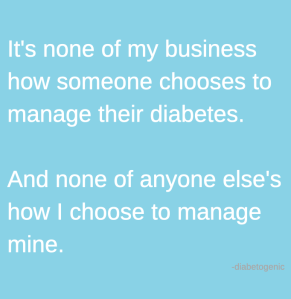
I have really tried to tone it down; I know that just because something works for me doesn’t mean it will work for others. But even more than that, it’s none of my business how someone chooses to manage their diabetes. And none of anyone else’s how I choose to manage mine.

So, I’m revisiting this little post from last year as a reminder that we are lucky to have choices. And to not shove ours down others’ throats.

____________________________________

Pumps. Pens. Syringes.

Patch pump. Pod.

Share your data. Don’t share your data.

Blood glucose monitors. Continuous glucose monitors. Flash glucose monitors.

Low carb. High carb. Low(er) carb. No carb. ALL the carbs.

Private diabetes team. Public clinic.

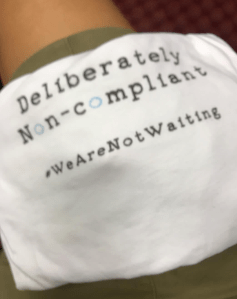
#WeAreNotWaiting. #WeAreWaiting.

Apps for recording data. Scribbling down numbers on the back of an envelope. Making up numbers as you go along.

Online peer support. Face to face peer support. No peer support.

How fortunate we are to have choices – to have choices we can make for ourselves for our own brand of diabetes.

I’m feeling a little burnt out at the moment by the zealots online who think it’s their way or the highway. Do what works for you and share it, by all means. But attacking someone else for doing something different is just being a dick. Don’t be a dick. There’s really no need.

Have you noticed how the social media feeds of many folks in the DOC are starting to look a little rosy? It’s a veritable florist out there at the moment, with lots of people talking and sharing information about #SpareARose.

I’m resharing is a recycled vlog from last year where I suggested that we try to get #SpareARose outside of the DOC and into the conscience of a broader audience. Watch my over-caffeinated rantings…and then tell someone about #SpareARose and ask them to donate.

The address for donations is: www.LFACInternational.org/SpareARose

(If this is your first time here, you may be wondering what’s #SpareARose? It’s a campaign that was developed by some pretty amazing advocates from the diabetes online community back in 2013. The idea is simple: send eleven roses instead of twelve to you love this Valentine’s Day and donate the money you saved (about USD$5 / AUD$7) to #SpareARose. Your donation will go directly to Life for a Child and provide a month of life-saving insulin to a child with diabetes. Spare a rose, save a child. Sounds like a pretty special Valentine’s Day gift to me.)

I went to the endo the other day armed with questions and issues I wanted to discuss. I’d found all random notes I’d typed on my phone and sticky notes I’d stuck around my office and cobbled together a list of things to work through.

And at the end of the appointment, there was a tick against every single one of them. (Except for the one about a new travel letter. I haven’t bothered travelling with a letter for some time now because I never needed it, but the last couple of times I’ve gone through security in the international terminal in Melbourne, I’ve been given some grief about refusing to walk through the full body scanner.)

I asked about other drugs that I could take to augment my current diabetes treatment. I know that others with type 1 have added Metformin or SGLT2s to their drug cocktail and wondered if I should be considering something else.

I asked about new drugs coming, how I will use faster insulins once they finally bloody hit our PBS shores and talked about protective measures I could take to reduce the risks of every single thing that diabetes likes to throw in our direction.

I realised half way through the appointment what I was doing and it struck me all at once why I was doing it. It was about feeling in that diabetes rut – not in terms of general ‘over it burnout’, but a treatment rut. It was about me wanting more. What else can I do? What else can I take? What else should I think about? What else? What else? What else?

Loop is continuing to do doing its thing. It keeps me and my diabetes ticking along with minimal effort and generally decent lines on my CGM.

But because I am an idiot and obviously have D-FOMO, apparently, it’s not enough. I turn into Chester, that annoying little puppy in the Warner Bros ‘Chester and Spike’ cartoons, bouncing around ideas and thoughts and different drugs and treatments.

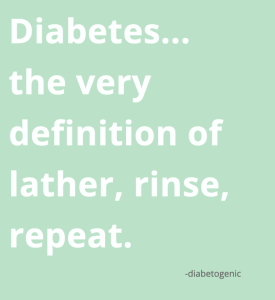
When you co-exist with diabetes, the very definition of ‘lather, rinse, repeat’, it’s easy to get complacent. And from there, it’s just a hop, skip and a jump to being in a rut. Is it any wonder that we get bored, disinterested and downright over the whole bloody thing? Or that to try to counter that boredom, we want to try anything and everything; whatever we can to keep a little bit of interest in what we are doing. We see things new and shiny and flashy and want it – not always because we feel we need it. But just because it’s something novel.

I walked out of my endo appointment without a prescription for any new drugs. We chatted about my options and when we weighed it all up, there didn’t seem to be any real benefit. But the door is open for further discussions when I see her next.

I don’t need anything new. There is nothing I can do really to be doing better. It’s just more of the same. Every day. Lather. Rinse. Repeat. (And repeat…repeat…repeat.)

I’ve been Looping for about 17 months now. I’m a fan (perhaps you may have picked that up).

The reason I am a fan has nothing to do with my A1c. In fact, right now, I couldn’t tell you what my A1c is (more about that later). I love Looping because it works for me. It takes away a shedload of my diabetes tasks. It helps me sleep better. It gives me more energy. It means I think about diabetes less. It significantly, significantly, significantly reduces the number of hypos I have, and the impact of the almost-hypos that have replaced the doozeys used to have. It means I get to wear cool t-shirts.

Badge of honour…

Because in exactly the same way as if I have tried a different eating plan it’s never been about numbers on the scale, Loop has never been about A1c.

It’s especially never about a measurement that is so flawed that it really is time to wonder why, for me and those of us who are able to access far more informative and useful data, even bother to have this checked. (Read this piece by Dr Steven Edelman from TCOYD for more on that.)

I have to say that I feel a lot of discomfort when I see A1c as such a focus. Some if it is for the reasons I’ve already stated, but also, it reinforces that we measure our success as PWD and how we are managing with this number. If my A1c went up this time, I really couldn’t care less. I’ve not long come off three weeks of holidays where diabetes barely interrupted the flow of sunshine, sea and sleep. And family, friends and food. I have not had a hypo in months. I have not had days of wanting ‘I hate diabetes’ tattooed across my forehead.

I went to my endo appointment last week still in slight January holiday mode. I completely forgot to call ahead for a pathology request – in fact, I’d forgotten all about the appointment until I was sent the text reminder a few days earlier. I used to think it was a waste of time not showing up without results waiting for me. But I wasn’t really all that concerned this time. I had some other information at hand including how much time I am spending in range. That gave me enough to focus on before I moved onto other things I wanted to talk about: the things that are really important to me with my diabetes.

Living well with diabetes is about so many factors. Those factors will be different for different people (and yes – A1c may be how some people consider living well).

As someone who has had really dark times with diabetes, it’s the light times that demonstrate how well I am doing. Those times may not be the times that I am ticking boxes that we are told gauge our success. They have certainly not been times necessarily marked with a low or in-range A1c. They are the times when the impact of diabetes is lightest. When it dances across my conscious rather than lives there. When it casts a gentle shadow rather than a thunderous cloud. A1c has never had anything to do with that.

I walk into a room of people. It’s a work meeting, and I am with a couple of colleagues. We’re greeted by about 8 others who all work for a large diabetes-related organisation. Two or three are from their Australian office, the rest have travelled from Europe. They’re here to meet with people working in the diabetes space to get an idea of the landscape in Australia.

We take our seats at a U-shaped table; we’re brought coffees. Introductions start. One of the overseas visitors tells us a bit about who he is, and rounds out his introduction by saying ‘I have type 1 diabetes. And I use Dexcom,’ he says, looking straight at me.

It’s summer in Melbourne and I am wearing a short-sleeved top. The Dex adorning the top of my left arm is clearly visible. I smile at him. ‘Snap!’ I say.

The meeting continues, with a lot of discussions and chatter. My new friend asks a lot of questions, some directed at me. I know what he is doing – it’s that thing people with diabetes who are ‘working in’ diabetes do. We try to learn how others manage living with a condition and working it too.

The meetings winds up; people start to chat with each other, continuing on from some of the discussions we’ve just had.

And the two PWD immediately turn to walk to each other. We shake hands and fall into an easy conversation. We speak about the challenge and responsibility of having diabetes while working in the space. We ask each other more questions and we listen carefully. And then we talk about our own diabetes, starting with ‘When were you diagnosed?’. I want to know how he found being diagnosed with diabetes after having already worked for a number of years for a diabetes-related organisation. We work out if we will be at any of the same meetings or conferences throughout the year.

The meeting is over. We shake hands again, and say good bye.

I walk to the elevator with my colleagues, thinking about the different ways people with diabetes connect. It happens like this. We find each other in a room. We see each other in a café. We opportunistically meet in a gelati shop. We bump into each other on the street. And we talk. We learn from each other. We gather information. We feel connected.

We get it.

I walked into my endo’s office yesterday, and was greeted by the receptionist with a smile (and by name). ‘You’re next; shouldn’t be too long,’ she said to me.

I was especially grateful for the welcome I received yesterday. Because earlier in the day I’d started the search for a new GP. It hadn’t gone well.

My quite awesome GP who I’d been seeing for almost twenty years decided to move interstate which is incredibly inconvenient. For me. But apparently it was a good opportunity for his family, so off they went and now I am left GP-less. Because, yes, it’s all about me.

So, I’ve been looking and asking friends in the area who they see and if they would recommend them. There is a woman at the same practice as my previous GP who I quite like, and a few people had suggested. I’d seen her a few times when my GP had been on leave, and she knows my convoluted medical history. But when I rang for an appointment the other day, I was told she was booked up until March. M-A-R-C-H. Over a month away. I was told that I could call at 8.20 the next morning as they keep a few on-the-day appointments, but there was no guarantee I could see the GP I wanted.

I sighed and said that I’d call back the following day. And when I did, there were no appointment times with the doctor I wanted. Continuity of care is important to me – I don’t want to have to explain the CGM on my arm, the pump down my bra, the way I manage my diabetes each time I need a quick visit to the GP for a UTI, or sore throat that won’t go away.

I decided that I probably needed to find another doctor, so I called another clinic that had been recommended to me. I didn’t speak to the receptionist. But I did hear the hold message.

Firstly, the calm voice on the recording told me that the doctors at the clinic all had lots of experience and were there to serve the local community, and that the whole clinic operated under a philosophy of patient-centred care. ‘Excellent,’ I thought. ‘That’s a buzz phrase I like. Good start’.

But then came a shopping list of things that callers should know before pressing hash to speak with someone.

  • Appointments can only be made before midday. If you call outside those hours, you will be asked to call back the following day
  • Same day appointments can only be made between 8.30am and 9.30am, although most will be taken by 8.45am
  • Doctors generally will not take or return calls from patients unless this has been agreed upon during an appointment
  • No results given over the phone by doctors (or anyone else); you need to a follow up appointment
  • No bulk billing is offered (even for people on a HCC)
  • If you are late, you will miss your appointment
  • You will not be contacted if the GP is running late
  • But you should call to see if the GP is on time
  • Missed appointments (by the patient) incur a no-show fee
  • If you want a referral (even to an existing specialist) you must make an appointment to see the doctor
  • Ongoing referrals will not be provided
  • If you want a prescription (even for an existing medication) you must make an appointment to see the doctor.

After listening to the message three times – just to make sure that I had everything correct – I hung up. There was literally not a single thing on that list that could be considered to be patient-centred.

Before I go on, I want to say that I know that GPs are overworked. I know that they are underpaid. I know that there are too many people trying to get into see them, and their time is precious. I can’t even imagine what it takes to run a GP clinic – or a clinic for any discipline really. I assume that there will be some using the service who have unreasonable expectations and demand that a doctor be available to them at all times of the day and night. So, rules are needed to deal with those sorts of people.

I am not one of those people. I am, however, a person who lives with type 1 diabetes and sometimes, I need a prescription for insulin because I thought I had another repeat left, or my current prescription has expired, or I lost the last one, or the littlest dog ate it (hasn’t happened, but wouldn’t put it past her). Or I need a referral to one of the other specialists I get to see semi-regularly (such as my dermatologist for psoriasis, rheumatologist for psoriatic arthritis, OB/GYN for gynae stuff etc.). And I definitely appreciate an ongoing referral, because, you know, diabetes doesn’t go away and I will need to see my endo forever (or until she retires, at which point I’ve decided I’ll give up this diabetes palaver too).

I don’t think these are unreasonable requests to have of a GP clinic. I don’t expect to be bulk billed. I am not asking for a diagnosis over the phone; or a phone consultation. But surely, it’s a waste of time (mine and the doctor’s) for me to need an appointment for a prescription for a drug that I will need to take FOREVER, and dose myself. Or for an annual referral to a doctor I’ve been seeing for over seventeen years for a health condition that I’ve had for almost twenty-one years. Or to be told that my A1c (or whatever else is being checked) is in range.

I wrote last week about how we get burnt out with needing to be advocates for ourselves. I felt a wave of that hit me as I listened to the list of rules from the GP clinic I will not be going to. I don’t want to start by giving a medical history … and then needing to beg for a little flexibility in their rules.

Does this make me sound like a princess? Maybe. Does it make me sound unreasonable? Perhaps it does.

But healthcare settings cannot have it both ways. They cannot promise that they are patient-centred if they are actively setting rules that make it more difficult – and exhausting – for us to live with a chronic health condition.

One day, I won’t be anxious when waiting to see my lovely endocrinologist. Today’s not that day.

Last year, the (current) Australian Prime Minister said that in Australia ‘If you have a go, you get a go’.

What a great sentiment on which to build a nation. Have a go, get a go. Sounds so easy. And you know what? It is. For people like our PM. And, I freely admit and recognise, people like me.

In diabetes, we hear this sentiment in a number of different ways: if you follow your diabetes plan, you’ll be fine. If you keep in line with guidelines, everything will be okay. In fact, you won’t just be fine. You’ll thrive! Because, diabetes can’t/won’t/doesn’t/shouldn’t stop us.

I spoke with someone at the end of last year who said that there was no excuse for people in Australia to not thrive with diabetes because we have ‘free’ healthcare and access to everything we need to do well.

Let’s just unpick that for a minute. Firstly, our healthcare in Australia isn’t ‘free’. It’s taxpayer funded – which is exactly how it should be. It is, however, important to acknowledge that it is not free because often, when we think something is free, we think it has no value. We take it for granted, or, even worse, we take advantage of it, and don’t realise just how significant and valuable it is. I couldn’t out a price on free healthcare to be honest. But I feel incredibly lucky to have been born in a country that has it!

Also, it’s all good and well to say that people have access to all that is needed to thrive, but there is a massive assumption that people actually know what they need, know why they need it, know how to access it, and know what to do with it once they have it.

It’s true that here in Australia we have universal healthcare . But it’s not fair or correct to think that everyone has the same ability to get the best out of the system. Or anything at all out of the system to be honest.

Expecting all people with diabetes to thrive is setting us up to not measure up. And it tells us that it’s not enough to just get by. Surviving isn’t adequate. Being alive isn’t sufficient. We need to go above and beyond all that.

I don’t know about other people with diabetes, but I feel a great pressure to thrive all the time. Honestly, it feels that I don’t have any excuse for that not to be the case. Latest tech – check; easy and affordable access to insulin, diabetes supplies and healthcare – check, check, check; health literate – check; loud and assertive advocate – (annoyingly for any healthcare professional who has to deal with me) check; support network to bring me cake, have my back and cheer me on as needed – check.

What do I have in the way preventing me from thriving? And just how is diabetes stopping me?

The concept of thriving with diabetes comes from a position of privilege. There are some people who really are just getting through, day by day, because diabetes is just so bloody hard for them. For some, diabetes doesn’t even get a look in because, quite frankly, there is more going on that takes precedence in their mind, their life and their day-to-day existence.

The truth for me is this: I don’t really feel as though I am thriving. I feel I am getting along. I’m not running marathons or climbing mountains or swimming channels. There is nothing I am conquering in the name of, or despite, diabetes. Instead, I’m happy to chase sunsets and sit in the fresh air and drink iced coffee to try to keep cool in the endless heatwave we seem to be having. I’m not complaining about it, because even though I feel this pressure, I’ve made peace with being a diabetes underachiever. I don’t need to be somebody else’s version of a diabetes superhero. I just need to do my own version of diabetes.

Magic Melbourne sunsets

While you’re here….

There are, of course, places around the world, where talk of thriving with diabetes simply cannot happen. Being alive with diabetes is hard enough and survival is a constant battle.

February is nearly here (already?) and the 2019 Spare a Rose campaign already well underway. Can you make a donation to provide insulin to keep a child with diabetes alive?  No one should die because they can’t access insulin. You can help by going here and making a donation.

Follow Diabetogenic on WordPress.com

Enter your email address to follow this blog and receive notifications of new posts by email.

Read about Renza

Archives