Over the course of this year, I have been involved in a number of diabetes-related initiatives and events organised by the World Health Organisation. I remember the first email I received inviting me to be involved in an event because I was impressed with the communication about diabetes. There was a clear commitment to centring the lived experience, and it seemed that whoever was coordinating the project had an excellent understanding of the condition. I wasn’t sure if anyone involved was living with diabetes themselves, but I was certain they were working with people with diabetes to help shape the messaging. The most recent event, just last week, was coordinated by someone in the diabetes community – someone I’ve met in person and interacted with online for some time, and someone who is an excellent communicator with an in depth understanding of the global diabetes stage. 

And so, you would think that with all this diabetes intel and track record of great engagement that I would be surprised when the WHO made a spectacular blunder on Twitter yesterday with its efforts for World Diabetes Day. 

Except, I wasn’t surprised. At all. Because I know exactly how it happens. It’s the very definition of the left hand not knowing what the right hand is doing, and it’s all too common when comms teams don’t work with the teams focusing on lived experience. 

September marked twenty years I’ve worked in diabetes organisations in Australia. On top of that, I’ve been involved with the IDF for the last decade, as well as other diabetes organisations and companies around the globe. And in that time, I’ve seen some absolute clangers – clangers of which I first became aware once someone had hit share, and people with diabetes were, quite rightly, baying for blood. I’m not going to mention any, but I can tell you that I am still in therapy for a campaign that involved clowns, sharks, and spiders. Sigh.

It’s a horrible feeling when the community fury starts, and it’s directed at something you feel you should have been ahead of it or stopped it from happening in the first place. 

It’s also horrible to be put in a position of seeing this happen and not knowing what to do about it, or rather feel that whatever you do, it’s going to cause trouble. At the IDF Congress two years ago, sitting on stage in a panel with the newly minted IDF President, I was put in that position. After the President used a stigmatising image in his presentation, I had two options: sit there and say nothing or call it out. Option A would have resulted in people with diabetes not understanding how I could let it go. Option B could have resulted in furious IDF powers that be and me never working with them again. 

Option B was the only thing I could do. I knew that. But I cannot tell you the fear I felt as I spoke out on that stage, or afterwards. I barely slept that night, terrified at what was going to happen. Before the sun was up the following morning, I sent my boss, the CEO of Diabetes Australia, a message asking for an early breakfast meeting, linking him to a tweet with video of what had happened the evening before. In the back of a cab through the still-dark streets of Busan, I was so worried that I was going to be told that I handled it the wrong way and that I shouldn’t have said anything publicly. But that’s not how he responded. 

By that evening, I’d spoken with the IDF President, as had a few others, and together, we planned to pen an article about the how language can stigmatise diabetes. It was published the following year in The Lancet, and you can read it here

Last year, I stuck my head about the parapet when a state-based diabetes organisation in Australia (one for which I worked for 14 years) got things wrong when they were putting together an event with last year’s Australia of the Year (who has, I’m sad to say, been very stigmatising about type 2 diabetes since he stepped onto the diabetes stage). It was uncomfortable for me to write about the disappointment I’d felt seeing the language being used in promotion for the event, but I found myself in the same situation as I’d been at the IDF Congress the year before. I knew I had to say something. Because staying silent isn’t an option, no matter how uncomfortable it might be. 

I look at the way the comms team at Diabetes Australia operates now and the incorporation and focus on lived experience means that we run campaigns like this year’s stigma campaign and last year’s diabetes burnout campaigns. (And yes, I am completely biased because I work at Diabetes Australia, but this integration is something that means our messaging is far more hit than miss.)

Perhaps the thing that organisations need to reflect upon when something like this happens is just how easy it is to avoid doing it again. Despite yesterday’s clumsy efforts, WHO is already a long way there to doing better next time. It really is simple – work with community advocates, because there are always people who are keen and willing to be involved (hand raised!). And identify the people in the organisation who can help shape messaging and get it right. The WHO has those people there already meaning that it can happen straight away. (And for organisations that don’t, employ those people now.)
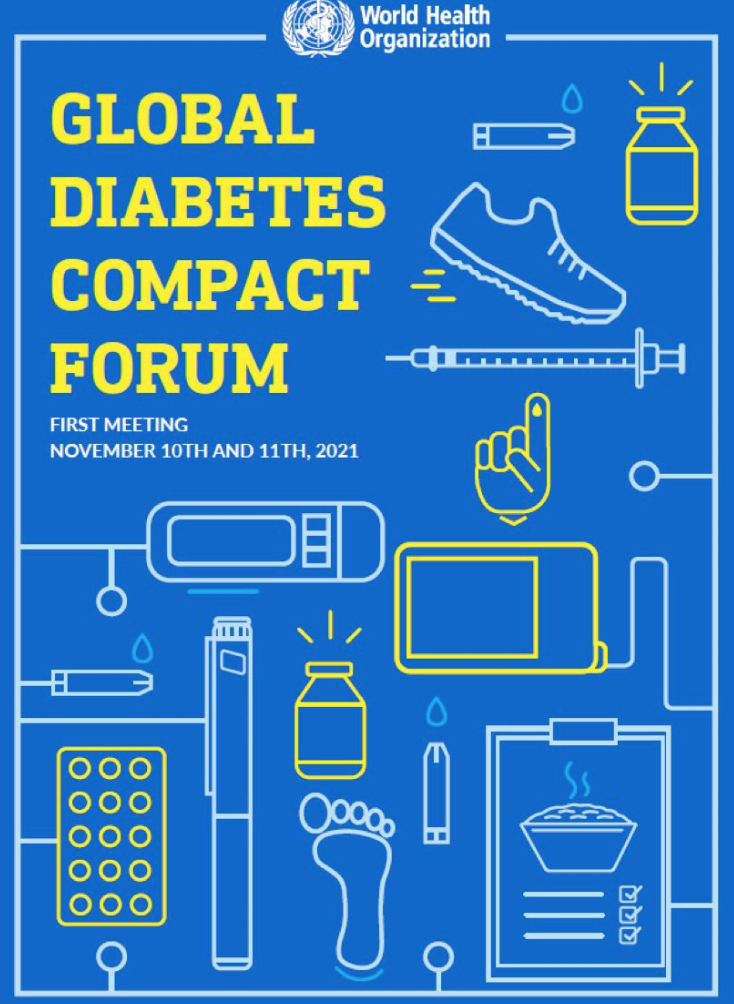
Over the last two days (or last two middles of the night if you’re perpetually in the wrong part of the world as it seems I am), I participated in the excellent first World Health Organisation Global Diabetes Compact Forum. (You can read the Compact which was launched earlier this year here.)

Once again, the WHO team had brought together stakeholders, including diabetes advocates, from across the world to talk about some critically important challenges facing people living with diabetes. These included access to insulin, research and innovation and prevention, health promotion and health literacy. The Forum was definitely not a ‘sit and be lectured to’ event. It was interactive, with everyone having the opportunity to participate and share their experiences and perspectives. The chat function was open and there was a constant stream of engaging, energetic discussion and sharing. 

The final session was about prevention and in his introduction, James Elliot, who expertly moderated the event, laid the foundation for the discussion. As with the previous sessions, there were no pre-conceived ideas or narrow focus about the topic. 

Prevention isn’t just about prevention of type 2 diabetes. There is a lot of work also going on looking at prevention of type 1 diabetes. And also, once living with diabetes, looking to do what we can to prevent diabetes-related complications.

When I spoke, the first thing I wanted to highlight was the problem I feel with the word prevention, and I revisited previous discussions in which I’ve been involved which highlight the struggle I feel with the word prevention. For too many people it is a word that offers a promise – a promise which guarantees that we can prevent aspects of diabetes that are often well beyond our control. I presented my case for instead focusing on how reducing risk is a far more accurate description of what efforts are truly about, a perspective that I have noticed is being used more and more.

The discussion pivoted to being about complications and associated stigma. Thankfully, this is not the start of the conversation about diabetes-related complications and the way people see them. When I wrote this piece back in 2013, I wrote about the way complications were presented to people with diabetes and how non-modifiable factors such as genetics, are rarely part of the conversation. There seemed to be a very one-dimensional presentation of diabetes-related complications: ‘take care’ of yourself, and you won’t get them. 

With communication around complications starting to be included in the language matters movement, I could see that too many people had been told that over-simplistic tale. 

It all got taken up a very significant notch when there was a concerted effort in the DOC to encourage dialogue about diabetes-related complications in a non-judgemental and safe way. Suddenly, we were seeing the hashtag #TalkAboutComplications accompany people’s stories, or questions others might have. This led to a real shift, as more and more people shared their experiences, with many saying that it was the first time they had seen others being so open about what was often considered a taboo topic. Starting to peel away the shame and secrecy of what can be a scary part of life with diabetes allowed many people to seek support from peers and help from health professionals. 

The legacy of the #TalkAboutComplications idea is that is that there are far more conversations today about diabetes-related complications. There is also a plethora of blog posts, podcasts, journal articles and conference presentations about the topic. I know that there is still significant stigma that we need to chip away at, but actually being able to easily find places online where conversations about complications are normalised and being part of those conversations is contributing to reducing that stigma. 

The session at the Global Diabetes Compact Forum was terrific because it tied together diabetes-related complications and stigma. With the theme of access this World Diabetes Day, perhaps we need to think about what that means when it comes to diabetes-related complications. While we absolutely do need to think about all factors at play when it comes to the development of complications, we also need to acknowledge that access is a factor when it comes to outcomes. Access to the right information, including information about risk reduction, access to insulin, access to glucose monitoring devices, access to complications screening, access to early diagnosis and treatment, access to peer support, access to stigma-free treatment, access to mental health support…all these have the very real potential to influence outcomes. 

It’s been a while since my last diabetes in the wild encounter. It makes sense. I’ve barely left my house for the last 20 months and I’ve not really been frequenting the places where I would usually have those happenstance meetings – cafés and airports. Gosh, remember airports? Remember the queuing and the waiting and the frustrations and the delays and the cancellations? Anyway, I digress…

It shouldn’t surprise me that it was a café that provided the setting for my accidental encounter with another person with diabetes. I was working away, happy to not be in my house, even happier that someone kept bringing me outstanding caffeine. Happiest because I knew that every single other person sitting there was fully vaccinated. 

I was doing the sort of work I do best in a café – editing. I get into a zone, concentrate on the task, and just read and edit in a super-efficient and fixated way. I don’t get distracted by anyone around me, and the noise becomes a reassuring beat that I work to. I completely block out anything on around me. 

Including the fall rate alert on my Dexcom app. Anyone who uses Dexcom knows that this is a particularly urgent, loud and unforgiving wail. It cuts through absolutely everything. I absentmindedly nodded in the general direction of my phone when I heard it, but didn’t make a move as I was totally focused on rewriting a particularly sticky sentence. (Probably like every bloody sentence in this post…) 

And so, I didn’t notice a woman sitting nearby get up from her chair and walk in my direction. I didn’t notice her stop right at my table. In fact, it wasn’t until she cleared her throat and said ‘Excuse me’ that I looked up, realising there was someone right there. She was fixing her mask behind their ears at the moment I looked up at her, my eyes focusing away from my MacBook. I blinked a few times and smiled, and then reached for my own mask before realising it was already on my face. I exaggerated my smile, so I was smiling with my eyes. 

There was a slightly awkward moment as I waited, because, look, I’ve forgotten how to engage with people. I probably should have said ‘hi’, but I’ve really lost the art of chatting with people. How do conversations start? So, I was thankful when she introduced herself. And then she asked, ‘Are you okay? I heard your Dexcom a couple of times. I just wanted to check you are okay.’

And that was how I broke my streak of having conversations about diabetes with other people with diabetes I’ve never met before. 

Turns out, I’ve missed it. Really, missed it.

We spoke for a while, sharing the usual things, comparing notes about which HCPs we see, and talking about which tech we are using. She is about to start looping, so I answered a heap of questions, remembering that I need to not be too evangelical and gushy about it. I toned down my ‘It’s the best thing I’ve ever done for my diabetes’ (because it is) by adding ‘But, of course it’s a learning curve and can be tricky.’

We told self-deprecating stories about how crappy our attitudes to diabetes have been at different periods. We shared our Covid-19 vaccination stories and compared when we’d be getting boosters. And we spoke about how we felt every time diabetes was mentioned in connection to Covid-19. 

Through it all my Dexcom kept squealing and I ignored it because I just wanted to slurp up a diabetes conversation with someone in real life, where all we really had in common was diabetes. It felt like a therapy session, a confession, and catching up with a long-lost friend all in one fifteen-minute encounter. 

When our conversation ended, she turned to return to her seat, and I settled back, searching for the sentence I’d been working on. But before I could do that, she turned back towards me and said, ‘I read your blog. I’ve seen you here before…well, used to see you here before Covid…and I wanted to say something. It’s really lovely knowing that there is someone like me who comes here.’ 

And then I cried. Because I remembered just what it is to connect. How real it feels. It’s why I started this blog in the first place – because I wanted to meet others just like me. Well over ten years of writing about diabetes, twenty years of diabetes advocacy, and that feeling of connecting never gets old.

Lots more diabetes in the wild stories on this blog post from earlier this year.

Gosh, there’s lots in the #DOC-iverse (#DOC-osphere?) about seeing diabetes, isn’t there? Yes, yes there is. Not sure about you, but I seem to be seeing a lot of bright, shiny, happy people (and a pop star or model or two) talking about diabetes, when usually they are pretty quiet about the whole diabetes thing. Which is fine. No one needs to spend their time advocating all about diabetes every minute of the day. 

But I wonder if any of the marketing boffins who threw together their messages of inspiration bothered to check to see what the International Diabetes Federation are up to for World Diabetes Day on 14 November. Afterall, that’s the showstopper event of the month, isn’t it? Celebrating the birthday of the bloke who I give thanks to every day for keeping me alive.

A bit of history about World Diabetes Day to help understand that it’s not just about privileged folks with diabetes showing off their high-tech gadgets strapped to their impossibly beautiful bodies. (And yes, I know I sound like the Grinch who stole World Diabetes Day, but I think that understanding the foundation of this day is kind of important because that all seems to get swallowed up in PR spin.)

World Diabetes Day means something. In 2006, it became an official United Nations Day thanks to United Nations Resolution 61/225. At the time it was one of only two official UN health days. But even before that, World Diabetes Day had been going on for some time. It was in 1991 that the IDF, together with the World Health Organisation, created World Diabetes Day in response to growing concerns about diabetes. 

Over the last thirty years, World Diabetes Day themes have aimed to be inclusive of people from around the globe, but perhaps there has been a (necessary) focus on how to improve diabetes outcomes for people in under-resourced countries. Maybe that’s why I find it a little galling when it appears that the day is about showing off your latest diabetes kit or shouting to the globe about how diabetes doesn’t stop people reaching their dreams. I love positivity and I’m often accused of being far too Pollyanna for my own good, but having a good look beyond our own privilege is important if we’re trying to get across a global idea of what is going on in the world of diabetes.

This year the theme is ‘Access to care: if not now, when?’. The World Diabetes Day website is full of resources that explain the theme. There are materials you can share to help explain just what access means to different people. 

It all seems to be a little bit of a throwback to community initiatives of the past. The diabetes community has been the creators of some absolutely stellar campaigns – ideas that seem to have been founded in similar frustrations about which I’m smashing on my keyboard today. In 2014 there was a campaign that asked us to ‘Put the World back in WDD’ which was in response to there being a very Western focus on World Diabetes Day. Sometimes it feels that some things never change. The #Insulin4All hashtag that was first used to highlight how people in under-resourced countries struggle to access insulin is now most often linked with insulin pricing in the US.

Access means different things to different people, and the materials the IDF has put together consider this. Even if you live in a well-resourced country, with decent subsidised, tax-payer funded (never free!) healthcare, it’s likely that some part of your diabetes care is still difficult to access. It may not be insulin or diabetes supplies that are your access issue – it could be mental health support or different tech solutions.

Here in Australia, thanks to Medicare, the PBS and the NDSS, we have well-subsidised diabetes care. It’s not perfect, but it is certainly better than I hear from friends in other places around the world. But there definitely are still deficiencies in our care. Mental health care is limited – and almost impossible, it seems, to access. Only 50% of people with type 1 diabetes can access subsidised CGM and Flash GM through the NDSS. People in rural and remote areas of the country have far more difficulty accessing quality, regular diabetes care. The outcomes for Indigenous Australians with diabetes fall far behind. As always, people who are disadvantaged in some way are disproportionately affected, and face more difficulties accessing the care they need.  

How you choose to celebrate (or not) this month and World Diabetes Day is entirely up to you. You may choose to ignore the ‘official’ theme of the day and focus more on other initiatives and once again, all perfectly okay. Just as YDMV, so may your diabetes advocacy. 

But if you are interested in focusing more on access, have a look at the World Diabetes Day website and pledge your support for greater access to diabetes care. Read about the Resolution that was adopted by United Nations Member States that calls for urgent, coordinated global action on diabetes. 

Look, I know. UN Resolutions don’t sound nearly as sexy as a six pack with a CGM plastered to it, but it is pretty cool that the WHO and the UN are talking diabetes. 

And while celebrating the centenary of insulin, learn where insulin is not easy to come by, and why that is. Through volunteer work supporting both Life for a Child and Insulin for Life, I have learnt a lot about the challenges faced by people with diabetes in under-resourced countries. If you can, please consider making a donation this month to either, or both, charities. 

And if looking to the community, it’s wonderful to know that there will be a docday° event on World Diabetes Day that is dedicated to the theme of access. You can learn more about that event here. It’s free to join, and will be live streamed on Facebook – you don’t even need to sign up.

But perhaps a final thought. How great would it be if those with really, massively high followings, (and followings not-only-in-the-diabetes-community), used this time to talk about making a real difference – a difference to people with diabetes who are struggling to access the basic drugs and supplies to actually live with the condition. 

Sure, ‘seeing diabetes’ helps raise awareness, but as ever, I ask how much of that actually cuts through and gets out of the community that is already seeing diabetes every single minute of every single day? 

A poster from the IDF World Diabetes Website. (Click image to be taken to site.)

I shared this photo to Twitter the other day:

I couldn’t care less if there are diet books on bookshelves at bookshops. Clearly there is a buck to be made with the latest fad diet, and so, diet scammers gonna scam and publishers gonna publish. 

What I do care about is the framing that health is limited to weight loss and dieting. 

Living with diabetes has the potential to completely screw up the way food, weight and wellbeing coexist. My own disordered thinking has come from a multitude of different sources. I know that even before diabetes I had some pretty messed up ideas about weight loss and my own weight, but once diagnosed all bets were off and that thinking went haywire! I know it didn’t help when, in the days before diagnosis as I was feeling as though I was slowly dying, someone effusively told me how amazing I looked after having lost some weight that I really didn’t ‘need’ to lose. And look at that! A little weight bias in there already as I talk about ‘not ‘needing’ to lose weight’. 

I remember that afternoon very clearly. It was Easter Sunday and my whole family was at my grandmother’s house. I’d had a blood test the morning before because I’d gone to my GP with a list of symptoms that these days I know to be ‘The 4 Ts’. (In hindsight, why she didn’t just do a urine check or, capillary blood check, I don’t know.) I was feeling awful and scared. I knew something was wrong, and suspected it was diabetes. 

But there I was, literally slumped on the floor against the heater (at my grandmother’s feet) because it was the only place I could feel any warmth at all. Sitting opposite me was a family member who felt the need to tell me how amazing I looked because I’d dropped a few kilos. I could barely see her across the room because my vision was blurry, but hey, someone told me I looked skinny. Wonderful!

That road to further screwing up my thought processes about weight and diabetes was pretty rocky and I was on it. I learnt that thing that we know, but we don’t talk about anywhere enough routinely, and that is that high glucose levels equal weight loss equals compliments about losing weight. (We don’t talk about it because there’s not enough research, but also because in the past a lot of HCPs have gatekept discussions about it because they think that by talking about insulin omission or reduction for weight loss will make people do it. Sure. And sex education for school-aged kids is a bad thing because by NOT talking about sex, teenagers don’t have sex. End sarcasm font.)

It has taken years of working with psychologists to undo that damage – and the damage that diabetes has piled on. I employed simple measures such as stopping stepping on scales and using that measure as a way to determine how ‘good’ I was being. As social media became a part of everyday life, I curated my feeds to ensure I was not bombarded with photos that showed a body type that generally is only achievable when genetics and privilege line up. I learnt to not focus on my own weight and certainly not on other people’s weight, never commenting if someone changed shape. I did all I could to reframe how I felt about different foods, because demonising foods is part of diabetes management.  

I was determined to parent in a way that didn’t plant in my daughter’s head the sorts of seeds that had sewn and grown whole crops in my own. While a noble ambition, I realise I was pretty naïve. Sure, we absolutely never talk weight at home, we never have trashy magazines in the house celebrating celebrities’ weight loss or criticising their weight gain. I’ve never uttered the words ‘I feel fat’ in front of my daughter even when I hate absolutely everything I put on my body. Food is never good or bad, and there is no moral judgement associated with what people eat. But the external messaging is relentless and it’s impossible to shield that from anyone. All I could do is provide shelter from it at home and hope for the best. 

But despite doing all I can to change my way of thinking and changing my own attitudes and behaviours, it takes a lot of work…and I find myself slipping back into habits and not especially healthy ways of thinking very easily. 

Which brings me to my favourite bookshop over the weekend and standing there in front of the health section. I was looking for something to do with health communications, or rather, the way that we frame life with a chronic health condition like diabetes. I wondered if there was anything that spoke not about ‘how to live with a chronic health condition’ but rather ‘how to think with a chronic health condition’. I didn’t want to read more about what to do to fix my body; I wanted to find out how to help focus my mind and love my body. But there was nothing. Nothing at all. 

Instead, there were shelves and shelves of books about losing weight, dieting, fasting, ‘cleansing’ (don’t get me started) and then more on fad diets.

When I tweeted the photo, one of my favourite people on Twitter, Dr Emma Beckett (you should follow her for fab fashion and fantastic, fun food facts), mentioned that it is a similar story in the ‘health food’ aisles of the supermarket, where there seems to be a focus on calorie restriction.

How has the idea of being healthy been hijacked by weight loss and diets? How has the idea that restricting our food, limiting nutrients, and shrinking our bodies equates health?

How did we get so screwed up at the notion that thin means healthy; that health has a certain look? Or that dieting means virtue? How is it that when we see diabetes represented that it so often comes down to being about weight loss and controlling what we eat, as if that will solve all the issues that have to do with living with a chronic condition that seeps into every single aspect of our lives?

It takes nothing for those disordered thoughts that are so fucking destructive, thoughts that I have spent so long trying to control and manage and change, to come out from under the covers and start to roar at me. Diabetes success and ‘healthy with diabetes’ seems to have a look and that look is thin. (It’s also white and young.) 

Health will never just be about what someone weighs. And yet, we keep perpetuating that myth. I guess that steering away from the health section of bookstores is selfcare for me now. Because as it stands, it just sends me into a massive spin of stress and thinking in a way that is anything but healthy. 

Last week’s Diabetes Australia Language Matters Global Summit was a terrific, snack-sized event that packed a lot into (just over) an hour. An absolutely stellar panel including Greg Johnson, Jane Speight, Partha Kar, Stephanie Haack, Nina Tousch and Tim Skinner made for an interesting, hopeful, encouraging and enjoyable discussion. I’m really proud of the way we were able to bring together people with diabetes, clinicians and researchers, offering different perspectives and ideas about why language matters.

During the event, Diabetes Australia launched our latest Language Matters Position Statement – ten years and one month after we launched our first. You can find it here.

If you missed the Summit, you can watch below.

Disclosure

I work at Diabetes Australia. I was involved in organising this event and hosted the panel discussion. I’m sharing this because I am choosing to.

NOTE

I work at Diabetes Australia. It is important for me to highlight this because I am writing about a TV show that has not been especially complimentary to that organisation. That is not why I’m writing though. I’m not here to defend or respond to the claims made about

Diabetes Australia. This post is about the way the story of type 2 diabetes is being told in the series. 

However, I think that it is important to highlight the lens through which I am watching this show and consider that bias. I think it is also important to consider that my position about stigma, blame and shame and type 2 diabetes has been consistent for a long time. 

This post not been reviewed by anyone at Diabetes Australia. As always, my words and thoughts, and mine alone. 

___________________________________________

It will come as no surprise to most people that when Diabetes Australia launched a new position statement about type 2 diabetes remission, there was a section on language when speaking about this aspect of type 2 diabetes management. There is also this point: ‘People who do not achieve or sustain remission should not feel that they have ‘failed’.’ 

Language matters. I wrote about my own concerns about how we talk about type 2 diabetes remission in a post a couple years ago. I am not saying that we shouldn’t be talking about it, or helping people understand what remission is, but I am saying that the way we talk about it must be considered. Because adding more blame and shame to people serves only to further contribute to the burden of living with the condition.

Unfortunately, the same consideration has not been given to a new show on SBS, grandly called ‘Australia’s Health Revolution’. The three-part show is presented by Dr Michael Mosley and exercise physiologist Ray Kelly, with the aim to show that type 2 diabetes remission is achievable with a low-calorie diet. Eight Australians with type 2 diabetes, or pre-diabetes are there as ‘case studies’.

This post is likely to draw criticism from some, and I accept that. But I will point out that it is not actually a commentary on whether remission of type 2 diabetes is achievable or sustainable for people with type 2 diabetes. I am a storyteller and a story listener, and I hear stories from people who say that they have achieved remission and others who haven’t. In the spirit of YDMV, I’m going to say that there is no one size fits all, and that this is a super complex issue. 

This post also isn’t a commentary on the struggles some people with type 2 diabetes face when trying to find a HCP who will support them to aim for remission using a low calorie and/or low carb diet. I think that my position on that is abundantly clear – if your HCP isn’t supporting your management decisions, find a new HCP. 

What this is about is how a TV show being shown at prime time is presenting type 2 diabetes, and what is being missed.

Michael Mosley is a TV doctor from the UK who has written books about low calories diets. I probably should be wary to say anything that isn’t glowing praise for the good doctor, because last time I dared do that on TV I was fat shamed. Of course, I wrote about it. Read it here. I know people who diligently follow his 5:2 or low-calorie eating plans and say it has greatly helped them and is terrific for their health. To those people, I say ‘Fantastic!’. Finding something that works is a challenge, and if you’ve found that and you are enjoying it and it’s sustainable for you, brilliant. Anything that improves someone’s health and makes them feel better should be celebrated!

I have no comment to make about Michael Mosley’s diets or the fact that he is selling something – books and a subscription diet plan. But I do have a lot to say about the way he is presenting type 2 diabetes. He is treating type 2 diabetes like an amusement park ride. He started in the first episode by sharing that he was going to ‘Put his body on the line eating a ‘fairly typical Australian diet’ … of ultra-processed food, to see if it pushes his blood sugar into the diabetes range.’ He then had baseline bloods and other metrics taken. 

The food Michael Mosley claims to be typically Australian bears no resemblance to the foods that I eat, that I grew up eating, that I cook, that any of my friends or family eat. But, unlike Mosely, I’m checking my privilege right here, and acknowledging that living in inner-city Melbourne with the means to buy fresh foods whenever I want or need and having an excellent knowledge of food and health, plus the time to make things from scratch (something I greatly enjoy doing) means that I am in a different situation to many people whose circumstances don’t mirror mine. 

I don’t judge what other people eat, and I don’t apply moral judgements to food. I consider what it costs to put food on the table, and food literacy. Plus, I am learning about how we have simply used the term ‘cultural groups’ to point to higher rates of type 2 diabetes in people of certain backgrounds is a lazy, get-out-of-jail-free card that doesn’t examine important factors such as food availability, poverty, education and history. 

I understand that while for some people, walking to the local market is easy and affordable shopping, others are at the mercy of what is on the shelves of their local supermarket. It is not as simple as saying stop eating processed foods when, for some people, that is all they have access to, or to tell people to cook for themselves where they have never been taught. These systemic considerations have not been addressed so far in the TV show, and without doing so, only half the story is being told. 

And mostly, I understand that there are genetics at play – massively. 

These are not excuses. These are factors that need to be mentioned and considered, because without doing so, we are presenting this as a simple, mindless issue and anyone who doesn’t put their type 2 diabetes into remission has only themselves to blame. 

Mosley ate his ‘typical’ Aussie diet for three or so weeks and when he had those same checks run to compare against his baseline, he found that his weight had gone up, as had his blood pressure, glucose levels, cholesterol etc. 

Now, if you are thinking you have seen all this before and jumped into a time machine and been taken back to 2004, you would be correct. We saw it first in 2004 when Morgan Spurlock entertained us with his documentary, ‘Super Size Me’. And then again in 2015 with Damon Gameau’s film ‘That Sugar Film’. There is nothing new about privileged white men eating the ‘foods of the poor’ and showing that their health has taken a hit. 

Michael Mosley then started eating a low-calorie diet to show just how quickly and simply his weight dropped, and other metrics moved back to within target range. 

Thankfully, alongside Mosley is Ray Kelly, and I am so, so grateful that he is there, because he leaves the sensationalist schtick behind to focus on the people and their stories, working to help them set achievable goals. He replaces Mosley’s melodramatic with compassion, simplicity with conversations about the complexity of diabetes, and privilege and assumptions with a genuine acknowledgement of the challenges – the social, generational, cultural, psychological challenges – faced by the people with diabetes and prediabetes on the show. 

When watching the show last night, my daughter said, ‘Is this like ‘The Biggest Loser’ on SBS?’. I smiled but pointed out that the difference is Ray Kelly. In this show, he is working with Lyn, a woman who is trying to lose weight. Lyn has decided she wants to climb a hill in her area. If it was ‘The Biggest Loser’, they would have tied a truck tire around her waist and made her climb to the top of the hill, with Michelle Bridges screaming at her while she was doing it. But here, Ray marked out the first challenge – a 50 metre there and back walk, to be increased to 75m the next day, knowing every step is one more than the day before. 

The big piece missing for me in this television series the absence of any sort of mental health professional (perhaps this will be included in the final episode?). Diabetes is never just about numbers. It’s never just about what we eat, or the medication we take, and it’s never just about what we weigh.  Addressing behavioural change must be part of this discussion if change is to be sustained. In an interview he did for the show, Mosley says ‘Anxiety also encourages people to eat more’. And yet, at no point has anxiety or any other mental illness and its impact into type 2 diabetes and obesity been discussed. 

Should we be speaking about type 2 diabetes remission? YES! Of course we should, especially as there is a growing body of evidence helping us to understand more and more about it. But we need to be doing it better than we’re seeing here. I don’t know Ray Kelly (expect for a couple of encounters on Twitter), but I feel that his approach is what we need more of. We certainly don’t need sensationalism and blame and shame. And please, we don’t need more stigma. 

Last month was the tenth anniversary of Diabetes Australia first launching a position statement about diabetes and language, encouraging everyone – health professionals, researchers, the media and the general public – to be conscious of just how powerful the words used about diabetes can be.

People with diabetes already knew this – we’d been speaking about it for decades. But to have a document supported by research certainly did add some weight to the discussion. It started a global movement and other diabetes organisations and groups have since launched their own guidance statements and documents motivating the use of language that doesn’t shame, blame and stigmatise diabetes.

Today, I’m so delighted to be hosting a panel with some of the people who have been instrumental in elevating and advancing the #LanguageMatters movement all around the world. You can watch from the Diabetes Australia Facebook page – there’s no need to register. And, I’ll share the full video of the Summit on here some time in the next couple of days.

Disclosure

I work at Diabetes Australia. I have been involved in organising this event and will be speaking at it. I’m sharing simply because I’m beyond exited that it’s happening and am hoping to see lots and lots of you there!

When I talk about the highs and lows of diabetes it’s not just the rollercoaster of numbers. I wrote yesterday about feeling a little low and overwhelmed after a particularly gruelling day. Today, however, I’m on an absolute high after a busy night, or rather, early morning, giving two talks at the ISPAD conference. 

docday° was a little different this time, in a truly brilliant way. It was the first time that the event was on the scientific program of a conference, meaning that it was easier for conference registrants to attend. Having a program session that is truly led and designed and features PWD, elevates the standing of lived experience.

The docday° program highlighted some of the topics very close to the hearts of many people with diabetes. Emma Doble from BMJ spoke about working closely with the docday°voices team to publish stories written by individual and groups of people with diabetes. How fantastic to see the words and lived experience feature in such a prominent medical journal!

I touched on language and diabetes – the first talk on the topic for the conference for me. Steffi Haack gave a beautiful talk about peer support and touched on what we get from being in a community of others with diabetes can offer. Steffi managed to perfectly capture the essence of what the community can offer, while also discussing why it’s not necessarily perfect. And we finished with Tino – Tinotenda Dzikiti – from Zimbabwe talking about access and affordability of diabetes medications and treatments. Tino has been a standout advocate in the dedoc voices program, and I make sure to take any chance I get to listen to him.

After docday°, I was an invited speaking in the Psychosocial Issues in Diabetes Symposium which involved an incredible panel of speakers including Rose Stewart from the UK and Korey Hood from the US. Rose spoke eloquently about the importance of integrating psychologists into diabetes care teams, and Korey provided some terrific tips about dealing with diabetes burnout. I followed the two of them (not daunting at all…!) to talk about the language matters movement in diabetes, starting with a reminder that we are talking about more than language – and it’s certainly more than just specific words. It’s about communication, attitudes, images used, and behaviours. 

The way that I speak about language these days is different. I think that at first, I spent the majority of the time explaining what it was all about. These days, there seems to be enough ‘brand awareness’ in the community about language matters and that means being able to home in on some of the more nuanced aspects of it. 

And so, while I still talk about words that I (and from research we’ve done, others) consider problematic (‘compliant’ is the one that I like to highlight), I spend more time talking about the image problem diabetes has, and about the trickle-down effect language has had on shaping that image. 

I point out that there are people who think that language is not all that important in the grand scheme of things, and that there are more important things to worry about in the diabetes world and I very much understand that. I also understand that people have different focuses. But when I ask people what those important things are, they include issues such as research for a cure and better treatments, better access, more education. And then I can’t help but see and think about how research is less because of the image problem about diabetes. That treatments and a cure need governments to prioritise diabetes when it comes to their research dollars and individuals need to give generously when there are funding drives. 

But because diabetes is seen as something not serious, and that people are to blame for their own health condition, we are not seeing those dollars coming our way. 

It never is and it never was about picking on certain words; it has always been about changing attitudes. Because that is what will change diabetes’ image problem. 

I am an advisor to the #dedoc° voices program. I do not receive any payment for this role. 

As an invited speaker at the #ISPAD2021 annual meeting, I was given complimentary registration for the conference. 

I am helping organise the Diabetes Australia Global Language Summit, and will be hosting the panel discussion. 

A couple of crappy anxiety days have left me feeling a little spent and exhausted. Add to that some low-key diabetes burnout, and I’m wondering if I can somehow leave diabetes out for the upcoming hard rubbish collection in our neighbourhood. 

The anxiety was mostly to do with a work thing yesterday which involved a live Q&A about type 2 diabetes remission. When I’m on my game, that sort of thing has me pumped! I know that the discussion will be lively and that there could be some contention in what we’re saying, and I thrive on robust debate.

But right now, I’m not feeling completely on my game. Burnout, lockdown and just feeling tired, combined with feeling a very long way away from friends and colleagues a lot of my work is with, has left me a little weary and downbeat. So instead of the fire I usually feel when I need to deal with something that could be a little controversial and provocative, I was dreading it.

A moment of light came after the live Q&A when I had a call from who wanted to speak with me about the new Type 2 Diabetes Remission Position Statement from Diabetes Australia. After watching, they decided to take the time to reach out to me and admit they were wrong about me. They thought I’d been dismissive and negative about the way they manage their diabetes, when in fact, it seemed I was the complete opposite of that. When I asked why they had thought that of me, they said, ‘You just seem so confident and assertive, and I mistook that for thinking you were really rigid in your beliefs about diabetes.’

It’s funny how we form impressions of people. Sometimes we can be spot on. Other times, not so much. I’ve been totally wrong about people in the diabetes community because once I’ve looked beyond the tweets, I see that there is far more to them than the soundbites that get all the attention.  

When people tell me (or, more likely, subtweet) that they think everyone should think the way I do about diabetes, manage their diabetes in the same way, feel the same about the issues important to me or that I think I speak for others with diabetes, I’m genuinely confused. I’ve never said any of those things. The about me page on my blog states: ‘This blog does not provide medical information or advice. I write about my own experiences of living with diabetes but please don’t think that you should take on board what I’m doing and apply it to you. We’re all different and our diabetes varies. Significantly. Get thyself to an appropriately qualified healthcare professional to help yourself out with your own particular brand of diabetes.’

I throw the caveat “my diabetes, my rules” around like glitter and anytime I do speak about diabetes, I am very clear that I am but one person in a very, very large choir, and that the audience should make a point of listening to lots of those voices. 

So, it is with no surprise at all that it seems that some corners of the LCHF world think that I completely and utterly condemn their chosen way of managing diabetes. What a lot of rubbish! I can only assume the reason they think that about me is because I have been pretty vocal about the way some in that community respond to others who have different ideas. I call out stigma and shaming, and I call out anyone saying that everyone should follow the same way of eating.

I stand by that. And I stand by it in all aspects of all types of diabetes. If anyone truly believes that there is one way and one way only to manage diabetes, they are very misguided.  

In case I was feeling too pleased with myself after that phone call yesterday, I was dragged back down to earth with a shouty email (in ALL CAPS) demanding to know why I don’t advocate remission in type 2 diabetes. Sweetie, I don’t advocate anything other than the rights of people with diabetes to do what they want to manage and treat their diabetes in a way that works for them. I advocate choice. Choice is critical and my passion lies in ensuring that people are given choice. 

I love my pump, I love LOOP, but I don’t reckon everyone should be on it. I don’t think everyone should do DAFNE or wear a Libre. I don’t think everyone should just follow what their doctors tell them to do. I don’t think everyone should be eating LCHF any more than I think everyone should be eating a vegetarian or Mediterranean diet. I wouldn’t try a vegan diet because the thought of no bacon makes me weep, but hey, if it works for you and you like it, can sustain it, can afford it and are happy doing it, high five!

Anyway, in a roundabout way, this post is to say that there is a new position statement about type 2 diabetes remission available and you can find it here if you’re interested

And it’s also to say that forming opinions of people in the diabetes world is perfectly fine and we won’t all agree or love each other (and that’s fine too). I know I’ve formed opinions of people based off one tweet, or one encounter. It’s probably quite unfair on my part, and when I’ve re-engaged with some of those people, I’ve found that they have a lot more going on that just that one idea of them I had. I’m glad I did try again. 

My anxiety is a little better today. I weathered yesterday’s storm and came out of it only mildly battered. I’ll call that a win. 

DISCLOSURE

I work at Diabetes Australia. I was not involved in the writing of the position statement that was launched yesterday. I’m writing about it because it’s interesting and relevant to my diabetes today and yesterday. 

Follow Diabetogenic on WordPress.com

Enter your email address to follow this blog and receive notifications of new posts by email.

Read about Renza

Archives