I’ve been thinking a lot about diabetes burnout lately. A lot.

I have been burnt out for a long time now – it’s been 18 months. I can see how it started – I know the trigger. I miscarried in terrible circumstances and, after the constant monitoring and intense management that comes with trying to get pregnant and then conceiving, losing the baby allowed me to ‘take a break’.

I’ve not come back from that break.

My question is this: When does it stop being ‘diabetes burnout’ and become something more? And what is the ‘more’?

We use the term burnout so much in diabetes; I feel that I’ve become a little desensitised. It’s the norm – most people go through periods where they are so unmotivated that they can’t deal with their diabetes, or pay less attention than they typically would. But how long is ‘normal’? How long can we go on like this?

My burnout is scaring me because it has been going on for so long. I fear I’ll never get my mojo back and actually get to a point where I am able to care for my diabetes in a capable way.

I go through periods of so few BGL tests that my meter resets itself. I have not seen my endo for far too long and I’m way behind in my complications screening. The only thing I am up to date with is eye screening because I had cataract surgery in the last twelve months.

A button on my pump has been playing up for over 3 months – half the time taking three or four attempts to get it to work – and instead of getting straight on the phone to the company’s customer service team and organising a replacement, I let it slide until Monday, when I realised that next week I am getting on a plane and going away for 6 weeks and if I don’t get it sorted I’ll end up with a dead pump while overseas.

I’m taking my insulin, although haven’t basal tested for a long while and know that the rates need adjusting. I ‘blind bolus’ a lot of the time. Wearing a CGM is useful because it gives me an idea of my glucose levels, but I don’t actually do anything constructive with the data I am receiving.

I keep in touch with the online community which is my link to seeing and hearing how others are coping. While I don’t participate in every week’s OzDOC chat, when I do get there I feel supported and know that I have people to turn to if I need them. I guess I’m not completely disengaged.

A nasty hypo often gives me a shock and I get a few days of decent and frequent monitoring out of it, but this is short-lived and I fall back into minimal self-care pretty quickly.

And I feel totally and completely shit about the whole thing. And guilty. Of course I feel guilty.

In a couple of years of some pretty difficult stuff, diabetes is the thing that I can let go of. At least, I feel I can. I mean, I can’t stop being a mum.  I can’t stop being a wife, daughter, sister, friend. I can’t stop coming to work. I can’t stop doing the things I need to do to be a functioning human. But I can stop with the self-care.

And because I am an idiot, or in denial, or just plain over it, I can’t see just how short-sighted this thinking is. I may be getting through the day and doing all those things that I tell myself I can’t stop doing. But how is all that going to work if something actually does happen as a result of my minimal self-care?

I honestly don’t know where to go from here. I feel paralysed and unable to make decisions that I know may help me start with some baby steps to get back on track. Is it a matter of re-engaging with my HCPs and talking to them for strategies? Do I try to set myself tiny goals, like a morning BGL check each day – or even every second day – that is achievable and will start to give me some data to work with? Do I go back to seeing a psychologist again and discuss ways to get back on track?

I don’t know.

It all seems too exhausting. It all seems too damn hard.

Is this burnout? Or is it something more?

I really don’t know.

This isn’t really a Christmas song, but I still think it’s a good song for this time of year. The wonderfully gorgeous Joni Mitchell and River.
‘Okay, so I’ll deal with the diabetic who’s just been brought in. She’s been in here four times in the last couple of months. Completely non-compliant.’

Whoa!

I was walking through the rabbit-warren-like corridors of the Epworth Hospital and passed a nurses’ station at the exact moment those words were spoken, stopping me dead in my tracks. If I was in a Warner Bros cartoon, there would have been a dust and smoke cloud around me as I screeched to a halt.

Move on, Renz,’ said the first voice in my head.

‘Not freaking likely,’ said the louder voice.

I turned to the nurses who hadn’t noticed me yet.

‘Hi,’ I said. I was trying for sweet and polite, but could already hear the patronising tone in my voice.

They turned and looked at me.

‘Um. I just wanted to say a couple of things. Calling someone a ‘diabetic’ isn’t helpful for anyone. It labels them as their condition and I’m pretty sure that the person you are referring to is a lot more than her insulin problems. Secondly, non-compliant is a really nasty term. I’m guessing that you’ve no idea what else is going on in her life – I have no idea either – but I am pretty sure that there is a reason that she is not managing her diabetes as well as she’d probably be hoping to. Non-compliant suggests that it is a deliberate ploy to make herself unwell – which it may be and if that is the case, then that is something that needs to be addressed.’

At this point, the nurses were just looking at me with a mix of surprise, suspicion, annoyance and interest.

‘Also, to be compliant means following a defined set of rules or guidelines. Diabetes has a funny way of mocking such an idea. The rules keep changing – without notice.

‘Now, I am hoping that you wouldn’t use this language around the person you’ve been referring to when you are actually in the same room as them, but here’s the thing. You’re saying those words now, and that means that somewhere deep inside (or, probably just on the surface) that’s how you really feel.

‘No one wants to have diabetes. No one wants to be in hospital. No one wants to be so overwhelmed by diabetes that they don’t – for whatever reason – manage their condition the best way possible. But sometimes, it gets like that. The never-ending relentlessness of diabetes can be so debilitating that all self-care stops. And then, sometimes, you wind up in hospital. Four times in a month, sometimes.

‘I have diabetes. I’ve been that person you are speaking about. But I wasn’t being non-compliant. I just couldn’t cope. And I felt really bad and guilty that I couldn’t cope. So on top of feeling crap about my diabetes, I also felt crap about not looking after my diabetes.

‘So. Maybe think about what else is going on in her life. She is more than diabetes (that’s why calling her a ‘diabetic’ isn’t a great idea) and I bet she is going to respond a lot better to some kindness and concern and perhaps a suggestion she see a psychologist if she’s not already doing so. Because the judgement and judgemental language is not helping at all.’

I looked at both nurses. I was still using a really calm, level voice, but I could tell that they were a little annoyed. And more than a little stunned. I smiled at them.

‘Okay then. Bye.’ I started to walk off, but stopped and turned back around. ‘Oh – can you tell me how to get to room 18A please?’


Right-oh. Next up on the holiday playlist is James Taylor. Have Yourself a Merry Little Christmas.

There was a piece in the Huff Post the other day about things to not ask someone living with a chronic health condition – specifically ‘Have you tried….’

You get the idea:

Have you tried not eating after 6pm to help your blood sugars?

Have you tried to quit sugar? Completely?

Have you tried the drug they were talking about on A Current Affair the other night?

Have you tried giving up coffee? (While I don’t advocate violence, it is perfectly acceptable to respond to the fool asking this question with a sharp slap to the back of the head.)

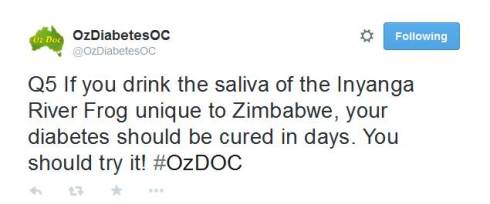
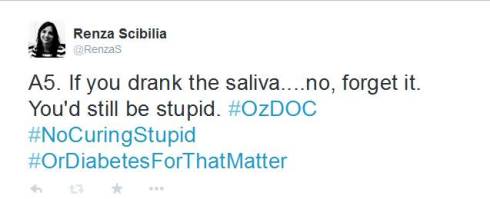
Sometimes the ‘have you tried’ suggestions are just plain ridiculous. In last week’s OzDOC tweet chat, moderator Ms Kim came up with this beauty, asking for us to tweet how we would respond.

Tweet 2My take on comments like this is to roll my eyes and try to change the subject. I don’t believe there is any malice in someone making these suggestions; they really are trying to help. They want to help.
It’s what it represents that pisses me off a little. My diabetes management is not for up public tender. I manage it in a way that I see fit. I will ask if I need help. Actually, I’m not great at asking if I need help, but that’s not the point.

It is as though having a chronic health condition is a ticket for everyone to offer their ideas and suggestions. I’m fairly certain I’ve never asked people to workshop my diabetes management and I certainly haven’t sought to crowd source ideas for helping me out. And yet, it feels like it’s a public free-for-all at times!

I am sure that this is the same for people living with conditions other than diabetes. But with diabetes, perhaps because there is the link with food, and food is in the public domain all the time that people think they can weigh in. It doesn’t help that there are twits like the frequently-mentioned-in-this-blog-because-she-infuriates-me-so-much-and-is-a-dangerous-tool, Sarah Wilson, and the equally-derided Pete Evans who have mega-huge megaphones that reach a lot of people and feel that their pseudo-science programs are a good way to treat chronic health conditions. (Spoiler alert – they are not.)

For some people, the most difficult thing about living with diabetes, is the way that the public perceives the condition. While I seem to not get too hot under the collar about the public’s perception, I do understand how tiring some people get at the constant comments about diabetes, the misconceptions and how others want to get involved.

Diabetes seems to be rather unique in this sense. That public ownership of a condition that is a significant public health burden is certainly annoying at times. It’s similar to people commenting on the size of a pregnant woman’s belly (or overall pregnant body). Because it’s a bit ‘out there’ some think it’s okay to offer comment or offer suggestions. When I was pregnant, I was standing at the counter of a juice bar at the Queen Victoria Market and a man I am quite certain I’ve never met before, put his hand on my belly and told me that I was ‘a good size.’ I asked him to remove his hand and suggested that he mind his own business. Or at least buy me my pineapple juice if he wanted to get involved.

Finding ways to deflect comments without appearing ungrateful or rude can be tough. I know people want to help. But there is no curing diabetes and there is no magic potion that is going to make it better. It is sometimes a little insulting when people suggest things – especially things that are clearly straight off the snake oil shelf. Most who know me should realise that I am pretty linked in with what’s going on in the diabetes world. Do they really think that I could have missed that cure?

I (hope I) have a long life ahead of me and as it stands, that life is going to be shared with type 1 diabetes (well, at least for the next five years). I accept this and know that it is my lot in life. It would certainly be easier if people just didn’t think that it was public property and they had a free pass to comment.

I really hope I don’t sound ungrateful. Or rude…

By the way, this is how I responded to the OzDOC zinger from last week: Tweet1

Because it’s so true. There ain’t no curing stupid!

Okay folks, it’s December. And my treat to you for the next couple of weeks is to provide you with fabulous Holiday songs. (I say Holiday not because I don’t want to say Christmas, but because they may not all be Christmas Carols.) Hold on – you’re in for a ride. Our Holiday album collection is certainly eclectic!

So, today, I’m starting with one of my all-time favourite musicians, John Pizzarelli singing Let it Snow.

On Wednesday, I discovered that I had been alive for 14,979 days. Not satisfied with having ticked off another year and just celebrated another birthday, I got a glimpse of how many days I’ve seen.

Today, I have lived with diabetes for 6,078 days.

Often, when people have had diabetes for a number of years, they start to measure the practical things – xxx number of injections; xxx drops of blood; xxx visits to hospital; xxx hours sitting in doctors’ offices; xxx kilos of jelly beans consumed.

Often these numbers can provide context which can be particularly useful to illustrate the impact of diabetes on people’s every day lives. It helps those without diabetes understand the day-to-day tasks, especially their frequency and consistency.

As a person who has lived with diabetes for sixteen and a half years, what these types of little exercises show is just how consuming diabetes is. I start to think of the minutes, the hours and the days diabetes has taken. It’s a toll that, when measured – especially when measured long term – is so significant. And I never forget that have had diabetes in the time of 5 second BGL checks, disposable everything and minimal preparation required. Those diagnosed years before me have tales to tell of 2 minutes countdowns to get a BGL reading, or the need to boil and sharpen needles.

I don’t really like to measure the minutiae of diabetes – it depresses me and has the power to overwhelm me. What I do like to measure is the time passed and the way I am going despite that time. Because as crap as individual situations can be, as much as it sometimes hurts to jab my finger and draw blood, as much as the thought of having to eat another jelly bean can make me weep, I have 6,078 days under my belt of it all. That doesn’t make me feel upset. Instead, it makes me feel elated.

It’s Friday. Sixteen years ago, I was listening (and walking) to this.

Do you think of diabetes as a struggle? In my ongoing (frequently failed) attempt to spin positivity into life with diabetes, and my love of language, I keep coming up with different words to use: challenge, undertaking, effort, opportunity, experiment, endeavour, complete and utter shitness…

But I guess when push comes to shove, at the end of the day and what it all comes down to is (cliché, cliché, cliché!) there are days when it just really is a struggle. Sometimes I think that living with something that is just so damn difficult and unpredictable all the time means that we just start to accept it. We accept the struggle. The struggle becomes our norm.

I saw this little poster on a friend’s Facebook page the other day and straight away, it resonated:

Struggle

I got very ‘rah rah’ about the sentiment on the poster, thinking that I should get it on a t-shirt. I do feel that living with diabetes has made me realise my strength.

But when I re-read it a couple of days later, I read the second word.

Thankful.

Am I thankful for my struggle, if my struggle is diabetes? I don’t know. I’m not sure.

Has diabetes made me a stronger person? Has diabetes made me understand my strength – just how tough and resilient I can be?

Perhaps it has. Perhaps it has made me realise that I can deal with pretty much anything that is thrown at me. If I can deal with the ‘never-ending-ness’ that is diabetes, the short term stuff – the things that are not chronic ­– seem more manageable.

So with that in mind, maybe it is not so much the diabetes that is the struggle. Maybe living with something that never ends, but never giving up; continuing to plug along and deal with it is the real struggle. And the real strength is in accepting it.

DCIM100GOPRO

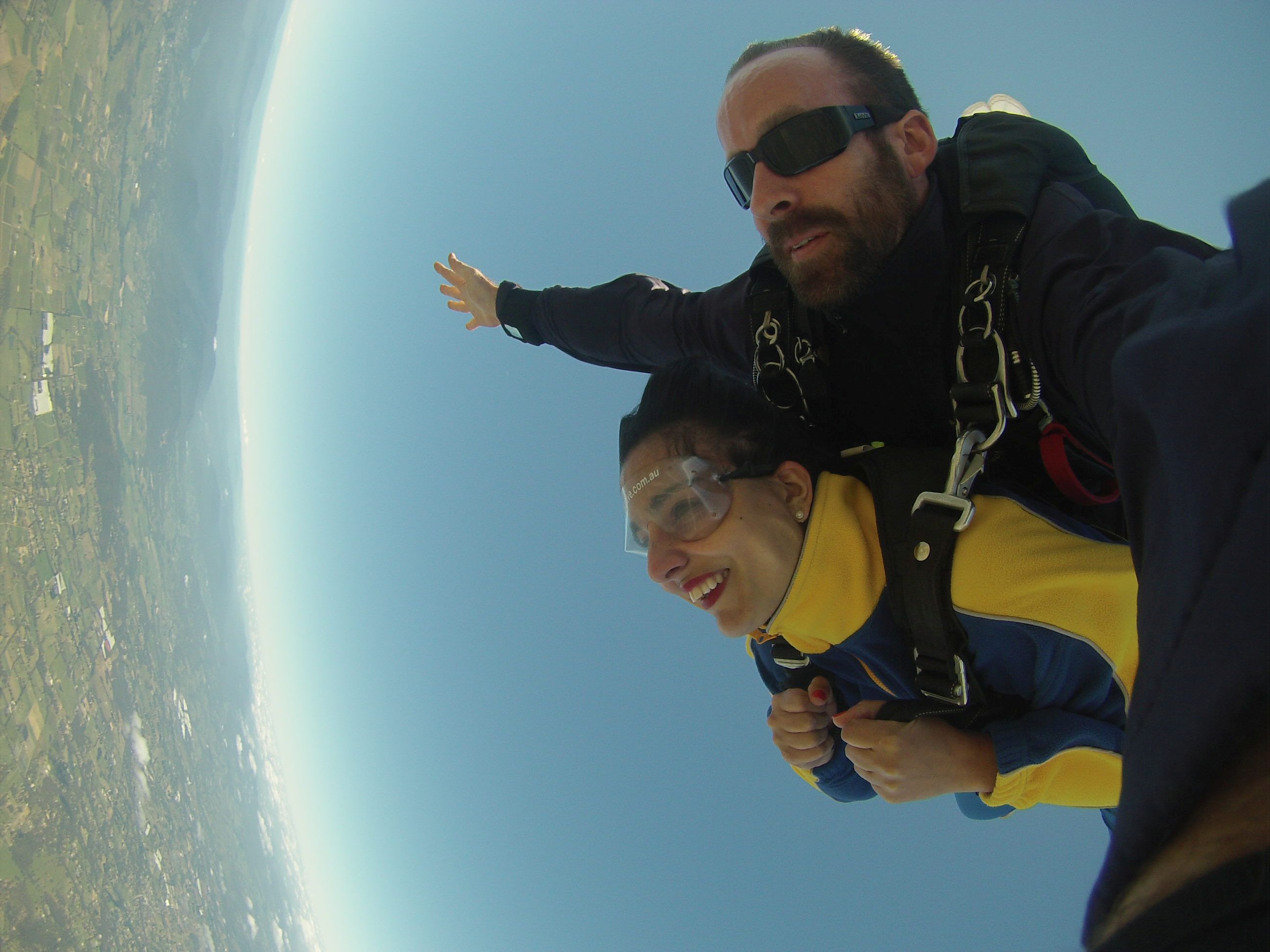
Free falling!

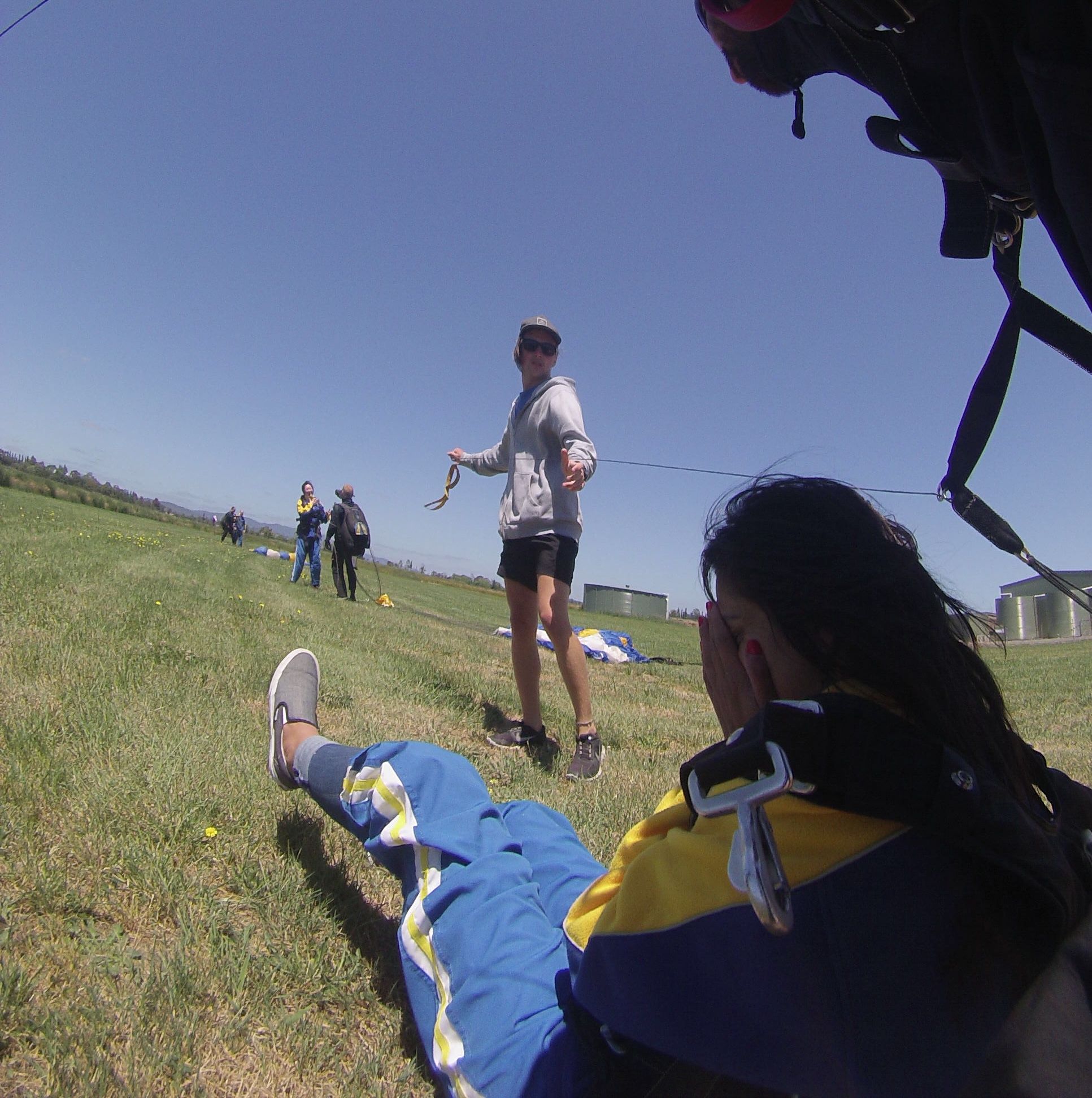
Over the weekend, I jumped out a plane. I didn’t mean to – it was completely unplanned. I had intended to go cherry picking while my husband went sky diving, returning just in time to see and photograph him landing safely. But as he was checking-in for his adventure, the lovely woman passing him some paperwork said to me ‘Do you want to jump?’ and inexplicably, I heard myself saying ‘Yes. Yes I do.’

Wait? What? I was meant to be picking cherries!

Instead, I found myself at 12,000 feet above the ground in a tiny Cessna, strapped to and sitting on the lap of a young man I’d met only half an hour earlier. We traded in clichés: ‘How long have you been doing this for?’ I asked him. ‘Today is my first day,’ he joked (I think…I hope…). ‘Shouldn’t you have bought me dinner first?’ I said as he strapped himself very tightly to me, pressing his body hard up against mine. Oh, how we laughed! Considering he was about to push himself out of a plane with me strapped to his front, we were very relaxed and chilled!

Let me tell you what jumping out of a plane does to ones blood glucose levels.

Just before I got out of the car – where the highest I planned to get for the day was up a ladder in a cherry orchard – my BGL was sitting nicely around 7.0mmol/l. Quite good, I thought, considering I’d eaten a lime brulee doughnut a mere 50 minutes earlier.

Floating....

Floating….

Just before I climbed into the plane to fly into the sky and then hurtle to the ground, my BGL had crept up to 12mmol/l. I gave myself a correction bolus before disconnecting my pump and leaving it on the ground.

I have no idea how high my BGL got, but I suspect that if I had checked the moment I was sitting half out of the plane, with my legs hanging somewhat lifelessly over the edge of the step, about to tumble into the sky, free-falling to the ground at around 200 kilometres an hour, it would have been stratospheric and my meter would have expoded!

When I got to the ground and finished screaming with absolute, unabashed joy, and jumping up and down, and high-fiving anyone near me, I checked again to see a nice 17.9mmol/l.

I was running on pure adrenaline. I could feel the blood pulsing through my veins, the bright blue sky was vivid, people’s voices were crystal clear. It was as though my senses had all been heightened and I was feeling everything with an increased, crisp intensity. It was like nothing I had ever experienced before.

Apart from being interested in my BGLs, diabetes was completely insignificant in this little adventure. I filled in a few forms, one of them asking the requisite medical questions. I told the woman behind the counter that I have type 1 diabetes and use a pump. ‘Disconnect it and leave it with me,’ she said. ‘Same with your meter. Just check your sugars before you jump.’ I must have looked surprised. ‘A friend has diabetes. She’s jumped heaps of times. But never with her pump – she leaves it with me. They are worth a bit, aren’t they?’

Still floating...

Still floating…

I have never had a burning desire to sky dive; it’s not been on my bucket list – actually, I don’t even really have a bucket list. So perhaps because I hadn’t been thinking about it for years, I didn’t really have any expectations.  I know deciding to do it was simply a spur of the moment decision – I wasn’t doing it to prove anything or to feel like a daredevil. It was just something to do because I was there at that moment.

I wasn’t nervous, I wasn’t scared. I just was. I hear all the time that people do things like this to shake up their lives or when they feel they are in some sort of rut. Was that why I did it?

As I was floating back to the ground, I thought about what I had just done and I realised that perhaps I hadn’t jumped to escape any feelings of boredom. I was not doing it to distance myself from feeling I was in a rut. I was jumping, and now floating, towards something. Towards my life. A life where, if I decided to, I would – and could – jump out of a plane. A life where nothing stopped me from doing things out of the ordinary; not even diabetes could stop me!

We headed to a cherry farm later the day. But picking our own fruit sounded like too much work, so we just walked up to the packing shed and bought a couple of kilos to take home with us. ‘I was going to pick my own,’ I said to the woman at the farm. ‘But instead I jumped out of a plane.’

I heard how strange that sounded and laughed, popping a cherry into my mouth. I had just jumped out of a plane. I had just jumped out of a plane.

Landed.

Landed.

If you are looking for somewhere to go cherry picking around the Yarra Valley, I suggest you head to Lanidale Orchard in Wandin. Awesome cherries and friendly staff.

There is much about me that is odd. And much of this oddness can be explained by knowing that I am an Australian-born-and-bred-Italian.

It has taken me some time to understand this, possibly because I spent the first 30 years of my life trying to deny my ‘Italian-ness’, or at least minimise it. Take one look at me, remember that my name is Renza and see me around a plate of spaghetti and you will understand how futile this was.

I am so Italian that there is espresso running through my veins. I talk with my hands and get ridiculously passionate when talking about food. My dream car is a vintage FIAT 500 and I own a Vespa. The ‘Italian-ness’ is somewhat overwhelming.

Italians have a weird way of dealing with physical illness. Actually, before this descends into some sort of cultural stereotyping, I should say the Italians I’ve been around have a weird way of dealing with physical illness.

Often, it is worn as a badge of honour. A conversation between two of ‘my people’ may sound like this:

‘Oh, you have a cold? I have pneumonia.’

 ‘Oh, you have pneumonia? I have pleurisy and bacterial pneumonia.’

‘Oh, you have pleurisy and bacterial pneumonia? I have Ebola. I am practically dead. Get me a hearse.’

You get the picture.

I grew up spending a lot of time with my extended family. My cousins were like close friends. I saw my grandparents pretty much every single week and aunts and uncles were a very present part of my life. I didn’t realise it at the time, but I was incredibly lucky to have been exposed to this. I took it for granted – actually, I thought that everyone had this sort of connection with their extended familia.

No one in my family has really had any significant health conditions. Well, my mother has lived with lupus for a long time, but her approach to having a chronic health condition is the same as mine – acknowledge it’s a shit and get on with life. She’s been a spectacular role model, really. But apart from mum and me, the rest of us are relatively unscathed by nasty health conditions.

My grandparents who always seemed old to me – even though they would have been quite young when I was little – were pretty healthy. It really wasn’t until they were elderly – and getting towards the end of their lives – that they were unwell.

But despite this, there was always talk about being sick, because they traded in the currency of illness. They constantly spoke about how unwell people were, and the closer the person to them, the higher the value. They could – and would – trade on close family members being sick. So when I was diagnosed with type 1 diabetes, I became a pretty valuable commodity!

‘Oh, your niece has asthma. That’s terrible. My grand-daughter has diabetes – the one where she has to stick needles into her skin. I win. Pass me the grappa.’

I have always been uncomfortable with using illness as a way to get one up on someone, or to use it as an excuse. Equally, I hated the constant talk of people being unwell or in hospital. One night, not long after I was diagnosed, I was at my grandparents’ sitting around a table laden with food, having our weekly family dinner. We were good naturedly laughing at each other and commenting on how much one of my cousins eats. And poking fun of my aunt’s driving abilities. And my sister and I were yelling at anyone making sexists comments.

Typically, the talk eventually turned to a distant cousin/the butcher/next door neighbour/family member in the old country who was unwell.

I’d had enough. I put down my cutlery.

‘I’ve had enough!’ I said (probably waving my hands around). ‘Until I hear of someone actually being close to death – as in actually dead, as announced by a qualified medical practitioner – enough of the sick talk. Enough! I have type 1 diabetes – I win! No one gets to be sicker than me unless they are actually a corpse. Got it?’

I suspect someone translated for my grandmother. Everyone else just looked at me like I was mad.

I reached over and grabbed another cotoletta and kept eating. The subject was changed. We went back to gently joking and laughing at each other – most likely, my sister, cousins and I were making fun of my dad for being short.

The sick talk was a lot less after that. I won. And yet, somehow, I really, really didn’t.

In Roma with my dream car.

In Roma with my dream car.

Today is the first day of Summer, but in true Melbourne style, we’ve already had a few scorchers. Also in true Melbourne style it is pouring with rain right now and if you walk outside there is steam rising from the hot footpaths. Humid, muggy, steamy and sticky is the outlook for the day. I love this city!

The temperature yesterday was a sweltering 35 degrees Celsius. The hypo was relentless.

This is the 16th Summer I will have lived with diabetes. Actually, if you add in a couple of New York Summers as well, it will actually be the 18th.

That’s a lot of time to remember that warm and hot weather affects my BGLs. Alas, remembering is not something I am particularly good at.

Hence, the warm weather hypos.

Each year, I curse the arrival of the warm weather hypo. Each year, I spend a week or so at the beginning of the warm weather season wondering why I am chasing lows all day. Each year, I remember after said week or so that it is warm weather hypo season. Each year, I act as though it is a new phenomenon. Each year, I eventually remember what to do when this season is upon me and finally start to effectively manage the stupid lows. Each year, I also remember that I am not particularly good at diabetes.

Hot dry weather is different to hot humid weather. The humidity is worse for me because it causes me to perspire more. Getting sweaty is, amongst other things, a hypo symptom. At times. It takes a while – and a shedload of BGL strips – to work out if the sweatiness is due to the heat and humidity or low BGLs,  (or other fun stuff in which case, I’ll possibly end up hypo anyway – digression…).  

Overnight high temperatures result in overnight low BGLs. I am sure there is some mathematical algorithm to show this – something with lots of x=458690 jelly beans about convex segments, real valued functions or vector spaces of multiple dimensions or something – but I am not smart enough to actually understand what an algorithm is, nor really care what x equals. Also, did I just write vector spaces?

Warm weather lows are particularly sticky – they sneak up on me and then don’t leave. In fact, they can hang around for hours and hours. During one horribly nasty low, I drank two litres of pineapple juice over a three hour period and ate and ate and ate lollies. My pump was disconnected – there was absolutely no insulin on board. And still I was stumbling around 3mmol/l for most of the day. (In my stupor, I like to pretend I am cured of diabetes.)

Today – the first day of Summer – I am officially announcing it warm weather hypo season, which, of course, coincides with another season – the Christmas/holiday season. But believe me, when you think I am saying ‘season’s greetings’, I am actually saying ‘season’s eatings’ – and I am shovelling glucose down my throat and dreaming of bowls full of jelly!

We don’t have Thanksgiving here in Australia. At this time of the year, we’ve just escaped from the craziness that is the Spring Carnival and we’re on the downhill slide to Summer, holidays, Christmas and long, sunny, lazy days.

But my social media feeds have been full of my US friends and their Thanksgiving celebrations, which is always lovely. The lists of what people are thankful for are beautiful and thoughtful and make me smile. I love that people are thankful for such different things. I love that people feel loved and grateful for what they have. I love that people are acknowledging those around them who make their life special.

I started to wonder what happens when we are not thankful for anything. What happens when we can’t – or are unable to – think of anything to be grateful for?

There was a time in my life – a number of years ago – when I was really unwell. I had problems with my stomach and experiencing constant and terrible pain. Eating caused pain. Not eating caused pain. Food started to scare me – which, in itself, terrified me, because my life has always been so focused on food as a means of celebration. Food for me was only ever associated with love and family and friends and sharing and fun times.

Not anymore. Suddenly, it was all about pain.

And at that time, I really struggled to feel thankful for anything.

I started spiralling because when I was unable to feel thankful for anything in my life at that particular moment, I started to struggle seeing anything to feel thankful for in the future. I think that’s the thing that gets you through tough times – the promise of ‘this too shall pass’ and believing that there are better things to come. I didn’t feel that way. I only saw darkness.

There was one night when I was in hospital where I just could not stop crying. The pain was terrible and nothing was helping. The pain killers that had provided some relief stopped working and I was starting to feel that this would never end.

And I wanted it to. I really, really wanted it to.

I felt that at that moment, there was nothing good; nothing worth feeling happy about. But even more, I wasn’t sure that I ever would again. JK Rowling’s Dementors are perhaps a perfect explanation of how I felt. In fact, I remember when I read Harry Potter and the Prisoner of Azkaban, and came across Harry’s first encounter with the terrible creatures that I thought ‘I have felt like that.’

That night remains one of the darkest in my life, and today when I think of it, I still can feel the blackness and the emptiness. I can remember how it enveloped me and threatened to capture me forever.

When I think of it now, the thing that stands out most is how my family must have felt seeing me like that. I feel such guilt that I put them through that – they could see how desperate I was; how awful I felt. And they were unable to do anything to help me. Helplessness when a loved one is going through such a terrible time is awful.

In that moment, when I couldn’t see out of the darkness, I honestly felt that I had nothing to feel grateful or thankful for. Of course, this wasn’t the case. I had so much in my life at that moment, and the promise of so much more.

I’ve never ever felt that way again. That’s not to say there have not been tough times. When I miscarried I was probably the saddest that I ever felt, but I never felt the hopelessness.

I’m not going to write my list of things I’m thankful for – it is a long list! But I will indeed think about it. Today and frequently.

Today’s Friday music was sent to me yesterday by my wonderful friend Biagio who I met in Berlin at the first EASD Bloggers Summit. Biagio, who is involved in the diabetes online community in Italy, is joy personified and knowing him is certainly one thing for which I am very grateful. Enjoy!

IMG_9411.JPG

Have a great day everyone!

Follow Diabetogenic on WordPress.com

Enter your email address to follow this blog and receive notifications of new posts by email.

Read about Renza

Archives