
You are currently browsing the category archive for the ‘Uncategorized’ category.
Yesterday, I awoke to social feeds flooded with images of a doll in a blue polka dot dress standing against a very recognisable shade of pink. Hi Barbie! But this one was different. This Barbie was wearing diabetes devices – and they were proudly on display.

American Girl did this a few years ago with a diabetes accessories kit. And T1D Barbie isn’t the first doll to be living with a chronic health condition or a disability. In recent years, Mattel has released a Barbie with a wheelchair, a Barbie that is blind, a Barbie with a prosthetic leg, a Barbie with hearing aids and a Barbie with Down Syndrome.
The launch was huge! In sync, Mattel and Breakthrough T1D celebrated the new doll with a pitch perfect media roll out. I could see just how meaningful this was to kids with diabetes. And adults with T1D too! I admit to squealing a little when I saw her pink pump (just like the pink pump I wore for the first 6 years I was looping) and her heart-shaped CGM over patch. I’ve worn one just like that! (And have the photo to prove it.)

It wasn’t just diabetes media that picked up the story. Type 1 diabetes Barbie was everywhere! And the stories were positive – T1D representation is important and matters. Which makes sense – seeing toys reflect diabetes helps normalise the condition we live every day.
And then I did something I knew I shouldn’t do. But because I’m an idiot – or maybe I was hoping that humanity would surprise me – I did it anyway. I read the comments. I didn’t read all of them – there were thousands. There were no surprises and what I read told me this:
Diabetes remains a horribly misunderstood condition and with that lack of understanding comes stigma.
There were a lot of comments about how unnecessary a T1D Barbie is, how it was ‘pushing an agenda’ and that kids don’t need toys wearing their health condition. I call rubbish on that from the get go, because representation does matter. Of course it does. To see our health condition in the mainstream tells us that we matter and that our experiences (and devices!) aren’t something to hide. That’s why we get excited when we see characters with diabetes in film and TV (albeit at the ready to criticise when diabetes is reduced to a single scary moment, or someone charges at a person having a hypo with a full insulin injection!).
Then there were the comments about how Barbie was glorifying ‘diseases’ or encouraging an ‘unhealthy lifestyles’.
And bam! The stigma was front and centre, with the loud confidence that comes from people who genuinely have no ideas at all about any type of diabetes.
People not impacted directly by diabetes often don’t understand it. If I could wave a magic wand I would have those people simply say nothing. In an ideal world, they’d learn a little bit about diabetes, but honestly; I’ve come to realise that’s not going to happen, and I really don’t care. I know nothing about health conditions that don’t directly impact me. My brain is too full of other things to learn the nuances of every single autoimmune, metabolic or chronic health condition out there.
If it were up to me (and sadly it isn’t) I would have every person with zero level of knowledge or understanding of diabetes simply scroll on by and say nothing. But of course that didn’t happen. Instead, they treated us to stigma-laden tropes about ‘lifestyle diseases’, ‘personal responsibility’ and the always fun ‘she doesn’t look like someone with diabetes’.
And that was followed by people from within the diabetes community trying to justify why this Barbie matters and going to great pains to shout back about different types of diabetes.
I read a lot of those comments with the same dismay as the comments from people outside our community. Because many of them did nothing but add to diabetes-related stigma. In efforts to define T1D, T2D and the people living with it were thrown under the (Barbie dream) bus.
I don’t know what it’s going to take for people to understand that responding to stigma with stigma doesn’t help the T1D community. It harms us.
All diabetes stigma is bad for people with diabetes. When we reinforce damaging stereotypes about other types of diabetes we do ourselves no favours. That’s not what is going to change attitudes of the broader community – in fact it will simply make many double down on their stigma. Stigma harms all of us. It doesn’t care about type. If we want stigma to end, we can’t keep adding to it.
The launch of our own Barbie with diabetes is a moment of joy and offers an opportunity to build confidence in kids (and adults!) living with T1D. Just think of the way it can start conversations and reduce feelings of isolation. This moment deserves to be harnessed as a moment for more visibility, more understanding, and more celebration of what it means to live with T1D. Let’s go Barbie!
Disclosures
I work in the Global Responsibility team at Breakthrough T1D.
In most cases, the answer to the question in the title of today’s blog post would be ‘no’. At best there might be a nod to some sort of involvement of people with lived experience. Most likely, there would have been some avenue for ‘feedback’ and that would be touted as ‘consultation’ and ‘engagement’. Spoiler alert: It’s neither.
The impact of co-design when done well can’t be underestimated. Have a look at D-Coded Diabetes for one example. This brilliant resource brings together PWD, researchers and clinicians to improve access to and understanding of diabetes research. The development of the international consensus statement to bring an end to diabetes stigma is another example – from its conception right through to the launch event. And this article published in BMJ just last week involved researchers, clinicians and people with lived experience to talk about the importance of uninterrupted access to insulin during humanitarian and environmental crises and was supported by the Patient Editor at BMJ.
I so often hear that initiatives are co-designed, but a look under the hood suggests otherwise. The same goes for when we are told that there has been engagement or consultation. The three terms get bandied around a lot when the truth is that there is so very little involvement at all with the very people who the work is for or about. (More for and about, rather than with and by.)
I grow increasingly frustrated at claims that PWD have been involved, because it’s simply not true. But even more worrying is how these claims are used to throw people with diabetes under the bus. Let me explain.
Not too long ago, a diabetes campaign was set free in the wild. It was not received all that well by many people in the community. I remember being alerted to it with messages from a number of advocates, and a quick look on Twitter and on other socials was all it took to see that many in the community were not too impressed, and they had made their feelings known.
I reached out to someone about the campaign and was told that it was ‘extensively tested with people with diabetes’. That response has stuck with me. Pointing to testing with PWD is, in effect, throwing PWD under the bus. The subtext of that is ‘Don’t blame us. We showed it to PWD.’
The plot thickened when I reached out to a couple of people who had allegedly seen the campaign only to be told ‘I saw it on Facebook this morning for the first time’. While that is troubling, it’s actually not the point. The point is that there is a feeling that ‘testing’ a campaign (or anything else) means that if it doesn’t land well, it’s the fault of the PWD who (probably cursorily) glanced at it. Whoever designed and launched it simply washes their hands of any responsibility.
I didn’t respond to the ‘extensively tested’ defence. But if I had this is what I would have liked to say: Just how much involvement did those people who ‘extensively tested’ the campaign have? Were they involved in the development or were they only brought in after the whole thing had conceived, story-boarded, filmed, been through post-production and was ready to launch? Were any of their recommendations, concerns, ideas taken on board? How and where? How many times did they see the campaign materials before launch date? Are they recognised or acknowledged anywhere as co-designers? Were they paid for their time and expertise? Getting answers to these types of questions forms a pretty good picture of how much engagement truly happened.
It shouldn’t need to be said but testing something – extensively or otherwise is no co-design. It’s not engagement. It’s not consultation. It’s an afterthought.
So is asking for ‘feedback’. By the time there is something to feed back on, too much work without the community has already transpired. My response to being asked to provide feedback these days is ‘No’, followed by an explanation that I am always happy to feed-in when things are being developed, but I refuse to simply feedback to satisfy some token window dressing engagement attempt.
Also, going to the right people for the right project is also critical. This remains one of the reasons that I feel challenged by the idea of community advisory groups. How is it possible to engage with the same people, regardless of the project. Most advisory groups would have a couple of people with each type of diabetes, a parent or two with a child with diabetes, someone from a rural setting. But really, are those people with T1D the best people to engage if the work that is being done is about older adults with T2D in aged care facilities? Or if the work is to do with gestational diabetes education, are parents of primary school-aged kids the best people to provide lived experience expertise?
We have a hashtag in lived experience communities that is a rallying cry. I use it constantly because I love it, but I also often use it because I am frustrated. And that frustration led to this tweet a few weeks ago:
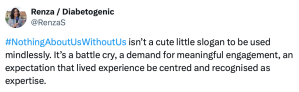
Saying #NothingAboutUsWithoutUs is how our lived experience community advocates for true community involvement and meaningfully change the status quo. We are the ‘us’ in the hashtag. The #dedoc° team uses it a lot because it forms the basis of so much of our organisation’s work. It is not okay for others to appropriate the term, seemingly hoping that it will lend them some credibility with PWD. It won’t.
There are stellar examples of how co-design works and can be truly branded with the #NothingAboutUsWithoutUs hashtag. The work that has been underway by a community group, to progress equity in access AID is one current example. The meeting in Florence that kicked this work off didn’t actually involve community. And yet, from there, a couple of endos in the meeting reached out to the community to put together a plan to make change that has a seat for everyone at the table. (And the fact that over 4,400 community members have signed this petition suggests that it resonates!)
It can be done! If you need some ideas for where to start, we really can’t make it any easier. Here are some guidelines that were launched earlier this year Jazz Sethi and I collated. It’s a really useful guide for how to kick things off. I think it’s time that we start asking questions when there is a claim of engagement. Let the burden of proof on that lay with anyone making the assertion. Because it’s easy to see when it’s done well. And even easier to see when it’s not.
I’m not alone in being fascinated by artificial intelligence and how it can be used in day-to-day life, including day-to-day life with diabetes. Every day there is more and more published about how it can be applied in healthcare and there’s a lot to be excited about.
Of course, it has its limitations. When I asked ChatGPT to manage my diabetes for the day, the response I got was disappointing:
I’m sorry, but as an AI language model, I’m not capable of managing your type 1 diabetes or any other medical conditions. Please note that managing diabetes requires careful monitoring of blood sugar levels, regular medication administration, and attention to dietary and physical activity habits, among other things.
Not really useful – and just a little patronising! – but I guess managing a chronic health condition that requires minute-by-minute consideration, frequent complicated mathematical calculations and constant monitoring is complex. If only there was some sort of technology that could automate aspects of diabetes and reduce its daily burden. Oh… wait!
But I wondered what ChatGPT might put together if I asked it about the importance of community and lived experience engagement in diabetes advocacy and here is what it said. (I’ve copied and pasted the exact response from my prompt, with my edits in italics.)
Prompt: Is it important to centre lived experience in diabetes advocacy efforts? Thank you!
Diabetes is a chronic illness (condition) that affects millions of people worldwide, and its impact on daily life is often underestimated. While medical professionals (and researchers) have made great strides in understanding and treating diabetes, the experiences of people with diabetes are often overlooked in discussions of the disease. (True, AI friend. True.) This is why centering lived experience in diabetes advocacy is so important. (This! A thousand times this!)
Lived experience refers to the unique perspective of an individual who has experienced a particular issue, such as diabetes. When it comes to diabetes advocacy, lived experience is critical for a number of reasons. Firstly, people with diabetes are the experts on their own experience. (Damn straight we’re experts! Louder for people in the back!) They understand the daily challenges and obstacles that come with managing this chronic illness (condition). By centering their experiences, we can gain valuable insights into what needs to change in the healthcare system and broader society to better support people with diabetes. (Twenty-one years of advocacy summarised in that last sentence!)
For example, someone with diabetes might be able to provide important feedback on the design of medical devices, such as insulin pumps or continuous glucose monitors. (Oh, hells yes!) They might be able to identify usability issues that would be missed by a team of engineers who do not have diabetes themselves. By incorporating the experiences of people with diabetes into the design process, medical devices can be made more user-friendly and better meet the needs of those who use them. (We can point to the brilliant folks who have developed open source AID systems to demonstrate this point! )
Secondly, centering lived experience in diabetes advocacy helps to promote empathy and understanding. When we hear firsthand accounts of what it’s like to live with diabetes, we are better able to put ourselves in someone else’s shoes and understand the challenges they face. This, in turn, can lead to more compassionate and effective care. By understanding the daily realities of life with diabetes, healthcare professionals can provide more personalized and patient-centered care. (Yes we can!)
Similarly, when policymakers hear from people with diabetes about the impact of policies on their lives, they are better able to make decisions that take into account the needs and experiences of those who will be affected. (I believe there might be a hashtag for this. Something like #NothingAboutUsWithoutUs) For example, if a policy change would make it more difficult for people with diabetes to access affordable insulin, those with lived experience could explain the real-world consequences of that change and advocate for alternative solutions. (Hello to the incredible community advocates who instantly busied themselves, organised, lobbied, donated their time and put in the hard yards to kick start advocacy efforts that resulted in a 6 month reprieve for Fiasp remaining on the PBS here in Australia!!)
Finally, centering lived experience in diabetes advocacy can help to reduce stigma and raise awareness. (Absolutely! Look at the amazing advocates who have been writing and speaking about stigma FOR YEARS, which resulted in it being put on the policy and research agenda!) Diabetes is often seen as a disease (condition) that can be managed with diet and exercise alone, which is not always the case (never ONLY diet and exercise – there’s a lot more to it!). By sharing their experiences, people with diabetes can help to dispel myths and misconceptions about the disease. They can also raise awareness about the emotional toll of living with a chronic illness (condition), including the fear and anxiety that can come with managing blood sugar levels. (YES! Effectively explaining the emotional toll or living with diabetes needs to come directly from those with lived experience. Cosplaying diabetes is a very poor substitute to hearing from those actually doing diabetes.)
In conclusion, centering lived experience in diabetes advocacy is essential for improving the lives of people with diabetes. (100%) By incorporating the perspectives of those who have firsthand experience with the disease (condition), we can gain valuable insights into what needs to change in the healthcare system and broader society to better support people with diabetes. We can also promote empathy, understanding, and awareness, ultimately leading to better care and improved outcomes for people with diabetes. So, let us listen (yes – do!) to those with lived experience and work together (and be led by PWD) to create a more inclusive and supportive world for people with diabetes.
-End
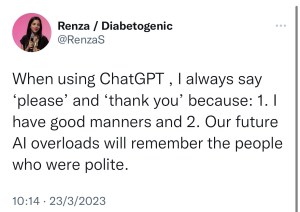
ChatGPT managed to pull together the case for centring lived experience in diabetes advocacy in 30 seconds. This is thanks to decades of work from advocates from around the world who continue to live, sleep, eat and breathe the #NothingAboutUsWithoutUs mantra. And this is really promising to me, because it seems that if AI has learnt this is true, then there’s hope for everyone else out there to reach that point too!
When I look back over 2022, it’s been a year of remarkable highs. From improved access to diabetes tech in Australia, extraordinary community alliances for initiatives such as spare a rose for Ukraine, and community-based activities reaching new heights, I feel that I can say goodbye to the year feeling that big things happened! And so, a little Interweb Jumble of this year’s highs. As well as some endings and new beginnings…
Tech access in Australia
After almost fifteen years of advocacy, Australians could celebrate with the introduction of CGM for all people with type 1 diabetes in what must be one of the most equal and simple access programs around the world. I’ve written before about the hoops required PWD need to jump through to get access to tech – even when it should be simple. With the NDSS CGM Initiative, there is one hoop and one hoop only – a form signed, and signed once only, by an HCP.
As if that wasn’t enough, some sort of miracle occurred, and Omnipod was added to the NDSS. I have been involved in discussions about Omnipod for well over a decade now, trying to massage models of access to fit a system that simply didn’t comply. Congrats to the Omnipod Australia team, and truly remarkable community engagement to make funded Omnipod a reality for Australians with type 1 diabetes.
These celebrations are all worthy, but it’s always worth remembering that there are still huge numbers of people with diabetes who would benefit from tech and are not eligible. Those cohorts need advocacy and community support to make it a reality, and I can’t wait to see just how that all rolls out – hopefully sooner rather than later.
And now we turn to NZ…
Great to see efforts increasing in New Zealand so our friends across the Tasman have access to funded CGM. Just before I flew to New York, I presented (virtually) at the ‘Transforming Lives: 100 Years of Insulin’ event held in New Zealand Parliament about community, grassroots and organisation advocacy to make the dream a reality.
#LanguageMatters keeps going from strength to strength.
The language matters movement has continued to grow, with new statements and documents launched across the world. I spoke at so many different events and webinars about language and communication and how to do better. Every little improvement, every little step towards reducing stigma is a step in the right direction.
The Diabetes Language Matters website is a brilliant resource that pulls together what’s going on around the world in one place. Massive kudos to Jazz Sethi for coordinating this work and keeping it updated – which is more than impressive when you consider just how far reaching the movement is now!

Ah, so that’s what you look like in real life?
As the world opened up again, and international travel slowly returned, face-face conferences started up again. It was with a mixture of fear, anxiety, and excitement that I jumped on a plane for my first international flight after a long time to chair the first ever lived experience symposium at ATTD. What a treat to be back around peers with diabetes who I’d only seen through Zoom screens for well over two years. I was just thrilled people recognised me without the rainbow bookshelf as my background.
#dedoc° spearheads lived experience presence at diabetes conferences
The #dedoc° voices program meant that most diabetes conferences had a visible, vocal, and very real lived experience presence not only roaming the corridors, but also on stages, in meetings and across social media more than ever before. It was truly remarkable to see people from across Europe, Asia, Africa the US, and Australia dominating social media leader boards, and building networks for collaborations, many of which are already delivering. See the #dedoc° website for more.
By the community for the community
Spare a Rose returned this year with a new name (Spare a Rose, Save a Life) and a new charity partner. And once again, we saw people with diabetes dig deep and jump on board to be part of the campaign. With war breaking out in Ukraine at the end of Feb, the SaR team pivoted quickly and literally overnight with a new, refocused operation to support people with diabetes affected by the war. Over $400,000 was raised by the community, all through social media promotion, and so, so many with diabetes doing the right thing and getting behind it.
And over November, #dedoc° led the charge for another community campaign – the Blue Balloon Challenge, which resulted in €100,000 donation from Medtronic to Life for a Child. If you want to see how amazing the community can be, all you need to do is see the hundreds of social media posts featuring blue balloons. It also is a great way to flag people who are doing things for others, uniting the community. Want to know who to follow? Follow those supporting community campaigns.
New communities
I know I have written about the weekly Diabetes Chat before, but I’m going to do it again, because any initiative that is welcoming, inclusive and fun for people across the community deserves a mention. You just need to see how diverse the weekly participants are to know the agenda set by Tom Dean and others behind the scenes – and that agenda is to create a safe space for all. I was beyond thrilled to be asked to speak at one of the first Spaces events, and even more thrilled to meet Tom in person at the #dedoc° symposium at ATTD. I know a number of people who said that they returned to participate in DOC discussions because of the weekly Spaces Chat. How special is that? Details on the Diabetes Chat website.
Global happenings
The WHO Global Diabetes Compact Forum has continued this year, ending on a high with the team publication of an article about language. It’s really worth commending the WHO for the way they responded to earlier criticisms about diabetes comms. They listened and engaged the community and this year for WDD, delivered a brilliant campaign, and hosted a terrific Spaces event they kindly invited me to be part of. I feel really lucky to know James and the WHO team working in the area of diabetes and know that they are just warming up!
IDF Congress
The conference year ended with the IDF Congress in Lisbon, which saw the Young Leaders in Diabetes Program return to the force it once was with some of the most incredibly young advocates I’ve ever had the pleasure of meeting. I can’t wait to see what they get up to!
The greatest honour …
The high to end all highs for me professionally this year was giving the Living with Diabetes Stream Award Lecture at IDF and I was so pleased to be able to use the lecture to recognise the importance of lived experience, and share how #NothingAboutUsWithoutUs became the basis of my own advocacy.
But it wasn’t only those with lived experience that I acknowledged in my lecture. I took the opportunity of standing at the lectern in Lisbon recognising the incredible allies who have supported me, and others. I started with Greg Johnson, CEO of Diabetes Vic and then Diabetes Australia whose simple words ‘If we’re talking diabetes there must be people with diabetes in the room’ have resonated each and every day in my advocacy life. And then, I moved onto people like Jane Speight, Taryn Black, Partha Kar, Sof Andrikopolous, Nat Wischer, Tadej Battelino, Chantal Mathieu, Ann Morris, Marg McGill, and the late, great, and so, so missed Tricia Dunning, who have elevated the role of lived experience, making space on stages, handing over microphones and creating places so that people with diabetes are able to influence in real, meaningful and significant ways. It was an honour to look up and see many of those people in the audience.
… and a big decision
In amongst all the highs, I decided it was time to make some big decisions. After twenty one years working in Australian diabetes organisations, I have decided that it is time for me to move on. Diabetes Australia has been my home for the last seven years, and Diabetes Vic (part of the Diabetes Australia family) launched my diabetes advocacy career fourteen years before that. My roles at both organisations have shaped my advocacy so much. They gave me a true understanding of the value of grassroots advocacy and just how vital community is in that advocacy. Greg’s words continue to ring in my ears, and I doubt there will ever be a time they don’t. And it’s those words that helped me make decisions about what I need to do next.
I walked into Diabetes Vic not knowing what diabetes advocacy was. I thought I’d spend six months doing the job while I worked out what I really wanted to do with my life after deciding that being a classically trained flute player really wasn’t it.
As it turns out, diabetes advocacy and activism is what I wanted to do with my life for those six months, and the twenty plus years after that. And it’s what I want to keep doing now. In the new year, I’ll finish up at Diabetes Australia and then take on a role that will see me working beyond Australian borders, and, most excitedly, with a focus on community advocacy and engagement. I simply can’t wait.
But for now, I’m celebrating the big year that was in NYC for another couple of months, hugging my family, hoping for snow, visiting holiday markets, listening to jazz, and finding warm corners of historic hotels to write and drink tea. All while looking forward to bigger and brighter things to come.

DISCLOSURES:
I work for Diabetes Australia and have been involved in advocacy efforts for CGM for All.
I was invited by A/Prof Ben Wheeler from University of Otago and Te Whatu Ora Southern to speak at the New Zealand event about CGM funding and volunteered my time.
I am Head of Advocacy for #dedoc°. Flights and accommodation for attendance at ATTD and EASD was covered by #dedoc°. Press passes were covered by the conference organising committees.
I am a volunteer for the Spare a Rose campaign.
I am a co-author for the WHO journal article mentioned. I volunteered my time to be involved in this work.
I was an invited speaker at the IDF Congress. I was also invited to speak at the Young Leaders in Diabetes Training Summit. I was not paid for my work with the group. Flights and accommodation were covered by the IDF.
Recently, I shared some good news that I was finally ready to release into the wild after sitting on for a few weeks.

And so, a tweet and a LinkedIn post later, I’d happily shared that I’ve been invited to give the Award Lecture in the Living with Diabetes Stream at the IDF World Congress in Lisbon later this year. When I talk about standing on the shoulders of diabetes advocacy giants, two of the previous Awardees define community and advocacy. I still can’t believe that anyone would consider me to follow on from Riva Greenberg or Manny Hernandez, who gave the lecture in 2015 and 2019 respectively.
I was overwhelmed by the messages of support and congratulations from friends and colleagues, many from the global diabetes community, a couple from my own workplace – by and large people who know diabetes. But also, from those without diabetes too who acknowledged how honoured I would be feeling to be recognised in this way.
But there was one comment that stood out and that was from one of the most dynamic, influential, and impactful diabetes advocates I know, Dr Sana Ajmal.
Sana’s message was this: ‘Thanks for being unapologetically yourself! That’s what truly defines your activism. Looking forward to it!
I stopped when I saw it and read it a few times over.
I often describe my style of advocacy as bolshy. Others have said I take no prisoners in my resoluteness. A former manager once said (I think affectionally) that I step off my soapbox only to climb onto my high horse. And I also accept that being unapologetically myself – and unapologetic in my approach – doesn’t always sit well. But Sara used the word so generously, which is probably not how everyone would see it…
I have been unapologetic in my attitude and determination. I’ve been unapologetic in the sheer doggedness I’ve employed over the last 21. I’ve been unapologetic for challenging the status quo and demanding that things change. I’ve been unapologetic in the issues that I have claimed are important to me. I’ve been unapologetic at sounding like a broken record and appearing a one trick pony when I’ve repeated over and over and over again that language matters, that peer support works, that people with diabetes have a right to be in the room and centred anytime diabetes is a topic of discussion. I’ve been unapologetic in the way I’ve challenged people – from HCPs, policy makers, diabetes organisations, industry – asking them to all do better for and by people with diabetes. I’ve been unapologetic in my fury against misogyny and the patriarchy in healthcare.
I’ve been thinking a lot about what I plan to say when I give the Award Lecture at the World Diabetes Congress. I have decided on the theme of the talk, and it will come as no surprise to anyone that I’ll touching on successes and challenges of advocacy. When I get to thinking about what a massive enabler of my work in this space has been, there is something I keep coming back to and that is the remarkable leadership of remarkable people I’ve been fortunate enough to encounter. I’ve learnt so much from the advocates who came before me. The barriers they broke down to do what many of us now do, and the grace, confidence and, often, brazenness they needed to push through is nothing short of inspiring.
And it’s been the extraordinary curiosity and bravery displayed by those without diabetes. I will forever be grateful for the way those people never asked me to apologise, never tried to stifle my voice, never tried to centre themselves over the community and always – always – included lived experience and were led by our needs, willing to be uncomfortable when they were challenged. They are the leaders who understood our expertise and made sure it was included when diabetes was on the agenda. And understood how they could learn from it. They define the idea of diabetes allies!
I’m thrilled that I’ll have a chance to stand up at an international conference and talk about why #NothingAboutUsWithoutUs is the foundation of my advocacy and activism and how, most unapologetically, I’ll never change that.

My new diabetes spares bag has my name on it.

I wrote a post many years ago taking the piss out of wanky ‘My day on a plate’ articles, or, as I renamed them, ‘My lie on a plate’. If you’ve ever read one of these (in Melbourne it’s a regular article in the magazine that comes with a Sunday paper) you’ll find some ‘influencer’ or celebrity who swears all they consume is hot water and lemon, steamed line-caught salmon, and organic kale and quinoa.
This is, obviously, the extreme of the ‘look how virtuous my eating is’ spectrum. Because that is what eating is all about, right? – virtue and honour and showing just how ‘good’ we are because we are all about fresh, healthy, green, CLEAN. (For the record, all food is clean. Unless it’s been dropped on the floor, and I’m not here to judge anyone’s commitment to the five second rule.)
I know I’m guilty of it too. I frequently share online the details of the food I’m making, planning to make later today, thinking of making in the future, eating, planning to eat later today, thinking of eating at some point. And that shared food is, inevitably, on the healthier side. Or the homemade side. Or the this-plates-up-beautifully side. I make hyper-lapse videos of the baking I do each week and share with friends and family and while it’s a little fun, there is a tiny part of me that knows how performative it all is. ‘Look at me in my kitchen whipping up some delectable goodie that is going to make its way into my kid’s lunchbox this week, because I’m not the sort of mother who would EVER deign to chuck in a fun size Milky Way!’
Really, I want to tell myself to fuck off sometimes! (And on the occasions my kid does get a Milky Way in her lunchbox she couldn’t be happier.)
As someone who does indeed love food, loves to cook and loves to share (online and IRL) my creations, I understand the allure of getting excited at asparagus season and only buying and cooking it at that time of year. But expecting everyone else to do that and judging those who don’t is pretty crappy. I know I’ve been guilty of it – if not explicitly, at least implicitly.
I’ve heard myself talk about how easy, quick and cheap it is to throw together soup, and how there is no need to do a fast-food run, because why would you need to when tossing together some onion, garlic, veggies out of the fridge, a couple of chicken legs and some small pasta (obviously in a Le Creuset pot because of course I am also wanky when it comes to cookware) and then sprinkling parsley on top and serving up with some crusty bread?
Man, there are a lot of assumptions there (even if we take out the need for heavy French cast-iron cookware). There is the assumption of people having those things in the house, and the know-how of just how to throw it all together. There’s an assumption that people want to make soup. There’s an assumption that people want to eat it.
It doesn’t sit right – and is also all shades of hypocritical of me to be this way – when you think about how very vocal I’ve been rallying against sectors of the community who like to badger people with diabetes about not eating carbs (or whatever other militant food rules they have), and criticise people who choose to eat in different ways.
It is all very well to tell people to eat fresh, grow your own where possible, shop at farmers’ markets, eat only what is in season, consider food miles, shop local, buy good quality and make everything from scratch. And then to demand that if people absolutely must venture into a supermarket, the rule is they must only be allowed to show on the perimeter – where the fresh foods live, while also banging on about how processed foods, ready-made meals, pre chopped fruit and vegetables, frozen and tinned foods are inferior and if you are truly treating your body like a temple, you wouldn’t go near it.
I’m tired just typing that. And it’s so freaking ableist, privileged and full of presumptions to consider that this is the only way to think about food.
There is nothing wrong with buying prepared food – whether it’s prepared food for babies, kids, or grownups. Prepared meals are just as valid an option as meals made from scratch. Prepared cakes work just as well for a celebration as one that has been baked in your oven. Packet cakes and biscuits are a shortcut that make things easier. Some people may prefer the taste of pre-prepared foods, which is as good a reason as any for deciding what and how to eat.
There is nothing wrong with purchasing pre-chopped fruit or vegetables. They are still fruit and vegetables, and a fabulous alterative for people who are in a hurry, really don’t enjoy chopping up foods, or find it difficult to wield a knife. Or for people who just grab a bag because that’s what they want to do!
There is nothing wrong with using frozen or canned vegetables rather than fresh. They are convenient, more readily available in rural and remote areas, often more affordable, super easy to whip up, and full of nutrients. Sure, it looks gorgeous on an Instagram feed to show freshly picked tomatoes from the plant growing in your front garden, and then offer a step-by-step photo guide of how you turned it into organic-vine-grown-homemade-truss-tomato soup, but some Campbell’s tomato soup also works! And, hey, it was good enough for Andy Warhol…
For the record, it’s not just social media over-sharers who need to be reminded to check our privilege. Often, dietary advice from health professionals and health organisations seems to think that everyone has a community garden over the back fence, and the time, interest, and know-how to not only plant year-round crops, but also then prepare healthful meals with it. Processed foods are usually an afterthought and deemed not as good for you. Assumptions are made about cooking capabilities, cooking utensils, time and all the other factors that go into working out what to put on the table for dinner.
We need to move away from the utopian world that looks through the lens of everyone having gone through a school with a Stephanie Alexander Kitchen Garden program, a dedicated cook at home who is able to do ‘All The Right Food Things’, a budget that never needs to consider the cost of food, and the idea that everyone is harbouring secret ambitions to win MasterChef, and living with grand delusions of Nigella Lawson (hand raised right now). Because that’s not the reality for most people.
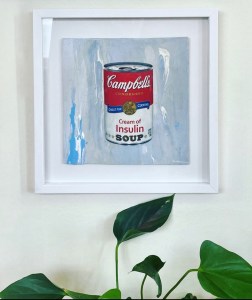
(Click on image for details of artist, Appleton, who kindly gifted us this artwork when we were hanging out in his New York studio in Jan 2020. We’re so lucky it’s hanging in our kitchen.)
For more information (all Australian sites):
Some people seem to think that if you are interested in DIY Diabetes you must be looping.
This is not the truth. At all. In fact, a lot of people who are really interested in the whole movement have made a very conscious and well-informed decision to not DIY themselves. There are a multitude of reasons for this, but they can all be filed under the banner of ‘My Diabetes; My Rules’.
(Let’s get out of the way the critically important point that for most people, the concept of DIYAPS is not even an option. When struggling to access the most basic of diabetes technology and drugs, the very idea of building a DIY system to automate insulin delivery does not even figure into one’s diabetes management plans. However, I am talking about people who are fortunate to have the choice to loop or not to loop, and choose not to.)
Last week, I was invited by the Danish Diabetes Academy to speak at an event they were running about the Diabetes Do It Yourself movement. I’d been asked to speak about how and why Diabetes Australia had become the first consumer/patient organisation to develop and launch a position statement on DIY technology solutions. More on that another time.
The day opened with a presentation from Bastian Hauck, and he could not have set the scene better. To start with, he challenged everyone’s idea of just what technology is. He showed his brand of tech: a reusable insulin pen, a glucose meter, and an explanation that he usually uses CGM with it. No pump. No automation. No integrated system. No DIYAPS.
Does this make him a luddite or anti-tech? Does this mean that he has no interest in or idea of DIYAPS, or that he is suspicious and opposes it? Of course not. It simply means that at this point in time, he has worked out what works best for him and his diabetes, and that’s what he is using. Sounds pretty sensible to me.
Bastian also drew everyone’s attention to the point I made in the first paragraph of this post: pens (or syringes) and a BGL meter are what the vast, vast majority of people are using to manage their diabetes. The people in the room and those involved in DIY tech are a minority. A very privileged minority. And we must never forget that.
I actually think it’s great when we have people actively involved in the #WeAreNotWaiting world using a variety of management solutions because it means we don’t get caught up only hearing the perspectives and opinions of those who are looping. We can be an evangelical lot, and remembering that there are others doing perfectly well (and are perfectly happy) doing what they have been doing is important.
What we don’t need is people who really don’t understand the systems claiming the reasons they steer clear is because DIY systems are unregulated and therefore unsafe, or other motives that are pretty damn inaccurate. No one needs to justify why they have or have not adopted certain diabetes management options, but it would be good if they didn’t point to reasons that are not especially truthful, perpetuating claims that only serve to scare people. (And anyone who is using this last weekend’s FDA warning about DIY systems to claim that their concerns are warranted should read this post from Katie DiSimone for some context.)
For every Dana Lewis (who gave an overview of her own story, and a typically brilliant explanation of just what OpenAPS is and how it came about) there are others who simply are not interested. And that is perfectly fine!
One thing that both Bastian and Dana reminded everyone is this: ALL diabetes is DIY. It is 24/7 and we do it ourselves for day to day. Call it what you want – DIY or off-label diabetes – it’s just diabetes. And we have no choice other than doing it ourselves.
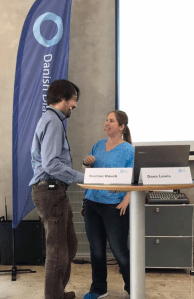
Bastian and Dana
DISCLOSURE
The Danish Diabetes Academy invited me to speak at the Diabetes – Do It Yourself conference in Copenhagen. They covered by (premium economy) flight home from Copenhagen and three nights’ accommodation and expenses.
Schiphol International Airport is one of the busiest transit hubs in Europe. The train station and airport merge into each other and there are people everywhere.
It’s bright and early and I got off the train from Nijmegen where I’d been for the HypoRESOLVE AGM. A 6.28am train does not make me a happy lass, so I was dreading negotiating an airport that is quite manic before 9am on not enough coffee.
Dropping off my suitcase was easy and I had a boarding pass. Security was the only thing stopping me from sitting down and having more coffee. Standing in line, I started the familiar dance of getting myself ready to pass through the security area. I pulled my laptop from my bag, removed my Apple Watch and medical ID bracelet; my leather jacket came off and I unwound my scarf from my neck.
‘Good morning,‘ I said to the person directing the traffic to the different gates. ‘I can’t go through the full body scanner – I am wearing some diabetes devices that can’t go through. I think I’ll need a pat down.’
‘Not a problem,’ he said. ‘I’ll organise someone. You can have a full massage!’ He smiled cheekily at me.
‘Great,‘ I said. ‘A manicure and pedi would be wonderful too.’
He laughed and directed me through to the woman waiting to do my pat down.
I greeted her, still smiling. ‘I’m wearing medical devices. I have one on my arm,’ I signalled to my Dexcom. ‘And two here.’ I pointed to where my pump and RileyLink were comfortably housed in my bra.
She started to pat down my arm. ‘I can lift my sleeve,’ I said. ‘It’s a glucose monitor.’
‘Oh,’ she said, stopping for a minute. ‘You have diabetes?’
‘Yes, I do,’ I said.
‘So does my son. Type 1. He was seven when he was diagnosed. He’s eighteen now.’
‘I have type 1 too.’
‘Do you need to see my insulin pump?’ I asked as she resumed patting me down.
‘No – it’s fine,’ she said. ‘My son doesn’t use a pump. He’s a teenager. Diabetes isn’t the most important thing to him.’
‘It’s not to me either,’ I smiled at her. ‘It’s not all that much fun.’
I looked over to my travel companions who were making their way through security.
‘My friends over there also have type 1,’ I said. ‘Having friends who understand helps a lot.’
‘Like a diabetes club,’ she said. She had finished now and we were just standing there chatting.
‘Not a very cool one, and not really one that I want to be part of. But yes,’ I looked carefully at her. She had that look that I see anytime I connect with someone from our diabetes world. A bit of sadness; interest in talking to others who know, and hope. Always hope. ‘I hope your son is doing well.’
‘He is. He has some friends with diabetes. It does help.’
We said good bye and I was joined by my band of friends. And we went to get more coffee.
 DISCLOSURE
My flight to Amsterdam and train travel to and from Nijmegen have been covered by the HypoRESOLVE project.





 Diabetogenic