
You are currently browsing the category archive for the ‘Travel’ category.
I travel a lot for work. Day trips interstate for meetings or giving talks are a regular feature in my working week. This week, I’ve had two early morning starts with two separate trips.
I have the airport routine down to a fine art. I arrive at the airport, make my way to the express lane through security, whipping my laptop from my bag, any bangles from my arm and emptying my pocket as I walk. I know which shoes trigger the metal detector and which don’t. I get through and then there is exactly enough time to get to the lounge, grab a coffee and make my way straight to the gate just as the plane is boarding. I sit down, grab what I need from my bag before tucking it under the seat in front of me and usually fall asleep within a few minutes, or read whatever book I’m carrying around with me. From arriving at the airport to being settled in my seat is usually about 20 minutes.
On a recent flight, nothing was out of the ordinary. It was early – I was half asleep as I sat down on the plane. It was still dark outside and I didn’t fall straight asleep as I needed to keep an eye on my CGM trace for a little. I’ve been hypoing out many mornings and I wanted to make sure that I was okay before settling in for the flight.
The temp basal rate I’d set in the cab to the airport had more than done its job and I was not too worried about going low – especially with the milky coffee I’d just finished.
I pulled my pump from my bra and, with the press of a few buttons, turned off the temp basal rate and gave myself a small bolus for the milk. I tucked the pump away again and then checked the Dex widget from the home screen of my phone, confirming the number on my Apple Watch.
I was on autopilot as I usually am when doing these sorts of diabetes chores. Buttons pressed, I pulled my book from my bag and started to read, completely oblivious of my surroundings. The plane took off and I was starting to get sleepy, so I put down the book on the seat next to me.
As soon as the seatbelt sign was turned off, a flight attendant leaned over to me. I was the only person in the row. I looked up and noticed that there were two other flight attendants standing there.
‘Excuse me, Ms Scibilia,’ she said.
‘Yes. Hi,’ I said, smiling, wondering what was going on.
‘Are you able to please tell me what you were just doing.’
I was confused. I had been reading. I showed the flight attendant my book.
‘No,’ she said. ‘Before that. You seemed to have some…machines?…or a box?…Down your shirt…? And checking your phone.’ She was searching for the right words to use and it took me a moment to realise what she was asking.
‘Oh,’ I said. ‘Um…I was just pressing some buttons on my insulin pump.’
It was the flight attendants turn to look confused.
‘I have diabetes. It’s how I deliver insulin. I needed to adjust some of the settings and give myself some insulin.’ I explained. I pulled the pump from my top and showed her.
‘I also wear a device that measures my glucose levels and it transmits to my phone….and watch. I was checking the numbers.’
I showed her. And then added quickly. ‘It’s Bluetooth. The phone and watch are both on Airplane Mode.’
‘Oh,’ she said, turning to the two other attendants behind her and quietly repeated what I had just said.
‘Do you have some sort of documentation about having diabetes?’ she asked.
Now I was really confused. This was a quick flight interstate. I never carry my doctor’s letter when travelling domestically and have never, ever needed it before – not at security and certainly not on board a flight.
‘Um…no,’ I said. ‘Oh, wait! Yes! I have a card for the NDSS. Hang on…’ I rummaged around in my bag searching for my purse.
‘Here. This is the card that gets me subsidised diabetes products,’ I said, pointing out the word diabetes on the card and then turning it over to show the information on the back.
She took the card and showed it to her colleagues.
‘Okay,’ she said. ‘I’m sorry. A passenger mentioned they had seen you pulling something from your shirt and they were a little concerned about what you were doing. I’m sorry for troubling you.’
I half smiled and said that it was all fine, but I realised I was fighting back tears as I did. Had someone thought that I…? I couldn’t even form the words in my head. What did they think when they looked at me?
I felt really self-conscious for the rest of the flight. I’ve no idea who spoke to the flight attendant. I looked around and noticed that most of the people nearby were on laptops or tablets or checking their phones. Everyone has a device …. What was it about mine that had set someone’s mind to thinking that I was going to do something nefarious?
Are people on heightened alert in the wake of the recent terrible events around the world? Is it general anxiety about devices and suspicious little black boxes? Are people noticing more, watching more, reporting things that ordinarily would be completely overlooked?
Would I notice if someone around me on a plane – or a café or in a park or on the street – was fiddling with a medical device? Maybe, but then I have a sixth sense about it, always looking for a new diabetes best friend in the wild!
I sat quietly for the remainder of the flight, my book open, but unable to concentrate. I read the same paragraph over and over. Diabetes is meant to be an invisible condition, but at that moment, there was a neon flashing sign above my head – an arrow pointing at me announcing that there was something not quite right – and I felt very, very conspicuous and very, very vulnerable. And I didn’t like it one bit.
Paris was, as always, wonderful. The mild weather, meant it was lovely to walk everywhere. With only three and a half days in one of my favourite cities, I was grateful for the daily 40-minute stroll from the hotel near the Eiffel Tower via the Trocadero to the conference centre so that I at least get to see some of the city.
Even early morning meetings were bearable with views like these. (Hashtag: not photoshopped!)

Sunrise behind the Eiffel Tower.
On my first full day in the city, I attended an event hosted by Roche (all my disclosures are at the end of yesterday’s and today’s posts, as always). The Blogger #DiabetesMeetUp brought together almost 40 bloggers from across Europe. And me.
The day’s activities were a continuation of their event at EASD last year (read about that here), although attendance was expanded to also include a contingent of fabulous women from Italy. It was actually the fourth #DiabetesMeetUp event hosted by Roche with many of the attendees having been to all of them. (There was a comment when I tweeted a photo of the day that the group didn’t look particularly diverse. I’m flagging that here because I acknowledge the privilege in the room. I do think that it is important to ask how better representation can be achieved. The flip side is that the event targets bloggers, so there is already a bias for well-connected and informed people. I have no answers….)
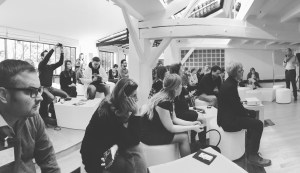
Just some of the bloggers…
The day was busy and very interesting. I have been an extremely vocal critic of device companies failing to engage with consumers in the early stages of device and software development. It frustrates me no end when I hear of the limited and barely tokenistic engagement undertaken by device companies so Roche’s approach is truly a breath of fresh air.
It was also pleasing that while some of the day was dedicated to showcasing product, there was a lot more than that on the agenda. Plus, all product presentations were an opportunity for the bloggers to provide feedback, plus there was plenty of frank discussion from both attendees and Roche staff.
So, what devices where on show? There was some more about the Roche Insight CGM, mostly about the app that is being developed to accompany the device. When this was discussed at the EASD #Diabetes Meetup last year, there were many suggestions and recommendations about how to improve the app platform. It was utterly brilliant to see a lot of those changes integrated in the new design. Obviously it’s a lot easier to make changes to software rather than hardware, but still this focus on gathering feedback and then making the changes is commendable.
One of the most exciting aspects of the discussion for me was the discussion around the Insight systems alarms, specifically the language being used. Some of the words and phrases were flagged as not being quite right, and there was an opportunity to wordsmith just what language would be used. For example, the term being used was ‘warning system’ and I questioned if that was really the best word available. I think of ‘warnings’ as something connected to inclement weather or danger on the roads, not really ideal when thinking about data I use to help manage a health condition each and every day.
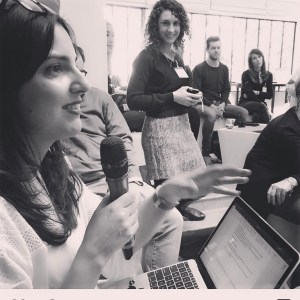
Talking language. It was hard to get the microphone away from me.
The customisation of this system is outstanding. Other than the super-low (safety) alarm, all others are fully customisable, can can be activated for certain times of the day, use different sounds for different alarms for different times and the user can build up to ten daily profiles. The objective for such thorough customisation is to work towards reducing alarm fatigue as well as create a more flexible, individualised and intelligent alarm system
As yet, there is still no integration with the Insight CGM and the Insight pump – a criticism and recommendation from the group back at EASD last year, however I believe this is on the radar. Undoubtedly, the feedback from the group was that this is essential, so I hope that the Roche team find a way to make it happen!
The other product that was (very briefly) discussed was the Senseonics Eversense system – a ninety day implantable CGM sensor and data management system. This tech is currently in trial stage and more information can be found here.
Roche gave all the Blogger #DiabetesMeetUp attendees a press pass to ATTD which meant that throughout the remainder of the conference, there was a significant consumer contingent roaming the halls and sitting in sessions. Considering that this is a group of highly connected, tech-savvy and smart individuals, it was terrific that there was the opportunity to be part of the conference amongst the health professionals.
I’m really grateful to have been offered the opportunity to attend the day – a very big thank you to Ute and the team from Roche for extending an invitation to me (I promise, I am not always the jet lagged mess you see at these events!) and for your ongoing commitment to engaging the community. As well as participating in the agenda set by Roche, I was able to speak to some amazing and activists who each day are advocating for people with diabetes in their own countries. The level or excitement and commitment to what they do simply never wanes.
Disclosures
My flights and accommodation costs to attend the Roche Blogger #DiabetesMeetUp were covered by Roche Diabetes Care (Global). They also provided me with press registration to attend ATTD. My agreement to attend their blogger day did not include any commitment from me, or expectation from them, to write about the day or their products, however I will be sharing my thoughts on the event here. Plus, you can read my live tweets from the event via my Twitter stream.

My darling friend, Annie.
Once we remembered that there were other people on the street, we set to introducing our families to each other. Our husbands shook each other’s hands, and our girls shyly greeted each other with hugs. That was the last moment of shyness for the rest of the week.
Our families have had a week of being tourists in the most wonderful city in the world. We looked at the Manhattan skyline from across the Brooklyn Bridge; we soared to the top of the Rockefeller Building, gazing across the city as the sun started to set from dozens of stories above the ground; we sat in cafes, warming up on coffee and hot chocolate and wonderful conversation; we wandered through Central Park as snowflakes started to fall, the girls unable to believe their luck as they ran with their arms outstretched catching the snow; we saw in 2017 standing in Central Park with fireworks exploding over our heads with the promise of a new year. And throughout it all, diabetes was managed by those of us who wear our pancreas on the outside of our bodies – but didn’t for a moment affect the time we were having.

Annie and I know each other because of diabetes. She is mother to three extraordinary girls, one (Pumplette) who happens to have diabetes. I’ve linked to her blog many times here, and if you’ve not popped by yet, please do!
We often spoke about how wonderful it would be to introduce our families – although we did have some concerns at our girls actually being able to discuss their neglectful mothers who, it seems, abandon them at the drop of a hat to rush off to some diabetes conference or another.
We made it happen this week, and our girls barely paused for breath, chatting constantly, getting excited at all the city has to offer and amusing themselves with endless rounds of Banagram. Our kidlet was thrilled to have three new friends and couldn’t get enough of spending time with them.

Friends for life.
We closed our apartment door. Annie and her family headed for the elevator and I sat next to our kidlet on the couch as floods of tears started. I hugged her tight, promising that it would not be the last time that she saw the girls. I reminded her that Annie and I live on opposite sides of the world and are in contact all the time – that we speak and message and FaceTime frequently.
And I reminded her how wonderful it was that as 2016 ended and 2017 started she had made three wonderful new friends. She nodded and wiped away her tears. ‘I miss them already,’ she said. And I nodded too. Because I understand how that feels. I know the elation of seeing friends from far flung places and then, when saying farewell, not knowing when we will see each other again. But the beauty of it is that while it hurts to say goodbye, there is an endless promise of saying hello again. And I assured it that she would say hello and hug those girls again. Many, many times.
Happy New Year, everyone!

Seeing in the New Year.
There is so much around at the moment that I wanted to write about properly. But it’s holidays and there is champagne and my kid made brownies with toffee popcorn on top and the neighbours came over for drinks and didn’t leave and I need to pack to go to New York.
So here are some links for some holiday reading.
THIS piece
The title of this piece sure seems to have riled up some people, but bloody hell, just read it. Anna Floreen, who is pretty damn awesome, has written this fabulous piece, sharing her experiences of going through the teen years with diabetes. A must read for parents of kids with diabetes to get some insight into what young people think about dealing with diabetes.
THESE biscuits
These have become my holiday favourites this year and I’ve made about 4,326 batches of them! Four ingredients, super-dooper easy, delicious and look impressive. Plus, they are gluten free, so great as a gift for friends with coeliac disease. What more could you want?
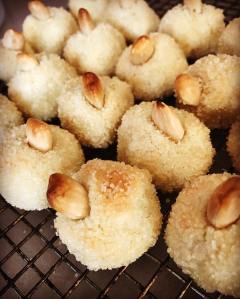
I’ve had the recipe for them scrawled in my recipe book for years – I can’t remember where I first copied it down from – and this from the New York Times is pretty much how I have been making them.
THIS news
Great update about the work Ed Damiano is doing on the Bionic Pancreas just published in The Lancet. The study has shown some pretty exciting results. It’s getting close – really close – and that is just so damn exciting! Maybe we can out one on our Xmas lists next year…
THIS study
If you are a young woman (aged between 16 and 25 years) living in Victoria, Australia, you can take part in a women’s health study, which is looking at the relationships between lifestyle behaviour, physical health and mental wellbeing.
You’ll be reimbursed for your time, so get involved! All the details are here.
THIS poorly worded sign
For the love of all that is good: proof read, people. Please, proof read!

THIS good news
Great news from the Australia Diabetes Society who has just released a new position statement about scuba diving and diabetes, recognising that motivated individuals with well-controlled diabetes (both insulin-requiring and non-insulin requiring), may be able to safely participate in recreational diving.
THIS story
You know, there are some people in the DOC world who are worth their weight in gold. Lou Vickers is one of them. Read her story here.
THIS (slightly old) article
This piece, from Dr Katherine Barnard and Dr Jill Weissberg-Benchell, was published just after ATTD this year (back in Feb) and provides comment on the relationship between diabetes technology and psychosocial aspects of diabetes. A very interesting read, especially considering the way DTech is moving!
THIS position statement
The National Health and Medical Research Council and the Consumer Health Forum of Australia have released a revised statement about the involvement of consumers in health and medical research.
THIS time of year
So, we’re heading off for a couple of weeks and I’ll occasionally be checking in, but probably not much as we’ll be spending a lot of time trying to keep warm on the cold streets of New York.
Thank you so much for reading, commenting and sharing Diabetogenic this year. The love and support I constantly am afforded by people who read posts here is astounding and makes living with diabetes that little bit easier. I wish I could adequately say just how grateful I am.
I’m looking forward to an exciting 2017 – there is already so much on the horizon with exciting projects, collaborations, activities and plans being hatched. It’s shaping up to be a very busy year, so I’m looking forward to a little downtime over the holiday time.
Season’s greetings to you all. I hope you manage some rest, relaxation and quiet reflection in the coming weeks. I’ll see you in the New Year.

Season’s greetings from my clan to yours.
Sometimes, the best diabetes meetups involve a few people with diabetes just sitting around having a chat. Perhaps it’s over dinner, or maybe over a coffee. There’s no formal agenda, there are no official speakers. It’s just people with diabetes catching up and talking.
Now, multiply that by … a lot. In fact, put about 40 diabetes advocates in a room together. Throw in a few HCPs as well. And some people from industry. Hell, there may even be a few people from professional and consumer diabetes organisations in there as too.
Now you have #DOCDAY; a diabetes meetup on steroids!
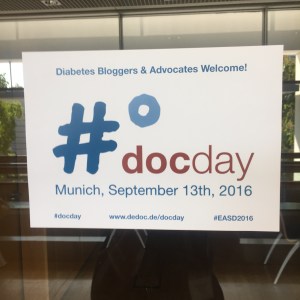
The second annual #DOCDAY event was coordinated and hosted by Bastian Hauck at EASD in Munich. Last year, he had this idea and organised what he thought would be a few people in a café in Stockholm. He underestimated how many people would want to attend, and the room was overflowing with advocates from Europe (and the usual Aussie ring-in).
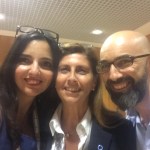
Dr Andrea Orecchio, right, with Danela D’Onfrio from Portale Diabetes (an Italian diabetes peer site).
This year, he got smart. He hired a room at the conference centre which was a genius move because it not only meant it was so simple and convenient to get to, but it also meant a whole heap of HCPs came along too. (Big hat tips to the divine trio from AADE, Hope Warsaw, Deb Greenwood and Nancy D’Houln, Aussie Dr Kevin Lee, and the delightful Dr Andrea Orecchio from Switzerland who impressed me with his ability to speak (and tweet in) four different languages. Perfectly fluently.)
There was no real structure to the meeting, apart from the insistence that all attendees have their photo taken on an old-school Polaroid camera to be placed on the attendee wall. Bastian kicked off the afternoon, saying a few words and he also asked some people to talk about any exciting diabetes initiatives they’ve been involved in. He asked me because he knows that in my jetlagged state I’m likely to say something inappropriate which will lighten the mood.
I was absolutely enthralled and excited to hear of some of the work other diabetes advocates have been up to lately. Here is just a taste:

Cannot wait to see this book published!
I simply cannot wait for the release of this new book from the team at Anna PS. Anna Sjoberg and Sofia Larsson-Stern from Sweden have collected stories from 20 people with diabetes and will share their personal experiences of lives with diabetes. The Swedish version of I Can, Want and Dare will be out in time for World Diabetes Day, and the English-language edition will follow shortly after. You can pre-order here. What a brilliant Xmas stocking filler! (Disclosure – Anna and Sofia invited me to contribute to the book. I have no financial interest in the book.)

Med Angel.
Did you know that 93% of people using temperature-sensitive medications are doing it wrong? Neither did I! Amin Zayani has created a very nifty smart sensor and app to help you know if your insulin is being kept at a safe temperature. This is a super easy device to use and is all about safety. I know I can certainly be accused of being very relaxed about keeping may insulin at optimal temperature and (touch wood) have never had a problem. But just at this conference, I was speaking with someone whose insulin had been affected by temperature and was absolutely not working. At all. This is something that will be very handy for a lot of people! Follow Med Angel on Twitter here.
IDF Europe has introduced a social media prize in diabetes. Quite frankly, the DOCDAY room was full of worthy recipients. Nominate someone now!
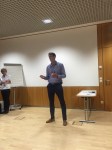
Peer networks in France with Paul-Louis Fouesnant.
I always love hearing about grass-roots diabetes support initiatives, and Paul-Louis Fouesnant from France spoke about Diab’ Mouv peer events he organises regularly.
So what did I speak about?
I spoke about driving and diabetes, specifically the advocacy win we have just had with the launch of the new Australian Assessing Fitness to Drive Guidelines. (More about that later this week.)
I spoke about CGM subsidies, a hot topic everywhere, but particularly in Germany where a reimbursement program had just been announced.
And finally, I spoke about language, because EASD is one of the most challenging conferences when it comes to language. I spoke about why language matters and why the real changes that are being made in this space are driven by people with diabetes. We have been talking about this for years and years now and it is terrific to see it (finally) on the agenda.
By the end of the afternoon, I was overwhelmed by all of these incredibly inspiring folk. For most of them, this is a labour of love with little, if any, financial reward. We blog because we want to share our stories and connect – nothing more. We come together to share our successes and our frustrations because we know that this is a sympathetic group who ‘get it’. Between now and when or if we next get together, we will keep in touch and continue to share our stories because that’s what we do. Thanks to everyone there for being so generous with this bumbling, jet lagged mess.

Just some of the advocates, activists, bloggers and HCPs in the #DOCDAY room!
My disclosures for my attendance to EASD2016 can be found on this post.
Twelve hours after arriving in Munich, I found myself in a beautiful tree-lined side street of the city at a diabetes bloggers event coordinated by Roche Diabetes Care. Fuelled by nothing more than coffee and jet lag, I walked into a beautiful building and found myself surrounded by diabetes advocates from around Europe who were probably trying to work out why an Australian had crashed their meeting.
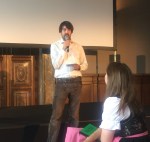
Bastian takes the stage.
Firstly, a little about this group. Roche convened the blogger group a few years ago as a channel to build a relationship with PWD in Europe. (Roche has had a long history of working with consumers. I remember back in 2012 watching the Roche Diabetes Summit in awe and then trying to replicate it here with Australia’s first and only SoMe Summit.) In a very smart move, they engaged DEDOC leader and nice-guy extraordinaire Bastian Hauck to be the liaison between Roche and the community. Bastian has done a stellar job bringing together some absolutely amazing and influential advocates to be part of this work.
The group has now met a few times, and at this year’s EASD, they opened the door to an Australian (slightly less weird now that Australia is part of Eurovision, which, obviously, is the new gold standard measure of inclusiveness. First Eurovision digression.)
The first part of the afternoon session was a demonstration of the yet-to-be-released Roche CGM. A short presentation showed how the device works, with an explanation of the technology. The timeline for release of the product is later this year with launch markets being Sweden, Norway, Netherlands and Denmark.
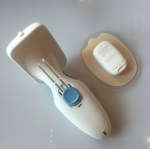
The soon-to-be-released Roche Insight CGM system.
We were then able to have a play with the device, inserting sensors into ‘fake’ skin pads and just getting an idea of the feel, size and look of it. The CGM app is completely customisable. It looks great – super clean and easy to use.
In a room of generally tech-savvy folk, you can imagine that there were a lot of opinions and feedback about the device. Most, if not all, of the participants were wearing at least one medical device – whether that be a pump, CGM or flash GM (and the slightly OTT Aussie who was wearing all three). We are obviously not the norm, but given our knowledge and experience with diabetes tech, we certainly did have a lot to say.

Dexcom and Insight side-by-side comparison.
There were some things that people really liked about the product. Accuracy was outstanding with MARD being comparable to Dex G5. The profile of the sensor was good – about the same as – maybe slightly lower than – the G5 on my arm when compared side by side. Insertion was super-easy and definitely doable with one hand. And the tape holding the sensor in tape is, apparently, better for people with skin allergies.
But as a first generation CGM, there were some limitations that people felt would frustrate them. The lack of integration with the Roche pump, for example, was of concern – however, this will be remedied with future generations. The first gen will only be compatible with an HTC phone (in a room full of very pro-Apple people, this was not particularly well-received) but, again, this will be addressed with future releases.
Also most unwelcome was the factory-set sensor life. Seven days without the possible of restarting is very surprising. There were some murmurings in the room about this setting a new precedent that other sensor makers would follow. Given that I am currently on day 18 of my sensor and the accuracy is spot on, I’d be bloody furious if I’d had to bin it 11 days ago!
Many of us frequently complain about the waste produced with all our device consumables, and there was some concern that the single-use sensor applicator contained a lot of plastic. Look, this is something that I personally struggle with. Every time I change my Dex sensor, or put in a new pump line or cartridge, I look at what needs to go in the bin and wince. It frustrates me each time I rip open the packaging for a new Medtronic Quickset (my preferred line), a bloody little cap falls out, usually to the floor. I have been using these sets since they first were released (maybe eight or ten years?) and never – not once – have I used the cap.
I get it – we need these consumables to be sterile. And safety and avoiding infection is paramount. But still, some of us are very concerned at the landfill we are contributing to!

Crowd sourcing opinion – What does CGM mean to you?
This discussion was very open. We were welcome to tweet, Instagram, Facebook (and blog) everything that we saw in the room, sharing it with the world. Following the demonstration, we all participated in real-time online feedback, where we commented on what we liked and disliked about the device. Our results and remarks were then shared on a screen for all to see.
Can we, for a moment, just consider how novel and out of character this is? Here is a company talking about a device that has not been released yet. And they are talking about it with a room full of over-sharers who all had screens open to various social media platforms ready to tweet, photograph and provide personal commentary. I have never seen such an open and transparent way to get feedback on a diabetes product, and the team from Roche should be absolutely commended on this approach. More please from more companies!
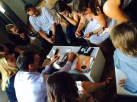
App making. (Photo credit: @Tadorna)
For the second half of the meeting we spent a most fun couple of hours where we played around with app development. My group – obviously the best – created an app that linked our CGM app with a juice machine to respond to low glucose levels. It also turned on bedroom lights if we were low overnight, to help wake us up. And if the wailing alarms of the app were not cancelled within 15 minutes, an ambulance was called to come and make sure we were okay. I know! Brilliant, right?!
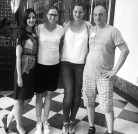
Go team! Anna, Steffi, Sascha
Overall, this was definitely a valuable afternoon learning about new product and also being given the opportunity to meet with some very smart and active diabetes advocates. You bet we were there to be told about Roche’s new CGM, but that was only part of the event and no one in the room is so naïve they don’t know it. But the chance to share ideas and projects and plan for truly global work together outside the device company space was also achieved.
POSTSCRIPT and DISCLOSURES
I’m going to ignore the online discussions that seem to pop up at any conference where PWD manage to score an invite…. Actually, who am I kidding, I’m not. Because I am a little sick and tired of the inevitable complaining and suspicion and passive aggressive comments. I’m a huge advocate for PWD being invited to HCP conferences (I may have written about it once or twice here). For us to get here, we need financial assistance because travel is expensive as is conference registration. So when pharma or device companies offer to bring PWD together to engage in a session they are running – and also provide us with access to the conference, then you bet I am going to think it’s a great idea.
Transparency is important and on this little blog, I will always disclose any arrangements, support, funding or product in place with any company.
So…my disclosures? Well in regard to Roche, none really. I don’t use any Roche products at the moment. I have in the past used their meters, which I have funded myself. I have been an invited speaker at the Roche Educators Day at the ADS-ADEA conference two years running now. And I wrote and disclosed all about that at the time here and here.
Roche did not contribute to my travel or accommodation costs at all to attend EASD this year. They did provide me with press registration, but I had already organised my own, as I do for all conferences I attend. Oh – and they did invite me to a dinner after the blogger event, but jet lag had kicked in so I politely declined. There was no expectation from Roche that I would write about the event (or comment during it). They don’t own my words, I do. But I am incredibly grateful that they are engaging consumers in this way. So thank you to Ute and the team so very much!
As for my disclosures for attending EASD? For the third time, they are all here.
The first message came at 7.58pm. I was finishing up a meal of dumplings in the city and about to head into Carlton to see a movie. There on my phone was a call for help from an Aussie friend on holiday in Europe. She had forgotten to pack reservoirs (cartridges) for her insulin pump and she was the first week into a six-week trip.
Help!!
Of course, she had called the local branch of the pump company and, (of course), she had been told that it would take time (as in three days!) to set up an account, before any product could even be sent out. This was not the easy resolution my friend needed in order to simply continue enjoying her holiday.
HELP!!
We sprang into action. As we waited for our bill to arrive, I messaged Annie straight away because if anyone can hook someone up with pump supplies within the UK, she’s the person to do it. She immediately took to Facebook and put out the call, all the while messaging me for details of where and how to get the cartridges to my friend.
As my friend would be leaving the UK and heading to France over the weekend, I also send a couple of Facebook messages to a couple of friends in Paris to see if they could help out. In the car on the way to the movie, I fired out messages and replies.
And finally, I took to Twitter, with a call out to friends in the #GBDOC, with a tweet that was retweeted to reach as many people as possible
My phone was in meltdown with messages (text, Facebook, Twitter) flying in from across the globe.
And then, at 8.25pm, it was resolved, before the movie started. Annie had found someone who had the right cartridges and would pop them in the post to be delivered to London, arriving on Thursday. Plus, back up in France has been organised too – just in case!
It was sorted in 27 minutes. All with a few messages, clicks and tweets. We didn’t worry about setting up accounts or timezones or working within business hours (it was after-hours here and early in the day in the UK!). Continents and business zones didn’t matter either. The only consideration was getting the cartridges in the hands of my friend so her pump would continue to deliver insulin and she could focus on enjoying her holiday.
So, there is no sequel to the Pumpless in Vienna story to be told here, I am pleased to say. Because the DOC did what it does best in these situations. It delivered like a well-oiled machine!
Apparently, I went to Munich. I was away for 6 days, and 60 hours of those days were spent in transit. I believe that, (as I deal with jet lag, hypoglycaemia, and mainlining caffeine), it is fair and accurate to say that I am too old for this shit.
I am also incapable of forming paragraphs. But dot points are fun! Here are some observations and a few silly thoughts from last week. (I’ll write some sensible things when my brain is back in the same country as the rest of me.)
- I am told by people Munich is a lovely city. I will have to take these people’s word for it, ‘cause I saw very little of the city.
- I did not buy a dirndl and for this, I will be eternally sorry. As will my husband.
- The EASD conference itself was, as predicted, very rats and mice-y. I sat in a number of sessions and wished I was a mouse (while wishing my diabetes away). Alas, I am not a mouse. And I still have diabetes. Damn.
- I did not get sick of laughing at the fact that one of the halls at ICM Messe München is called Langerhan Hall. Also, I did not get sick of saying ‘I wonder if my islet cells are in there’ – to everyone within earshot. Even if I didn’t know them.
- Obviously, Grumps was not as amused by this as me.
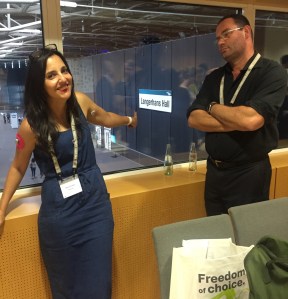
- As was the case at ADA, my arm is more recognisable and famous than me. A barista at one of the exhibition hall stands said, as making me a decent coffee, ‘Oh – I know you. I saw your arm the other day near the station.’ I am a walking billboard for Rockadex! (I am not sponsored by Rockadex and purchase my own patches.)
- Dr Kevin Lee from Queensland is a tweeting machine! In fact, I think the thing I was proudest of at EASD was seeing him tweet! (Actually, probably should say that Professor Mark Cooper’s giving the Claude Bernard Lecture was also a moment of national pride, but Kevin’s tweeting was on another level!)
- One of my favourite talks was about diabetes, cardiac health and exercise (go on, laugh….), but that was mostly because presenter Dr Nikolaus Marx, finished up with a discussion about passive exercise and cardiovascular events during the World Cup. If you were in the room, it was me who cheered when he mentioned the increase of cardiac events after Italy beat Germany. (#VivaItalia!). For clarification, I was cheering at Gli Azzuri’s victory, not the number of Germans having heart attacks. (By the way, this was a real study. Published here.)
- A HUGE shout out to these three women. AADE presidents elect, past and present, Nancy D’Hondt, Deb Greenwood and Hope Warsaw are absolute advocates for and champions of people with daibetes, and peer support. This is them at the docday blogger and advocate event. This level of commitment by HCPs to consumer engagement is enlightening, and a lot could be learnt from their example here. Thank you. Thank you. Thank you!
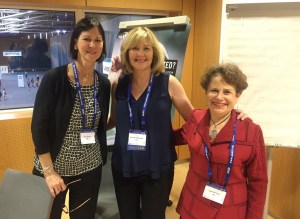
- It was wonderful to see quite a lot of discussion about AP. Anytime someone wants to actually get these into market and into the hands of people with diabetes, that would be just great! Thank you.
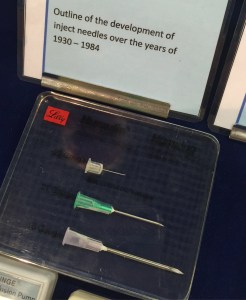
- I may have screamed a little when I wandered through the Association Village to the excellent historical display of diabetes by the German diabetes Association. Terrifying might be the word for these needles. I said a little prayer of thanks to the diabetes angels for modern day tech, and for being diagnosed in 1998.
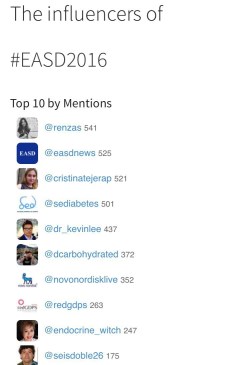
- I need to take a break from twitter. This was the state of play when I said good bye to the conference.
And finally, a word about language, because I am unable to attend a conference and not talk and write about it. (I think it’s actually become a law somewhere.) This probably deserves a post of its own and that may happen, but here we go anyway.
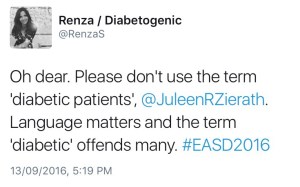
This is the fifth EASD conference I have attended, and going in, I know that it is going to be challenging, language-wise. There often appears to be very little consideration that there could be PWD in the room listening in to how HCPs are speaking of us. In the opening ceremony, I tweeted this at EASD president, Professor Juleen Zierath:
I was a little disappointed at Professor Mark Cooper’s constant use of ‘diabetic’, but it was by no means any more than most of the other speakers. I suppose I just hold Australian speakers to higher account given the work we have been doing here around language and diabetes.
This tweet generated quite a lot of discussion, and came about after I was exhausted and annoyed and mostly frustrated by the way speakers were referring to people with diabetes.
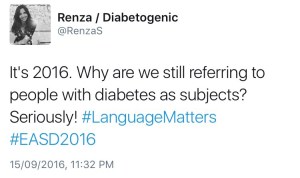 Perhaps the best response was from Nick Oliver:
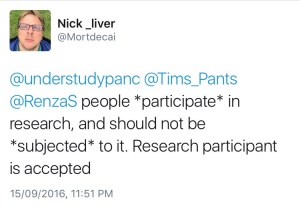
Here’s the thing – and it is something I spoke about during my talk at the DOCDAY event. Language DOES matter. We all know that. It’s completely and utterly disingenuous to say it doesn’t. For some people, it doesn’t bother them and that’s terrific. For others, though, it really does. So why would anyone do something that may offend when it is so easy to avoid that?
DISCLOSE DISCLOSE DISCLOSE
My (economy fare) flights and accommodation expenses were covered by AMSL and J&J. I was attending the EASD conference mainly to attend the J&J DOC exchange meeting which I was involved in preparing and presenting. No one ever expects me to write anything. These are my words and observations only. (And seriously, have you seen what I have just written? No one wants to be associated with that!)
We watched the movie Looking for Alibrandi with the kidlet the other night. I remember when the book came out. I’d left school, was in first year at Uni, and still trying to work out who the hell I was. My mum, sister and I all read the book and couldn’t stop talking about it.
That book was one of the most important things I read when I was younger, because it resonated so much. The idea of not understanding where I belonged had shaped a lot of my adolescence, and was continuing to confuse me as a young adult. I know I wasn’t the only one feeling like that – many kids of post-war migrants felt the same way. Not that we really spoke about it, which was why Looking for Alibrandi was so important. It put into words the jumbled thoughts in my head.
My parents moved from Italy to Australia in the late 1940s (my dad) and early 1950s (my mum). They both grew up here – all their schooling was in Australian schools. They speak English perfectly without a hint of an Italian accent.
We didn’t speak Italian at home, and weren’t particularly involved in the Melbourne Italian Community. Most of my parents’ friends were not Italian, and I only had very, very few Italian friends. At secondary school, there were a number of Italian girls whose families would have been similar to mine, and yet they weren’t the girls I hung out with.
I wasn’t really sure where I fit. I didn’t belong with the Italian girls, because their parents were all a lot stricter than my kinda strict parents; they all spoke fluent Italian – often to each other – and were more involved in the Italian community. Equally, I didn’t really feel that I belonged with my ‘Aussie’ friends because they totally didn’t get the overprotective Italian father thing I had going on at home. Or my love of Fiats. (Or that we had Nutella in the cupboard at home!)
I was in this kind of middle ground that left me wondering where I belonged. And it is a position in which I find myself again today in the diabetes world.
I am a person with diabetes. But for the last 15 years (so, for all but 3 of my diabetes life) I have worked for a diabetes organisation. It leaves me in a unique position that brings great opportunities and privilege, but also makes me feel like a complete outsider at times.
HCPs are confused by me and sometimes suspicious of my vocal advocacy on engagement and the power of peer support; others with diabetes are sometimes wary because they wonder just how free I am to be open and honest about my diabetes; within diabetes organisations I am seen as someone who has fingers in many, many pies; global advocates are curious about how I manage to write this blog while still being in paid employment with a diabetes organisation. To avoid confusion (frequently my own), I speak differently depending on the audiences I stand before, and adapt my tone and language and stories slightly to suit HCPs, PWDs, industry reps or government people.
But essentially the stories are all the same and it is my voice telling the stories.
Next week, I’ll be in Munich at the European Association for the Science of Diabetes (EASD) Annual meeting. The EASD conference is an interesting one. It is very ‘rats and mice-y’ – the term I use for conferences where I look confused in most of the sessions because I have pretty much no idea what is being said, however understand enough to know that someone, somewhere has managed to cure diabetes. In mice.
Despite it’s very science-focused content which attracts very science-focused folk, I feel very ‘right’ at this particular conference, because there is a wonderful advocate, blogger and consumer satellite program that means the city is full of ‘my people’. And that is why I am there – for those events.
If I feel as though I don’t belong at EASD, it’s because I am the only Australian advocate there. I have travelled the furthest distance, I am jet lagged for most of the time and people have trouble understanding my accent. But the Italian contingent at the advocate events claim me as one of their own (albeit one of their own who doesn’t speak the language), so at least I feel that I fit somewhere.
So at least for next week, I’ll know my place. And it will be alongside some of the most dynamic, clever, passionate and dedicated people I know. My people. They will teach me a lot as I learn what they’ve all been up to since we last met and I’ll clumsily share what’s been going on here in Australia. That’s where you will find me.
(And you’ll also find me sitting down the back of science-y sessions looking confused. And wishing I was a mouse.)

Throughout my recent trip, I kept a diary of sorts of some of the diabetes things that happened. Here is a selection of what I noted down.
ON THE KITCHEN BENCH…
…I left all my hypo treatment. Brilliant, Renza. Brilliant. I was reunited with said hypo treatment when Aaron got to NOLA. He took advantage of the situation to snap a pic:

And of course, he captioned it ‘Snakes on a plane.’ Oh, yes, he did.
ENDOS ON TOUR
The Qantas Lounge at Melbourne Airport was swarming with local endos. As was the Admiral’s Lounge once I got to LAX. If there was ever a time to have a diabetes emergency, this was it!
HIGH WHILE HIGH
Try as I might, I am hopeless at not rage blousing when high. There I was, 30,000 feet above the ground, relatively comfortable after an airline upgrade (and spare seat next to me) and high as a freaking kite.
I had a temp basal set – a very aggressive temp basal rate. I had done a correction bolus every thirty minutes. And yet, there are double arrows up on my Dex which was pissing me off beyond belief. I eventually did another correction with a syringe and slowly, but surely watched my glucose levels return to a far happier number. Just in time to get off the flight at LAX…
…AND OF COURSE, THEN I WAS LOW…
…which necessitated this:
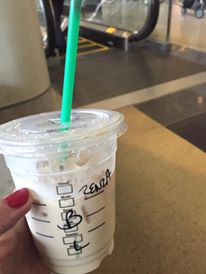
I most eloquently ordered it by saying: ‘Can I please have a small iced latte with Half and Half. Because I’m hot and it’s low. Wait…What?…I mean…I’m low and it’s hot…Oh jeez… Can I just have my coffee with Half and Half. Because: HALF AND HALF. I LOVE YOUR COUNTRY.’ (All class. All. Freaking. Class.)
TSA FUN
‘I can’t go through the full body scanner. I’m wearing a couple of medical devices,’ I said politely to the TSA officer as I queued at LAX security. I was tired, felt grotty and getting over my latte-cured low.
‘Well, the wait will be a while,’ he said a little abruptly. ‘It’s very busy.’
‘That’s fine,’ I said. I understand that the palaver of what comes when avoiding the scanner takes extra time and resources. I didn’t appreciate his tone though. Or the follow up comment.
‘You could be waiting a while. You WILL be waiting a while. You could go through the scanner. Or you’ll have to wait,’ he said.
‘That’s not a problem. I can’t go through the scanner – there is a risk my devices will stop working. And then so will I,’ I smiled at him to show that I really wasn’t going to be upset at the wait.
‘Stand over there out of the way. You know you’ll have to wait, right?’ I’m glad he mentioned it again, in case I had missed it the previous times.
I didn’t ask for this condition and I certainly don’t ask for the extra degrees of difficulty it often attracts. Equally, I don’t demand special attention and am prepared to wait and deal with whatever I need to do to. So I really hate to be made to feel that I am deliberately putting someone out.
As it turned out, I didn’t have to wait too long. A mere three minutes after the call for a ‘female opt out officer’, a lovely TSA official beckoned me to the pat down area and kindly explained the process. I nodded and pointed out where I was wearing my pump and Dex and stood there while she did her thing. And then thanked her and was on my way.
MY ARM KEPT GETTING PAPPED
When you decide to pimp your Dexcom sensor and transmitter in Melbourne while the weather is cold, necessitating long sleeves, you don’t necessarily think about what that will mean once you get to far sunnier climes and are bare armed all the time.
My arm became a mini-celebrity at the conference with complete strangers coming up and commenting and asking if they could take a photo.

(No idea what I’m pointing at…)
Hopefully the lovely folks at RockaDex will see some benefit – I was promoting you guys like you wouldn’t believe! (Yes, they post ANYWHERE!)
THE WAITRESS AT THE DIABETES EVENT
At the end of the fabulous Musings Under the Moonlight event, hosted by diaTribe, a few of us gathered our things and decided that a late night Café du Monde visit was necessary. And as we walked out the door, I was stopped by one of the waitresses. ‘Excuse me, Ma’am,’ she said (because everyone is either Ma’am, Sir or Miss). ‘Can I ask you about the tape around your Dexcom. My daughter has diabetes and is a swimmer. Her Dexcom tape is always coming loose. Maybe this will help it stay on longer.’
I grabbed a pen and wrote down the details of RockaDex and told her how terrific it is. (I am absolutely not on their books, a part owner or even get free supplies. It’s just great stuff!)
‘Can you imagine?’ said Scott. ‘Her mind must have been blown being in that room tonight!’
Always – ALWAYS! – love a bit of diabetes in the wild!
NPH ON CROSBY STREET
Walking back to our hotel on Crosby Street in SoHo, I looked up and saw this pasted to a wall:

And my day was made. (Check out Appleton Artworks for more of their diabetes awareness raising street art.)
‘IT’S FOR THE KID. THE OTHER THINGS ARE FOR YOU…’
One of my favourite diabetes people, gorgeous Alecia, lives in NY and one of my favourite things to do in NY is see her. We met for lunch in Murray Hill at Penelope’s and she handed me a Kate Spade bag.
I peered inside and excitedly pulled out a pink box with familiar writing on it. ‘That’s for the kid,’ I was told in no uncertain terms. She was referring to the American Girl Diabetes Kit and I actually squealed when I opened the box and gently pulled out all the teeny tiny pieces.
Sorry hon – I kept the American Girl diabetes set. The kidlet is still trying to convince me to give her the pencil case and I am desperately resisting. But the candle – that’s on my windowsill at work making me think of you.

AND FINALLY…
If you need to have a hypo in NY, this is probably the best place to do it:
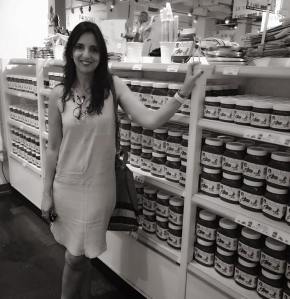
The Nutella Bar at Eataly.





 Diabetogenic