
You are currently browsing the category archive for the ‘technology’ category.
I’m a little late to the whole Black Mirror thing. Aaron has watched through all four series and has repeatedly told me that I should get onto it, but I’ve just not been in the right mood to start and work through a new sci-fi series. (For anyone equally behind the times, Black Mirror is a Netflix series.)
However, there was one episode in particular that Aaron, and a couple of other people, suggested I watch. It is called Arkangel. The Netflix description for this episode is:
Worried about her daughter’s safety, Marie signs up for a cutting-edge device that will monitor the girl’s whereabouts – and much more.
The device (called Arkangel), an implantable chip, allows Marie to see her three year old daughter, Sara’s, location and vitals – blood pressure, heart rate, cortisol levels etc. – in real time. But more than that, the chip allows Marie to actually see exactly what Sara is seeing – not to watch her child as if there were CCTV cameras everywhere, but to see the world precisely as her daughter is seeing the world. There are parental controls that allow Marie to change what her daughter sees, effectively, blocking out (by pixilating) anything not PG-rated. The device was completely controlled via an iPad-type device and would alert if Sara was in any distress.
Arkangel was sold as a way for parents to know that their children were safe at all times. And what could possibly be wrong with that? It’s what all parents want. Right?

About ten minutes into the episode, I looked over at Aaron. ‘This is making me really uncomfortable,’ I said to him. Watching Marie getting on with her life, with the Arkangel tablet device next to her for easy access to what her daughter is experiencing at that moment, made me feel very uneasy. Every single thing her little daughter saw was replicated on the tablet.
As the episode progressed, Sara got older and Marie continued to monitor her daughter’s every move. But by the time she gets to about ten years old, Sara starts to question her mother’s use of Arkangel. Sara has come to realise that the parental controls mean she had never seen, and therefore could not understand – a lot of things her friends were talking about. Marie decided it was time to put Arkangel away. The tablet was switched off and stored in the attic, and Marie and Sara got on with their lives.
Until Sara hit teenage-hood…!
One night, after discovering Sara lied about her whereabouts, Marie reactivated the Arkangel tablet to locate her daughter, and see what Sara was up to.
My neighbour, Jo, was one of the people who urged me to watch this episode. She knew that I would see what she had seen when she watched the episode. And I did, immediately recognising the parallels between sharing of CGM data and Arkangel. And the issue of consent, or rather, the absence of it.
At the Roche Diabetes MeetUp at ATTD this year, I joined in a very robust conversation about the whole idea of sharing CGM data. There were adults with diabetes and parents of children with diabetes in the discussion, each with their own idea about the value of the technology.
A number of adults were appalled at the idea of sharing data, claiming it was simply a way for others to spy on them.
Personally, I am very apprehensive about sharing my data. Of course, this is a highly personal way to feel about the technology and there are other adults who absolutely love the idea that there is someone else keeping an eye on what’s going on with their glucose levels, and able to make sure they are okay if there is a problem. It makes them feel safer and more confident – and if that’s what people get from the technology, it’s only a good thing. But I am not sure just how comfortable I am at having someone see every high or low.
But we are adults – fully formed and grown and making decisions about ourselves and our diabetes, forourselves and our diabetes.
I also completely understand that as a tool, CGM sharing is one of, if not THE, most valuable and essential tool for parents to feel confident that their children with diabetes are safe at school, or other places, when they cannot be with their child. I know that CGMs with share capabilities have, in many cases, completely changed family dynamics for the better.
So when I question the technology and what it can do, I’m not in any way searching for answers about the value of the tech – that is indisputable in my mind. But I am questioning the issue of consent.
While it may make perfect sense for an infant in day care, or a primary school-aged child to have data share activated, what happens when the child starts high school. Or begins university? Or moves out of home? At what age does the idea of having the ability to remotely monitor someone’s CGM data become the decision of the person whose data it is?
I don’t think we have had these discussions, or thought through the long-term implications of CGM data sharing. And I worry that we still seem to not be having those conversations.
When the episode of Black Mirror ended, I felt unsettled. I actually noticed that my heart rate was elevated. I was rattled and had trouble sleeping that night, and I couldn’t help but see Arkangel as a cautionary tale.
Where are the conversations about consent? Where is the line in the sand when it comes to who makes the decision about data sharing? Obviously it will be different for every family, but where are the guidelines or conversation starters to equip people to make those decisions? If this is not being discussed at the time that children and adolescents are commencing CGM, why not?
These are not easy conversations to have – and, quite frankly, as an adult with diabetes, one diagnosed as an adult and not the parent of a child with diabetes, I am not sure that I am the right person to be even talking about it. Some might (and undoubtedly will) say that I should pull my head back in because I don’t understand the situation at all, and simply stop talk about it.
But someone does need to. And I think that it needs to start happening right now.
Last Friday, as I was getting ready to fly home from Copenhagen, I realised that the beautiful city was being inundated with some of my favourite European diabetes bloggers and advocates.
I was lucky enough to manage to meet up with the truly wonderful Tine who I have come to know and love through my involvement in the Roche Blogger program. When it comes to dynamic, sassy, smart and downright wonderful advocates, Tine is at the top of the list. We caught up briefly, talked about diabetes and language, and drank iced coffees and I am so glad that I got to see her gorgeous face.

Tine. She is so wonderful!
Unfortunately the rest of us were ships in the night and probably standing right near each other on opposite sides of the departure/arrival gates divide at Copenhagen airport. Brutal!
My friends were in Copenhagen to meet with the team from YpsoMed, which they do a couple of times a year, to talk about the YpsoPump and other YpsoMed products, advances in diabetes technologies and come together for some peer support. Some of them are using the YpsoPump, but certainly not all of them.
I’ve had a play with the YpsoPump a few times in recent years. My good mate Finn, who blogs here, (in German; Google Tanslate is your friend) stayed with us a couple of years ago when he visited Australia, and I tried bribing him with Tim Tams in exchange for his YpsoPump. Alas, my tactics didn’t work. (Apparently he needs it to infuse insulin into his body or something.)
And each year at EASD, I would annoy the team on the YpsoMed stand by demanding to know when they were bringing their pump to Australia. (This is standard line of questioning for me at international conferences when I see technology I like the look of and thing we should have access to. I am probably known as the annoying woman from Australia, a badge I am willing to wear and a cross I am willing to bear.)
Yesterday, the YpsoPump was launched in Australia. I’d like to think it was my pestering, but the reality is that it is a smart move by a company that has been around the diabetes world for some time now and saw a market that is truly crying out for some choice.
Lucky us!
So, here are a couple of things of note about the YpsoPump
- Undeniably, the first thing that is abundantly clear is the size of the pump. It is teeny-tiny compared with other offerings. The Medtronic 640G, in a side by side comparison, looks like a monster. (This was one of my criticisms when I trailed that 640G a couple of years ago. It felt bulky, clumsy and huge!) The YpsoPump is streamlined and sleek, and sits comfortably down my bra. (First thing I did with it. I know; all class.)
- The touchscreen and icons are a departure from the buttons we have come to expect on insulin pumps. When the pump is ‘sleeping’ it is completely black and blank. This adds to the sleek look of the device.
- It is pretty easy and intuitive to use. We got to have a play and set up the pump yesterday and it was simple and logical. Loading and priming the glass cartridge was quick. The cartridge holds 1.6ml of insulin – this is not a pump for people on huge daily doses of insulin.
- The pump uses and is integrated with a smart phone app (search MyLife from the App Store to download for free). At this stage it is uni-directional, so the pump cannot be driven from your phone. (i.e. The pump speaks to the phone/app; the phone/app doesn’t speak to the pump.) However, this is something that will, in the future, happen. (‘In the future’ apparently means a couple of years.) For those of us Looping, we shake our heads, because we are currently doing this and it makes no sense that regulatory processes are holding up something that is already available and perfectly safe. It also negates the whole thing about discretion when it comes to the pump. If you still need to pull it out from under your clothes, it doesn’t matter how small the thing is – you still need to pull it out from under your clothes!
- Really pleasingly, customer service is all being run out of Australia which means that whoever you speak with has a really good understanding of the Aussie health system. This is especially useful for ironing out any potential glitches with getting approval through PHI.
- Consumables are already on the NDSS. Want this pump? It’s ready to go. Talk to your HCP!
Two other things I asked about were a little broader than simply the use, design and practicalities of the pump.
Firstly, I wanted to know what was going to be done to protect us from coming to love this device, only to see it disappear from the market in four or six or eight years’ time. I have lived through the loss of the beloved Cosmo pump (I LOVED that pump!) and now Animas. While for some this can be seen as just an evolving market, I think it is much more than that. We are intimately connected with these devices. We see pumps come and go from the market. We invest in them, we become attached to them (literally and figuratively). To have them disappear from the market is heartbreaking for some people. I was grateful that Eberhard from YposMed acknowledged our disappointment. He told us that the company has been around for a long time and is very invested in continuing to provide new, innovative and cutting edge technologies to the diabetes market. I hope he is right, because I can see people falling in love with this pump very easily.
And secondly, I wanted to know what sort of engagement YpsoMed were doing to ensure that what they are delivering (they have a lot of things in the pipeline, including a patch pump due for release in 2012/22) really aligned with what people with diabetes want and need. Their engagement with the community is strong and they seem committed to it. The European blogger group has been meeting regularly and provide feedback on design and development. The launch of the product into Australia was with consumers (the HCP launch is today). There is definitely a desire to work and link closely with people in the community and that should be commended.

Just some of the advocates and bloggers at the YpsoPump launch yesterday.
With the YpsoPump ready to go in Australia, we are seeing increased choice in the pump market. No longer should we feel pushed into a pump that we don’t really want because that’s all there is, or all that is supported. This is only a good thing for people with diabetes.
You can find out more about the YpsoPump by going here.
DISCLOSURES
You bet! YpsoMed flew me to Sydney, put me up in a hotel, and fed and watered me. They did not pay me for my time, nor for my words. They did not pay me to ask annoying questions – or to not ask annoying questions for that matter. You can and should consider this when reading what I have written today.
We have a beautiful tree over the back laneway at our place. Usually at this time of the year, it is in full autumn brilliance. The red and gold leaves catch the gorgeous afternoon sunlight, and where the leaves have already littered to the ground, the branches are bare.
But this year, things have been a little different. Our tree brought out its autumn clothes a much later than usual, but sure enough a couple of weeks ago, we noticed that the leaves were beginning to turn. Every day, I’d look over the fence to see a deeper red, a more golden glow. Sure, we hadn’t needed to turn the heating on inside the house yet, and my really warm knits were still tucked away in the cupboard, but the tree was promising winter and cooler days.

Blossom buds. In May…
Over the weekend, as I sat in the kitchen, the back door open letting in a lovely breeze, I looked up at our tree. And there, on the bare branches, I could see something shooting. I went outside to have a closer look and realised that what I could see was the start of the blossom that comes out in the middle of springtime.
Our poor tree was looking mighty confused. I was confused. This isn’t how things go. The seasons are meant to be somewhat regulated and ordered. I like order. Order makes sense. This didn’t make sense at all to my brain, which likes things to be as they should be!
This wasn’t the only confusion I dealt with this week. Last Friday, I spoke about DIY diabetes technology at a health professional event and there was a lot of confusion.
I only had ten minutes (seriously not long enough to talk about something that is a completely novel concept to most of the audience), so I spoke fast, waved my hands around faster and tried to simplify the whole idea of looping into about 8 slides. ‘Renza will be around afterwards if you have questions,’ the emcee announced to the audience who all looked slightly bamboozled and winded after I finished.
There were questions. Lots of them about how Loop works, what it really is and who can use it.
But the one thing that seems to garner the most confusion is the cost. ‘You didn’t say how much has cost you,’ a few people said to me once the event was finished. Actually, I did. (Admittedly, very quickly, because: 10 minutes!) ‘Well, you need to source a pump that works, so that may be costly. And if the person using it is over 21, they will need to fund CGM themselves. Plus, the Riley Link is about $150 and there is a cost associated with becoming an Apple developer,’ I repeated what I’d said in my talk. (Obviously, I was talking Loop, but there was an OpenAPS user in the room too and I think he may have answered a couple of questions about the cost of his set up.) ‘No, no…what about the actual cost to use the app? How much does that cost?’
I have had this question asked probably more than any other. For some reason, people don’t seem to understand the concept of open source information sharing. No one is making money through this. The clever people who have developed DIY diabetes solutions place the details online for anyone to see and use. For free.
But this seems to be a confusing concept for a number of people.‘Wait. So no one is making in money from this? What about the people who worked it out in the first place? They are. Right?’
‘Nope,’I always reply, wondering how many ways I need to say it (along with wondering why I am so lousy at communicating things and also, if my hands waving around are distracting people).
Inevitably, the next comment is ‘Well, I’m not sure why someone doesn’t try to commercialise it. That would get it through regulations, wouldn’t it?’
At that point, it’s my turn to look confused. Why is it so difficult for people to understand that there are actually people in the world who genuinely want to do something good for others? Or that the WHOLE point of the #WeAreNotWaiting ‘movement’ is the fact that there is no waiting for regulations that are inevitable with commercialisation?
I guess that unless you are part of this community, it could be difficult to understand. But the generosity of those in the community is on show all the time. Whether that be the people doing the grunt work behind the scenes to make the dreams of DIY diabetes a reality, or the people who are then writing the step by step instructions so even fools such as me can follow those instructions, or the incredible community members who are ready to jump in any time to answer SOS calls for help when something doesn’t seem to be working, these people are doing it all for nothing more than the gratitude of those of us who are reaping the rewards of their cleverness and kindness.
The confusion – and disbelief – about this community is confusing to me, because every day I see how incredible it is. I only wish I was smart enough to give back even a fraction of what I have received from those brilliant folks who are there for the rest of us. And I really wish I was able to do a better job explaining what a marvellous bunch of people they are!

In what has possibly been the worst kept secret in diabetes in Australia, AMSL today announced their partnership with Tandem Diabetes Care, officially revealing that the much anticipated TSlim pump is on its way to Australia. You can read all about it here, but please note that at this time there is no official launch date available. AMSL is still going through registration and subsidy processes, and this will take some time. (But we’re told we can expect it on the market some time later this year.)
This is the latest development in changes to the Australian pump market which, to be honest, was looking a little dire.
With the announcement that Animas was leaving the market completely (the Australian departure was declared a few months after our North American friends were told; no one particularly surprised), Australians were left with a choice of pump offerings from Medtronic and Roche. Cellnovo had just launched, but there were supply issues. Really, it was slim pickings for us!
Fast forward three months and the Aussie pump landscape is looking a little different, which is great news if you are thinking about starting on a pump, or are due for an update soon. If you’re in the market for a new pump, you can now consider:
- Medtronic 640G or MiniMed Veo
- Roche Accu-Chek Combo
- Cellnovo
- Ypospump (registered and available soon)
And now, Tandem will be AMSL’s pump offering. For updates, check the AMSL socials.
So what does this mean for me? Well, twelve months ago, I would have been beside myself with excitement at today’s announcement. My pump’s warranty would have been about to expire and I was in the market for a new pump. I was extraordinarily frustrated at the ‘pump limbo‘ I found myself in with the limited options available to me not giving me any joy at all. I would have been hassling the gorgeous AMSL team for more details, desperate to get my grubby paws on a TSlim the second it was on the market.
Today I am indeed thrilled by the announcement. I am all about choice and this provides people with diabetes who want to pump another option. This is nothing but a great thing! But for me personally, I am actually happy with my old loopable pump and won’t be making any moves away from what I am doing.
A shiny, sexy new TSlim pump would be lovely shoved down my bra. But unless I can loop with it, it’s not for me. But I will certainly be keeping a very, very close eye on developments, because I do know that with its Dexcom integration, it will have hybrid-closed loop capabilities available in the not too distant future…

I really love a good list. And twenty is such a lovely round number. Plus, I’m going to milk the twentieth diaversary thing for as long as I can. Or at least until I bore everyone. And myself.
On the day I was diagnosed, I was given a meter. It came in a padded navy bag and had a cream-coloured lancet device. The meter looked quite similar to a basic BGL meter today. And it took twenty seconds once the drop of blood was placed on the strip to countdown to give me my reading. I know, twenty seconds! Barbaric!
There have been a lot of advances in DTech in the last twenty years. Some of it has been incredible (CGM, Flash, advances in pumps, better insulins); some…not so much (hello GlucoWatch!). But either way, I’ve always been interested in the latest technologies and have wanted to get my hands on it as soon as possible. It’s not all been great. But I’ve always learnt something when I’ve tried something new.
So, here are twenty things I’ve learnt about diabetes technology.
- There is no one way to do diabetes technology. This fits into the My Diabetes, My Rules thing again.
- Diabetes technology does not only refer to the latest and greatest! It includes your BGL meter (even if you are using one from a few years ago!), your insulin pen, the app you use to track your glucose levels and food intake…
- And MedAngel!
- You don’t need to use the latest and greatest if you don’t want. If you are happy with using a BGL meter and MDI, keep going. AKA: If it ain’t broke, don’t fix it. Unless you want to. And then knock yourself out.
- An insulin pump is just a way to deliver insulin. That’s all it is! It’s a fancy way to do it, but it’s just an insulin delivery device. There are other ways to deliver insulin, so if you don’t want to pump, that’s perfectly okay.
- But if you do want a pump, learn to use it properly. I spent the first three years pumping not having a clue with what I was doing because I was trained by a rep from the pump company who just wanted to get in and out as quickly as possible. I learnt what the buttons did, but had no idea about anything else. I learnt nothing about carb counting, or how to make adjustments. My basal rates were wrong, but I couldn’t fix them because I’d never understood how to.
- That actually goes for any sort of technology. You won’t get the most out of anything if you don’t know how it works.
- So…find HCPs who know DTech, will support whatever you want to use, are up to date with the latest technology and are okay with you customising your devices to suit your needs.
- Once you find those awesome HCPs, listen to them. Learn the rules for your Dtech devices. And then break them to suit you. Being deliberately non-compliant only works if you know what you’re being deliberately non-compliant about!
- And further to that, after listening to your HCPs and reading all the official information and documentation, find out the truth about diabetes technology! Turn to your peers and learn how to use it in real life. I can honestly say that every single tip and trick I have learnt when it comes to DTech came from other people with diabetes. Peer support for the win!
- Worrying about how and where you will site wearable technology is not a frivolous thing to worry about. It makes perfect sense and it’s okay if that is something you are concerned about or if it’s the reason you’re wary about getting a pump, CGM or Flash glucose monitor. (But do ask around for tips in online groups to hear about how others manage – you’ll get some great ideas!)
- Just because you have decided to try something doesn’t mean you have to use it forever. If you decide that tech isn’t for you, put it away in a drawer, or pass it onto someone who wants to use it, and go back to what you were doing before. Or switch between the two. DTech is not like a puppy – it can actually be just for Xmas!
- Dtech may not necessarily make your diabetes easier to manage. Sometimes, it can feel like (and may be) more work – especially at first. Those of us who have been using different devices for some time can forget that.
- Just because one brand is the market leader and has the flashiest flyers, or your HPC wants you to use it, doesn’t mean that’s the one to go with. Look at all on offer and work out which one works best for you.
- And if colour is important (or anything else about the way it looks), and you’re using that as a factor when making a decision with which device to choose, that is perfectly fine!
- Diabetes technology is not a luxury item and don’t let anyone tell you otherwise. I once had a politician ask me when I was giving a presentation at Parliament House why it should be up to the Government to fund my ‘Mercedes Benz DTech’ when there was a perfectly suitable Hyundai option available. We had such a fun conversation after that…?!
- The playing field is not even. Some diabetes technology is expensive to use and out of reach of a lot of people. This is unfair. And sometimes, it’s really hard to talk about DTech access when people can’t access insulin.
- Going old school and analogue is perfectly fine if that’s what works for you. Sure, there are brilliant tracking apps (hello mySugr!), but if you really want to use a record book and pen, knock yourself out.
- DTech can be overwhelming at times. There can be a lot of data available all of a sudden and it is perfectly understandable if you find that it’s a little bit too much to manage.
- Don’t compare your glucose graphs to someone else’s. Their diabetes is not your diabetes.
Extra tip for good luck:
Just as you don’t need to use the latest in DTech, you don’t need to know all about everything new or emerging. But it makes sense to keep an eye out if you can. Find a trusted source that gives sensible information that is up to date. Some great places to start include diaTribe, Diabetes Mine and A SweetLife.

I’m all about the redundant post titles these days, aren’t I? (See: here.) But this last long weekend, diabetes really didn’t make sense.
On late Wednesday afternoon, I noticed a slight tinge on the lower right side of my jaw. I started calculating the last time I’d been to the dentist and thought it was about time for me to make an appointment for a check-up.
Within an hour, I was reaching for some ibuprofen to help with the now more-than-niggling pain, and was on the phone trying to get an appointment with my dentist as soon as possible.
I could spend a long time explaining the pain I was in by late Wednesday night, but I won’t because it was nowhere near as bad as what I had coming for the next two and a half days. Plus, at this point, the pain was still responding to Nurofen every six hours, and I managed to get a good night’s sleep.
By Thursday morning, the pain had increased, and I found myself counting down after I took a dose of pain killers for the next time I would be able to find some relief.
I saw the dentist around the midday on Thursday, and after a quick couple of x-rays, he gently announced that the troublesome tooth would need to come out. There was a nasty infection, and the root canal that I’d had a number of years earlier just wasn’t cutting it anymore. (There was probably a far more technical term for what was going on, but I’d tuned out by this stage and was just wanting some decent relief from the pain that was becoming more incessant.)
I was sent on my way with a prescription for some strong antibiotics and an appointment for a week later when the infection had cleared. That’s when the tooth would come out.
Two hours later, the ibuprofen dose I’d taken earlier hadn’t even touched the sides of the pain and I was starting to think I was in agony. Rookie mistake – that was still a few hours off. I called the dentist and asked if he could recommend any more effective pain relief. The usual suggestion of alternating between ibuprofen and paracetamol wasn’t an option of course, thanks to my Dexcom, so he prescribed me some ibuprofen with codeine. (New prescribing regulations from earlier this year mean codeine is now a prescription only drug.)
The codeine worked. At least it did for the first dose. By 10pm only five hours after I’d taken the two tablets, my understanding of pain had been taken to a new level. Not the top level, mind – that was still to come. But I knew that there was no way I would get any sleep unless I had someone help me deal with the pain.
As it turns out, we don’t have a 24 hour emergency dental service in Victoria. The so-called 24 hour dental clinics I found online didn’t answer their phones when I called, and the dental hospital closes at 9.30pm. Hospitals won’t touch people with dental problems, although the triage nurse did kindly suggest I could go in and sit in the A & E waiting room until I could be seen, ‘…but the wait will probably be at least four hours.’ She suggested I find a late-night GP clinic and go there.
Which I did. An hour later, I was back home, after having filled a prescription for a pain killer, taken the first one and found that it that pretty much killed the pain. (Love it when things do exactly what they say on the box!)
I wish I could say that was the end of the saga. But alas, by the morning, that new drug stopped working too and I spent the next 24 hours in dark rooms, holding an ice pack to the side of my head. I wondered how long it was going to ne before the antibiotics kicked in (I’d been promised bet ween 24 and 48 hours), and the pain would start to truly ease.
By Saturday morning (about 36 hours on antibiotics), the pain had started to subside and by Sunday morning, in time for the Easter Bunny’s visit, I was only needing straight ibuprofen to manage the pain.
And today, Tuesday, I’m back at work and it’s been over 24 hours since I’ve needed any pain meds at all.
So, where was my diabetes in all this? Well, I had a frightful infection. I was in more pain than I have ever experienced in all my life. My blood pressure was up. And my diabetes looked like this:

This made absolutely no sense to me (hence this post title). Usually, just the hint of an infection sends my glucose levels sky-high. Any sort of pain – whether it be a sore throat, aching back or headache will be reflected in rising glucose levels.
But I was looking at this trace: the lowest point was around the 3.4mmol/l mark and the highest was 9.3mmol/l.
Also, my brain was incapable of dealing with anything other than the extreme pain, so I literally did not touch Loop in that whole time, other than to keep checking what my numbers were doing, fully expecting I’d need some serious rage bolusing highs. But the highs never came.
Loop was certainly working overtime, but not as much as I would have expected. My insulin requirements didn’t increase all that much at all, really. At least not until Sunday morning when I had my first hot cross bun of the season, but I can’t blame the infection on that!
I’m just chalking this up to yet another example of diabetes not making any sense; plus being grateful for the technology to help me keep an eye on things with as little effort as possible.
In one of those moments of coincidence, this article came across my Twitter feed today. Apparently, people with diabetes see the dentist less frequently (as compared with people without diabetes). So, my CSA today is: if you’ve not been to the dentist for a while, think of making an appointment today.
I wrote a piece last week about how nervous I was about a talk I was giving at the Victorian ADEA Branch Conference about my personal Loop experience. The conference was held on Saturday, and I did my talk and escaped unscathed. It’s a good news story!
Thanks to everyone who encouraged and sent me words of support before my talk. I decided that I’d come clean before starting and admit to the audience that I was feeling a little nervous because I understood just how contentious many may consider what I was about to say.
Having legendary CDE Cheryl Steele share the stage with me – and her story with the audience – certainly helped!
Here are my and Cheryl’s talks.
A reminder – I am not recommending using Loop. This is my personal story and my personal experience. If you would like more information, please search ‘Loop’ on the blog. (There’s lots here because I keep banging on and won’t shut up about it!)
When I first spoke to my endo about Loop, I wasn’t really all that concerned or nervous. The decision to take my diabetes management in a new direction was mine and mine alone and I knew she would support and work with me. My approach was pretty much the same as when I have changed any aspect of my management, whether it be introducing new tech, a new eating plan or anything else that deviates from the norm.
And after my first post-loop appointment, when she listened to what I was doing and how it was going, her response was brilliant. I guess that after she heard how great I was feeling and how well I was going since looping she realised that this was the best thing for me to do at the moment and she wanted to know how to continue to support me.
But I know that is not the case for everyone and that is especially evident at the moment with more and more people using DIY diabetes technology solutions.
I frequently see discussions online from people who are very apprehensive about an upcoming appointment when they will be telling their HCP that they are Looping. And I have heard stories of HCPs refusing to continue to see people with diabetes who have started using the technology.
This actually isn’t about Loop. At the moment, a lot of the discussion may be about DIY technologies, but actually, this goes far beyond that.
It’s the same as for people who have adopted a LCHF approach to eating and have been told by their HCPs that it is not healthy and they would be better off returning to an evidence-based eating plan.
It is the same as when pumps were new and CGM was new and Libre was new, and HCPs were wary to recommend or encourage their use due to the lack of evidence supporting the technologies.
I am keeping all this in mind as I prepare for a talk I’m giving this weekend for the Victorian branch of the Australian Diabetes Educators Association. I guess I am a little battle-scarred after my talk at ADATS last year, and am being far less cavalier about charging in and extolling the brilliance of Loop. I know that the audience is new to this technology, know little about it, and might be uncomfortable with the idea that I ‘built my own pancreas’. For some, it will be the first time they have ever seen or heard of it.
I’m trying to think of a way to talk about it so that the audience responds positively to the technology rather than the way many responded at ADATS last year.
But I am a little stuck. Because if I stand up there and say that since looping I feel so, so well, have more energy than in forever, am sleeping better than I have in 20 years, feel less anxious about my diabetes and feel safer, don’t have hypos anymore, feel the least diabetes burden ever, and have an A1c that is beautifully in range… and people still question my decision to use the technology, I’m not sure what else I have. I don’t know what more I can say to try to convince the audience just how much this has benefitted me.
The ending I’m looking for in my talk is for the audience to leave feeling interested in the technology and open to the idea of Loop as a possible tool for some of the people with diabetes they see.
But perhaps more than that, it is wanting the HCPs to think about the way they react when someone walks into their rooms, wanting to talk about something different or something new. It’s about being open to new ideas, accepting that the best thing for the PWD is not what the guidelines say, and realising that there is a lot going on out there that is driven by the end user. And perhaps it’s time to really start listening.
Since my talk last at ADATS year about my journey to Loop, I have had many HCPs want to talk to me about my experience using a DIY system. When I was ATTD two weeks ago, several Aussie HCPs also at the conference cornered me, and, in almost hushed tones, asked if they could pick my brains about the whole DIY thing.
I have to keep reminding people that all I can talk about is my own experience – I’m certainly not an expert, my involvement has been following the brilliantly clear step-by-step how to guides developed by a brains trusts of brains far, far smarter than mine could ever hope to be. But I am always happy to talk about my own decision to try Loop, and experiences since.
DIY is not going anywhere and I’m pleased to say that over the next few month I’m giving a number of talks at HCP conferences where I have been asked to speak about how my diabetes management – and attitude to diabetes – has changed since I started Looping. It great to see this on the agenda of diabetes HCP meetings (including the ADEA Victorian Branch conference later this month and the ADS ADEA ASM – or whatever it’s being called now – in August this year. I hope that ADATS will give it more airtime when that come around in October.)
Naturally, and I suppose somewhat reassuringly, the first part of any conversation about Loop is about how safe it is, or rather, questions including varieties of: ‘But the safety! There’s no regulation! There are no RCTs! Where’s the evidence?’ These are often the same things held up by device companies when talking about their products: ‘We are ALL about safety! We have jumped through all the regulatory hoops and come out the other end with flying colours! Here are our RCTs! Here is the evidence!’
When I began reading up about Loop, the thing that would make me close my computer, shake my head and pack all thoughts of it away, was not that I didn’t think it safe. It was that I didn’t think I had the technical aptitude to make it happen.
From the very first reading of the documents and listening to others speaking about it, I realised that this was something that had been built from the foundations of safety. Unlike the health condition that moved in almost 20 years ago.
Type 1 diabetes is not no-risk. At the point of diagnosis, we are handed a supply of a potentially lethal drug. I know I don’t like to think of it in those terms– insulin is my lifeline – but anyone who has even an ounce of knowledge about the treatment of type 1 diabetes knows how potent insulin is.
We know that too much insulin – even a tiny bit too much – can be problematic. And that problem spectrum can be from ‘Shit, I need jelly beans’ to … well, to death. We are faced with this reality every day. I have enough insulin in my pump at any time for it to be extraordinarily problematic if overdosed.
With this knowledge on board – alongside that theoretically lethal drug on board – we mitigate risks with every single thing we do. We over treat lows; we err on the side of caution when we bolus – under dosing for fear of overdosing.
We live safety, we breathe safety – all the time – because if we don’t the risks are high. All too terrifyingly high.
I say this without an ounce of disrespect, but when a device company or HCP implies – intentionally or otherwise – that those of us using a DIY system are being reckless and being unsafe, I find it insulting, and a little disingenuous, because any conceivable hazard is highest to those of us who have the devices stuck to our bodies, and using an algorithm that decides how much insulin to push into our bodies.
I feel much safer Looping that I did pre-Loop. Scary hypos are a thing of the past. My glucose levels sit in a straight, tight line for most of the day instead of the rollercoaster I was used to that would send my mind into a permanent state of fuzziness. I am not running low overnight, only finding out for just how long when I finally wake in the morning and see my Dex trace below the red line for hours and hours and hours without my knowledge. My A1c is in the range that means (allegedly) I am least at risk for developing diabetes complications.
I honestly don’t know how I can be any safer while living with a health condition that throws so many unsafe things at me!
Curled up in the comfort of my bed in Melbourne on Saturday night, I was transported to London where I was watching the live stream and live tweets of the Type 1 Diabetes Rise of the Machines event. (You can read details of that here, or by checking out the #T1DRoM Twitter stream.)
When you are not actually there and able to see and gauge the reaction of the audience, it can be easy to misinterpret the vibe of the room. I couldn’t see the faces or body language of the people in the audience, so I wasn’t sure if my response was the same as theirs.
But there are somethings that can’t be missed – especially with a live Twitter feed!
A representative from one of the device companies was speaking about their range of products, one of which is a blinded CGM device*. Immediately, I bristled. His words celebrating the ‘blinded’ nature of the device, ‘There’s no way for you to interfere with it’, did nothing to make me feel more reassured at what he was saying.
The tweet I sent out pretty much sums up how I felt about his comments:

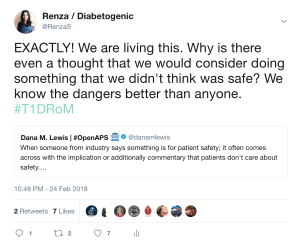
And this one from Dana Lewis, who was a guest speaker at the event, was bang on:

Yeah – clearly I was not the only one who had that reaction!
I remember a number of years ago wearing a blinded CGM. It was actually the first CGM here in Australia and I was on a trial for something (I actually can’t remember what the trial was for…) and wearing the clunky CGM was part of the study.
But I certainly do remember demanding that once I returned the CGM (after about 3 or 4 days), I was given a print out of my data. ‘Why would you want that?’ the trial nurse asked me. I imagine that the look I gave her could only be described as ‘withering’.
‘Um…so I can see what is going on with my glucose levels throughout the day. That data is gold – there is no way I will ever have seen anything like it before and the insights will be incredibly useful.’
‘But you probably won’t be able to interpret it all. And what are you going to do with the data?’ That question was asked with an element of suspicion.
I don’t suffer fools and was about to yell loudly at the trial nurse who needed some lessons in ‘patient empowerment’, so I decided to take my questions elsewhere, asking to see the trial supervisor who had enrolled me in the study. The result was a crisp envelope with my name neatly printed across the front handed to me at the end of my next visit to the centre.
Fast forward – probably about 17 years – and I wear CGM all the time and use the data to make daily adjustments to my insulin doses. (Well I did until Loop took over that for me. Reason #124978 I love Loop. Have I mentioned that before?)
I can’t imagine having something connected to me that is collecting information that I could use in real time to improve my diabetes management and not be able to access that data. How frustrating it would be to have something attached to me that could tell me when I was going out of range, but not letting me know it at the time so I could actually do something about it!
Today, if a healthcare professional suggested I wear a device for any period of time where I could not access the data there is no way I would agree.
If you think that it is a good idea because not all PWD could understand the information, then that is a shortcoming of the education process – not a shortcoming of the person with diabetes. And, yes, of course not everyone wants to see all their data, but they should certainly have it offered to them if it is out there!
Denying us access to our own data is simply another way of trying to control the narrative of our health condition and our health education. Not arming us with the information – especially if it is readily available – serves no one.
*Blinded devices are often referred to as the ‘Pro’ version which makes me a little annoyed. Pretty sure the ‘Pros’ here are the ones wearing the devices and analysing and acting on the data 24/7…





