You are currently browsing the category archive for the ‘Social media’ category.
Happy Diabetes Awareness Month! We don’t really celebrate it in Australia, reserving our energies and efforts and enthusiasm for World Diabetes Day. I always thought it was a US thing (where it’s called National Diabetes Awareness month or #NDAM), but it seems that more and more countries around the world are celebrating, and who am I to not jump on a bandwagon? Plus, as I write this, I’m in a café in SoHo New York, so joining the NDAM party makes perfect sense to me!
The concept of awareness raising of health conditions is a really interesting one and has puzzled me a little for some time. Plus, it can be fraught with a lot of potential landmines. When it comes to the huge issue of diabetes, we get into criticisms of awareness initiatives being too niche and ‘exclusive’ (such as this one and this one) or too broad.
In my role at Diabetes Australia, we do awareness raising all the time. Our main efforts are around National Diabetes week, and perhaps the campaign of which I’m most proud is the three-year drive highlighting the importance of diagnosing diabetes early for both T1 and T2 diabetes. I like that our campaigns have calls to action – they’re not airy-fairy ‘tell the world about how hard my life is with diabetes’, but campaigns that have meat on their bones, with a strong ‘why’ behind them.
Why do I think that is important? Because I honestly don’t think that there is appetite from people outside the diabetes world to truly understand the intricacies of day-to-day diabetes. I don’t have a clue what the day of a person living with a chronic condition such as MS or Parkinson’s is like. And I don’t think it is all that necessary for people not living with diabetes to understand what it feels like when my glucose levels are 25mmol/l.
With the month all of a few hours old, social media pages are already awash in blue. The enthusiasm on day one is a powerful force. But I wonder how far outside the diabetes echo chamber that force extends. Are we reaching people who don’t know anything about diabetes? And will it compel them to find out more? Or do they scroll by and not even really clock what they have seen, because perhaps the topic is not really all that relevant?
I am sure that this blog is primarily read by people who are in some way connected to diabetes, and I would expect more skewed towards people affected by type 1 diabetes. I guess that makes sense – when I read diabetes blogs, I want to hear and read about people whose experiences mirror my own.
I would never, ever regard what I am doing as awareness raising. I’m telling my story to people whose awareness of diabetes is already incredibly heightened.
So, it surprises me when events, activities and campaigns generally consumed by people already affected by diabetes are seen as awareness raising. How aware do we need to be? If you’re at an event where the people on stage are all people with diabetes telling their life story, I think you can be pretty sure that most, if not all, of the people in the audience with you either also have diabetes, have a loved one with diabetes or are a healthcare professional working in diabetes.
Diabetes tweetchat contributors are always people affected by diabetes; webinar viewers are too. Sure, participants may learn something new, but has the cause of diabetes been elevated to new people?
I am all for events and activities that celebrate people with diabetes and give us a platform to share our stories. But I think we have to be sensible when we think of what they are actually achieving. I listen to diabetes podcasts and read diabetes blogs. I see all of this as a form of peer support – a way to connect with my tribe. It makes sense to me to use the limited time and mental bandwidth I have to enhance my own diabetes.
I think that awareness raising initiatives – whether it be awareness months or weeks or days, or smaller events – usually serve the community that they are speaking about. There is nothing wrong with that. In fact, there are huge benefits. Learning from others as they offer up wisdom of their tips and tricks for navigating the difficult, mundane or even amusing aspects of diabetes is brilliant. It can be validating (‘Oh, I’m not the only one who does <enter non-compliant behaviour>’) and it can help us remember that we don’t walk this diabetes path alone.
This is how I have come to see these sorts of social-based activities. Awareness raising – to those unaware of diabetes? Maybe not. But I still believe that any opportunity to hear the voice of people living with diabetes is a good one. And any change to connect with our tribe, to feel like something bigger than our own diabetes world, is great.
So, this November, as my socials continued to be flooded in blue, I’ll be thinking of it as diabetes connections month and am looking forward to seeing how my diabetes tribe around the globe is talking about their own diabetes. We’re already diabetes aware enough!
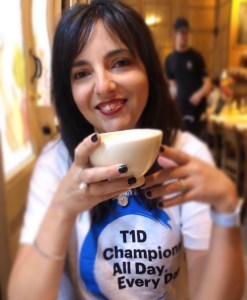
More than happy just raising a cup of coffee!
My first endocrinologist was a really nice man. He was very kind in the way that he acknowledged that I was dealing with something quite scary – a new diagnosis of type 1 diabetes.
I remember he was nice. In fact, when people asked me what my new doctor was like, it is highly likely that I actually used that word to describe him.
What I remember more was the way that he told me about diabetes-related complications, and the way that he told me that if I didn’t look after myself, and follow his instructions to the letter, that I would get those complications. If I was a good girl and did as I was told, I would be right. If I didn’t, every one of those terrifying, horrible, distressing complications would occur and it would be my fault.
Now, he didn’t say this in an ‘un-nice’ way; he wasn’t mean, he wasn’t cruel, he didn’t yell. He was saying it as if it was an absolute, and I quickly came to understand that being compliant was what was expected, and that there was a good and bad way to behave in diabetes, and that resulted in good and bad numbers. If I did what he said, I was good; if I didn’t, I was bad. And if I was bad, terrible things would happen and I would have no one to blame but myself.
That was twenty-one and a half years ago, and I can still hear those words in my head. The language he used set me on a course of not coping with my diagnosis and feeling intense fear about my future – a fear that sometimes paralysed me into inaction.
This week, there has been discussion on Twitter about what the #LanguageMatters movement is all about. It started with this tweet from a diabetes consultant in the UK, which suggests that it is ‘..mostly about being nice…’.
Eight years ago, when Diabetes Australia launched the first language position statement, the response from many was that this was not an important issue and that perhaps we should put our efforts into other things; things that matter. This was seen as a little bit of fluff that was a waste of time. It’s political correctness gone mad, was the reaction from many.
We’ve become smarter at showing the evidence to support just how destructive words and language can be. We hear stories from people who explain how damaging language resulted in them not seeking help when needed, and how the fear of being blamed kept them away from their healthcare team. We can show that diabetes gets fewer research dollars; that it’s harder to get people to put their hands in their pockets to donate to a diabetes charity, and that the general community does not understand just how serious diabetes is.
The timing of things is interesting, and it seems that last night someone on the TV show The Great British Bake Off referred to a dish as ‘diabetes on a plate’. The host’s reference to the sugary confection in that way wasn’t about him not being nice. It was about him using a phrase that has been thrown around by many for years, because it is accepted that diabetes is something to make fun of.
Now sure, the way people responded to this incident could be termed as nice and not nice. Nice would be ‘Please don’t refer to my health condition like that’; not nice would be ‘Don’t be an arse’. Obviously, I lean towards the latter. (Also, not especially nice is using an example like this to explain the different types of diabetes, because it is not relevant to the discussion and only adds stigma to type 2 diabetes. Don’t do that!)
As I read the tweets responding to this tired ‘joke’ from people in the diabetes community, what I saw was not people urging the TV host to be nice. It was for him to understand the seriousness of diabetes, to stop shaming people with diabetes, to not fuel the misconception that sugar causes diabetes, to not make diabetes a punchline.
People make diabetes ‘jokes’ because the words and language used around diabetes for years has given them permission to do so. And with that, attitudes were formed and the construct that diabetes is self-inflicted and free game for comedians and TV hosts became accepted.
And that’s where we are now and what we have to undo.
Perhaps part of the problem is that we don’t have an ‘ist’ or ‘ism’ word that we can attach to the language matters movement. We understand that when we challenge racist or sexist conduct, we are not asking people to simply ‘be nice’. We are trying to make a culture shift away from such damaging attitudes and to change behaviours. When I call out a bloke for making a sexist comment, I’m asking him to reconsider the way he thinks about women, change his behaviour and be respectful. I’m not asking him to ‘be nice’. I’m asking him to stop being sexist.
When someone makes a comment about someone based on the colour of their skin or the country they were born, we don’t dismiss it as them not being nice. We (rightly) expect them to stop that rhetoric because it is wrong and no acceptable.
So, I’m making up a word (and I hate made up words…). If you use words and language that judges, shames, blames, and stigmatises people with diabetes, you are being diabetesist. Diabetesism is not okay and should not be tolerated, and we need to challenge people behaving in that way. Perfectly nice people could still be diabetesist; their attitudes are long-held and seemingly socially acceptable. It’s what they have heard all their lives. We need them to stop doing that.
Here’s the thing: I don’t actually consider myself as being a particularly nice person a lot of the time. Nice people are agreeable, and don’t challenge others or their ideas; they accept them. They don’t call people out on Twitter. They’re not the person who rocks the boat. I am the boat rocker, and I do that because I believe that there are institutional, systematic problems that need to be changed in diabetes and diabetes care, and one of those is the way that the language used around diabetes.
So, back to where this all began and this tweet. I agree that berating HCPs is not the way to get the message through. #LanguageMatters is not only looking at HCPs attitudes and behaviours, anyway. My strongest criticism has been aimed squarely at the media and industry. I also believe that it works best when all stakeholders are involved.
But while I accept that there are different approaches, I don’t accept – and really don’t appreciate – that all the work, the research, the education and the efforts about this issue can be distilled into the concept of good manners and niceness.
I also believe in taking a harder line. That doesn’t mean haranguing or being aggressive. But it does mean understanding that there is a (real or perceived) power imbalance in healthcare, and those with influence should be held to account when it comes to the way they speak to and about people with diabetes. It means calling out HCPs and researchers when they stand up at conferences use language that hurts us by reinforcing wrong attitudes; correcting the media when they get it wrong, and calling out industry when their marketing teams misfire.
And I also believe that this is personal. Living with diabetes is not a bit of ‘fun stuff’ or something that we chose to do. It is incredibly personal for me and every single person with diabetes who has been made to feel not enough, or blamed or shamed, or judged or mocked due to beliefs about diabetes – beliefs that have been formed and accepted over time because of the language and attitudes about our health condition. The concepts of non-compliance, of good and bad numbers, of ‘bringing this on myself’, of ‘diabetes on a plate’, of grading A1cs have all been thrown at me, and affected me in ways, varying from feeling a little annoyed right through to deciding diabetes care was an exercise in futility so I was simply not going to bother anymore.
That is why #LanguageMatters and I would ask – and urge – everyone working in this space to listen to those of us living with diabetes, hear us. And sit down and learn. Sure, we can all be nice, because being nice is a good thing to aim for (and I promise that I will endeavour to do better there, too), but accept that language matters much, much, much more than that.

Firstly, let me start this piece by saying #NotAllHealthProfessionals. There: I got it out there upfront because I know that what follows is likely to garner response from a shedload of healthcare professionals that they would never do the sort of crap I am about to write about.
Sure – I know that there are lots of great ones out there. I get that there are champions for our cause; HCPs who genuinely walk alongside us and truly listen to what we say and what we need.
But here’s the thing. It takes more than that; more than just doing the right thing in your own little world. It takes guts and leadership to take a stand, and it takes standing up to colleagues who are not getting it right. And sadly, even the good ones don’t do that enough.
Last week, I shared a pathetic image from a Facebook page that is, allegedly, a satire site. It seems to be administered by HCPs and most of the comments appear to be from HCPs. (You can see it here if you are on FB. I don’t want to share the image on my blog.)
I shared the image with these words: ‘This isn’t funny. it’s not smart. It’s not clever. Even less funny is that it appears this is a page for and by healthcare professionals. The comments are disgraceful. HCPs are not our allies when they do this sort of shit. Instead, they’re contributing to the distress and shame that many PWD feel.’
The thing that upset me most wasn’t the pitiful attempt at humour. Let’s be honest – there was nothing in there we had not seen before. A million times over. This sort of ‘humour’ is in the DNA of every stigmatising diabetes ‘joke’.
What upset me were the comments that followed. At last count, there were about 1,000 of them, most of them applauding the image. Here’s just a selection from the first few:
‘Brilliant – but no one ever heeds this advice.’ (From a nurse who claims 30 years of nursing experience.)
‘This is how I label things.’ (Pharmacist.)
‘Should be on every diabetes med.’ (Exercise physiologist.)
‘The things you wish you could say to patients without losing your job.’ (Nurse.)
‘Love that!’ (Med student.)
‘Hahahah!’ (Podiatrist.)
‘Legit needs to be on boxes.’ (Nurse.)
‘Sorry…I can’t read that small print on account of my sugary eyes.’ (Doctor.)
‘Hahahah. Great quality labelling.’ (Pharmacy student.)
‘Accurate.’ (Physiotherapist.)
‘I love this so much.’ (Doctor.)
‘Damn, should’ve mentioned patient’s McDonalds intake as consideration for Contrave (a weight loss drug).’ (Doctor.)
‘If only we could write that!’ (Nurse.)
‘Control your diabetes or you’ll lose your feeties.’ (Doctor.)
There were more… a lot more. Predictably, the very few of us who questioned just how this was meant to be amusing were told that we needed to lighten up/see the funny side in it/understand it was satire. Or people doubled down to tell us that we were wrong and then went on to school us with further myths about diabetes. Seriously, these people need to get just a touch of originality and try to come up with a stigmatising meme we’ve not seen several million times already, and then come back at us with inventive comments.
I am willing to bet that pretty much every single one of those HCPs will claim to be all about ‘patient-centred care’. I am sure that they believe that they are truly there for what their ‘patients’ need. If pressed, they would probably say that they would never, ever say something like this in front of a patient – because they care about us so much.
That’s bullshit.
A healthcare professional who is truly there to champion PWD would have called that meme out for every shade of stigma that it is. They would not have shared it amongst their colleagues or wanted to print it out for the tea room (as a couple of people said they had done). They wouldn’t have found it funny; they would have found it offensive, stigmatising and downright wrong. And they would have said that, trying to put a stop to hundreds and hundreds of comments.
And those HCPs who realised that it was a load of bullshit and said nothing? They need to look at themselves too. The standard you walk past is the standard you accept. When you say nothing, you’re implicitly saying that it is okay.
It is not okay.
Who remembers the outrage from HCPs last year when #DoctorsAreDickheads was trending on Twitter? (Here you go: I wrote about it here.) Doctors were outraged, offended and irrate, and urged patients to counter the horror stories that people were sharing with positive stories of their own doctor experiences. And what happened? People – patients – did that. Even I defended my HCP team when I wrote my blog post. And I even prefaced this post with a disclaimer, because I know that some HCPs will read this and be all indignant. If that is your response to this… respectfully, get over yourself!
Because, where are those HCPs now? Where are the doctors getting angry and outraged every.single.time we have to endure another stigmatising, cruel, demoralising and downright wrong ‘joke’ or comment? Where are the HCPs standing up at conferences when a presenter makes some comment about how PWD ‘fake’ our BGL results or ‘forget our meters’ for download or whatever other behaviour gets us a non-compliant mark against our name?
So, here is what I want to say to HCPs – every single one of you.
Please, please be an ally. Stand up for us. Listen to us. Don’t talk over us. Don’t tell us that our experience is wrong or doesn’t matter. Don’t walk by when your colleagues do this sort of crap. Don’t minimise or delegitimise us by saying that it’s ‘just a joke’ or promising us that you wouldn’t do this. Because enough of your colleagues do. (Also, don’t @ me and tell me how much better you are because you are a leader and don’t do this kind of shit or do call it out. That’s great. And thank you. This isn’t about you. But you still can do something.)
We need you to do this for us. Or rather, along with us. Because when we do it alone (and most of the time, it is us doing it alone), we are dismissed as being too emotional or not being able to understand the humour. As much as I wish it was enough for our comments to resonate, it isn’t. So, we need allies. We need you.
It takes courage and leadership. But if you truly, truly want to be there for us for what we need, then you need to step up. Please be an ally. Please.

P.S. There were a couple of HCPs who commented on the FB page that obviously, this meme was about type 2 diabetes and not type 1 diabetes. If you are one of those HCPs who insists on doing things like that, ask yourself just how much you are contributing to the misinformation and stigma about type 2 diabetes. We know that T1D is autoimmune/not preventable, but when you use a broad brush to correct comments about diabetes with ‘You mean T2D‘ you are not really helping. In fact, you’re just adding to the misinformation by suggesting that all T2D is preventable and that is not true. You know that. Do better.
It’s day one of the Australasian Diabetes Congress (#19ADC) which is being held in beautifully sunny and shiny Sydney over the rest of this week. Once again Diabetes Australia has brought together a team of diabetes advocates and bloggers to provide real time, on the ground updates from the Congress, which is a brilliant way for people with diabetes not here to keep updated on the sessions, latest research and new tech that is on display.
I have spent a lot of my advocacy life talking about the value of having people with diabetes at this sorts of healthcare professional events. I’ve defended our right to be here until I have turned blue in the face. I have said the words ‘Nothing about us without us’ so frequently that people have asked me if I coined the phrase (of course I didn’t – others have been saying this for years longer than I have). I have challenged people who have said that this conferences are a safe place for HCPs to talk amongst each other without concern that PWD might misinterpret what they are saying. We belong here – it is as much a place for those of us living with diabetes as it is for those working in diabetes.
Yesterday I was involved in two events – I gave a talk with Grumps at the Roche Educators Day (#RED2019), and then we co-facilitated the Ascensia Social Media Summit (#OzDSMS) – and there was a lot of talk about the importance of people with diabetes at events like this. I’ll be writing about both these sessions later on, but for now, I want to share a comment that came out of the Ascensia event when we were talking about what advocacy means and why we need to be present in all diabetes discussions. Kim Henshaw spoke about the importance of PWD being advocates and I think this just nails it.
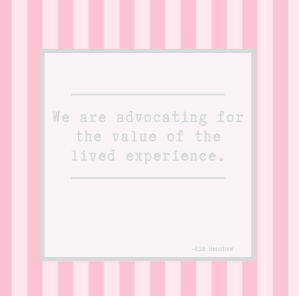
The lived experience is critical for people to understand what diabetes is all about. It was so refreshing to hear Diabetes Australia CEO, Greg Johnson, say ‘I’m a real believer in the power of the person with diabetes telling their story. It’s not just about organisations doing it, it’s about individuals doing it in all sorts of ways.’
This is why it makes sense to have us at these conferences. Our insights, ideas, thoughts and knowledge and expertise is valuable. That’s why we’re here.
Disclosures
My flights to attend ADC were covered by Roche Diabetes Care Australia. Thanks to the Australian Diabetes Society and the Australian Diabetes Educators Association for providing me (and the other #DAPeoplesVoices) with a complimentary press pass. My accommodation and all other costs have been covered by Diabetes Australia (which is where I work). My words here and in all my tweets and other social media activity are mine and mine alone. I’m trying really hard to not be sweary and these efforts should be rewarded with chocolate.
With National Diabetes Week launching tomorrow in Australia, I’m resharing this post today.
Once again, Diabetes Australia (disclaimer again – I work there, but sharing this becuase I am choosing to be because it’s so important, not because I’ve been asked) is once again running parallel campaigns about the importance of knowing the signs of type 1 and type 2 diabetes.
I’m really pleased with this year’s campaign, because we’ve gone harder than in the last two years by highlighting that not diagnosing diabetes in time is fatal. I know that sometimes we get nervous using words like that, but the reality is that missed or misdiagnosis of type 1 diabetes is fatal. People have died. And that is not good enough. (Melinda Seed wrote a powerful piece about this just yesterday – please read it.)
I echo Mel’s plea and ask that you will share the poster below with your non-diabetes networks. Do it now, and do it regularly. Sure, share it in your diabetes support groups and with your mates with diabetes. But if that’s all we’re doing, nothing is going to change.
I am certain that almost all the people who read this blog are in some way affected by diabetes. (Because, really, if you are not, why would you be reading?) It makes sense that the people who want to hear about my real life with diabetes have their own real lives with diabetes.
Most of the blogs I read are to do with diabetes. Most of my interactions online are to do with diabetes (with the occasional detour down avenues of language, Nutella recipes, Effin’ Birds, and idolising Nigella).
It makes sense and there is nothing inherently wrong with focusing on things that we understand, or that is interesting to us personally. Of course we feel a connection when reading stories by others going through similar experiences, and that makes us feel safe and less alone.
This week, however, I am hoping that a lot of what we are talking about is received by people outside the diabetes world. Because #ItsAboutTime that others know and understand the importance of early diagnosis and treatment of diabetes.
It’s National Diabetes Week (#NDW2019) and Diabetes Australia’s campaign this year is building on the 2017 and 2018 campaigns of raising awareness of the signs and symptoms of type 1 diabetes, and the fact that there are 500,000 Australians with undiagnosed type 2 diabetes. (Disclosure: I work for Diabetes Australia. I am writing about this because it is an important issue, not because I have been asked to.)
These days, my loved ones and I know all about the symptoms of diabetes. And somehow, I knew them just over 21 years ago when I walked into my GPs office and said ‘I’m thirsty all the time, I can’t stop peeing, I’ve lost weight and I’m exhausted. I think I have type 1 diabetes.’
My GP told me that she thought I was being a hypochondriac, so I’m actually not sure if she would have sent me off to pathology for a fasting glucose check as quickly as she did had I not prompted her with my (as it turns out correct) self-diagnosis. (In hindsight, getting me to pee on a stick would have been an even better idea, but I didn’t know that at the time…)
The rest of the story is that a few days later, I was told I had type 1 diabetes. That’s my whole story. It’s utterly, completely, totally uneventful and, quite frankly, I love that it is.
But that’s not the way it is for a lot of people. In fact, each year 640 Australians end up in hospital because the signs of type 1 diabetes have been missed. In many cases, these people have already been to see their GP one, two or more times because they , or their families, have known that there was something not quite right, and they were not checked for type 1 diabetes.
Is that your story?
Here’s the thing: if you have diabetes, or someone you are close to has been diagnosed type 1 diabetes, you know the signs. You may not have known them beforehand – in fact, you may have your own diagnosis story that mirrors those that we are sharing throughout NDW – but you know them now. You are not the target audience for this campaign.
The target audience is people in the community without a connection to diabetes. It’s GPs who are not routinely asking people to pee on a stick so they can quickly and easily check if a person has glucose in their urine.
We need to tell those people. Because we can talk all about this amongst each other all we want, but then all we are doing is adding to the noise in the echo chamber. We need to step outside of the diabetes world and shout from the rooftops 4Ts of type 1 diabetes:

These symptoms need to trigger people – everyone – to automatically think type 1 diabetes.
Share the poster. And ask everyone you know to share it too – including people not affected by diabetes. #ItsAboutTime we ALL knew the 4Ts so that we can diagnose and treat type 1 diabetes sooner
The Diabetes Australia NDW2019 campaign can be found here.
And here’s a Facebook Live video that Grumps and I did yesterday where we speak about the campaign and some other things too.
Let’s imagine, just for a moment, that a television program or newspaper claimed that there was a cure or treatment for type 1 diabetes that you could brew in your kitchen with a few pantry items.
It’s not really all that hard to pretend that this scenario is real: almost every week there is something somewhere that claims to be a way to treat diabetes, and sometimes, this mythical treatment is for type 1 diabetes.
What happens when we see this? Well, usually, it starts with some low level ranty outrage from a first responder who caught the piece and feels that they need to share it with the diabetes world (hashtag – DOC).
Then, as it gains momentum, others get onboard, because we all love a little SoMe outrage. Inevitably, there will be some comments about how ‘This might work for type 2 diabetes, but I/my child has type 1 diabetes, and I/they did nothing to cause it and this is the serious type of diabetes so stop it now.’ (Because adding some ‘type wars’ to the discussion is always helpful.)
There will be blog posts written about it (possibly/probably by me) and someone will demand an audience with the reporter, so they stop perpetuating myths about type 1 diabetes.
Right?
The outrage can be exhausting, but I do get it. We don’t want people to simplify our condition, of have people thinking that there is an easy fix. We want people to understand that it is hard work to manage diabetes and that every time there is a claim that it can be easily treated, people move further away from what it is really like. We want people to know that, so we talk about it loudly and everywhere.
So, after watching the ridiculous claims from Medicine or Myth the other night, I turned to Twitter to see what people were saying about the idea that hemp kombucha was miracle cure or to hear the criticisms about the poor study design of the trial.
Was there a barrage of people questioning the idea that simply drinking 100ml of a fermented drink a day could possibly be all it is going to take to treat the incredibly complex health condition that is type 2 diabetes? Or tweet after tweet probing whether the ‘trial’ that decided that we’re on a winner with Kombucha would pass any sort of test? Was there a choir suggesting that this was really all a lot of hocus pocus and it was undermining just how serious type 2 diabetes is – and how hard it is to treat it?
There was now tweet from Jane Speight…

…and that was pretty much it. (It is a very fine tweet, and that #sciencefiction hashtag deserves accolades!)
And there was no one up in arms about the way the merry band of doctors was talking about type 2 diabetes in such sensationalist and stigmatising ways. If they had been talking about type 1 diabetes, our response would have been swift.
What we saw on this program this week is actually dangerous. We can’t dismiss it as yet another ridiculous claim from a nut like Pete Evans, or Sarah Wilson, or the latest footballer’s wife. We can’t attribute it to an Instagram wellness guru. Instead, we saw three qualified healthcare professionals – a neurosurgeon, a GP and an immunologist; healthcare professionals that people trust with medical advice.
And – showing some bias here – perhaps it would have been easier to dismiss and discredit the whole show if it was broadcast on a more traditional tabloid program such as A Current Affair. An SBS show, with three Australian practising HCPs? People will think this is legitimate.
The way Medicine or Myth whitewashed type 2 diabetes was a disgrace. And as diabetes advocates, we should be calling out this sort of garbage, the same way we would ludicrous claims about type 1 diabetes treatments.

Totally unrelated, but I live in the most hipster street in the most hipster suburb of Melbourne and there is a place on my street that brews and sells seventeen different types of kombucha.
One thing that is somewhat of a consolation while dealing with jet lag, is that while I’m not sleeping in the middle of the night, Twitter is right there keeping me company! There is always someone from the DOC up and ready for a chat. And if I don’t feel like chatting (because honestly, at 3am when I’ve not had enough sleep, stringing words together is a challenge), there are always things to read.
And that is great.
Also great is when people jump on board to support each other, or cheer when others are involved in an exciting initiative. (Seeing people in the DOC welcome and embrace the amazing young advocates from the Philippines as they have launched their online activities is one such example.) There is comfort in the reliability of the way people respond in those situations.
But then there is frustration in the reliability of how people react and complain about being left out when it seems some folks in the DOC are doing something. It may be an event, a conference, or people just doing stuff like starting peer support campaigns. It could be people giving talks, writing pieces or coming together on advisory committees.
I wrote a whole thing about this at 3am. Words were strung together, and I started getting strung out, so I deleted it after wise counsel from a Twitter friend who reminded me that sometimes just writing stuff down is therapy enough. (Thank you to that wise person.)
She is right.
What is also right is that there is an Effin’ Birds moment for everything in life. Even when you don’t think there is and you put a call out, the nice folk at Effin’ Birds direct you and then deliver. And it’s perfect.




 Diabetogenic