
You are currently browsing the category archive for the ‘Real life’ category.
‘Storytelling is the essential human activity. The harder the situation, the more essential it is.’
Tim O’Brien

Come fly with me…. (2015 to Orlando)
By the end of this year, I will have travelled overseas five times and interstate heaps more. And over the last few years, have done a lot of travel – for business and pleasure with my family. So with this recent experience under my belt, I decided to enter Diabetogenic into the Top Travel Tips competition run by Virgin Australia and ProBlogger with some tips and tricks that I have learnt on my travels.
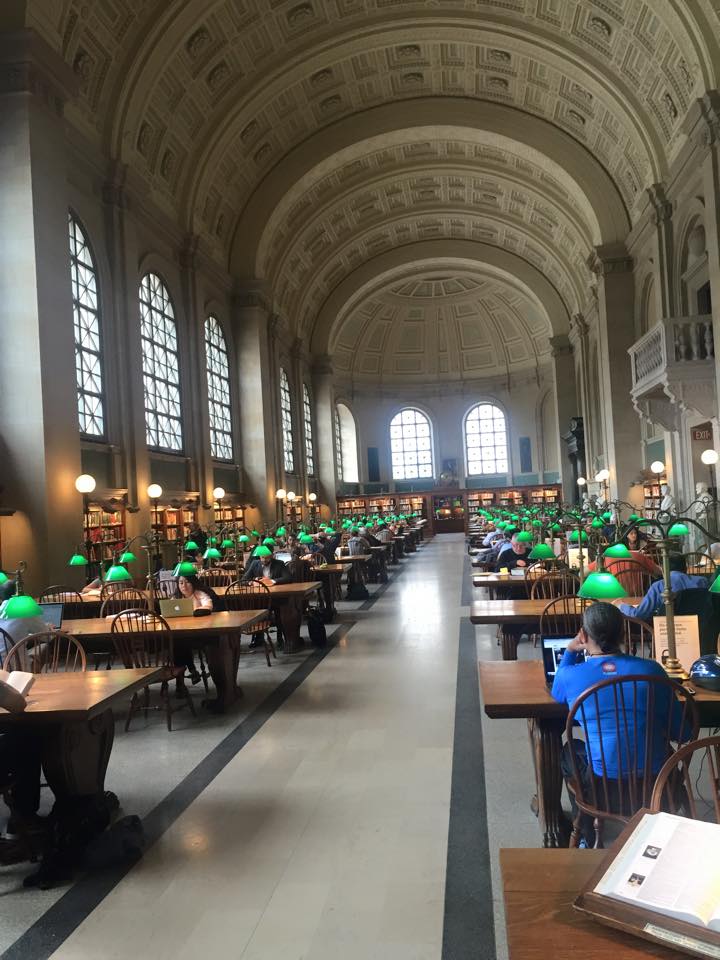
Always visit the city public library. (Boston 2015)
‘Travelling with diabetes’ is just ‘travelling’ for me. It’s not like I can leave the diabetes at home – I asked and it refused. I have never considered diabetes as being a reason to not travel. It just takes some planning. But then, so does travel in general!
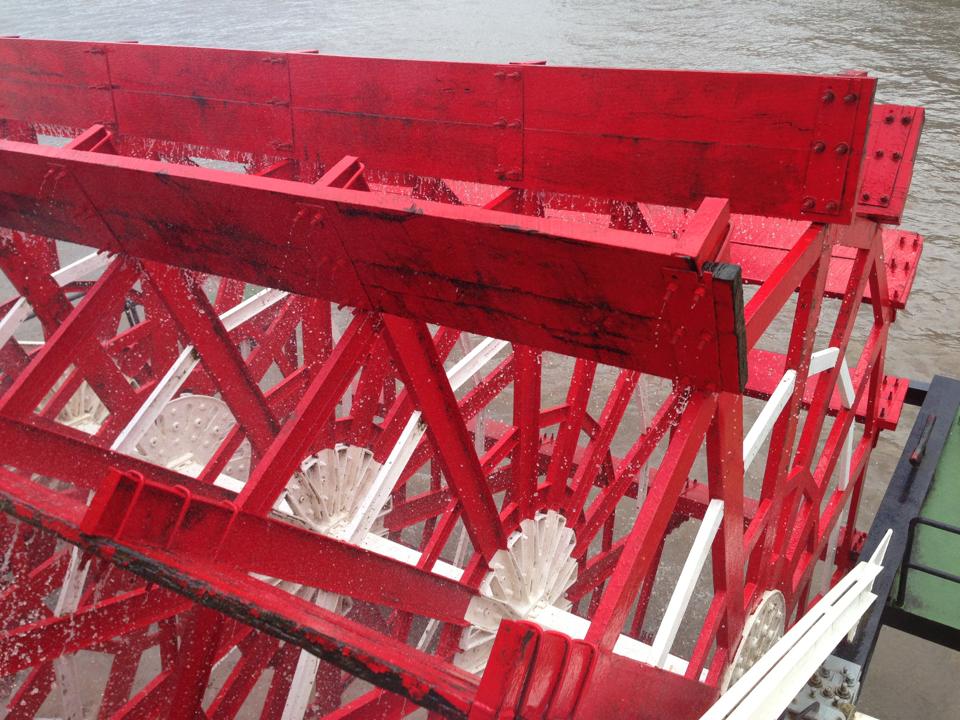
Steamboat Natchez (New Orleans 2013)
As I have said frequently, diabetes adds an extra degree of difficulty to life. And it is the same with travel. It’s not anything all that significant, just something to consider. So here are my fail-safe tips to travelling not only safely, but also ensuring that a wonderful time is had.
Camels in the Atlas Mountains (Marrakech 2013)
1. Have fun!

Lady Liberty (New York City 2010)
2. Don’t let diabetes be the reason that you don’t travel. And further to that, don’t let diabetes be the reason that you limit your travel to areas you consider ‘safe’.
Shoes in every possible colour combination. (Barcelona 2013)
3. Read points one and two again.

Ice skating in Central Park (New York City 2011)
4. Work out what diabetes supplies you need to take. And then double it. I know: diabetes paraphernalia add bulk and that is a pain – especially when you are trying to travel light (a concept completely alien to me, because: shoes). It is highly likely that you will end up coming back home with a lot of the extras, but that is a far better option compared with trying to work out how to access insulin/pump lines/BGL strips etc. when you are in the middle of a cooking with truffles tour of southern Italy. (Note to self: find and book cooking with truffles tour in southern Italy.)

The magic of a gondola (Venice 2009)
5. And again – I know it’s a pain, but carry things with you rather than packing them away with your stowed luggage. That way, you know where it all is, and the insulin won’t be subject to significant temperature changes. I do know of people who stowed their insulin and it froze, rendering it useless. And someone else whose luggage sat on the taxiway in direct sunlight for 6 hours cooking their insulin. It’s unlikely, but in rare cases, it can happen. You don’t want to be that person!

Mozart everywhere! (Vienna 2012)
6. To declare or not to declare? That is the question. I never walk up to security and announce that I have diabetes. But equally, if necessary, I am happy to answer any questions. I seem to set off security alarms with alarming (!) regularity. By the time my shoes have come off, and any jingly-jangly bracelets are removed, I still frequently set off the alarm. No idea why. At that point, with a pat down on the way, I do point out that I am wearing a couple of medical devices, pointing to them on my body. I am always relaxed about it and willing to pull them out for show and tell. It’s never ever been a problem. Ever. And I don’t assume that the security person will know what I am talking about, so I use simple terminology when explaining what they are for. Often, an interesting conversation ensues!

Dubai 2011
So on that: stuffed in with my travel documents is a letter from my endocrinologist stating that I have diabetes. That letter has never, ever come out – I’ve never been asked. However, it always there, because it is a piece of paper, weighs nothing and the day I decide I don’t need it will be the day I am asked for official documentation to prove my faulty beta cell status.
7. For pump users. Having an insulin pump undoubtedly makes travel easier. No need to do any sorts of tricky calculations for time zones and working out what time to take your long acting insulin. I always have the same procedure: once it’s wheels down at my final destination, I reach for my pump and reset to local time. That’s it! Done! I don’t do it earlier in case of any delays along the way.
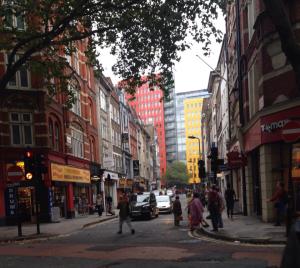
Denmark Street for music stores (London 2014)
TAKE A PUMP BACK UP. Most pump companies offer loan pumps. Just make sure you give yourself enough time to organise one.

Oh, Paris. (2008)
Write down your pump settings. I save the settings in my phone and save a copy in the cloud as well. Because I seriously couldn’t tell you my insulin sensitivity factor (or anything else) if my life depended on it. Which it kinda does!
Pumps fail. It’s a reality. It’s crap. And even back up pumps fail. I know the likelihood is small, but it can happen. And if it does, you’ll still need insulin – both basal and bolus. So with that in mind, don’t forget long acting insulin. You can get pre-filled pens if that is your preferred option (don’t forget you’ll need needle tips!). I take syringes because they are easy to use, light, and do the trick!
8. Travel insurance. Don’t leave home without it. And don’t forget to disclose diabetes.

Apartment doorway. (Rome 2012)
9. Medical ID? Some people don’t go to the corner store without their medical ID. Other people rarely, if ever, wear something (guilty as charged). It is an incredibly personal decision as to whether or not you wear something identifying you as someone with a health condition. Think about where you are travelling, if you will be spending periods alone and if you think that having a medical ID would be the best thing for you.

Montmartre (Paris 2013)

The gorgeous seaside Honfleur. (Normandy 2009)
10. Frio packs are great if you are travelling to hot places and you are not sure the availability of a safe fridge. I have found (increasingly) that some hotel rooms don’t even have fridges in them anymore; in Boston, I spent 10 minutes looking for a cleverly hidden fridge in my room at the Hyatt only to realise that there wasn’t one! Having said that, insulin is a lot hardier than our pharmacists would like us to believe, and it won’t disintegrate before your eyes if it’s not refrigerated constantly.
11. One of the best things about travelling is exposure to new foods. Often what you are eating and its nutritional value are a complete mystery. Eat it anyway. You can always correct a high blood sugar or treat a hypo. Don’t let diabetes be the reason to not try the local delicacies.

So much delicious food. Carb counting is your friend!
And while we’re talking food – think about the food available while you are actually in transit. Aeroplane food will never be the best food you will eat. I have never, ever, ever ordered the meal for PWD, but I know others who do and say it’s fine. Don’t think you HAVE to order a special meal just because you have diabetes.

There seem to be some recurring themes in our travel photos. (Coffee everywhere)
I always make sure that I have my own hypo stash while on planes. But don’t worry if you don’t (or if you’ve already munched your way through). You can always get juice on flights. (Don’t forget – on some flights food and drinks are not included in the fee and you will have to pay on board.)

Ampelmann (Berlin 2012)
12. I don’t exercise, so when I travel, I spend the first couple of days low until I remember that I am walking miles and miles and miles. And then remember to alter my basal rates on my pump. (If I was smart, I would do this before the hypos start. I am hoping to become that person one day.) Same thing applies, of course, if you are usually super active and suddenly doing nothing but lying on a lounge chair, reading a book and doing nothing more than waving your hands at a waiter for another cocktail.
13. The Diabetes Online Community (DOC) is your friend! There are people with diabetes EVERYWHERE and we’re a helpful bunch! If you’re in a pickle, social media might just be the thing to connect you with someone to help you out. (And here is the famous Pumpless in Vienna story again.) And even if you are not having a diabetes crisis, travel is a great chance to meet up with people you’ve gotten to know in tweetchats and diabetes discussions online.

Bright (xmas) lights, big city (New York City 2014)
One of my favourite things when travelling is to do just that. I have spent countless hours all over the world getting to know people from the diabetes online community and they have moved from being wonderful cyber friends to truly wonderful in-real-life friends. Diabetes may have connected us, but there is much more that has secured that friendship!

Yankee Stadium (New York City 2013)
14. Shop for diabetes! (Yep, of course there is a shopping angle.) Shopping overseas gives you access to things you may not find at home – especially if you visit markets and fairs. I have found gorgeous little purses for my diabetes supplies while travelling and one of my favourite bags ever was bought on the Rialto Bridge in Venice from a man who makes all the bags in the store. (I justified the purchase by the size of the bag, telling myself it would carry everything I needed for my diabetes for the rest of the trip!)

Rijksmuseum Bibliotheca (Amsterdam 2014)
Travelling should be fun and exciting and enlightening and enriching. It’s a chance to spread your wings, find new places, meet new people and discover new things about yourself. It’s an awesome ride, and diabetes – whether you like it or not – is there with you. Most of all, remember what I wrote in this post here:
The theory of travelling and diabetes is different for every person and every trip. And every trip I learn something new – and not everything I learn is about diabetes!

We have made a point of visiting somewhere new each year over the last five years.
(Well, yesterday, but whatever.)
There has been lots of discussion about what happened 94 years ago yesterday – on 27 July 1921. University of Toronto scientists Fredrick Banting and Charles Best successfully isolated the hormone insulin. Today, that means that I am alive and kicking, 17 years after my islets stopped making any.
It means that type 1 diabetes treatment moved from being a starvation diet and not much else, to injecting a drug that was life giving and life saving.
It means that I take a drug that while giving me life, is also lethal and if not dosed carefully and with great consideration can cause terrible side effects.
It means that people with diabetes don’t die terrible, agonising deaths simply because they were diagnosed with diabetes.
It means that I need to be able to do crazy calculations to ensure what I put into my body completely and utterly imperfectly mimics what those with functioning islet cells do completely and utterly perfectly.
It means that there is a treatment therapy that gives us hope and life and allows us to live – sometimes very long, long lives.
It means that each and every day I feel fortunate to have been born when I was and not 100 years earlier.
It means I take for granted that I have access to a drug that keeps me going.
It means that there are far too many people around the world who still do not have access to the drug I take for granted. And 94 years later, that is not good enough.
It means that it was 94 years ago – 94 years ago – since the discover of insulin to treat diabetes and we are still without a cure.
And it means that I wonder when there will be the next breakthrough that is as significant and meaningful and life changing and life saving as what those two Canadian scientists discovered 94 years ago.
But mostly. It means that I live with hope. Hope that those scientists are somewhere working away, and perhaps – just perhaps – are about to find that next big breakthrough.
Any day that sees a BGL of 32.4mmol/l is not going to be fun.
It happened around midday on Saturday. It came from nowhere. In range BGLs at waking. Trip to a new café for a breakfast of delicious coconut-y porridge and milky coffee. A quick trip into the city to buy a birthday present for one of the kid’s friends who was having a party that afternoon.
So far, so fun.
And then, suddenly, nausea hit.
At that point, I realised just what a bad diabetes day it was about to become. I’d changed handbags that morning and my BGL meter hadn’t made the transfer. I was CGM-less as well, so apart from the nausea and a slightly dry mouth, had no idea if I was high – or just how high I was.
Thankfully, we live less than a ten minute drive from the city. We got home, me holding the bag that had contained the present close by in case the feeling of nausea became the real deal.
We made it home. I checked my BGL. Oh yes, I was high. So, so, so high.
I calculated a bolus does of insulin and used a disposable syringe to jab it into my stomach. I changed out my cannula, line, cartridge and insulin, inspecting the old one I’d just removed. It looked absolutely fine. And I’m sure it was fine. I set a slightly elevated temp basal, resisting the urge to set it at 200% – effectively giving myself double the usual dose – and sternly told myself that I needed to let the bolus do its thing. Slow and steady was the way!
Then the vomiting started. Then it ended.
And then I fell asleep. And a couple of hours later, I awoke feeling fine. Well – as close to fine as one can be after a couple of hours of unexplained, very high BGLs and the muscle pain that comes from throwing up.
My BGLs returned to range gradually. The nausea was gone. The mild ketones I’d had earlier disappeared, flushed out with lots of water.
Not fun. At all. But I did what I planned to do that night, brushing off the looks of surprise from my friends when I mentioned the day I’d had. They probably wondered why I was up and out and not curled up in a ball under the doona. There were moments I wondered that too.
If I was to stop every time I had a diabetes thing happen, I’d never get up I thought, but didn’t say it out loud because it doesn’t really make sense to people who don’t have diabetes.
It’s what we do. We get on with things. Because diabetes throws so much our way that we just learn to accept it and push forward. We do it without much fanfare. But sometimes – sometimes – I kinda do feel like I deserve a medal. And yesterday I got one after I did the 5km in Run Melbourne!

Medals for the family!
This time last week, I was sitting on a plane, flying back from Friends for Life. As we’d booked this trip at the last possible moment, I was not travelling the long LA – Melbourne leg with Aaron and the kidlet. We hadn’t managed to all get on the same flight and my trip (booked though work) and theirs didn’t coincide.
So I had a lot of thinking time and kept trying to put into words what the Friends for Life (FFL) experience was for me. I found myself tearing up quite a bit, and kept touching the green bracelet that was wound around my right wrist. It’s still there, and I find myself glancing at it when I am sitting in meetings, or as my fingers fly across the keyboard typing these words.
I had an idea of what I was going to experience at FFL. I have spent enough time with FFL alumni and read a lot about it to have formed an impression about what the week would hold.
I knew what to expect.
Excect I absolutely didn’t. I had no idea.
I expected it to be all touchy-feely. I expected lots of hugs. I expected a quiet understanding – of all and from all who were there. I expected to feel included and part of something and welcomed.
And those expectations were all met. Ten fold.
But what I didn’t expect was the sheer, overwhelming emotion of the conference.
And I didn’t expect the science.
Make no mistake. Friends for Life is a diabetes conference in the truest sense of the word. It is not a support group meeting – of course there is support, but it is much more than that – it is a scientific meeting with the focus very clearly on providing up-to-date, evidence-based, important information to people living with diabetes. It’s not dumbed-down – absolutely not! The information presented at FFL would not be out of place at the ADA scientific meeting I’d attended the month prior, or ADS-ADEA conference I am attending next month.
I didn’t expect an exhibition hall that was bigger than what I know I’ll see at the annual ADS-ADEA conference.
I didn’t expect that there would be announcements like the one Ed Damiano made about his work on the (brilliantly named, iLET) bionic pancreas. And when it was made, I didn’t expect the outpouring of emotion, of gratitude, of understanding, of hope.
And running alongside it – as part of it – are the sessions where you sit, and breathe and cry and nod and share your story. Or say nothing and just fill up.
This is not a cult-like gathering of the pancreatically-challenged and our support people. There is no sitting around feeling sorry for ourselves. Equally, it’s not a pep rally where we marched to the beat of the same drum, patting ourselves in the back. Every person at that conference has their own story and while there certainly are similarities, there are also differences.
Friends for Life challenged me. It made me feel uncomfortable at times. The discussions were not all easy and self-affirming. There were topics that I don’t regularly talk about, instead hiding them away in a chamber of my mind that I manage to keep locked away most of the time. I sat quietly in talks about how diabetes affects those around me. I struggled to share my story at times. But I did, often with hesitation, because talking about how diabetes impacts on Aaron and our beautiful girl hurts me in ways that make me feel like I am falling to pieces inside.
I didn’t walk out of all of those challenging sessions feeling great. But I felt validated and I felt less alone. And I understood better that it was okay to speak about those confronting issues, even if what I am feeling isn’t wonderful. I took away from those sessions the ideas and strategies other use and I feel better equipped to manage some of the more difficult aspects of living with diabetes in the family.
I attended FFL as a guest of Children with Diabetes (CWD). For years, I have been begging CWD President, Jeff Hitchcock to bring this event to Australia and while I did that with the idea that it would be great for people affected by diabetes to have the experience, I had no idea just what that experience would mean. I still am not fully cognisant of what the experience has given me.
My expectations weren’t met at Friends for Life. They were exceeded. And I hope that we can find a way to bring it to Australia so that as many people as possible can become part of the FFL family.
A huge thank you to Jeff Hitchcock and the CWD Board for covering my costs to attend Friends for Life 2015.
Standing at the counter of my usual morning coffee shop, I was flustered. I placed my order and stepped out of the way, juggling my phone, glasses, loose change and handbag. I’d been ignoring my vibrating pump since I’d walked into the café – I knew that it was telling me that my BGL was heading south. I knew that. I had it in control. I knew I wasn’t low yet – just headed that way. I knew I was still more than safe and there was no need to panic.
But my pump doesn’t understand the subtleties of diabetes. It works in absolutes and it was absolutely telling me that my BGL was dropping and dropping too quickly.
And then, because it thought that I was ignoring it or hadn’t realised it was trying to tell me something (it sits hard up against my sternum, held in place by the tight elastic of my bra – how could I not know?!) it started wailing. Well, maybe not wailing, but that is what it sounded like to me.
In a move completely devoid of any classiness or poise, I dumped everything in my hands on a nearby communal table, giving an apologetic –and grateful –glance to the office worker who managed to catch my phone before it crashed to the ground.
Continuing with the grace and polish I was exuding, I roughly reached down my top, pulled my pump out and silenced the wailing with a firm press of the ’ok’ button before, equally elegantly, depositing it back in my bra, tubing still poking out.
I took a breath, gathered my things and shoved them into my bag and turned to continue waiting for my coffee, the alarm now silenced. And caught the eye of a man who had just been handed his coffee.
Almost imperceptibly, he nodded at me; his head inclined downwards only a tiny bit. I must have looked puzzled. He placed his coffee down – also at the communal table I had just used as my dumping ground, and reached into his pocket where he pulled out the same pump as mine. He waved it at me, picked up his coffee and walked out.
‘Renza? Your coffee is ready, hon.’ The barista was calling my name. I thanked him and grabbed my coffee, walking into the cool morning air outside. I looked around for the man with the pump, but he was nowhere to be seen.
I seem to have had a significant number of diabetes in the wild experiences recently. Even though I am frequently around others with diabetes, I still get a thrill when I find myself seeing evidence of diabetes out of context or unexpectedly. When I am in a room full of others with diabetes, my experience is legitimatised and normalised. But perhaps that is the case even more so when I see someone just going about being themselves, doing their daily activities. With a little diabetes add on.
There’s no rhyme or reason why songs go through my head. Here’s one that has been on repeat in my mind for the last three days.
Baby, it’s cold outside. It really is. I am shivering my way through most mornings, cursing the cold and complaining about how far away Summer is. Which is all really weird because I think the coldest it’s been is about 7 degrees (Celsius), and a mere few months ago, I was delighted and delighting at the New York snow. I think that’s what I need. Snow in Melbourne. Snow makes the cold worth it.
Anyway, sit somewhere warm and have a read at what I have been checking out lately.
She quits helmets
I’ve made no secret of the fact that I think Sarah Wilson is a fool. She has done nothing to alter that opinion with her rant and rage against mandatory helmets for cyclists. She wrote this at the end of last year and it has resurfaced, once again showing how irresponsible and downright stupid she is.
If I had a superpower, it would not be flying or invisibility or a magic unicorn. No. It would be to mute people who are dangerous; people with D-grade celebratory status with a following who sprout harmful rhetoric. Sarah Wilson would possibly be first on my list.
beyondblue
Yesterday, this media release from beyondblue had me cheering. Raising awareness about men’s health – in particular men’s mental health – is a tough gig and beyondblue are doing a damn fine job trying to cut through.
Inside Out
When I saw the preview for the new Pixar film, Inside Out, I was so excited. What a gentle, fun, and enjoyable way to talk about mental health with kids. I couldn’t wait to see it. I still can’t. Aaron took the kidlet and one of her friends to see it while I was in the US and they all thought it was terrific. And it has sprouted some really interesting discussion about the topic.
I love this article which talks about the importance of having a strong female character as the protagonist of the film who is not a princess.
Jenna from the Block
A few years ago, Jenna and Josh were contestants on the Block. Josh was diagnosed with type 1 diabetes a couple of years ago, and this moving story from his wife, Jenna, is doing the interweb rounds here at the moment. Thanks for raising awareness of diabetes, guys!
Up your nose
Glucagon injections are not fun. They are not fun for the person who is jabbed (the jabbee?)– mostly because it means that they are having a nasty hypo that warrants being jabbed – and they are not fun for the person doing the jabbing (the jabber?).
Under what is usually an incredibly stressful situation, the ‘jabber’ has to open the little orange box, draw up things into a syringe, shoot it out again, mix it up and then inject it.
Not. Fun.
So, it is with great interest that I have been reading about the trials of inhalable glucagon. Read about it here.
Friends like this
My friend Alecia is awesome. She is uber-talented (her jewellery designs are stunning and her lighting designs a marvel) and is so much fun to hang out with – even if she makes me drink things that taste like orange bathroom cleaner.
We hung out recently in NYC, where she took me to a gorgeous place for dinner and we ate the best Brussel sprouts ever. And then I took her to hear some jazz where she made guitarist Mike Stern kiss me three hundred times so she could get the perfect photo. I didn’t complain. Neither did he, actually.
She is also slightly crazy. But she is crazy for a cause which, I guess, makes it kind of okay. Next month, she is going to be riding 100 miles on a bike. In our language that’s 161 kms. In whatever language, that’s a long way.
If you can, throw her some coin. All money raised is going towards finding a cure for diabetes. Which she has had for 36 years, and since 2001, has raised over USD$350,000 for a cure for type 1 diabetes. I did mention she’s awesome right?
Music and words
Most weeks, I post a link to music I have been listening to. This is fun. And embarrassing at times. But I also think that I should start to post links to some of my favourite JK Rowling quotes because the number of times she beautifully and succinctly manages to say something that I have been trying to bash out is startling.
For all the blog posts and talks I’ve ever given on the importance of language, I could have simply said this.
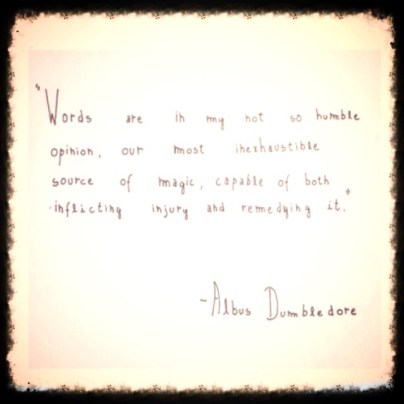
Remedy injury. Always.
Gallery
One of the best films ever is the Peter Sellers’ classic The Party. A couple of years ago, we bought our first ever Josh Agle (known as SHAG) print which is a tribute to this fabulous film.
It was the first in The Party series. Somehow, we completely missed the release of the second print (and now can’t find one anywhere!), but a few weeks ago, when visiting Outré Gallery, we saw and bought the third.
Last night, after a couple of hours of lining things up, measuring things, banging hooks into walls (very satisfying), we finally have our SHAG gallery done.
It looks spectacular and this photo absolutely doesn’t do it justice – mainly because it was really difficult to get the whole wall in one photo. Those larger photos in the middle are each about 150cms wide. Nonetheless, here it is! And we can’t stop looking at them!

Drink Nutella
I mentioned it’s cold, right? Well, here is a nice way to warm you up. Nutella hot chocolate. Just because.
I was low on Saturday. For hours and hours of Saturday. I cannot tell exact numbers for the exact time because on Friday my CGM sensor died and I removed it ceremoniously (i.e. ripped it off in the shower) and didn’t replace it. A few BGL checks give me some information, but not a complete picture. Because that’s the imperfection of modern BGL meter technology.
At about 6pm as the kiddo and I were sitting down to our 145th 6th episode of the Gilmore Girls for the day and eating home-delivered noodles out of a box I started to feel crapola which is the a highly technical term for ‘jeez, I’m low’.
BGL check showed that I was about 2.7 on the crapola scale, so I downed a juice box, and ate my way through my carb-laden noodle box. That should have fixed it. Several times over. But it didn’t.
At about 10pm when I was thinking that an early night was in order (because: effing jet lag) I started getting ready for bed and realised that I was low. Again. Or still. I wasn’t sure. Another juice box and I figured I’d be right.
And then an hour later, warm in bed, reading some Truman Capote, I was still sitting just under 3.0, so I drank more juice. By this stage, I was pretty sure that spikes were about to start growing out of my head.  Around 12.30am when Aaron got home from his gig, I was sitting up in bed, munching jelly beans.
‘Hypo?’ he asked.
‘Yep. For hours.’ I said. ‘Hours and hours.’
This was one of those lows that is so non-eventful. It is what healthcare professionals and all diabetes books refer to as a mild hypo because at no time was I in any way afraid that I couldn’t manage it myself. I just munched on or chugged down glucose, willing my BGL to get moving upwards.
I didn’t feel scarily low – there was no profuse sweating or shaking or numbness. I felt slightly woozy when I stood up or moved suddenly, but nothing scary. My heart rate didn’t increase. I didn’t feel out of control. I wasn’t afraid.
And it was all for no apparent reason. Hard as I tried, I couldn’t explain why the low just would not budge– I’d not done any sort of prolonged physical activity or forgotten to eat. I’d barely bolused for my uber-carb meal.
If I had sensor in, the squiggle would have been pretty straight for hours and hours and hours – frequently dipping below the low-alert level into the nasty red part that would have had alarms squealing and me swearing.
But all I have are a couple of BGL checks with numbers in the 2s and 3s until I decided I was sick of looking at numbers in the 2s and 3s so stopped checking. Plus I was feeling better.
The next morning, there was no reminder of the night before. I woke up without a hypo-hangover. No headache. No screaming high BGL. In fact it wasn’t until I looked over to my bedside table and saw the empty juice boxes that I remembered. I got up and collected the remnants for the recycling bin. Just another day. Another night. Another hypo. Nothing to see here. Boring as all get out.
David Sedaris wrote this book:
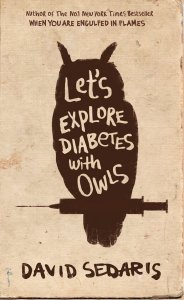
It came out a while ago (back in 2013), and as with all things Sedaris, I bought it, read it in a day and laughed out loud so many times and so loudly that I annoyed everyone around me.
I first discovered David Sedaris back in 2008. I was standing in line at (the now-defunct) Borders in Carlton. His Holidays on Ice compilation was conveniently placed on the counter, just ripe for an impulse buy. It was a few days before we were about to go to Europe for Christmas, so reading about Wintery holidays seemed like a good idea. I bought it and tucked it away in my carry-on luggage to read on the flight.
I started the book about two hours into the flight and very quickly learnt something about David Sedaris’ writing: it should not be read in close confines. It should not be read when there are people around you wanting to sleep. It should not be read when your husband is sitting next to you and keeps asking ‘What’s so funny? Let me read it.’
Eventually, with me laughing so hard that my sides hurt, unable to see for the tears running down my cheeks, Aaron took the book from me to see what all the fuss was about. His response was similar.
Our absolute favourite story from this compilation is Six to Eight Black Men, which originally appeared in Dress Your Family in Corduroy and Denim. I am not even going to start to tell you what it is about, but I found this gorgeous little video that gives you some idea.
In recent years, David Sedaris has visited Australia. In 2010, when we heard of his upcoming tour, we booked tickets, initially baulking at the $70 ticket price. Seriously? For a book reading? We could go to Readings any week of the year and hear someone give a reading of their book. For nothing. And get a free glass of wine.
However, we forked out the money – along with thousands of other Melbournians. His tour sold out. There was not a spare seat in the Melbourne Concert Hall. And it was brilliant. Hearing him read aloud was mesmerising. Even the stories that I had read – some of them several times – were completely different when read in his very distinctive voice. It was a thoroughly enjoyable night!
We bought tickets as soon as his 2014 tour was announced. Again, the Melbourne event sold out. Again, it was an absolute delight hearing him read not only his short stories, but also diary entries of often mundane occurrences.
Anyway, back to his latest book. When we saw him last year, as soon as he stepped off stage, Aaron and I ran out to the foyer to wait in line for him to sign our copy of the book. I desperately wanted to know what the title meant. There is not a single reference to diabetes other than the title. What did it mean?
Apparently, not much at all! When it was my turn to chat to him, I asked my pressing question. ‘Why ‘exploring diabetes’?’ As it turns out, it came from a book signing – just like the one he was doing then! – when a woman asked him to write a dedication in the book for her daughter. She wanted him to write something about her daughter needing to ‘explore her feelings’. He refuses to write what people ask him to, so he kept the word ‘explore’ and instead wrote ‘let’s explore diabetes with owls.’ She was not pleased. I doubt he could have cared!
He asked me why I was so interested in the title. ‘I have diabetes,’ I said. ‘I was hoping that I would read your book and find the secret to diabetes.’ I smiled at him. ‘I didn’t. But I loved the book nonetheless.’ He handed me back my book with his signature and a little scribbly drawing. ‘Thank you,’ I said.
‘Oh, before you go. I have something for you.’ He reached into a bag under his desk. ‘You can have some hotel shampoo and conditioner. Because you have diabetes and are special.’
I laughed loudly. ‘Thanks! See – something good DOES come from having diabetes.’
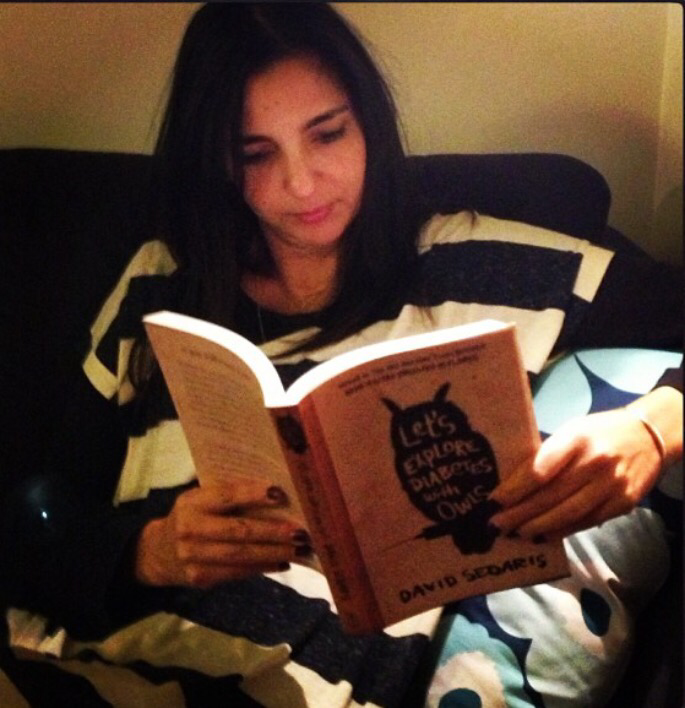
The day I got my grubby paws on this book.
I’ve been singing this song all day thanks to one of my Kate Spade bangles that has ‘You put the lime in my coconut’ written in gold. This version, whilst not the original, is great. Because Muppets. Have a great weekend. (And read some Sedaris!)
It’s fan girl here again. I want to talk more about Bill Polonsky’s talk at the ADA meeting – specifically this:
 This point had me thinking. A lot. We speak frequently about how diabetes is an invisible illness. And it is a lot of the time. This piece I wrote for The Glow last year really resonated with a lot of people with diabetes who thought that it was such a good representation of what life with diabetes is about that it was shared almost 4,000 times.
It’s invisible – we can’t see it. We rarely point to it. And you can’t walk down the street identifying the people with diabetes. (Although I like to think we sparkle a little brighter than the average person and have an aura of brilliance surrounding us, a rainbow above our heads and ride around on a unicorn. Just me?)
But I’m not sure that as a person with diabetes that I have ever weighed up the management aspects of diabetes against the (for want of a better term) return on investment.
ROI is such a big thing in our world. We expect some sort of return or reward for work we put in. Whether it be in our friendships or relationships or work or play. We do something and there is an underlying need to see something come back at us. We seem to expect acknowledgement or compensation and pats on the back for what we have put in.
There’s a problem with that expectation when it comes to diabetes. Because sometimes it doesn’t matter how much effort we put into our diabetes, the ROI is negligible. Not always – sometimes we see results and we can point to our efforts for the improvements. But sometimes – and unfortunately, a lot of the time – we get nothing back.
That all makes so much sense, so I’m not sure why I have never seen that before. Bill Polonsky’s point was such an ‘Aha moment’ for me. I went away and kept thinking about it and started listing the reasons I give for eliminating self-care tasks of diabetes. And they all came down to versions of ‘Because it doesn’t matter what I do, I still get crap results.’
Is it an easy excuse? Maybe. But I ask those without diabetes this: how inclined would you be to keep doing something if you got nothing back in return? It’s why people leave jobs, or relationships or other situations. Not feeling that you are getting something in return for your work? You can walk away.
Of course, we can’t leave diabetes. So how do we keep going – keep up with the hassles of self-care – when the ROI can be so minimal. I don’t have the answers to that one, I’m afraid. I wish I did. I really do.
Throw back Thursday to this post from a few years ago with a meme – 30 Things About My Invisible Illness You May Not Know. Most of it is still applicable today.





 Diabetogenic