
You are currently browsing the category archive for the ‘Real life’ category.
‘I’m bored with diabetes. So, so bored.’That was how I opened last week’s appointment with my endocrinologist.
She nodded at me. I’m sure it wasn’t the first time someone had commented on the boring nature of diabetes. It’s programmed into the DNA of the health condition we live with. She waited for me to go on (she really is the master of not filling silences).
‘What can I do to shake things up? What should I be doing?’
It was a repeat performance of my last appointment back in February. I walked in with this need to shake things up; do more; be more proactive; add stuff to my routine.
My endocrinologist, thoughtful as ever, waited some more for me to finish my brain dump. So, off I went…
‘I am doing so little to manage my diabetes these days. I’m not burnt out – that’s not what I am saying at all. I’m not doing that thing where I pretend I don’t have diabetes. I am doing everything I need to do, except these days, it seems I don’t really do much. Loop keeps Looping and I really feel that my only input is making sure there is insulin in my pump and a working cannula and sensor in place. I bolus as required.
‘But it doesn’t seem enough. There was time each day that I had set aside for diabetes that I don’t need anymore because managing rollercoaster glucose levels, or responding to countless alarms, or managing those hypos that resulted in multiple lost hours…these things just don’t happen anymore. Or if they do, they take so little time to address that it almost seems insignificant.
‘I feel like I am not doing enough. So…what can I do?’
When she knew I had finished sharing my stream of consciousness, she looked straight at me and said: ‘You do exactly what you are doing. There is nothing more that I would suggest or recommend that you do. You asked last time about adding some different therapies to your current management, but there is nothing that would suggest any benefit to that.
‘If you were not looping and doing what you used to have to do and all that entailed and telling me what you are telling me: that you are feeling well, you feel your diabetes is in a good place, you are not feeling burnt out and that you are happy with how and where your diabetes was tracking right now…and if that was accompanied by the A1c you are running, I don’t think we would be having this conversation. I doubt that you would be asking what more you could do. You would know that you are meeting all the targets you want to and are feeling overall great about your diabetes.’
Of course, she was right. That was my situation two years ago: I was feeling fine about my diabetes (or as fine as I ever was going to) and was thrilled with my A1c (which wasn’t as low as it is now). And I certainly wasn’t thinking that I needed to do more. I accepted that I was putting in the effort and for once was seeing the outcomes I liked. The idea of adding more tasks to my diabetes life would never have entered my mind!
‘I know you are right,’ I said to her and then mentioned the talk I’d heard at #DData last year when fellow DIY-er, Justin Walker, said that since using OpenAPS he saved himself about an hour a day. ‘An hour a day. That’s a lot of extra time I didn’t have before. I don’t know what to do with it,’ I paused. ‘Maybe I should take up knitting.’
‘You could learn a language in that time,’ she suggested, helpfully.
It has me wondering if this is a thing for others who have embraced the DIYAPS way of life. Have you all just embraced this renewed freedom and extra time and run with it, or are you too wondering what to do with your hands?
Nineteen years of constantly focusing on the minutiae of diabetes, and second guessing myself and having to DO SO MUCH diabetes is a really hard thing for me to unlearn. The last two years have been really, really different. Who knew that my response to finally getting that break that I so desperately wanted would be to not know what to do with myself and want to do more?!
Since Looping, diabetes has taken a back seat in my life because the daily demands are far fewer. Sure, the emotional toll is still somewhat there – especially when it comes to the fears I have about the future. But the daily frustrations and intrusions are not there. And that means that as well as having to physically do less, I think about it less. I had no idea just how much that all took until I stopped doing it.
I get that this is coming from a position of extraordinary privilege, and feel free to file it away under not only first world, but also first-class problems. And ignore me. (Seriously, I thought of myself as insufferable when I was having conversation last week.)
Or send me knitting patterns. In the meantime, I’ll be over in the corner conjugating irregular verbs.

I’ve been struggling the last week or so. It’s a combination of a lot of things. It’s the typical post-NDW slump. It’s the relentless Melbourne winter weather. It’s coming down from a few months of intense travel. It’s dealing with people doing annoying things. Plus, more annoying people throwing a bit of body shaming in my direction – new and fun. It’s the white flowers on the kitchen table, which wedded to the sadness that is never too far out of reach suddenly feels overwhelming, signifying that time of year.
It adds up. All of it. And people notice. ‘Is everything okay with your diabetes?’ someone asked me when I mentioned I was having a little bit of a tough time. I glanced at my green Loop, and my Clarity app and clocked my time in range. ‘What diabetes?’ I said, knowing that I was doing less than ever in my diabetes management, yet yielding results that just a couple of years ago would have taken attention, effort and energy that I just don’t have.
Then someone else asked me a similar question. ‘Are you feeling a little bleurgh (my word – not theirs) because of your diabetes?’
Well no. But yes. Or as we Aussies like to say ‘No, but yeah but…’. (For the record – I have never ever uttered those words in that order…)
Diabetes is not the source of me feeling over everything. I can’t point to any aspect of my diabetes that is playing up, giving me a hard time, being a jerk. But can we ever truly extricate diabetes from our emotional wellbeing?
I looked at the things that have been adding up. Post-NDW slump happens because the lead up to and then a week of solid diabetes-ing will always mean diabetes overload. The weather means less time outdoors and doing things that take my mind away from the mundanity of diabetes – it’s seasonally affected diabetes and it brings me down because I’m far too much in my own head. The travel exhausts me, and the jet lag overpowers me and that means not sleeping which means diabetes behaves less predictably; annoying people are just bloody annoying and because of the playground I frolic in, are often connected somehow to diabetes. White flowers – something I have written about to share the personal way I mark the heartbreak of pregnancy loss – and the loss they represent, and grief they signpost is tied up with a body that is broken in part due to diabetes.
Diabetes may not be the reason for any of these separate pieces of a bigger puzzle, but it is there for each and every single one of them, no matter how small. And together, it really does start to add up.
We often want to shout from the rooftops that sometimes it’s not diabetes. The frustration we feel when everything – from a grouchy mood through to a broken arm – is blamed on our beta cell dysfunction. It’s not diabetes – rarely is it ever only diabetes. But it is never without diabetes.
I know there is light at the end of the tunnel – that I’ll be all good. NDW always gives way to the next thing and focus moves to that; blossom on trees and the daffodils in florists everywhere guarantee warmer days; the travel will start again and I’ll get back into it and just get through it; the annoying people will continue to annoy, but I’ll be better at ignoring it (at least, that’s what I tell myself…). And the white flowers? They will die and the vase on my kitchen table will instead hold something new and bright, and the grief will return to where it lives, burrowed there with the lost dreams and the memories I didn’t get to make.
And diabetes? Oh, that will still be there. Never the main thing, because I will never let it be that. But there, nonetheless.
Last week, Instagram got rid of ‘likes’. The company line was that it wants people to concentrate on content shared, rather than its popularity. Sure, Instagram, let’s go with that.
For the platform that is preferred by ‘lifestyle influencers’ (seriously – can you imagine putting that on your arrivals card?) it all seems a little disingenuous, but if not knowing who is liking content speaks to you, then perhaps this is a good idea.
I have a love/hate relationship with Instagram. I have mine pretty locked down and only share with friends and family. I only follow people who make me feel good, or make me laugh. I don’t follow anyone who makes me feel like I am not enough. Or anyone who drinks kale juice for breakfast. These good folks can namaste themselves elsewhere.
If you are connected with me on there, you’ll know that what you see mostly is photos of my family, the coffee I’m about to drink, the cookies I have just baked, and, depending on the season, blossom trees (hello, promise of spring) or jacaranda trees (hello, promise of summer). Plus, there’s diabetes spam…so much diabetes spam.
You won’t see me telling you about my perfect diabetes life though, because my diabetes life is not perfect. And you won’t hear me going on about how grateful I am that diabetes has given me so much, because really, I’m not. And you won’t hear me saying that others have it worse and that I am #SoBlessed, because … well … because #FuckThat.
I wrote once that I despise the concept of ‘At least…’ or ‘It could be worse’. Could it worse? Of course it could! But having a body that does what it is meant to would be a shed-load better!
Positive affirmations are great if they give us hope or something to hold on to. They’re not great if they start to make us feel like we are failing, or feel bad for not always being optimistic and upbeat. Sometimes, diabetes makes it really hard to walk on the sunny side of the street.
I frequently say diabetes sucks (because honestly, I am yet to hear someone tell me how it doesn’t), or that there are days that I truly hate diabetes (because I really, really do). This doesn’t mean that I am looking for someone to throw me a pity party. It doesn’t mean that I think my life is hopeless.
But some days, diabetes is especially challenging, and no number of positive memes or positive self-talk is going to change that.
I am a positive person by nature – annoyingly so at times. I see the good in people and in situations. But I refuse to believe that it is not okay to sometimes admit that my arse has been beaten that day by the health condition that is so difficult to live with, or to privately and publicly say that I truly, honestly, totally, absolutely despise diabetes.
I need the space to have those down days and the bad days and the days where I admit that I am not a superhero. I need the time to snuggle under a quilt on the sofa and watch some trash and not feel all positive or like I can conquer the world.
It is easy to believe that a lot of Instagram diabetes folks are all happy and accepting or grateful to have diabetes. Truly – if they are and are able to maintain that positive attitude all the time, that is wonderful. I’m not those people. I don’t resent them in any way. I just believe it is important to understand that not everyone is able to have that sort of outlook.
Sometimes, it’s not possible to ‘positive’ your way out of a bad diabetes day or try to convince yourself that you don’t hate diabetes, but really do love your body when it feels just so damn broken. And that is okay.
Really – it is okay to not be okay. It is okay for us to not be shiny, happy people* all the time.
What I will say is this: If your hard days are outnumbering the good days, please do see if there is someone who can help. It truly is okay to feel down about diabetes, but when you are feeling that way all the time and it’s affecting your day-to-day life, there is help.
When I find that the scales are definitely tipping that direction, my first port of call is my friends with diabetes. They never make me feel crap for not being positive. They certainly don’t feed my misery, but they do remind me that this is hard and that it is perfectly understandable and acceptable to have negative days. And closer to home, my husband knows that I don’t need a pep talk, or to be told to snap out of it, or a reminder that life could be worse. He tells me that diabetes sucks while passing me some chocolate. Smart, smart man.
I have come to learn the signs of when I need more help than that, and have a great psychologist I can link in with when I need to. I can’t tell you how much this has helped me. One of the first things my psych said to me was that it was okay to grieve my old life, and to feel that diabetes sucked. Being given permission to feel down at times felt like being able to breathe again.
And here’s the rub: knowing I don’t have to be Ms Positivity all the time – and saying just how hard things can be sometimes – actually has made me far more positive in the long run.
*I was talking about this with my beautiful friend Georgie yesterday. She is one of the first people I turn to when I am having a shitty diabetes day and we spend a lot of time just talking about how hard it can be. Her advice is always spot on. Or there is no advice – just an ear and a shoulder and a coffee date. As we were chatting, I said the thing about it being okay to not be shiny, happy people all the time, when I realised (and told her) that REM reference was from before she was born. Oh, how we laughed and laughed. And then I felt old.
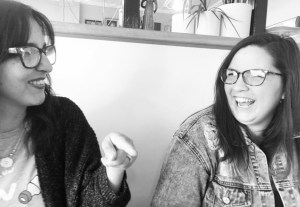
Right here, Georgie and I ARE being shiny, happy people.
The other day, I was standing in a noisy café, waiting for my take away coffee to be ready, not really paying attention to anything, other than a tree I could see that had what must have been Melbourne’s first promise-of-spring blossoms. Suddenly, a loud noise dragged me from thoughts of warmer weather and not needing to wear fifty layers of black to leave the house. The man standing next to me turned his head and I caught him looking at my phone.
‘Your Dexcom is wailing,’ he said to me.
‘Indeed it is, needy little shit,’ I replied, after I got over my surprise at his comment. Usually people just look annoyed at the disturbance.
‘So…you’re one of us?’ I asked him, pointing to the pump I’d just noticed on his waist band.
‘Yep. Hi! I’ve never, ever just come across another person with diabetes in a café or just out and about,’ he said. ‘Have you?’
‘Ridiculously regularly in the last few of months,’ I replied, and told him about the mum of a young woman with diabetes at the airport lounge, the security guard at the airport in Amsterdam who referred to me and my travelling companions as a ‘diabetes club’, the woman talking about Libre in my favourite local café, and now him in this café near work.
‘Maybe stay away from airports and cafes. That seems to be where PWD congregate,’ he helpfully suggested.
At that exact moment, my pump beeped its on-the-hour alert that it was sitting on a temp basal rate.
My diabetes-in-the-wild mate looked at me, his eyes narrowing. ‘Now your pump is beeping. Oh – are you looping?’
I was more than a little startled at that one. The noise my ancient Medtronic makes on the hour is not loud at all – three little beeps to gently remind me that a temp basal rate has been activated by Loop. ‘Wow,’ I said. ‘Your hearing is next level. And yes. I am.’
We did the usual diabetes stat check: length of time with diabetes; age of diagnosis; things that drive us nuts; inventory of our diabetes devices; a couple of amusing diabetes anecdotes. ‘I pulled my pump line out on the door handle of my office today,’ he said. ‘Have you ever done that?’ I laughed. ‘No – don’t be ridiculous! I am a smart and clever and always paying attention person with diabetes. Of course I’ve never done that… And by never, I mean once every couple of months for the eighteen and a half years I’ve been pumping.’
My Dexcom fall rate alert wailed again. ‘I’m ignoring it. Hoping it will go away,’ I sighed. ‘Yeah,’ he said. ‘I’ve been doing that with diabetes for the last 32 years.’
We looked at each other and mirrored in his face was the same expression I knew I was wearing – slight defeat, but also defiance. It’s the default expression that so many of us living with diabetes wear when we are feeling a little over it all.
The barista handed me my coffee, and juggling my phone and coffee and umbrella, I turned back to friend. ‘Lovely to chat,’ I said to him. ‘Always nice meeting one of my tribe.’
‘Tribe? Is that what you said?’ he asked.
‘Yep,’ I said, a familiar feeling washing over me: The ease and comfort of talking with someone who absolutely understands. In the place of making our own insulin, we make connections. And I was reminded, once again, how these chance encounters, along with the time I get to spend with my friends who have diabetes, sustain me.
‘Find your tribe. Love them hard,’ he said. ‘Isn’t that how it goes?’
I nodded and took a deep breath, raising my coffee up to him as I started to leave the café.
‘Yes. That’s exactly how it goes.’

Blossom…
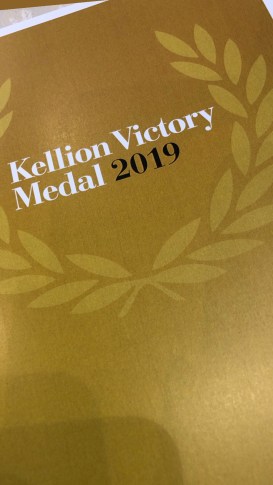
This is an edited version of the first post I ever wrote about my experiences attending the Kellion Victory Medal Award Ceremony. I wrote it back in 2011 (for the old Diabetes Victoria WordPress blog), ten years into working for a diabetes organisation, and already had attended a number of these award ceremonies.
Since this post, I’ve written about other ceremonies I’ve been lucky to attend, and shared the stories of the medal recipients. I love hearing their tips and tricks, and tuck away their words of advice for when I need them. Peer support, I think, as I hear them talking. Their stories are our stories are my stories…
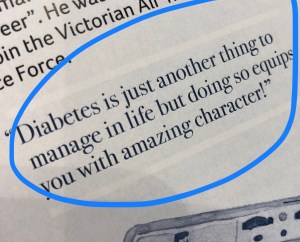
Today, I’m back for this year’s Victorian medal ceremony. I flipped through the program and read the stories of the people receiving their medals. This was my favourite quote for the day. It’s so, so true.
Today is my favourite day of the work year. It’s the Kellion Victory Medal award celebrations where we acknowledge people who have lived with diabetes for 50, 60, 70 and even 75 years. Just stop for a minute and think about that. Seventy-five years with type 1 diabetes. Now think about what diabetes was like back then: urine was boiled, needles were sharpened. Home blood glucose testing was still about forty years away, modern insulins hadn’t been considered. Insulin pumps, of course, were things of the future.
When I started working at Diabetes Victoria, I had lived with diabetes for just under four years, and in that time I hadn’t met anyone else with type 1. I was still getting used to the new reality that had opened up the day I was told that I had type 1 diabetes. My 27 year-old self had re-written my future, and instead of the life I had imagined, I had reshaped that into one that involved terrifying diabetes complications, probably no children and a reduced life expectancy. I pictured myself unable to take care of myself at a time in my life where I wanted to be travelling and seeing the world. And I saw a life where my still-new husband would have the burden that is a wife with diabetes.
Because that was the picture of diabetes that had been presented to me in the four years since my diagnosis. Time after time, the health professionals I saw delivered news of doom and gloom. And inevitability. Hope was not discussed. Except, strangely, the promise of a cure in five years – although I could tell that even the medicos telling me this didn’t believe it. I felt devoid of hope. Hopeless.
And then I was invited to the Kellion Medal ceremony. I can still remember clearly my apprehension about attending the awards, but I went along to Parliament House to see what it was all about.
It was the best thing I could have done. It wasn’t about living with diabetes for decades. It was about LIVING. I heard tales of travels, raising families, busy and successful working lives. Stories of being pioneers to make sure people with diabetes were not discriminated against. I heard stories of hope.
Kellion medallists are in every way remarkable – not because they are inspirations for living with diabetes. That’s just what they have to do as part of their life. They’re remarkable because they’ve made diabetes just something they do. In learnt that I needed to stop holding them up as some sort of magical unicorns – they were just playing with the cards they’d been dealt. The same way I do.
Each year I walk away from the awards ceremony with an ‘injection’ of motivation and determination. And a booster shot of hope. That’s my response to the day and the medalists – but not their responsibility.
We have a duty to be honest to people newly diagnosed with type 1 diabetes. Promising a life that is full of puppy dogs and bowls of cherries does not accurately paint the picture of what life with diabetes is all about. But neither does scaring people senseless. When people are in that initial fog, where they can’t see beyond the end of the week and they are starting to rewrite their future, that is when they need stories. The positive and real ones. The stories of hope.
If I could find a way for every person newly diagnosed with diabetes; for every parent of a child newly diagnosed; every partner, loved one, sister, brother of someone newly diagnosed with diabetes to attend the Kellion Medal awards, I would.
There is no promise of a cure, no threat of nasty complications, no dread of being a burden. But there is laughing and sharing and amusing stories. And hope. To meet a Kellion Medallist leaves people feeling one way: filled with hope.
With National Diabetes Week launching tomorrow in Australia, I’m resharing this post today.
Once again, Diabetes Australia (disclaimer again – I work there, but sharing this becuase I am choosing to be because it’s so important, not because I’ve been asked) is once again running parallel campaigns about the importance of knowing the signs of type 1 and type 2 diabetes.
I’m really pleased with this year’s campaign, because we’ve gone harder than in the last two years by highlighting that not diagnosing diabetes in time is fatal. I know that sometimes we get nervous using words like that, but the reality is that missed or misdiagnosis of type 1 diabetes is fatal. People have died. And that is not good enough. (Melinda Seed wrote a powerful piece about this just yesterday – please read it.)
I echo Mel’s plea and ask that you will share the poster below with your non-diabetes networks. Do it now, and do it regularly. Sure, share it in your diabetes support groups and with your mates with diabetes. But if that’s all we’re doing, nothing is going to change.
I am certain that almost all the people who read this blog are in some way affected by diabetes. (Because, really, if you are not, why would you be reading?) It makes sense that the people who want to hear about my real life with diabetes have their own real lives with diabetes.
Most of the blogs I read are to do with diabetes. Most of my interactions online are to do with diabetes (with the occasional detour down avenues of language, Nutella recipes, Effin’ Birds, and idolising Nigella).
It makes sense and there is nothing inherently wrong with focusing on things that we understand, or that is interesting to us personally. Of course we feel a connection when reading stories by others going through similar experiences, and that makes us feel safe and less alone.
This week, however, I am hoping that a lot of what we are talking about is received by people outside the diabetes world. Because #ItsAboutTime that others know and understand the importance of early diagnosis and treatment of diabetes.
It’s National Diabetes Week (#NDW2019) and Diabetes Australia’s campaign this year is building on the 2017 and 2018 campaigns of raising awareness of the signs and symptoms of type 1 diabetes, and the fact that there are 500,000 Australians with undiagnosed type 2 diabetes. (Disclosure: I work for Diabetes Australia. I am writing about this because it is an important issue, not because I have been asked to.)
These days, my loved ones and I know all about the symptoms of diabetes. And somehow, I knew them just over 21 years ago when I walked into my GPs office and said ‘I’m thirsty all the time, I can’t stop peeing, I’ve lost weight and I’m exhausted. I think I have type 1 diabetes.’
My GP told me that she thought I was being a hypochondriac, so I’m actually not sure if she would have sent me off to pathology for a fasting glucose check as quickly as she did had I not prompted her with my (as it turns out correct) self-diagnosis. (In hindsight, getting me to pee on a stick would have been an even better idea, but I didn’t know that at the time…)
The rest of the story is that a few days later, I was told I had type 1 diabetes. That’s my whole story. It’s utterly, completely, totally uneventful and, quite frankly, I love that it is.
But that’s not the way it is for a lot of people. In fact, each year 640 Australians end up in hospital because the signs of type 1 diabetes have been missed. In many cases, these people have already been to see their GP one, two or more times because they , or their families, have known that there was something not quite right, and they were not checked for type 1 diabetes.
Is that your story?
Here’s the thing: if you have diabetes, or someone you are close to has been diagnosed type 1 diabetes, you know the signs. You may not have known them beforehand – in fact, you may have your own diagnosis story that mirrors those that we are sharing throughout NDW – but you know them now. You are not the target audience for this campaign.
The target audience is people in the community without a connection to diabetes. It’s GPs who are not routinely asking people to pee on a stick so they can quickly and easily check if a person has glucose in their urine.
We need to tell those people. Because we can talk all about this amongst each other all we want, but then all we are doing is adding to the noise in the echo chamber. We need to step outside of the diabetes world and shout from the rooftops 4Ts of type 1 diabetes:

These symptoms need to trigger people – everyone – to automatically think type 1 diabetes.
Share the poster. And ask everyone you know to share it too – including people not affected by diabetes. #ItsAboutTime we ALL knew the 4Ts so that we can diagnose and treat type 1 diabetes sooner
The Diabetes Australia NDW2019 campaign can be found here.
And here’s a Facebook Live video that Grumps and I did yesterday where we speak about the campaign and some other things too.
The other night, I cancelled going to a party – a cousin’s kid’s 18th– at the last minute. I seriously never do this. And I absolutely hated doing it.
But I’d had a couple of hypos during the day (Fiasp is absolutely kicking my arse) and I was feeling exhausted. These hypos weren’t what I’ve become used to dealing with (i.e. Loop hypos for me generally look like an alert telling me I’m going to head low, me ignoring it, alert saying I am really about to be low – but not really low because Loop is doing its thing, me having a couple of fruit pastilles, and that’s it). These were the types of hypos that spin me around, turn me upside down and resettle me feeling completely discombobulated. It had been a while.
After the second one, I was so knocked out that I lay down for a bit and ended up getting an hour’s sleep. It was mid-afternoon and when I woke up, I felt no more refreshed.
I contemplated going to the party – I had a shower and started to put on some make up. I looked fine – no different to how I usually look. If I’d gone, no one would have known any different.
Earlier in the day, after I’d already had the first hypo, Aaron had posted a photo of me online. The next day, when I mentioned to someone that I had cancelled plans the evening before thanks to a lousy diabetes day, said ‘Oh. I saw a photo of you online in the morning and you looked great.’
They didn’t mean this in a nasty way, or that they thought I had just cancelled because I couldn’t be bothered going out. It was just a comment. And they were right – I looked exactly the way I would look any other weekend morning when I was having breakfast with family and friends
The next day I was messaging a friend with diabetes and mentioned I’d cancelled my plans at the last minute the night before. ‘Oh babe,’ she said. ‘How’s the hypo hangover?’ and then she detailed all the things that are the inevitable fallout of nasty (and nasty-ish) lows; the things I’d not mentioned to others who’d asked after me.
I told her she had nailed exactly how I was feeling. I told her what had happened, and I didn’t hold back, and I didn’t minimise it. I knew she wouldn’t worry or be unnecessarily concerned or wonder if it was anything more than what it was. I knew she would know – because those feelings are wound into the DNA of diabetes and the people living with it.
Plus, she would know just how I felt about the last-minute cancellation, and feeling that I’d let people down.
‘So, I bet you’re feeling even more crap about cancelling that about the hypos now, right?’ she said.
I laughed. ‘You know it!’ I said to her
‘Don’t you sometimes wish that when you were having a shitty diabetes day it couldn’t be covered up so easily with lipstick and a smile?’ she said, hitting me right in the guts with that comment.
Because she was so right. Lipstick and a smile. That’s every diabetes day. It’s there when I’m feeling great and all is going well; when diabetes is behaving and not impacting on me much at all. And it’s there when I’m feeling crap and diabetes is casting far too large a shadow over my existence for that day. But for most people, they couldn’t tell the difference.

Managing this hypo with iced coffee…and lipstick and a smile.
Diabetes is a big deal. Most people living with diabetes can talk to that. But are there ways that we can reduce its impact in small ways that may just add up to something meaningful?
I was thinking about this when I saw Dana Lewis tweet an update from her most recent travels. She does this often – a photo and a comment as she has breezed through security, and I love that she does. Dispelling myths that travel with diabetes has to be a logistical nightmare involving routine strip searches and confiscation of devices is only a good thing, and hopefully will show that diabetes shouldn’t be a reason to delay a trip somewhere.
I’ve made it no big deal by never declaring that I have diabetes or that I am carrying diabetes kit, because why the hell draw attention to something unless necessary? If, for any reason, an alarm sounds, or I get asked about what I’m wearing or carrying, I have a clear, polite, stock standard response that usually does the trick.
That doesn’t mean that travel is never going to involve diabetes-related questions, but there are certainly ways that can minimise just how much of an issue it all is – or even stop it starting to begin with! Dozens and dozens of flights, more security check points than I care to think about … and the times there was an issue can be counted on one hand. No big deal.
The longer you live with diabetes, the better you are at finding shortcuts to make life easier. And reducing just how big a deal every day occurrences are is one way to do just that.
For example, being weighed at diabetes consultations (in fact, most consultations) is a no-no for me. I’ve made it clear to my endo why I don’t want to be, the circumstances under which I will agree to it, and why I find it difficult.
By the way – I know that being weighed is actually a big deal for a lot of people, me included. There’s a lot tied up in stepping on scales. I’m certainly not trying to minimise the minefield that is weight and being weighed. I am just trying to explain how I have been able to remove a lot of the angst just by doing something simple and being clear about my wishes.
Apart from a few times where I have had to repeat my position more than once, it’s never been a problem. It’s actually interesting how HCPs respond when you ask why they need to do something. ‘We need it for our records,’ is never a good enough reason for anything as far as I’m concerned – certainly not how much I weigh.
I get the position of privilege I am coming from here, by the way. I know that I am assertive enough to state what I want and expect, back it up if necessary, and having that confidence means I find it easier to navigate the often treacherous waters of diabetes and getting what I want. I am comfortable saying no and holding my ground, and I can’t remember the last time that wasn’t the case.
Diabetes is a huge deal, so working out ways to make things a little less big makes sense to me. I don’t have the time, inclination or energy to waste on things that really can be minimised. What is important and a big deal (or what isn’t) for me, will be different for others, but I do wonder if sometimes we make more out of things that we really don’t need to. Because, really, sometimes it’s good to shrug our shoulders and just think ‘no big deal’.

#TravelWithDiabetes – no big deal
If there is one trait that drives me absolutely batty, it’s passive aggressiveness. I suspect part of that is to do with my directness – I am very good at being clear about how I am feeling and what I need. Skirting around an issue or saying things indirectly and being obtuse in the hope that others will understand what is going on just annoys me. Why make people guess when I can just tell them?
And of course, social media provides the most perfect platform to excel at passive aggressive behaviours: ‘vague booking’ and ‘sub-tweeting’ are the habits de jour of those who employ passive aggressive behaviours. I just swear too much and pointedly say pretty much everything that is going on in my head. Without a filter. Have I mentioned recently that I’m a delight?
So, naturally, I have the most passive aggressive of all health conditions possible; the health condition that appears one way, when really there is so much more going on. This is the health condition that likes to leave pathetic little hints as to what is going on, but rarely decides to be direct about anything.
Let me introduce you to diabetes where the passive aggressive comes in different forms.
We see this at diagnosis. Sometimes, there’s shitloads of stuff going on behind the scenes, but nothing outward (hello all the people walking around with undiagnosed type 2 diabetes), or it does give little suggestions, but those symptoms could also be another million other things (hello to all the people who were told their type 1 diabetes was just a cold/UTI/tummy virus etc etc.).
There are rarely super, super visible, really obvious and unmistakeable signs that scream loudly ‘THIS IS DIABETES’, which would be really useful because we know that early diagnosis and treatment means better outcomes.
Also, there’s impaired hypo awareness. For those of us living with this particularly fun type of hypoglycaemia, we have our lows, but diabetes has found a way to hide the symptoms away. That’s right, don’t actually let us know that we’re low (even though previously there were lots of symptoms), just go about letting us believe that everything is okay.
Or those times when we are convinced that we are low and are exhibiting all the classic signs, only to realise that actually, no, right now I am either sitting right in that sweet spot; or high as a freaking kite and downing that juice would really not have been a great idea. At all.
Diabetes complications can give the silent treatment for years, and conversely, there are weird symptoms that mimic the onset of a complications, setting us up for sleepless nights of worry, only to find out that actually, there is nothing sinister there.
But perhaps the most frustrating and maddening way that diabetes exhibits is passive aggressiveness is the way it makes us appear to others. Mostly, we look perfectly fine and good and that all is well I the world, when really, it is doing all it can in the background to make it so that we are not.
Living with a health condition that doesn’t communicate effectively (and deliberately in a wishy-washy manner at times) really is one of the things I like least about it. It’s no wonder that often we don’t realise that there is something wrong, because everything seems okay, or the message we’re getting is that nothing has changed. Being blamed for this is unfair, and yet that’s the way the cards fall.
I don’t really know how to overcome this particular trait of diabetes, but I have been known to silently scream ‘Tell me what you mean’when it seems to be deliberately confusing and not responding the way I would expect. Really, that’s all I’m asking for: clarity, no ambiguity, directness. And a health condition that isn’t trying to drive me to despair by not just telling me what I need to do and responding accordingly. It’s not too much to ask.

Passive aggressiveness is never the answer. However, I do love this cartoon. Because Poe puns are hilarious! (Click for artist details.)
My favourite answer to give when someone asks me how I went at any diabetes-related medical appointment is ‘Nothing to report.’ I love being able to say that things are boring. If there is ever a time in my life that I want to be unexceptional and routine, it is when I am hearing or sharing news about my diabetes.
For as long as I live with diabetes, I want to forever be told ‘It’s nothing,’ or ‘There’s nothing.’ I want there to be nothing there when my eyes are screened; nothing to report when I have my kidney function checked; nothing new, nothing scary, nothing to worry about.
The thing is: to get to nothing, we put in a lot of effort. We push ourselves and do things over and over and over and over. Because we’re told if we do all the things, all the time, nothing will happen.
But sometimes, despite all that effort, it’s not nothing; it’s something.
We have done everything possible – everything we possibly can – and we walk in and expect to hear another nothing. But instead, this time we’re told there’s something and we can’t help but wonder why we didn’t do more.
That’s just how diabetes works. There is no rhyme or reason. There is nothing fair about it. But we keep doing it – whatever we can manage at that particular moment.
And we ask and hope for nothing – absolutely nothing – in return. Except our health.
Which, as it turns out, is absolutely everything.

Hoping for nothing.





 Diabetogenic
