
You are currently browsing the category archive for the ‘Pumps’ category.
Our kid has always enjoyed drawing. I’m someone who struggles to draw a stick figure, so I am frequently impressed by her ability to sketch and paint things that are actually quite good, and I’m able to easily identify.
The other day, I was tidying up the kitchen table when I came across one of her sketches. I picked it up and looked at it. ‘This is gorgeous, darling,’ I said to her as she sat at the table doing her homework. And then I stopped. ‘Wait…why are you drawing a woman pole dancing?’

Exhibit A
She looked at me with that expression that only a teenager-in-training can, and then started laughing. ‘Mum!’ She exclaimed, taking the drawing from my hands. She turned the paper ninety degrees, and held it up to me. ‘It’s a witch on a broomstick!’

Exhibit B
Ah, perspective!
On Friday last week, I spoke at the first Australasian Diabetes Advancements and Technologies Summit (#ADATS) in Sydney. My talk was ‘The consumer perspective on new technologies’. So, as usual, I crowd sourced some ideas from Facebook friends. I do this for two reasons… one: it gives me the opportunity to share the thoughts of other PWD so that my voice is not the only one heard. And two: I’m lazy.
I centred my talk around the love/hate relationship I have with diabetes technology and asked others to give me a couple of dot points on what they love, and what they don’t really love (or hate) about diabetes tech.

In many cases, the things people love are also the things they hate, and that makes so much sense to me!
Our perspective of our diabetes devices can change all the time. Some days, I am so appreciative for all the information my diabetes technology offers; other days I want to ignore it as it just makes me want to cry. Sometimes I love the devices and I can’t imagine being without them; other days I long for my body to be free of them. Some days, I love the alerts and alarms, and respond to them promptly; other days, the noise is unbearable and I switch off everything I can so I don’t need aural reminders of just how hopeless I am at diabetes.
My perspective can spin on a coin, and often it takes very little for me to move from loving every piece of technology to wanting to bin it all.
The point of my talk was not to bitch and moan about the technology I know I am so fortunate and privileged to be able to afford and use. It was to try to explain that the bells and whistles, and data and information can truly be wonderful. But our feelings about the tech will change (often several times in the space of a day) and this does affect how we feel about our diabetes.
Disclosures
My travel costs were covered by the National Association of Diabetes Centres, the organisers of ADATS. I was on the ADATS organising committee.
In my jet lagged stupor (HI! I’m back!) I reached for my phone in the middle of the night, and as I scrolled through my social media feeds, I was promptly alerted to the fact that Animas Corporation, a Johnson & Johnson Diabetes Care company, was out of business. Effective immediately, Animas pumps would no longer be supplied in the US or Canada
My initial thought: ‘No surprises here.’
My second thought: ‘What a mess.’
(My third thought: ‘Jet lag sucks.’)
So, what does this mean for Australia? Australian Medical and Scientific Limited (AMSL), the Australian distributors of the Animas pump, have today stated that the overnight announcement does not affect Australia. Supply of Animas pumps, pump consumables and technical support will continue.
So, business as usual?
Well yes. It is. And that’s great for people who are using Animas here in Australia. Unlike our friends in the US, we are not suddenly being forced to make an urgent decision about which pump will be changing to.
But can we say business as usual when we know not that there will be no upgraded, updated or new technology from Animas in the future? I don’t really think so. One of the important factors of diabetes tech is the element of ‘what’s next?’ There is no ‘what’s next?’ from this company.
The pump market seems to keep getting smaller. Deltec Cozmo and now Animas are all out of the game in Australia leaving us with less and less choice. (Cellnovo has delayed their 1 October launch for another month.)
My fear is that we will end up with no choice at all. I am very much turned to the US right now with my eyes are firmly planted on Bigfoot Biomedical and Beta Bionics as I watch the developments of their automated delivery device systems. And, of course, I have particular interest in how they are going to supply markets outside the US. Are they even going to supply markets like Australia?
This is not a good day for people with diabetes.

Happier days with my Animas Vibe pump.
It’s both exciting and slightly demoralising walking around the exhibition hall at a truly international diabetes conference. Exciting because it’s often where new things are launched. And it’s a good place to find coffee. Demoralising because a lot of the exciting things will never make their way to Australian shores. And the coffee can be really shit (the Lilly coffee stand was staffed by Aussie baristas, so it because my favourite!).
On day one, I wandered around the Expo Hall at EASD, doing the circuit a number of times. I seemed to find myself repeatedly drawn to stands showcasing insulin pumps. Maybe it was subconscious. Maybe it was just that their stands were the brightest!
Interestingly, Medtronic was not at EASD. Their absence was conspicuous – especially in a week of another product recall – and one that really is significant. I did see several talks that mentioned the 670G however, so it was disappointing that they were not here to answer the questions that many people seemed to have. (Although, given that I spent most of my time with European advocates, those questions would have all been variations of ‘When are we getting it?’…)
Animas was tucked away in the corner of the J&J stand, with no news on offer about where things are with the long-promised, and long-awaited Vibe Plus which is integrated with Dexcom G5. Rumour on the street (but it is just rumour) is that it’s not happening any time soon.
There was little mention of the Roche pump offering on their stand, although there were images and sales staff to answer questions. But there is nothing new coming in this space from them at the moment with most of their energies being dedicated to MySugr, GoCarb and the Senseonics implantable sensor.
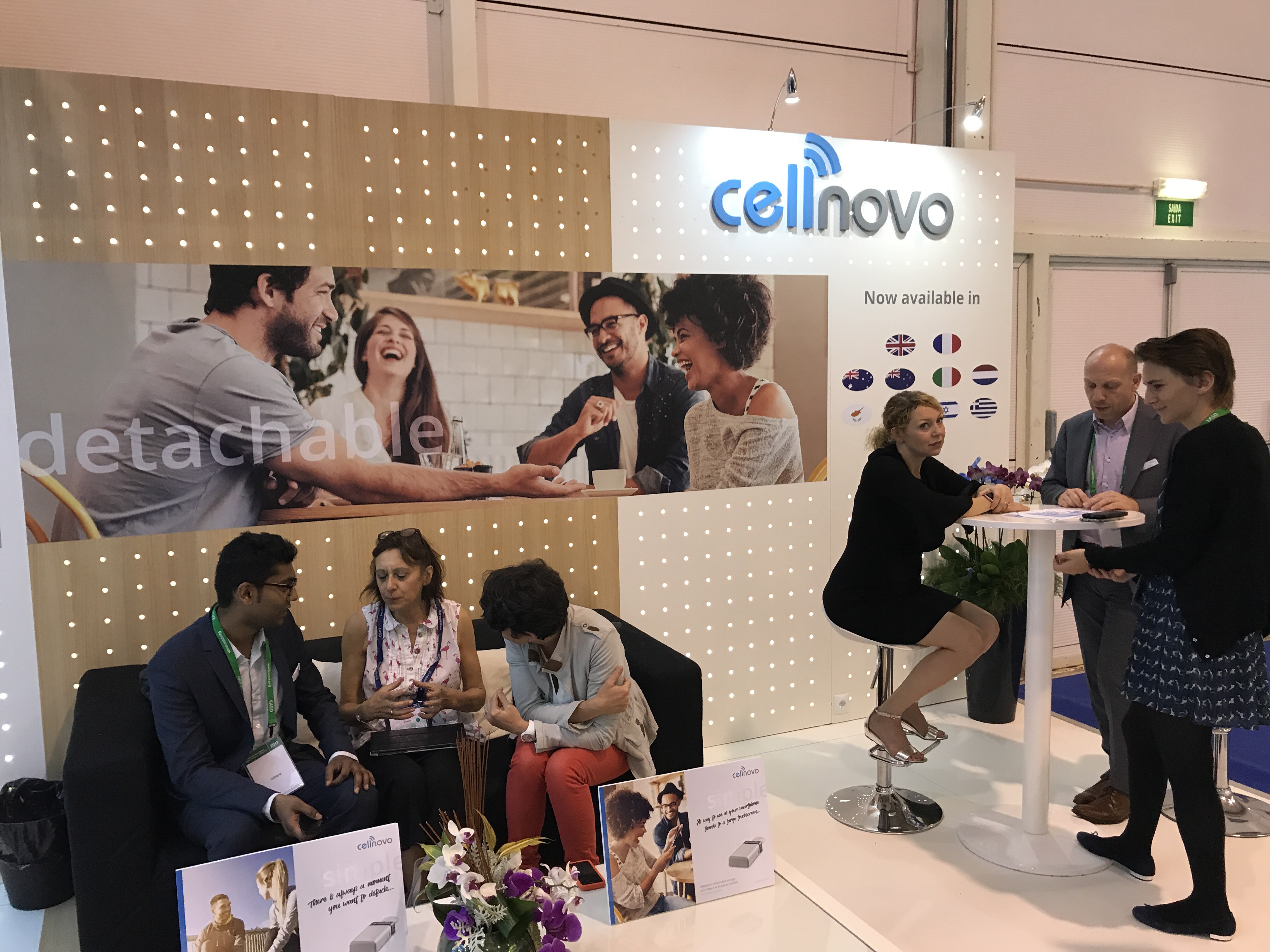
I said hi to the European Cellnovo staff (all of whom somewhat disconcertingly knew who I was). They are super excited about launching in Australia. There is nothing new from them at this stage (but you can read my initial thoughts on the pump here, and Frank Sita’s here.)
No stranger to the Australian market, DANA had a pretty damn big and glossy stand here at EASD, proudly branded with their somewhat odd tag line is ‘Ubiquitous insulin pump’. DANA in Australia (distributed via a third party) has had some issues in Australia recently – mostly to do with the availability of their infusion sets.

The most exciting news from DANA was their big EASD announcement of their new pump – the DANA RS. You can read Mike Hoskins’, from Diabetes Mine, scoop about it here, but the essence is that the pump is ‘Android OpenAPS-able’ without the need for an additional piece of hardware. This is a very big step in the very right direction for integration of pumps with the whole #WeAreNotWaiting philosophy and congrats to the team for embracing it.
What I’m far less enthusiastic about is that DANA has persisted with using a proprietary battery. I find this really, really appalling and utterly non-user-centric. This was the case with the previous DANA R pump, and to replace the battery, users needed to place an order for cartridges.
No idea when the new DANA will be in Australia… I guess it’s just a wait and see, but absolute credit to DANA for making it possible for people to use Android OpenAPS with a new pump.
Ypsomed (‘Ipso-med’) had their nifty Ypsopump (‘Ipso-pump’) on show and I had a little play. It’s fun – I like the look of it and it is super-easy to use. I’ve been told that they are heading down under, so please do watch this space!

And finally, the bright and shiny team from Kaleido were brightly and shinily showing off their pump again. It still is beautiful. It still is fun. It also still is not on the market. I really, really would like to see them actually get to launch stage. And soon.

Okay, so the pump wash-up in relation to Australia is this: it looks like we might actually start to have some real choice on the pump market in the (hopefully) not-too-distant future. I remain frustrated with the current situation, dismayed that if I wanted a new pump this very minute (which I am entitled to) my choice is a pump that is just too large and clunky with features that just don’t work for me, or exactly the same pump as I’ve been using for the last four and a half years. Come 1 October Cellnovo will be ready to go with consumables on the NDSS, and there is the first hint of improved choice for people with diabetes.
And that can only be a bloody good thing!
A recurring theme throughout last week’s ADS ADEA meeting in Perth was the need to manage expectations. I think, in general, we do a really lousy job of this in diabetes.
We’re told that can expect to live a ‘normal life’ after a diabetes diagnosis, when that’s not necessarily the truth.
We’re told we can expect to eat whatever they want, when really, the effort that goes into calculating medication doses depending on the nutrient value of our foods is hard and it may be easier for some to actually limit food choices to make things a little easier.
We’re told to expect a cure in five years’ time, when the truth is that a cure is not even on the distant horizon.
We’re told that we can expect new technology to significantly reduce the burden of living with diabetes, when the reality is that sometimes, it’s more – not less – work.
We’re told to expect person-centred care, when, really, our health system, is not designed to cater for the individual needs of people living with diabetes.
We’re told that emerging technology will be fully automated, smart and cure-like, but we are not told that there will still be human-input necessary and that the devices are not as smart as a functioning pancreas.
We’re told that if we keep our A1c below 7% we can avoid complications, and yet, there is no guarantee, and some of us do develop complications despite an A1c regularly hitting that magic number.
We are told that if we count carbs and dose the right amount of insulin at the right time, we can keep our glucose levels in range, often neglecting to be told that there are a lot of other factors at play.
We are told all this, and then, when these expectations are not met, we are told we’ve failed. Or we are disappointed.
Here’s the thing. The tools are actually really great. Our health system here in Australia is mostly terrific. The majority of our HCPs genuinely do want to give us the best care they can. We don’t need to oversell things as much as we do.
Our expectations are being set so realistically high, that it’s impossible to meet them.
So, THIS is what I would like to say about all the things I’ve covered above to help manage expectations:
Your life will be different after a diabetes diagnosis. But that’s okay. Your new normal is going to be different to your old normal, but hopefully, there will be very things that diabetes will prevent you from doing. Acting like a pancreas is not really normal, but you can do it!
Yeah, you can eat whatever you want. But it’s undeniable that certain foods are harder to manage after your pancreas decides to go on strike. Find what works for you – and that can change. But do be prepared for food to become something that can be a little fraught because you may find that some of your most favourite foods are a little difficult to deal with.
Researchers are brilliant and amazing and the advances in diabetes management are actually quite mind blowing, but a cure? We’re nowhere near that yet. Keep up to date with everything and try to mine through it to work out what is relevant for you. Keep getting excited about management and tech advances – but do keep it in perspective. (Also – consider the source. I promise you that the Channel 10 news or Buzzfeed is NOT going to be where you learn that diabetes has been cured forever.)
You are going to have a lot that you will want to know and work through, and possible a variety of healthcare professionals to see. As wonderful as it would be to have someone to coordinate it all for you, you’ll have to put in the leg work to find the right team, the right service and the right people. And then, once you’ve found them, it’s still up to you to direct what you need. Otherwise you might find yourself at the mercy of a system that is not really going deliver exactly what you need to get the most from it.
You may have heard that in the US there is a (hybrid-closed loop) pump/CGM combo. Some are calling it an artificial pancreas. It’s not. The tech is incredible, but it’s not fully automated. It still requires calibration and it still requires operator input. This is not me being negative, because the tech is exciting. It’s me being realistic about the level of automation
No new devices are going to completely remove the load diabetes adds to your life, or your involvement in their operation. Insulin pumps need buttons pushed; CGMs need calibration, food needs to be considered. Full automation may be the goal, but it’s a while off.
An A1c of 7% or below will indeed reduce your risk of developing diabetes-related complications and there is a lot of evidence to support that. But it doesn’t eliminate the risk. That’s the annoying and somewhat unfair reality of diabetes. Unfortunately, it’s the reality. Obviously, do what you can to manage your diabetes as well as you can. But don’t expect that a number is a guarantee of anything.
Carbs and insulin are only part of the equation. How you’re feeling emotionally, illness such as colds and flus, hormones, nutrients other than just carbs, the phase of the moon (well, maybe not) … all these impact on your numbers. And they change. Don’t expect that there is an equation that will work all the time.
In life, we’re often told to expect the unexpected. But in diabetes, the unexpected is often only that way because what we have been told to expect is unrealistic. If we were told the truth, and provided with realistic expectations from diagnosis – and throughout our diabetes lives, perhaps we wouldn’t feel that we’re constantly falling behind and failing.
Here’s me and my boss talking about expectations in technology.
Disclosures
Roche Diabetes Australia has covered my travel and two night’s accommodation for my stay in Perth as I am a presenter at the Roche Educators Day (RED). There is no expectation from Roche that I will write anything about the RED, but I expect I will because it’s always such an interesting and enjoyable day!
The remainder of my time in Perth is part of my role at Diabetes Australia.
New York in the rain is quite magical. That’s probably something only tourists say, but it’s what I was thinking as I emerged from the subway, way, way downtown on a cold and wet January afternoon early this year.
I hurried along the busy business district streets to my destination – an old cosy pub, chosen by the local I was meeting because of its historical significance (which you can read about here).
I was catching up with a diabetes friend – one of the smartest people in the game – to chat about what was going on in our respective diabetes worlds.
After a while, we started talking about how exciting new tech developments will be finally coming to market in just a few short years. And then, he told me about Loop, showing me his phone and briefly explaining what it was all about.
I was enthralled. ‘Wait,’ I said. ‘So, your iPhone now drives your pump? And basal rates are adjusted automatically?… Whoa! Send me all you can about it,’ I pleaded, after he promised that it wasn’t that difficult to set up.
This was back in January. It’s now August. In the intervening months, I read through the documents and have had conversations both on and offline about Loop and what it does. I searched through my diabetes cupboard for the pump I’d need (finding my old-school Medtronic 522 hidden away).
In May, I bit the bullet and ordered one of the components required to build my rig. About ten days later, a box arrived and inside was a tiny little computer and battery – my RileyLink. I took them out of their packaging, running my fingers over them gently… and then got scared and popped them back in the box, and left the box at the back of my desk.

Hello RileyLink!
Every time I sat down to work, I’d see the box and sometimes I’d take a peek inside again. And then I’d read the documents again, each time a little more committed to get started.
In San Diego, I chatted with a few people who had taken the leap to Loop, everyone telling me that it was life changing and also promising that it wasn’t too hard to set up. I kept having conversations on Facebook, Twitter and Instagram with people from all around the world who were Looping, every one of them urging me to get on the bandwagon and offering to answer any questions I’d have.
I joined Facebook groups, continued to read over the documents, and every time I was ready to go, I freaked out about how technologically advanced it all sounded, and how technologically inept I am, and shut everything away.
Until ten days ago. Ten days ago, I did take the leap. I read through the Loop documents another time. I told myself that I could do it. And I started. Step 1….
I hit a snag a few steps in, but fortunately was meeting a Twitter friend on Wednesday to chat. He is not technologically inept. In fact, he is the complete opposite and answered all my (probably rather silly) questions and didn’t even roll his eyes once.
I went home with Loop installed on my phone and proceeded to enter all my settings into it.
I played around with the app and before I knew it, I was blousing directly from my phone (rather than from my pump):

After a couple of days of running open loop, I took the plunge and switched to closed loop. And waited and watched. The circle on the top left hand corner of the app closed and I waited for the automation to begin. And begin it did!
‘OHMYGOD,’ I squealed to Aaron, as the first basal adjustment was made. ‘LOOK AT THIS! IT’S ADJUSTING MY BASAL RATES ALL ON ITS OWN. LOOK, BABE. LOOK!!! THIS IS JUST LIKE YOUR PANCREAS…Except it’s a mobile phone, mini-computer thingy, insulin pump and Dexcom. BUT I’M JUST LIKE YOU!!!’ To his credit, Aaron nodded his head, pretended he was as excited as me, and agreed that this was EXACTLY the same as a functioning pancreas.
I admit to being more than a little fascinated and obsessed with watching what Loop is doing and the accuracy of its predictions.

This morning’s waking Dex number. And the Loop app showing me how we got there…
I’m only a few very short days in and already, I can see that this is giving me a whole lot more insight into my diabetes. I had a very minor car accident the other morning and seeing the adrenalin spike, and how Loop managed to deal with it, was amazing. I would have rage bolused the spike which would have inevitably resulted in a low. Instead, I resisted the urge to bolus and allowed an increased basal adjustment to bring me back into range slowly and safely.
Obviously, as with everything to do with diabetes, Loop isn’t for everyone. But for me – firmly in a diabetes rut and living in pump limbo – this has been just what I’ve needed to get me re-engaged.

My clever mate David (who is running Open APS) 3D printed me a case for my RileyLink. In pink, to match my pump.
Wait! What is Loop? If you are interested in reading about Loop and how to get up and running, all the info is here.
It arrived in the post back in April: a little package from my pump company reminding me that my pump warranty was due to expire and it was time to start thinking about getting a new pump.
Inside the thick envelope was a shiny brochure with bright pictures of people looking very happy and excited with life, while wearing an insulin pump; the insulin pump the company was suggesting should be my new pump. The insulin pump that has been my insulin pump – the exact same model I trialled for the first time back in January 2013 and have been shoving down my bra for the last four years. Nothing new to offer; no design changes; no software upgrade. Exactly the same pump.
Today, I am walking around with an out of warranty pump. Does this concern me? Well, yes and no. If I didn’t have a couple of old pumps at home in my diabetes cupboard, I’d be far more concerned.
I don’t particularly feel any loyalty towards one particular pump or pump brand. I know that there are some people who are very much Team Pump Company A or Team Pump Company B. My feelings about pumps are they deliver insulin. I know that some have different bells and different whistles, but I just need something that is going to easily and accurately deliver the drug that keeps me alive.
Making the decision four years ago was a no brainer: I was desperate to use Dexcom, so I chose the pump that integrated with it. These days that’s less of an issue because I use G5, so integration with a pump is less of an issue.
To be honest, I’m a little cross. As someone who is clearly a Dtech enthusiast, it’s laughable that I would even for one minute consider committing for another four years to a pump that I have already been using for four years – and let’s remember, it wasn’t new when it arrived in Australia; friends in Europe had already been using the Vibe for a couple of years when we eventually got it here. Can you imagine committing to using the same model mobile phone for eight years?
Plus, it’s worth noting that the look of the Vibe is very similar to the Ping and 2020, both of which had been around for a number of years before the Vibe. The design is well over ten years old and you bet that’s important if I’m wearing the bloody thing 24/7.
My trial last year of the Medtronic 640G, truly the only real innovation in pump technology in recent years, left me cold. I found the sensor accuracy a problem, which negated the excitement I had about the SmartGuard technology. And I found the pump clunky and big, and struggled to get it to fit comfortably down my top.
If I’ve ever understood the reason for the whole #WeAreNotWaiting movement, it is right now. It’s why I started reading up on Loop and ordered what I need to get my own build underway. I’ve not had the time or headspace to actually do anything about it yet, but right now, it’s the only thing that is giving me any buzz about real diabetes tech advancements here and now.
So, for the time being, I’m in pump limbo (which sounds like an cheeky game that happens after a few drinks at a DOC get together, but really is not). I’ll get around to working out if I can manage to get Loop happening and see how I go with that. But I can’t see that there is any likelihood that, unless absolutely critical, I’ll be getting a new pump soon. My PHI will be pleased about that. Even if I’m not.
I’m a little cranky this week. At least, that’s how it may seem with some of the ways I’ve been responding to things I’ve seen online.

Yesterday, mice were cured again which was awesome and wonderful if I were a mouse, as suggested in the photo to the right.
Alas, I am not, so I felt the way I usually do when I hear of diabetes disappearing in rodents – ambivalent, as I crabbily pointed out to anyone who would listen. (It was quite timely when this article came across my radar which did a good job explaining how mice and humans are different and therefore what works for a mouse may not work for a Renza…or any other human.)
And then there was Monday’s post about the Twitter discussion about how much power and influence healthcare users have in the healthcare system (spoiler alert: the answer is very, very little…).
But today, I’m writing about an ongoing Twitter discussion that has me shaking my head for different reasons.
I wasn’t around the diabetes world when home blood glucose monitors came onto the market. I was handed a meter the day I was diagnosed in 1998, and I was able to take myself off to an NDSS outlet and pick up strips. Blood glucose monitoring was expected then, and I was easily able to access what I needed to meet the recommended glucose monitoring treatment I was prescribed. I remember being told just how essential it was that I prick my finger and check my glucose levels before meals and before bed – at least. This was the technology that was readily and affordably available to people in Australia and healthcare professionals were very, very in favour of using it.
But it wasn’t always the case.
In the early 1980s, home blood glucose meters started being offered to people with diabetes to take home and use. It was the start of self-monitoring blood glucose (SMBG) – before this, it was all about weeing on a stick and analysing colours. The advent of SMBG is certainly one of those moments on the diabetes timeline that stands out as an important step in diabetes management and improved care.
At the time, there was a lot of criticism of this new-fangled device, with many HCPs believing that it wouldn’t take off, the expense was needless and that there was not enough evidence to support the ongoing subsidisation of such technology. According to a short reflection piece to BMJ in May 1998, the introduction of SMBG had clinicians believing home glucose monitoring ‘a dangerous practice’.
As insulin pumps became more popular, the same attitudes were emerging and in 2001, when I decided I wanted to start on a pump, I had to doctor shop before I could find an endo who would agree to filling out the necessary paperwork. The reasons for refusing my request ranged from ‘You’ve not had diabetes long enough yet,’ (I started on a pump almost three years after diagnosis) to ‘They’re not safe’, and ‘There’s no evidence a pump will improve your A1c’, to which I replied ‘Okay – but will it let me sleep in on a Saturday morning and present more flexible food timings and options? Because my quality of life is seriously impacted on having to freedom to live my life because of the restrictions my current diabetes treatment regimen demands and I am becoming burnout and resentful of it right now.’
I wish I could say that these ideas ceased when I started on a pump, but we still hear today people being refused pump therapy for a litany of reasons that, quite frankly, don’t hold water in most cases.
And then, the arrival of CGM was met with exactly the same reaction. ‘It will make people obsessive,’ and ‘there’s no evidence to suggest that it actually improves clinical outcomes and A1c’ and ‘It’s a gimmick – we have blood glucose monitoring that works just fine,
This, despite a recent talk I attended at ADA where endocrinologist, Steve Edelman from TYOCD declared:

Which brings us to the the Twitter discussion this week which centred around FreeStyle Libre and concerns that there is not enough evidence to warrant subsidy of the product in the UK (following a report on the device from NICE in the UK). Arguments shared in 140 characters or fewer very much centred on the lack of evidence about the Libre.
I understand the arguments: clinicians were calling for randomised control trials (RCTs) to provide the evidence they feel comfortable with before they are willing to recommend a product: they want evidence to support clinical outcomes (i.e. lower A1c).
The problem here is that RCTs are costly, take a lot of time and often don’t measure anything more than clinical outcomes. Plus, they are rarely, if ever, co-designed by the people impacted by whatever is being studied.
It was the same sentiments as when other new tech was released into the market. Often it’s new diabetes tech that provides the user with more information, more data….and more control over how and what they are doing to manage their diabetes.
The pattern repeats itself each time there is something new: clinicians are wary (which, it could be argued is their role), people with diabetes are excited. In the case of Libre, I know of many people who, after years of refusing to measure their blood glucose due to pain and intrusion, have started actively monitoring their glucose and making meaningful treatment decisions due to the ease of Libre. One woman said that it has meant that for the first time in over a decade she feels she actually has some idea of what is going on with her glucose levels which has resulted in her making smarted food choices.
As I read the tweets, I started experiencing very strong feelings of déjà vu. And I also was once again reminded of why so many subscribe to the #WeAreNotWaiting movement. And I ask: Is it any wonder that people are hacking diabetes devices and building their own systems to do what we want them to – what they are capable of doing – now?
P.S. Just a reminder that there is currently a stakeholder engagement underway following a submission to list FreeStyle Libre on the NDSS. You can read all about it here (where you’ll also find the link to take you to the survey).
I travel a lot for work. Day trips interstate for meetings or giving talks are a regular feature in my working week. This week, I’ve had two early morning starts with two separate trips.
I have the airport routine down to a fine art. I arrive at the airport, make my way to the express lane through security, whipping my laptop from my bag, any bangles from my arm and emptying my pocket as I walk. I know which shoes trigger the metal detector and which don’t. I get through and then there is exactly enough time to get to the lounge, grab a coffee and make my way straight to the gate just as the plane is boarding. I sit down, grab what I need from my bag before tucking it under the seat in front of me and usually fall asleep within a few minutes, or read whatever book I’m carrying around with me. From arriving at the airport to being settled in my seat is usually about 20 minutes.
On a recent flight, nothing was out of the ordinary. It was early – I was half asleep as I sat down on the plane. It was still dark outside and I didn’t fall straight asleep as I needed to keep an eye on my CGM trace for a little. I’ve been hypoing out many mornings and I wanted to make sure that I was okay before settling in for the flight.
The temp basal rate I’d set in the cab to the airport had more than done its job and I was not too worried about going low – especially with the milky coffee I’d just finished.
I pulled my pump from my bra and, with the press of a few buttons, turned off the temp basal rate and gave myself a small bolus for the milk. I tucked the pump away again and then checked the Dex widget from the home screen of my phone, confirming the number on my Apple Watch.
I was on autopilot as I usually am when doing these sorts of diabetes chores. Buttons pressed, I pulled my book from my bag and started to read, completely oblivious of my surroundings. The plane took off and I was starting to get sleepy, so I put down the book on the seat next to me.
As soon as the seatbelt sign was turned off, a flight attendant leaned over to me. I was the only person in the row. I looked up and noticed that there were two other flight attendants standing there.
‘Excuse me, Ms Scibilia,’ she said.
‘Yes. Hi,’ I said, smiling, wondering what was going on.
‘Are you able to please tell me what you were just doing.’
I was confused. I had been reading. I showed the flight attendant my book.
‘No,’ she said. ‘Before that. You seemed to have some…machines?…or a box?…Down your shirt…? And checking your phone.’ She was searching for the right words to use and it took me a moment to realise what she was asking.
‘Oh,’ I said. ‘Um…I was just pressing some buttons on my insulin pump.’
It was the flight attendants turn to look confused.
‘I have diabetes. It’s how I deliver insulin. I needed to adjust some of the settings and give myself some insulin.’ I explained. I pulled the pump from my top and showed her.
‘I also wear a device that measures my glucose levels and it transmits to my phone….and watch. I was checking the numbers.’
I showed her. And then added quickly. ‘It’s Bluetooth. The phone and watch are both on Airplane Mode.’
‘Oh,’ she said, turning to the two other attendants behind her and quietly repeated what I had just said.
‘Do you have some sort of documentation about having diabetes?’ she asked.
Now I was really confused. This was a quick flight interstate. I never carry my doctor’s letter when travelling domestically and have never, ever needed it before – not at security and certainly not on board a flight.
‘Um…no,’ I said. ‘Oh, wait! Yes! I have a card for the NDSS. Hang on…’ I rummaged around in my bag searching for my purse.
‘Here. This is the card that gets me subsidised diabetes products,’ I said, pointing out the word diabetes on the card and then turning it over to show the information on the back.
She took the card and showed it to her colleagues.
‘Okay,’ she said. ‘I’m sorry. A passenger mentioned they had seen you pulling something from your shirt and they were a little concerned about what you were doing. I’m sorry for troubling you.’
I half smiled and said that it was all fine, but I realised I was fighting back tears as I did. Had someone thought that I…? I couldn’t even form the words in my head. What did they think when they looked at me?
I felt really self-conscious for the rest of the flight. I’ve no idea who spoke to the flight attendant. I looked around and noticed that most of the people nearby were on laptops or tablets or checking their phones. Everyone has a device …. What was it about mine that had set someone’s mind to thinking that I was going to do something nefarious?
Are people on heightened alert in the wake of the recent terrible events around the world? Is it general anxiety about devices and suspicious little black boxes? Are people noticing more, watching more, reporting things that ordinarily would be completely overlooked?
Would I notice if someone around me on a plane – or a café or in a park or on the street – was fiddling with a medical device? Maybe, but then I have a sixth sense about it, always looking for a new diabetes best friend in the wild!
I sat quietly for the remainder of the flight, my book open, but unable to concentrate. I read the same paragraph over and over. Diabetes is meant to be an invisible condition, but at that moment, there was a neon flashing sign above my head – an arrow pointing at me announcing that there was something not quite right – and I felt very, very conspicuous and very, very vulnerable. And I didn’t like it one bit.
The ATTD conference is, by its nature, very technology-centric. This is absolutely not a negative; in fact, it was one of the reasons that I had always wanted to attend because I am such a DTech junkie.
However, as it turns out, it wasn’t the promise of hearing about, or seeing, the latest devices that had me most excited as I perused the program, setting out my schedule for my busy days in Paris.
No, it was this session on the afternoon of the Thursday that really piqued my interest:
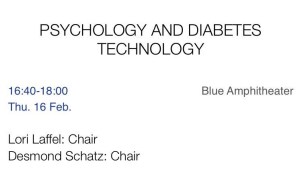
I knew we were off to a good start when session co-chair and first speaker, Dr Lori Laffel, flashed this slide up, announcing ‘Diabetes is Stressful’.

Sometimes, there is an assumption that diabetes technology automatically reduces stress. To a degree – and for some – that may be true. For me, the thought of wearing CGM all the time reduces the stress of not being aware of hypos. But it also adds stress with the never-ending, pervasive data data-feed.
There was also this dichotomy that so many of us face:

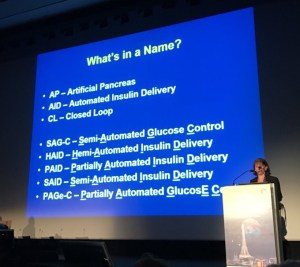
Acknowledgement of the terminology we use was a welcome addition to this talk. I think that at times our expectations are not being particularly well managed with the way technology is named.
Expectations were covered again when Dr Kath Barnard took the stage.
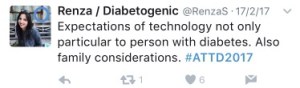
I love that Kath discussed the responsibilities of health psychology researchers when it comes to improving the outcomes of tech. She mentioned the importance of developing and using device-specific measures to assess psychosocial impacts on both people with diabetes as well as their carers. Most important was the point of ensuring robust and consistent psychological assessments in clinical trials to better understand participant experiences. This often seems to be a missing component when it comes to researching technology.
This is a recurring theme from Kath: that the juggernaut of diabetes technology advances needs to stop being only about button pushing and changes to clinical outcomes if their full potential is to be realised.
It’s important to note Kath is not anti-tech – in fact she frequently acknowledged the ground-breaking nature and significant potential of diabetes technologies. But her dedication to individualising technology use for each person with diabetes is her over-riding message.
Overall, the take-home from this whole session was this comment from Kath, which became a mantra for me for the remainder of the meeting: 
Next up, Dr Andrea Scraramuzza from Italy explored the human factor in technology in paediatric diabetes, however his talk was relevant to adults too. Human Factor brings together information from psychology, education, engineering and design to focus on the individual and their interaction with products, technology and their environments with the aim of better understanding the connection between human and technology.
I really loved this presentation because it brought home the idea that it doesn’t matter how whiz-bang the tech is, if the education is not right, if human limitations are not considered and if people with diabetes are not willing to learn – or clinicians are not willing to teach – the potential of that tech will never be reached.
The session closed with the always brilliant Professor Stephanie Amiel who spoke about hypoglycaemia – specifically, where to go when the technology hasn’t worked. I thought this was a really sensible way to round out the session because it reminded us all that technology is never a silver bullet that will fix all situations. Sometimes, we need to revert to other ideas (possibly alongside the technology) to search for solutions.
I was really grateful for this session at the conference. All too often psychology is ignored when we talk and think tech. The focus is on advances – and the speed of these advances – all of which are, of course, super important.
But it is undeniable that alongside currently available and still-in-development technology is the fact that there is a very personal aspect to it all. Whether it be considerations of actually attaching the tech to our bodies (unfortunately this wasn’t really discussed) or tech fatigue and burnout, or simply not wanting to use the tech, this is the side of diabetes and technology that needs to be researched and understood because how we feel about using the tech absolutely impacts on the results we get from it.
Well done to Professor Tadej Battelino and the ATTD organising committee for including this session in the ATTD program. It really was most useful and hopefully the HCPs and researchers in the room walked out thinking a little differently. I know that there were a lot of advocates in the room who really appreciated the session – because we always are thinking about this side of diabetes!
I do, however, have a challenge for the organising committee. As excellent as this session was, it could have been even better if they had dedicated some of it to hearing from people with diabetes talk about this issues being discussed by the clinicians and researchers. That would have really brought home the message. Perhaps next year…?
Disclosures
My flights and accommodation costs to attend the Roche Blogger #DiabetesMeetUp were covered by Roche Diabetes Care (Global). They also provided me with press registration to attend ATTD. My agreement to attend their blogger day did not include any commitment from me, or expectation from them, to write about the day or their products, however I have shared my thoughts on the event here. Plus, you can read my live tweets from the event via my Twitter stream.





 Diabetogenic