
You are currently browsing the category archive for the ‘Loop’ category.
Do you remember life before diabetes? It’s getting harder and harder for me to. I had 24 years without diabetes, and occasionally, I’ll look at a photo from the BD years and think about how much simpler my days were.
Today, I’m wondering how much I remember diabetes before I started using automated insulin delivery (AID). It’s been eight years. Eight years of Loop. Happy loopiversary to me! Diabetes BL (before Loop) felt heavier. And scarier. I remember those months just after I started looping and how different things felt. I remember the better sleep and the increased energy. I remember a lightness that I hadn’t experienced since I was diagnosed.
That’s now my “diabetes normal”. Life with Loop is simply easier than life BL. On the very rare occasions I’ve had to DIY diabetes, it’s been a jolt as I’ve realised just how truly bad I am at diabetes. Embarrassingly bad.
While there was a stark difference back then between people who were using DIYAPS and those who were using interoperable devices on the market, today that difference is less. AID systems are not just for people who choose to build one for themselves. These days, it’s so great to know that there are commercial systems available which means more people have access to AID. We can debate which algorithm is better or whether a commercial or an open-source system is better, but I think that’s a little pointless. If people are doing less diabetes and feeling happier, better and less burdened, it doesn’t matter what they’re using. Your diabetes; your rules!
Eight years on, and despite there being commercial systems I could access, I’ve decided to keep using Loop – the same system I started on 8 years ago. The changes I’ve made are the devices with which I am using Loop. My pink Medtronic pump has been retired, along with the Orange Link (which was obviously in a pink case). Instead, I now use Omnipod, a single device instead of two which has further simplified my diabetes. It’s also meant not worrying about a working back up Medtronic pump, and it means carrying less bulky supplies when travelling.
These may all seem like little things, but they add up.
My decision to not move to a commercial system has been based on a couple of different reasons. I always said that I wouldn’t move to something that required a trade-off whereby any of the convenience of Loop was compromised. I’ve been blousing from my iPhone or Apple watch since 2017, and I refused to let that go. In my mind, having to wrangle my pump from my bra or carry an additional PDM to bolus was a step backwards. Of course, this is now available on some commercial systems, and it’s been super cool to see diabetes friends have access to something that does make diabetes a little less intrusive.
The customisability of Loop has meant that my target levels are set by me and me alone. The lower limit on commercial systems is not what I like mine set at. I wasn’t prepared to sacrifice the flexibility of personalised settings fora one-size-fits-all approach.
I do understand that there are pros to having a commercial system. Having helplines to trouble shoot and customer support on call is certainly a positive. Knowing that an annual Loop rebuild (always anxiety inducing because …well, technology?) is upcoming is stressful. And the worry that the update will break something that’s been working perfectly.
And yet, measure for measure, the decision to continue to use Loop has been very easy.
I still thank the magicians behind open-source technologies for their brilliance and generosity every single day. I’m grateful for the algorithm developers, the people who have written step by step instructions that even I can follow, and I am so thankful for the people who have tried to make devices more affordable. I believe that device makers do genuinely want to make diabetes simpler and help ease the load of diabetes. But in my mind, it’s undeniable that user-led developments have been more successful in actually making diabetes easier. These magicians know firsthand just what it means to claw back from diabetes.
In the end, the goal for me has always been clear: I want diabetes to intrude in my life as little as possible, and I will avail myself of anything that helps. It’s why I continue to use an Anubis even though there is no out of pocket cost for G6 transmitters. Using an Anubis means I change my sensor when it’s getting spotty, not when the factory setting insists, and the transmitter last six instead of three months. See? Fewer diabetes tasks. Less diabetes. That’s the whole point. (And it’s also why I’m hesitant about moving to G7)
When I try to quantify how much less diabetes, I just come back to Justin Walker and his presentation at Diabetes Mine’s DData back in 2018 when he said ‘By wearing Open APS, I save myself about an hour a day not doing diabetes’. Eight years down the track, that’s 2,922 hours I’ve gained back. That’s almost 122 days. It may be thirty seconds here, a minute there. But it adds up. And that time is better in my pocket than in diabetes’.
And so, here I am. Eight years on. With diabetes in the background as much as it can be with the tools I have available to me. I still really don’t like diabetes. I still really resent it takes up the time and brain space it does, and I still want a cure for all of us. Damn, we deserve that.
But in the meantime, I’m going to keep leaning into what the community has done for the community and know how lucky I am to benefit from that knowledge and expertise. Never bet against the T1D community. We know exactly what diabetes takes from us every day. And exactly what it takes to give some of it back.
More on my experiences with Loop
That time I scared the hell out of healthcare professionals
What looping on holidays looks like
A list of how Looped changed my diabetes life (and all of it is still relevant today!)
Postscript
As ever, I’m very aware of my privilege. Access to AID is nowhere near where it should be. If we look at the Australian context, insulin pumps remain out of range for so many people with T1D thanks to outdated funding models. Remember the consensus statement developed last year? And beyond our borders, technology access varies significantly. As a diabetes community, we are not all beneficiaries from this tech until every single person with diabetes has access. And that starts with affordable, uninterrupted access to insulin, right through to the most sophisticated AID systems, to preventative treatments, to cell therapies.
‘A fire has been lit.’ They were the words I wrote in my first post about AID access in Australia earlier this year.
There are some truths about grassroots advocacy that I have always known to be consistent. It has to come from community. If the issue isn’t important to a significant number of community members, nothing will happen. Advocacy efforts are truly organic. To be real and honest to the consultation process, there cannot be any pre-conceived ideas about the results of that consultation. Or rather, there needs to be an acceptance that agility and swift pivots are necessary if that is what the community directs. And there needs to be meaningful engagement every step of the way, with a genuine belief that expertise lies with all stakeholders, in particular people with lived experience. I am so pleased that this was the foundation and ran through every single step of the way with our AID grassroots advocacy over the last few months.
After months of working and meeting with the community, it was time to bring all stakeholders together. In May, I was so honoured to co-chair the National AID Access Summit with Professor Peter Colman. Again, this was always part of the plan – a clinician and a person with lived experience chairing the meeting to signpost how critical it is to have input from different cohorts. Unashamedly, we had almost as many people with lived experience as others in attendance, because that’s the way to centre people with diabetes. We also had independent facilitators directing traffic. This was important because we didn’t want there to be ownership of this work by any individuals or organisations. This wasn’t anyone’s show; it wasn’t anyone’s vanity project. This was a community endeavour. You know, with and by for people with T1D, not for us!
The outcome from the Summit, and the work that led to it, is a consensus statement that offers clear, concise recommendations. Stars aligned, and the statement was completed the same week as the Parliamentary Inquiry into Diabetes report was tabled. And that alignment was even more significant, when our recommendations neatly mirrored those in the report.
The consensus statement can be accessed and shared here, as well as from the survey for equitable access to AID that has been signed by almost 6,000 people.
Now, it’s over to the community. We have recommendations from the parliamentary inquiry, but that’s not enough. It’s now time to do the work to turn that into policy. And that’s where people in the community come to the fore once again. Today, I wrote to my local MP to ask for a time to meet with him, sharing with him the consensus statement. I am going to highlight just how important this tech is and how it’s not fair that only those of us who can afford it have access. The better outcomes AID delivers should be available to everyone with T1D, not just those who can afford private health insurance, or meet the eligibility for our Insulin Pump Program.
If you’re interested and able to get involved, please do. It is the groundswell of community efforts that has in the past seen some truly remarkable results. If we look back to the path to CGM access for all people with T1D, the community stepped up in truly remarkable ways. It took time, and it took energy, but we got there because people with diabetes never stopped pushing for it. Being able to access CGM really mattered to people with T1D and their families and that drove the ‘never give up’ attitude to get it done.
Now, it’s time for all Aussies with T1D to have access to AID if they choose. This update from the Access to AID Survey has some great ideas about how you can get involved. And reach out to me if you want any ideas.

‘Why would you bet against the type 1 community?’ That was a question asked in a session at the ISPAD conference a couple years ago. It wasn’t someone with T1D drawing attention to the community. Instead, it was said by someone working in global health who had seen the remarkable efforts such as the #WeAreNotWaiting movement and grassroots, peer-led education initiatives in low-income countries. These efforts have driven change and improved lives of people with diabetes. They have been led by those with lived experience and supported by other diabetes stakeholders. But the starting point is people directly affected by diabetes identifying a problem, solving it and leading the way. In the history of diabetes – from the first home glucose meters, to building systems leveraging off existing technologies, to global advocacy movements – community powered initiatives have been a driving force for change.
And so, here we are today, coming together once again to advocate for better equity and fairness for all people with type 1 diabetes, this time in Australia, and this time advancing access to automated insulin delivery devices (AID).
Insulin pump funding is broken. AID is standard care and yet far too many people are left unable to use the tech because of how pumps are funded in Australia. Right now, unless a person with T1D has the right level of private health insurance, or meets the criteria for the Insulin Pump Program, they must find the funding for an insulin pump. That needs to change.
We know how to do this in Australia. The reason that pump consumables are on the NDSS is thanks to community advocacy efforts back in the early 2000. And more recently massive community noise helped to get CGM onto the NDSS for all Australians. Of course, these wins worked because everyone was involved in advocacy: people with lived experience of diabetes, healthcare professionals and HCP professional groups, researchers, diabetes community groups and organisations and industry. What a lot of noise we can make when we’re singing from the same song sheet!
Right now, attentions are razor focused on improving access to automated insulin delivery systems because the evidence is clear: AID reduces diabetes distress, improves quality of life, and (for those who like numbers!), help with glucose levels. And as an added bonus for the bean counters – it’s a smart, cost-effective investment for our health system.
If AID is standard care, financial barriers preventing people from accessing it need to be eliminated.
And that’s where we would love your help.
Please sign and share the petition that has been started by Dr Ben Nash and supported by a group of people with T1D (including me). Petitions are a great way to get people talking and interested in a topic. It builds momentum and helps contribute to whole of community conversations. While we know the T1D community is already on board, we’ve now seen a number of HCPs, community groups and diabetes organisations share and promote the petition and are keen to get involved with broader advocacy efforts. That’s pretty cool!

Postscipt:
Understandably, there are questions about why this work is specific to T1D technology access. That’s a fair question and I think that our very own Bionic Wookiee provided an excellent explanation of that when he said this in a social media post earlier this week:
‘AID systems were developed for T1D (where they can track all the insulin going into the system without having to cope with the body’s variable insulin generation). So right now they mainly apply to T1D…
Expanding CGM and pump access to people with other forms of diabetes than just T1D is important for the future. Having wider access to AID for the T1D population will be a beach-head for that.‘
And in a conversation I had about this with UK diabetologist Partha Kar yesterday he cautions that there needs to be a starting point because the sheer numbers of diabetes can be daunting and tend to scare policy makers. He also points out that when it comes to outcome modifying interventions, technology is THE thing in T1D, whereas in other types of diabetes there are other options. I’ll add that those other options often have stronger evidence which is why they already have funding.
Hasn’t it been terrific this week seeing a couple of great news stories in the T1D tech world? Our friends across the ditch in NZ have welcomed an announcement from medical regulatory board Pharmac that all people with type 1 diabetes will have access to CGM and automated insulin delivery devices (AID). Meanwhile, this week saw the start of a five-year national roll out of AID in England and Wales which recommends access be granted to children and adolescence (under 18 years) with T1D, pregnant people with T1D and adults with T1D with an A1c higher than 7%.
So, where is Australia when it comes to people with T1D being able to affordably access automated insulin delivery devices?
Let’s start by highlighting the positives. There’s so much to be grateful for here in Australia. The NDSS continues to be a shining light for Australians with diabetes. Syringes and pen tips are free at NDSS collection points and BGL strips are subsidised. Since 2004, insulin pump consumables have been on the NDSS, CGM sensors and transmitters have been subsidised since 2022. Insulin is heavily subsidised by the PBS.
But even with these benefits diabetes remains costly, and the playing field isn’t level. Pumps remain out of reach for many Australians. Without private health insurance or meeting eligibility to apply for the government funded Insulin Pump Program, people with T1D are required to find up to $10,000 for an insulin pump. That’s simply not affordable and it means that Australians with T1D can’t access AID.
With AID providing real life-changing benefits and significant reduction in diabetes burden, now is the time to ensure that the tech is available to everyone with T1D who wants it – not just those who can afford it. And that means that it’s time to equitably fund the missing piece of the AID puzzle: Pumps.
A fire has been lit. From a small meeting at ATTD in Florence to catch ups, coffees and phone calls back home, the groundswell has well and truly started. People with diabetes are central to this, working closely with motivated and determined HCPs and diabetes community organisations. There is a united focus on what needs to be done: affordable insulin pumps so AID is a reality for every Australian with type 1 diabetes who chooses. And excitedly, there seems to be an appetite for this from policy makers.
So what can we learn from the recent successes in NZ and the UK? Well, it’s exactly what we know from our previous advocacy experiences and wins here in Australia. A united stakeholder approach is critical with everyone from individuals with diabetes, community groups, diabetes organisations, professional bodies, researchers, industry all being clear and consistent about the ask. Simple and effective communication about the issue is needed. Community drives the momentum – it always does and recognising that is essential. Using evidence to support why AID must be available to all with T1D is important, and goes perfectly with sharing examples of lived experience to highlight the benefit of the technology. Hearts and minds.
With the push already well established and a number of people powering the charge, it’s inevitable that the diabetes world in Australia is going to be hearing a lot about equitable AID and pump access in coming months. Keep an eye out on community groups for grassroots efforts to elevate the issue and for calls to get involved. We know that we can get this done – just as with getting CGMs funded for all people with T1D, for finding a novel way for Omnipod to be funded, and for Fiasp remaining on the PBS. (And, if we look further back, for getting pump consumables on the NDSS.)
Community will be critical to getting this across the line. Once again, we’ll need people with diabetes to step up and write letters, meet with local MPs, make noise, and show why this is necessary. Every single person with T1D and their families has a role to play here. If you’re already fortunate to be using AID, meet with your local MP and tell them how it has changed your life. If you haven’t had access, write about why you know it will help. For me, I’ll be talking about how much time I have grasped back not needing to do diabetes, how I have far fewer hypos, how I have an A1c in the ‘non-diabetes’ range which evidence suggests reduces my risk of developing costly complications. But most importantly, it has reduced my diabetes burden so much and that makes me a far happier, more productive person. And I want that for everyone with T1 D.
Postscript: a quick word (or two) about language. Media reports, especially in the UK, have incorrectly referred to the technology as an ‘artificial pancreas’. What we are talking about is automated insulin delivery devices (or hybrid closed loop systems). It’s important to get the language right for a couple of reasons: Artificial pancreas is simply not the correct term for what the technology is. It overstates what it does and potentially leads people to think the technology is a cure for T1D. Additionally, it underestimates the work that PWD do to drive the technology. More detail about why getting the terminology right is important can be found in this piece I wrote back in 2015 about the same issue and then again here from almost exactly two years ago.)
I’m introduced most generously by Adrian Sanders, Secretary General of the Parliamentarians for Diabetes Global Network.
On the day I was diagnosed with diabetes I was given a blood glucose meter. It was a nondescript cream colour, came in a dark blue padded bag and took 20 seconds to count down before giving me a reading, as was norm back in 1998. I can’t tell you much more about it.
In 2001, I got my first insulin pump: a Medtronic 507C. I think it was black. That’s pretty much all I remember about it.
Sometime in 2004, I upgraded to a Deltec Cozmo pump as soon as it was launched in Australia. It was a beauty – a charcoal grey, wonderfully organic design that felt sublime to hold. It was smart and cute, with a heap of features my first pump didn’t have. I loved the bolus wizard, and credit it a lot with the incredibly tight glucose management I maintained while pregnant with my daughter. That was the pump that was in the operating room with me when she was first handed to me, and it was nestled down my bra for the two years I breastfed her. She would hold onto the pump tubing in her tiny baby paws while she nestled into me for a feed. I was heartbroken when Deltec went out of business because I knew I’d need to change pump brands when the warranty was up. My old Cozmo is in a box in my diabetes supplies cupboard, too precious to throw away. To this day I think of that pump fondly and get all excited when someone else mentions how they used one, reminiscing about their love for it.
Since then, there have been a couple more pumps and countless blood and continuous glucose meters. I have limited memories of any of them. Oh, except for maybe the pink MDT paradigm I rebooted when I started DIY looping and still use today. But my fondness for that particular device is mostly because it’s pink. There was the iBGStar – a fun little gimmick because it attached directly to the charging point at the bottom of an iPhone. Remember? It was around for all of about 15 minutes because the next gen iPhone used different chargers and iBGStars were relegated to the DTech museum.
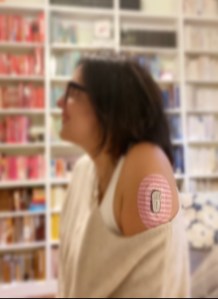
Really, there has only been one piece of kit that stands there next to that Deltec Cozmo. And it’s this (slightly blurred) baby you see on my arm. My Fenix.

I have been using this same transmitter pretty much continuously since June 2018. It’s a rechargeable Dexcom G5 and has worked like a dream. Other than a few months where I was gifted some Dexcom G6 products, I’ve exclusively had this Fenix attached to my arm. It has worked like a dream and has saved me a fortune. How much?
The retail cost for Dexcom transmitters here in Australia is $540 (now available fully subsidised on the NDSS for people with type 1 diabetes). For the last four years, I’ve forked out exactly zero dollars. Had I been purchasing a new transmitter every 3 months, I would have paid $8,640. That’s a lot more than zero dollars. In fact, it’s about the price of a second-hand 2012 Fiat 500.
Where did I get this remarkable piece of kit? From a bloke called Simon who lives in rural Victoria and has been an absolute marvel in the way he has been providing affordable CGM kit for people with diabetes not just in Australia, but around the world, so they can use what they need at an affordable price. He re-batteries transmitters and forwards them on; answers questions about loopable pumps so that people can reap the rewards of DIYAPS. He is at the end of the phone or Facebook messenger to answer questions. He has also found a way to extend the use of G6 transmitters, with the Anubis.
My Fenix is one of the simplest, least fussy DTech devices I’ve used. It works the same way as any Dexcom transmitter, except that after about three months, instead of being thrown in the bin, it gets plugged into the wall for an hour to recharge. Simon created a super simple reset tool to override the factory-set cut-off timer built into Dexcom transmitters, so the ‘Transmitter expiring’ warning was just a reminder to reset it next senor change.
I’ve done this for over four years.
At diabetes conferences, after spying the slightly odd-looking device on my upper-arm, Dexcom reps have stopped me as I’ve been rushing by to ask about it. Most want to know if it’s ‘one of those rechargeable ones’ – they all knew about the mythical Fenix! – and were always interested to know just how it worked. I had dinner one night with a senior engineer from Dexcom who asked me dozens of questions and was delighted to hear about it. I only had one question: I wanted to know that if a bloke in Victoria’s High Country could make this happen and make this life saving tech cheaper for people with diabetes, why couldn’t a multi-million-dollar tech company do the same? I didn’t get an answer to my question.
My Fenix is retiring because I’ve worked my way through my G5 sensor tash. Even though Dexcom G6 was launched into the Australian market over 12 months ago, I have happily continued to use the earlier generation with sensors either purchased or gifted from friends overseas who have been forced to upgrade. I haven’t minded that the sensors have been out of date (sometimes by years!) because it was never an issue. Plus, it meant that I could continue to use my Fenix.
The ingenuity and generosity of people in the diabetes community will never stop to amaze me. I reckon Simon could charge a fortune for his inventions, but he doesn’t. He covers his own costs, (but only sometimes; he donates a lot to people who can’t afford to pay). He is another example of a remarkable person in our remarkable community trying to make diabetes a little less burdensome. And my Fenix has meant four years of that.
When I talk about the diabetes kit I wear each and every day, I am at great pains to point out just how important it is that it does a lot more than just simply work. It needs to be simple, accurate, and not cause more stress. Skin in the game is literal and figurative when I stand up and speak about this, including how we literally and figuratively get attached to the devices that we love. I’d keep using my Fenix forever if that was the only CGM technology available to me because not once did it cause me any stress. It just made my life simpler; it reduced my diabetes burden, saved me money, and helped me hate diabetes a tiny bit less. My Fenix rose for the last time a couple of weeks ago, and now retired, lying in the same box as my Cozmo – reminders of how great DTech can be.
What’s the holy grail when it comes to diabetes technology? I suspect the answer may change depending on who you ask. Different people with diabetes, different ideas of burden, different priorities. But one thing that seems to be quite universal is that people with diabetes want to do less when it comes to their diabetes, and they want tech to help with that.
Each and every week, I get asked to review or promote new apps, devices and other types of technology. Or I am asked if I can provide some feedback on an idea which has the aim of improving the life of people with diabetes.
When time permits, I’ll spend some time with developers, and I always start by asking ‘What’s your point of difference?’. I want to know that because there’s so much out there already, and if it’s just another app or program to add to the noise, why bother?
The point of difference I am always searching for is the bit that means doing less. Anything that requires more input or thought process than what is currently available, without offering benefit elsewhere seems to be a waste of time.
I want to do less for more. Surely that’s not asking too much…
For me these days, if I want to check my glucose level, I glance down at my watch. I don’t need to do anything more. Or I swipe right on my iPhone to see a little extra: the header of my Loop app (which shows current glucose level, predicted graph, IOB and battery volume).
To bolus, I either open the Loop app on my phone (two taps after waking my phone), or on my watch and go from there (one tap after waking my watch).
It takes very little effort. I don’t in any way have to stop what I am doing. And it is super inconspicuous. No one knows what I’m doing – not that I’d care. But it’s nice not to have to do something that often draws attention, or questions from others.
I have often wondered if I’ll try a Tandem t:slim pump once Control IQ is finally launched into Australia, and the one thing that is stopping me is knowing that I’d have to give up bolusing from my phone or watch.
New devices or technologies that demand more seem to be in direct contrast to PWD demanding to do less. I wrote this piece after a conference presentation about the (first gen) Medtronic hybrid-closed loop system that showed added burden from users because the system required so much extra input. The very idea that a device developed to increase automation needed users to think about it more was baffling.
DIY systems are developed by people with diabetes, or loved ones of people with diabetes. Having that skin in the game means that there is a determination to deliver not only a product that does more, better, but one that doesn’t add to diabetes burden. You will never hear the idea of ‘it’s good enough’ because to us, it never is!
But even with these goals, there still is a user burden. Cartridges don’t fill themselves; infusion sets don’t change themselves; sensors don’t insert themselves; batteries don’t replace or recharge themselves.
Which brings me to the latest toy I’ve started using, which has managed to cut a few tasks from my diabetes job list.
The diabetes DIY world continues to push the envelope with all components of systems. And the latest from a group that has been looking at the use and affordability of CGM has recently been launched (albeit in limited numbers).
Say hello to Anubis, named for the god of death and the afterlife. The group working on Anubis has worked out how to give used G6 transmitters a new life, and, quite frankly, they are far more impressive in their afterlife! Simon Lewinson from the stunning and aptly named Mt Beauty part of Victoria has led on this work. Simon is the bloke who developed a rechargeable G5 transmitter – the Fenix – which has been one of my all time favourite pieces of DTech ever. I used it continually for about three years, only stopping to trial an Anubis.
I realised just how impressive the other day when I checked the settings on my newly inserted sensor using an Anubis transmitter:

That number circled is when my sensor expires – 60 days after the sensor was inserted. What that means is that there is no need for me to do a restart after 10 days. I’m not sure how many of you reading this have tried to restart a G6 sensor, but my experience has required my husband and a butter knife, and ensuring that sensor restarts were only done when there was harmony in the home. As someone who fully self-funds CGM, I will get every single last minute of life out of a sensor, so restarts G6s up to three times.
The spouse-wielding-cutlery step has now been removed, as has the need for a two hour warm up every ten days. Now, a sensor goes in, and it keeps going until it finally just stops working. I’m not really sure how long that will be. It’s day 12 now and there’s not been a blip, and I’m super interested to know just how many days it will tick along, undisturbed and uninterrupted. I certainly don’t expect to get to 60 days, but I’ll give it a red hot go!
My Anubis is the latest device in my arsenal that is helping to chip away at all the things diabetes demands of me – things that, quite honestly, spark no joy at all. I’ve not yet found that holy grail, but compared with what else there is available to me, and what I have used before, this is better. Less work, less burden, better results. Why wouldn’t I want more of that?!
Want more information?
The Bionic Wookiee has written this terrific piece explaining the nitty gritty tech details of Anubis. My eyes usually glaze over when reading this sort of stuff, but David does a stellar job making it interesting. And understandable!
Want an Anubis? Of course you do. This is the FB page to head to. It’s a new page and there’s not much on there just yet, but it is where info will be shared.
Last week, I posted this on Twitter:

I take no credit for these numbers or that straight CGM line, or the first thing in the morning number that pretty much always begins with a 5. Those numbers happen because my pancreas of choice is way smarter than me. Actually, in a perfect world, my pancreas of choice would not be outsourced, but what are you going to do when the one you’re born with decides to stop performing one of its critical functions?
Anyway. I should know by now that any time diabetes thinks I’m getting a little cocky or too comfortable, something will happen to remind me not to get used to those lovely numbers.
And so, we have Tuesday this week. I woke up with a now very unfamiliar feeling. I reached over and looked at my CGM trace which immediately explained the woolly-mouth-extreme-thirst-desperate-to-pee-oh-my-god-I’m-about-to-throw-up thoughts running through my head. I found the culprit for that feeling very quickly – a pump with an infusion set that had somehow been ripped out overnight.
I didn’t get a screenshot of that number in the high 20s to share, because my head was down the loo. Ketone-induced vomiting is always special first thing in the morning, isn’t it?
I put in a new pump line, bolused and waited, all while resisting the urge to rage bolus the high away. Because that’s all there is to do, isn’t there? I hoped that just waiting and allowing Loop to do its thing would work, and that everything would settle neatly – especially my stomach which was still feeling revolting.
And as I lay there, I had another feeling that is somewhat unfamiliar these days: the feeling that I absolutely loathe diabetes. Beautifully mimicking the waves of nausea were the waves of my total hatred for this condition and how it was making me feel and the way it had completely derailed my morning’s plans.
I don’t feel like that most of the time anymore, because diabetes so rarely halts me from taking a moment out to deal with it. Hypos are so infrequent, and so easily managed; hypers that need real attention just don’t happen; sleep is so seldom interrupted because of diabetes anymore. Life just goes on and diabetes drones on in the background – annoyingly, but not too intrusively.
But this morning was completely handed over to diabetes to wait it out for my glucose levels returned to range – thankfully with a gentle landing and no crash – and for my stomach to stop lurching. Ketones were flushed and the feeling of molasses-y textured blood running through my veins subsided.
By the afternoon I was feeling mostly human, with nothing more than a slight hangover from the morning. But the feeling of diabetes hatred had been reignited and was flashing through my mind constantly.
A couple of days later, with a full day of decent numbers behind me, there is no physical aftermath of those few hours of diabetes trauma. But there is a whisper of the absolute contempt I feel towards diabetes. It’s always there, I guess. It just had reason to rear its ugly head.
The OPEN Diabetes Project is currently running a survey to look at the impact of do-it-yourself artificial pancreas systems (DIYAPS) on the health and wellbeing of users. There are stories all over the DOC about how people with diabetes (and parents of kids with diabetes) have taken the leap to Loop. These stories provide wonderful anecdotal tales of just why and how this tech has helped people.
The idea behind this new survey from the OPEN Diabetes team is to continue to build evidence about the effectiveness of this technology as well as take a look into the future to see just what this tech could have in store.
And important part of this new study is that it is not only OPEN (see what I did there?) to people who are using DIYAPS. That means anyone with diabetes can participate.
This project is important on a number of levels. It was conceived by people with diabetes and a significant number of the people involved in the project team (and I am one of them) are living with diabetes. We very much live the day-to-day life of diabetes and that certainly does make a difference when thinking about research. Also critically important is the fact that the ACBRD has recently joined the OPEN Project consortium. Having a team of researchers exclusively looking at the behavioural impact of diabetes technology will offer insights that have not necessarily been previously considered in such a robust way.
All the information you need can be found by clicking on the image below – including who to speak with if you are looking for more information. Please share the link to the survey with any of your diabetes networks, healthcare professionals who can help pass on details and anyone else who may be able to help spread the word.
A reminder – this is open to everyone with diabetes – not just people using DIYAPS. (I’m stating that again because it may not be all that clear as you are reading through the material once you click through to the survey.) You do not need to be Looping or ever tried the technology. Anyone with any type of diabetes, or parents/carers of kids with diabetes can be involved.

DISCLSOURE
At the best of times, I’ll celebrate any kind of anniversary, but it seemed even more important to acknowledge my ‘loopiversary’ this year in what can really only be termed as the most fucked of times. Last week, I clicked over three years of looping, a decision that remains the smartest and most sensible I have ever made when it comes to my own diabetes management.
In reflecting just how Loop has affected my diabetes over the last three years, I’ve learnt a few things and here are some of them:
- The words I wrote in this post not long after I’d started looping are still true today: ‘…this technology has revolutionised every aspect of my diabetes, from the way I sleep, eat and live. I finish [the year] far less burdened by diabetes than I was at the beginning of the year.’
- The #WeAreNotWaiting community is but one part of the DOC, but it has provided the way forward for a lot of PWD to be able to manage their diabetes in ways we never thought possible.
- Even before I began to Loop, the kindness and generosity of people in that community was clear. I took this photo of Dana and Melissa, two women I am now lucky to count amongst my dearest friends, at an event at ADA, just after they had given me a morale boosting pep talk, promising that not only could I build loop for myself, but they would be there to answer any questions I may have. I bet they’re sorry they made that offer!

- Loop’s benefits are far, far beyond just diabetes. Sure, my diabetes is easier to manage, and any clinical measurement will show how much ‘better’ I am doing , but the fact that diabetes intrudes so much less in my life is, for me, the real advantage of using it.
- That, and sleep!
- I get ridiculously excited when other people make the leap to looping! I have watched friends’ loops turn green for the very first time and have wanted to cry with joy because only now will they understand what I’ve been ranting about. And experience the same benefits I keep bleating on about.
- It’s not for everyone. (But then, no one said it was.)
- You get out what you put in. The more effort and time and analysis you put into any aspect of diabetes will yield results. But with Loop, even minimal effort (I call the way I do loop ‘Loop lite’) means far better diabetes management than I could ever achieve without it.
- It took an out of the box solution to do, and excel at, what every piece of commercial diabetes tech promises to do on the box – and almost always falls short.
- It’s amazing how quickly I adapted to walking around all the time with another but of diabetes tech. My trusty pink RL has just been added to the phone/pump/keys/ wallet (and, of course, mask) checklist that runs through my head before I leave the house.
- Travelling with an external pancreas (even one with extra bits) is no big deal.

- I was by no means an early adopter of DIY tech, but I was way ahead pretty much any HCPs (except, of course, those living with diabetes). The first talk I gave about Loop still scars me. But it is pleasing to see that HCPs are becoming much more aware and accepting of the tech, and willing to support PWD who make the choice to use it.
- The lack of understanding about just what this tech does is astonishing. I surprised to still see people claiming that it is dangerous because users are ‘hacking’ devices. Language matters and you bet that this sort of terminology makes us sound like cowboys rather than having been thoughtful and considered before going down the DIY path.
- The lengths detractors (usually HCPs and industry) will go to when trying to discredit DIYAPS shouldn’t, but does, surprise me. The repeated claims that it is not safe and that people using the tech (for themselves or their kids) are being reckless still get my shackles up.
- Perhaps worst of all are those that claim to be on the side of those using tech, but under the guise of playing ‘devil’s advocate’ do more damage than those who outwardly refuse to support the use of the technology.
- The irony of being considered deliberately non-compliant when my diabetes is the most compliant it ever has been hurts my pea-sized brain. regularly.
- There is data out there showing the benefits and safety of looping. Hours and hours and hours of it.
- My privilege is on show each and every single time I look at the Loop app on my phone. I am aware every day that the benefits of this sort of technology are not available to most people and that is simply not good enough.
- Despite all the positives, diabetes is still there. And that means that diabetes burnout is still real. But now, I feel guilty when feeling burnt out because honestly, what do I have to complain about?
But perhaps the most startling thing I learnt on this: The most variable – and dangerous – aspect of my diabetes management has always been … me! Loop takes away a lot of what I need to do – and a lot of the mistakes I could, and frequently did, make. Loop for me is safer and so, so much smarter and better at diabetes than I could ever hope to be. I suspect that as better commercial hybrid closed loop systems come onto the market, those who have been wary to try a DIY solution will understand why some people chose to not wait.
And finally, perfect numbers are never going to happen with diabetes. But that’s not the goal, really is it? For me, it’s about diabetes demanding and being given as little physical and emotional time and space in my life. With Loop, sure numbers are better – but not perfect – and I do a lot less to make them that way. It took a system that did more for me, keeps me in range for most of my day, and has reduced the daily impact of diabetes in my life to truly understand that numbers don’t matter.
Sometimes it feels as though discussions in the diabetes are seasonal. Like clockwork, we see the same conversations happen at the same times. Without missing a beat, almost as soon as a scientific conference is over, someone will comment about how difficult it is for PWD to get to conferences (true, however this year, #dedoc° voices could have assisted a number of the people who were stating that), and then there are discussions about disclosure by PWD who are fortunate to attend, even though pretty much every advocate I know who attends these sorts of things does a stellar job of disclosing.
And of course, the nature of the first big meeting of the year, ATTD, means that there inevitably will be noise about the gap in technology access. And you bet this is a discussion that we need to be having on regular rotation.
After attending my first ATTD, I wrote a piece about the complete and utter dichotomy of being at a conference that was only talking about the latest and greatest in technology while, at the same time, whilst the community was in the midst of its usual Spare a Rose month of fundraising. I struggled to balance the idea that we were talking about automated insulin delivery at the same time as urging donations so people could just get insulin!
Today, I’m revisiting the piece I wrote after last year’s ATTD, where my worlds of diabetes technology and language matters merged, and combined this with the over-representation of those at the super-dooper-tech-y end of the diabetes technology spectrum. (‘Super-dooper-tech-y’ is, obviously, a very technical term.)
I don’t for a moment think that meetings with a strong tech focus should end, or that those who are innovators in technologies should take a seat and let others speak. I don’t believe that at all. I will be forever grateful to the pioneers who continue to push the envelope and make things better for people with diabetes. But I do think that we need to ensure that there is equal attention to those who – by choice or because of their circumstances – are not walking around with an algorithm driving their diabetes.
If we truly believe that all diabetes stories matter, then we need to hear from people doing diabetes in every way possible. Perhaps if we make more of an effort to find and hear those stories, we will stop minimising our experiences, and starr seeing that whatever we are managing to do is truly enough…
DISCLOSURE 1 (for ATTD 2020)
I was an invited speaker at #ATTD2020, and my registration was covered by the conference organising committee. My airfare and part of my accommodation to attend ATTD was covered by Lilly Diabetes so that I could participate in the DOCLab advisory group meeting which took place on Friday, Saturday and Sunday. Other accommodation was covered by DedocLabs (I am an advisor for the #dedoc° voices program) and Novo Nordisk (I am a member of DEEP). I have not been asked to write or speak about any of the activities I attended, or anything I have seen at the conference.
We all do a good job at undermining ourselves at times. We use a four letter word that diminishes what we are doing, and limits the value of our experience and expertise. That four letter word is ‘just’.
In diabetes, we hear it all the time: ‘Oh, I just have type 2 diabetes’ as though it is insignificant and doesn’t have any challenges. ‘I’ve lived with diabetes for just a couple of years’ because we think there is only currency in decades of living with the condition, when really any length of time with diabetes is meaningful.
And we are all about minimising our experience when it comes to the treatment of our diabetes. ‘I just use diet and exercise to manage my type 2 diabetes’ or ‘I’m just on tablets’ or ‘I’m just on injections twice a day’ or ‘I’m just on MDI’. The list goes on and on. And on.
I realised just how ridiculous we have become with this when I heard myself, during a conversation with a fellow Looper, ‘Oh, I just use Loop’. (More on that later…)
At the Ascensia Social Media Summit at ATTD we spoke about this, specifically how there is almost a stigma within the diabetes for those seen to not be using the shiniest and brightest and newest of technologies. It seems that some people almost feel embarrassed if they are not constantly updating their technology toolkit with the most recently launched product.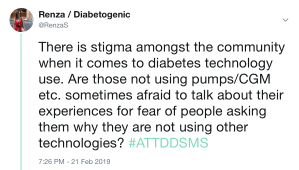
The idea that anything that we are using today is ‘yesterday’s technology’ is wrong. Blood glucose monitoring can’t be ‘yesterday’s tech’ if it is what most people are using to track their glucose. And syringes and pens can’t be considered the ‘old way to deliver insulin’ when that is how the vast, vast majority of inulin-requiring people with diabetes get insulin into their bodies. Plus, every single one of us using a pump must be able to deliver insulin this way because machines break.
Somewhere in discussions about our treatment technologies, we seem to have forgotten that, actually, not everyone wants to be using the latest kit. And that is okay. There is a spectrum of diabetes technology, and as long as we are on it somewhere and managing our diabetes the way that works best for us, then elephant stamps all around!
There is clearly an over-representation of people at one end of that spectrum dominating on and off line conversations. Spend a couple of hours in a diabetes Facebook group and it would be a reasonable assumption that most people are wearing pumps and CGM. But that’s not true.
And it could appear that DIYAPS is the way to go for most people with T1D, when the fact is that numbers are relatively low. It’s hard to estimate exactly, but there may be somewhere between 2,000 and 3,000 worldwide how have ‘built their own pancreas’. That is just a drop in the type 1 diabetes ocean.
It’s fantastic for those of us interested in this technology to be able to (virtually) congregate and talk amongst ourselves. I learn so much from my peers in these groups – just as I have with all aspects of life with diabetes. The lived experience continues to trump any other way of learning about diabetes.
Of course, that doesn’t mean that we shouldn’t be talking about technology used by limited numbers. Of course we should. We want others to know about it so they can make an informed choice about whether it may be right for them. We want our HCPs to know about it and to support those of us using all sorts of technologies and treatments.
Where it becomes problematic is when there is the misconception that this is the norm. Or when those not using the newest technology feel that they are wilfully doing diabetes the ‘old way’. It’s unfair to think for a moment that those who are not using the tech ‘don’t care’ enough about themselves – especially when decisions are made based on a very good understanding of what is available and what they have decided works best for them.
So, back to my ‘Oh, I just use Loop’ comment. It was directed to someone far more technologically advanced than me; someone who runs all sorts of other programs alongside their DIYAPS. They generate lots of reports and make lots of changes and seem to have far more bells and whistles than I even knew were available.
I nodded as they told me all they were doing and then, when they asked me how I manage my diabetes, I answered that I just use Loop. I heard myself saying it and stopped and corrected myself. ‘I mean…I use Loop. It works for me. Perfectly.’
We don’t need to make excuses for doing diabetes our own way. If we truly have choice (which I know is not always the case), and we have made the choice based on what we believe to be the best possible treatment and technology for us at that moment, then surely that’s a great thing. We shouldn’t ever be made to feel less committed to our own health and wellbeing. That’s not how it works.
DISLCOSURE 2 (for ATTD 2019)
I was invited by Ascensia to co-chair the Diabetes Social Media Summit at ATTD (#ATTDDSMS). I did not receive any payment or in-kind support from them for accepting their invitation. I have co-written a piece for the blog, however this was not edited (apart from inevitable jet-lag-induced typos) and all words are those of mine and the piece’s co-author. You can read that piece here.





 Diabetogenic