You are currently browsing the category archive for the ‘Language’ category.
Growing up, when I infrequently visited our family GP, he was always referred to by his first name. I do remember when we were really young putting a ‘Doctor’ before his first name, but we never referred to him by his surname. He was always ‘Dr Sam’ until he became just ‘Sam’.
Since being diagnosed with diabetes and becoming a frequent flyer of healthcare services, I have only ever addressed HCPs by their first name. (Except my endo who frequently gets referred to by her first and middle name together, but that is because my kid has the same middle name (named for my endo) so when speaking to and of each other, we use both names..)
When meeting a new HCP, I will walk into a first appointment, hand extended as we do our introductions. I always say, ‘Please call me Renza,’ although I don’t know that I have ever had a doctor not call me by my first name in the first instance. In fact, usually, when called in from the waiting room, they do so by using my first name.
So it’s probably not surprising that I found myself prickling a little as I read this article from a couple of months ago, written my an oncologist from the US. James Salwitz MD tells the story of a new patient – an elderly man who attended with his adult son. The son insisted on calling Dr Salwitz* by his first name which, apparently, was a little unnerving for the doctor. He referred to it as a cultural faux pas, suggesting that it was being done to… ‘diminsh the power and value of my experience, control and guidance.’
Now, I know it is possible that there are some cultural differences here. In Australia, we seem to have a far more relaxed attitude about being formal. And we also don’t necessarily consider that using someone’s first name shows a lack of respect as suggested by Dr Salwitz and some of the commenters at the end of the piece.
I asked a few people – also regular users of healthcare – and most said they used only first names. A few said they would always refer doctors by their titles, but nurses by their first names. This raises another point about the hierarchy of healthcare professionals. I’m not sure why one would be more inclined to use Dr Diabetes for the endo, but not Ms/Mr Diabetes for the nurse.
I treat and regard my healthcare team with nothing other than respect. I speak to them with respect, I respect their time and how busy they are, and I recognise their professional expertise. How I address them does not diminish this respect, nor undermine their qualification.
What was not clear in the article I read was how Dr Salwitz addressed the person he was treating (or his son). If there was an expectation from doctors that they are addressed by their professional title, then surely they should demonstrate the same courtesy (if that is what it is) and address their patients by their title and surname.
Any discomfort can be solved at the first greeting. This is one of the reasons the #HelloMyNameIs campaign is so important. Clear introductions from the beginning establish how people would prefer to be addressed. If unsure, the question ‘Is it okay for me to call you by your first name’ can be asked by both physician and consumer.
Feeling comfortable in our medical appointments is necessary if we are to get the most from the limited time we have before our HCPs. And for that to occur, there needs to be mutual respect and no imbalance of power. I feel very fortunate to have that with my team.
*Thought is best to refer to Dr Salwitz by his title throughout this post.
I frequently refer to myself as ‘the difficult child’ – not so much in my family setting, because there I am clearly the perfect daughter (just ask my sister!). But professionally, I am sometimes difficult because I have been known to ask a lot of questions, think outside the square and am a risk taker.
And I would also be termed difficult in other settings.
For example, I am, according to this article, what would be considered a ‘difficult patient’, a term that I really struggle to understand.
Anna Reisman MD, an associate professor at Yale School of Medicine, wrote the article, sharing a recent conversation she had with some med students who asked ‘can’t these patients stop with all the questions?’ instead, wishing for patients who simply listened and did what they were told. They wished for ‘easy patients’ rather than ‘difficult’ ones.
Living with diabetes can be difficult. It doesn’t behave how we would like it to or how we expect it to. It makes us frustrated and angry and sad and annoyed. It makes us want to try different things as we hope to get better results and see in-range numbers. And sometimes – often – we are the ones searching, Googling, asking others and wanting for more and better and different treatments.
When I ask questions or walk into a HCPs office asking to try something new, I am not being difficult or questioning their expertise. I simply want a discussion about how I can improve my health.
The only reason I manage my diabetes the way I do is because I researched, asked questions and told my HCP it was what I wanted to do. I wasn’t being difficult when I first raised the idea of ditching MDI for a pump. Nor was I being difficult when I asked about CGM. Or when I wanted to change to a different insulin.
I was looking for ways to make my diabetes less difficult – because it is a difficult monster! It is not the person being difficult. It is the condition. And this clarification is important.
I think frequently the term ‘difficult’ is used instead of the word ‘empowered’ or assertive – neither of which are interchangeable with ‘difficult’.
In the article, Dr Reisman offered some excellent advice to the med students explaining why patients who do ask questions and want to take charge should be celebrated – not discouraged. And she ends the article with this pearl:
‘Don’t dread patients bearing questions, I told my students. Welcome them. They’re some of the best teachers you’ll encounter.’
I can’t think of a better way to explain it!
I read a few other pieces by Dr Anna Reisman and this is another brilliant take on the expertise of patients.
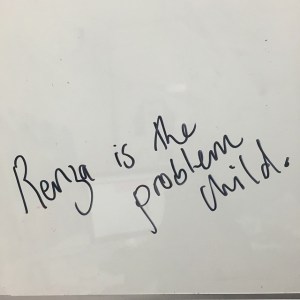
Always difficult. I mean assertive.
Collective nouns are one of my most favourite things.
I was given a gorgeous book as a birthday present a couple of years back and love flipping through the pages, remembering the collective nouns and admiring the stunning illustrations.

From ‘A Compendium of Collective Nouns’ from Woop Studios. Click for more!
Today, I thought I would throw it out there and start to collect some diabetes collective nouns. (I only wish I could draw so they could be accompanied by images…)
A BRILLIANCE of PWD
A POSSE of PWD (at a diabetes conference)
A HUSTLE of PWD (meeting for a drink)
A DEFIANCE of PWD (when asked ‘should you be eating that?’)
A SADNESS of diabetes diagnoses
A KINDRED of DOC folk who are more than just diabetes peeps.
A BAZILLION of BGL strips
A SUPPORT of family
A SPLURT of bloods
A HAPPINESS of Nutella jars

Source
A FAILURE of kinked pump lines
An EXPENSE of sensors
A JUDGEMENT of HCPs
A ROBOTIC of CGM users
A DELIVERY of insulin pumps
A HOPELESSNESS of NPH insulin
A BEEPING of BGL meters.
A SAVIOUR of dirt-covered-jellybeans-discovered-at-the-bottom-of-one’s-handbag-(or-in-one’s-car-glove-box)-when-there-are-no-other-hypo-treatments-around.
A FRUSTRATION of consistently high BGLs
An INTELLIGENCE of diabetes blogs
A CERULEAN of Blue Fridays
A BINGE of hypos
And finally my favourite diabetes-related collective noun. I was thrilled when I discovered the unofficial mascot of the DOC already has a collective noun and it is so fitting:
A BLESSING of unicorns.

This Thursday is World Health Day and the spotlight for 2016 is being shone on diabetes. In the next few days, we can expect to see diabetes mentioned in the media a lot. There will be numbers describing the size of the ‘epidemic’, there will be scary pictures and there will be threats about what will happen if we don’t all act NOW.
Much of what is written will be by journalists who do not have an in depth knowledge of diabetes, so the chance of them getting it wrong – or, at least, not finessing the details – is pretty high.
What upsets me most is when people with diabetes are not represented particularly accurately. I don’t like the pity party often thrown for us – especially because once we get there, the only food served is sugar free. And carrot not in the form of cake.
Seeing myself referred to as a ‘sufferer’ or ‘victim’ infuriates me, and the assumptions and the blame and stigma associated with a diabetes diagnosis makes me even madder.
Those of us living with diabetes (or with someone with diabetes) understand just how much language matters when talking about diabetes.
There are tools available that can point journalists in the right direction when speaking about and to people with diabetes – and the issue of diabetes.
The terrific Team Novo Nordisk has made real strides with providing the media outlets covering the team with some practical tips and a ‘Guide to Communicating About Diabetes.’
And, of course, the Diabetes Australia Language Position Statement* is also a valuable resource that offers suggestions of language and words that motivate and empower people living with diabetes, highlighting how negative and inaccurate language can be harmful and discouraging.
The fact that World Health Day is focusing on diabetes is a good thing in my mind, because it means that people are talking about diabetes. And if we can, in some small way, shape the dialogue – or at least, shape the language being used when speaking about diabetes – the outcome may be a better representation of life with diabetes. We can bust myths, set the record straight and explain how paralysing diabetes-related stigma can be.
This is not only about defining the different types of diabetes, although there are times in the dialogue that would be helpful. It is about offering a fair, precise and considerate picture. And it is about remembering that even when talking about huge, scary numbers that clearly define the issue, there are people involved who are living with diabetes every single day, doing the best we can with the cards we’ve been dealt.
So, with this in mind, I am making a slight pre-emptive strike and asking that anyone writing about diabetes does so in an accurate and respectful way. I will be tweeting throughout the week using the hashtag #LanguageMatters and, when I see examples of writing that is neither accurate nor respectful, will be tweeting the journalist and source directly. I won’t be aggressive; I won’t be angry. But I will call them out.
If it’s something you are interested in, please get on board. Let us tell the real story of diabetes OUR way. #LanguageMatters 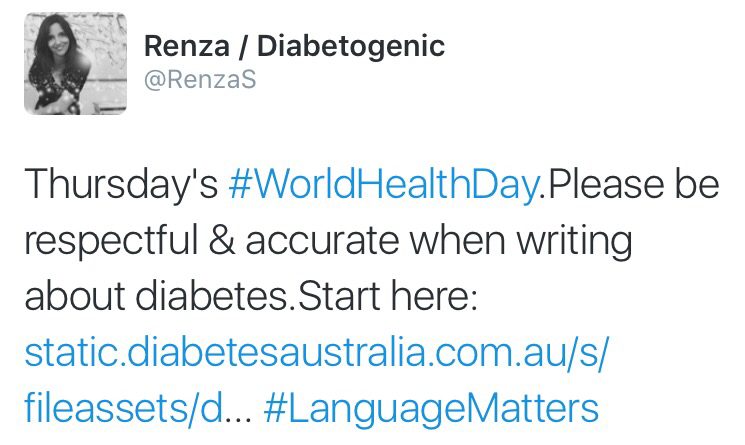
*I work for Diabetes Australia, however at the time this position statement was developed, I worked for Diabetes Victoria. During the writing of this statement, I provided some comment (from a consumer perspective) to the ACBRD team who composed the position statement. The ACBRD is a collaboration between Diabetes Victoria and Deakin University.
I speak and write about language a lot.
I will continue to do so, because I truly believe that the words that engulf us when we speak or hear about diabetes have a direct impact on how we feel about our condition. The emotion cannot be removed from it and negative or judgemental, stigmatising or blaming words make us feel…well….negative, judged, stigmatised and blamed.
I frequently point my finger at healthcare professionals for their use of judgemental language and the media for their use of poorly researched facts and sloppy language. And I note lazy jokes where my health condition is considered a punch line.
You may have read it here or heard it when I have given a talk (it will probably get an airing tomorrow!). And if you follow me on Twitter, it is highly likely you will have seen me tweet the link to the Diabetes Australia Language Position Statement to someone who hasn’t quite got it right.
But I have never ever been able to put into words how I feel about the language that some of our loved ones – or caregivers – use when speaking about diabetes and how it can – completely unintentionally – be damaging.
My dad – love him to pieces – sees my diabetes as an illness. He thinks that I am sick. I have spoken with him over and over about why that is not the way I see my diabetes and that I am actually incredibly healthy, and he absolutely means to harm when he uses the words he does. But they do affect me.
I sat in a meeting while low – managing perfectly well, but having explained the reason I was munching on glucose tabs – and my manager at the time asked if I needed a nurse. He was concerned, but I realised he also didn’t trust my ability to look after myself when I am more than capable – something I had demonstrated to him over and over again.
I am not the parent of a child with diabetes, so I don’t get to play in that space and comment. But I do have real concerns at times. I worry about the language that is used around kids and the way that the child’s diabetes is being represented.
So that is why when I woke this morning and read this piece over at A Sweet Life from Moira McCarthy Stanford, my words stopped. I couldn’t even think straight for a moment because every single thing she wrote resonated so strongly. I actually burst into tears. (I was low, so there was that too. But honestly, I just couldn’t believe how clearly and articulately she put into words my thoughts.)
Moira’s blog post should be required reading for anyone around someone with diabetes. She nails it. Perfectly. I urge you to read it. I urge you to share it. If you are part of a family support group, send it to all members of the group and discuss is amongst yourselves. You don’t need to agree with it all, but it is definitely worth having a robust and honest discussion about it.
If you are a parent (my parent!), I hope that you understand why these phrases and words have the potential to be damaging.
At no time would I ever dismiss the difficulty of having a loved one with diabetes. I can’t imagine what it takes to watch us living with it and not really be able to do something. I would never underestimate your role.
But sometimes, the words you use underestimate ours. Moira – thank you for not doing that.
OzDoc tweetchats are fertile ground for posts on this blog! Often, as soon as the chat is over, I start to write because some that was discussed has triggered a wave of ideas, or thoughts or, as was the case after last night’s chat, wanting to know more.
This week’s chat was all about food – one of my favourite topics in the world, and one that I could, quite honestly, speak and write about full time. I think about food a lot. A. Lot. I have been known to ask the question ‘What will we have for dinner?’ as we sit down to start to eat lunch. I have rushed home, desperate to turn on the oven and bake a cake and then sit in front of the oven, watching it cook.
There is a lot to love about food. But clearly, from last night’s discussion and from many discussions with others, food is not all about bowls of cherries. (I am counting down until November when cherry season is upon us again….)
Guilt and food are two words that are frequently used in the same sentence. This is not only for people with diabetes. It is entrenched in our way of thinking.
We are almost conditioned to feel guilt when we eat certain things and this in turn forces us to think that what we are eating – and could be enjoying in the moment – is a bad, bad thing.
I’ve written about how language and food get intertwined and mixed up. But what I really want to know is where the guilt comes from. Why do we feel it? How did we learn to feel that way?
I don’t ever feel guilty about what I eat. Ever. I’ve no idea why – I just don’t. (There’s plenty of other stuff I feel guilty about, so I don’t feel guilty about not feeling guilty about food!)
Is it what we hear from those around us? Cutting comments from family members, shaming comments from friends or judgemental comments from health professionals can all take their toll.
I have heard them all. I have had family members comment on what I am eating (especially when I was younger and ate like a proverbial horse). I have been asked if I should be eating that. I have had healthcare professionals judge what I eat (when I bothered to tell them).
But besides annoying me, (and visualising hitting them on the head with a spoon I have recently been using to scoop Nutella directly from the jar), I’m not bothered. No long lasting effects and certainly no feelings of guilt.
That’s not the case for everyone. And that’s what I am interested in. Why is it that in some people guilt-inducing comments are like water off a duck’s back, yet for others, result in hours of anguish, hurt, tears and stress?
I watched the response to last night’s chat with great interest. The questions were all very thought provoking and generated a lot of discussion. But not once, was the word ‘guilt’ mentioned in the questions. And yet a lot of answers did.
It seems that the two just do go together for a lot of people. I know that is the case for people without diabetes. But undeniably, it is worse for many of us who do live with it.
Yesterday, we took the kidlet to her new orthodontist. We had been referred from her dentist and this was going to be the first discussion about the kid needing braces. She had a bit of nervousness about the whole process and wasn’t feeling all that great. She was also concerned that there would be pain involved. But, as I explained, this was just a chance for us to hear what was ahead and hopefully be able to ask any questions we might have. Plus she could meet the people at the clinic who she would be seeing regularly. And I also reminded her several times that if she didn’t feel comfortable with what she saw and who we met, we could go elsewhere.
The second we walked in, I knew that we would be staying with this clinic. The first thing we noticed on the wall was a white board which said ‘Welcome to today’s new patients’ and we spotted our kid’s first name up there with a few other names. The kidlet felt pretty good about that!
We walked to the front desk, and a lovely woman smiled at us all and turned her attention straight to the kidlet, saying hello and welcoming her to the clinic and introducing herself. She made eye contact the whole time with the kid before turning to hand me a clipboard. ‘Would you mind filling this in please? And, if it’s okay with you,’ she said turning back to the eleven year old, ’I’d like to show you around.’
The two of them went on a little tour of the practise and I heard them chatting away, the kidlet asking questions as each different space was introduced. When the kid returned to us in the waiting room, she was holding a clipboard of her own. ‘I need to fill this in,’ she said, and took great care answering questions about her likes and dislikes and interesting things about herself.
A short while later, the dental nurse came into the waiting room and, again, went straight to the kid. ‘Hi, I’m K,’ she said holding out her hand. ‘Is this mum and dad?’ She asked turning to us.
‘Now, I need to take some photos – just in that room over there. The room is tiny – are you okay to come by yourself? Or you can bring mum or dad if you’d like.’ The kidlet jumped up and smiled, clearly very pleased at being asked directly what she wanted. ‘I’ll be fine,’ she said.
The rest of the appointment continued the same way. When we were shown into the treatment room, K explained exactly what would happen once the orthodontist entered the room. The orthodontist welcomed the kidlet first and then introduced herself to us. The kidlet was asked regularly if she had any questions and anything she did ask was answered efficiently and clearly. She was congratulated on asking smart questions (mostly different versions of ‘is it going to hurt’) and no one tried to rush through things or to dismiss any of our questions.
The practical side of things – i.e how we would need a second mortgage to afford the treatment – was explained clearly to the grown-ups in the room and the ‘rewards’ system (a points program which earned gift vouchers) was explained to the kid. She looked delighted!
We left the clinic feeling very well informed. All our questions had been answered and we knew exactly what was going to happen next. The kidlet felt really positive about the whole experience too.
This is ‘patient-centred’ care at its best. It’s not just lip-service – it was far more than the staff all being overwhelmingly lovely. They were genuinely focused on ensuring that everyone knew what was going on and that the kid understood that this was all about her. She was given options – each of them explained to her – and then we were asked to think about them and make decisions, with the option of being able to ask further questions if needed.
So what does this level of care and attention take? It certainly took no more time that would be expected of a first consultation. There were no more staff members involved than at any other clinic offering the same service.
But what it did take is care and attention and an understanding of the ‘customer’. And respect. A lot of respect.
Eleven days out from Xmas and I have done hardly any gift shopping. I managed to get online and do a few things the other day, and then spent the rest of the week patting myself on the back and not doing anything more. So, as it stands there are two presents wrapped under our tree, two things in transit….and a list as long as my arm of gifts still to buy.
But! I have found something so special for any of you reading this. (To be honest, it was handed to me from a work colleague, so I can’t even take credit for being thoughtful and finding it myself.)
So, enjoy! Or don’t.
(To make up for that, listen to this.)
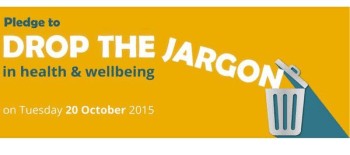
Tomorrow is Drop the Jargon day here in Australia. According to the campaign website, the aim of the day is … for professionals in Australian health, community services and local government to challenge themselves to use plain language.
People working in the health space are being urged to take a pledge to assist Australians who have low literacy make sense of health information and help them navigate our health system. Six out of ten people in Australia have low health literacy, so there is a real need to make sure our messages and information are presented in a way understandable to everyone.
The pledge asks people to:
- Use plain language in all communication
- Not use acronyms
- Explain medical and other technical terminology
- Check that information has been understood by your clients
- Work with a professional interpreter when necessary
- Politely point out when your colleagues use jargon
Diabetes is a condition rife with jargon. I’ve said before: it is like another language. I am as guilty as anyone when it comes to popping in acronyms, technical terminology and assuming everyone knows what I am talking about.
The website includes a link to a handy Plain Language Thesaurus to assist with finding simpler, clearly and less ‘jango-istic’ words when writing health information.
When considering writing in this manner, a lot of sensitivities and intricacies about different conditions are lost. For example, the thesaurus suggests replacing ‘diabetes’ with ‘elevated sugar in the blood’. (Amusingly, the same document suggests – just a page or two down – to replace ‘elevate’ with ‘raise, lift, make higher’.) Obviously, this doesn’t provide a particularly rounded definition or explanation of diabetes, and those of us who ‘get’ this space and understand the words we use when talking about it could criticise the ‘dumbing down’ of what diabetes is all about.
But think about it. If you were new to the diabetes game – just diagnosed or a family member was just diagnosed – and your health literacy was considered low, then this is probably a good starting point. It is certainly better than ‘a touch of sugar’, which are the words used by some healthcare professionals STILL when telling people what diabetes is.
I guess the dilemma for me – as someone who does a lot of writing about diabetes – is that I know that there are some people who want and need more information. Frequently, I write for people whose health literacy is of a higher standard, and there is a need to write at an appropriate level for this target group too. They want – and are able – to read technical and quite difficult jargon.
But I can never ever assume that is the case for everyone. When writing for this blog, I use language very much the way I speak – whatever comes into my head, thoughts going at a million miles an hour, lots of jargon and, if my hands weren’t flying across the keyboard, they would be flying around the air. It’s not really great for people whose health literacy is not high.
However, when writing for work, I am far more conscious of not doing those things. But I suspect, I am not conscious enough. Which is why I will be taking the pledge, and why I think this is a terrific initiative for those of us working in the health space.
Dear people who speak to (or about) people with diabetes
Hello! I write and speak a lot about language – see here and here for starters. I see people’s eyes roll and hear them sigh when I get back on my bandwagon. But it is an important issue, so please allow me to once again ask you to consider the words you use, the tone you employ and the message you are trying to get across. I am doing this having just returned from one international conference – EASD – and about to head to another – ISPAD – tomorrow.
Diabetes conferences can be a minefield when it comes to language. I can still feel my indignant response to a healthcare professional when, in his conference presentation, he repeatedly referred to the people who attend his clinic as ‘non-compliant diabetics’.
Language matters. It really does. You may think the words you use do not really matter and that once they are out of your mouth they are done and gone.
But that is not the case. Words last a very long time. They hang around for years and years. Don’t believe me? I am seventeen years into my diabetes journey (stupid word – is there a diabetes destination?) and I can remember things that were said to me at the start line.
I can remember the exact words muttered by my GP when she diagnosed my type 1 diabetes.
I can remember the fear my very first endo instilled when he (I am sure – I hope – unintentionally) scared the bejeezus out of me, with words of threat, warning what would happen if I did.not.look.after.my.diabetes.
I can feel the judgement in the words used by a nurse when she asked me why my blood sugar was so high as I was admitted to hospital with a frightful case of gastro.
I can remember choosing my words so carefully when I saw a diabetes educator so as to hide what was really going on because the words I wanted to use were so raw – I did not want to feel vulnerable in front of her and I did not want her to judge any of my diabetes management, or life, decisions.
I can remember zoning out when a healthcare professional was lecturing me about what I was doing wrong. Her words were making me start to second guess things that I knew were making some improvements to my diabetes management – mostly because they were making me feel better about myself, and making me feel okay about having diabetes.
But also…
I can remember the relief I felt at the kindness of the words used by my current endo when I first met with her.
I can remember the concern and genuine desire to help from the diabetes educator who found me crying in a stairwell the day after my diagnosis, and being so appreciative of her kindness.
I can remember a psychologist inviting me to tell my story by being open and non-judgemental, and then just listening. It made me feel validated and understand that saying ‘diabetes sucks’ is okay.
I can remember the cheeky – but incredibly respectful – humour used by a podiatrist when we spoke about my need to wear sky-high heels. And being thankful when she said that I didn’t need to throw out my boot collection!
I can still remember how pleased I was when a dietitian didn’t tell me off – in fact laughed with me – when I admitted that my breakfast that day had included two coffees and a doughnut.
Words have power. And they have staying power. You may not know that when you are in the middle of a conversation, or even afterward, but believe me when I say that they do hang around.
I can remember what people have said, the way they have said it, and the way I have felt about that throughout the last seventeen years, and some of those things still cause me to shudder. I know others feel the same way.
I am sure that you never, ever want to inflict any sort of pain from the words you use. But be aware that there is the potential for that to happen.
Choose your words wisely. Once they are said, they cannot be taken back.
Best,




 Diabetogenic