You are currently browsing the category archive for the ‘Language’ category.
I am as guilty as the next person of being judgemental at times. I like to think that I am not, but I’d be lying to myself if I honestly believed that I never uttered a pejorative comment about other people’s choices.
I really, really try to not be judgemental when it comes to how people choose to manage their diabetes. But I know that I am a zealot when it comes to technology and have been very, very guilty in the past of having conversations that sound like this
‘Are you on a pump? Why are you not on a pump? You should be on a pump? Pumps rock! Your life would be so much better if you were on a pump? That’s not a valid reason for not being on a pump. Do you want the details of my pump educator? Here, let me list the million reasons why I love being on a pump. Let me list them in a LOUDER VOICE to convince you. If you’re not on a pump you don’t really care about yourself.’
I know; I’m an absolute joy to be around sometimes.
But I’m trying to not be like this anymore. And to help remind me, I have made a poster of one of the things that has become a bit of a mantra and have it hanging in my office.

Feel free to substitute ‘diabetes’ for any other health condition. Or simply for the word ‘life’.
Because here’s the thing: when you make a decision about how you manage your diabetes, it is about your health. And that is an incredibly personal decision based on your own perspective, circumstances and experience. It’s got nothing to do with anyone else.
There is one caveat to this that I think is really important.
This works and is all fine as long as the decisions that you make as part of your ‘whatever’, (your diabetes, your life etc.) don’t negatively impact on others.
As a result, anti-vaxxers don’t get to claim this as their own. Because their irresponsible actions do affect others.
Same goes for doing anything that emotionally or physically hurts another person, or has the potential to.
Actually, also goes for people who wear leggings as pants. Because, LEGGINGS ARE NOT PANTS and your decision to treat them that way hurts my eyes.
BUT! If you are making decisions that impact on you and you alone, knock yourself out. You don’t owe anyone an explanation or need to justify your choices. Own it.
A few years ago, when the Diabetes Australia Language Position Statement was released, I wrote a post about why words used to describe people matter. At the time, I asked people around me to pick a noun or two that they would use to describe me. The polite suggestions made it on the list which looked like this:

These terms are all still correct. Actually, that’s not true. I’d probably replace ‘Twitter novice’ with ‘Twitter enthusiast’, but the rest are all true. Although, having said that, there have been (brief) periods in the intervening years where things have changed a little. I point specifically to the short-lived-but-still-boasted-about walking period. But that’s over now, so what-the-hey! What you see up there still describes me perfectly.
Many of these words are consistent with what I use for my author profile when I write for another site, or speaker bios when I present at conferences. When I have three or four short sentences, I want to convey the things that are the most important in my life – the focus.
Generally, all bios start with the same thing: ‘diabetes consumer advocate’. This is the bit that is particularly relevant to my work and what it is that I am writing or presenting about. But then there are other things that try to give a fuller representation of who I am. My Twitter profile has ‘wearer of stripes’. A recent bio noted my love of New York. Another pointed to my boot collection. In this blog’s bio, the pets get a mention.
And there, along with explaining where I live and with whom, you will find out that I have diabetes, but this is simply wrapped up in the other things that make me part of who I am.
Why is all this important? Because the things that make me who I am shape my thoughts and experiences of living with diabetes. The inner-city dwelling bit is important because when I write about ‘interviewing health care professionals’ it makes sense. I wouldn’t have this privilege if I was living in a remote area serviced by a single GP.
The scarf collector comment above along with the mentions of striped clothing and boots help explain the sartorial importance of diabetes paraphernalia. (Or I could just be shallow – you decide!)
And if I am talking at a conference about how I use social media for peer support, you can understand my love (and use) of Twitter or Facebook as a means of connecting with people.
Telling you that I am a mum to a gorgeous nine year old goes towards explaining the anxiety I feel when thinking of the genetics of type 1 diabetes. And when I write about how worried I am about how diabetes impacts on those around me, you can appreciate why I’d feel that way because I’ve briefly mentioned my immediate and extended family.
Even if we say – and truly want to believe – that diabetes doesn’t shape us, the truth of the matter is – it does. Of course it does. How can a condition that is so present, sends out reminders constantly, requires so much time and attention not feature in who we are? If it were not for diabetes, my life would be significantly different today.
I’ve no idea what I would be doing had my beta cells not taken early retirement, but I doubt it would involve being an advocate for a condition about which I know nothing (which is precisely how much I knew about diabetes before my diagnosis). But here’s the thing. All of those other things – the family, the love of travel, the addiction to coffee, the preoccupation with words and punctuation, being drawn to stripy clothes and loving cupcakes – those things would still be the same. All of them. It’s the diabetes that would be different. It just wouldn’t be there.
It’s the Friday before National Diabetes Week here in Australia. Over the next 10 days, diabetes will be in the press. A lot. And that means a lot of misreporting and a lot of people saying the wrong things about diabetes.
So, here are some of my thoughts about how to address this:
- Stay calm. If you hear or see or read something about diabetes that is incorrect, don’t get angry. Send a balanced, calm response to the journalist, radio/TV station/person talking with CORRECT information. Be brief, use facts – dot points are good.
- Know your facts! And that means no perpetuating other myths to bust the one that’s pissed you off.
- Get over the type 1 versus type 2 thing. Seriously. Don’t bash the ‘other’ diabetes.
- I send the Diabetes Australia Language Position Statement out to any journalist who uses damaging language when writing about diabetes. I tweet the link directly to journos all the time!
- Naming and shaming is okay if you’re nice and polite about it.
- Don’t engage. Make your point and walk away. There is no need to enter into an argument that will most likely get heated and result in abuse. Grace and dignity are amazing qualities; demonstrate them in spades!
- Action! If you’re going to complain, make sure you actually do something meaningful with it. It’s all very well to bitch and moan amongst your peers, but find the source of whatever has upset you and write to them directly. (See point 1 for the tone to use.)
- Follow up. And if you do take the time to write, you should expect a response. If you don’t get one within a reasonable time, re-send your correspondence.
- Pick your battles. I can tell you now that no one has bucket loads of money to spend on diabetes campaigns, so no matter how much you want the government or diabetes organisation in your state to run a full-blown campaign explaining the difference between type 1 and type 2 diabetes, it’s not gonna happen. Accept it!
- Remember that you know a lot about diabetes out of pure necessity. Don’t expect that same level of knowledge from everyone. Most of the stupid things people say are out of sheer ignorance or bad manners. Politely correct and move on.
- There are some great resources out there that can help. Check out this and this.
The primary aim of National Diabetes Week is to raise awareness of the condition – specifically awareness about prevention of type 2 diabetes. Consider any misreporting or silly comments an opportunity to provide information and education in the hope that the people perpetuating the myths won’t do it again. And as your (and everyone’s) grandmother would say: Keep yourself nice.
It’s Friday! And it’s freezing here in Melbourne. I’m trying to imagine warm sun on bare skin, so here are The Beatles with ‘I’ll Follow the Sun’.
I’m tired.
Today, I woke in a great mood after a good night’s sleep. The weekend had been relaxing and lovely – family, friends, food and gorgeous weather on top of it all. Plus, I bought a new necklace with a pineapple on it. It was a good couple of days!
I was standing at my favourite café near work, waiting for a takeaway coffee and thinking that the barista was a magician as I watched his choreographed movements, filling takeaway cups with perfectly brewed caffeine.
‘This good day is about to get better,’ I naively thought, the taste of that first sip of coffee so close.
And then, I checked my email and ‘bam’. There it was.
A discussion about not distinguishing between type 1 and type 2 diabetes in a setting where it really is not relevant. I sighed.
And realised how tired I am.
Nearly thirteen years ago, I was employed to run a very small and, at the time, somewhat tokenistic type 1 diabetes program for a diabetes organisation. Thanks to a very supportive CEO and me being a pushy little thing, the program grew and grew and now, incorporates a dedicated team doing some incredibly good work for people living with type 1 diabetes.
One of the reasons for the program’s success is that we have been very clear about defining it as a program for people with type 1 diabetes, making sure the information we provide is targeted and relevant to the people we are trying to reach. We acknowledge each and every day that people with type 1 diabetes have specific information requirements and then we go about providing that information in the way people want.
In exactly the same way, a couple of years ago, we realised that the information for people with type 2 diabetes was completely forgetting the changing face of the type 2 diabetes community. There are more and more younger people being diagnosed with type 2 diabetes and the information we had was very much for an older audience. Hence, Generation T2 – a new program for 18 to 39 year olds with type 2 diabetes.
There are times that it is important to distinguish between the diabetes and there is no louder advocate for that than me.
But there are times that it is irrelevant. Yet, people still get angry – even when it really doesn’t matter if the type of diabetes is defined.
I am tired.
I am over this argument and this discussion.
Last week, the government handed down a budget that is going to hit the hip pockets of people with diabetes like never before. All people with diabetes will be affected – regardless of type.
During the World Diabetes Congress we heard of places around the world where the cost of insulin is so prohibitive that there are people dying because they cannot afford to buy the drug they need to stay alive. Slow, painful, horrible deaths because they cannot afford to buy insulin. Just think about that for a moment.
Here in Australia, there are people who cannot afford to use an insulin pump despite desperately wanting to because they cannot afford private health insurance or qualify for the Insulin Pump Program to assist with cost of purchasing the $9,000 (plus) device.
These are the issues that we should be fighting for and getting angry about. These are the issues that are important. Access to healthcare – a basic human right for all people – ALL people with diabetes – is what the topic should be; not whether or not the Channel 10 news forgot to say type 1 (or 2) before the word diabetes.
I am a card carrying member of the diabetes community. I am proud of this community and I am pleased to have a voice within it.
But we need to stop the finger pointing and the name calling and the blaming. How can we expect people outside of our community to get it right if we can’t? Why is it more important for people to understand the how and why we got this condition as compared with the how and why we’re trying to live and manage with it?
I am proud of the Australian diabetes community, but it is here that I hear this attitude more than anywhere else in the world. This discrimination is not helping us – it is harming us. Does it matter if people don’t really understand the different types of diabetes? I get it. It’s annoying, it’s frustrating; it’s constant. But really; does it matter?
This is a first world – a first class – problem.
And I am tired. I am saying it’s time to stop. Enough!

It’s the fifth annual Diabetes Blog Week, with thanks to the lovely Karen Graffeo from Bitter~Sweet Diabetes. Today it’s diabetes in pictures. Come back tomorrow for the last instalment, and in the meantime, check out #DBlogWeek and follow along!
It’s Saturday and this morning, I had to work for a short while at a diabetes event. And when I was done, there was only one way to celebrate the real start of the weekend. With these:
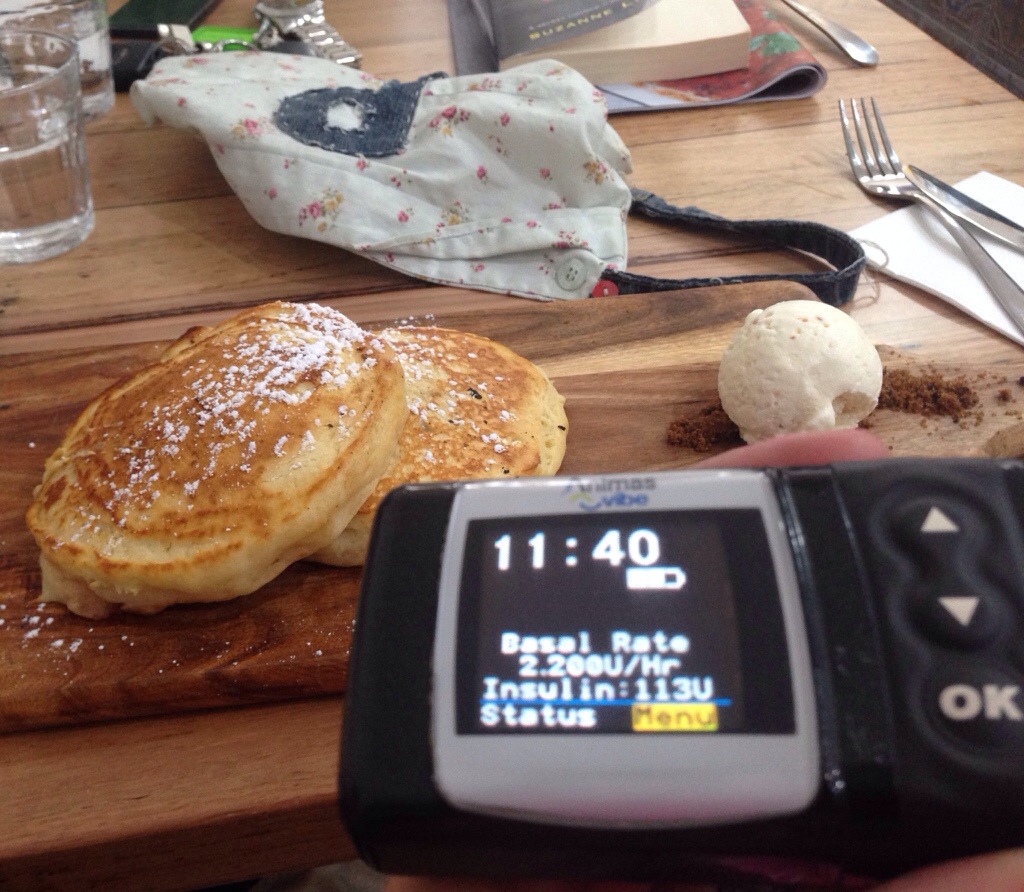
A new cafe has opened up in my ‘hood serving amazingly good coffee and this fabulous dish. Yes – the doughcakes are delicious. They’re fluffy and light and filled with strawberry jam, which oozes out onto the serving board in a most pleasing way. But the most exciting thing? The bacon ice cream. Yes. Bacon. Ice. Cream.
Has there ever been a better nod to the DOC than this very dish? The only way it could be better if it was served up by unicorns.
So yes. I can eat that, and thanks to that nifty little pump thing, insulin takes care of all the carbs.
There seems to be a little bit of a theme to my Saturday Snaps for Diabetes Blog Week. Last time this was the prompt, I wrote (and snapped) about cupcakes. Apparently, when it comes to pictures of diabetes, it’s all about the food for me!
I’m on a bit of a language thing at the moment. (I should add that my language is pretty horrid a lot of the time. Current diabetes burnout combined with general feelings of exhaustion mean the f-bomb gets dropped far more than it should. Our swear jar is so full that it has become our daughter’s private school education fund. But, I digress…..)
Today though, I am writing about how the language of food sends us down a slippery slope of guilt and competitiveness.
We say things such as ‘naughty’, ‘guilty pleasure, ’oh, I shouldn’t’ or ‘I’ve been so good lately’ when talking about food. We say that food is ‘good’ or ‘bad’ for us.
No, it’s not. Food doesn’t have a moral compass.
Stupid comments like ‘a moment on the lips; a lifetime on the hips’ mean we feel guilty about having a piece of cake or a chocolate bar when we should just enjoy it for what it is – something sweet and delicious!
We start this when talking about the nutrition babies receive (thank goodness the babes in arms are unable to comprehend what we’re saying).’ Breast is best’, we’re told, and nutritionally that may be correct. But the demonisation of formula only makes those unable or not wanting to breastfeed feel they’re failing their babies. Although, that doesn’t last. I went from looks of approval and comments of ‘aren’t you wonderful’ for breastfeeding my daughter. Until she got to 18-months when suddenly I was being asked when I was going to stop.
In recent times, we’ve added ethical eating into the mix so the good/bad extends to more than health. Suddenly, we’re expected to feel guilty if we’re not eating and drinking ethically sourced foods and beverages. Are those apples organic? Is your coffee single origin fair trade?
Today, in The Age there’s an article about clean eating and what using this terminology hints at, saying ‘It implies that anyone who doesn’t eat in the way you deem “clean” is eating “dirty.”’
We detox, inferring that we are full of toxins. We’re not and suggesting that our body is a poisonous, polluted pit of impurities that needs to be exorcised is nothing more than a money making scam at best; a way of making us feel somehow unclean at worst.
Messaging gets confusing – think about how the I Quit Sugar movement has impacted on people with diabetes who already spend a lot of time ‘un-demonising’ sugar. ‘You should do that. It’s good for people with diabetes.’ I’ve been told several times. How? It’s pointless and just like every other diet craze. And mind your own business, by the way.
Reading about food used to be so much fun. The Magic Faraway Tree series included tales of pop biscuits, toffee shocks, lands where lollies grew on trees, and everywhere, oh everywhere, there was warm toast with lashings of butter. There were Mad Hatter Tea Parties, and Harry Potter feasts were full of Pumpkin juice and Butterbeer. Books such as Like Water for Chocolate describe dishes such as ‘quail in rose petal sauce’, and Chocolat sets scenes with ‘The air is hot and rich with the scent of chocolate’. Food is a celebration and joy and a delight. No one counts calories or promises to ‘be good tomorrow’.
I don’t think that we need to go so far as only using utilitarian words such as ‘fuel’ to describe food. But I do think it’s time we moved away from the judgement and the guilt-inducing rhetoric that accompanies the language of food.
Friday listening and dancing – James Taylor singing ‘How sweet it is to be loved by you’ which is for my beautiful daughter who means I get to celebrate Mothers’ Day on Sunday.




 Diabetogenic