
You are currently browsing the category archive for the ‘Engagement’ category.
Saturday afternoon I was flaked out on the sofa, the Winter sun shining palely through the front window. It had been a cold day and I’d been dealing with an unpleasant and tedious head cold, so I was enjoying the comfort of the house, a dog snoozing on my feet helping to keep me warm.
I was lazily scrolling through some things that I’d missed on Twitter and I stumbled across a protracted twitter exchange that began with this tweet:
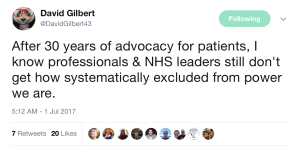
Fair point. And reading David Gilbert’s Twitter feed and skimming through his blog, his commitment to patient-led healthcare is strong. He has a lot of experience fighting for the rights of healthcare users to be true partners in the system.
I was interested in the commentary that followed after Partha Kar, an NHS clinical director, quoted the tweet suggesting that things are different in the diabetes world. You can read that thread here.
I struggled with the exchange, feeling a little discomfort when every point made by the original poster was almost dismissed with a ‘but we are doing better’ comment, which completely and utterly missed the point.
I typed a couple of quick responses, deleting all of them. My head was foggy and I was not sure that my thoughts could be condensed in 140 characters or fewer. But I was trying to say that while I actually agree that ‘patients’ do have very limited ‘power’ and are often actively excluded from processes, that isn’t the point. For me, the discomfort was stemming from someone’s personal experiences being rejected by someone who is actually not in the same position – or rather, by someone who holds a position of responsibility in the very system being questioned.
Let’s reframe it this way. There is a gender pay gap that continues in every industry. Women are significantly under-represented as Company Board Directors, as CEOs, and in politics. Health outcomes for women are worse than they are for men. As a woman, I am conscious of the imbalance; I have fought for equality for as long as I can remember; I see the discrimination; I have experienced the discrimination firsthand.
Are there initiatives in place to try to address these gaps? Yep. Is the situation improved today as compared with 100 years ago? Perhaps. Are there men who are fighting for the rights of women? Of course there are.
But does that mean that women who are affected by the imbalance should have their (our) concerns and experiences dismissed because some are ‘trying to make a difference’? Absolutely not.
It is the same in healthcare. Just because there are some dedicated people steadfastly working to support and deliver a more person-centred, inclusive approach with its foundations in true partnership doesn’t mean that the problems are not still there. And it certainly doesn’t mean that we should stop paying attention to those who speak up about the inequality.
If people are feeling excluded – especially people with 30 years of experience in health advocacy, a Twitter following and a blog – we need to believe people are being excluded.
Just as it is not the place for men – even men who might be unequivocally feminist in their words and actions – to tell women that we need not feel discrimination because there are people committed to levelling the playing field, it is not up to HCPs to question the experience of healthcare consumers when we say we have no power and no ability to influence.
For the record, I agree with David’s original tweet. How much power do healthcare consumers really have in shaping healthcare? How much opportunity is there to truly influence the way the system, activities and programs are designed? In fact, how much of the system, and how many of the activities and programs are co-designed?
If we look at diabetes, how many positions are dedicated specifically to people affected by diabetes on Boards, expert reference groups, working parties, organising committees (etc.)? Can you think of an example when the split between HCPs and people with diabetes was equal?
And finally, a thought on language. The word ‘patient’ was used throughout the Twitter discussion and I believe it is problematic. It’s not a word I use; I don’t refer to myself that way. The Diabetes Australia Language Positions Statement advises against the use of the word because it ‘implies the person is a passive recipient of care, rather than an active agent in his or her own self-care’.
In a discussion about people feeling they have no power, using a word that clearly diminishes the role and involvement of the central person in the healthcare equation speaks volumes. At least I think it does.
One of my bookmarked pages is this:
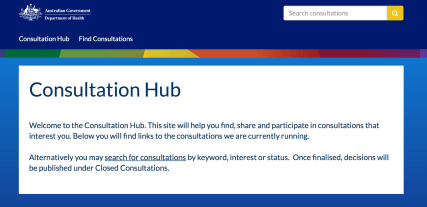
This is a public page and lists all open consultations from the Australian Government Department of Health.
I know. I live the exciting life.
I have it marked and check the page regularly to see if there are any consultations that are of interest to me and on which I would like to comment. The consultations I respond to are not necessarily diabetes-related, but then, my health is not always diabetes-related…
At the moment, however, there is a very diabetes-related consultation underway and I would encourage anyone affected by diabetes to take a few moments to fill in the survey.
The Department of Health is currently evaluating the FreeStyle Libre, specifically to consider whether it is suitable for subsidisation under the NDSS. (The consultation is happening following a submission to the Department for subsidisation of the product.)
An Assessment Panel will be set up to consider the submission, but before they meet, the Department is seeking comments from consumers and other stakeholders about the product.
You can take part by completely a very short survey. You need to provide some personal details (name, address, phone number and email address). There is one comment box for thoughts for the Assessment Panel to consider. You are asked to think about how diabetes impacts your quality of life; if you’ve used the Freestyle Libre, did it improve your diabetes management; what are your personal experience of using the device and any benefits or negative affects you may have noted; If you’ve not used the device, what would you expect it to do if you did. You are also asked to write about other devices and tools you use to manage diabetes and think about how they benefit your management.
Some things to consider when filling in the consultation survey:
- Be honest about your experiences. You don’t have to have used the Libre to complete the survey. This is for anyone who is affected by diabetes and would like to weigh in on whether or not they believe the product should be subsidised.
- Stay on topic! This is about Freestyle Libre, so it’s not really the time to say that you want a fully-funded artificial pancreas delivered to your door now please. (And just further to that, it’s not the time to lobby for the expansion of the NDSS CGM Initiative. Comments that are not relevant to the issue at hand usually get ignored. Stay.On.Topic.)
- Try to use really clear language and don’t assume the person reading what you have written knows a great deal about diabetes. It’s likely that the Assessment Panel will include people who do know a great deal about diabetes, but the people from the Department conducting the initial consultation may not. So, don’t use abbreviations and acronyms, or jargon and diabetes slang.
- This is the opportunity for people with diabetes to have their say. Health professionals are also invited to participate in the consultation, but obviously, their perspective is going to be very different to someone who is actually wearing the device to help manage their diabetes. What you have to say can’t be found in glossy brochures or opinions of those working with diabetes. Use the opportunity to really share your thoughts.
- So, your experience about actually wearing the device, the accuracy of it, how it has changed your diabetes management (if at all), why you do or don’t like it, the devices convenience (or lack thereof), the best and worst aspects of it are really, really valuable.
The consultation is open until 17 July and can be accessed via this link. Please share with anyone you think may be interested.
DISCLOSURES
None! I’m sharing this information because I know a lot of people who are interested in this device and because many are frustrated at how expensive it is.
 A lot has already been written about the photo ban at ADA last week. For the first couple of days of the meeting, the first topic of conversation I had with everyone I met was not about what I’d seen or learnt. It was about the photo ban and the ADA’s failure to appropriate deal with the complaints. It was a debacle, an absolute shit storm that could have been addressed in many ways to make it better.
Firstly, it’s worth noting this is not new. Two years ago, I was swiftly reprimanded for tweeting a photo during one of Bill Polonsky’s talks. The ADA bot who was monitoring any flouting of the no photo rules quickly responded to anyone sharing photos on twitter or other social media platforms. The message was strong: stop doing this or your credentials will be revoked. For the record, this was the photo that got me in trouble:
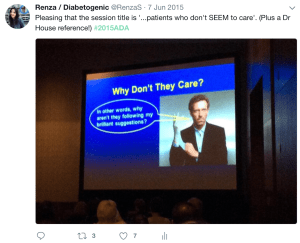
Yes – that photo of Dr House straight from the Internet was the reason that removal of my press credentials was threatened.
This year, execution of the archaic policy was increased to expert level. And people were not happy.
Many were asking why the ADA was being so strident in their enforcement of the policy or, more importantly, why the policy was there in the first place. But it’s not just the ADA. Taking photos or videos during sessions or of posters is banned at the IDF’s WDC, EASD meeting and here in Australia at the ADS-ADEA meeting. (How’s that for a sentence of alphabet soup?)
However, I have never known it to be enforced the way it was last week with a multifaceted approach of vigilant soldiers in red approaching anyone daring to photograph a slide during talks or in the Poster Hall, as well as social media (mostly Twitter) responses being fired left right and centre to anyone who then tweeted a photo.
The ridiculous thing is that anyone at the conference could tweet WORD FOR WORD what the speaker was saying (provided they are a speed Tweeter), but just couldn’t take a photo of the slides. And to be honest, a lot of the speakers were pretty much reciting WORD FOR WORD what was on the slide, so it was possible to pretty much tweet out every single thing being presented. (Also, that makes for a really boring presentation. Don’t do that!)
Suddenly, the story of #2017ADA was not new diabetes research or technology or treatment. In fact, the story wasn’t diabetes at all; it was how pissed off people were at the ridiculous ban.
People trying to follow along from home felt excluded and annoyed. Attendees of the conference felt frustrated that we couldn’t share what we were seeing with those not in the room. As is often the case at these meetings, there were two or three or more concurrent sessions I wanted to attend, but as I’m yet to learn how to be in more than one place at the one time, rely on people in the sessions I’m not at to share what they are seeing and hearing.
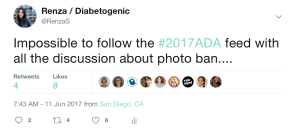
And me? I was irritated and exasperated at how difficult it was to follow the #2017ADA Twitter feed because of all the bloody criticism of the photo ban. (And just delicately, those people who commented on EVERY SINGLE TWEET about the ban, you were not helping. You were making it harder.)
I understand that I am very fortunate to attend diabetes conferences both here and overseas and I am conscious that not many people with diabetes are sitting in the audience. I also know – from personal experience as well as anecdotally – the people in the audience are not always the best sharers. When they return from conferences, they don’t sit with people with diabetes to share what they have learnt.
So, as a person with diabetes who likes to share and communicate, I think it’s my responsibility to share as much as I possibly can about what those of us with a registration or press badge are seeing and hearing.
Trying to stop the flow of communication in digital times is ridiculous and it demonstrates an appalling lack of understanding about harnessing digital platforms’ reach to educate, inform and support not only people with diabetes, but also healthcare professionals. It was also ludicrously naïve of the organisation to think that there would not be backlash and that they would get off without condemnation.
The control of information is really not possible in this day and age. A conference about diabetes should not be shut off from people with diabetes, and if the only way ‘in’ for most people is online, then that avenue should be thrown open as broadly as possible.
In two months’ time, the ADS ADEA conference will be in Perth, bringing together diabetes healthcare professionals from across Australia. It is our largest meeting. Currently, on the meeting website, there is this warning in their social media guidelines:
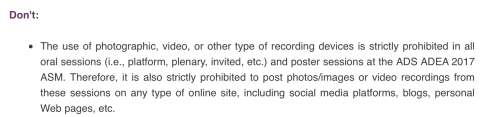
I am calling on the organisers of the ADS-ADEA conference to change this policy immediately, instead, encouraging the sharing of information far and wide. Consider those who cannot afford the time or fee to be at the conference, yet would benefit significantly from learning what is going on. Embrace social media as a way to extend reach from the few thousand attendees (or few hundred in any one session) to a far larger audience. And welcome all diabetes stakeholders to be part of the discussion online.
Just think how much better #2017ADA could have been if that had been the story.
Some excellent commentary on the photo ban at ADA.
Medscape’s piece written while the meeting was happening.
The always thoughtful Marie Ennis O’Connor’s piece for Medium.
Paris was, as always, wonderful. The mild weather, meant it was lovely to walk everywhere. With only three and a half days in one of my favourite cities, I was grateful for the daily 40-minute stroll from the hotel near the Eiffel Tower via the Trocadero to the conference centre so that I at least get to see some of the city.
Even early morning meetings were bearable with views like these. (Hashtag: not photoshopped!)

Sunrise behind the Eiffel Tower.
On my first full day in the city, I attended an event hosted by Roche (all my disclosures are at the end of yesterday’s and today’s posts, as always). The Blogger #DiabetesMeetUp brought together almost 40 bloggers from across Europe. And me.
The day’s activities were a continuation of their event at EASD last year (read about that here), although attendance was expanded to also include a contingent of fabulous women from Italy. It was actually the fourth #DiabetesMeetUp event hosted by Roche with many of the attendees having been to all of them. (There was a comment when I tweeted a photo of the day that the group didn’t look particularly diverse. I’m flagging that here because I acknowledge the privilege in the room. I do think that it is important to ask how better representation can be achieved. The flip side is that the event targets bloggers, so there is already a bias for well-connected and informed people. I have no answers….)
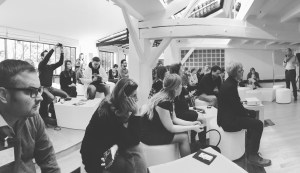
Just some of the bloggers…
The day was busy and very interesting. I have been an extremely vocal critic of device companies failing to engage with consumers in the early stages of device and software development. It frustrates me no end when I hear of the limited and barely tokenistic engagement undertaken by device companies so Roche’s approach is truly a breath of fresh air.
It was also pleasing that while some of the day was dedicated to showcasing product, there was a lot more than that on the agenda. Plus, all product presentations were an opportunity for the bloggers to provide feedback, plus there was plenty of frank discussion from both attendees and Roche staff.
So, what devices where on show? There was some more about the Roche Insight CGM, mostly about the app that is being developed to accompany the device. When this was discussed at the EASD #Diabetes Meetup last year, there were many suggestions and recommendations about how to improve the app platform. It was utterly brilliant to see a lot of those changes integrated in the new design. Obviously it’s a lot easier to make changes to software rather than hardware, but still this focus on gathering feedback and then making the changes is commendable.
One of the most exciting aspects of the discussion for me was the discussion around the Insight systems alarms, specifically the language being used. Some of the words and phrases were flagged as not being quite right, and there was an opportunity to wordsmith just what language would be used. For example, the term being used was ‘warning system’ and I questioned if that was really the best word available. I think of ‘warnings’ as something connected to inclement weather or danger on the roads, not really ideal when thinking about data I use to help manage a health condition each and every day.
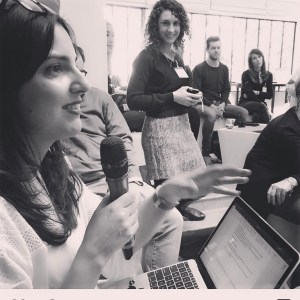
Talking language. It was hard to get the microphone away from me.
The customisation of this system is outstanding. Other than the super-low (safety) alarm, all others are fully customisable, can can be activated for certain times of the day, use different sounds for different alarms for different times and the user can build up to ten daily profiles. The objective for such thorough customisation is to work towards reducing alarm fatigue as well as create a more flexible, individualised and intelligent alarm system
As yet, there is still no integration with the Insight CGM and the Insight pump – a criticism and recommendation from the group back at EASD last year, however I believe this is on the radar. Undoubtedly, the feedback from the group was that this is essential, so I hope that the Roche team find a way to make it happen!
The other product that was (very briefly) discussed was the Senseonics Eversense system – a ninety day implantable CGM sensor and data management system. This tech is currently in trial stage and more information can be found here.
Roche gave all the Blogger #DiabetesMeetUp attendees a press pass to ATTD which meant that throughout the remainder of the conference, there was a significant consumer contingent roaming the halls and sitting in sessions. Considering that this is a group of highly connected, tech-savvy and smart individuals, it was terrific that there was the opportunity to be part of the conference amongst the health professionals.
I’m really grateful to have been offered the opportunity to attend the day – a very big thank you to Ute and the team from Roche for extending an invitation to me (I promise, I am not always the jet lagged mess you see at these events!) and for your ongoing commitment to engaging the community. As well as participating in the agenda set by Roche, I was able to speak to some amazing and activists who each day are advocating for people with diabetes in their own countries. The level or excitement and commitment to what they do simply never wanes.
Disclosures
My flights and accommodation costs to attend the Roche Blogger #DiabetesMeetUp were covered by Roche Diabetes Care (Global). They also provided me with press registration to attend ATTD. My agreement to attend their blogger day did not include any commitment from me, or expectation from them, to write about the day or their products, however I will be sharing my thoughts on the event here. Plus, you can read my live tweets from the event via my Twitter stream.
‘Why do you even care what’s happening in America? It doesn’t affect you, does it?’
I’ve been astounded to hear a few people ask me this question after finding out that the kidlet and I participated in the Women’s March a few weeks ago, or after hearing me speak about the current situation in the US with the Trump Administration threatening to repeal the Affordable Care Act, and allowing insurers to discriminate against those with pre-existing health conditions.
I care a lot about what is happening in America at the moment. Without a doubt, my main focus is what is going on with healthcare and insurance, (however today, I am stunned, dismayed at Betsy DeVos’ confirmation as Education Secretary, but that is mostly because I cannot believe that someone who thinks guns have a place in schools ‘because of, you know, grizzlies’ is in charge of education).
Does it affect me directly? Well, probably not. But it is incredibly naïve of us to think that what happens in the US is completely irrelevant here in Australia. We know our politicians look to the US for policy direction. Our new Health Minister, in his maiden speech to Parliament, put forward the case for the adoption of a healthcare system more in-line with the US-system.
Of course what is going on in America affects us, but, actually, that’s not the point.
The real point is that I care because it’s about people. Not only that, it’s about the most vulnerable people. And like it or not, people with chronic health conditions are vulnerable. We are high-level users of healthcare, we face more discrimination and we cost more to the system. We can be hit where it hurts: easily and unfairly.
Of course, within this group there are some more vulnerable than others.
In the same way, I’ve had people ask me why I care so much about insulin access around the world, which seems like such a callous thing to even think, much less say out loud, when you remember that the life expectancy for a child diagnosed with type 1 diabetes in sub-Sahara Africa is 12 months. I actually still struggle to get my head around that really.
I care because I am a global citizen and I care because my social responsibility is to those less fortunate. I care because when my brothers and sisters around the world are struggling because they can’t access diabetes care, it hurts us all. I care because when I hear that instead of protecting the most vulnerable – as they should – governments are building walls (no pun intended) to make it more difficult, more frustrating and more tiring, the response should never be ‘oh well’, it should be ‘What.Can.I.Do?’ I care because diabetes is hard enough without having to fear being turned away from A&E or from other treatment. I care because no one should die because they can’t easily and affordably access a drug that has been around for 95 fucking years.
Of course I marched last month and you can bet that I will be doing it again. And you bet that I will be standing alongside my friends in the US as they fight one of the hardest battles they’ve ever faced just to be able to access healthcare, and my friends from around the world too as they fight access issues. And I will continue to make donations to charities helping those who cannot access insulin and be an Ambassador for Insulin For Life Global as they continue their excellent and necessary work.
But if you really think that it’s all too far away, so it won’t touch us, then perhaps you might like to do something to help people closer to home. As someone delicately reminded me last week, it is not only people in developing countries who struggle to access diabetes healthcare and drugs, and whose outcomes are far, far poorer than those of us living firmly inside a privilege bubble.
Get involved with or make a donation to an Australian-based charity if you would prefer to do something to help those closer to home.
We should all care because when others are disempowered, it means they are not able to get the best care or expect the best outcomes. And we do something because we can; and if we can, we should. That is what being socially responsible is all about.

Flowers die; children shouldn’t. Make a donation to Spare a Rose, Save a Child, and Life for a Child today. Click on the rose to take you straight to the donation page. Simples!
Yesterday, on her first day of school, the kidlet’s English class was about autobiographies. So, we had a long chat about some biographies and autobiographies we’d read – and ones we wanted to read – and why they are a really important way for people to share the stories of their life.
Story telling is one of the most powerful ways to record events, emotions and life experiences. Others who may be going through similar experiences can feel great comfort knowing that others have not only lived through certain situations, but stuck around to tell the story! And it is also a fabulous way to share stories with those not familiar with different places, circumstances or surroundings.
Our stories have the ability to inspire, offer an opportunity to learn, and help make sense of things around us.
So, it took me no time at all to respond with a resounding ‘YES!!’ when I was contacted by Anna Sjöberg from Anna PS and Sofia Larsson-Stern from Diabetesia, asking me to be in their book about people living with type 1 diabetes.
The e nd result of their hard work is a fabulous book – ‘We can, want and dare …and we have type 1 diabetes!’ – and it features people from all over the world telling their stories of life with type 1 diabetes.
When putting together the book, Anna and Sofia wanted to provide real-life stories from people with type 1 diabetes from all walks of life: from kids and teens
(such as this one who is, quite simply, AMAZING!) to adults doing all sorts of amazing extraordinary, and every-day things. There is a Brooklyn-based chef, an incredible young advocate from Sweden and another Swede whose Instagram profile describes him as a Multisport Team Ninja Warrior! Oh, and a Melbourne blogger and activist.
The books was launched it its original Swedish-language version last year on World Diabetes Day and the English-language version has just been launched and is now available.
This book is not just for people with type 1 diabetes, although, with its stories of hope it certainly would be a wonderful thing to give someone newly diagnosed! It is also for friends and families of those living with type 1, and people who really have no significant connection to type 1 diabetes, because it provides an understanding of the complexities of the condition that we live with and offers a very personal insight into life with type 1.
You can order your copy of the book here.
GIVEAWAY GIVEAWAY GIVEAWAY
I have three copies of ‘We can, want and dare …and we have type 1 diabetes!’ to give away to Aussie-based readers of Diabetogenic, thanks to the team at Anna PS. Just click here and send me a message telling my why you would like a copy. Keep it short – brevity is key here!
DISCLOSURE
I was invited to provide my profile for the book and received no payment for my contribution. I will receive a signed copy of the book for my bookshelf, though, and can’t wait to see it!
Last week, my Timehop app reminded me of this snapshot in time.
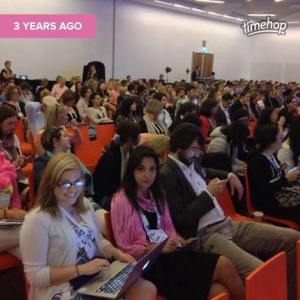
This photo was taken at the 2013 International Diabetes Federation’s World Diabetes Congress in Melbourne, and that look on my face is of pure anger. I was listening to a speaker – a doctor – referring to ‘non-compliant diabetics’ as he was telling of the ‘poor outcomes’ of ‘patients’ in his practise.
The old language chestnut came up again on the second day of the #MayoInOZ conference during the innovation showcase was held. In this session, nine speakers were each given five minutes to present how they are using social and digital tools to improve healthcare. (This is where Kim spoke about #OzDOC and how healthcare professionals use the hourly tweetchat as an opportunity to engage and learn from people with diabetes.)
The final speaker in the innovation sessions was a late addition and it was great to see diabetes again being represented. I know I am biased, but I do always get excited when I see diabetes on the program!
Andy Benson from Coffs Endocrine and Diabetes Centre presented on the project she has been working on: telling the story of diabetes in a series of documentaries to be screened on the BBC.
So, first things first. I love this idea. I am a huge fan of having diabetes out in the ‘public’ space, pulling it out from diabetes groups and diabetes-specific forums, because in most of these cases, we’re preaching to the converted. It’s one of the reasons I love writing for Mamamia Women’s Network where I know that most of the readers probably don’t already have a connection to diabetes.
If these documentaries are screened on the BBC, imagine the audience! It is so refreshing to see people thinking outside the box and looking for ways to present to a new audience – and to tell stories, real stories of real people who actually live each day with diabetes.
Andy showed two short video clips from the still-in-development documentaries. As healthcare professionals on screen spoke about diabetes, I automatically prickled, my language and stigma sensors being alerted straight away.
I wasn’t the only one. In a room with two other diabetes advocates – Kim, Melinda Seed (Once Diabetes), as well as several very vocal health advocates and activists, there was a sense of discomfort at what we were seeing.
I inhaled – maybe ‘gasped’ is a better word – when one of the HCPs used the words ‘diabetes plague’ in his introductory words. There was an undeniable sense of blaming the person with diabetes in the words being used and the sentiments being expressed.
The Twitter conversation from both people in the room and those following along was honest and candid. And, quite frankly, it was uncomfortable too. Andy had disclosed that she has type 1 diabetes, and I didn’t want to be actively criticising the work of a fellow PWD.
However, I could not keep quiet either. When Andy came over to chat after her talk, we had a very open discussion. I was probably quite blunt in my comments.
It is not okay to use language that is stigmatising. The format of the information being presented (i.e. unscripted interviews) doesn’t preclude anyone from being courteous and respectful, and I don’t believe that PWD were being treated either courteously or respectfully in the way about which we were being spoken.
I understand that there is a desire for authenticity and genuineness when interviewing documentary ‘talent’, however it is possible to be clear from the outset that language needs to be respectful at all times. Not sure where to begin with this? How about the Diabetes Australia Language Position Statement which actually provides suggestions for inclusive, non-stigmatising language?
I think it is really important to acknowledge that the road to satisfaction in the way we use language that is inclusive and non-stigmatising is a very, very long one. Also, I genuinely don’t believe that there was any malice intended on the part of the film makers or the interviewees.
We also need to acknowledge that the language used in what has been (and many would argue continues to be) a patriarchal health system is entrenched in the thinking of many – it was part of their training and is a habit that will take time to break. But by acknowledging it, we are not saying it is okay.
As I said, I love the idea that diabetes is a topic for a documentary that is being made for a non-diabetes-specific audience. However, if those people walk away thinking that my healthcare condition is a burden to society (and therefore I am too!) or that they believe it is okay to continue to use words that stigmatise, then there is the potential for this work to do more harm than good.
And finally, a call to not only the coordinators and owners of this work, but to all who are developing any sort of health information using any sort of platform: talk to people with the condition. Lots of them. It is not okay to have one token consumer representative; there should be many – as many as (if not more than) any other expert being consulted.
Today, I just want to follow up a little about one of the points I wrote about yesterday in my post about the event I attended on Tuesday evening about diabetes-related foot complications, specifically this point made my A/Prof Ramon Varcoe:
He explored how we make people with diabetes know this technique for saving limbs is available, and said that it is really, really important to inform PWD about it so that they can ASK for it and not just accept a diagnosis of requiring an amputation. He said that this was the group that could really drive change here, by demanding that they have the best treatment possible.
This had me thinking long and hard. I agree with A/Prof Varcoe here, but that is not really a surprise. I am so much about consumer-led healthcare, that I dream about it (sad, but true).
Mostly, I thought about it in context of my own diabetes care and how it has happened that I am such a DTech nerd. I decided after about two years of living with diabetes that I wanted to use an insulin pump. I really just could not get the hang of the MDI situation I had been put on at diagnosis and was the living embodiment of why Protophane was referred to as Protopain.
I went to an information session and heard a women speaking about how much she loved using an insulin pump and what a difference it had made for her quality of life. Afterwards, I spoke with her and by the end of our chat, was convinced. I wanted one of those! (Impressionable little thing, aren’t I? #MarketersDream) This woman would become my pump trainer and the only diabetes educator I have ever seen.
At my next endo appointment, I marched in with the research I had done, the questions I needed answered and an expectation that by the end of the consultation, I would leave with details of how and when and where I would be getting my pump. Ha, the naivety!
My endo was absolutely not keen for me to take the pump road, ‘You’ve not had diabetes long enough,’ he told me, which confused me no end, because it already felt like a lifetime. ‘I think we should talk about this again after you’ve had diabetes for about 5 years. Yes?’
Well, no. That was the last time I saw him. I spent the next six months endo shopping until I found one that (I was promised) would agree to helping me on a way to a pump. I walked in and made it very clear why I was there and he nodded straight away. ‘Yep – we can do that,’ and picked up the phone. And about three months later, I was a pumper. This particular endo and I parted ways not long after because I needed someone who was far more expert in the diabetes and pregnancy track I wanted to embark, but I have always been grateful that I found him and his open attitude to diabetes technology.
When CGM was launched into Australia, I spoke to my diabetes educator and asked her to fill in the required paperwork to get me sensing. She sent the form off the day we spoke.
And the same has happened when I have wanted to change or upgrade diabetes devices.
What I am trying to say is that this has all been led by me. So when A/Prof Varcoe spoke about the importance and value of connecting with PWD and telling them about these new vascular procedures to save limbs and prevent major amputations, it made perfect sense. He urged that we needed PWD to be the ones who, if told they needed to have an amputation, spoke up and asked for a second or third opinion, specifically asking about the very procedure he had just discussed.
This ground swell of action is what causes change, but we need to know exactly what to ask for. It’s far more effective to ask the question ‘Can my artery be revascularised? I understand there is surgery than can do that and may prevent the need for a major amputation.’ rather than just ‘Is there nothing more than can be done?’
So many of the people with diabetes I know are using particular drugs or devices because they have asked for them – not because they were recommended or suggested by their HCP. And this is why PWD need to have all the information. This is why device companies should be going straight to the consumer to share information, not expecting it to happen through HCPs. (I know that there has been discomfort from some HCPs at Abbott’s direct to consumer promotion of Libre – and the fact that PWD can order themselves without needing to see a HCP, but why would that be the case?)
But it is more than just making sure the information is there for PWD to know and see. It is a complete and utter reshaping of a system that a lot of times actually isn’t about empowerment. There are still too many ‘old school’, patriarchal attitudes that dictate care choices to the PWD instead of accepting and encouraging us to lead the way for our own care. I think things are changing, but I also think they are changing far too slowly.
Sometimes, the best diabetes meetups involve a few people with diabetes just sitting around having a chat. Perhaps it’s over dinner, or maybe over a coffee. There’s no formal agenda, there are no official speakers. It’s just people with diabetes catching up and talking.
Now, multiply that by … a lot. In fact, put about 40 diabetes advocates in a room together. Throw in a few HCPs as well. And some people from industry. Hell, there may even be a few people from professional and consumer diabetes organisations in there as too.
Now you have #DOCDAY; a diabetes meetup on steroids!
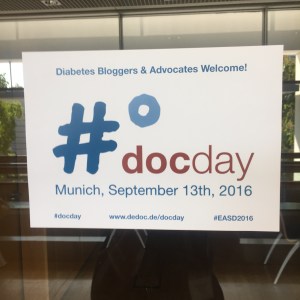
The second annual #DOCDAY event was coordinated and hosted by Bastian Hauck at EASD in Munich. Last year, he had this idea and organised what he thought would be a few people in a café in Stockholm. He underestimated how many people would want to attend, and the room was overflowing with advocates from Europe (and the usual Aussie ring-in).
Dr Andrea Orecchio, right, with Danela D’Onfrio from Portale Diabetes (an Italian diabetes peer site).
This year, he got smart. He hired a room at the conference centre which was a genius move because it not only meant it was so simple and convenient to get to, but it also meant a whole heap of HCPs came along too. (Big hat tips to the divine trio from AADE, Hope Warsaw, Deb Greenwood and Nancy D’Houln, Aussie Dr Kevin Lee, and the delightful Dr Andrea Orecchio from Switzerland who impressed me with his ability to speak (and tweet in) four different languages. Perfectly fluently.)
There was no real structure to the meeting, apart from the insistence that all attendees have their photo taken on an old-school Polaroid camera to be placed on the attendee wall. Bastian kicked off the afternoon, saying a few words and he also asked some people to talk about any exciting diabetes initiatives they’ve been involved in. He asked me because he knows that in my jetlagged state I’m likely to say something inappropriate which will lighten the mood.
I was absolutely enthralled and excited to hear of some of the work other diabetes advocates have been up to lately. Here is just a taste:

Cannot wait to see this book published!
I simply cannot wait for the release of this new book from the team at Anna PS. Anna Sjoberg and Sofia Larsson-Stern from Sweden have collected stories from 20 people with diabetes and will share their personal experiences of lives with diabetes. The Swedish version of I Can, Want and Dare will be out in time for World Diabetes Day, and the English-language edition will follow shortly after. You can pre-order here. What a brilliant Xmas stocking filler! (Disclosure – Anna and Sofia invited me to contribute to the book. I have no financial interest in the book.)

Med Angel.
Did you know that 93% of people using temperature-sensitive medications are doing it wrong? Neither did I! Amin Zayani has created a very nifty smart sensor and app to help you know if your insulin is being kept at a safe temperature. This is a super easy device to use and is all about safety. I know I can certainly be accused of being very relaxed about keeping may insulin at optimal temperature and (touch wood) have never had a problem. But just at this conference, I was speaking with someone whose insulin had been affected by temperature and was absolutely not working. At all. This is something that will be very handy for a lot of people! Follow Med Angel on Twitter here.
IDF Europe has introduced a social media prize in diabetes. Quite frankly, the DOCDAY room was full of worthy recipients. Nominate someone now!
Peer networks in France with Paul-Louis Fouesnant.
I always love hearing about grass-roots diabetes support initiatives, and Paul-Louis Fouesnant from France spoke about Diab’ Mouv peer events he organises regularly.
So what did I speak about?
I spoke about driving and diabetes, specifically the advocacy win we have just had with the launch of the new Australian Assessing Fitness to Drive Guidelines. (More about that later this week.)
I spoke about CGM subsidies, a hot topic everywhere, but particularly in Germany where a reimbursement program had just been announced.
And finally, I spoke about language, because EASD is one of the most challenging conferences when it comes to language. I spoke about why language matters and why the real changes that are being made in this space are driven by people with diabetes. We have been talking about this for years and years now and it is terrific to see it (finally) on the agenda.
By the end of the afternoon, I was overwhelmed by all of these incredibly inspiring folk. For most of them, this is a labour of love with little, if any, financial reward. We blog because we want to share our stories and connect – nothing more. We come together to share our successes and our frustrations because we know that this is a sympathetic group who ‘get it’. Between now and when or if we next get together, we will keep in touch and continue to share our stories because that’s what we do. Thanks to everyone there for being so generous with this bumbling, jet lagged mess.

Just some of the advocates, activists, bloggers and HCPs in the #DOCDAY room!
My disclosures for my attendance to EASD2016 can be found on this post.





 Diabetogenic