
You are currently browsing the category archive for the ‘DOC’ category.
Last night, I had the honour of speaking at the World Health Organisation Informal Consultation on Diabetes, which is currently taking place as a virtual event. It’s a three night/three day (depending on where you are in the world) event that has brought together people living with diabetes from all corners of the world.
This was a widely advertised event, and anyone could apply. The expression of interest call out was all over Twitter, Facebook and diabetes community groups. Unlike some other initiatives and programs, PWD didn’t need to be nominated by a diabetes organisation or HCP to be part of it. You just needed to fill out the application form (which didn’t take too long), and submit. Clearly a lot of people with diabetes saw it and thought it was something they wanted to be involved in! I’m not sure of the overall numbers, but there is certainly terrific representation from a number of communities.
On my Zoom screen I could see a combination of familiar faces, faces of people I know of but have never met or engaged with, and a whole lot of new faces. Hearing their stories, and reading the discussions that are filling up the chat box are enlightening. And reassuring. Because once again I was struck by how strong, vulnerable, admirable and strong-willed others treading the diabetes path can be. There are striking similarities and glaring differences. But common threads that run through the narratives we heard And mostly? There is support and gratitude to be there and to bear witness to others sharing their stories, ask questions and learn. Not a single snipy comment or passive aggressive remark – not because we all agree or are a homogenous group. But rather because we respect and value and admire the people who have the courage to stand up and be present.

I was invited to speak in a session about diabetes advocacy. The session’s title was ‘Strategic communication in global diabetes advocacy’, and it included Christel Marchand Arpigliano from Beyond Type 1 and Lauren Carters-White, a research fellow from the University of Edinburgh. Christel spoke about how when we tell our diabetes stories, we are translating the language PWD use – language that makes sense to us – into words that reach a broader audience.
Lauren used some terrific examples from around the world to show the impact data and evidence can have in advocacy efforts.
And I rounded out the session by talking about how when we bring the two together, we win the hearts and minds of the people we are trying to influence – decision makers, legislators, policy makers, educators, healthcare professionals and researchers. Because when we have the emotional pull of how diabetes impacts on daily life, combined with the evidence to show what that means, we can’t be ignored! I highlighted how working with healthcare professionals and researchers to further our messages means that our lived experience can’t be dismissed.
I also spoke about how the power of stories is magnified when there are many voices and many different narratives. I have rarely, if ever, heard someone share their diabetes with the pronouncement that they speak for all with diabetes, or that their story is THE story. But they are all experts in their own lived experience and that certainly should be celebrated. And its power should not be underestimated.
I think the thing I have felt most strongly in that Zoom room is the camaraderie and solidarity – again, not because we are all on the same page and all want the same things. But rather, everyone truly supporting each other and bringing others into the conversation has been an overarching quality of the meeting. No one dominates; no one is more important than anyone else; no one claims to be THE advocate. We are all advocates working together, and supporting each other for a bigger cause.
Of course, we want, and expect, to see action come from the three days of meetings and workshops, and I have confidence that will happen. But in the meantime, to have such large group of dynamic people come together whose only agenda is community and to build each other up, rather than tear each other down, reminds me that THIS is what diabetes advocates can do and what the community is mostly about. Those snippy voices who try to minimise people who are truly trying to improve outcomes for people with diabetes aren’t present. Because what a waste of time that would be!
I may have spoken about, and given tips about how to win others’ hearts and minds in my talk, but it’s my own heart and my own mind that have been won over by my peers in this event.
(You can follow along the discussion by using the hashtag: #WHOPLWDs)
Disclosures
None. I am not being paid to attend this event, and have not received payment, honoraria or in kind donations for my presentation, and am attending in my own time. I might need a nap later today though, because the 11pm-3.30am time for Aussies on the east coast is tough going!
Every year on International Women’s Day, I write a post about the incredible women in the diabetes world doing remarkable things for the community. I’m going to link to some of them at the end of today’s post because they highlight some truly brilliant women making a difference in the lives of so many, and their stories should be told, and contributions shared.
But today’s post isn’t about that. Today’s post is more about the way that women in diabetes often get treated. I should point out that a lot of what I’m writing about isn’t unique to diabetes. It’s seen time and time again in healthcare, and in health communities. But my space is the diabetes world, and that’s what I write about, so here goes.
So-called ‘women’s issues’ continue to be under-represented in research. Those issues and concerns are dismissed and ignored, and women are simply told to ‘deal with it’. Sexual function can be as relevant for women as it is for men with diabetes, and yet, do a search using the words ‘sexual dysfunction and diabetes’ and you’ll need to scroll a long way into the 32,000,000 results before women are mentioned.
I have sat on panels and been spoken over, and sat in audiences as I’ve watched women be spoken about and over. Last year, I spoke in a session at an international conference and then was the only PWD in the panel discussion at the end of the presentations and the chair (a male HCP) answered all questions directed at me.
Conference organising committees continue to be majority male, and award lectures seem to be more frequently given by men – and white men at that.
I sat in an online conference last year and was astonished to see that the woman whose contribution to one of the most significant advancements in diabetes tech in recent years was minimised. Thankfully a number of women in the audience corrected the misconception, and then had to deal with having mansplainers tell us all the ways in which we were wrong. (Spoiler: we were not wrong.)
I have heard so many mothers (and sometimes fathers too, but usually mothers) of kids with diabetes tell stories of being dismissed when they took their kid to the GP with symptoms of diabetes. They were told that they were imagining things, and there was no need to investigate further.
Remember the furore we saw when the IDF dared to focus women for WDD a few years ago? So many fragile egos were hurt because the challenges unique to women were centred in this ONE campaign.
I’ve been called a girl in meetings (still, at 47 years old), and seen the same happen to other women – women who are professional, qualified, experienced and absolute leaders in their fields.
And then there are the words used to speak to and about when, because of course, I’m going to talk about language.
I asked about this on my Facebook page the other day and these were some of the words and phrases that women who had called out shitty behaviour from men were called:
Angry. Aggressive. Hysterical. Dramatic. Attention-seeking. Pushy. Loud. Hormonal. Over-sensitive. Too much. Shrill. Strident. Opinionated
We’re told to calm down, moderate our words, and when we dare call out crap, we are gaslit and belittled, and told that we need to chill out.
How often do you see the same language used to describe men when they are calling out crap? It’s more likely they will be identified as brave, assertive, progressive …
In our own diabetes online community, it is fascinating to see how often this happens when women share experiences or lousy experiences, or simply have an opposing view. I have never believed that everyone needs to get along, but look at how comments, subtweets, even direct messages work and you will see the gendered language that is used to scorn and dismiss women. The label of the ‘angry woman’ is alive and well when a woman stands up. For extra credit, the ‘angry old woman’ tag adds some ageism to the sexism.
These words are used to minimise, dismiss and silence our voices. And it works. The number of women I know who have stepped away from support communities because of the way they have been spoken to or about is significant.
I usually like to use this day as a chance to celebrate women, because we deserve to be celebrated. Our contributions to the diabetes world are significant. The diabetes community has been fashioned by amazing women doing amazing things.
But it has also been shaped by women being silenced, reduced and curtailed. And that also needs to be recognised.

Previous International Women’s Day posts:
2020 – Strident women
2019 – Interweb jumble – the IWD edit
2018 – The women
2017 – Hear me roar
2016 – The F word
One evening this week I made pizza scima, a flatbread from Abruzzo.
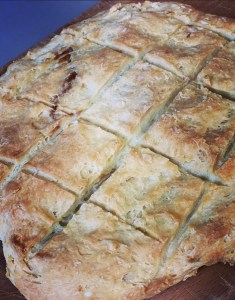
Baking bread became a pandemic hobby for me. I love it, but the process takes time. Time to knead and time to rise. Time to punch down before the second rise. It’s a slow and calming practice that I have learned to appreciate. Baking bread became abeautiful way to mark the hours of a lockdown afternoon and I delighted in stopping in between work calls to take a peek under the cloth that was covering the dough, as it was snuggled – and getting ever more snuggly – in a bowl by the heater (in winter) or sunny window (in warmer weather). The oven would heat up the kitchen and as we sat down to dinner, a golden, crunchy loaf would emerge, ready to accompany whatever was being served up.
But days are returning to somewhat (new) normal here and there is less time. No lockdown means a different pace during the day, because I now inevitably rush out during lunch hours to run errands or stop off for a quick visit to the fruit and veg market before work gets started. Or I’m slowly venturing back into the office for a day here or there. All this means that those minutes that lent themselves to slow food activities now run into each other again: time is not as leisurely as it was, and suddenly it’s dinner time without time to make a loaf of bread.
But on this day, I wanted bread; fresh, homemade, just out of the oven, bread.
And so, I made pizza scima! It’s a five-minute process where all the ingredients: 00 flour, olive oil, salt, bicarb soda and white wine get tossed into a bowl, mixed together and then flattened on a tray. The dough is scored, and the oven does the rest. No kneading, no proofing, no resting, no rising.
Half an hour later, a stunning crispy on the outside, chewy on the inside flatbread emerged and honestly, it is the best bread hack there is to know. (Plus, the recipe calls for only a little wine in the dough meaning you have something to drink with dinner!) Viva gl’Abruzzesi!
There’s nothing like adding a sneaky little shortcut to your repertoire – whatever that may be. I think that often people with diabetes become super smart at finding these sorts of little techniques that become a snappy solution to a diabetes problem.
Yesterday, I learnt a new diabetes hack thanks to Kelly Kunik, DOC old-timer who writes at Diabetesaliciousness. Here is what she shared via a collaboration with Ascenisa*:

This reminded me of one of the topics for Diabetes Blog Week. For newer folks to the DOC, DBlogWeek was an initiative of Karen Graffeo who used to write at Bitter~Sweet Diabetes (seriously, check out all these people and their blogs). Each year, Karen would coordinate this monster effort, coming up with different writing prompts and then setting up a platform for them to all be collated in one space.
Back in 2014, one of the topics was diabetes hacks and ninety-five diabetes bloggers all wrote posts sharing tips and tricks they have discovered that goes towards making their diabetes a little easier. Here’s what I wrote. I’m so pleased to find that all the other contributions are still all together on this link, and I’ve just spent a delightful hour scrolling through and re-reading some of them, getting a refresher on some super ideas from super people!
Call them hacks, call it inspired improvisation, but MacGyvering the fuck out of diabetes is a talent worth cultivating, because you never know when a diabetes moment will call for it.
DISCLAIMER
I am on the Editorial Board for Ascensia Diabetes. I am paid for the pieces I write that appear on their blog. Kelly is also on the Ed Board. Sharing this for no other reason than it blew my mind!
Here’s some stuff I’ve seen in the diabetes online world that I think is pretty cool. And I also think you might like it too if you’ve missed it.
If nothing else, this serves as a reminder that there are some super talented, smart, funny, productive, and downright awesome folks who are doing some super brilliant things and I am always happy to share that around. (I’m forever grateful when others in the DOC have shared my posts and other work. Building each other up is always a lovely thing to do!)
Vaccine in Australia (finally)
We may be a little behind the curve, but Australia’s COVID-19 vaccine rollout has finally started! Some links that might be useful to folks with diabetes:
- THIS statement from Diabetes Australia (disclaimer: I work there), the Australian Diabetes Society and the Australian Diabetes Educators Association
- THIS piece from Diabetes Mine
- THIS eligibility calculator from the Australian Government which will give you an idea of when you can expect to get your jab.
And THIS message from me (and science):

Diabetes poetry to make you laugh and cry
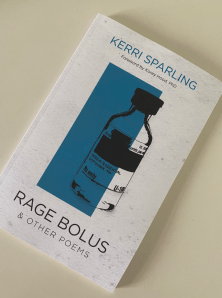
Kerri Sparling has just released her book of diabetes poetry. It’s called Rage Bolus and it is all shades of wonderful. It’s a gorgeous collection of words that will have you nodding, laughing (chortling) and crying, and is a must on the shelves of all folks with diabetes.
You can get your own copy here.
A new diabetes podcast to check out
Chelcie Rice has been around the DOC for a long time now and frequently provides thoughtful commentary on what’s going on in the diabetes world. And so, I’m thrilled to see that he has just launched a new podcast, ‘The Soul of Diabetes’.
The launch episode can be heard here, and then you should subscribe!
Also, Chelcie shared a video of his thoughts on the recent Dexcom Superbowl advertisement and it’s definitely worth a look.
Clare Diabetes Group meeting
More than a little honoured to have been invited to speak at the upcoming meeting of the Clare Diabetes Group in Ireland. You can register here.

Not an easy read…
Phyllisa Deroze remains one of the most incredible voices in the diabetes community. I have been lucky enough to hear her speak (she is such an engaging speaker!), and read everything she writes because I know it will get me thinking. On Valentine’s Day she wrote about her diagnosis story, which is not an easy read, but it is a very important one.
Phyllisa’s blog is called ‘Diagnosed Not Defeated’ and I don’t think that has ever been more accurate or relevant than in this post. Read it here.
CORONADO Study
Just today DiabTribe has published this great piece breaking down the findings from the latest findings of the CORONADO Study which looks at people with diabetes hospitalised with COVID-19 in a number of centres across France.
Read their article here (and there is a link to the full study there).
Totally not relative to anything diabetes wise, but why?
I’m just going to leave this here…
Can you see it??
Check out this advertisement from Bonds Australia for a bit of diabetes technology on show! A little representation can go a long way! (You’ll have to watch carefully…but check out the 36/37 second mark.)
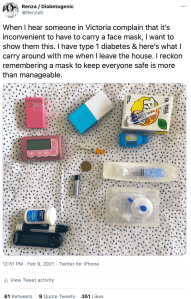
Keep wearing a mask…
…because the science says they work. And share this with anyone without diabetes who is complaining about just how inconvenient it is to have to carry around a bit of fabric with them when they head out to the supermarket!
Spare a Rose final push
And finally, February is dwindling and that means that the 2021 Spare a Rose campaign is coming to its end. So far, an amazing USD$40,000 has come in from the community – that is, donations from people with diabetes and others affected by or associated with diabetes. There will also be corporate donations added to the final tally.
If you’ve not yet donated, or even if you have and would like to donate again, there is still time to make your contribution count towards the final tally. Every single donation makes a difference to the life of a child with diabetes.
Apparently, diabetes blogs are dead. At least, that’s the proclamation that seems to made every month or so. You should very much consider my bias when I say that I don’t agree with that sentiment at all. I mean, I have a shitload of content on this here site – including new and re-visited posts that for me have some relevance to my diabetes life in the moment.
Newer and shinier platforms are here now, so surely that means it’s time to retire WordPress and Blogger. Or is it? Newer and shinier platforms are great, so I’m not here to claim that that they’re a waste of time. Podcasts and vlogs are great tools for sharing diabetes information. YouTube and Reddit are great places to learn. And then there is Tik Tok, but I am too old to be allowed to even log into that platform. (Not true, and I have loved some of what’s been shared there. It can be a brilliant storytelling and info-sharing format!)
I’m here to say that every single platform for sharing a diabetes tale has its place. And blogs are still very relevant: the long-form post is not dead. Not yet anyway.
It is from blogs that I learnt, and continue to learn from others with diabetes. I revisit old posts I’ve read because they remain relevant today, and have many bookmarked and saved because the information shared is so spot on! I use them as research for pieces I’m writing and presentations I’m giving. I send links to old (and new) blog posts to others with diabetes when they ask questions that I know someone has answered so beautifully. And I send posts to HCPs to give them an insight into real life diabetes that they may otherwise have not understood – a glimpse into the things we are hesitant to share with them – and how our interactions with them can leave a lasting impression: both good and bad.
Blogs are also where we hear from those who are adjacent to actually living with diabetes. Reading posts from parents of kids with diabetes and partners of loved ones gives me a perspective that I simply don’t have firsthand.
Advocacy and awareness efforts have been described and fought through blog posts. I’ve used this blog to advocate increased funding for products, research and healthcare. It helps get the message out to people, with simple calls to action so they can get involved too. And the first time I ever heard about Spare a Rose was via this post (the links in the post are not current), and from there so many in the diabetes blogosphere – myself included – jumped on the bandwagon to support this important campaign. We knew that while donating was important, getting the word out was critical too. Since 2013, dozens and dozens of posts have been shared, raising awareness about how this ‘by the community, for the community’ grassroots initiative.
Blogs are where some of those deep and scary issues that we only whisper about or hide away are discussed. It was in blog posts that I first read about just how diabetes impacts on mental health. Experiences about diabetes-related eating disorders were shared without judgement and shame. It was through my writing about infertility and diabetes that I connected with so many other people going through the same thing.
Diabetes blog posts – old and new – are a patchwork quilt of lived experience gold, with the common thread that no one’s diabetes story is more valuable or important, but that everyone has a story to share that is worthwhile.
Some believe that blogs posts are just a way for people to ramble and navel gaze and seek attention. Well to them, I say please enjoy (or don’t) exhibit A – the 1100+ posts here that may be navel gazing to some, but paint a picture of my 22 years of diabetes. It’s not everyone’s experience; it’s not everyone’s cup of tea. And I’m okay with that! If you don’t like the blog format, move on. No one is forcing anyone to read a blog post. Or to get on any other format for that matter. Because, of course, your preferred diabetes info mode may vary (#YPDIMMV).
Someone said to me that reading new blog posts these days is boring because there is nothing new – it’s already been said. And you know what? That could well be true. Diabetes is boring and even though everyone’s diabetes is different, many of us write about similar situations. But actually, that’’s okay. Because for some people, it may be the first time they see or read a post about a particular topic – even if there are five million others! – or perhaps there is a different outlook in there.
I think that people write for different reasons. I write for a creative outlet and writing provides me with a way to explore different ideas about not only my own diabetes, but the diabetes landscape. But mostly, I write to connect with others. I don’t think anything I have to say is particularly erudite or mind blowing. I don’t have any revelations that will help someone else’s diabetes make sense. My own diabetes makes no sense to me, so the chance of it making sense to someone else is very unlikely.
I found most diabetes blogs because their writer shared them on Twitter or on Facebook. Or, others in the community shared them, which is one of the truly wonderful things about the DOC – the way some people elevate others in the community. There used to be an annual event called #DBlogWeek which was a brilliant opportunity to learn about others writing about diabetes. Diabetes Mine’s monthly blogosphere wrap up keeps me updated with some wonderful pieces. (And for German speakers, here you can find a curated collection of blog posts by Bastian from deDOC : I run posts through Google translate to understand them.)
And so, here are some of the brilliant pieces written by PWD I’ve read in recent times. I hope that you enjoy them too.
Corinna Cornejo writes at Type 2 Musings, and is also a contributor to the Ascensia Editorial Board (disclosure: I am too and am paid for my contributions). This great piece about power imbalance in the clinic room.
One of my favourite Aussie bloggers, Frank Sita, wrote this insightful piece about taking a pump break over the festive season:
Diabetes and pregnancy and baby blogs have always been a favourite of mine. I cannot tell you how many I read back when I was at that stage of my life! New mamma Ashley has shared this gorgeous post while (literally) awaiting the arrival of her baby girl.
I loved Dave Sowerby’s 2020 look back in this post.
Kerri Sparling may have retired her blog a couple of years ago, but I was so grateful for this new post on September last year while Melbourne was in the depths of lockdown. I’m sharing it here for others who are locked down at the moment. (And Kerri’s fourteen years of posts are still available at SixUntilMe.com)
Tim Street’s blogs are not for the faint hearted! They are often super technical, but non-techies (my hand is raised) will definitely get a heap out of them. His latest blog post from just a couple of days ago has me thinking about what I need to do to jiggle my basal rates a bit.
I haven’t watched the video that accompanies this blog post from Jen Grieves, but the words expressing how she is feeling in the midst of lockdown resonated so beautifully.
Holly Allen’s post from the end of 2020 about imposter syndrome hit a little too close to for comfort! It’s a recurring theme from some diabetes advocates (and my hand is raised for this one too!)
This from Molly at Hugging the Cactus had me aching as I read it. I miss my diabetes mates so hard and mourn all the opportunities we’ve missed to catch up.
And finally, I’ve not been able to stop thinking about this piece from Cherise Shockley that she wrote for diaTribe recently, and the idea of a carb glass ceiling. I realise that I have a very similar way of thinking when it comes to counting carbs and I love how she has explored the psychology behind why people may think this way.

My email autoreply is on and I have a glorious four weeks of holidays to look forward to. The last time I took any time off was back in January when my family travelled to NYC. There is no travelling this year. We have a new, beautifully landscaped back garden to camp out in over the next month instead. (By ‘camp out’ I mean sit comfortably on a sun lounger and drink Pimm’s.)
My plans are simple – do as little as possible. I’ve rallied against taking any time off this year because I’ve not seen the point. Why would I take time off to simply stay within the walls that I’ve stayed within for most of the year?
That was a mistake. I should have taken some time off. I should have stepped away from the computer and from work – even if it were just for a couple of days.
And so, I’m going to truly try to log off, to not stare at my computer, or open my laptop to just write a quick thing, revise something I’ve been working on, message a friend. I’m going to remove SoMe apps from my phone so that it’s not all that simple to quickly check for an update of what is going on in the Twitterverse or the world of Facebook and Instagram.
I wanted to finish the year on a positive by highlighting some of the people who have made the DOC truly remarkable. So, this is a little Interweb Jumble of the folks in the DOC who have made the place safe, happy and continue to truly be about community. Check them out if you already don’t. Expanding your view of the DOC is important if you want to learn about more than just your part of the world.
Cherise Shockley has a new podcast…
…and you should subscribe! It’s called ‘Don’t Keep it to Yourself’ and it’s my favourite new diabetes podcast which is completely not about diabetes! Instead, Cherise is pushing people outside their comfort zones and asking them to share things that others may not know about them. I’ve loved hearing the episodes she’s already shared and had an absolute ball chatting with her.
The thing about Cherise is that she IS community. Even though her podcast is not about diabetes, it is still about people supporting and looking out for each other. Because that is who this woman is! Subscribe and listen from wherever you subscribe and listen to podcasts.
DOC friends who have made me uncomfortable – but in a good way.
First up is wonderful Steffi from Pep Me Up whose Instagram stories challenged me to look at what was going on in the world in different ways. She has been absolutely relentless in her efforts to elevate the stories of people who are forgotten or left behind and highlight the bias we inherently have. You can find Steffi on Instagram here.
And secondly, the also wonderful Tine who you can find on Twitter at @SayTine. We’ve known each other for a number of years now and we bonded over a mutual love of food. We have been allies in the language matters movement. Tine’s feminism has always been aligned with my own, but she has introduced me to different people and ideas that have made me consider some of my own ideas.
Accessible Dtech information…
…from the always enthusiastic and excited Nerdabetic. I met Kamil for the first time a year or so ago and discovered that he is every bit as awesome and lovely in real life as he is online. I love the way he makes the latest in diabetes tech accessible and relevant to tech-imbeciles like me while also making it relevant to people whose interest in and understanding of technology generally makes my brain synapsis short circuit. It’s great to see Kamil appearing in the global DOC more with appearances on diaTribe. Kamil’s YouTube channel is here.
Brilliant photography…
…from a DOC stalwart. Mike Durbin was one of the first people I noticed in the DOC when I started participating in DSMA tweetchats over ten years ago. I’ve never met him, but am always interested in what he has to say, and his thoughtful takes on the diabetes world. Mike appears in every single presentation I give about diabetes peer support and the DOC because I always share this picture. It speaks community to me.
On top of being such an integral and wonderful part of the DOC, Mike is a truly outstanding photographer and this year, I have found myself absolutely obsessed with what he has shared. You can see his work on Twitter here.
More Clever creatives
I adore the gorgeous artwork Nicole Buchanan shares on her Instagram. She absolutely nails diabetes moments with stunning designs and clever captions. I’ve shared so many of her posts because it’s like she has climbed into my head and then perfectly explained the mess in there with a beautiful illustration. You can follow her on Instagram here.
Another favourite diabetes creative is Katie Lamb, another talented illustrator who manages to capture diabetes in her lush drawings. She’ll even draw you for a small fee! Find her here.
Aussie Jenna Cantamessa continues to share beautiful drawings on her Instagram here, and she has just opened an Etsy store so you can own one of her beautiful pictures.
Special mention to dedoc for keeping PWD at conferences…
…because it would have been all too easy for us to have been forgotten with conferences going online. Bastian has done a stellar job getting DEDOC Voices up and running, offering scholarships to PWD to be part of ATTD (the only IRL large-scale conference this year), EASD and ISPAD.
CWD keeping people connected
Children with Diabetes did a herculean job of not only running hugely successful Friends for Life conferences online, but also churned out relevant content all year, and seemed to run a bazillion meetups to keep people connected. In case you missed the fireside chat hosted by Kerri Sparling about #LanguageMatters, you can play catch up here.
Spare a Rose…
…will be back next year, but I just wanted to mention the amazing efforts of the community this year as we smashed all previous records and delivered a magnificent USD$73,748 straight to Life for a Child. How remarkable is it when the DOC stops looking inwards??
The offline DOC friends who kept me going…
…are the reason that I have reached this stage of this year with some sense of balance. A huge thank you to the squad of four friends from the US & UK who have shared their lives with me throughout this clusterfuck of a year in an endless message thread that has kept me going. And the IRL friends too – with special mentions to Georgie and Jo. I am so grateful we live close to each other.
And don’t forget…
…please do consider making a donation to Insulin for Life’s Secret Santa Campaign.
Finally…
…that’s all from me for 2020. I’ll be back in the new year, but for now I am switching off and doing everything in my power to be less busy, less online and less engaged. Probably the only downside I see with Loop is how reliant it is on being close to my iPhone at all times, because honestly, I would like to let my phone battery run flat and not charge it up again until the end of January! But I am making a concerted effort to turn off and ignore notifications and be more present with the people I am so, so lucky to spend my life with. To those celebrating, have a wonderful festive season. Thanks to everyone who has stopped by. See you in 2021.
I know…it’s almost Christmas. And if you are anything like me and mine, you’ve left the run of gift buying a little late. Or you’ve wound up in lockdown. Or the thought of battling crowds is not something that you are all that keen on because there are too many un-masked bandits in the shops.
And so, here’s another little reminder that there is no need to panic because Insulin for Life is doing Secret Santa and your can absolutely buy the BEST. PRESENT. EVER. with heaps of time to spare. All without hitting pause on your Netflix binge!
It only takes $5/€5/£5 to make a real difference to a person with diabetes in an under-resourced country. That small amount will provide a week’s worth of insulin and diabetes supplies to someone who otherwise might not have them.
My family made the decision this year that in lieu of gifts for my cousins’ kids, we’d make donations instead. We absolutely adore these kids, but know that they probably won’t miss the book or book voucher we usually give them. And we also know that making a donation in their names literally means saving a life. That seems like a pretty good trade.
Without a doubt, 2020 has been horrid for many, and those doing it toughest were already likely doing it tough even before a year-long pandemic. If you are in the position to make a donation to this cause, please do. If you can share the link to the donation page with friends, colleagues and loved ones, please do.
I know that the diabetes community comes together to support our own beautifully. We’ve seen it in a million different ways. I’m hoping that in the lead up to Christmas that support will look like people making donations to Insulin for Life…and encouraging others to do the same. Please do help if you can.

Diabetes Awareness Month has come to a close and with it the blue that has washed over my social media feeds will dim a little. I had a quiet month, spending most of my time following others rather than sharing my own content. It seems to have been representative of my year in diabetes advocacy, really.
I’ve been quiet. It wasn’t planned, but it has been deliberate. And it hasn’t gone unnoticed. I’ve started and stopped and started and stopped this post for a while to answer the messages from people who have so kindly asked if I am okay. Let’s see if this is the one that sticks…
Earlier this year, I wrote about having a panic attack while on a plane after landing back in Melbourne from ATTD in Madrid. You can sort of read about it here, although I was pretty vague about what actually happened saying little more than that I turned on my phone to a million Twitter notifications about a blog post that some people had assumed was written about me and then subsequent comments. I was surprised, horrified and more than a little confused.
This came hot on the heels of a couple of other tricky situations. There was the run in with the diabetes HCP who told me to tone down (after they completely misrepresented what I had written about). And then there was another HCP rallying troops to call me out (that caused me to lock my twitter for the first time ever at the end of last year).
Anyway…the culmination of all these things resulted in the realisation that this year was going to be a lot different for me. I was going to take a massive step back from much of the work I did that was public facing. I felt that I simply couldn’t take the scrutiny that was coming my way.
Even before the panic attack on the plane incident, I was feeling unsettled. I was unspeakably nervous about the presentation I had been invited to give at the conference in Madrid. This was a completely alien feeling to me. I have been speaking publicly for decades, and for twenty years, comfortably stood on stage playing the flute for anyone who would listen. Standing in front of an audience doesn’t make me nervous. It doesn’t make me sweaty and scared. And yet, here I was wondering whether I should not go to Madrid at all to stand up on that stage. But after some ridiculous bravado as seen in this post, I decided that I had to go.
As I sat on that plane, desperately trying to recover from the panic attack that was making it difficult for me to breathe and hiding my tears from the other passengers, I had a fleeting thought that I probably should have gone with my gut feeling and stayed home!
And so, I felt that there was only one thing I could do. Forget the whole stand up thing and instead step back. I wasn’t necessarily sure what that would look like. I couldn’t stop attending and being part of diabetes meetings and conferences because that is part of my job, but I could turn down speaking engagements or anything that put me in a position where I was sharing my personal, lived experience that others might find challenging, or at odds with their own. I needed to deal with the diabetes burnout that was so, so heavy and weighing me down.
COVID-19 certainly helped with that. As the world got turned upside down, a lot of the things that I was worried about simply didn’t happen. It became easier for me to limit my interactions with people and hide away a bit more.
The feelings of burnout and anxiety about being part of the community didn’t disappear, but they seemed less urgent.
And with that came the realisation that the burnout I was feeling because of diabetes actually was not because of my diabetes at all.
Diabetes burnout has always happened to me when those constant diabetes tasks became too overwhelming; when just the thought of opening up a meter bag, or checking my CGM trace was too much to even contemplate. Burnout meant that every single number became a measure of my value and worth. I’d lose all perspective and lose all confidence of my abilities to actually do what I needed to do.
The burnout I felt now was the effort of being a diabetes advocate IN the diabetes community. It was fearing that I was being seen in ways that actually were completely inaccurate – in fact at complete odds with everything I have ever stood for – and that led me to second guess everything I said, fearing that I would be misunderstood. It was feeling vulnerable and scared and exposed in the community that was meant to support me.
I received an email from someone in the DOC who has been around for many years, and I have known (on Twitter only) who told me that because I am confident in my communication, am comfortable challenging ideas different to mine and share opinions that not everyone agrees with it, I leave myself open to criticism. And that criticism and the dialogue that follows resulted in their corner of the diabetes community being less enjoyable to him and others. All while suggesting that, unlike he, who has never deliberately set out to disagree with anyone – I seem to revel in it.
Interesting take. I don’t seek to disagree with people. But if anyone is saying something that I believe is stigmatising to PWD or minimising our experiences, I will call it out. It’s been my MO for almost twenty years.
I never replied to the person who sent me that email. I cried about it for days, however, and have it filed away and occasionally return to the half-written response that I keep meaning to finish so I can hit send on my reply. I feel it’s quite impolite that I’ve not replied to someone who took the time to write to me… But, truthfully, I am too tired, and that so-called confidence has abandoned me.
Diabetogenic is the least active it’s been since I started it close to ten years ago. That’s not because I have nothing more to write – I still write every single day, I just squirrel things away now, too afraid to share them, sticking to safer topics – research call outs, fundraising initiatives, commenting on things that aren’t controversial or taboo topics.
I started this blog because it was the space for me connect with others – not only people who were walking the same diabetes path as me, but also those who were doing things very differently. Because often, they are the people I learn most from.
It became a place I could write about those issues that were tough – the mental health challenges of diabetes, the frustrations and desperation I felt about the health system, trying to navigate through health professionals who refused to acknowledge that PWD belong everywhere and anywhere diabetes is spoken about. And it was a place that my split-apart heart was able to open up and share the unspeakable sadness that I felt as fertility issues became part of my life. I am so grateful that I was able to do that and receive the support that I so desperately needed from people who understood how the impact of diabetes on those fragile, and so, so hard parts of life shattered me into a million broken pieces. Because it was those people who helped glue me back together.
Wanting and needing that support and connection hasn’t stopped. I still seek it. I’m just a little more cautious about how I go about it these days sticking with friends and others I feel safe with rather than the wider community that doesn’t feel safe. I know where to go to get what I need.
I don’t really know what to do with this blog anymore. Feeling unable to share a lot of what I want to say is alien to me. But for now, this doesn’t seem to be the place to do it. I guess I continue as I have been – hitting publish when I feel I can, and for the next month, anyone popping by will see a lot of pleas to donate to Insulin for Life.
And I guess that will have to be enough for now.

I’m loathe to talk Christmas while still in November. In fact, we have rules in our house that we do not even mention the word until after my daughter’s and my birthdays which both fall in the last week of the month.
However, the other day as I was doing some supermarket shopping, I heard the strains of Silent Night and noticed glittery decorations starting to adorn the streets. Honestly, this year is so all over the shop that I have no idea what month it really is, but if Woolies wants me to believe it’s the festive season, who am I to argue?
And so, let’s talk Christmas…specifically this:

We all know how tough this year has been. We all know that there is no corner of our globe that has not been touched some way by the COVID-19 pandemic. What we should all also know is that even though COVID-19 may be global, there are some people who have been disproportionately affected, and it is always the most vulnerable people in the most vulnerable places that find themselves in that situation. Contrary to the idea that COVID doesn’t discriminate, people already doing it tough are finding things even tougher.
Which, to me, means that for those of us who can, now is as good a time as ever to step up and support anyone finding themselves in that situation.
I’ve been trying to get rid of the tradition Secret Santa or Kris Kringle (or whatever you call it in your family or workplace) for years now, instead directing those funds to a charity that supports people with diabetes living in under-resourced countries . You can read my grinch-like posts about that here and here oh, and here, where I yell that NO ONE WANTS A BATH BOMB!! It’s true. NO.ONE.WANTS.A.BATH.BOMB.
BUT! People with diabetes want insulin, diabetes supplies and education, and by ‘want’ I obviously mean ‘need’. (NO.ONE.NEEDS.A.BATH.BOMB.)
Insulin for Life Global is a charity that helps people with diabetes in need of the things that I (try really hard not to) take for granted. I have spoken and written a lot about Life for a Child (LFAC), mostly in relation to the Spare a Rose campaign. Insulin for Life Global picks up where LFAC ages out. Because, diabetes is for life, not just until you’re 26 years old.
This year, Insulin for Life is launching its new #IFLSecretSanta campaign and is asking the diabetes community to please get on board. I’m totally on board with this Secret Santa campaign because it will be more than just a novelty gift that is likely to end up in landfill.
A donation of $5 (or €5 or £5) will provide a week’s worth of insulin and diabetes supplies to a person with diabetes in one of the countries supported by the charity.
I asked around, and it seems that most office Secret Santa gifts have a limit of $10. That’s two whole weeks of diabetes supplies (including insulin) to an adult with diabetes who might otherwise not have it. If your whole workplace gets on board (or family, or friendship group, or book club…) that suddenly starts to add up to a whole lot of weeks of diabetes supplies!
As with any campaign like this, it works best when people share to help raise awareness of just how easy it is to be a part of it. AS well as making a donation, it would be terrific if as many people in the DOC could share details of the #IFLSecretSanta drive and encourage friends and family to donate.
I promise that no one is going to miss not getting a bath bomb. But people with diabetes, unable to access or afford essential diabetes meds and supplies, will be grateful if the money for that bath bomb was redirected to the charity that helps them.
Okay, DOC, now’s the time to do our thing. We do this and we do this well. While there are lots of people in this community and we certainly do not all agree, or even all like each other, it’s campaigns like this that seem like a good time to put aside differences and come together. Let’s see just what we can do to help Insulin for Life and their first #IFLSecretSanta campaign.
Donate here. (It will take you straight to PayPal to donate, and your donation will go directly to Insulin for Life.)
Hashtag away on your preferred socials: #IFLSecretSanta





 Diabetogenic