
You are currently browsing the category archive for the ‘Diabetes’ category.
On Saturday night, before delving into the craziness that was White Night, I attended the launch of a terribly exciting new resource. Enhancing Your Consulting Skills; supporting self-management and optimising mental health in people with type 1 diabetes is described as an ‘education resource for advanced trainees in endocrinology and other interested health professionals’. That’s right. It’s written for health professionals who will be working with and for people with type 1 diabetes. 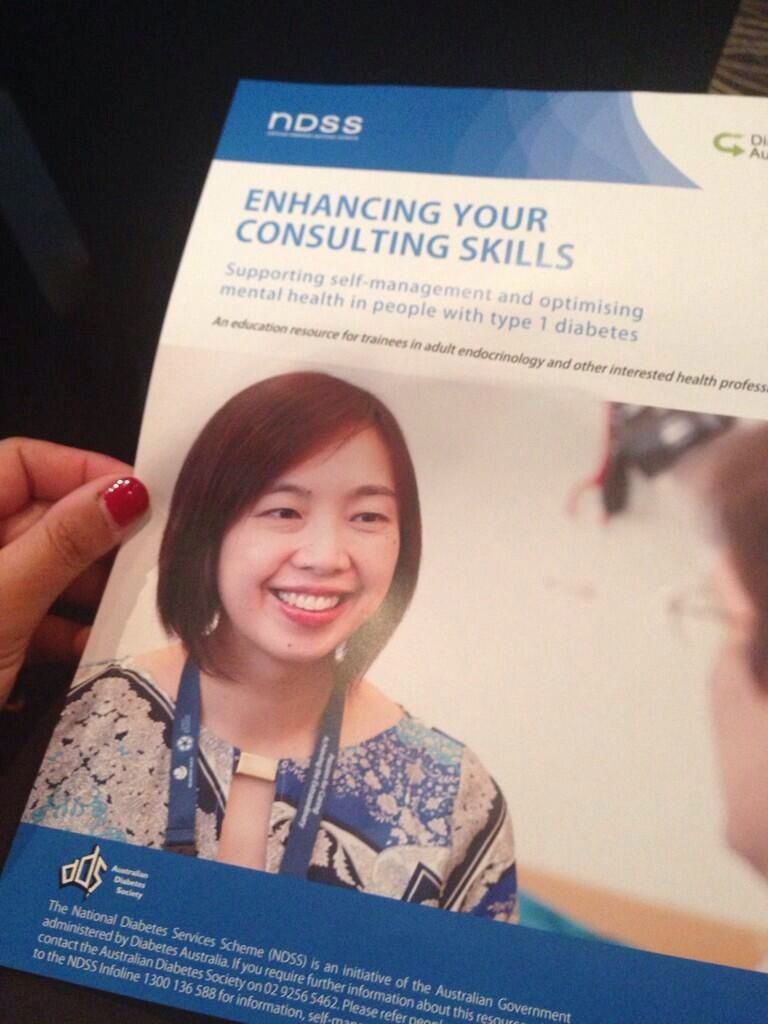
I attended with a dear friend who shares my pancreatically-challenged state. We also share the same endocrinologist – one of the collaborators on the resource – and were there at her invitation. We know just how lucky we are to see an endo who understands self-management, ‘gets’ the fact that burnout happens and doesn’t have a judgemental gene in her body. We know that having an endo who we can email in between appointments is a privilege we would never abuse. And we know that living in the inner city means that we have access to healthcare that many others can only hope for.
Hopefully, this resource will mean better education of new endo trainees and that the care we are so fortunate to receive will be available to many more people with diabetes.
This resource is a huge step forward in medical education. It is the first time that the needs of people with type 1 diabetes have been directly addressed with a strong focus on self-management and mental health. As Professor Alicia Jenkins highlighted in her speech, people with type 1 diabetes spend, on average, three hours per year with their healthcare team. The remainder of the time we’re doing it alone. There is no treatment option other than self-management and an understanding of how HCPs can support that is critically important.
Endocrine trainee, Michelle, gave a candid speech how she has come to view people living with diabetes. She said that when she first started attending a young adults with diabetes clinic, she was frustrated and said that she blamed her patients for not getting the results she expected. This honesty was refreshing and it was so pleasing to hear how she now knows to focus on the positives rather than negatives when working with PWD.
Dr Jennifer Conn gave a warming speech about how she never stops learning from her patients. This humble attitude is one of the reasons that this book is so well written. It acknowledges the expertise held by the person who lives with diabetes and knows their condition better than anyone else possible could.
I looked around the room and saw that there with the glitterati of the diabetes HCP world, were some of the pancreati – the people with diabetes who the book was written for. It’s a tribute to the writers and organisers of the launch event that people with diabetes were invited.
I’d like to congratulate the team who have put this together, and the NDSS for supporting the development of the resource. This is a win for people with type 1 diabetes and I can certainly see similar volumes being written for type 2 diabetes and, indeed, other chronic health conditions.
At the end of the event, I wandered back out onto the Melbourne streets, waiting for nightfall when the city would light up and fill up with hundreds of thousands of people. I looked at my friend and thought how lucky we are – a night of Melbourne brilliance kicked off with hope for a better future for people with diabetes.
Disclaimer
One of the collaborating writers involved in this resource is my endocrinologist. I was asked to provide comment on some sections of the book and my photo and a screen shot of this blog are included in the final book. I did not receive any payment for any of this involvement.
The development and printing of this book were funded by the National Diabetes Services Scheme (NDSS) which is administered by Diabetes Australia. I am employed by Diabetes Australia – Vic.
I couldn’t be more excited to receive this in the mail today:
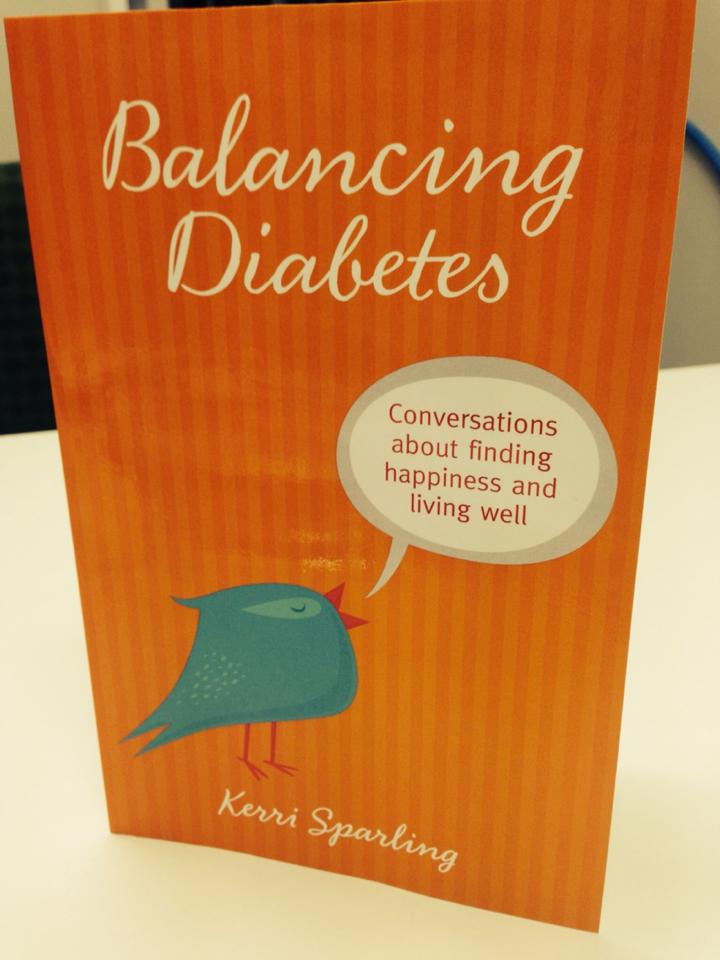
And I couldn’t be more proud of the wonderful Kerri Sparling who I am lucky enough to call my friend.

Run, don’t walk, to order your copy of Balancing Diabetes now!
Today is Diabetes Art Day. The last time I took part in Diabetes Art Day was in 2012 when, instead of making art, I looked at it. We were in Rome and spent the day wandering around the Sistine Chapel. But this year I decided that it was time to actually produce something. I’m not a great artist. In fact, our daughter overtook my drawing abilities when she was about…oh, maybe 12 months old. However, Diabetes Art Day isn’t about producing perfect works of art. It’s about thinking about how diabetes can be represented in ways other than words (I kinda missed the brief as you will see below).

So in an endeavour to do something quiet and cool (and indoors) to escape yesterday’s sweltering heat, my family sat around our kitchen table and made some art. Out came coloured paper, crayons, textas, colouring pencils, stencils, stamps and anything else in the craft basket that looked like it might be fun.
And then we drew and collaged and stamped. I decided to use lots of different colours and place the blue circle over the top. I liked the idea of a rainbow-esque kaleidoscope of bright and not-so-bright colours because to me, that’s how diabetes is. And while the elusive pot of gold at the end of the rainbow may be a cure, there is still hope in between even if we never actually find it.
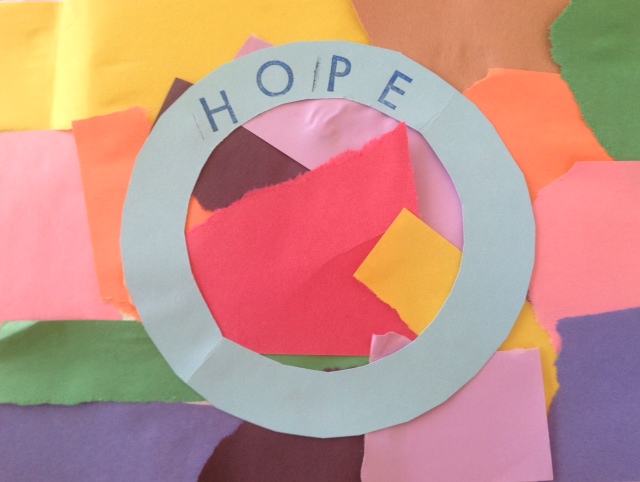
Hope. For me, there always needs to be hope….
And the kiddo and Aaron came up with these gorgeous pieces.

Is that a Twitter bird I can see?
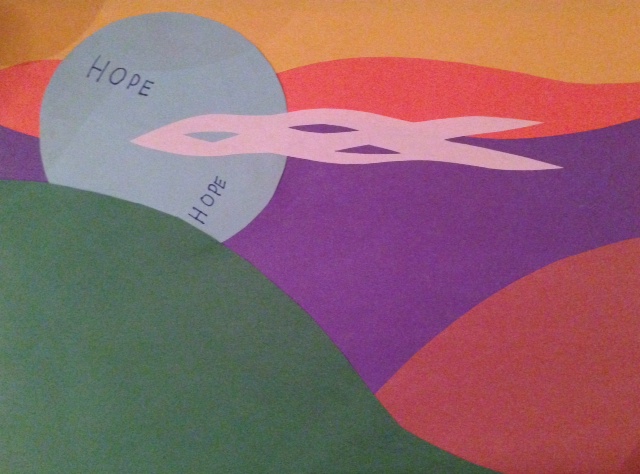
More colours and a blue disc of hope.
So, here is our family’s contribution to Diabetes Art Day. I’m going to frame the pictures and put them up in my office so that I can be reminded that sometimes it helps to look at diabetes in a different way.
Postscript:
And then I got a little carried away with the stamps and did this:
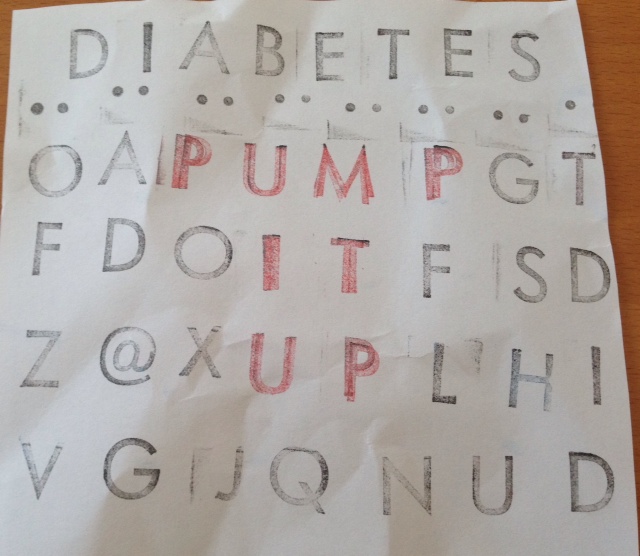
Follow Diabetes Art Day on Twitter: #DArtDay
For the first time in a while, I woke this morning feeling rested. I realised that it had been some since I’d had a solid night’s sleep without getting up for anything. And it felt good!
I’ve always been someone who can fall asleep at the drop of a hat. Sitting in the passenger seat of a car for more than 20 minutes is all it takes for me to doze off (I’m really not a great driving companion). And I think that in all my travels I’ve been awake for take-off maybe twice. The second the plane starts taxiing, I’m asleep. Caffeine doesn’t affect me and I can sleep in bright light and through loud noise.
When I was diagnosed with diabetes, one of the most difficult things to deal with was the need to wake at a certain time (much earlier than I was used to) so I could have breakfast and take my first insulin shot for the day. I can still remember the relief I felt when I started using a pump and could go back to sleeping away half the day if so desired (as it often was).
I worried about how I would cope with the promised sleep deprivation that a baby would bring, but pure luck delivered us a baby who slept through the night from an early age and who, even now, sleeps in on weekends and over holidays and knows to leave the grown-ups alone if she rises first.
But lately, sleep hasn’t been coming easy. Between the heat (and resulting hypos), getting used to sleeping in a new house and waking due to pain in my right eye following my second cataract surgery, I haven’t really had many nights of restful slumber. Plus, it doesn’t help that the allure of ‘just one more episode’ of Breaking Bad is reducing the number of hours spent in bed.
The nights disrupted by diabetes result in days disturbed by diabetes. I find myself yawning and finding excuses for more coffee to try to keep me alert. And I think about sleep – and then stress because I’m tired and not sleeping properly. I feel sluggish and slow and find it difficult to stay on task. And I spend most of the day banging on about how tired I am because I didn’t get enough sleep.
Which, apparently, is the problem.
I read today that just thinking about sleep positively can impact on performance. This study published in the Journal of Experimental Psychology says that complaining about not getting enough sleep is the reason that performance suffers – not the actual lack of shut eye. There’s a placebo effect for you!
I’m not sure if that’s true, but given the number of nights diabetes does reduce the hours of sleep I get, perhaps some positive thinking is in order. Diabetes unfortunately means that there are nights of broken sleep. Maybe instead of complaining about it, I just accept it and think about the time I was actually dreaming and how good that was. Or look forward to the sleep that’s coming up.
Also, maybe a limit on the number of Breaking Bad episodes would help too. Just saying.
‘I’ve been compliant,’ I said to my ophthalmologist with great pride. ‘Compliant’, I said again and smiled at him and waited for a pat on the back. It didn’t come. So I tried again, emphasising my point. ‘Four times a day; both drops in my eye. Just like you said. Didn’t miss a single drop. I was com-pli-ant.’
If there is a word that is evokes rage in me it is compliant. When used in terms of diabetes management, it makes me see red and start imagining the painful things I’ll do to the person using the word. Actually, it’s usually used with the prefix ‘non’ to give the word noncompliant which is even worse.
At the World Diabetes Congress last year, Twitter nearly broke thanks to a group of DOC renegades sitting in a lecture given by a doctor who insisted on using the term ‘noncompliant diabetics’ to illustrate the point that some of his patients were having difficulties following their diabetes treatment plans. There we were, non-compliant diabetics because we couldn’t keep our BGLs perfect and follow the rules and do the things we ‘should’ do and, you know, do it all with a smile. Bad, bad, BAD diabetics. This photo shows how happy I was:

So with this hatred of the word, why was I bandying it about in front of my ophthalmologist like there was no tomorrow? And saying it so proudly? And frequently?
The answer is quite simple. Following the treatment plan I’d been given after my cataract surgeries was easy. Two different eye drops; four times a day; for 4 weeks. Then it was over. It was something that, for me, was manageable. There was a point where it would stop and then I wouldn’t have to think about it again.
The complete opposite of living with diabetes where there is no end point and no time where a box can be ticked and it will all go away. It was so lovely to be able to do something that was predictable, easy, knowing that there would be a time when it didn’t have to happen again.
Understanding the relentlessness of diabetes management is difficult to communicate. I don’t really expect people to truly appreciate what it is that is so frustrating and annoying and challenging. But I do expect a little respect and a little acceptance when things are not going to plan. I also think that using judgemental words that suggest that there is a deliberate attempt to ‘break the rules’ is unfair and lacks any sort of comprehension about a condition that never goes away.
Perhaps my delight in announcing so loudly and proudly to my ophthalmologist about how clever and bright and shiny I’d been with my eye drops was because for once I felt like I was actually doing something right when it comes to my healthcare. Perhaps I needed recognition (probably more from myself than anyone else) that I could follow directions and get the desired results. Perhaps I just needed to believe that I was doing something that would result in predictability and a satisfactory outcome. Diabetes doesn’t ever provide any of those things. No matter how compliant you are.
One of the reasons social media is so powerful is because of the way it connects people. By removing all the constraints that would normally prevent people from sharing, we form connections based on shared experiences and familiar stories. We know that in the Twitterverse, there are no boundaries or territory lines to divide us. Last year, this blog was read by people from over 90 countries around the world. (Seriously, I couldn’t name 90 countries, so I’m going to have to take the word of the clever WordPress fairies on this one.)
There are so many examples of times when I read something and feel a pang of familiarity because the story mimics my own experience. And I’m always touched when people tell me that my posts ring true to them. There can be real solidarity when you are part of an online community. In today’s diabetes online community, I am fortunate to say that I feel I was welcomed from when I first hesitantly put up my hand and waved hello. The reluctance came because in a previous attempt to participate in an online diabetes site, I was condemned for having an opposing opinion to the moderators. I meekly retreated, insulin pump dragging behind me, and never went back for another play.
It saddens me when I see stories of internet trolls who deliberately upset people and consider it fair game and sport to have a go at those with differing opinions. The cowardice and manipulation shown be some who use anonymity as a screen to hurt people can be terrible.
There are billions of stories in the world and when we find people we connect with, we reach out and want to hold on. I know that’s how I feel about the DOC – I hear familiar stories and want to grab onto them and the people who wrote them (metaphorically, not literally; that would be creepy) because they help make sense of my diabetes life.
We’re not all the same and that is so okay. Perhaps the reason that online communities like to DOC work is because rather than looking for differences and calling each other out on them, we look for the similarities instead. We search for the things that connect us and build our community on that. And that makes me want to keep coming back for more. And more.

They’re both red.
Focusing on the things that connect us.
Yesterday as I skimmed a few news sites and social media sites, I came across endless diets, weight loss fads and a downright disturbing article about ‘bikini bridges’ which, it appears, is the latest in ‘thinspiration’ trends (we’ve moved on from the thigh gap, apparently). I caught up on a piece about ‘diabulemia’ and thought about how diabetes adds an extra degree of difficulty to all things – even eating disorders.
The relationship between weight, food and diabetes is so complex and confusing. We’re told to maintain our weight to remain healthy (or prevent developing type 2 diabetes in the first place); we’re told to manage our cholesterol for heart health; we’re told that certain foods are taboo; we’re told we need to eat at certain times to prevent lows; we’re told we should eat a lot of carbs/not too many carbs (depending on who you listen to today); we’re told to cut sugar (tweet below gives you some indication to how I feel about that one!) and we’re told that our waist circumference is yet another number to think about.

Quitting sugar (or anything else for that matter) will not cure type 1 diabetes.
Now take diabetes away and we’re told a heap of other things.
There are polls about who has the ‘hottest’ body as if it is something that can be measured, and there are ‘half their size’ magazines at the supermarket. Ads for The Biggest Loser are already on our screens. Faux-concern is directed towards celebs who seem to have lost too much weight. Between fat-shaming and skinny-shaming, it appears no one is safe.
We refer to women’s bodies as ‘hot’ as if they are pieces of meat to be graded. There is no consideration for whether they also happen to be intelligent, have a strong social conscience or are good at horticulture. Or knitting or whatever it is that they are good at. Because it doesn’t matter. As long as they look hot.
Women become known as specific body parts (except Elle Macpherson who is known as ‘The Body’ which means that no one cares what’s going on in her brain). Pippa Middleton isn’t known for being Pippa Middleton. She’s known because her arse looked ‘hot’ in a white dress.
Apparently having a certain body shape makes a woman ‘authentic’. Curves, allegedly make a woman ‘real’, whereas being skinny somehow, miraculously, makes her less real. Believe me, as someone who has at times had some decent curves to hold on to and then at other times can see bones protruding, I’ve always been real.
I don’t think much about my weight. It’s never been an issue for me and I’ve never been on a diet. During periods where I’ve tried to eat better, the focus has been health, not weight loss. Also, I love Nutella too much to even contemplate cutting processed foods out of my life. Also, bacon. And cupcakes.
And yet.
Daily, I find myself struggling with how I feel about the dozens and dozens of images that I see. I’m confused at how I should feel about my own body. Today, I look in the mirror and see that I am probably the thinnest I’ve been in some time, meaning I’m closer to the ‘body ideal’ that the fad diets promise. And yet, I look at my collarbones – all sharp angles – and feel slightly ill.
Where in there is the message that to be happy with ourselves we need to – well, be happy with ourselves? Where are the messages of celebrating who we are for more than how we look in a pair of skinny jeans? In fact, can we stop referring to jeans as skinny, please?
The discussion needs to shift. We need to stop talking about weight loss and ways to look ‘hot’. No one can achieve the things being promised. In fact we’re all destined to fail. But health? Health is something we can all work towards achieving. And if each step is measured by our wellbeing – not the size of our thighs – we’re working towards something worthwhile and meaningful. Feeling better inside. And my guess is that will have far longer-reaching consequences than detoxing for a few days.
Hypo Boy (AKA Spike Beecroft) is back with what I hope will be his first of many 2014 posts for Diabetogenic. Here, he shares some of his hypo stories. Thanks mate!
Hypos, like taxes, Christmas and birthdays happen. You can try hard to avoid them but eventually the sneaky buggers find you out and drop you to the floor, slug you for dollars, make you have to suffer the indignity of shopping or remind you that your age-growth may have out stripped your wisdom-growth. The main point is to keep calm and carry on.
Hypo Boy probably has had a slightly alarming number of hypos over his life time, but he’s not dead yet and he’s getting better at staying upright. Here he shares some of the funnier aspects of hypos.
Hypos affect your brain. What was once an instrument of sharpened surgical steel, able to slice through complex problems of logic may struggle with simple ideas. Such as the concept of a cupboard or door and the hypo fixes that live behind them.
Hypo Boy (HB): I need the stuff that’s in the thing…. You know the thing (mime show of cupboard door opening).
Better Half (BH): You what?
HB: I need the stuff that helps me. It’s in the packet in the place with the thing (more miming).
BH: Are you okay? Hypo Boy you’re really low, aren’t you?
HB: That’s what I’m telling you! I need the stuff that helps me. It’s in the place with the thing (more miming).
BH: Okay, you’re really low Hypo Boy. Now tell me where your snakes are.
HB: (exasperated) In the place with the thing. I can’t remember what it’s called but it goes like this (mime) and looks like that (points to door). But it’s smaller.
BH: Just wait here. I’ll look in the cupboard and see what’s there that might help.
HB: Cupboard! That’s it! The snakes are in the cupboard!
Even if the surgical steel is only moderately rusted it still might not quite hit the mark.
BH: (on waking to hear HB in the kitchen) What are you doing Hypo Boy?
HB: I’m low. I’m just getting something to eat.
BH: (turning the lights on in the kitchen) What are you doing?
HB: I’m low. I’m just getting something to eat, then I’ll come back to bed.
BH: Is roast beef good for hypos? (Hypo boy was busy carving and eating left over roast beef. It was delicious in his defence.)
Hypos can also impact those around you. While that may seem obvious, occasionally you do get an odd ball one. For a long time while dating a young women, Hypo Boy had fallen into a disturbing routine during moments of intimacy:
i) Amorous activities (details withheld to maintain the mystery and allure);
ii) Hypo;
iii) Amorous-activity-interruptus walk to 24-hour Coles for hypo fix; return home for fix and talk before….
iv) Return to complete point (i)
After a while, point (ii) began to interrupt point (i) too much. Hypo Boy made some dose adjustments without informing his partner, so that when they started on point (i), he managed to skip points (ii) and (iii). Hypo Boy was happy, and if he was a bit more Gallic would have lit up a cigarette.
Hypo Boy’s partner, rather than being happy about the new arrangement, started to question why.
‘Wasn’t I energetic enough? Do we need to do something different? Why didn’t I give you a hypo with my young, fit, flexible and nubile body?’ (Some dialogue may have been adjusted for writer’s own benefit.)
Hypo Boy learnt a number of lessons that night:
(a) Let people around you know when you’re making dosage adjustments. It’s helpful if they know there could be a reason for a change in routine.
(b) DO NOT laugh at a young woman who is questioning her performance. She might not let you play with her toys for a while.
Sound advice, Hypo Boy, sound advice. Sometimes you just gotta laugh. Do you have any amusing hypo stories to share?

How are your New Year’s resolutions going? I read something the other day that most men who resolve to lose weight in the New Year have given away their diet by 2 January. Way to commit, guys!
The reason most of us fail when we make resolutions – at any time, not just New Year – is because we’re unrealistic about what we’re hoping to achieve. We grandly make claims that we will reinvent ourselves in ways that are simply destined to fail. We get disillusioned at the lack of progress or disappointed any time we fall by the wayside. So, we give up.
Diabetes resolutions are no different. Promising to start being a ‘good diabetic’ (my eye is twitching right now!) and swearing to never have a BGL reading above 8mmol/l is noble in its vision, but downright impossible to attain. The first reading above 10mmol/l and the towel will be thrown. In.
Changes need to be small and goals achievable. Small rewards along the way acknowledging what we’ve accomplished help too.
My main diabetes goal for the start of the year is to get my basal rates sorted. I know that things aren’t great and haven’t been for some time. Despite having lost a significant amount of weight over twelve months ago, I haven’t done proper basal testing for a long time. I guesstimated some changes at the beginning of last year after some really nasty hypos and that kinda helped, but not so that I felt that things were really on the right track. Despite knowing that reduced weight means reduced insulin requirements, I didn’t bother to work things out properly and faffed around by reducing bolus doses to compensate for too much basal insulin. Just ‘cause you know these things doesn’t necessarily mean you fix them. Apparently.
So, I’ll be starting with my morning basals and taking it from there. It’s frustrating and I really would prefer to be doing anything else, but I know that when my basal rates are tight, everything else diabetes-wise is that little bit easier.
Outside my diabetes life, I’ve decided that this year my goals include things that stretch me and push me out of my comfort zone. Last year, we visited Marrakech, which was so unlike anywhere we’d ever travelled previously. It was great. I loved it! I loved being in a country where each day I experienced something new and I was surprised around each corner. As much as I enjoy going to places where I know how things operate, it was so much fun working out a new place.

So with the desire of searching for something new to keep me busy – something that was a bit of a stretch – I found myself uttering the words ‘Yes, I think I would like a banjo ukulele’ while I was wandering around a music store in inner-Melbourne last week. It’s been years since I played any music, and rather than pick up my flute and start playing that again, I’m going to start something new. Why not?
The goal isn’t to be a virtuoso, it isn’t to play gigs. Hell, it isn’t even to be any good at it. The goal is to do something new and something fun.
New starts excite me. I love the possibilities of what lies ahead. The beginning of a new year has me filled with optimism. I don’t do resolutions, but I do like the ‘clean sheets’ feel of the start of January. And with a year behind me that was probably one of the most difficult I’ve ever had to endure, saying goodbye to 2013 has been more than welcome.
But as much as I love the new, the old makes me feel secure.
Old habits die hard, and for me that’s never more apparent than when it comes to diabetes. As much as I like to be up-to-date with the latest gadgets and know what’s at the cutting edge of research, I can still be relied upon to do many things the same; day in, day out. There is comfort in knowing that when checking my BGLs, my middle and ring fingers will always draw blood, so they are the two that I always use. There are minimal surprises when I insert a new cannula into the only fleshy part of my middle region – around the sides. Insulin delivers smoothly and evenly and after four or five days, I know that it’s time to change the line before my BGLs start to rise. Hypo treatments that work are the ones I rely on and mixing it up only reminds me why I’ve used The Natural Confectionary Company snakes for the last 10 years. Call it a rut if you want, but I prefer to look at it as ‘if it ain’t broke, don’t fix it’.
It only becomes a problem when something I’m doing – and continuing to do – isn’t working and I don’t do anything about it. Not learning from mistakes is denial in its worst form. There have been times when I’ve known what I’m doing isn’t working and instead of dealing with it and making changes, I make excuses for it. ‘Oh, inserting cannulas into my leg isn’t providing as stable insulin delivery as usual, but it’s only because I’m sitting at my desk for work. When I start walking around more it will be fine.’ (Note to self: your job means sitting at your desk. You don’t like walking around. Stop putting the cannula in your leg!) Or ‘Yep – I’ve been hypoing constantly at 3am for a week now. But I don’t need to change my basal rates. Oh, no. I’ll just keep seeing if it fixes itself’. (Note to self: it won’t. Change your basal rates, you twit.)
Einstein said that the definition of insanity is ‘doing the same thing over and over again and expecting different results’. I say denial is often easier than trying to work out what’s going wrong and making changes.
So even though I say I don’t do resolutions, I am making one promise to myself for this year. Denial is out. If something isn’t working or if something is wrong, I’ll address it. Making the same mistakes over and over and over again doesn’t serve me well in any way. I’ve been too complacent in accepting things simply because I’ve felt I haven’t the energy to tackle them head on. But no more.
As I stood watching the fireworks explode over the city, signalling the start of two thousand and fourteen, I exhaled the year that just closed and said a quiet good bye. But better than that, I felt the strength in me that had built over the year. Because that’s the thing. Learning from the tough times means that hopefully the same mistakes won’t be made again. I know that if faced with any trials and tribulations like the ones that came into my life last year, I won’t be dealing with them the same way. I’m ready for them.





 Diabetogenic