
You are currently browsing the category archive for the ‘Diabetes’ category.
Albert Einstein is a fraud. He may have worked out that E=mc2 thing and received a Noble Prize in Physics, but he got it all wrong when he defined insanity as doing the same thing over and over again and expecting different results.
Because anyone who has ever had to pretend to be a pancreas, (which, when working, is a magical, perfect organ), will know that the monotony of diabetes, which involves repeating the same things day in, day out, ALWAYS yields different results!
For people with diabetes, insanity is doing the same thing over and over again and expecting the same results. Just doesn’t happen.
This week, I had the same lunch on two consecutive days. Both days, my pre-meal BGL was in the mid 6s, I bolused the same amount of insulin and then sat at my desk for pretty much the next two hours writing and reading. How do you think that turned out?
DAY 1 – 5.6mmol/l (two hours after eating)
DAY 2 – 16.5mmol/l (two hours after eating)
Insanity would have been trying to work out why the hell that happened. Or being surprised at the difference. Sanity is saying ‘that’s diabetes’.
UPDATE
So, within 2 minutes of posting this on Facebook, a deluge of similar posts were listed. Here they are:
Glucolift (makers of the BESTEST glucose tabs in all the lands) have this brilliant infographic (about to be stuck up on my office pinboard)
Kerri at Six Until Me suggests that it’s perhaps diabetes that is the definition of insanity (she might be onto something)
And Sara from Moments of Wonderful wrote this as part of this year’s Diabetes Blog Week.
Great minds think alike?
I don’t consider myself a worrier. I never assume the worst, in fact, always assume things are NOT the worst. A cold is a cold – never pneumonia. I’ve had my thyroid operated on because of a benign lump, and when I’ve found subsequent lumps, have never thought it anything other than a pesky bit of rogue tissue. And I’ve always been right. ‘I’ve got this!’ I tell myself as I deal with pretty much any health stuff.
A headache is a headache – certainly not a migraine and definitely not a tumour.
But all of this is thrown out the window when it comes to how I behave about eye issues. I panic, I am paranoid and I expect to hear the worst.
I’m not sure why it is diabetes eye complications that cause me the most concern. I don’t seem to get as panicked when I have my annual kidney screening or have my cholesterol checked. It’s the eye thing that gets me each and every time.
Recently I had my post-cataract check-up. I was actually seeing the doctor because I noticed a slight change in vision and some pain in my left eye, but in addition to sorting that out, I would be having a full eye examination. My ophthalmologist would be making sure my new lenses had settled in okay and were doing whatever lenses are meant to do, and while I was there, he would be having a good look behind my eyes to check for any diabetic retinopathy. He would have a really clear view for the first time now that those pesky cataracts had been removed.
With this in mind, I was not thinking that everything would be clear and look fine. I was expecting to hear that the changes I’d noticed signalled some retinopathy and we would have a discussion about treatment. I did not think that all would be fine. I worried. I didn’t feel that I had this at all.
Following a routine distance vision and pressure check (all fantastic), my pupils were dilated and I was sent back to the waiting room. I concentrated on my vision getting blurry and felt my breathing quicken as I waited to be called back in.
My lovely ophthalmologist, now more than used to my histrionics, joked about how relaxed I was becoming seeing him. I twisted my mouth into what I hoped was a smile and told him that even after having cataract surgery, eye things still made me nervous as all get out!
He started by taking a look at the new lenses and was pleased to see that they were great. No problems post-cataract. There was a small scratch on my eye which explained the pain, but nothing else at all. And then he checked my retinas.
‘It just doesn’t make sense’, he said, snapping the light back on once he’d had a really good look at both eyes – checking and checking and checking again. ‘Those cataracts were pretty nasty and you got them very young. But there is absolutely no diabetic retinopathy in either of your eyes. Nothing at all! It looks really, really good, Renza.’
I could feel my shoulders relaxing and realised I’d been holding my breath. He was watching me carefully. ‘I don’t need to see you for a year, Renza – unless of course you notice a change. Your eyes are great. But I think we need to talk a bit about you worrying so much about your eyes. You do everything right here. You come and see me regularly. You made the decision to have your cataracts removed at the right time. You may get some diabetic retinopathy, but we will pick that up early and treat it. Your worry is understandable, but not necessary. Are you speaking with someone about it?’
I started to tell him that I’m really not a worrier. I don’t get anxious about things. But my eyes….my eyes. I don’t know if it’s all tied up in the anxiety and fear I have of physically having my eyes checked or if it is something else. But I stopped myself, because he is right. I am a worrier about this.
I thanked him for being so kind – and for being the bearer of good news. I may have hugged him a little. And I left. I paid the bill and made an appointment for twelve months’ time. I clamped on my sunglasses and prepared myself for dealing with the bright Winter sunshine. And I breathed. No need to worry today. I’ve got this.
This week in the UK, it’s Diabetes Week. I’m always interested to see the focus of campaigns for awareness weeks and this has to be one of my favourites!
Having lived first hand through diabetes weeks that have involved ticking time bombs and threats of every single diabetes complication under the sun, I wish I could give a proverbial hug to the team at Diabetes UK who have put together an empowering, positive campaign. In lieu of that, I sent a tweet.
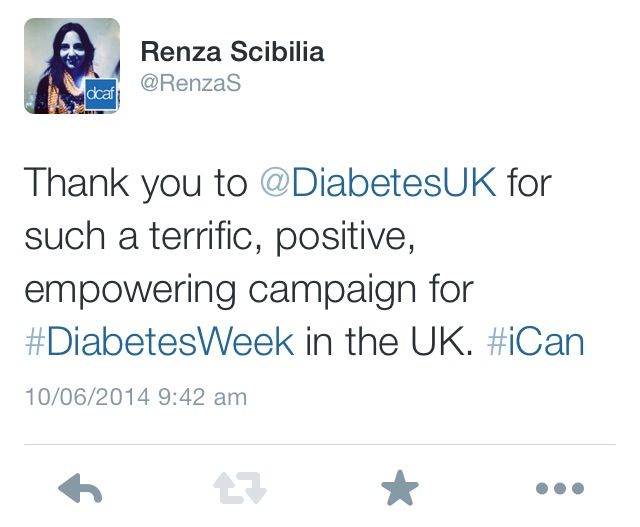
Using the slogan ‘I Can’ the campaign acknowledges the difficulties people with diabetes may experience, but wants to focus on the things that we CAN do. I love this!
I’ll be keeping an eye on this week’s campaign. I’m interested to see and hear the stories of people living with diabetes and how they have managed to face challenges.
I hope that this year’s initiative is a positive one for Diabetes UK and we see more of these kinds of campaigns in the future.
Check out the Diabetes UK Diabetes Week campaign here.
And follow the #iCan tag on Twitter.

I’ve written before (here and here) about how the day we award Kellion Victory Medals to people who have lived with type 1 diabetes for 50, 60, 70 and even 75 years is my favourite work day of the entire calendar year.
Today was the first 2014 ceremony, and fifteen people were awarded medals, including three who received their seventy year medal.
The amazingness and brilliance and inspiration of these incredible people was captured in this one perfect tweet from Professor Jane Speight. I’ve nothing more to add:

In a dark jazz club in Melbourne, I had a diabetes ‘moment’ when I least expected it. It was ‘diabetes in the wild’, a term Kerri Sparling uses that perfectly describes these sorts of incidents.
This is a serious club. There’s a sign at the door that reminds you that talking during performances is frowned upon. Patrons are there to listen to the music, not the inane chatter of the person at the next table. A ringing mobile phone could result in public stoning. Well, not quite, but when someone’s phone did ring at this gig, the musician stopped playing until it was silenced.
I was sitting at the bar, watching and enjoying the music. Thanks to a pump line that really (really, really) should have been changed that morning, my BGL was a little high. I knew that I needed to do a correction bolus, so I pulled my pump from my top, pressed a few buttons and waited until I saw the insulin had been delivered.
Out of the corner of my eye, I caught the woman to my right surreptitiously staring at me and then looking at the pump in my hand. She looked away and leant towards her friend and, (breaking the rules of the club), whispered something. Her friend, just as stealthily, looked around her at the moment I was returning the pump to its place in my bra and then whispered something too.
What was the interest? Did they think it was a phone or a charger and were about to tell me off for not concentrating on the music? Were they wondering what the hell I was doing reaching into my top and pulling out a weird device the lit up?
I stopped wondering and went back to listening to the music.
About ten minutes later, I saw out of the corner of my eye, the woman take something from her handbag. It was a BGL meter. I swung my head around (clearly I’m not as cool or good at being covert as she was) and looked at her straight in the eye. I suddenly got flustered and looked away again, so thankful the ‘listening policy’ at the club meant I couldn’t do what I wanted to. Which was start a conversation with her (whether she liked it or not) and would have sounded like ‘YOU-HAVE-DIABETES-TOO-OH-MY-GOD-SO-DO-I-HOW-LONG-HAVE-YOU-HAD-IT-FOR-DO-YOU-WANT-TO-HAVE-A-COFFEE-AFTER-WE-FINISH-HERE-AND-TALK-TALK-TALK-TALK-TALK-TALK’. I would have stopped at some point to take a breath. Probably.
The music kept going and I tried to stare straight ahead, and not look over at her again. (Which, of course, I did. Several times.)
At the end of the gig as I collected my things, I turned to her and we looked at each other. I smiled; she smiled back. Diabetes in the club. I collected my bag and we walked out into the cool Melbourne night.
UPDATE
(My friend Kelly who writes at Diabetesaliciousness (read it – it’s great!) just sent me this wonderful diabetes encounter story. Contains cupcakes so it makes it even more awesome!)
The Melbourne International Jazz Festival is on now. Here’s the program – there are some great local and international acts playing.
I was recently sent an article from Medscape that was written by Svetlana Katsnelson MD, endocrinology fellow at Stony Brook University Medical Center in New York.
The gist of the piece is that for a week as part of her endocrine fellowship training, Dr Katsnelson wore an insulin pump and checked her BGLs, and now believes she knows about living with diabetes. She also considers herself non-compliant because she didn’t bolus for an apple.
This may be oversimplifying the article a little and I honestly do believe that the intention here is good. But a little perspective is needed, I think. It was this comment that really upset me:
‘The experience provided me with a better understanding of how to use the devices that many of our patients use every day, but it gave me much more than that. I truly began to understand how difficult it is to live with diabetes.’
No, Dr Katsnelson, no. You do not truly understand how difficult it is to live with diabetes.
What you have is an idea of what it is like to walk around with a device delivering non-life saving saline into your system. You also have an idea of how it sometimes hurts when a sharp object pierces the skin on your finger. You probably could have deduced that anyway because, you know, sharp object, skin, nerve endings etc. You know how the buttons of these devices feel under your fingers and the weight of the devices in your hands.
You may have an idea of how tricky it can be to accommodate a pager-like device if you are wearing a pretty, flowing dress to work (if that is your want). You may now understand how annoying it is to have to stop what you are doing because it’s time to do a BGL check.
But what you don’t understand is that diabetes is about so very much more than that.
Here is what you don’t have any idea about.
You don’t understand the feeling of ‘this is forever’ or ‘I never get a holiday from this crap’. I know that this was acknowledged in the article, but really, you don’t know how it feels to never be able to escape diabetes.
You have no concept of the boredom of living with a chronic health condition, or the monotony of doing the same tasks each and every day over and over and over again!
You don’t understand the fear that overtakes your whole being as you imagine all the terrible complications that have been threatened and promised as result of diabetes.
You have no notion of the frustration of living with a condition that doesn’t have a rule book – and in fact changes the rules all the time!
You haven’t any perception of the fear I sometimes feel that I’ve passed my faulty genetic matter onto my beautiful daughter; or that I am a burden to my family and friends.
You will never feel the judgement from healthcare professionals because numbers are too high or too low – or that there are not enough of them.
You will never be called non-compliant by a doctor or made to feel guilty because you are eating a cupcake – all because your beta cells decided to go AWOL.
While I really do commend the notion of HCPs trying the ‘day in the life’ (or ‘week in the life’) idea, I think that being realistic about what this experience provides is important. It does not give any insight into the emotional aspects of living with a chronic health condition. It doesn’t explain the dark place we sometimes go when we are feeling particularly vulnerable or ‘over it’.
I have to say that all in all, this article left a sour taste in my mouth and I don’t like to feel that way because it sounds like I am being Grouchy McGrouch. I’m not. And as I said, I think that the intention here is good.
I just don’t want Dr Katsnelson to think that she now knows what is going on in my head when I wake up at 4am and every terrible scenario plays out leaves me feeling a pressure on my chest and a blackness in my mind that threatens to overtake me.
But I also want Dr Katsnelson to know that I really don’t expect healthcare professionals to know and understand all of these things. I expect them to treat me with respect and dignity. If this exercise has helped that, then great, but please, call it for what it is.
The article discussed in this post (Svetlana Katsnelson. Becoming the Patient: Not as Easy as It Looks. Medscape. May 12, 2014.) can be accessed here by first creating a free login.
I woke up this morning with that unpleasant and disagreeably familiar feeling. Ever-so-slight nausea, furry mouth and a desperate need to go to the loo. Why was I high? I grabbed my meter and a lovely number in the low 20s appeared for me. ‘Eff you, diabetes’ I thought.
I rushed to the loo, brushed my teeth, drank two glasses of icy-cold water. And grabbed my pump to see a completely dead, black screen. ‘What the eff?’ (Second f-bomb for the morning and I’d been awake for a total of five minutes. It was shaping up to be a good day.) I pressed buttons, trying to wake my pump up. Maybe it was having trouble getting the week started too. Nothing. Completely and utterly blank and unresponsive.
I rummaged around for a spare battery and located one in my diabetes supplies bag (seriously, every contingency is catered for in that bag!) and changed batteries. It responded with a lovely sounding ‘Boo-beep!’ and fired into action.
I primed, bolused, checked for ketones (too little to be too concerned about), drank more water and started my getting-ready-for-work routine.
Crisis averted, but how long had my pump been dead? And did it alarm? And if it did, how did the whole household not get woken by it? (And the neighbours for that matter. Living in inner-city Melbourne means we almost live on top of each other!) The alarm on the pump is loud, constant and downright annoying until it is silenced with a button push (or new battery). It wakes everyone – people and pets alike.
There was no low battery alarm before bedtime last night, so I had no warning this was going to happen and I slept like a log, not waking for anything until the alarm went off this morning. Is it possible that my pump had died just after I went to bed and I was insulin-free for 8 hours? Surely not, given the negligible ketones in my blood this morning.
I’m putting in a call to the pump company today because I don’t think that this is okay. There needs to be a much longer warning period for a dying battery.
Now I’m at work and I have that slightly fuzzy-head feeling that comes from high sugars. I’m guzzling water and checking my sugars (and ketones) regularly, trying not to over-bolus in a desperate attempt to get by BGLs back into single figures.
A dead pump. In 13 years of pumping that’s never happened. Diabetes – and diabetes therapies – have a way of making sure you never get complacent. Effing diabetes. (That’s number three…..)
I don’t deal with stress particularly well. I shrink away.
I don’t eat; simply unable to stomach the thought of food or drink and getting through the day with water and gagging on whatever I force down.
I also go to ground, staying at home, not wanting to engage with anyone, switching off online, not blogging or posting to Facebook or Twitter or Instagram.
Recently, I caught up with one of my best friends after a (very unusual) three week break. ‘What happened?’ she asked. ‘The last time we saw each other you said you weren’t feeling great and then I didn’t see you for three weeks and you didn’t respond to my messages.’
I stopped and thought about it. And realised it wasn’t her that I was trying to avoid – why would I? She is nothing but supportive and wonderful and lovely. It was me.
‘I’m sick of myself,’ I heard myself saying. ‘I am sick of what’s going on. I’m sick of the diabetes burnout I’m experiencing. I’m sick of it all. I just want to disappear.’
I wonder if that is what I am trying to achieve when I am dealing with a stressful situation.
I stop eating and see and feel myself shrinking away.
I stop standing tall, instead wrapping myself in blankets and jumpers, folding into myself and taking up less space.
I stop seeing people so I don’t have to hear myself talking.
I limit my online presence, making my cyber-self withdraw.
Am I trying to make myself disappear somehow? Shrink away from the world and my problems?
I want to take up less space, not fill a room, curl into a corner of my bed. I want to be small. And insignificant. Because what I am dealing with seems so big – too big – and momentous. I want to be less weighty because the problems are bearing down on me.
I see this clearly when I emerge from the fog. As I stretch and look for sunlight and see people and engage again, I find my voice and start to feel bigger. Literally and figuratively.
I’m tired.
Today, I woke in a great mood after a good night’s sleep. The weekend had been relaxing and lovely – family, friends, food and gorgeous weather on top of it all. Plus, I bought a new necklace with a pineapple on it. It was a good couple of days!
I was standing at my favourite café near work, waiting for a takeaway coffee and thinking that the barista was a magician as I watched his choreographed movements, filling takeaway cups with perfectly brewed caffeine.
‘This good day is about to get better,’ I naively thought, the taste of that first sip of coffee so close.
And then, I checked my email and ‘bam’. There it was.
A discussion about not distinguishing between type 1 and type 2 diabetes in a setting where it really is not relevant. I sighed.
And realised how tired I am.
Nearly thirteen years ago, I was employed to run a very small and, at the time, somewhat tokenistic type 1 diabetes program for a diabetes organisation. Thanks to a very supportive CEO and me being a pushy little thing, the program grew and grew and now, incorporates a dedicated team doing some incredibly good work for people living with type 1 diabetes.
One of the reasons for the program’s success is that we have been very clear about defining it as a program for people with type 1 diabetes, making sure the information we provide is targeted and relevant to the people we are trying to reach. We acknowledge each and every day that people with type 1 diabetes have specific information requirements and then we go about providing that information in the way people want.
In exactly the same way, a couple of years ago, we realised that the information for people with type 2 diabetes was completely forgetting the changing face of the type 2 diabetes community. There are more and more younger people being diagnosed with type 2 diabetes and the information we had was very much for an older audience. Hence, Generation T2 – a new program for 18 to 39 year olds with type 2 diabetes.
There are times that it is important to distinguish between the diabetes and there is no louder advocate for that than me.
But there are times that it is irrelevant. Yet, people still get angry – even when it really doesn’t matter if the type of diabetes is defined.
I am tired.
I am over this argument and this discussion.
Last week, the government handed down a budget that is going to hit the hip pockets of people with diabetes like never before. All people with diabetes will be affected – regardless of type.
During the World Diabetes Congress we heard of places around the world where the cost of insulin is so prohibitive that there are people dying because they cannot afford to buy the drug they need to stay alive. Slow, painful, horrible deaths because they cannot afford to buy insulin. Just think about that for a moment.
Here in Australia, there are people who cannot afford to use an insulin pump despite desperately wanting to because they cannot afford private health insurance or qualify for the Insulin Pump Program to assist with cost of purchasing the $9,000 (plus) device.
These are the issues that we should be fighting for and getting angry about. These are the issues that are important. Access to healthcare – a basic human right for all people – ALL people with diabetes – is what the topic should be; not whether or not the Channel 10 news forgot to say type 1 (or 2) before the word diabetes.
I am a card carrying member of the diabetes community. I am proud of this community and I am pleased to have a voice within it.
But we need to stop the finger pointing and the name calling and the blaming. How can we expect people outside of our community to get it right if we can’t? Why is it more important for people to understand the how and why we got this condition as compared with the how and why we’re trying to live and manage with it?
I am proud of the Australian diabetes community, but it is here that I hear this attitude more than anywhere else in the world. This discrimination is not helping us – it is harming us. Does it matter if people don’t really understand the different types of diabetes? I get it. It’s annoying, it’s frustrating; it’s constant. But really; does it matter?
This is a first world – a first class – problem.
And I am tired. I am saying it’s time to stop. Enough!

It’s the fifth annual Diabetes Blog Week, with thanks to the lovely Karen Graffeo from Bitter~Sweet Diabetes. The first topic for the week asks us about the diabetes causes and issues that really get us fired up. Here’s what I have to say! Come back tomorrow for the next instalment, and in the meantime, check out #DBlogWeek and follow along!
I am not in any way foolish enough to believe that what I write on this here little blog or the work I do as a diabetes consumer (patient) advocate has the ability to change the world.
But I am confident enough to believe that my messaging is strong and that I generally stay on topic.
There are many things that I feel passionate about when it comes to being a diabetes advocate, but nothing more so than who is in charge of driving the diabetes bus. And that is the person with diabetes.
There is so much written about patient-centred care. Google it and you’ll come up with a…well a google of links. But despite much of it talking the talk, I’m not sure that it really walks the walk. The idea of patient-centred care is often at odds with policies and procedures of healthcare settings making it difficult for the person with diabetes (or other medical condition) to really be in the driver’s seat.
For the person with diabetes to be truly in control (and I’m not talking control in the sense of their BGLs, I mean in the sense of decision making) everyone needs to really subscribe to the model where the patient is smack bang in the middle of the picture, directing traffic, and making the ultimate decisions.
This doesn’t mean that it is done in isolation. No. It’s the exact opposite really.
It means that with support from HCPs, from diabetes organisations, from peer groups and from the health system, the person with diabetes is armed with all the information needed, given the right guidance, shown all the choices. And then, with all of this, they make a decision as to what they believe is the best thing for them. Nothing is withheld, everything is discussed, all options are in the table and considered.
I have too often had the options taken away from me. While I am pretty good at standing up for myself, it is exhausting at times to have to fight for my care to be the way I want it to be. And it’s frequently when we are at our most vulnerable that we have to fight the hardest. Hospital admissions (planned or emergency), times of extreme diabetes burnout or when we’re struggling to stay on track are the times that we often need to stand up for ourselves…even if we don’t have the energy, the inclination or the desire to.
When push comes to shove if I am charged with dealing with this condition 8,736 hours a year, then I AM driving this bus. The role of the support team around me is to give me suggestions and options about how to navigate, but then let me decide if I’ll turn left or right. And come along for the ride – even if they don’t necessarily agree with the road I’ve chosen.
Today, I’ve also written a post at the Diabetes Australia – Vic blog about another cause close to my heart – The Diabetes Stigma Project. Have a read!





 Diabetogenic