
You are currently browsing the category archive for the ‘Diabetes’ category.
My in-laws gave me a beautiful cherry tree for my birthday last year. We planted it in the middle of our garden so we could see it whenever we are in the back part of our house. A couple of weeks ago, after a particularly brutal day of blistering heat and blustery winds, all the leaves were torn from its spindly branches.
I looked out the kitchen window and saw it standing there completely naked and thought that I had killed it.
Today, it is covered with new growth and is looking gorgeous. I didn’t kill it. It just needed a little time to recover from the nasty weather and some space to regrow.
It’s autumn here, so the colours are starting to turn and as I drive home down a stunning tree-lined boulevard, golden leaves trickle down onto my car. I want to jump out and stand in the middle of the road and twirl in the leaves, which would be dangerous given that there are trams and bikes and cars. But it is so lovely.
I love watching the seasons change. I love that the red-golden-brown of autumn is just hitting here as the spring starts to hit my friends in the northern hemisphere. Friends in the UK are posting photos of daffodils and US friends are showing photos of sprouting gardens, devoid of snow. And I looked at our fireplace the other day, thinking that it wouldn’t be long before it would be crackling each evening.
We’re already over half way through March and I am pretty sure that the year will be over before I know it. And there is so much going on in the world of diabetes all the time, all over the place.
Dexcom app
Earlier this week, my US friends were all abuzz with the excitement of the updated Dexcom G5 App which, amongst other things, displayed BGL data directly to their Apple Watches, rather than the push notifications that we currently get.
I hungrily searched to find if the update had been – or was about to be – launched here in Australia, but unfortunately, it hasn’t as yet.
I am not sure when it will be here. I am not sure if it will be here. But I am bloody frustrated that it is not here now – especially considering I bought my Apple Watch in June last year for this exact purpose.
Diabetes, infertility and pregnancy loss
Kerri Sparling is a dear friend of mine and I was so pleased when she made public her exciting news last week. I couldn’t be happier for this darling girl and her family.
She bravely wrote about the infertility she had been dealing with for a couple of years and the miscarriage she experienced in the middle of 2015. I say brave because pregnancy loss and infertility is still something that is shrouded in stigma and shame. And it shouldn’t be.
When I miscarried for the first time, before the kidlet was in our life, I told no one. I was so ashamed and felt hopeless. But I decided after my second miscarriage that I would talk about it. In some cases, people were quite uncomfortable with the candour and honesty I shared. But for the most part, women were glad I had opened up and they shared with me their stories, too.
While I was certainly doing it to help with my own healing, I was also doing it because I didn’t want others to feel the same isolation and shame that I had felt.
Thanks Kerri for using your considerable reach to bring light to this issue. Infertility is terribly difficult to manage. Diabetes makes it even more so.
Diabetic Living Magazine
Check it out – I’m in there!!
Patterns
I have a love of patterns. Stripes, of course, will be my first love and rarely a day goes by when I am not wearing stripes of some sort somewhere on my body.
But I have also developed a love of many other patterns, including anything with a nautical theme, spots and gingham.
And today, I am rocking a new argyle patterned patch around my new sensor. Rockadex is an Aussie company started by a mum whose child has type 1 and offers a great selection of patches to help keep CGM sensors holding on.
Megan from Rockadex kindly reached out, offering to send me some samples of her product, but I’m a big believer in supporting small business, so I declined. And purchased some for myself. My order arrived within a couple of business days and a pile of gorgeously coloured patches tumbled from the envelope when I tore it open. Today, I’m rocking an argyle patch. Details about the product and how to order can be found here.

Rocking my Rockadex patch.
Huge world
We hear all the time that social media makes the world feel very small and how we are connected with people from around the globe at our fingertips. I say it all the time. I believe it.
Except when I don’t. This week, I am really feeling the distance between my friends in the northern hemisphere. Despite tweets and Facebook posts and even a video message, I really wish I could sit down and have a cuppa with them right now. It’s a long time until June – the next time I will be visiting the US – and even longer until September when I will be in Europe. Sometimes, distance does really suck.
For no particular reason, I wish I could feel the embrace of those friends across oceans – literally not just virtually – for a bit. I feel like I need those stores built up at the moment.
Living Well
I’m returning to my old stomping ground on Saturday, presenting at Diabetes Victoria’s first Living Well event for 2016. The event is focusing on going back to basics and there are two separate streams – one for people with type 1 diabetes and one for people with type 2 diabetes. Read all about it over at the Diabetes Victoria blog. And come along and say hi – I’m speaking on a panel in the type 1 diabetes stream!
Beautiful writing
The lovely Annie Coops always writes so, so beautifully over at her blog and this story about her diabetes diagnosis is stunning.
And more
There was an interesting piece in the New York Times over the weekend from Allison Bond, an internal medicine physician at Massachusetts General Hospital. She wrote, most eloquently, about reading patients’ obituaries gives a lot of perspective to treating doctors. There is much to love and quote from her short blog, but this particular thought caught my attention – and my breath in my throat:
‘So when patients do pass away, their obituaries are a gentle reminder that behind the illness lies a story and a unique human being. This is something that is easy to forget, but vital to remember.’
If only it didn’t take death for healthcare professionals to remember that.
Speed. Super fast free-falls. Crazy highs. Your heart races in anticipation of what is around the corner and just when you think you have worked out what is going to happen, you wind up going backwards, or find yourself hanging upside down. In the dark. You plummet without the ability to stop, or you feel yourself going higher and higher and higher – knowing that there will be an inevitable and uncontrollable drop and all you can do is throw your hands up in the air and scream really, really loudly – loving every minute of it!
Sounds awful, but rollercoasters are actually really fun.
Unless, of course, it is of the BGL type. Then they are just repulsive.
Diabetes was really kicking my arse and every other part of me for few days last week.
I couldn’t seem to find a middle ground, and was either struggling to bring my BGL from the yellow zone or up from the red zone. That is how I have come to see my diabetes – the zones on my CGM trend.
I spent far too little time in the comfort of the grey zone – my target range.
And the aftermath of the extended periods spent in yellow (above the target range) or in red (below the target range) was exhausting me beyond belief.
I write a lot about the hypos that won’t quit. I’ve had a few of them in recent times and the sticky, stubborn and stupid lows knock me for six – sometimes for days afterwards.
But the belligerent highs are just as awful. Their aftermath is completely different – a heaviness in my arms and legs, shortness of breath after climbing a flight of stairs and a bone-tired exhaustion that takes a few days to get over – but no less debilitating.
Combine the two of them, and there is an overwhelming sense of defeat. I ache all over, struggle to get out of bed in the morning and fall asleep as soon as I sit down on the couch.
The frustration of pouring juice down my throat, or pumping insulin into my body gets old very quickly. And with the recovery time between the yellow and red seemingly shrinking, bouncing back after an annoying low or high is getting rougher and rougher.
In the never-ending and downright impossible aim of in the zone BGLs, I found myself with no option but to employ the big guns. I sat down and turned on ALL my CGM alarms. To avoid getting overwhelmed and pissed off with the wailing and beeping and vibrating warnings, my basic setting is ‘fall rate’ (which alerts to BGLs dropping too quickly) and low range. The fall rate alert is enough to catch a lot of lows – it does a great job of telling me they are coming and I usually act upon them.
I turn off the repeated high and rise rates because they start to get on my nerves very, very quickly. But I turned them all back on now and found they forced me to at least acknowledge I should do something. And most of the time I did.
I knew this was a short-term fix. I knew that I probably needed to do some basal rate checking – it’s been a while since I really checked to make sure that they were right. I knew that the weather was not helping. I knew that my change of routine with a new job is impacting on my BGLs. I know it all.
And I also know that diabetes, when behaving like this, is a full time job on its own. I felt as though I was barely staying above water. Despite being in a good headspace for dealing with diabetes and using the full arsenal of technology at my disposal, I still found it very difficult to stop this rollercoaster.
This week, things certainly do seem smoother sailing. The rollercoaster seems a little more friendly and a little less horrific. And I feel more equipped to cope and manage. At least for today. Who knows what will be around the corner.
I often think I see diabetes where there isn’t diabetes. But I didn’t realise just how much diabetes has seeped into the subconscious minds of my loved ones, too.
Last night, we were all sitting on the couch watching some TV.
There on the screen, the actress reached down and pulled something out of her bag and held it up. It was her pager. (The show was from a few years ago. Clearly.)
‘Oh,’ said Aaron after a moment, sounding confused. ‘That’s a pager.’ And then he laughed.
‘Huh?’ I said. ‘What?’ I wondered what he meant. If course it was a pager. What else could it be?
‘I thought it was an insulin pump. I thought ‘Of course it’s an insulin pump.’ Because a small box shaped thing someone is holding in their hand has to be an insulin pump.’
So apparently, it’s not just me who sees needles in tall buildings or thinks someone must have high BGLs if they drink two glasses of water in quick succession. Even if I’ve no idea if they have diabetes.
My kid sees me rattling around in my bag for something and automatically asks ‘Are you okay, mum? Are you hypo?’ expecting me to pull out a juice box or some jellybeans, when really, I’m probably just trying to find a pair of glasses.
I yawn and my mum asks me if I had a lousy ‘diabetes night’ which kept me from sleep, when really, I am probably just tired because Aaron and I were binge watching House of Cards the night before. (Oh jeez – could Claire Underwood be anymore awesome and terrifying?!)
I look distracted in a meeting and my colleague asks if she can get me anything, thinking I may be low, when really, I am probably just trying to gather my thoughts and try to pull them into something cohesive.
Or, a black square box in a show from the early 2000s is actually just a pager and not an insulin delivery device.
Normalising diabetes. It’s what happens when it is part of the landscape for almost 18 years. And those around me have had to adapt. I love them for it!
Oh, I love the Friday afternoon before a long weekend! And this morning, as I climbed into my car this was playing, thanks to my husband who was in control of the music last time I was in the car. Great way to kick of the weekend!
We frequently say that diabetes is twenty-four hours, seven days a week, three hundred and sixty five days a year. And it’s true. It absolutely is.
But this year – a leap year – we have an extra day. I thought that the most wonderful way to celebrate it would be to take a day off – to have a day where I don’t think about it; don’t talk about it and don’t write about it.
But that’s not possible. Even if I decide to have a ‘low-diabetes-activity’ day, there is no way that I can’t take the day off completely. My pump is still attached to me, as is my CGM. I still need to eat food and that needs to be considered. My CGM needs calibrating, so I’ll need to do at least a couple of BGL checks. And I’ll need to respond to any highs or lows as they are thrown my way.
So, instead of ignoring, I decided that I needed to mark my diabetes in some special way and decided that an extra lancet change would be the way to do it. Actually, I’d be lying if I said that this was my choice. This morning, it took 8 stabs to actually draw blood (I know, I know…probably could have been changed sooner).
So, I replaced the lancet and have done a couple of lovely, easy checks with free-flowing, easily accessibly blood.
I was most pleased – and couldn’t stop laughing – to see that the team at Diabetes Mine were on the same page with this week’s Sunday Funnies cartoon.
So, there you go. That’s the way I am acknowledging this extra day of diabetes.

#LeapYearLancetChange
‘You’ll be pleased to know that I represented people with diabetes very well in the meeting that I attended yesterday.’
The meeting was all about people with diabetes; making decisions about people with diabetes; looking at processes and practices for people with diabetes; discussing how people with diabetes access healthcare.
And in the room? Not a single person with diabetes.
I looked at the healthcare professional who told me that she had so well represented ‘my people’ and shook my head.
‘And yet,’ I said. ‘You are not a person with diabetes. Can you imagine how much more powerful it would have been to actually have people affected by the things being discussed in the room?’
I was reminded of this conversation, which took place a few months ago, this morning when I saw this from the folks at T1 International. (I’ve written about them before, but please check them out. Their work is so important.)
T1 International is working towards adequate access to insulin and diabetes supplies, as well as healthcare for all people across the world living with type 1 diabetes. They are giving a voice to communities that are most often not heard by sharing their experiences and amplifying their stories.
But I wonder, what hope can there be for people in countries where diabetes is so tough if in places like Australia, where we have heavily subsidised medication and supplies (I know, I know – CGM is not subsidised), we are still not being given the microphone?
I never doubt the amazing advocacy initiatives that many healthcare professionals undertake for people with diabetes. It is important and necessary and I am so grateful for it.
However, there is an authenticity that can only be delivered by those walking the miles in our (diabetes-appropriate – pfft!) shoes; not those walking alongside us.
Bringing home the point again was this cartoon that has appeared frequently on my SoMe feeds this week.

Copyright – SocialMediaPearls
Let us in the room. Don’t speak for us. We have voices. Hand us a microphone so we can be heard.
This morning as I was buzzing around getting ready for work, I suddenly stopped. I realised something that had obviously been creeping up on me so incrementally that I had not noticed it before.
I looked around the bedroom and saw empty cannula packaging from the line change I had done when I got out of the shower and the empty sensor pack with the date written on it so I would remember when it was inserted. I went back through my CGM trace and pump history, noticing where I had bolused for a high BGL, set a temp rate for an impending low and calibrated at the appropriate times. I checked the history on my BGL meter and saw that I have been checking regularly and that the numbers were not as crazy as they have been.
I looked in my bag and saw a spare bottle of strips, my fully stocked ‘emergency’ kit, and a juice box and a small container full of glucose tabs ready in case I needed them.
When I got into work, my desk was prepared for all contingencies – more glucose tabs on the desk, a couple of spare cannulas in the top draw, as well as a few syringes. And a few single portion packs of Nutella.
I was – I am – managing my diabetes – well and without any stress at the moment. The burnout fog that had enveloped me for a long, long time seems to have lifted without me even noticing, and the diabetes tasks that form part of my day and had been so, so difficult to manage, have become routine. I do them without thinking. Checking my BGL and calibrating my CGM just happens. Bolusing for meals or my morning milky coffee is done before I take that first taste rather than half an hour later because my CGM is blaring at me that I am high.
Am I feeling motivated? I’m not sure that is the right word. I don’t have a desire to do these things. I am not so focused on diabetes that I think about it all the time.
But I am doing what I need to. Routinely. Just like brushing my teeth, combing my hair and putting on a necklace in the morning.
Perhaps that’s the thing about managing diabetes well. It’s the balance between getting the things done and not panicking about them. Or feeling so anxious and guilty because they are not getting done.
I don’t know the secret to this change. I do think that a big part of it is wearing my CGM all the time. Once I managed to hurdle feeling overwhelmed by the data and just accepted the numbers for what they are and acting accordingly, I feel much more driven to ‘do diabetes’. And perhaps as I see that things are not as dire as I often imagine them to be, I feel that I can just get on with things.
This is the roller coaster of diabetes. The ebbing and flowing of motivation and being in the headspace to get things done. I’m in a good place for now. I just have to work out how to stay here.

Emergency stash at the office (for lows or as required….)

I don’t get to take part in the OzDoc tweet chats as frequently as I would like to anymore, but when I do, I know that I am guaranteed an hour of thoughtful and engaging discussion about real life with diabetes.
This week, I popped in a little late, but in plenty of time to catch a terrific chat a out diabetes stigma – from both within and outside the diabetes community.
Diabetes stigma is real. Have I experienced it? You bet.
Stigma is unsettling, and it comes from a place of ignorance. Is there any real animosity or vitriol? I like to think no, but it pains me that when there have been times of nastiness, it has come from within the community.
I can honestly say that I have never been stigmatised about my diabetes from anyone inside the diabetes community. But then, I have the type of diabetes that I didn’t cause myself. You know, the one that has nothing to do with the sorts of foods that I ate. The one that has nothing to do with me being overweight or inactive or lazy. I have the one that cute kids get – kids who are innocent and have done nothing to ask for this. And I have the tough one – the one that is the worst, the one that can cause death in an instant, the one that no one understands.
These are words that people from within the diabetes community have used when talking about type 2 diabetes. That’s right – by others living with (or living with a child with) diabetes. Perhaps it was in a discussion about the hopeless and insensitive comments made by some silly comedian; or perhaps in response to a diabetes report that doesn’t separate type 1 and type 2 diabetes.
And I am not the only one to have noticed this. The Walk With D campaign was set up because there was a need to acknowledge that … ‘Even within the diabetes community, there are levels of misunderstanding, misrepresentation, and mistaken messaging, often creating a divide where there should be a bridge.’
There have been some studies that also reinforce the idea that there certainly is stigma from within the community.
The ACBRD has been researching diabetes stigma for a couple of years now, starting with a project looking at the stigma experienced by people with type 2 diabetes and following up with a similar study about people with type 1 diabetes.
The second study discussed the perpetuation of type 2 diabetes stigma by people with type 1 diabetes and it’s interesting reading. You can read the full article here, but here are just some of the findings:
- In general, participants expressed somewhat negative attitudes towards, and beliefs about, people with T2DM. This included stereotypes such as ‘lazy’, ‘fat’, ‘over-consume’, ‘sedentary’, ‘unfit’ and judgment about the intelligence and character of people with T2DM, and blame for ‘bringing it on themselves’.
- These attitudes and beliefs served to perpetuate, and give voice to, the stigma surrounding T2DM and drove an in-group/out-group (or ‘us vs them’) mentality.
- It was also evident that there was resentment among people with T1DM toward those with T2DM, which stemmed from two main factors: (1) the perception that people with T2DM are responsible for many of the negative connotations that surround diabetes, and (2) the perception that T2DM, as a largely preventable condition, attracts more attention and therefore gets more resources and support than T1DM.
- Some participants believed that T1DM was the ‘real’ or ‘serious’ type of diabetes, and was more worthy of research attention and investment of societal resources than T2DM.
That sounds pretty stigmatising to me.
Let me be clear about my position here – there are different types of diabetes and people living with each of those types of diabetes has the right to find support and healthcare that is relevant and specific to their diabetes. A young person living with type 1 diabetes is, of course, going to have different needs to an older adult living with type 2 diabetes.
There are many times that we need to clearly define the different types of diabetes as this is important when it comes to getting the right treatment, seeing the right HCPs and ensuring the person living with diabetes has the right information.
I am not saying that there shouldn’t be specialised and tailored services and activities available to people depending on what they need, or relevant to the type of diabetes they have. I built a program from the ground up that was very specific and targeted in its approach to being only about and for people with type 1 diabetes. I get it!
And you absolute bet that people with type 1 diabetes should have access to support and peer opportunities that are specific. I know that for me the sense of ‘me too’ comes most strongly when I am speaking with other people with T1, usually women around the same age, who are working and have the same sort of technology, caffeine and boot addiction as I do – sometimes there does need to be a ‘sacred space’ for us to discuss the issues that are particular to the challenges presented by our brand of diabetes. And finding the perfect pair of knee-highs.
What I am saying is that I know that the stigma comes from a variety of places. And I believe that we should be advocating for diabetes messaging to be positive and beneficial to people living with diabetes. The challenge of getting that message across to people in the general community who have no idea about diabetes is difficult to manage and sometimes it has not been executed particularly elegantly.
But I am a firm believer in the strength of community and the support that it can offer. And to me, the diabetes community means everyone affected by diabetes – everyone. Stigmatising anyone inside that community does a great disservice to us all.
DISCLAIMERS ALL OVER THE PLACE!!
The ACBRD is a partnership between Diabetes Victoria and Deakin University and until very recently, Diabetes Victoria employed me. Since the ACBRD was established (6 years ago) I have worked with foundation director, Professor Jane Speight and her team on a number of different projects.
I have not received any funding from the ACBRD for my work with them. I just like to write about them because the work they do is very important and is changing the way that diabetes is perceived. And their work in diabetes and stigma is ground breaking. (Really! The Washington Post published this article in 2014, quoting Dr Jessica Browne from the ACBRD.)
Now, I just happen to share an office with the ACBRD. And this is on my office wall. I have found myself reading it quite a lot this week!
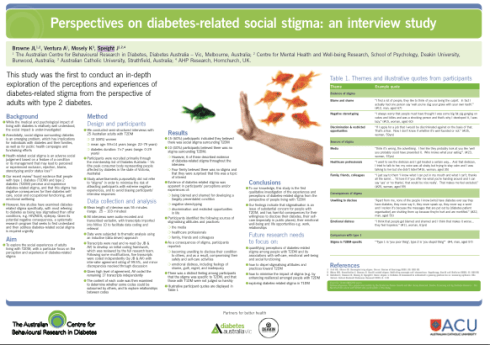
Click for larger image
It’s 7.25pm on Sunday evening. I am battle-scarred from a hypo that hit me like a ten tonne truck. It was 6 hours ago now, but I am still foggy and so fatigued.
We were out – at our local shops picking up a few things. All of a sudden, I felt like I was going to fall over. One of my legs gave way, I was dizzy and I couldn’t find the words I needed. Focusing hard, I looked at the kid and said ‘We need to get out of here.’ I passed her my phone and she called Aaron who was in another shop nearby, asking him to come and find us.
Where had this come from? My CGM started wailing at the moment that Aaron joined us. But when I looked over the previous few hours, I could see that I had been sitting around 4mmol/l for the whole time. Until I dipped – suddenly – and it seemed the CGM trace took a little while to catch up. The wailing continued as I gulped back orange juice and groped for my pump to silence the alarm.
It was almost fifteen minutes later before I was ready to move. As I sat there, I very consciously started to notice the fuzziness in my head, the overwhelming and all-encompassing exhaustion hit. My eyelids began to droop and my eyes were having trouble focusing, my hair was wet at my neck making me shiver, and my hands were shaking a little. The noises around me sounded like they were coming through a tunnel – everything echoed, but sounded muted and fluffy.
Eventually, we got up and got home and I went straight to bed. I took off my shoes, lay down, and was shivering as I fell asleep, almost instantly. And I slept – a deep, heavy, dreamless sleep. Two hours later I woke up and was ready to move again – slowly and gingerly at first.
And now. Six hours later. I am sitting on the couch, and in between writing I stare out the front window onto our street. It’s a gorgeous night – warm, but not too warm, with a gorgeous cool breeze blowing through our open front door. I hear the leaves flutter in the trees in the garden, people walk by, chatting to each other, and the folk across the road are having a band rehearsal. It’s peaceful; it’s Sunday night and I’m starting to think of the week ahead.
And in my thoughts about school lunches, and work schedules, and everything else, I have another thought. I don’t have it often, but when I do, it’s always the same.
I feel a pull at the bottom of my stomach.
My breath catches in my throat.
Tears spring to my eyes.
I wish I didn’t have diabetes.
Almost fourteen and a half years ago, I took up a very part time job at Diabetes Victoria.
The diabetes world was a little different back then and today, as I packed up my office and was farewelled by a group of amazing women I have been honoured to call my team, I reflected back over the years.
- I had been using a pump for about five months when I started working there. It was the first time that many people in the organisation had ever seen one and there were a lot of questions.
- The pump situation in Australia was a little different to today. If you wanted a pump, you had a choice of a Medtronic 507C or a Disetronic DTron.
- Smart pumps were not a thing yet!
- There was no DAFNE yet either.
- The few of us who were pumping had to self-fund the consumables to the tune of about $300 per month.
- It was in May 2004, after a lot of lobbying, that the Government announced that pump consumables would be listed on the NDSS, reducing their costs to about $30 per month. This was the first taste I ever had of political lobbying and advocacy and I loved it!
- Within my first three weeks of being in the job, about half a dozen different women called saying they wanted information about diabetes and pregnancy. We didn’t have anything, so together with some like-minded groups, we set about developing a resource that provided all the information women wanted in a format they liked. That was my first taste of realising how important it was to listen to the ‘consumer’ and it became the overarching philosophy of my work.
- No one was talking prevention of type 2 diabetes. And when that started, it started a discussion about a huge issue.
- No one was talking about diabetes and mental health – except those of us living with the condition. We knew that it was real; we knew that burnout was debilitating; we knew that our mental health directly correlated with our ability to manage our diabetes. Seeing the Australian Centre for Behavioural Research in Diabetes become a real thing has been a game changer for people with diabetes as it has opened the discussion in ways we could only have imagined!
- People with diabetes at diabetes conferences? Not really, but we have made some strides there! (Psssst….but not enough!)
- Social media? Not a thing back in 2001. Now, online support, which was fledgling to say the least back in 2001, is everywhere and accessible by many, many people.
What a change a (almost) decade and a half makes! The diabetes landscape is very different. I’m glad I get to still be a player in this space in my new national job.
But today, it’s about saying goodbye.
And with that, I want to acknowledge a group of women. These women:
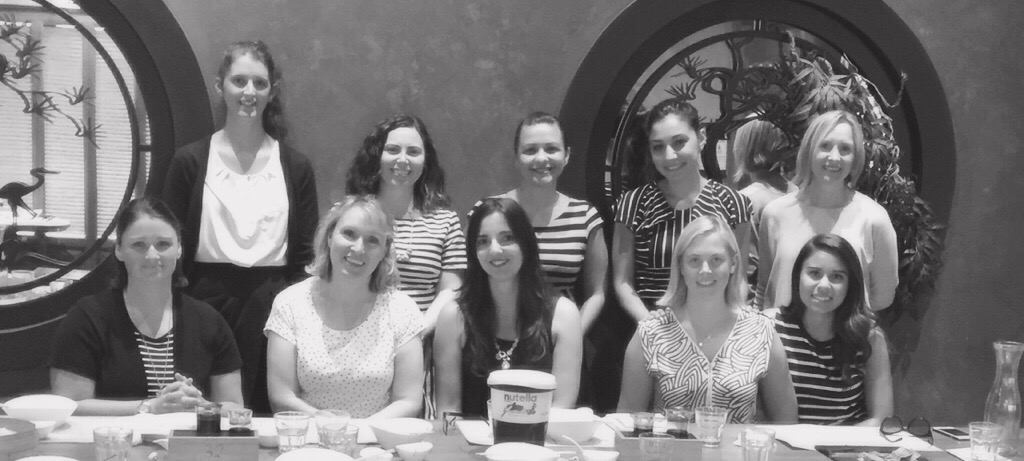
To (in alphabetical order), Alice, Angela, Anika, Carolyn, Elise, Elizabeth, Jane, Kelly, Kim and Kristina: thank you for making my last day so lovely. But more so, thank you for being the people who ‘do’. Each and every day, you come into work and do things alongside – in partnership – with people affected by diabetes to improve their lives in some way. Your commitment to people living with diabetes is second to none, there is no other team like this one in Australia and the work that you do each and every day is, in fact, life changing. We hear that frequently.
I am so fortunate that I got to lead you in my clumsy and sometimes ranty way, and I thank you all for indulging me as you have. I wish you all the best and will be watching – very closely – all your future successes.
It’s no secret that I have had some problems with my local licensing authority (VicRoads). It’s also no secret that I have been annoyed and rather vocal about the Austroads 2012 Assessing Fitness to Drive Guidelines – specifically, the introduction in 2012 of the ridiculous section defining ‘satisfactory control of diabetes’ as an A1c of 9% (and the ensuing problems it caused!)
Austroads and the advisory group involved in putting together the guidelines a couple of years ago claim that this value was never meant to disadvantage people with diabetes; that it was there to simply trigger further, specialist treatment. And that it was never intended as an automatic suspension of a driver’s licence.
That may have been the theory. The reality was quite different. Many people with diabetes reported that their treating doctor did in fact interpret the guidelines as meaning that a 9% or above A1c was grounds for licences to be suspended. And that is what happened.
But here is some good news. The new draft guidelines – currently open to consumer consultation, and due for release later this year, have removed the A1c value defining satisfactory control of diabetes. It’s been a long process, but thanks to a lot of advocacy by Diabetes Australia, this is an excellent result for people living with diabetes in Australia.
One of the most enjoyable things about my job is the policy work in which I am involved, and I was pleased earlier this year when I was asked to join the working group reviewing and revising the diabetes chapter in the Guidelines. (Disclaimer: this is part of my work at Diabetes Australia and I was asked to represent the organisation on the working group. Diabetes Australia has received a significant number of complaints from people with diabetes who had been negatively impacted when the 2012 Guidelines were introduced and I have been involved in this work since then.)
The outcome of the review has been that some parts of the diabetes chapter have been completely rewritten. The advocacy efforts led by Diabetes Australia and involving the ADS and the ADEA, resulted in the removal of the 9% (arbitrary) value being eliminated. This is an outstanding outcome.
So, now it is your turn to do a little advocacy.
If you have some spare time over the next couple of days, and you feel really strongly about this issue, now is the time to get on board and participate. The point of public consultation is that people who are directly affected can have their say. If you have diabetes, you are directly affected. If you are the parent of a child with diabetes who, at some point, will want a driver’s licence, you are directly affected.
All the details of the consultation can be found here, including how you can make a submission. I urge you to comment – even if that is to simply say that you support the changes which should ensure that people with diabetes are not losing their licence because for a reason without an evidence base. And you might like to also add that you support the Guidelines’ focus on hypoglycaemia which absolutely can and does affect safe driving. Quick sticks – the consultation closes tomorrow.





 Diabetogenic