
You are currently browsing the category archive for the ‘Diabetes’ category.
I’ve been Looping for about 17 months now. I’m a fan (perhaps you may have picked that up).
The reason I am a fan has nothing to do with my A1c. In fact, right now, I couldn’t tell you what my A1c is (more about that later). I love Looping because it works for me. It takes away a shedload of my diabetes tasks. It helps me sleep better. It gives me more energy. It means I think about diabetes less. It significantly, significantly, significantly reduces the number of hypos I have, and the impact of the almost-hypos that have replaced the doozeys used to have. It means I get to wear cool t-shirts.
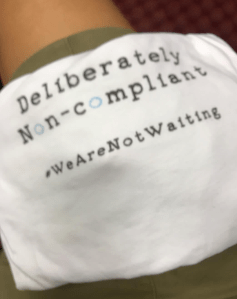
Badge of honour…
Because in exactly the same way as if I have tried a different eating plan it’s never been about numbers on the scale, Loop has never been about A1c.
It’s especially never about a measurement that is so flawed that it really is time to wonder why, for me and those of us who are able to access far more informative and useful data, even bother to have this checked. (Read this piece by Dr Steven Edelman from TCOYD for more on that.)
I have to say that I feel a lot of discomfort when I see A1c as such a focus. Some if it is for the reasons I’ve already stated, but also, it reinforces that we measure our success as PWD and how we are managing with this number. If my A1c went up this time, I really couldn’t care less. I’ve not long come off three weeks of holidays where diabetes barely interrupted the flow of sunshine, sea and sleep. And family, friends and food. I have not had a hypo in months. I have not had days of wanting ‘I hate diabetes’ tattooed across my forehead.
I went to my endo appointment last week still in slight January holiday mode. I completely forgot to call ahead for a pathology request – in fact, I’d forgotten all about the appointment until I was sent the text reminder a few days earlier. I used to think it was a waste of time not showing up without results waiting for me. But I wasn’t really all that concerned this time. I had some other information at hand including how much time I am spending in range. That gave me enough to focus on before I moved onto other things I wanted to talk about: the things that are really important to me with my diabetes.
Living well with diabetes is about so many factors. Those factors will be different for different people (and yes – A1c may be how some people consider living well).
As someone who has had really dark times with diabetes, it’s the light times that demonstrate how well I am doing. Those times may not be the times that I am ticking boxes that we are told gauge our success. They have certainly not been times necessarily marked with a low or in-range A1c. They are the times when the impact of diabetes is lightest. When it dances across my conscious rather than lives there. When it casts a gentle shadow rather than a thunderous cloud. A1c has never had anything to do with that.
I walk into a room of people. It’s a work meeting, and I am with a couple of colleagues. We’re greeted by about 8 others who all work for a large diabetes-related organisation. Two or three are from their Australian office, the rest have travelled from Europe. They’re here to meet with people working in the diabetes space to get an idea of the landscape in Australia.
We take our seats at a U-shaped table; we’re brought coffees. Introductions start. One of the overseas visitors tells us a bit about who he is, and rounds out his introduction by saying ‘I have type 1 diabetes. And I use Dexcom,’ he says, looking straight at me.
It’s summer in Melbourne and I am wearing a short-sleeved top. The Dex adorning the top of my left arm is clearly visible. I smile at him. ‘Snap!’ I say.
The meeting continues, with a lot of discussions and chatter. My new friend asks a lot of questions, some directed at me. I know what he is doing – it’s that thing people with diabetes who are ‘working in’ diabetes do. We try to learn how others manage living with a condition and working it too.
The meetings winds up; people start to chat with each other, continuing on from some of the discussions we’ve just had.
And the two PWD immediately turn to walk to each other. We shake hands and fall into an easy conversation. We speak about the challenge and responsibility of having diabetes while working in the space. We ask each other more questions and we listen carefully. And then we talk about our own diabetes, starting with ‘When were you diagnosed?’. I want to know how he found being diagnosed with diabetes after having already worked for a number of years for a diabetes-related organisation. We work out if we will be at any of the same meetings or conferences throughout the year.
The meeting is over. We shake hands again, and say good bye.
I walk to the elevator with my colleagues, thinking about the different ways people with diabetes connect. It happens like this. We find each other in a room. We see each other in a café. We opportunistically meet in a gelati shop. We bump into each other on the street. And we talk. We learn from each other. We gather information. We feel connected.
We get it.

I walked into my endo’s office yesterday, and was greeted by the receptionist with a smile (and by name). ‘You’re next; shouldn’t be too long,’ she said to me.
I was especially grateful for the welcome I received yesterday. Because earlier in the day I’d started the search for a new GP. It hadn’t gone well.
My quite awesome GP who I’d been seeing for almost twenty years decided to move interstate which is incredibly inconvenient. For me. But apparently it was a good opportunity for his family, so off they went and now I am left GP-less. Because, yes, it’s all about me.
So, I’ve been looking and asking friends in the area who they see and if they would recommend them. There is a woman at the same practice as my previous GP who I quite like, and a few people had suggested. I’d seen her a few times when my GP had been on leave, and she knows my convoluted medical history. But when I rang for an appointment the other day, I was told she was booked up until March. M-A-R-C-H. Over a month away. I was told that I could call at 8.20 the next morning as they keep a few on-the-day appointments, but there was no guarantee I could see the GP I wanted.
I sighed and said that I’d call back the following day. And when I did, there were no appointment times with the doctor I wanted. Continuity of care is important to me – I don’t want to have to explain the CGM on my arm, the pump down my bra, the way I manage my diabetes each time I need a quick visit to the GP for a UTI, or sore throat that won’t go away.
I decided that I probably needed to find another doctor, so I called another clinic that had been recommended to me. I didn’t speak to the receptionist. But I did hear the hold message.
Firstly, the calm voice on the recording told me that the doctors at the clinic all had lots of experience and were there to serve the local community, and that the whole clinic operated under a philosophy of patient-centred care. ‘Excellent,’ I thought. ‘That’s a buzz phrase I like. Good start’.
But then came a shopping list of things that callers should know before pressing hash to speak with someone.
- Appointments can only be made before midday. If you call outside those hours, you will be asked to call back the following day
- Same day appointments can only be made between 8.30am and 9.30am, although most will be taken by 8.45am
- Doctors generally will not take or return calls from patients unless this has been agreed upon during an appointment
- No results given over the phone by doctors (or anyone else); you need to a follow up appointment
- No bulk billing is offered (even for people on a HCC)
- If you are late, you will miss your appointment
- You will not be contacted if the GP is running late
- But you should call to see if the GP is on time
- Missed appointments (by the patient) incur a no-show fee
- If you want a referral (even to an existing specialist) you must make an appointment to see the doctor
- Ongoing referrals will not be provided
- If you want a prescription (even for an existing medication) you must make an appointment to see the doctor.
After listening to the message three times – just to make sure that I had everything correct – I hung up. There was literally not a single thing on that list that could be considered to be patient-centred.
Before I go on, I want to say that I know that GPs are overworked. I know that they are underpaid. I know that there are too many people trying to get into see them, and their time is precious. I can’t even imagine what it takes to run a GP clinic – or a clinic for any discipline really. I assume that there will be some using the service who have unreasonable expectations and demand that a doctor be available to them at all times of the day and night. So, rules are needed to deal with those sorts of people.
I am not one of those people. I am, however, a person who lives with type 1 diabetes and sometimes, I need a prescription for insulin because I thought I had another repeat left, or my current prescription has expired, or I lost the last one, or the littlest dog ate it (hasn’t happened, but wouldn’t put it past her). Or I need a referral to one of the other specialists I get to see semi-regularly (such as my dermatologist for psoriasis, rheumatologist for psoriatic arthritis, OB/GYN for gynae stuff etc.). And I definitely appreciate an ongoing referral, because, you know, diabetes doesn’t go away and I will need to see my endo forever (or until she retires, at which point I’ve decided I’ll give up this diabetes palaver too).
I don’t think these are unreasonable requests to have of a GP clinic. I don’t expect to be bulk billed. I am not asking for a diagnosis over the phone; or a phone consultation. But surely, it’s a waste of time (mine and the doctor’s) for me to need an appointment for a prescription for a drug that I will need to take FOREVER, and dose myself. Or for an annual referral to a doctor I’ve been seeing for over seventeen years for a health condition that I’ve had for almost twenty-one years. Or to be told that my A1c (or whatever else is being checked) is in range.
I wrote last week about how we get burnt out with needing to be advocates for ourselves. I felt a wave of that hit me as I listened to the list of rules from the GP clinic I will not be going to. I don’t want to start by giving a medical history … and then needing to beg for a little flexibility in their rules.
Does this make me sound like a princess? Maybe. Does it make me sound unreasonable? Perhaps it does.
But healthcare settings cannot have it both ways. They cannot promise that they are patient-centred if they are actively setting rules that make it more difficult – and exhausting – for us to live with a chronic health condition.
One day, I won’t be anxious when waiting to see my lovely endocrinologist. Today’s not that day.

Last year, the (current) Australian Prime Minister said that in Australia ‘If you have a go, you get a go’.
What a great sentiment on which to build a nation. Have a go, get a go. Sounds so easy. And you know what? It is. For people like our PM. And, I freely admit and recognise, people like me.
In diabetes, we hear this sentiment in a number of different ways: if you follow your diabetes plan, you’ll be fine. If you keep in line with guidelines, everything will be okay. In fact, you won’t just be fine. You’ll thrive! Because, diabetes can’t/won’t/doesn’t/shouldn’t stop us.
I spoke with someone at the end of last year who said that there was no excuse for people in Australia to not thrive with diabetes because we have ‘free’ healthcare and access to everything we need to do well.
Let’s just unpick that for a minute. Firstly, our healthcare in Australia isn’t ‘free’. It’s taxpayer funded – which is exactly how it should be. It is, however, important to acknowledge that it is not free because often, when we think something is free, we think it has no value. We take it for granted, or, even worse, we take advantage of it, and don’t realise just how significant and valuable it is. I couldn’t out a price on free healthcare to be honest. But I feel incredibly lucky to have been born in a country that has it!
Also, it’s all good and well to say that people have access to all that is needed to thrive, but there is a massive assumption that people actually know what they need, know why they need it, know how to access it, and know what to do with it once they have it.
It’s true that here in Australia we have universal healthcare . But it’s not fair or correct to think that everyone has the same ability to get the best out of the system. Or anything at all out of the system to be honest.
Expecting all people with diabetes to thrive is setting us up to not measure up. And it tells us that it’s not enough to just get by. Surviving isn’t adequate. Being alive isn’t sufficient. We need to go above and beyond all that.
I don’t know about other people with diabetes, but I feel a great pressure to thrive all the time. Honestly, it feels that I don’t have any excuse for that not to be the case. Latest tech – check; easy and affordable access to insulin, diabetes supplies and healthcare – check, check, check; health literate – check; loud and assertive advocate – (annoyingly for any healthcare professional who has to deal with me) check; support network to bring me cake, have my back and cheer me on as needed – check.
What do I have in the way preventing me from thriving? And just how is diabetes stopping me?
The concept of thriving with diabetes comes from a position of privilege. There are some people who really are just getting through, day by day, because diabetes is just so bloody hard for them. For some, diabetes doesn’t even get a look in because, quite frankly, there is more going on that takes precedence in their mind, their life and their day-to-day existence.
The truth for me is this: I don’t really feel as though I am thriving. I feel I am getting along. I’m not running marathons or climbing mountains or swimming channels. There is nothing I am conquering in the name of, or despite, diabetes. Instead, I’m happy to chase sunsets and sit in the fresh air and drink iced coffee to try to keep cool in the endless heatwave we seem to be having. I’m not complaining about it, because even though I feel this pressure, I’ve made peace with being a diabetes underachiever. I don’t need to be somebody else’s version of a diabetes superhero. I just need to do my own version of diabetes.

Magic Melbourne sunsets
While you’re here….
There are, of course, places around the world, where talk of thriving with diabetes simply cannot happen. Being alive with diabetes is hard enough and survival is a constant battle.
February is nearly here (already?) and the 2019 Spare a Rose campaign already well underway. Can you make a donation to provide insulin to keep a child with diabetes alive? No one should die because they can’t access insulin. You can help by going here and making a donation.
I read a powerful piece yesterday by Canadian writer, speaker and health advocate, Sue Robins. She has years of experience as a family advocate (her son has Down Syndome), and then, after being diagnosed with cancer, a patient in the health system.
Sue’s post was about her decision to withdraw from the world of patient engagement. Clearly, it was not an easy decision, but one that she felt she needed to make for her own wellbeing. No one could ever blame her.
So much of what I read in Sue’s piece resonated. The desperation she beautifully and eloquently outlined is something that I keenly have felt (feel?). And I know it’s not just me. I see that in the eyes of others trying to elevate the role of ‘patients’ and to ensure that we are truly listened to, and treated with the respect, compassion and kindness we deserve, all the time.
I get the constant battle that we have – and it does feel like a battle a lot of the time. On one hand we feel so invested in what is going on because it is happening to us directly. How can we feel any other way?
If we are living with the condition, it is personal beyond measure. If we are caring for someone and advocating for them, there is a different sense of pressure and investment. And if we decide that this is ‘a calling’ and do it professionally, there is a different again as we try to work within different parameters – the need to keep within the realms of what our work allows, and the less structured realities of actually living with a health condition.
For me, there is a mixture of the professional (because of my job) and the personal (because of my pancreas). I feel the push-pull of that daily.
I get tired. I get overwhelmed. I get discouraged. I get disengaged. I get disheartened.
I feel the system is broken and I feel how that goes on to break people. I have found myself at that breaking point on more than one occasion when the system is failing me, and equally, when I see it failing others and I can’t help.
Operating in a network with so many stakeholders is always difficult, but when each of those stakeholders seems to have a different mission, it becomes impossible. Because as much as we want to think that everyone’s mission is for the best outcome for the ‘patient’, I don’t know that that is necessarily true.
What I want when I walk into a hospital or a clinic appointment (or a GP appointment, pathology room, specialist check-up, operating surgery, or any other healthcare setting) is different to what the hospital administrators want, or the HCP, or policy makers, or any other stakeholder. Despite the claims of mission statements everywhere, it is undeniable that it is not the persons in the so-called person-centred care that direct outcomes.
Every single story we hear where someone is treated poorly, isn’t listened to, is blamed for their condition, is not given time or space to voice their needs, feels uncomfortable with how they have been spoken to, is another example of the system not being person-centred.
In diabetes, it could look like this:
- A person not being given the option of using the device they want to manage their diabetes. I repeatedly hear people say that they were told they could not use the pump they want to use because their clinic doesn’t offer that one.
- A person who is just diagnosed with type 2 diabetes, or needing to go on insulin to treat their type 2 diabetes being told that it was through their doing that this has happened.
- It could be not being able to manage our diabetes as we do at home when we are in hospital – insulin is removed from us, pumps are taken away, we are not allowed to use CGM in hospital and must go back to using blood glucose monitoring, not being able to eat the foods that we want because we must have the ‘diabetic menu’.
- A diabetes-related complication diagnosis is met with judgement instead of information about how to move forward.
- A person with diabetes being denied the time they need to speak about what is really concerning them, instead appointments following a formula that is unable to be adjusted.
It also looks like being excluded from the consultation, development, coordination and evaluation of programs, services, activities and resources that we are meant to use and find useful.
I don’t say these things because I think HCPs are out to get us, or that hospital admin teams are trying to make our lives hell, or that policy makers don’t care. I understand that everyone is working in trying times with funding cuts that are crippling the system. I know there are guidelines that need to be followed.
But at the end of the day, diabetes is our life. Melinda Seed has said ‘We have skin in the game’, a term I use when talking about the safety of using DIYAPS. We mean it literally as well as figuratively.
Again – I am not in any way minimising the commitment and dedication that HCPs have to working in healthcare. I genuinely believe that almost all are there trying to improve our lives and help us make sense of what is going on in our bodies.
But our desired outcomes are different. My KPIs when I walk out of a HCP appointment include feeling positive, feeling listened to and knowing how to move forward until my next appointment. I need to feel that I am equipped, motivated and encouraged.
We can read stories like Sue’s and shrug and say that she is burnt out. Burn out is almost inevitable when living with, or advocating for someone, with a life-long condition. But we shouldn’t be getting burnt out by the system. We get that enough when our bodies decide to start working against us. We need the health system to be working for us. And with us.
It’s hot in Melbourne today and it’s going to get warmer over the next few days. I’m loving the bone-warming sun that just makes everything look so sparkly and bright. So, I’m spending as much time as possible soaking up the rays (and adding to the ridiculous tan mark around my Dex), because the cooler weather will be here before I know it. I’m trying to build up those vitamin D stores to last me for when winter hits here and I’m reliant on quick trips to the northern hemisphere for work to see the sunshine and warmer temperatures.
Anyway, diabetes doesn’t take a break over the summer. Or winter. Which means, there is always lots to read and see about it. Here are some of the things I’m catching up on now.
Hospital life in pictures
This piece from the guardian will break your heart. Explained pictorially, it’s easy to see that the medical system is broken, medical education is broken, hospitals can be incredibly cold and anxiety inducing places, doctors are at breaking point. And patients in the system are left to deal with the fallout from the disarray.
IDF comps
The International Diabetes Federation is working to reduce the stigma association with diabetes-related complications, with a focus on how the language used can make people feel judged and stigmatised. Last year, they launched the #DiabetesComplicationsTalk Facebook page, encouraging people with diabetes to share stories and support each other.
It’s really great to see the IDF in the #LanguageMatters space, encouraging people to openly speak about diabetes-related complications to help reduce the stigma associated with them. More here.
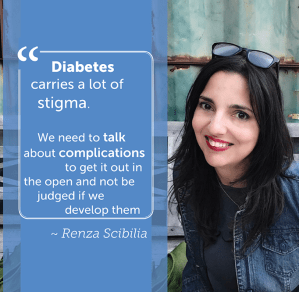
Diabetes Voice
Still on news from the IDF, the organisation’s quarterly magazine is now available electronically. The first edition is an absolute cracker. Start with this incredibly powerful piece from editor, Elizabeth Snouffer, about diabetes-related stigma. Read it. Share it.
Patient Revolution
If you’ve not checked out the Patient Revolution website, now is a great time to have a look.
Start with this page, which is a library of stories you can click through, finding any specific topics that you are interested in.
Also, there is a Patient Revolution chat which uses the hashtag #WhyWeRevolt. To keep up to date with their chats, and to take part, follow @PatientRev on Twitter.
1,200 mason jars
Do you ever find yourself in the midst of a Twitter thread, wishing, in equal measure, that you hadn’t started, but can’t get enough of it? Sometimes these threads are diabetes-related; sometimes they’re not. Go here for one that is definitely not.
I have spent far too much time in the last week invested in this bizarre tale. There is a lot to take away from the whole saga – maybe starting with: don’t pay USD$169 to hear someone ‘teach’ you how to ‘be you’. And there are a lot of unanswered questions, such as what the hell is going to happen to the mason jars.
Happy reading. (You may need a drink …)
Diabetes in the US
I will never understand the US health system. My head and heart hurt as I hear the struggles of friends with diabetes, and the difficulties they have accessing insulin, and diabetes tech and supplies.
This piece from the New York Times talks about non-medical switching, where insurance companies decide which drugs (and devices) they will cover and subsidise. In Australia, the government decides which drugs will be listed on the PBS (Pharmaceutical Benefits Scheme). If a drug is on there, it is the same price for everyone who has a prescription. There are some drugs that require a special prescription to be provided at the subsidised price. But there is no extra negotiating or pleading, or any involvement, with insurance companies.
In a system that is broken beyond measure, this seems like one more roadblock to make just surviving with a condition such as diabetes impossible.
Going beyond
Beyond Type 1 has grown to include a new platform for people with type 2 diabetes. Check it out!
Real life Loop stories
The team at diaTribe has a new series of personal stories of people who have been using DIYAPS solutions. Adam Brown’s story was first, and Kelly Close has now offered her experiences. Such a great idea to get a number of different insights into what has worked, what hasn’t and hopes for the future of DIYAPS.
Sharing and caring
Also from diaTribe, this great piece from Kerri Sparling which provides her own and others’ perspectives on sharing of CGM data. There is no one way to share data – it is personal, individual and can change over time, depending on circumstances. Some choose to; others don’t. I love this piece because it is balanced and offers some interesting thoughts.
Ascensia and CGM
More tech choices for people with diabetes is always great to hear, so Ascensia’s recent announcement of their move into the CGM market has been met with enthusiasm from the community. Read their release here and Diabetes Mine’s take on the announcement here.
SoMe at conferences
I believe social media engagement and use at all health conferences is a critical and necessary part of any communication strategy. There is no better, easier or more effective way to share details of the conference that by encouraging the people attending to broadcast using their own social media networks.
This article explores that, referencing the ridiculous photo ban at ADA in 2017 (which thankfully was changed in 2018).
Menopause and T1D blog
Sarah Gatward is a blogger from the UK and she is writing a series sharing her experiences of living type 1 diabetes and going through menopause. Yes! And thank you, Sarah. Start here.
NDSS reminder
Now is a good a time as any to make sure your NDSS details are up to date. Remember – the NDSS is not just about subsidised diabetes supplies. It also provides information and support for people affected by diabetes.
Go here to make sure your registration details are correct.
Bin the fax
All my dreams came true when I read this article in the Limbic today! Finally calls to get rid of the archaic fax machine in health care. Halle-bloody-lujah!
Last November I spoke at the HIMSS (Healthcare Information and Management Systems Society) conference in Brisbane (and wrote about it here). I was only flying up for the day and my schedule had been diligently planned but the HIMSS team, utilising every single moment I was at the conference centre. I was in two sessions, but before that, I was to be filmed for HIMSS TV.
Best paid plans, and all that – my flight was delayed. By quite a bit. The interview would need to be rescheduled. I landed, unsure if I would make it in time for my first talk, and begged the taxi driver to do all he could to get me there on time. The man was a miracle worker, delivering me to the conference centre five minutes before my first session started, and I walked onto the stage with the sound guy’s hand halfway down my dress (the back of it, settle down), mic-ing me up as the chair was introducing the session.
As soon as the second session was done, I was whisked away for the interview. We were running through the conference centre halls (this time the sound guy was trying to retrieve the mic he’d affixed on me earlier – we’re now very good friends), to get to the interview area.
I had literally 15 minutes before I needed to get into a cab to head straight back to the airport for my flight home, but the HIMSS team was determined to get me chatting on camera. Good thing I talk so fast.
Also, good thing that I was asked to speak on a topic that I could happily blab on about for hours. While underwater. I was there to speak about person-centred care in healthcare.
I find it a little odd that the title of the interview is ‘Disrupting diabetes treatment with a person-centred approach’, because we have been talking about this for a long time. This isn’t new; it’s not disruptive. But clearly, it’s still something that we need to be talking about, because I think that there is far too much lip service and not enough action when it comes to patient-centred care.
I’d completely forgotten all about the interview until someone tagged me in a post on Twitter and LinkedIn when the interview was launched just after New Year. You can watch it by clicking on the image below. I talk very fast…I had a plane to catch.

So, who’s jumped on the Marie Kondo bandwagon and is in the midst of a massive clean-up and subsequent drop off at the local op shop?
I was all ready to roll up my sleeves and get dirty, until the bit about books. Thirty books? What kind of person only has thirty books? That was the point I decided there was nothing about Kondo that sparked joy and that she could fuck right off.
But, after opening my diabetes cupboard at the end of last year and half the contents falling to the floor, I decided that decluttering might be a good idea.
Here are some of the things that I found in there:
- Eight different diabetes spares bags in different stages of disrepair.
- Three brand new Casualty Girl bags, waiting to be used.
- Seventeen (I am not exaggerating) meters that I have no strips for, have dead batteries and I wouldn’t even know if I could still order strips through the NDSS. One of them I am sure was so old that if I could get it working and had the necessary strips would take twenty seconds to do a reading. No one has time for that kind of messing around in 2019.
- Some brightly coloured lancets (which actually looked so pretty, and almost – almost – made me change my lancet).
- And enough boring white lancets to last me and all people with diabetes in Australia until the year 2456.
- Some questionable looking glucose gel that was, apparently, grapefruit flavour. (That noise you hear is me retching.)
- Far too many blood glucose log books which I picked up and laughed at. Such optimism to have kept them in there.
- Pump supplies for my old Animas pump.
- And my Animas Vibe pump – which is the back-up to my loopable backup pump. (Back-up to the back-up. Look at me growing as a person!)
- My old Deltec Cozmo pump. (At this point, I may have teared up a little. And given it a hug. Because, damn, I loved that pump. So much joy was sparked just looking at the gorgeous little thing and remembering what a nifty little pump it was.)
- Three boxes of syringes (clearly bought when I found myself desperately needing syringes for some reason and walked into a pharmacy only to be told I needed to buy them in bulk, because that’s how they come via the NDSS.)
- Loose strips – dozens and dozens of them. Some of them may have been used. Some of them I can’t even remember ever having seen before. Some of them look as though they are from meters that we don’t even have in Australia. Is it possible that glucose strips can just apparate from someone else’s diabetes cupboard?)
- Manuals for pumps (dating back to 2001) and meters and other long forgotten diabetes devices.
- Crumpled up brochures about healthy eating with diabetes that had been annotated with comments including ‘As if!’, ‘YOU eat plain yoghurt’, and ‘This cereal tastes like gravel’.
- And cables and cables. And cables.
- Five empty Dex transmitter cases, with the date they were started scribbled in black Sharpie across their tops.
- Programs from diabetes events past, including the first Six in the City series run back in 2006!
- An iBGStar meter. Wasn’t that a fun little diabetes trend for about 25 seconds?
- Cartridges for pumps I’ve never used.
- Lanyards from a couple of conferences.
- A few empty insulin bottles that I was going to use for a craft project until I remembered that I don’t do craft projects.
I threw out a heap of things, straightened up the rest and closed the cupboard door. I sat down on the bed and looked at my diabetes cupboard. I realised that trying to apply the Marie Kondo approach to cleaning up diabetes supplies has one major flaw. Going through all the things in there sparked a lot of emotions, but joy was not one of them. In fact, joy is not really ever an emotion that I would associate with diabetes. Frustration, anger, sadness, ambivalence, tedium, fear? They’re sparking all over the place. But joy? Not so much.
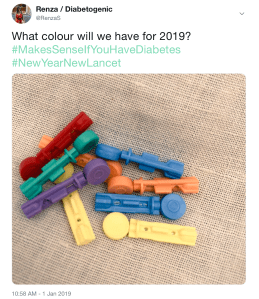
Thought about changing lancets. But the idea didn’t spark joy.
Welcome to January when suddenly the only thing that I seem to see on social media feeds, giant billboards around the city, and TV advertisements is details of weight loss programs. Because, of course, that’s what we should all be aspiring to, right? If we were happy to see the back of 2018 after a hard year, losing a few kilos will obviously set us on the track to eternal happiness in 2019.
Right?
Of course not.
Nevertheless, wellness gurus, celebrity chefs, local gyms, celebrity trainers, everyone who drinks green juice and has an Instagram account come into their own when January ticks over, heralding the birth of a new year and, while the fireworks are still bright in the sky, urging us to start a new (and completely unsustainable) diet, detox, and/or exercise plan to lose weight.
Under the guise of pressing us to be the best person we possibly can, they remind us that we have been slobs for all of December and need to shed weight because that will make us happy. Oh, and buy this teatox/12 week program/juice cleanse/lemon fast for a small monthly fee of $39. That’s not much, right? And what value can you put on your happiness, right? Lose weight; be happy. The equation is simple.
Except, it’s not. And when the emotional burden of diabetes is added to this – when there is something else that we are made to feel we need to fix – the start of the year suddenly doesn’t feel full of shiny and bright and new promise. It feels like we are about to fail. Yet again
I like the idea of stopping and hitting the reset button (oh – did you read yesterday’s post?) and if weight loss is your goal, then that’s fine. But we need to stop equating happiness and perfect health with a number on the scales. We need to stop being made to feel guilty because we may have eaten a little more than usual over the holiday period. And we need to stop being made to feel that we should be seeking redemption for our sins of enjoying the holiday period. We need to stop being sold the idea that the road to happiness and health is signposted by losing kilos
Because the reality is that all these messages actually add mental weight. And no one needs that shit in January. Or any time of the year.
But, I have found some ways to shed that weight.
You could start by getting of social media completely. But that’s as laughable to me as suggesting I should be running 5Ks a day and consuming only kale and kombucha. It is, however, worth acknowledging social media – actually, any media – is a fucking nightmare at this time of year, maybe even more so than at other times. But, there are some bright lights out there that, instead of suggesting that we are full of faults and problem areas that need fixing, encourage us to just damn well like (or even love!) who we are. Here are just some things you may want to check out:
Nina Mills is a Melbourne-based dietitian who just gets it. Her blog, Twitter and Insta feeds are well worth following for their no-nonsense approach to eating and anti-diet messaging. She nourishes the SoMe soul with delicious recipes and sensible ideas, and a healthy dose of self-deprecating humour too (her food fails posts are hilariously honest!). It is no secret that I have had very few positive experiences with dietitians – both personally and professionally – in my 20 years with diabetes, but had I met someone like Nina years ago, I would have a very different story to tell.
You can follow Nina at Feel Good Eating on Insta.
Body Posi Betes is run by my mate Georgie, who thankfully has returned from Paris and made Melbourne feel right again. The diabetes thread that weaves its way through her posts is life-affirming, as is the complete and utter refusal to subscribe to any sort of diet culture. She is sassy, sweary and fucking fabulous.
Start with Body Posi Betes on Insta.
Claire Christian is one of my kid’s favourite writers and her Insta stories are full of great ideas and strong feminist messages. She is a high school teacher as well, and if you have teenagers, (especially teenage daughters), check her out. (I have no issue with swearing…obviously…but if you do, you may find some of her posts a little confronting. But if you can push through that, she is just such a great role model for young girls, and 45 year old women too!)
Watch Dumplin’ on Netflix. And then watch it again! It is so, so gorgeous. It’s completely PG, and totally appropriate for kids. Plus, Dolly!
It’s not hard to love Jameela Jamil, and her amazing #IWeigh campaign continues to remind women that we are so, so much more than a number on the scales. She tore strips through celebrity weight loss products at the end of last year with a hilarious video of her spruiking a (fake) detox program. Her posts are brilliant, she is brazenly feminist, and calls out any bullshit she sees.
Her Insta is here. And here’s what I wrote about the #IWeigh campaign last year.
Obviously, there are so many other great thing to check out, and if you have any suggestions, please share them in the comments. This is a great time to curate what and who we follow by removing anything that makes us feel that we have faults or need fixing. Because we don’t. There is nothing wrong with wanting to be better or to find ways to make ourselves feel happier and healthier. But shaming or guilting us into it, or focusing purely on how we look is not the way to happiness. That just weighs us down.

Ice cream is not a reason for guilt. Tastes good, though…





 Diabetogenic