
You are currently browsing the category archive for the ‘Conferences’ category.
I’ve always thought that being pushed out of my comfort zone is a good thing. There’s something to be said about feeling uncomfortable and being stretched outside the boundaries of familiarity.
And so, with that in mind, I jumped on a plane and flew to Barcelona for ATTD. If you read my last post, you’ll know it was nowhere near as easy and flippant as that last sentence sounds.
A lot of the stresses I had before I left ended up amounting to nothing. There were no endless queues at the airport, or crowds who didn’t understand keeping 1.5 metres apart. Almost everyone was wearing a mask. Security was even more of a breeze than usual (apparently laptops and other devices don’t need to be removed from carry-on luggage anymore), and, requesting a pat down rather than walking through the full body scanner was met with a nod and a smile.
Everyone wore masks boarding the plane and most seemed to leave them on throughout the flight. This isn’t something to treat lightly. The first flight alone was almost 15 hours long! My mask was removed only while drinking and eating, staying on snugly while I slept.
While there were no formal requirements for a supervised COVID test to enter Spain or return to Australia, my daily tests did cause 15 mins of countdown anxiety. One evening, someone messaged me to tell me that she had tested positive. We’d had a breakfast meeting the previous morning. I calmed my initial response (which was to freak out and burst into tears) by remembering that we’d all been masked up apart from the minutes we were eating.
When I arrived in Barcelona, I had been cautioned of convoluted arrival procedures and extra queues to check health and vaccination status. Before leaving, I’d had warnings and reminders from the airline and friends already there to make sure I’d completed my online Spain Travel Pass because the QR code would be needed. Except, it wasn’t. Passport control took under than 90 seconds. And my code wouldn’t scan for the woman checking my pass. ‘Where are you from,’ she asked me. When I said Australia, she laughed and told me just to go get my bag. (Clearly, she wasn’t up to date with our COVID numbers…)
Luckily, the people I spent most of my time with were all on the same page as me when it came to masking. We were not the norm. Most people were not masked up. I realised that when I walked into a hotel restaurant to meet someone a couple of hours after I arrived, and again as I walked into the conference centre on the Wednesday afternoon. As I stood on the stage to welcome everyone to the #dedoc° symposium, I was grateful to be greeted by a sea of masks with fewer than ten people in the packed crowd choosing to not wear one. And a couple of them searched in their bags for one after I and first speaker, Dana Lewis, thanked people for masking up.
I have to say it did surprise me to see so few healthcare professionals wearing masks, and eagerly reaching out to hug or shake hands when we met. I actually was okay with giving people I know a hug, but we always asked first. I adopted a weird kind of hopping around to avoid people I don’t know too well as they approached, instead extending my elbow.
I went into last week with a very clear idea of how I was going to, at all costs, avoid people. I’ve held tightly onto health measures (masking, distance, lots of hand washing, meeting people outdoors) since the pandemic began, and there was no way I was going to be partying like it was Feb 2020 just because I was back in Spain.
But there was a moment that I did throw a little caution to the wind. The evening I arrived, after my first meeting, I got in the elevator to the rooftop of the hotel where I was staying. It was the same place all the #dedoc° voices were, and they were having an informal meet up on the roof. I walked out, and a few of them – the ones I know well – screamed and charged at me. And instead of freezing and freaking out, I teared up and was happy to just be enveloped by them all. I was wearing a mask and, in that moment, that as enough.
Since I have returned home, I’ve been asked dozens of times what it’s like travelling and being at a conference again and how I coped. The answer isn’t straight forward.
Travelling again was terrifying. I didn’t enjoy being in transit at all. I struggled with there being so many people around me. And I was uncomfortable with the unpredictability of the whole situation. But I focused on the bits I could control and did my best to just deal with it.
Being at a face-to-face diabetes conference was in equal measure exhilarating and difficult. Being able to have in real life conversations with people about their advocacy and how they have been going is different to messaging or Zooming – it just is. Bumping into people in conference centre hallways starts conversations that absolutely wouldn’t have happened otherwise. And it’s those conversations that often lead to collaborations and new projects. I predicted in my last post that the muscle memory of a real-life conference would return without much effort, and I was right.
The equation for me is this: the good outweighed the bad. The moments of joy and delight dwarfed the moments of terror. The feeling of being part of something – that truly global diabetes community of truly incredible diabetes advocates and healthcare professionals and researchers – returned with a fierceness I wasn’t expecting. I felt at home and where I belonged, and the moments of anxiety – sometimes almost paralysing – were overcome by knowing that. And the peer support was immense. I didn’t realise just how much I needed that contact again.
I’m not going to be rushing back to the same conference and travel schedule I had built in 2019 – it’s not sustainable in so many ways. And there is a lot of risk assessment going on. I won’t be at ADA this year, but EASD is on the cards. Carefully chosen meetings with clear goals and plans are worthwhile.
The world is definitely a different place. But within those differences is the comfort of knowing that the diabetes world – the diabetes advocacy community – has absolutely not stopped doing what it does best. As I stood in corridors speaking with people and plotting and planning, or took the stage to chair a session, or caught up with people after hours on rooftops, I realised that it’s going to take a lot more than a global pandemic to stop the passion and dedication and determination of those who have one thing in mind and one thing in common: improving lives of people with diabetes.
DISCLOSURE
My flights and accommodation have been covered by #dedoc°, where I have been an advisor for a number of years, and am no working with them as Head of Advocacy.
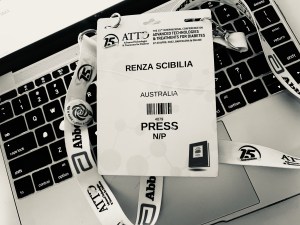
Thanks to ATTD for providing me with a press pass to attend the conference.
Before the world changed, I was in Qantas’ top five per cent of travellers. They told me this in an email, as though it was worth celebrating – they actually used the word ‘congratulations’ in the opening paragraph. To me, it just represented all the time I spent on aeroplanes. In 2019, I did ten long-haul flights for work and one for pleasure. I couldn’t tell you how many domestic flights I took but suspect it would be close to fifty. I had a tally at one point of the number of airbridges I’d walked but stopped counting when I got to 100 because I was feeling sad about it. 2020 was shaping up to be the same, but then that global pandemic thing happened and grounded pretty much all flights in and out of Australia. And me along with them.
But before then, I was what you would call a seasoned traveller. I could pack in ten minutes, while going through my mental checklist to make sure I had all the diabetes supplies I’d require, as well as regular-people things. I was brilliant at calculating future time zone gymnastics so I wouldn’t find myself woken at 3am with an expired sensor or empty pump reservoir.
I had my airport routines timed down to the minute. I knew I needed a cab at my house exactly 60 minutes before a domestic flight. That would give me enough time to breeze through the express security aisles, walk straight into the Qantas Business Lounge, order a takeaway coffee, walk to the gate, and get on the plane, just in time to watch the Qantas safety video that (lied) told me there was good coffee onboard.
International flights needed a little extra time. I’d arrive at the airport no more than 90 minutes before flight time. Speed through the First Class check in (no, I was not flying first class, but Platinum status – thanks to all the flying – meant I was treated as though I was. At least until I boarded the flight!), dive for the shortest e-passport queue and speed-walk through duty free and find a window seat in the First Class lounge and wait for my flight to be called.
I was that person at the airport who could tell which queues were moving quickest, understood that unpacking laptops/phones/removing jewellery PRIOR to getting to the front of the queue kept things moving, knew the best seats in the lounge, was recognised by lounge staff (the Qantas Business domestic lounge baristas knew my coffee order; I could easily get a pre-flight massage in the international lounge). Flying was tedious, tiresome, and far too frequent, but I had it worked out.
Right now, I’m at the airport, about to board an international flight for the first time since I returned home from ATTD in Madrid in February 2020. Getting to this point has been stressful.
I’m terrified of people and I’m guessing there will be some on the plane with me. I don’t like my new passport photo. I’m beyond terrified at the thought of being away from home. I’m scared about getting COVID and not being able to return home. I’m confused about COVID requirements. I’m concerned about diabetes being a shit while in transit, even though that’s really not something I’ve had to contend with in the past. I’ve been worried all week that I’ve forgotten how to travel!
It took me forever to work out what to pack. I checked, double checked and triple checked diabetes supplies, packing them, and then unpacking them over and over. I couldn’t work out which charging adaptors I needed. I finally shut my suitcase, (after spending an age deciding just the right one to use), which I know has far too many changes of clothes, but I’ve lost the knack of throwing together a ‘conference capsule’ of just the right things to wear for just the right number of days.
I couldn’t remember the layout of the airport – I walked by the elevator for the lounge and somehow found myself at a deserted part of the airport before I realised I was lost. I was worried about crazy-long airport queues but was pleasantly surprised at the efficiency of the whole check in process, so probably didn’t need the extra hour I gave myself to make sure I wasn’t running late.
I feel like one of those people at airports who holds up everyone else because they don’t know when to have their passport ready and open at the right page, or their shoes off, or to unload everything from their pockets before going through the scanner. You know, one of those people that used to drive me to despair back before the world changed.
As it turns out, the whole process of getting through security and passport control was effortless. My pump, CGM and OrangeLink were barely noted during the security pat-down. The only difference with 2022 travel as compared with 2020 travel is that I’m sporting a pink mask and had to show my vaccination certificate. I walked into the Qantas Lounge and was greeted with a ‘Welcome back’, and I nearly burst into tears.
I can see my plane out the window from the lounge (I still remembered where the best seats are!) and have had my last Melbourne coffee for a week. I managed to deal with a little hypo (thanks to all the extra steps from getting lost!) without too much drama. It all feels oddly familiar and completely alien at the same time.
In just over 25 hours, I’ll be in Barcelona. A real life conference seems so strange still, but I have a feeling that muscle memory is going to be strong there, and being around an incredible network of diabetes advocates (follow the #dedoc° voices!) is going to be an endless source of support and inspiration. Through it all – the anxiety and the stress of getting to this point – I’m so excited! Let’s see what ATTD 2022 has in store!

DISCLOSURE
My flights and accommodation have been covered by #dedoc, where I have been an advisor for a number of years, and am no working with them as Head of Advocacy.
Thanks to ATTD for providing me with a press pass to attend the conference.
Sometimes it takes me a couple of days after a big diabetes meeting or event to work out my main takeaways. I think about it and throw things around, reliving certain aspects, considering what was discussed, carefully thinking about all possible interpretations to make sure that I am clear about what people were saying
I didn’t need time after last week’s World Health Organisation Focus Group on Advancing the Lived Experience of People Living with Diabetes because the takeaways were there straight away, loud and clear.
There were three things for me:
- The acknowledgement about the importance of language and communication. I wrote about that the other day.
- Barriers to access include far more than affordability. Affordability is absolutely a cornerstone of being able to get the best care, take the right meds and use the right technology, but there are a lot of other obstacles and blocks that impact on outcomes. More on this another time.
- But, for me, THE biggest take away was the support that was overflowing from most people in attendance, and they way they were looking out for each other, looking to each other, and looking for ways to remain connected to support the astonishing work being done in the community – from grassroots initiatives, right through to involvement in political campaigns at the highest organisation level.
I have been so lucky to be the recipient of that sort of support from other people with diabetes over the years. Whether it’s invitations to be involved in their projects, or having an EOI flyer flicked my way, or being recommended for something, the love and generosity of others with diabetes has certainly opened up a lot of advocacy opportunities. I have tried to pay it back, and, (to use a #dedoc° voices motto), #PayItForward as well. A benefit of working for a diabetes organisation has meant that I have been able to co-design and develop programs to involve others. Initiatives like the #DAPeopleVoice and countless speaking occasions, and nominating people for initiatives such as the IDF YLD have opened the door for others with diabetes to step through and find a platform for their own advocacy.
One of the things that I learnt early on is that there is a lot of stuff to go around. If people want to get involved, there are always ways in. Chelcie Rice’s ‘If they don’t have a chair for you, bring your own’ words ring in my ears a lot when I think about making sure PWD have a seat at the table, and I’ve extended that to ‘And make sure you bring a chair for someone else, or give yours up for them’. Increasingly, I’ve done more of the latter.
Also early on I learnt to ignore the people who did nothing more than complain about who gets invited where, instead understanding my own value and reason for being involved, while also making sure to find a way to bring along those who genuinely were interested in being included and were willing to work to make it happen. (The incredible responses to this tweet show how people got a break in diabetes advocacy and what it’s taken to keep going.)
Supporting others is as easy as sharing someone’s blog or social media posts, linking to them here in my own writing or to their Twitter handle when I mention them, celebrating their work to others and applauding their wins.
Attitudes of support were demonstrated in spades last week. I had direct messages from dozens of attendees, some reaching out for the first time, that were just so damn encouraging and kind.
At the same time, I was frantically messaging others to ask about their work and if there was anything I could do to promote it. I sent the #dedoc° voices application link to a number of people who were at their first advocacy meet, and hoped to do more.
One of the nicest messages I received was from someone I’ve known for years on Twitter, but never actually been at the same event or involved in the same project. We exchanged some lovely messages, acknowledging how terrific it was to finally find ourselves in the same Zoom room, and a hope that it would continue.
The overwhelming openness, kindness and consideration of others was disarming. There wasn’t a sense of competition or resentment for anyone doing other things. There was appreciation and respect of others’ efforts. And that led to meetings being set up, collaborations taking shape, and a list of exciting new things to check out and share.
Look, if this seems all a little utopian, maybe it is, and maybe I sound annoyingly Pollyanna-ish. I’m sure that there were some folks there who walked away with a very different vibe. And that’s fine. Not everything floats everyone’s boat. Perhaps not everyone connected with others the same way I did. Perhaps they weren’t as comfortable reaching out to others to offer their support, or maybe they didn’t see or hear anything they thought worth supporting. As always, diabetes experiences – whether in a clinic appointment or an advocacy event – will be different for different people.
For me, I started from a place of wanting to be there and wanting to connect with others. When I think about it, there is an element of selfishness in my advocacy work, as it’s allowed me to always find a way to connect with others with diabetes, to learn from them, to work together, to jointly elevate our place in the diabetes healthcare space. It’s served me well. And it’s given me the change to receive and give support to others, too. It’s a good place to start. And it’s a good thing to keep doing.

DISCLOSURE
I was invited by the WHO Global Diabetes Compact team to be part of the facilitators at the Focus Group on Advancing the Lived Experience of People Living with Diabetes. I happily volunteered my time.
When I talk about the highs and lows of diabetes it’s not just the rollercoaster of numbers. I wrote yesterday about feeling a little low and overwhelmed after a particularly gruelling day. Today, however, I’m on an absolute high after a busy night, or rather, early morning, giving two talks at the ISPAD conference.
docday° was a little different this time, in a truly brilliant way. It was the first time that the event was on the scientific program of a conference, meaning that it was easier for conference registrants to attend. Having a program session that is truly led and designed and features PWD, elevates the standing of lived experience.
The docday° program highlighted some of the topics very close to the hearts of many people with diabetes. Emma Doble from BMJ spoke about working closely with the docday°voices team to publish stories written by individual and groups of people with diabetes. How fantastic to see the words and lived experience feature in such a prominent medical journal!
I touched on language and diabetes – the first talk on the topic for the conference for me. Steffi Haack gave a beautiful talk about peer support and touched on what we get from being in a community of others with diabetes can offer. Steffi managed to perfectly capture the essence of what the community can offer, while also discussing why it’s not necessarily perfect. And we finished with Tino – Tinotenda Dzikiti – from Zimbabwe talking about access and affordability of diabetes medications and treatments. Tino has been a standout advocate in the dedoc voices program, and I make sure to take any chance I get to listen to him.
After docday°, I was an invited speaking in the Psychosocial Issues in Diabetes Symposium which involved an incredible panel of speakers including Rose Stewart from the UK and Korey Hood from the US. Rose spoke eloquently about the importance of integrating psychologists into diabetes care teams, and Korey provided some terrific tips about dealing with diabetes burnout. I followed the two of them (not daunting at all…!) to talk about the language matters movement in diabetes, starting with a reminder that we are talking about more than language – and it’s certainly more than just specific words. It’s about communication, attitudes, images used, and behaviours.
The way that I speak about language these days is different. I think that at first, I spent the majority of the time explaining what it was all about. These days, there seems to be enough ‘brand awareness’ in the community about language matters and that means being able to home in on some of the more nuanced aspects of it.
And so, while I still talk about words that I (and from research we’ve done, others) consider problematic (‘compliant’ is the one that I like to highlight), I spend more time talking about the image problem diabetes has, and about the trickle-down effect language has had on shaping that image.
I point out that there are people who think that language is not all that important in the grand scheme of things, and that there are more important things to worry about in the diabetes world and I very much understand that. I also understand that people have different focuses. But when I ask people what those important things are, they include issues such as research for a cure and better treatments, better access, more education. And then I can’t help but see and think about how research is less because of the image problem about diabetes. That treatments and a cure need governments to prioritise diabetes when it comes to their research dollars and individuals need to give generously when there are funding drives.
But because diabetes is seen as something not serious, and that people are to blame for their own health condition, we are not seeing those dollars coming our way.
It never is and it never was about picking on certain words; it has always been about changing attitudes. Because that is what will change diabetes’ image problem.
I am an advisor to the #dedoc° voices program. I do not receive any payment for this role.
As an invited speaker at the #ISPAD2021 annual meeting, I was given complimentary registration for the conference.
I am helping organise the Diabetes Australia Global Language Summit, and will be hosting the panel discussion.
Often when we talk or read about technology it is very much about the latest, newest, shiniest devices. And yes, I wrote about those last week. There’s nothing wrong with learning about latest tech releases, or desperately wanting to get your hands on them.
But the devices are only ever half the story. And that’s why it was so great to see that in amongst all the data and the new things, was a presentation that reminded everyone watching the technology symposium at ADC that the data belongs to people and the devices are worn on the bodies of those people.
This is the whole warm hands, cool tech concept that is often missing when we hear about technology. The devices are not inanimate, they need human interaction to make them work for … well … for humans.
I despair at some of the stories we hear about technology and people with diabetes. Some talk experiences that have left them feeling like a failure when the tech has simply not been right for them. Because that is the way it is posed. If we decide the tech doesn’t suit us, hasn’t worked for us, hasn’t helped us achieve our goals, we’ve failed it.
The truth is, it’s more likely that the failure – if we need to frame it that way – is not the PWD at all. It’s more likely that the tech is not right for the person, and there wasn’t enough assistance to help navigate through to choose the right tech. Or the education was insufficient, or not tailored for the PWD, or not interesting, or not relevant (more on that soon, from Dr Bill Polonsky’s opening plenary from the conference). It is possible that the timing wasn’t right, the circumstances were not optimal, not enough conversations about cost or effort required … whatever it is, none of the blame for something not being right should be placed on the PWD.
When we look at diabetes education, or engagement with healthcare professionals, the stories that are celebrations or considered successes (from the perspective of the PWD and, hopefully, the HCP) show the right recipe. The ingredients will all be different, but the method seems to be the same: the person with diabetes is listened too, time is taken to understand what is important for them, the PWD’s priorities are clear, and goals are realistic and checked along the way. The end results are not necessarily based on numbers or data points, but rather, just how well the person with diabetes is feeling about their diabetes, and if anything new has added to their daily burden. Reviews are focused on successes more than anything else.
My favourite ever diabetes educator, Cheryl Steele, gave an outstanding presentation on how HCPs can best work with people with diabetes to ensure we get the most from our technology.
I spoke with Cheryl after her talk (you can watch the video of our chat for Diabetes Australia at the end of today’s post), and she laughingly said that she could have said the most important things she wanted to say in 2 minutes, and with one slide that basically just said that HCPs need to be truly person-centred and listen to PWD.
But thankfully, she spoke a lot more than that and covered a number of different topics. But the thing that got to me – and the thing that I hope the predominantly HCP audience would take home and remember – was Chery urging her colleagues to focus on the positives.
Cheryl said, ‘The emphasis has to be on what you’re doing well’ and I feel that is a wonderful place to start and end healthcare consultations. I think about experiences where that has happened to me. Such as the time I went to my ophthalmologist after a few years of missing appointments and his reaction to seeing me was not to tell me off for not showing up previously, but instead to welcome me and say it was great I was there. I’ve never missed an appointment since.

How many PWD reading this have stories to share of times when they went into an appointment with data and all that was focused on was the out-of-range numbers? There are countless stories in online diabetes groups where HCPs have concentrated on the 10% out of range numbers rather than the 90% in range. Actually, even if only 10% of numbers were in range, that is 10% that are bang where they need to be!
Perhaps that’s what’s missing from diabetes appointments. Gold stars and elephant stamps!
There is something devastating about walking into an appointment and the first, and sometimes only, thing that is on the HCPs radar is numbers that are below or above the PWD’s target glucose range. I’ve sat in those appointments. I know the feeling of walking in and feeling that I’m tracking okay, only to have none of the hard work I’ve managed acknowledged and instead, only the difficulties addressed.
But then, I think about one of the first experiences with the endocrinologist I have been seeing for twenty years. Without judgement, she acknowledged that I wasn’t checking my glucose much, and asked if I felt that I could start to do one check every Wednesday morning when I woke up. I said that it seemed like such a pathetic goal to set, but she gently said, ‘One is more than none’. The focus was not on what I wasn’t achieving. It was on what I could.
What a wonderful motivator that is.
Disclosures
Thanks to the Australian Diabetes Society and Australian Diabetes Educators Association, organisers of the Australasian Diabetes Congress for complimentary registration to attend the conference. This gave me access to all the sessions.
I work for Diabetes Australia and the video shared is part of the organisations Facebook Live series. I am sharing here because is relevant to this post, not because I have been asked to.
As usual, no one has reviewed this piece before I hit publish (which is unfortunate because I could really do with an editor).
This week, I’ve been at the Australasian Diabetes Congress. By ‘at’ I mean ‘sitting in my home office in lockdown, watching sessions on my MacBook’, because that is what ‘at a conference’ means in the time of COVID.
Today is the final day, and I spent a couple of hours in the technology session, listening to news about the latest and greatest in diabetes technologies, as well as the best way to work with people with diabetes who are using these technologies. I’ll be writing about the latter next week.
Today is all about shiny new stuff!
Big tech news from the Congress was the announcement from Insulet Australia that Omnipod DASH will be available this month, which is fabulous because it means that there is another choice added to the pump market for Aussies with diabetes – and a tubeless pump at that!
The not-so-great news is that Insulet has been unable to successfully negotiate a reimbursement model with the Department of Health. Pumps in Australia are generally covered through private health insurance, and pump consumables subsidised through the NDSS.
This has worked perfectly well to date because pump products have been easily divided into devices (the actual pump) and consumables (infusion sets and reservoirs/cartridges). The Omnipod system is different – it comprises a tubeless pod which is, essentially the pump and consumables. The pod is worn for three days before being discarded. There is a touchscreen ‘personal diabetes manager’ which is used to drive the device. This system simply doesn’t easily slide into the funding model that has worked for the last thirty odd years.
The latest notice from Insulet Australia is that they will now have to go through another submission process, and that will take a further 8 – 12 months. There is no guarantee of reimbursement at the end of this process, but Insulet – and Aussie PWD – are hopeful there will be good news.
Frustratingly, this means that anyone who decides that they really want an Omnipod and want it now needs to purchase it out of pocket, with no subsidy scheme on offer. The price that was announced at the Congress is AUD$400 for a one-month supply. There will be discounts for two- or three-month orders.
In other new tech news, Abbot’s new flash glucose monitor, Libre 2, is very much now available in Australia, and the positive here is that it is already listed on the NDSS for those eligible for the CGM Initiative. Those of us who need to pay out of pocket, the price is the same as for the first-generation Libre. It’s a small win.
Libre 2 has been out and about in Europe for some time now (and Libre 3 is out in limited release in some markets), and has recently received approval for use in the US.
The main difference with Libre 2 is that it alarms when glucose levels are out of range. The wearer will still need to scan over the sensor (either with a mobile phone or reader device0 to see the actual reading, but they will have been alerted to any numbers that are either too high or too low. The great thing is that the alarms are optional, which is great for PWD who prefer their diabetes to be silent.
It’s been described as an evolution rather than a revolution, which is not a negative. We don’t necessarily need every new generation to be a complete and utter overhaul with all new bells and whistles, but it’s always great to see improvements – especially when they are improvements PWD have recommended! I haven’t tried the Libre 2 yet, but will be doing so in the next week or so.
You can find more information about these two new technologies by clicking on the images below.
Omnipod (there is currently very limited information on the site, however that should change in coming weeks.)
Disclosures
Thanks to the Australian Diabetes Society and Australian Diabetes Educators Association, organisers of the Australasian Diabetes Congress for complimentary registration to attend the conference. This gave me access to all the sessions.
I hosted the Australian launch of the Omnipod DASH for diabetes advocates back in May this year, and was paid an honoraria for my time.
Abbott Diabetes Australia has provided me with a Libre 2 sensor to use.
All words here are mine and I have not been asked or paid to write anything you’ve just read.
I went to my first international diabetes conference back in 2011. It was the IDF World Diabetes Congress in Dubai. In a slightly convoluted way in, I was there as a guest of the City of Melbourne. The next Congress was to be held in my home city, so the tourism arm of our local government attended the conference, talking up all that Melbourne has to offer. I was invited to go and spruik the city I love so much, encourage people to make the (very) long haul trip Down Under… and hand out little clip-on koalas while standing next to giant koalas.

After attending and getting a taste for what was on offer at one of these large-scale conferences, I realised that I wanted to be able to be involved in others moving forward. Undoubtedly, it was great professional development for me – as someone working in advocacy in a diabetes organisation – but it was also a great way to network and meet others in the advocacy space, learn about what they were doing, and work out how we could collaborate. I can’t begin to think of all the terrific projects that started in the corridors, running between sessions! And most importantly, I realised that having PWD at diabetes conferences meant that what was on show was being shared with our peers in a way that made sense.
The struggle, of course, was getting to these conferences. Australia is a long way from anywhere and with that comes expensive travel costs. The organisations I have worked for cover maybe a max of one event per year as part of my professional development, so the rest of the time it was up to me to find a way in. Good thing I know how to hustle! In fact, that’s the way that most other PWD who attend these meetings get there.
My disclosure statements at the end of posts detail the support I’ve received. Sometimes I’m an invited speaker so that makes covering costs easy. In recent years, research projects I’m involved with, or ad boards I’m a member of, often run meetings alongside international conferences, so my travel and some accommodation are covered. I was informed early on by other advocates that there are often satellite events run by device and pharma companies, and I became very good at begging asking for an invitation, and then following that with more begging asking for help to cover accommodation and travel costs. I know that it doesn’t come easy for lots of people to ask for money, especially when most of the time the answer is going to be no, but I’ve developed tough skin in 20 years of advocacy, and can take rejection. It just propels me to the next ask! (For the record, HCPs also do this hustle to help cover their costs. It’s not just advocates!) Another thing that has helped is my growing conviction about how critical it is – and non-negotiable – that people with diabetes are at these meetings. #NothingAboutUsWithoutUs may have started as a whisper, but now it’s a roar that comes with an expectation that we must be there, and we must be supported to get there!
Pretty much every single time I have travelled overseas to one of these meetings, I am out of pocket. Some of the costs are always borne by me. I am fortunate to be able to cover those costs, but I am fully aware that it is one of the many reasons that advocates don’t pursue attending.
I get that there are myriad reasons that getting to these meetings is difficult. It can seem that there is no way in; there are costs to cover; time needs to be taken from work; it means leaving family; getting registration can be difficult for non-healthcare professionals. And for many, they simply have no idea how to actually make the first move to attend. It can seem daunting. I know that it can seem that it’s always the same people at these events, and I think that’s partly because once people have found out the process of getting in, they keep doing it, because they realise it’s not as daunting as they first thought!
And so, that’s why initiatives like #dedoc° voices are so magic. It is an opportunity for all PWD to apply for a scholarship which will offer an access-all-areas pass to professional diabetes meetings. Want more details about this great program from advocacy group #dedoc°? Try here and here. The pilot for this was at ATTD in Madrid, just before the world turned upside down. It was a brilliant showcase of just how an open application process works, breaking down barriers that prevent people from attending.
While the #dedoc° voices at ATTD in Madrid offered travel and accommodation costs, as well as registration to the conference, the other two times the initiative ran (ISPAD and EASD) were virtual events, so only registration was covered.
And that brings us to 2021, and the first global diabetes conference for the year, ATTD, which kicks off next month. Applications for #dedoc° voices is open to PWD from all around the world now, but closes on Friday. It’s been a super short timeframe for this event, but it won’t take you too long to apply. You’ll find all the details right here.
Run don’t walk, and apply now, for your change to not only get to ATTD, but also to meet diabetes advocates from across the globe. It’s your way in. What are you waiting for?

Disclosure
I am an advisor to the #dedoc° voices program. I do not receive any payment for this role.
Last night, I had the honour of speaking at the World Health Organisation Informal Consultation on Diabetes, which is currently taking place as a virtual event. It’s a three night/three day (depending on where you are in the world) event that has brought together people living with diabetes from all corners of the world.
This was a widely advertised event, and anyone could apply. The expression of interest call out was all over Twitter, Facebook and diabetes community groups. Unlike some other initiatives and programs, PWD didn’t need to be nominated by a diabetes organisation or HCP to be part of it. You just needed to fill out the application form (which didn’t take too long), and submit. Clearly a lot of people with diabetes saw it and thought it was something they wanted to be involved in! I’m not sure of the overall numbers, but there is certainly terrific representation from a number of communities.
On my Zoom screen I could see a combination of familiar faces, faces of people I know of but have never met or engaged with, and a whole lot of new faces. Hearing their stories, and reading the discussions that are filling up the chat box are enlightening. And reassuring. Because once again I was struck by how strong, vulnerable, admirable and strong-willed others treading the diabetes path can be. There are striking similarities and glaring differences. But common threads that run through the narratives we heard And mostly? There is support and gratitude to be there and to bear witness to others sharing their stories, ask questions and learn. Not a single snipy comment or passive aggressive remark – not because we all agree or are a homogenous group. But rather because we respect and value and admire the people who have the courage to stand up and be present.

I was invited to speak in a session about diabetes advocacy. The session’s title was ‘Strategic communication in global diabetes advocacy’, and it included Christel Marchand Arpigliano from Beyond Type 1 and Lauren Carters-White, a research fellow from the University of Edinburgh. Christel spoke about how when we tell our diabetes stories, we are translating the language PWD use – language that makes sense to us – into words that reach a broader audience.
Lauren used some terrific examples from around the world to show the impact data and evidence can have in advocacy efforts.
And I rounded out the session by talking about how when we bring the two together, we win the hearts and minds of the people we are trying to influence – decision makers, legislators, policy makers, educators, healthcare professionals and researchers. Because when we have the emotional pull of how diabetes impacts on daily life, combined with the evidence to show what that means, we can’t be ignored! I highlighted how working with healthcare professionals and researchers to further our messages means that our lived experience can’t be dismissed.
I also spoke about how the power of stories is magnified when there are many voices and many different narratives. I have rarely, if ever, heard someone share their diabetes with the pronouncement that they speak for all with diabetes, or that their story is THE story. But they are all experts in their own lived experience and that certainly should be celebrated. And its power should not be underestimated.
I think the thing I have felt most strongly in that Zoom room is the camaraderie and solidarity – again, not because we are all on the same page and all want the same things. But rather, everyone truly supporting each other and bringing others into the conversation has been an overarching quality of the meeting. No one dominates; no one is more important than anyone else; no one claims to be THE advocate. We are all advocates working together, and supporting each other for a bigger cause.
Of course, we want, and expect, to see action come from the three days of meetings and workshops, and I have confidence that will happen. But in the meantime, to have such large group of dynamic people come together whose only agenda is community and to build each other up, rather than tear each other down, reminds me that THIS is what diabetes advocates can do and what the community is mostly about. Those snippy voices who try to minimise people who are truly trying to improve outcomes for people with diabetes aren’t present. Because what a waste of time that would be!
I may have spoken about, and given tips about how to win others’ hearts and minds in my talk, but it’s my own heart and my own mind that have been won over by my peers in this event.
(You can follow along the discussion by using the hashtag: #WHOPLWDs)
Disclosures
None. I am not being paid to attend this event, and have not received payment, honoraria or in kind donations for my presentation, and am attending in my own time. I might need a nap later today though, because the 11pm-3.30am time for Aussies on the east coast is tough going!





 Diabetogenic