
You are currently browsing the category archive for the ‘Community’ category.
Is it really all that radical an idea to suggest that there is no one size fits all when it comes to people with diabetes and what they choose to eat? Surely any reasonably minded person would say that no one should be forced to follow a specific diet, in much the same way as no one should be told which diabetes tech they must use.
But in the last couple of weeks, and after a couple of different incidents, I’m realising that reasonable doesn’t play into the attitudes of many people when it comes to what can only be termed as diet wars. I don’t bait anyone with tweets about food. I really don’t. I’ve no interest in defending what I eat. It’s my business and mine alone.
My position is very clear on this, but I’ll state it again. I genuinely believe that people with diabetes should be able to eat the way they want. I also believe that it is incredibly privileged to get all preachy about what people should be eating when there is a lot that goes into how that decision is made. For some people, that decision is made for them in a lot of ways. It’s pretty ridiculous – and showing just how out of touch you are – to demand someone eat specific foods if they live in a food desert, can’t afford whatever they are being told to eat or if those foods are not culturally considered.
But let’s, just for a moment, pretend that we are living in some utopia, and everyone has access to, and can afford to buy, whatever food they choose to eat. We’ve taken out the factors that may make it difficult to afford and access the widest, freshest, healthiest variety of foods. Let’s now add to that and say that everyone is fully informed and has a high level of understanding about the different types of diets and earing plans available. This is as level a playing field as we can get.
Guess what? People will still make different choices and decide what works for them.
And that’s because there is no one way that works for every single person. That’s the bottom line. I think that’s a balanced starting point – understanding that not everyone is the same, not everyone wants to eat the same, and different things work for different people. That’s the way I think.
I want to make this position clear, because what comes next is perhaps not quite so generous.
After some pretty boring encounters in the online diet space, (I say boring, because haven’t we done this all before?), I decided to do something that I shouldn’t really do. But jet lag, too many long-haul flights on WIFI-enabled planes and, well, some sort of desire for self-sabotage, made me do a bit of a deep dive into the some of the people offering the more aggressive and downright nasty comments.
It will come as no surprise to anyone that the comments came from people who are very vocal about following a low carb diet because isn’t that where these comments usually come from? In my experience, the only people who have been critical of comments I’ve made online about food are those who are deep into the low carb community. I am not in any way tarring all those who eat low carb with the same brush. Of course I’m not. But there are ratbags in that community (as there are in all communities) who seem to take pleasure in seeking out and coming at those who have decided to eat a certain way, or comment about food in a certain way. And come at them they do. It gets personal, nasty, and downright horrid.
It is one thing to suggest people eat in a certain way. It’s another thing to refer to someone’s weight and fat shame them. A reply to one of my tweets that dared suggest that people with diabetes eat how they want, included a reference to ‘an obese nurse’. That tweet was followed by another low carb advocate (a physician) naming and adding a video of a diabetes educator and asking if she was the nurse. In what situation is this kind of behaviour okay?
Who are these people? I skimmed through the feeds of some of the people who commented on it being their low carb way or the high (but obviously not high carb) way, and it was unsettling. There was a lot of anti-vax sentiment. Along with anti-mask sentiments. One of two of them had an unhealthy obsession with Anthony Fauci, and wishing something terrible would happen to him. The Aussies in the mix had the same pre-occupation with Dan Andrews. I want to be clear – not everyone had these pretty extreme views, but a significant number did. It does the low carb movement no favours when so many of its members hold these types of views. It makes it easier to dismiss the whole community as being ‘cookers’ or anti-science, and I actually don’t believe that to be the case.
There are people who regularly comment on my posts and share balanced experiences about eating low carb and why it works for them. I always, always welcome discussions like this. It’s a great opportunity for me to learn, and I have adopted some of what folks like this have shared into my own diabetes management. I have also come to understand the frustration among some low-carbers because they feel that keto is not readily highlighted as an option and how many of them have been met with resistance by their HCPs when they’ve said they want to eat low carb.
But you know who else has been met with resistance? People using DIY automated insulin delivery systems. In fact, some people using a DIY system have been told what they are doing is dangerous and have consequently been ‘sacked’ by their HCP. But I am yet to see a single person from the #WeAreNotWaiting community shame anyone who has decided to not use a DIY system. Or ‘tech shame’ them. Or tell parents of kids not using a DIY system that they are the reason their kid will develop diabetes-related complications.
I’ll break this down again, by saying that I think low carb is a great option for people with diabetes. But it’s just that – an option. I know and see people with diabetes absolutely thriving, sharing in range A1cs and high percentage time in range each and every day on low carb, high carb, moderate carb and moderate-to-low carb (that’s generally where I fit in), vegan, vegetarian, carnivore, keto, Mediterranean, and every single other diet you can imagine.
I have a really simple wish and that is for people who are doing low carb do be left to do that in peace, and at the same time, they afford others the same respect and courtesy. It’s really not that radical an idea at all!

Want more on this topic? Here’s heaps I prepared (i.e. wrote) earlier.
The one where I was fat shamed after a TV interview.
The one where a fundraiser for kids in under-resourced countries was almost cancelled because of Easter eggs. (Still makes no sense!)
The one where a bloke hijacked an online discussion about menopause by demanding I explain why I don’t advocate low carb.
The one that was a plea for respecting choice.
The one that was in response to the storm after a chocolate cake recipe was shared.
The one where I shared the start of my own experiences of eating low(er) carb. And a follow up post.
I’ve just returned from Berlin, where I attended the ATTD Conference for a week of super busy meetings, information gathering, collaborations and advocacy. At every turn, people with diabetes (many attending after being awarded a #dedoc° voices scholarship) were discussing how community advocacy is key to driving change. I heard about remarkable efforts from people across the globe who are genuinely improving the lives of people with diabetes in their part of the world. And when anyone had a question, or asked for advice, people were only too happy to offer and share.
Right now, if you’re in Australia and live with diabetes, especially type 1 diabetes, you may have heard the kerfuffle about Novo Nordisk’s Fiasp being withdrawn from the PBS after Novo Nordisk made the decision to withdraw Fiasp. The Government can’t compel them to keep it listed.
So what now? Well, now is the time to rally the troops. Already, grassroots advocacy efforts by people in the Australian diabetes community (and friends across the globe thanks to the #dedoc° network) are making a lot of noise. There’s a petition (with over 6,000 signatures) and there have been blog posts. Social media groups are lighting up with comments and questions. This is how a groundswell starts.
You can also get political by reaching out to your local MP. I know that many people think that this is a daunting task, or believe that nothing will come of it. I counter that suggestion by pointing to any significant change in diabetes access in Australia. I’ve been in these trenches for decades now and know the effectiveness of people power. Community advocacy is often the starting point of rumblings that, combined with strong advocacy from diabetes organisations, leads to policy change. I can’t tell you how many letters I wrote back in the early 2000s before insulin pump consumables were on the NDSS. (I thought that the PM and health minister were going to take out restraining orders after I wrote to them both a couple of times each week for three years!) At one point, back in around 2002, I was invited to a meeting with Julia Gillard (in opposition at the time) who asked to speak with a group of diabetes advocates (did we even use that word then?) who had been regularly writing about the cost of pump therapy.
I also think of the incredible community efforts that lead to the Carers’ Allowance being changed back in 2010 so that the parents and carers of children continued to receive payments until their child was 16 years old, rather than being cut off when their child turned ten. Or the numerous letters I wrote, along with thousands of other people, to have CGM added to the Scheme. There have been other issues too – diabetes seems to mean one after another that needs attention.
Right now, the issue is Fiasp and you may be thinking about sending an email, but wondering where to start. Start with your story. Because only you can do that.
You can tell your story and write whatever you feel comfortable – your diabetes may vary and the way you advocate will too. I have some ideas I’m going to share below and I think they are worth considering when you are writing to your local MP. My philosophy is always to keep things short and sweet. I bring the heart with my story and add limited data to win over minds. Hearts and minds remains a central basis to my advocacy ideas. So, if you’re wondering where to start, here are some ideas that may help:
- They don’t know diabetes and don’t know details, so start with the basics and keep it to the point: I am writing about an issue affecting me as a person with diabetes and that issue is the withdrawal of Fiasp from the PBS. Fiasp is the only ultra-rapid insulin available in Australia and there is no comparable and easy swap to be made.
- Be clear about the issue: Fiasp is being withdrawn from the PBS. While it may be available on a private prescription this will make it too expensive for many people with diabetes, meaning a management option is being removed.
- Explain how that impacts you: As a person living with type 1 diabetes, I am required to take insulin every day. Fiasp is the insulin that works best for me and if I am no longer able to afford to use it due to it being removed from the PBS, my diabetes management will be negatively impacted.
- Be clear about your ask: I am asking for you to advise what the Government is doing to address this matter, and how it is working with Novo Nordisk to resolve the concerns of many people with diabetes who are worried we will no longer be able to afford the best treatment option for our diabetes.
Don’t ever believe that you are not going to be part of the movement that makes change. Just a minute in the Australian diabetes community right now is enough to see how a movement has already started. It’s organised and collaborative and the noise is already beyond a rumble. And you can add your voice.
Disclosure
I have worked in diabetes organisation for the last twenty-one years. Recently I joined the Global Advocacy Team at JDRF International as Director of Community Engagement and Communications and until earlier this year I was Head of Community and International Affairs at Diabetes Australia. My words on this blog are always my own and independent of my work and the organisations where I am working. My individual local and global advocacy efforts are in addition to my ‘day job’. I am also Global Head of Advocacy for ##dedoc°°.
Like clockwork, the beginning of February heralded a sea of red in every retail store, with cutesy cupid motives and love hearts adorning shop windows. Valentine’s Day was the next big merchandising opportunity and, friends, it’s time to buy up.
At the same time, the diabetes community also starts to be sprinkled with red – this time red roses. Because once again, it’s time for Spare a Rose, Save a Life. It’s the complete opposite of consumer culture. And it’s something that is very close to my heart.
This year marks ten years since Spare a Rose was first launched by a group of diabetes advocates from the US. The story has been told many times but it’s worth repeating, because it says a lot about this community. These advocates wanted to do something that supported others living with diabetes, specifically those in under-resourced counties. And so, Spare a Rose, Save a Child (now Spare a Rose, Save a Life) was created, with a vision to bring together the diabetes community, uniting in the collaborative goal of supporting those who need it.
The simple equation of ‘sparing’ one rose and donating the $5 saving to a diabetes charity was tangible. That face dollars provides insulin for a month. That’s how it has worked for ten years now. Close to one million dollars has been raised in that time, which is truly remarkable when you think about it. It’s people in the community reaching into our pockets to help make a change.
This year, donations are once again going directly to Insulin for Life, a charity that continues to support people with diabetes in countries where there is most need. Insulin for Life has been running for many years and their work is significant. Last year, as war broke out in Ukraine, the charity was able to rally their networks within days, getting critical diabetes supplies where they were most needed. That support continues, and a big part of that is due to the generosity of the diabetes community getting behind Spare a Rose for Ukraine.
As soon as the war started, the diabetes community were desperately looking at how to help and almost immediately, people dug deep. With $400,000 raised in months, so many in the community showed just how committed we are to focusing on others. That’s the diabetes community I know and love!
And so, this year – the tenth anniversary of Spare a Rose – we’re asking again for people to dig deep and help if they can. Leave egos at the door and do the simple thing of supporting community efforts by sharing links, encouraging others to learn about Spare a Rose and, where possible, donate. The only people who benefit from this campaign are people with diabetes who need it. By the community, for the community. Truly the best way to celebrate Valentine’s Day.
Here’s your Spare a Rose, Save a Life refresher for how it works. It’s super easy, and if you click on the image, it will take you directly to the donation page. (Donations are made directly to Insulin for Life.)

Postscript and disclaimer
I have been a community volunteer for the Spare a Rose campaign for a number of years, involved in promotion and communications. I’ve taken a step back this year (for a bucketload of reasons, including this), but am no less involved behind the scenes. I have just started a new job and much of the focus is supporting people with diabetes in low to middle income countries which means I’ll be supporting efforts of many different diabetes charities, including Insulin for Life and Life for a Child (previous charity partner of Spare a Rose), A4D, CDIC and others, as well as the brilliant community groups lead by advocates on the ground.
Manhattan’s East 41st Street is Library Way. Patience and Fortitude, the grand lions that stand guard outside the New York Public Library gaze down the street, keeping an eye on people hurrying by, and those who stop to admire the beautiful and imposing building.
Library Way is paved with bronze plaques engraved with literary quotes. I’ve walked the street between 5th and Park avenues a number of times, just to read the inscriptions.
The other day, as I hurried home to our apartment, this plaque caught my eye:
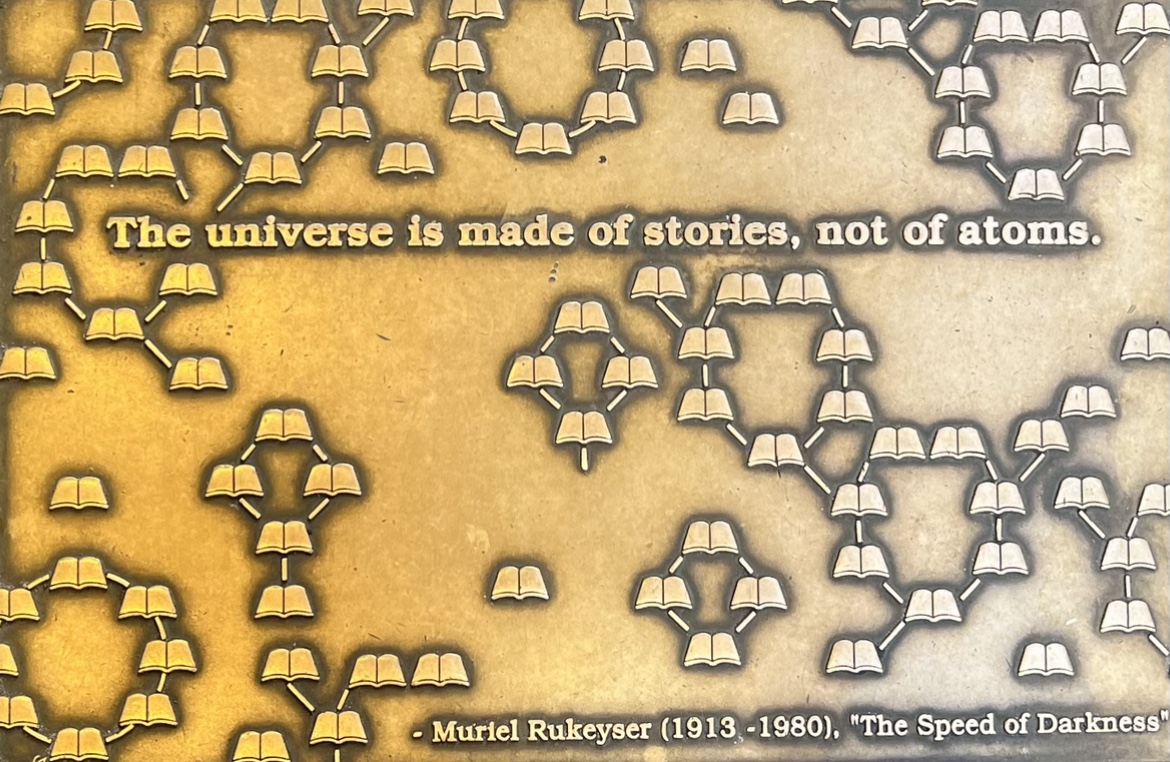
I stopped, made sure I wasn’t blocking any one’s way (lest I attract the wrath of Fran Lebowitz who is living rent free in my mind after I watched ‘Pretend it’s a City’), and I snapped a quick photo with my phone.
‘Isn’t that true,’ I muttered under my breath as I picked up speed and walked at the only pace I’ve come to accept in this gorgeous city – ultra fast.
This blog has always been about stories. Mostly mine, sometimes mine intersected with others. My advocacy life is about sharing stories and encouraging others to understand the power and value of those stories. It’s stories we connect with because we connect with the people behind them.
My time in New York is wrapping up and I’ll be back in Melbourne soon. I’ll be home, starting a new job and I’m so excited. And part of the reason for that excitement is that I will still be working with people with diabetes and their stories.
In the world of advocacy – in my advocacy life – lived experience is everything. I can’t wait to hear more stories, meet more people and learn more. And keep centring lived experience stories. Because, after all, that’s what the universe – and the diabetes world – is truly made of. Just like the plaque says.
I recently was invited to run a workshop for health advocates (not just diabetes) who are affiliated with health and community organisations either as employees or volunteers. I was asked to primarily focus on safety in advocacy communities – both online and in person. All participants were women. This was interesting to me because the workshop was open to anyone who was a health advocate – not just women. I could see why, after a few short minutes in, it was women who were keen to come together for this topic and talk about it in a safe space, with other women.
I was delighted to be involved for a couple of reasons: 1. It’s important and 2. I know that when I run a workshop properly, I walk away learning a lot. And this was a topic I wanted to learn about. I set about developing a very vague program that would leave a lot of time for experience sharing and co-developing ideas that could be used by everyone in the room. I had a few discussion starters and things that I think have worked for me, so they formed the basis of the workshop, but most of the suggestions came from the day and with permission, I’m sharing some of the ideas here.
Before I do that, though, I want to highlight the overarching message was that health communities and groups are really important and really valuable. I know I frequently talk about not needing to love everyone in the diabetes community, and how critical it is to find the people you want to be around, who are supportive, who build you up, who you build up and who make you feel safe. That squad becomes sacred. Everyone else spoke of the same thing. One woman mentioned that it had taken her years to find the right people in her health community before truly understanding how peer support can be so beneficial. Many mentioned that it took time to work out exactly what they were looking for – was it friendship, solidarity, advocacy mates, opportunities to grow professionally? There are as many reasons to ‘do’ peer support as peer support models!
But even knowing that, it came as no surprise that every single one of the dozen or so women participating in the workshop had examples of where they had felt unsafe, vulnerable, targeted, or exposed in their own health communities. As stories were shared, there were frequent looks of recognition and heads nodding. Many said it was the first time they had ever spoken about these experiences. And others took time to warm up, asking several times if anyone would know what they had said – worried that they may be identified. This reminded me a little of the Ascensia Women’s Diabetes Social Media Summit I facilitated last year. I’d probably done close to a dozen of those before and each one involved a lot of social media outreach while the event was taking place. But this event was different. This one, was not quite as open. As facilitator, it’s my job to read a room, and the reading I got was that there were a group of women who wanted to share in private. And so, we did. As happened again at this recent workshop.
None of the ideas I’m sharing will identify anyone, and this post has been reviewed by the people who attended. Safety of the women is my primary concern. So, here are some ideas that may or may not be of use to folks out there:
- You are not alone. Feeling unsafe in a community group can feel isolating, especially if there are cliques and groups that seem to form alliances. But there will be others you can turn to – often outside the group. I know I have turned to people outside the diabetes world at times to learn about how they have managed certain circumstances. It’s fascinating just how transferable things can be and how universal others are!
- There are reasons that functions such as block and mute are available on all social media platforms. But go one further. By blocking certain accounts, you may still see people you would prefer to distance yourself from. Mute their name, their account handle and, if they are associated with any specific words, terms or hashtags, mute those too. (So, want to not see my stuff? Block #LanguageMatters and mentions of coffee, stripes, bookstores, baking and red lipstick.)
- Keep records. Even of things that seem irrelevant. I have an online folder where I collate anything that has ever made me feel unsafe or helpless. It’s shared with others, so they know what’s going on.
- Talk to your workplace or associated organisation. This was one of the points that I wanted to raise. As all participants were either employed by, or volunteers for, health organisations, they have access to several services to support them if they feel unsafe. Perhaps they can use the organisation’s EAP which can be a terrifically helpful resource. It’s also important that those records you keep are seen elsewhere and there is a timeline of when things happen, and they are reported in real time. I do this a lot, mostly because it helps to talk to someone. Sometimes it’s done proactively. Other times, it’s after something happens. For example, the first time I spoke about DIYAPS and a slew of HCPs made formal complaints about me daring to talk about something so dangerously off label. Or the time a diabetes educator wrote to my employer after I called them out for tone policing me. There have been the multiple times people in the low carb community have become aggressive and threatening. Or just weird. There have been times when I’ve spoken with the CEO or other senior managers about situations and as well as being great sources of advice and comfort, it also means that they have an idea of how things started and are going. Oh, and it means there are few surprises!
- Walk away – for a bit or a lot. No one is obliged to continue to be involved in advocacy spaces or being part of a community if it is not working or if it is feeling unsafe.
- Go incognito. My name and face have always been associated with the advocacy work I do because that is what I have chosen. But there are times that I wish I’d come up with a nifty pseudonym (Blossom?) and a cute meerkat picture. I know that probably wouldn’t have been possible considering the number of quite public facing things I do means there’s limited anonymity. But there are lots of super effective advocates who are anonymous when doing any online work, and that is absolutely an option. It doesn’t mean that you don’t need to do any media or presentations. It just means not linking the public stuff to your socials. A couple of women at the workshop do that, and I somewhat embarrassingly squealed when I realised that they were amazing anonymous campaigners I’ve learnt so much from over the years!
- Learn the anatomy of gaslighting. It’s an artform, but it’s a predictable one. And expect to be gaslit if anyone ever takes objection to what you do – especially if the source of that objection is from a group that is used to not being challenged. Don’t believe me? I present exhibit a: #AllLivesMatter and exhibit b: #NotAllMen. The term gaslighting was coined to refer to misogynistic abuse and manipulation and it often presents that way these days. Learn how it works and you’ll be astonished at how frequently it is used to disempower women.
- Be prepared for your work to be challenged; to be told you’re not good enough; to be told that you are not worthy; to be told that your work is irrelevant and insignificant; to be criticised for your successes and to be diminished. The first time that happened to me, I was crushed. Now, it’s only mildly soul-destroying. (This isn’t to say that people can’t disagree with your work. Of course, they can, and they will. And that’s perfectly fine. It’s when your work is dismissed and disparaged, and you are personally targeted that it can be especially challenging.)
- Cry. This was my suggestion. I know it sounds ridiculous, but it really helps. I think it just comes from the idea of giving myself permission to not have to be confident all the time and to admit when I am feeling especially vulnerable. When there were weird emails coming to me about fundraising activities, I spent a lot of time bawling.
- Be public about how you are feeling and your experiences. This is a tough one, because it can add being vulnerable onto an already vulnerable situation. But if you are able to assess if it is going to help you get through it, go ahead.
- Ignore it. That sounds naïve considering some of the points I’ve shared, but we all agreed that in some instances, this does work and is the best way forward (albeit with keeping notes).
It is undeniably true that women face a lot of rubbish online and a lot of that is from men. Women who dare to be strident, vocal and stand up and are confident often get it more. We see it everywhere. But I will add that as a straight, white cis woman, I know that the lousy behaviour I’ve experienced is nothing compared to women of colour and people from the LGBTQIA+ community. I’m so grateful to people from those groups who are bravely sharing the horrible attacks they receive and absolutely feel that doing what I can to support them, listen to them and believe them is essential.
The women in the workshop are so committed in their advocacy efforts. It seems unfair that they have had periods where they’ve felt unsafe or targeted. I know how hard it is. Maybe the tips in this post might help others and if they do, great! And if you are reading this and prickling because you object to what you’re seeing, please remember that these experiences are from women who have had a tough time. That doesn’t in any way delegitimise what you have experienced. But I hope that everyone does understand and accept that in living with the patriarchy and with internalised misogyny pretty much part and parcel of everyday life, women do face an unfair share of rubbish, including in advocacy communities.

One of my favourite memes on social media is the response to people who tell the world they’re taking a break from or leaving social media groups or platforms: ‘This is not an airport. There is no need to announce departures.’ (Aussie airports at the moment are full of cancelled flights, so departure announcements seem to be few and far between, but I digress.)
And so, I didn’t announce that I was taking a little break from the online world. It wasn’t really planned. But it has coincided with a couple of weeks break from work and it’s been nice to step away a little and just be. Plus, it’s given me a lot of time to write and write and write and smash deadlines for some of the freelance work I never seem to have enough time to get done. (My submission emails inevitably start with ‘I’m so sorry for the delay in getting this to you…’) But here on Diabetogenic, I’m the editor, so delays are only holding me up and it would be weird to apologise to myself for repeatedly missing deadlines, especially when I don’t even have deadlines (mostly because I don’t set them because I know I’d never meet them) and there I go digressing again and is it any wonder I get nothing done?!
Having said that, I’ve received dozens of emails from people asking when to expect a new post, so to everyone who has messaged or wondered: ‘I’m so sorry for the delay in getting this to you…’.
But here I am back again, with a heap of great things I’ve seen recently and I want to share them here in a bit of an interweb jumble!
I’m writing
Yes, I know it’s weird to share my own writing on my own blog, but whatever! Plus,, there is nothing wrong with a bit of self-promotion. I’m back writing for diaTribe and absolutely delighted to have had these two pieces published recently.
This one is about how it’s important to tell stories of people with diabetes who choose to not run marathons or climb mountains in amongst stories of those who do.
And this one is about a new type 1 diabetes screening program for Australian children. I write about the reservations I had about having my daughter screened when she was little, but how things might be very different with research like this. The response to this article has been lovely and a lot of parents with diabetes have reached out to say that they have had similar concerns and feelings to those I articulate in the post.
Advocacy through art
I’m a huge fan of Jenna Cantamessa’s artwork, and this beautiful image and accompanying post is one of the reasons why! Click on the artwork to be taken to the TypeOneVibes Instagram account to read Jenna’s words.

Stripped Supply
I’m always happy to promote smart women doing smart things and so let me introduce you to Ashley from Stripped Safely.
When Ashley’s boyfriend was diagnosed with type 1 diabetes, she realised there was a gap in the market when it comes to mail ordering NDSS supplies. Remember the old days when we used to be able to easily place an order online and have our pump lines or BGL strips delivered straight to our front door? Well, Ashley is making that happen again. It’s a subscription service and is super easy to use. Details about how to use Stripped Supply here.
Gong
You bet I’m proud to share this! Diabetes Australia’s Heads Up on Diabetes campaign recently received an award from the Australian Patients Association. The campaign was recognised as the Best Patients’ Campaign and how wonderful that shining a spotlight on diabetes and mental in such a powerful way has been awarded.
I’ll just say that while it is truly amazing to be acknowledged in this way, the real measure for me of the success of a campaign is how the diabetes community responds and it was clear from year one of this three-year campaign that people with diabetes from across the world absolutely loved it, as evidenced by the number of times the campaign videos were shared online. Oh, and there’s something quite incredible about sitting in a conference room and seeing our work played back to us by someone from outside the organisation. Yeah – that’s happened a number of times!
The Human Trial
So much buzz in the diabetes world at the moment about the incredible documentary out of the US, The Human Trial. Until 9 September, you can stream the film for free by going to this link. You will be prompted to make a donation if you can. All funds raised go to diabetes research.
More about this documentary soon.
Advocacy through poetry 1
At the recent Australian Diabetes Congress, I had the honour and pleasure of chairing a session with an brilliant array of diabetes advocates from Australia and across the world. One of the speakers was Ash Byrne who began her presentation with an incredibly powerful poem and then went on to speak about the mental health burdens of diabetes. You can see Ash readying her poem, Invisible, at this Facebook link.
Advocacy through poetry 2
Aussie diabetes advocate and #dedoc° voice, Leon Tribe shared this poem on Twitter earlier this week which beautifully explains the power of language and communication between people with diabetes and our healthcare professionals. (You may need to click on the image to read the poem more easily.)

Stigma – diabetes and beyond
‘I have a new thing, and I didn’t want to talk about it. In part, because of stigma. Mostly, because of stigma.’
This is the start of a powerful post from Dana Lewis where she shares how the stigma that comes with diabetes has influenced how she feels about being diagnosed with another autoimmune disease. Read it here.
TEDx does diabetes advocacy
I’ve been a long-time fan of Grainne Flynn’s advocacy work and have shared her posts here before. Recently, she did a TED Talk about grassroots advocacy. It is all shades of brilliant and an absolute joy to watch. So… watch!
#dedoc° is busy!
There is a lot going on in the world of #dedoc°! Here’s just a taste of upcoming events that everyone can get involved in. Plus, the #dedoc° voices program will be kicking off again later this month at EASD with a cohort of new voices and alumni on the ground in Stockholm as well as following along virtually.
I’m so excited to be part of the #dedoc° symposium at EASD! Delivering a community led and focused symposium as part of the scientific program at a professional is a Big.Deal. We’re continuing to live and breathe #NothingAboutUsWithoutUs in the most impressive ways!

Disclosures
As always, I am thrilled to share things that I’ve found interesting, but disclosures are important. I’ve not been asked to share anything you see here, but figure if I find something interesting (or feel like doing same shameless self-promotion) you might too. I also figure that being transparent is important as is reminding you to consider my bias when sharing things.
- I am a paid contributor to diaTribe
- I am the Head of Communities & International Affairs at Diabetes Australia
- I am the Global Head of Advocacy at #dedoc°
On the day I was diagnosed with diabetes I was given a blood glucose meter. It was a nondescript cream colour, came in a dark blue padded bag and took 20 seconds to count down before giving me a reading, as was norm back in 1998. I can’t tell you much more about it.
In 2001, I got my first insulin pump: a Medtronic 507C. I think it was black. That’s pretty much all I remember about it.
Sometime in 2004, I upgraded to a Deltec Cozmo pump as soon as it was launched in Australia. It was a beauty – a charcoal grey, wonderfully organic design that felt sublime to hold. It was smart and cute, with a heap of features my first pump didn’t have. I loved the bolus wizard, and credit it a lot with the incredibly tight glucose management I maintained while pregnant with my daughter. That was the pump that was in the operating room with me when she was first handed to me, and it was nestled down my bra for the two years I breastfed her. She would hold onto the pump tubing in her tiny baby paws while she nestled into me for a feed. I was heartbroken when Deltec went out of business because I knew I’d need to change pump brands when the warranty was up. My old Cozmo is in a box in my diabetes supplies cupboard, too precious to throw away. To this day I think of that pump fondly and get all excited when someone else mentions how they used one, reminiscing about their love for it.
Since then, there have been a couple more pumps and countless blood and continuous glucose meters. I have limited memories of any of them. Oh, except for maybe the pink MDT paradigm I rebooted when I started DIY looping and still use today. But my fondness for that particular device is mostly because it’s pink. There was the iBGStar – a fun little gimmick because it attached directly to the charging point at the bottom of an iPhone. Remember? It was around for all of about 15 minutes because the next gen iPhone used different chargers and iBGStars were relegated to the DTech museum.
Really, there has only been one piece of kit that stands there next to that Deltec Cozmo. And it’s this (slightly blurred) baby you see on my arm. My Fenix.

I have been using this same transmitter pretty much continuously since June 2018. It’s a rechargeable Dexcom G5 and has worked like a dream. Other than a few months where I was gifted some Dexcom G6 products, I’ve exclusively had this Fenix attached to my arm. It has worked like a dream and has saved me a fortune. How much?
The retail cost for Dexcom transmitters here in Australia is $540 (now available fully subsidised on the NDSS for people with type 1 diabetes). For the last four years, I’ve forked out exactly zero dollars. Had I been purchasing a new transmitter every 3 months, I would have paid $8,640. That’s a lot more than zero dollars. In fact, it’s about the price of a second-hand 2012 Fiat 500.
Where did I get this remarkable piece of kit? From a bloke called Simon who lives in rural Victoria and has been an absolute marvel in the way he has been providing affordable CGM kit for people with diabetes not just in Australia, but around the world, so they can use what they need at an affordable price. He re-batteries transmitters and forwards them on; answers questions about loopable pumps so that people can reap the rewards of DIYAPS. He is at the end of the phone or Facebook messenger to answer questions. He has also found a way to extend the use of G6 transmitters, with the Anubis.
My Fenix is one of the simplest, least fussy DTech devices I’ve used. It works the same way as any Dexcom transmitter, except that after about three months, instead of being thrown in the bin, it gets plugged into the wall for an hour to recharge. Simon created a super simple reset tool to override the factory-set cut-off timer built into Dexcom transmitters, so the ‘Transmitter expiring’ warning was just a reminder to reset it next senor change.
I’ve done this for over four years.
At diabetes conferences, after spying the slightly odd-looking device on my upper-arm, Dexcom reps have stopped me as I’ve been rushing by to ask about it. Most want to know if it’s ‘one of those rechargeable ones’ – they all knew about the mythical Fenix! – and were always interested to know just how it worked. I had dinner one night with a senior engineer from Dexcom who asked me dozens of questions and was delighted to hear about it. I only had one question: I wanted to know that if a bloke in Victoria’s High Country could make this happen and make this life saving tech cheaper for people with diabetes, why couldn’t a multi-million-dollar tech company do the same? I didn’t get an answer to my question.
My Fenix is retiring because I’ve worked my way through my G5 sensor tash. Even though Dexcom G6 was launched into the Australian market over 12 months ago, I have happily continued to use the earlier generation with sensors either purchased or gifted from friends overseas who have been forced to upgrade. I haven’t minded that the sensors have been out of date (sometimes by years!) because it was never an issue. Plus, it meant that I could continue to use my Fenix.
The ingenuity and generosity of people in the diabetes community will never stop to amaze me. I reckon Simon could charge a fortune for his inventions, but he doesn’t. He covers his own costs, (but only sometimes; he donates a lot to people who can’t afford to pay). He is another example of a remarkable person in our remarkable community trying to make diabetes a little less burdensome. And my Fenix has meant four years of that.
When I talk about the diabetes kit I wear each and every day, I am at great pains to point out just how important it is that it does a lot more than just simply work. It needs to be simple, accurate, and not cause more stress. Skin in the game is literal and figurative when I stand up and speak about this, including how we literally and figuratively get attached to the devices that we love. I’d keep using my Fenix forever if that was the only CGM technology available to me because not once did it cause me any stress. It just made my life simpler; it reduced my diabetes burden, saved me money, and helped me hate diabetes a tiny bit less. My Fenix rose for the last time a couple of weeks ago, and now retired, lying in the same box as my Cozmo – reminders of how great DTech can be.
Psst…forgotten something?
If you’re in the northern hemisphere right now, you’re possibly all caught up in the sunshine, splashing around at the beach or spending time off work just taking time out. If you’re from the southern hemisphere, you’re either smart and have taken a holiday to Europe because EVERYONE.IS.IN.EUROPE.RIGHT.NOW, or under fifteen quilts in front of a roaring fire, counting down the days until it gets warmer. Sadly, I’m in the latter group.
I get it. Things slip by either way.
But! You only have a few days left to make sure you don’t miss out on applying for a #dedoc° voices scholarship. Wherever you are, a scholarship means you have something to look forward to in a couple of months’ time and the absolute thrill of either virtually or in-person attending a global diabetes conference or two. That’s right – TWO! EASD (European diabetes conference) and ISPAD (paediatric diabetes conference) are the next international conferences on the diabetes conference calendar. Both will be hybrid, with the in-person locations being Stockholm and Abu Dhabi respectively.
We’re well over two years into the #dedoc° voices program now, and the awesome thing about it is that it’s not just about the few days of the conference where you get to learn from incredible researchers and clinicians, while waving the lived experience flag and being surrounded by others with diabetes. I mean, that is all pretty great. But being a #dedoc° voice goes way beyond that! Once you receive a scholarship you are part of a network of remarkable diabetes advocates from across the world, and this network is the most supportive, encouraging, brilliant group of people, always ready to help. Every single week, I see people reaching out for support and advice and the responses are swift and many. I’ve not seen a single example of anything other than support, and have watched advocates truly flourish as they have worked with others, developed mentoring relationships and been supported to do brilliant things.
Unless you’re part of the program, you wouldn’t know this. And here’s the deal: anyone can become part of it. The #dedoc° voices program is open to people from across the world and everyone is in with an equal chance. You just need to spend some time completing an application. It is a competitive process, and places are limited. The people who get accepted are the ones who have taken some time with their application and really been able to demonstrate just how they are going to #PayItForward to their diabetes community if successful. No one is a shoe in; having a high follower count on socials means nothing if your application is sub-par. We take people who are new to the diabetes advocacy space, and are looking for a hand carving out their space, as well as seasoned advocates who are keen to work with others and become part of a global network, outside their own country.
So, get on it! Click on the image below, fill in the form and join us! You get to work on your advocacy while giving back to the community, all while wearing the #NothingAboutUsWithoutUs badge. How amazing is that?!

More on #diabetogenic about the #dedoc° voices program:
#dedoc° voices helping people with diabetes get into professional conferences
How #dedoc° voices supported people with diabetes in Ukraine
More on why to apply to join the #dedoc voices program
Disclosure
I have been an advisor for a number of years, and am now working with them as Head of Advocacy.
One day during one of our lockdowns (honestly, can’t remember which one), I was taking a government mandated walk to fulfil another government mandate – supporting local businesses when possible. Living where we do means there were always a variety of cafes to visit to fulfil this mandate.
I was with Aaron and possibly one of the pups and we were walking along our street, happy to be outside the confines of our house, masked to the max and looking forward to some inane conversation with a barista as our coffees were being prepared. Small pleasures made for big excitement during those long and seemingly never-ending lockdown days.
There was a woman walking towards us, so we exaggeratedly smiled with our eyes and murmured hello, because that’s what everyone did when only eyes were visible, and we were all desperate for human interactions.
‘Are you Renza?’ she asked me. Surprised, I said yes. (I was also impressed she knew who I was considering I was wearing a mask.)
Look, I am hopeless at the best of times when it comes to recognising people. In fact, I have the double hopelessness of forgetting names AND faces. But turns out, in this case, it wasn’t my absentmindedness to blame. We’d never met before; she recognised me from here. She had stumbled across Diabetogenic when she was newly diagnosed and doing the unthinkable and Googling diabetes.
She said some very lovely and kind things, and said she was really glad she’d found the blog because it helped her feel less alone. And then, after we had a little chat about diabetes and diabetes things, we each continued our hour out of the house. Once again, a lovely little demonstration of the value of shared lived experience – interactions which will delight me forever.
It never gets old.
There are countless examples of this sort of support in the diabetes community. Just a couple of weeks ago on Twitter, there was a gorgeous discussion as a back and forward chat happened organically. It started with a tweet about how it’s okay to feel that we don’t need to be diabetes superheroes, and ended up with a group of women tweeting about body image, and appreciating what our bodies were able to do, even as they bear (and we wear) the blemishes and scars of diabetes.
The conversation focused on truths of diabetes, with each person in the exchange sharing something about their own reality. These are the snapshots and glimpses of diabetes that are often missing for the glossy marketing materials, social media influencer posts and ‘you can reach the stars’ articles in diabetes magazines.
At one point, the only way I could respond to the familiar tales that were being tweeted from women across the world with such generosity, was ‘I am with my people.’
Despite decades of people with diabetes explaining the value of peer support, and ever-growing research showing how important it is, it’s still up to newly diagnosed people to stumble across others with diabetes thanks to a simple Google search. I don’t know that peer support can be ‘prescribed’, but surely there must be a better way to make sure that people – whatever stage of their diabetes life – at least know that there is a global community out there of people who will ease their isolation and whose stories will help give their own shape and understanding.
But I guess until then, we hope that Google, or whatever other search engine someone uses, will point to blog posts, vlogs, online communities, Twitter chats and other virtual gatherings. Because who knows just where those cyber connections and chance encounters will lead.





 Diabetogenic