
You are currently browsing the category archive for the ‘Communication’ category.
The other week, as I sat on the stage as part of a panel session at the HIMSS conference in Brisbane, a term kept getting thrown around that had me squirming in my seat. It was not said with any malice – in fact I believe it was being used under the perhaps misguided idea that it is represents positive and empowering language. But as I sat there and the term was being used, almost with abandon, I knew that we were going to have to have a chat about it. As per exhibit A:
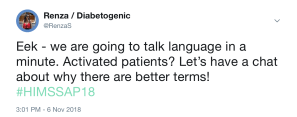
Exhibit A
Activated patient? No. Just no.
When the moment was right, I took a breath. I’d been asked to comment on the current My Health Record situation, and whether I thought it was something that would benefit people living with chronic health conditions. ‘Before I answer the question, can we just consider the term ‘activated patient’ and how it is being used here today – and often in other contexts too. I’ve heard from people on the stage and in the audience use the term ‘activated patients’. I’m really not a fan of this term. In fact, I think it is really quite problematic.’
Activation is something that is done to something. Think Pete Evans and his activated nuts. Or yeast when making bread or cinnamon buns. Or my pink debit card that came in the mail with a sticker across the front telling me how to activate it. Pete Evans’ almonds were just passive little nuts before he decided to activate them. And before the warm water was added to the yeast, it was just powder sitting in a sachet. My pink card was simply a piece of plastic before I called a number, pressed a few other numbers once the automated message was played and agreed to a heap of terms and conditions, making the card able to work.
Those inanimate objects had something done to them to become activated – it didn’t happen on their own. Beforehand, they were passive.
I was not ‘activated’ to become a participant in my own healthcare. I was not given permission to lead the agenda of how I want to engage. I chose the people I would see; the health service I would use; the devices I wear strapped to me. I have never been a passive participant in my healthcare – or any other aspect of my life, for that matter. I have always been active. Of course there are times that I struggle with motivation and may be less active and pro-active, but getting out of those times was never an exercise in activation by others.
The idea that people become activated because they are given the opportunity reeks of the typical paternalistic attitudes that are still rife in healthcare.
Look, we can have a long discussion about the ‘consumerisation’ of healthcare, and how that is what is to blame for terms such as this. It is business lingo and while many think it probably refers to people being in charge of their health, it actually suggests the opposite.
Words that suggest something is being ‘done’ to a person utilising the health system are not empowering. They are not putting the person at the centre. They don’t indicate that the person is driving their care.
The term ‘activated patients’ provides a narrow interpretation about how a person is in charge of their healthcare, because it always is used to highlight people who are loud advocates for themselves, walking into every appointment with a list the length of their arm of things to discuss, therapies they want to use. But not everyone wants to do healthcare that way. Just because someone prefers – and chooses – to have a healthcare professional drive the direction of their care does not necessarily mean they are not ‘activated’.
Also – consider this: if a person can become an ‘activated patient’, that means there must also avenues for them to become a ‘deactivated patient’. That’s certainly not being person-centred. In fact, suggesting that we become something only because we have been given the right to be that way is the opposite of person-centred.
Oh, hello! It’s World Diabetes Day this week. And that means one thing and one thing only: diabetes will be elevated to health condition of the week, and we will see it EVERYWHERE.
I recently wrote that I’d been a little out of sorts a couple of weeks ago. I’m back to my usual robust and resilient self, but on the way back, I seem to have misplaced the filter that usually muffles the directness for which I am sometimes pretty much always known.
I realised it was missing when I was speaking at HIMSS last week and I was pretty direct when talking to some app developers. Instead of doing my usual sandwich feedback (i.e. something positive to begin with; suggestions for how it could be better in the middle; something positive to round it out, all with what could be considered a Dolores Umbridge smile on my dial), I went straight for the filling of the sandwich.
It turns out that without my filter, my comments eschew (rather than chew) bread and are all about the meat in the middle. I become totally low carb in my feedback. And I lose my smile. (A doughnut would probably bring that back, though…)
For this week, we will be banging on about the need for diabetes awareness. Of course, this morning as I was dressing and tucking small vibrating or lighting up boxes and infusion sets into my bra, and checking the tape on the CGM on my arm, while wondering if Loop really did have that downward arrow on my Dex under control, all I could think of was diabetes to the left of me; diabetes to the right. And I’m stuck in the bloody middle with it because it won’t leave me alone. I can’t help but be diabetes aware. All the fucking time!
But this week isn’t about us, (this piece from Tom ‘Diabetes Dad’ Karlya from a few years ago does a great job of explaining that in ways less sweary than my own). It’s about putting diabetes on the agenda for those of us who don’t already think about it morning, noon and night because it’s mailing address is our body.
So, for that reason, local newspapers, news bulletins, online new outlets and everywhere else that is trying to fill a 24-hour news cycle with content will want to talk about diabetes. If previous years are anything to go by, what we see will not necessarily be all that great. But that doesn’t need to be the case.
Last week, I was involved in a news segment about diabetes. When I watched in back on the news that night, I was so impressed with the way the story was presented. I’d managed to chat with the reporter as she was putting together the copy for the newsreader to use when introducing the story, and what she would say. There was no use of words such as ‘sufferer,’ ‘diabetic’ or ‘disease’. Instead, it was a balanced story that presented the facts. It was no less a piece because it left out sensationalist language.
I know that news outlets like a melodramatic take on things, but if you are in a position to help frame the way that diabetes is presented in the media, do it! It’s easy to do (the Diabetes Australia Language Position Statement helps) and mentioning that it takes no more time to use engaging and empowering language rather than stigmatising and negative language may help too.
I’m all about hope at the moment – well always – so here is what I hope for this World Diabetes Day:
In the posts celebrating the theme of this year’s WDD, diabetes and families, I hope that nowhere is a person with diabetes made to feel guilty, or that their diabetes is a burden on their family. I know that diabetes affects my family. I know that diabetes has moments of keeping them awake. I know there are times they may worry. But thankfully, I have never, ever heard them tell me, others, news outlets, social media, one of our dogs that they don’t sleep because of my diabetes, or they spend every minute thinking about how diabetes impacts on us, or that my health condition eats into our savings. Think about what you are saying and how we may feel if you talk about us like that.
In news reports, I hope for accurate reporting that doesn’t make us look pathetic or as though we deserve pity. I hope for language that presents the facts about diabetes without adding judgement or blaming us for our condition.
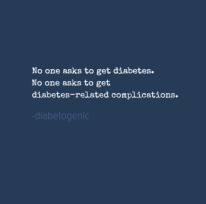
I hope that whoever is thinking, writing, speaking, presenting about diabetes this week remembers that no one asks to get diabetes; no one asks to get diabetes-related complications. Blaming and shaming us does nothing for anyone.
I hope for balance, and that for every story that celebrates an Everest climbing (or similar) we acknowledge the less grand endeavours. Because when speaking about diabetes, we cannot only hear from those at the extremes of the spectrum. Most of us are somewhere in the middle and our stories shouldn’t be left out.
In online groups I hope for no discussions about why we need to change the name of type 1 diabetes to distance ourselves from people with type 2 diabetes. Because: 1. Shut up and 2. Stop it; you’re adding to the stigma.
And more about online groups. If people are sharing news stories that will inevitably show overweight people eating hamburgers, the correct response is not to shame these people and tell them they are pathetic for not eating low carb. Because: 1. Shut up and 2. No one cares about how many grams of fat or how few grams of carbs you ate today, or how much insulin you didn’t need because you ate a bowl of organic kale with some organic tuna with coconut oil for lunch.
I hope that diabetes is presented as a serious health condition that does not discriminate when selecting whose body it wants to hang out with (in?). And that all different body types are represented.
And while we are talking about representation, I hope that we see diversity in diabetes stories from people of different colour, race, religion and sexual orientation. Because factors affecting our diabetes go beyond just the medications we take, and not everyone living with diabetes looks or is the same.
I hope that the voices of people with diabetes are not drowned out by those around us.
I hope to see myths busted.
I hope that somewhere we see that diabetes affects the whole person – body, mind and spirit – and that any solution claiming to help us, addresses each and every one of those parts of us.
I hope to see those who are happy to #MakeDiabetesVisible take whatever platform works for them and shares, shares, shares; and equally those who want to be more quiet ,are given the space to do that too. (Read this beautiful piece from Melinda Seed for more.)
And most of all?
Most of all I hope that no person with diabetes sees anything this World Diabetes Day that makes them feel diminished in any way for having diabetes. Because if that happens, then surely the day cannot be measured a success.
I’m heading to Sydney this morning (it’s early…too early) for the Australasian Diabetes Advancements and Technologies Summit – ADATS, (follow along at #ADATS2018), which had me thinking about the conference last year where I spoke about Loop, scared a shitload of HCPs, was almost traumatised into never speaking again in public (almost – didn’t happen) and was happy to be branded non-compliant.
Today will be a far gentler experience – my role is as a member of the organising committee, and as a session chair. Surely no one will want to sue me for that. Right?
As I ponder that, and reminisce about last year’s talk, here are some links. So many links that I have been wanting to share. So, have a cuppa, have a read, and share stuff.
Also, being deliberately non-compliant is kind of fun…

(Disclosure first: My flights from Melbourne to Sydney are being covered by the National Association of Diabetes Centres (NADC), the organisers of ADATS. I am on the organising committee for the conference.)
_________________________________________
Finally DIYAPS makes it to the mainstream media in Aus
I’d heard of The Saturday Paper, (which was a surprise to the journalist who interviewed me), but apparently not all that many people have. It’s a weekly newspaper (somewhat unimaginatively named – it’s a paper and comes out each Saturday) with long-form articles. One of those articles was about DIYAPS and came about after journalist Michele Tyde heard about the Diabetes Australia DIYAPS Position Statement.
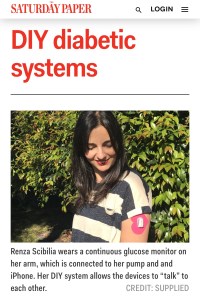
Read the DIYAPS Position Statement here.
The body part is connected to the PWD
‘Talking about the “diabetic foot,” the “diabetic kidney,” or the “diabetic eye” suggests they are somehow separate from the person whose body actually hosts the diabetes. This language suggests the diabetes-complicated body part is more like a malfunctioning car part that needs service – if only we could be provided with a courtesy foot, eye, or kidney to use until our own is better!’
The language at ADA this year (all the way back in June…all the way over in Orlando) didn’t really set off too many alarm bells. Until we had a good look at the program. I wrote this piece with The Grumpy Pumper for diaTribe about how it seems that #LanguageMatters a whole load less when talking about diabetes-related complications…and that needs to change.
Conference blogs
It’s great to see the Ascensia Diabetes Care team continue to support diabetes bloggers by inviting them to write up their thoughts on diabetes conferences. The latest contribution is from Sascha Stiefeling (who blogs at Sugar Tweaks) where he gives some insights into the start of EASD. (It was written in German and translated into English.)
Oh – and here’s the post I wrote for them about the Australasian Diabetes Congress a couple of months ago. (I was not paid to write this, or supported by Ascensia to attend, but I did work with them on their Social Media Summit.)

No weakness at all
On Mental Health Awareness Day this year, UK writer and poet David Gilbert wrote this beautiful post about the strength – not weakness – of living with mental illness.
How we are wrong about obesity
This piece about obesity is a must read. It talks about how weight bias from healthcare professionals and stigma often results in higher weight people avoiding going to the doctor because they fear discrimination, not being believed and being shamed.
More on weight stigma
And read this piece (also on diaTribe) about how weight stigma hurts people and affects health outcomes.
Keep Sight
This week, Diabetes Australia officially launched the first ever national eye screening program, Keep Sight. The program will make it easier for Aussies with diabetes to get their eyes checked. You can read about the program here (from when it was announced back in July).
Disclosure: I work at Diabetes Australia, but was not asked to write about this program. I’m doing so because it is important.

Your story is important
True champion of listening to ‘the patient’, Marie Ennis-O’Connor wrote this wonderful piece about the power of storytelling in healthcare.
Always be kind
I’m always fascinated to read stories from HCPs who write about their experiences on the other side of healthcare. Moving from care-giver to the one needing care can be life-changing. In this BMJ Opinion piece, health researcher Maria Kristiansen writes about how important compassion and kindness from healthcare professionals were for her and her family during her young son’s illness and death.
More on kindness (because we can never have enough)
The first sentence of this article in BMJ by Dr John Launer had me hooked: ‘I’m not a clever doctor, but I’m a kind one’. Have a read.
Diabetes in hospital
I know I’m not the only one to be terrified of needing to go into hospital, worrying about a lack of knowledge about type 1 diabetes treatment and my technology, and having to fight to maintain ownership of my own diabetes care. Adam Brown at diaTribe has written about his recent trip to A&E, surgery and subsequent recovery after his appendix ruptured. Lots of great tips for anyone who may wind up in hospital.
Digital diabetes
How can digital medicine and research, and artificial intelligence transform diabetes? That’s the question research scientist in diabetes, Dr Guy Fagherazzi, asks in his (open source) review in Science Direct that you can read here.
Bake these!
And finally…It’s nearly the weekend and if you have a spare 20 minutes, you really, really should think about baking these! They are crackled parcels of molasses, spice and all things nice and are, quite possibly, one of the best things I’ve ever baked.

The first day of ADC was a hectic one for me. After the busy and generally well-received DIYAPS session, I had a break for lunch and then headed back to the same room as earlier in the day to co-chair a session on co-design.
I quite loved that the idea of this session was included in the program. And even more in love with watching the room fill up as Congress attendees filed in and took their seats. The session was the brainchild of Dr Kirstie Bell, who among other things, is a huge advocate for involving PWD in the program at ADC. She absolutely slayed it with this one!
The planning for the session involved a number of people, including PWD, HCPs and researchers and the aim was to highlight examples of co-design in diabetes and healthcare to help attendees understand that this wasn’t something to be afraid of. I think that sometimes there is an idea that it is just too hard to include everyone because it will mean a lot of coordination and fingers in the pie. But we wanted to show that could be managed effectively.
Another objective was to try to explain the principles of co-design. In this case, it was to underline (and probably italicise and bold) that co-design does not mean showing a finished product to someone and asking for ‘feedback’, with a further point being made that asking for feedback shouldn’t be the aim as that is done when things are already completed. Instead ask for ‘feed in’ the whole way along the process.
If the idea of co-design had a slogan, surely it would be #NothingAboutUsWithoutUs, meaning that the ‘us’ in that phrase need to be the ones driving initiatives – and definitely not being left out. Unfortunately it does seem that in diabetes, often the ‘us’ (i.e. people actually affected by diabetes) are not included in design, instead having others make decisions about what they thinkwe need and want.
And that’s why I made a really important point – something that I frequently speak about. And that’s the reminder that when it comes to the idea of co-design, if there is no opportunity for all stakeholders engaged to influence – ESPECIALLY in the case of diabetes, PWD – then it is not true co-design.
Too often, we see examples of services, activities and programs that don’t provide PWD that opportunity to influence. When that is the case, what we have is pure tokenism. And in my mind, tokenism is even worse than not consulting at all, because it gives the illusion of co-design without the reality of it. Too frequently I hear of organisations and services saying ‘Oh – we have these policies in place’ when truthfully, they are worth little more than the paper on which they are written because PWD do not actually have real power to effect any influence.
In my experience working in diabetes organisations, one of the things that I have come to understand as being critical is support from leadership. The role I started in 17 years ago at Diabetes Victoria could have been considered tokenism (one person ‘doing type 1 diabetes’) three days per week, without any budget only grew because then-CEO, Greg Johnson, had an attitude of ‘if we’re talking about diabetes programs services and activities there better be people with diabetes in the room talking about it with us.’ For a while, the director I reported to, Dr Ralph Audhem, a GP from Melbourne, was committed to establishing a national type 1 diabetes program that was fully staffed by people affected by people affected by diabetes.
Both were willing to grow the program through resourcing (both staff and funding), but most importantly, by listening to people with diabetes – and not just those from within the organisation – and including them in every single step of the way.
Perhaps, my most favourite example of co-design recently is the Mytonomy diabetes language matters video. Deb Greenwood in overseeing the development of the video consulted with all stakeholders, firstly to help write the script that would be used. It was honed and finetuned by repeatedly asking people to feed into what others were saying. Instead of using actors to deliver the message, Deb engaged PWD, healthcare professionals and researchers. The result is something that not only hits the mark when it comes to its messaging, but it feels wonderfully authentic and real. No wonder people have been sharing it far and wide.
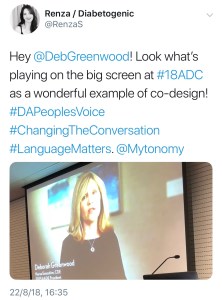
I was thrilled to be able to show it as part of the introduction to the co-design symposium at ADC, and then Jane Speight shared it again the following day during her ADEA Plenary talk. (I would really encourage ANYONE involved in putting together a diabetes conference or event to find a way to fit this three minute video into the agenda! It resonates with all involved in diabetes.)
The other speakers in the symposium all shared their own examples of where the principles of co-design had been applied with great success. Melinda Seed spoke about the Type 1 Network and how that grew from a gap of providing support and information for young adults with diabetes; Frank Sita shared his experiences of being on the Perth Diabetes Care Young Adults with Diabetes Committee and Melinda Morrison provided an overview of stakeholder involvement and engagement in the NDSS Diabetes and Pregnancy priority area.

These real-life examples provided attendees with an understanding of how they too could incorporate the idea and principles of co-design in their own work – which is exactly what we hoped to achieve when designing (co-designing!!!) the session. And it seems that just maybe, we got through to some people. I’ll finish this post with this tweet from credentialled diabetes educator and midwife, Belinda Moore:

The day before the Australasian Diabetes Congress (ADC) started, Ascensia Diabetes Care brought together a number of Australian diabetes blogger and advocates for the Australian Diabetes Social Media Summit, #OzDSMS – an event that promised to tackle some interesting and difficult topics in diabetes. The social media component was relevant for a number of reasons: the #TalkAboutComplications initiative that The Grumpy Pumper would be speaking about had been (and continues to be) driven on social media; and we really wanted to share as much as we could from the day on different social media platforms to ensure that those not in the room had a clear picture of what was going on and were able to join the conversation.

This planning for the event happened after one of those brainstorming meetings of minds and chance that sometimes occur at diabetes conference. I caught up with Joe Delahunty, Global Head of Communications at Ascensia at ADA because he wanted to speak with me about the launch of their Contour Next One blood glucose meter into the Australian market. And from there, plans for the social media summit were hatched. Joe isn’t afraid to look outside the box when considering ways to work with PWD, and his idea of a blogger event tied in beautifully with the ADC which would already have a number of diabetes advocates in attendance. We both knew that we needed a drawcard speaker. So he sent us Grumps.
One thing was clear from the beginning of the event’s planning – we wanted this event to tackle some issues that aren’t always readily and keenly discussed at diabetes gatherings. It is often a frustration of mine when following along industry-funded advocate events that the topics can seem a little frivolous, and there is the risk that they can seem a little junket-like because most of what is being shared is selfies from the attendees in exotic locations. (For the record, I am always really proud of the Aussie DX events hosted by Abbott because the programs don’t appear as though we’ve been brought together to do nothing more than celebrate our lack of beta cell function while swanning around Australian capital cities.)
The #OzDSMS program was simple – three talks plus a product plug. The discussion was going to be led and directed by the PWD in the room, but the Ascensia team wanted to be part of that discussion, rather than just sitting and listening.
Grumps led the first session in a discussion about how the whole #TalkAboutComplications thing came about after being diagnosed with a foot ulcer. Although he had prepared a talk and slides, the conversation did keep heading off on very convoluted tangents as people shared their experiences and asked a lot of questions.
 For the second session, Grumps and I drove a discussion focused on decision making and choice when it comes to diabetes technologies, with a strong theme running through that while the people in the room may know (and perhaps even use) the latest and greatest in tech, most people using insulin are still using MDI and BG monitoring as their diabetes tech. (For some perspective: in Australia, there are 120,000 people with type 1 diabetes and about 300,000 insulin-requiring people with type 2 diabetes. Only about 23,000 people use insulin pumps as their insulin delivery method. And there would not be anywhere near that number using CGM.)
This certainly is interesting when we consider that most online discussions about diabetes technology are about the latest devices available. We tried to nut out how to make the discussion about the most commonly-used technologies relevant – and prominent too.
Also in this session was a conversation about back up plans. While this is one of Grumps’ pet topics (he wrote about it in one of his #WWGD posts here), I think he met his match in David Burren, our own Bionic Wookiee. Between the two of them, they have back up plans on top of back up plans on top of back up plans, and over the week came to the rescue of a number of us at ADC who clearly are not as paranoid well organised as them.
Yes, there was talk of product. Ascensia’s Contour Next One meter was being launched at ADC, so there were freebies for all and a short presentation about the meter. (For a super detailed review of the new meter and the app that accompanies it, here’s Bionic Wookiee’s take.)
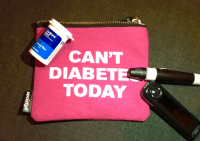
It makes sense that device companies use these sorts of events as an opportunity to spruik product, especially if it’s a new product. I am not naïve enough to ever forget that we’re dealing with the big business of medical tech, shareholders, ROI and a bottom line. But as I have said before, I WANT us to be part of their marketing machine, because the alternative is that we’re not included in the discussion. I’ve not drunk the Kool Aid – I’m fully aware they know that we will have some reach if we write about their product. I’m also fully aware that even though our bias should always be considered, the words remain our own.
I was super pleased that during the small part of the day dedicated to talking about the device, the presentation wasn’t simply about trying to blind us with all the fancy bells and whistles included in the meter. Instead, the focus was on accuracy. As I wrote here, accuracy will always be king to me, because I am dosing a potentially lethal drug based on the numbers this little device shows me. (Well, these days, I need it for when I calibrate my CGM which will then inform Loop to dose that potentially lethal drug.) Accuracy matters. Always and it should be the first thing we are told about when it comes to any diabetes device.
 We moved to the Adelaide Oval for dinner for a final presentation by CDE and fellow PWD, Cheryl Steele, who also spoke about accuracy and why it is critical (this went beyond just talking about the new meter). I walked away considering my lax attitude to CGM calibration…not that I’ve necessarily made any changes to that attitude yet.
It was an exhausting day, but a very satisfying one. There was a lot of chatter – both on- and offline and it felt that this was just the start of something. Ascensia has not run an event like this before and hopefully the lively discussions and engagement encourages them to see the merit in bringing together people with diabetes for frank and open dialogue about some not-so-easy topics. While this event was exclusively for adults with type 1 diabetes, I think people with type 2 diabetes, and other stakeholders such as parents of kids with diabetes, would benefit from coming together to share their particular experiences and thoughts in a similar event setting, and potentially some events which bring different groups together to hear others’ perspectives.
As ever, I felt that this event (and others like it) go a long way towards boosting opportunities between PWD and industry, and I am a firm believer that this is where we need to be positioned. Thanks to Ascensia for allowing that to happen; thanks to others from far and wide who joined in the conversation – we were listening. And mostly, thanks to all the advocates in the room for contributing so meaningfully.

Disclosures
I was involved in the planning for the Ascensia Diabetes Care Social Media Summit and attended and spoke at the events Grumps attended. I did not receive any payment from Ascensia for this involvement or for attending the Summit. They did provide lunch and dinner, and gave me a free Contour Next One blood glucose meter. And an almost endless supply of coffee. Ascensia has not asked me to write about any of the work I’ve done with them. But I will, because I like to share and I know there are people who are desperate to know what was going on while Grumps was here!
Grumps was here as a guest of Ascensia Diabetes Care, who brought him to Australia to be the keynote speaker at the Ascensia Australia Diabetes Social Media Summit and to speak at other events about his #TalkAboutComplications initiative.
My travel and accommodation to ADC was funded as part of my role at Diabetes Australia. I would like to thank the ADS and ADEA for providing me with a media pass to attend the Congress.
I have a very scientific way of collecting info to share in these Internet Jumbles. I make weird notes on my phone that absolutely make sense when I note them down, and then make absolutely no sense when I revisit them to put together the latest edition. (Case in point: ‘DMK mine’ had me stumped for a few hours until I realised that was shorthand for the HypoRESOLVE piece on Diabetes Mine. The DMK is because the meeting was in Copenhagen. Of course it makes sense. Perfect sense.)
Half the time, even after trying to work it out, I still can’t understand my notes, so there is a shedload of stuff I wanted to share that is still a mystery trapped in my iPhone.
But! Here are the ones I was able to decipher. Buckle up…it’s a long one.
Ask patients? That’s novel
Results of a review of international literature examining patient involvement in the design of healthcare services showed that patient engagement can inform education (peer and HCP) and policies and improve delivery and governance.
I am always interested to read these sorts of articles, but must say, my response is often an eye roll and the words ‘No shit, Sherlock’ muttered under my breath.
Research and people with health conditions
What is the role of people with health conditions when it comes to research? This editorial from BMJ suggests that full partnership is the best way.
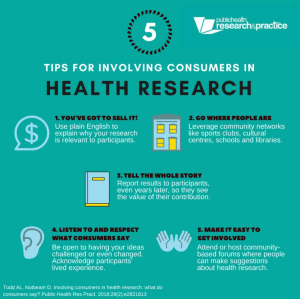
And this infographic from Public Health Research and Practice about how to involve consumers in health research is also useful.
Thanks for listening
It’s so nice when people actually take home some tips and tricks from presentations I’ve been involved in. This tweet over the weekend from diabetes educator Belinda Moore (referring to a symposium at last year’s ADS ADEA meeting in Perth in which I was fortunate enough to be involved) was gratifying.

Peer support remains an absolute cornerstone of how I manage my diabetes as effectively as I possibly can. It is those others walking the same road who help me make sense of a health condition which takes delight in confusing the hell out of me!
The driver’s seat
This post from Melinda Seed underlines why she believes that the idea of diabetes being a ‘team sport’ is not especially accurate.
Complications and language
The awesome PLAID Journal (which you really should bookmark and read) published a piece just as ADA kicked off about why we need to change the way we speak about diabetes complications.
The piece was written by me and Chris Aldred (AKA The Grumpy Pumper), bringing together Grumps’ #TalkAboutComplications initiative and my constant banging on about language. (I first wrote about needing to reframe the way we talk about complications five years ago in this piece. Every word still holds true.)
You can reads the PLAID Journal piece here. And please share. This is a message that we need to get out.

Wellness is not the same as medicine
My huge crush on OB/GYN Dr Jen Gunter only increased after she published this piece in the NY Times last week.
I have written before about how damaging the ‘wellness industry’ can be in diabetes, including this piece on the language of wellness.
Diabetes Voice reboot
The IDF’s magazine has had a reboot and is not delivered in a digital format. Check it out here.
Well, that’s candid…
This photo of Cherise and me snapped at Diabetes Mine’s DData Exchange is hilarious in itself, but Amy Tenderich’s caption is gold!

(Click for source)
Right device, right person, right time
Dr Kath Barnard’s piece in Diabetes Medicine Matters reiterates her message from the 2017 ATTD meeting (I wrote about it here) about the importance of matching the right device at the right time for the right person.
What are the barriers to preconception care ?
This piece was just published in Diabetes Research and Clinical Practice looking at the reason women with diabetes may or may not attend pre-pregnancy care. (I was a co-author on this piece.)
‘If only there was a….online community for people with diabetes’
That comment came from a HCP at a diabetes conference a few years ago – just after someone (maybe me? I can’t remember…?) had literally just given a talk about the diabetes online community.
The DOC is not new – it’s been around for some time – and this great piece from Kerri Sparling gives a history of the DOC.
HypoRESOLVE on Diabetes mine
I was interviewed by Dan Fleshler from Diabetes Mine about HypoRESOLVE. You can read his piece here – it gives a great overview of the project.
On a break
I’m going to be taking a little Diabetogenic break for the next couple of weeks. The rest of the year is shaping up to be super busy, so I thought I’d use the next fortnight to get myself organised.
I’ll be sharing some old posts from the Diabetogenic archives and expect to be back just in time for the Australasian Diabetes Congress which kicks off in Adelaide on 22 August.
In the meantime, be well and be kind to yourself.
Every second Saturday morning, I can be found at my favourite café having a very important date. Aaron has a rehearsal at that time each fortnight, so it’s become habit for me and the kidlet to traipse to the café for coffee, breakfast and a chat. (Judge me all you like – I gave in to the thirteen year old after a coordinated campaign from a number of people, including one of the owners of this café and the kidlet’s grandparents. Apparently it’s a birthright of kids with Italian heritage to be provided with legal stimulants from when they are children. At least, that’s the story they sold me…while they reminded me that I was drinking the dregs from my dad’s evening espresso before I could talk. Anyway, the outcome of their campaign is the kidlet sits there with her latte feeling all grown up while I silently remind myself caffeine is not crack in an effort to not feel like a completely negligent mother. But I digress…)
The kidlet and I spend quite a bit of time alone together. I often drive her to school or collect her afterwards, as her school is halfway between home and work. And we have a lot of evenings together while Aaron is playing a gig somewhere around town. But those car trips are rushed and usually involve checking off what is happening that day/homework requirements after school and those nights at home usually see us snuggled in front of the TV watching a favourite movie. I love these times, but they’re not really built for detailed conversations.
Our Saturday mornings are leisurely and free of screens. Other than greeting the staff at the café (one who has appointed herself as the kidlet’s ‘other mother’ – something our daughter is more than happy to endorse, because Jo is far cooler and more fun than me!) and said hi to the other regulars, we sit down and focus just on each other.
It is these Saturday morning catch ups that are the most revealing, and provide me with great insight into what ‘s going on in her life. With no need to rush and the comfort of being somewhere safe, she shares things that just wouldn’t be shared in the rushed car trip to school in the morning.
My job on these dates is simple. Listen. Nod my head so she knows that I am paying attention. Don’t impose my ideas on to her. Try not to be shocked when she says anything I wasn’t expecting. And when she asks questions, I try to frame my answers in a way that hopefully helps her feel supported and encouraged to make her own decisions, rather than trying to foist my own onto her.
A few weeks ago when I was seeing my endo, I realised that she takes the same approach with me that I do with the kidlet. I always feel that I have her complete and utter attention and I never feel judged by her. While she may want to just tell me what to do and have me follow it to the letter, she doesn’t do that. When I ask questions, she helps guide me to an answer that I feel comfortable with.
I really believe that my endo’s style has meant that I am far more confident about the diabetes decisions I make each day. Knowing that I have been able to troubleshoot, or make a choice after weighing up all the options gives me conviction and assurance that my decision-making skills are sound, all the time knowing that she is there if I need to ask something.
I am sure it’s no accident that I am this way with my kid. I’ve seen how effective it is in helping me do better with diabetes…and it’s certainly translatable to parenting a teen!
Recently when I was preparing a talk for practise nurses about the way for both HCPs and PWD to get the most out of healthcare appointments, I came across this:
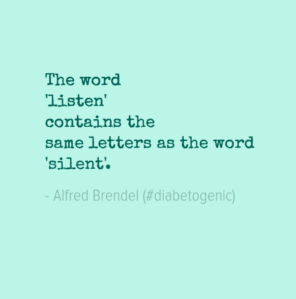
Listening doesn’t seem to come easily or naturally to a lot of us. We want to jump in and interrupt. We want to offer our suggestions (because of course we know best!). We want the person to listen to us and do what we say. And we want to fix things. We so want to fix things!
But the best thing we can do in a lot of cases is to just shut up. I frequently employ the WAIT (WhyAm I Talking?) approach as I have found it is the best way to truly gauge what is going on and find out things that are too easily missed.
Those Saturday morning catch ups are illuminating for me. As well as seeing how my daughter is dealing with the sometimes tricky trials and tribulations of teenage-hood, I am being allowed a front row seat to a lot of what is going on in her life – things I may otherwise miss. Most of the time these days, she doesn’t need me to tell her what to do as she is working out stuff. She needs to feel safe, comfortable and not judged as she bounces her ideas off me; and to be given the space to learn how to weigh up options, make errors in judgement and work out what is best for her.
And that sometimes, making a decision that isn’t necessarily the best may not be the worst thing in the world. (At least – that’s what I’m telling myself when I see the look on her face as she takes her first sip of coffee for the day, and I know I have been complicit in her teenage caffeine addiction…)
I have always loved shoes. I have a killer collection that ranges from perfectly comfortable and sensible flats, to impractical, not all that sensible – but damn gorgeous – heels. My boot collection is enviable – current faves are the animal print stacked heel ankle boot, and tan coloured knee highs that wouldn’t be out of place in an ABBA revival band. Shoes can be works of art – the elegant black suede pumps with stunning bright coloured embroidered flowers now sit on a bookshelf, too worn to wear anymore, but too beautiful to throw out.
 I remember the shoes I was wearing at important times in my life – they mark significant moments, sending memories flooding back to me. My wedding shoes were white satin pumps, comfortable enough to walk in all day long and dance in all night long. They are decorated with beads from my mum’s wedding dress and are still one of the prettiest pairs of shoes I have owned.
I dread being told by the podiatrist on my not-frequent-enough visits that I need to start to think about wearing more sensible shoes all the time. But so far, that’s not happened. She tells me that I can continue to go about wearing what I have, as long as I remember to regularly check my feet and get anything unusual checked out as soon as I notice anything.
I get to keep walking in my shoes, and not worry that the heel could be lower or less stiletto-y, the base slightly wider and orthotic-friendly.
I frequently hear cries for others to ‘walk a mile in our shoes’ as a way for them to get an idea of what living with diabetes is all about. It often happens after a particularly lousy piece of journalism that just gets diabetes wrong, or when yet another comedian makes yet another lousy diabetes joke. These days, it happens a lot when politicians say ridiculous things about why they won’t fund diabetes products, services or programs.
I guess the idea is that if someone walks in our (diabetes) shoes, they’ll know what diabetes is like.
I have no interest in people walking a mile in my shoes (or boots, more likely at the moment in freezing cold and wet Melbourne) because really, how effective is this idea in getting people to truly know what diabetes is like? What will someone learn in that mile, especially with the knowledge that they can take off my diabetes shoes once they’ve walked that mile…something that those of us living with diabetes can’t do.
Just like puppies, diabetes shoes are for life…not just a mile.
It’s for this reason that I have always questioned the value of hypo simulators. (I wrote contributed to a piece for Diabetes Mine a few years ago after first seeing – and sitting in – a hypo simulator at the first EASD I attended, and pointed out how absurd they are in my talk at the HypoRESOLVE kick off meeting earlier this year.) Anyone using the simulator can get out at the end of the demonstration and they’re done. There isn’t the thought of another simulator hanging over their head forever, or doing whatever is possible to avoid them – which is what living with diabetes and the threat of hypoglycaemia is like. Or suddenly becoming immune to actually seeing a hypo simulator until they find themselves in one, like what happens with impaired hypo awareness.
And it’s why I’ve questioning exercises where people are asked to wear diabetes devices for a few days. (Such as the time I was highly critical of a doctor who, in a piece about wearing a pump for a few days, declared she understood the frustrations of living with diabetes.) I remember standing in a room of first year med students explaining diabetes and as part of the talk, they were asked to do a blood glucose check and inject saline into their stomachs to get an idea of what we go through. Some of them refused, so perhaps the value of that session was explaining to them that those of us required to do such tasks don’t have the privilege of choosing not to because we don’t like needles.
My criticism of these sorts of activities is not to make people feel bad. I’m simply attempting to bring some perspective to what they can actually achieve. Suggesting diabetes is about merely wearing devices (or wonky vision when hypo) is reducing it to a condition that can and should be easily managed, and is easy to live with.
I don’t want anyone to walk in my shoes. I can do that for myself. But I’m always happy to have people walking alongside me. There is always room for that. Especially if we’re going shoe shopping!
A few years ago, I wrote this piece about why I am uncomfortable with the term ‘carer’. (I’m sharing it again below.) I often think about the word around Kellion Medal time, because there is a certificate given to ‘carers’ of medallists.
This is a lovely part of the ceremony, and acknowledges that diabetes can indeed take a village. Usually, the ‘carer’ is the partner of the person receiving the medal. Sometimes, it is a parent, sibling or other close relative. Other times, it is a healthcare professional.
Carer is a word with a broad meaning. It encompasses a wide range of situations and responsibilities.
As I said in the original blog post, I don’t believe that I have a carer. Aaron certainly supports all my efforts with my diabetes, is a wonderful cheer squad and knows when to mutter ‘Diabetes Sucks’ when I am feeling a little over the whole thing. I feel very fortunate to have him do that.
But carer? Nope.
It got me thinking to what I would want if (when?) I stand up to receive my Kellion medal. In thirty years’ time, I hope to proudly stand up there and appreciatively receive my medal. And in the room, I would want those near and dear to me, celebrating the milestone. I would certainly want to thank them for having lived alongside me as I lived with diabetes for so long.
But the word carer does not really adequately describe that role. And yet, I don’t know the word that does – or even if there is a word…
Words matter – so what is the right word?
So, please help me out! If you are an adult with diabetes, do you have a word you use to describe the people who support you? Are you comfortable using the word carer? Do you prefer to use something else? Or nothing at all? (Fifth option: Never even thought of it. Get over yourself with your language palaver, Renza!)
__________________________________________
I am lucky when it comes to my diabetes support network. I know this and I will say it several times in this post. I also know that I am likely to come off as being ungrateful which is not the case at all. Today, I want to explore the idea of how these support people are identified, either by themselves or by people living with diabetes. Specifically, I want to talk about the term carer.
The Oxford Online Dictionary defines carer as:
a family member or paid helper who regularly looks after a child or a sick, elderly, or disabled person.
I don’t have a carer. I am the person responsible for living with my diabetes, but I do not have a disability and I certainly don’t consider myself sick. And, although I’m pushing a ‘significant age’ I am not yet elderly.
I understand and completely believe that there are people who are really and truly carers. There are people who are responsible for feeding, toileting, bathing, communicating for another who is unable to do it themselves. I am not referring to instances like this. I am referring to, I guess, diabetes.
I don’t consider my husband, who is involved in my life with diabetes to be my carer. He’s my husband, my partner.
Living with diabetes is not a solo game for most and this is a truly wonderful thing. We get support and help from people and I for one feel very fortunate to know that I have people (family, friends, healthcare professionals), I can rely on if I need them.
But I don’t consider any of them my carer. I would refer to them as my support network. In the case of my HCPs, they’re paid to help me with the things I need.
My husband would never say that ‘we’ are a family with diabetes. He would say that I (his wife) have diabetes. Not for one moment would he consider himself to be living with this condition even though he regularly is part of it. But as far as ‘ownership’ goes, it’s mine. He will step up as much or as little as I ask and in the few times it’s been necessary, he’s taken over, done what’s needed to be done and then, when safe, stepped back.
My independence and confidence in my ability to self-manage comes from being given the space from those around me to do what it is I need to do. I know there have been times when Aaron would like to sit me down and force feed me glucose because he can see that I am low. As I stand at the open fridge and in my hypo-fog state try to calculate the carbs in a cucumber (yes, I know!) he has had to just step back and let me work it out myself, stepping in if asked.
I see this like watching my daughter do something in a way that is frustrating to me. I would love to jump in, show her how to do it far more effectively (or do it myself) and then move on. But her self-confidence and her ability to trust her decision making process needs to be encouraged, not overshadowed by a parent who insists on taking over all the time which suggests that she cannot do anything herself.
To me, the term carer implies helplessness. I get that diabetes is a lifelong condition and that there are stages in a person’s life when they may need extra care. For example, children with diabetes are reliant on their parents for the day-to-day management tasks. But is that being a carer or is that called parenting albeit with an incredibly extra degree of difficulty? Or what about an adult with diabetes who is having a period of hypo unawareness and their partner is required to, at times, inject them with glucagon? Is this being a carer or is this just doing what partners do – look after each other at a time of illness or need?
What about when I am lying in bed, unable to move because my BGL is high, I have mild ketones and am vomiting? As I decide whether or not I need to take myself off to A&E, my husband is holding a bucket in one hand and my hair in the other. I don’t consider him to be my carer, any more than I considered myself to be his carer when he hurt his back and I was warming up a heat pack and giving him pain killers every four hours.
I don’t in any way want to undermine the importance, help or value of the support I receive. I don’t for a minute want to say that I don’t need it or resent it. But equally, I don’t want to be considered as being helpless. The relationships I have with people where diabetes is sometimes considered are based on incredible respect – from both parties. They respect that I am the one who is living with this and dealing with it and I respect the way they allow me to do that.
__________________________________________
Thanks to Ash for chatting with me over coffee about this today.





 Diabetogenic