You are currently browsing the category archive for the ‘Communication’ category.
Last night, I was the ‘here’s one we prepared earlier’ on a panel discussing CGM technology. The audience was all healthcare professionals – mostly DEs, but some dietitians, RNs and also a GP-in-training (so much yay to him for coming along!).
I love being in the room for these events! I wrote about my last experience giving the same talk here. I cannot speak highly enough of the two experts on the panel last night. Dr Peter Goss – who spoke at the last one of these events – is what I would call a disrupter in the diabetes healthcare space and, honestly, all the power to him. He may ruffle some feathers with his sometimes unorthodox approach, but it is undeniable that he is a champion for kids and teens (and young adults) with type 1 diabetes. Also on the panel was A/Professor David O’Neal who is best described as a truly awesome endo (I have heard that from every single person I know who sees him as their endo) and an absolutely brilliant mind. His expertise in diabetes tech is second to none and he is genuinely interested in how the technology can safely, efficiently and effectively be incorporated into the lives of people living with diabetes.
I know that all sounds rather effusive. But I need to point out that they are remarkable. And that they are the sorts of HCPs you want on your side if you are a person with diabetes.
Because now I am going to talk about language and why I pulled them up a little bit after we all did our presentations and sat on the stage ready to answer questions from the audience.
As happens frequently when I am in the room with a group of healthcare professionals, the conversation turned to language. Okay, I made that happen. In fact, the words I used were ‘I’m going to hijack this conversation because we really need to talk about language here.’
One of my biggest pet peeves is the jokey, and somewhat snide, comments made about people with diabetes making up numbers in their diabetes log books. Because, it’s not a joke. It’s not something for HCPs to roll their eyes over and dismiss as ‘non-compliant’ behaviour.
The word that was used for PWD who make up numbers in their books was ‘fakers’. I cringed the moment I heard the word. And cringed even more at the audience’s response – laughter, heads shaking from side to side and knowing looks. I looked around the room and knew that we would be talking about this later on in the evening!
As I pointed out when the panel was seated on the stage, I absolutely did this. And I was incredibly good at it – different coloured pens, splotches of blood on the pages, dog-eared corners of the book. Once, I even splattered a few drops of juice, because on that particular page, I was having a lot of lows and I thought the juice would make it look more authentic.
Now, let’s all just remember for a moment that I was diagnosed as an adult. This wasn’t insolent teenager behaviour. This was a woman in her mid-twenties who was terrified of disappointing and being judged by the HCP to whom she would be handing the grotty book and its made up numbers.
I told the room my story of this last night and there was laughter – because the way I spoke about it was amusing. It was a cheeky anecdote. But at the time, it wasn’t funny. I was scared, I hated checking my BGL, I was paralysed by numbers that didn’t make sense and I didn’t know what to do about it. So I lied. Of course my HCPs knew that. And I knew my HCP knew.
But the question is about WHY people do this. The discussion needs to stop being about diabetes at that point, because really, managing BGLs and most other diabetes tasks is not the issue here. The issue is distress, anxiety, fear. And, in my case, I felt desperate.
One of the panellists made the point that the reason that he brought it up was because HCPs need to know what to do when someone is ‘faking’ their numbers. He’s right. I completely agree. And then there needs to be understanding of how to approach it, which is likely to be different with each PWD.
For me, it took until I found a HCP who I felt I could trust – one who wouldn’t judge the numbers that were out of range (which one HCP always circled in red pen, making me feel even more like a delinquent adolescent) – and was interested in knowing what was stopping me from feeling able to check my BGL.
When we worked through that, I was better equipped to not only regularly check my BGL, but also to deal with the numbers and act upon them. I came to understand that a number was nothing more than a piece of information that I could use to make a treatment decision – not an indication of me being a good or bad person.
Language does matter. And words count for a lot. Using the word ‘faker’ in this context is loaded with judgement and accusation, and even if that is not the intention, it made me – a person with diabetes – feel very uncomfortable. But mostly, it fails to consider the real problem at hand which is not that a PWD is making up numbers in a book. It is why they feel the need to do that.
The contradictions in diabetes are complex and confuse my little mind sometimes. Today is one of those days.
Getting the message that diabetes is serious – and needs to be taken seriously – is sometimes messed up in our determination to show that diabetes won’t stop us from being superheroes. In our proverbial capes*, we do amazing things; we are brilliant; we advocate; we inform. All while pretending to be a pancreas.
We use language that empowers us and makes others see us as forces with which to be reckoned. I say I live with diabetes (often saying I live well with diabetes, never struggle with it. I refuse to even suggest for a minute that I am suffering with or from diabetes and will correct anyone who suggests otherwise.
But is that undermining the seriousness of it? And is it ignoring the days where it does seem like a battle – and an uphill one at that.
I refer to diabetes as a condition, never a disease. Is that the right terminology? And why do I do that?
According to this piece at Health Writer Hub a disease is an …’ abnormality in systemic function…that causes both physical and emotional signs and symptoms’. A condition is …’an abnormal state of health that interferes with the usual activities or feeling of wellbeing’. Both are actually correct when talking about diabetes, and yet I (and many others) object to using the term disease.
Perhaps we don’t want to be thought of as ‘diseased’ or as if there is something wrong with us and ‘disease’ does suggest that.
We want people to think we are superheroes who manage to not only thrive and excel with the condition (disease?) we have been dealt, but also demand that they don’t think of us as any different to everyone else and are given the same opportunities and choices.
Are we doing ourselves a disservice by appearing so ‘in control’ and, dare I say it, ‘normal’, when there is truly nothing normal about having to pretend to be an internal organ, day in day out?
I don’t for a minute want to stop being the empowered, confident, secure and capable person I am. But sometimes I do feel that in all my cheerleading efforts, I sometimes forget – or rather refuse to admit – that it can be tough.
And mostly, I wonder, and fear, that if we all are making diabetes look so easy to manage and impact us in such insignificant ways, do others not see and understand the urgency that we feel every single day in our desire to make things better? Who needs a cure if we look so bloody happy and competent with our little condition?
I am the first to admit that my name is not especially easy to remember. Or spell. Or even pronounce. I blame my parents. They could have called me Cindy. That would have been easier. And I would have managed to find cups, drink bottles, novelty number plates and key rings with my name printed across them. Plus, Miss Helena would have seen me through the Romper Room window.
My first name is pronounced as it is spelt: Ren-za. My surname is a little more difficult. It’s pronounced Shi-bil-ia. This is mighty confusing because it is spelt Scibilia, so people usually think it starts with a ‘sk’ sound. For some unknown reason, they often add an ‘r’ so it becomes ‘Scribbler’.
I have been doing lots of radio interviews in recent weeks and the media monitoring that arrives in my inbox in the last week has reminded me just how tough people find my name.
One day, I was apparently ‘Brenda Chevalier’; another, ‘Peta Shivanya’. Today, I had to correct a radio presenter who was calling me ‘Wendel’. These errors caused much humour and many fabulous comments from friends when I posted them on a couple of my social media pages. (I would like to point out that none these mistakes come close to my all-time favourite: ‘Wendy Lichtenstein’. That chick sounds fierce!)
I get it – my name is not typical. Most people will never have heard my surname before and even I have not met another Renza. But here’s the thing. When I do an interview, the radio station has received an email with my name spelt out. They have probably had a conversation with a media advisor or PR person who has clearly said my name. And then, once I get on the phone I not only say, but spell my name very clearly and explain how to pronounce my surname.
So what does this demonstrate? Well, it shows once again that no matter how much care you take to give the right information, it will be interpreted however people choose to interpret it. This is one of the issues with diabetes in the media. The number of times we see and hear diabetes being misreported is horrendous. In fact, it is a rare occurrence for the facts to be correct, the images to be appropriate and the details finessed.
I take a lot of care to prepare the person interviewing me. They are usually sent the Diabetes Australia Language Position Statement prior to speaking to me for the first time. I make a particular point of clearly stating that I do not want to be referred to as a ‘sufferer’ and would prefer to not be called (a) ‘diabetic’. And yet, it inevitably happens!
When it is important to state the different types of diabetes and explain how type 1 and type 2 differ, I always take great care to do that. And yet, there appears to be an inability (or perhaps, lack of care) from the reporter to actually get the facts right.
I’ve stopped getting annoyed when people in the media get my name wrong. If it happens around me, I politely correct them and move on. I’ve still got a way to go before I stop getting annoyed when people in the media get diabetes wrong but mostly that is because I believe it often contributes to the stigma associated with the condition I live with.
But I have learnt to not take it personally. Even when it is my own name that is being butchered!
Twitter is a great source of discussion and yesterday this tweet from a diabetes consultant in the UK certainly did start an interesting conversation that had me thinking.
I should point out a couple of things before going any further. The tweet, asking if lack of guidance in social media is a concern, was in response to a tweet from someone else who shared a post from a Facebook page about insulin omission for weight loss. This is a very serious issue – one that I have written about here, (and elsewhere), and worked on a lot in the last decade or so.
Also, the consultant was absolutely not suggesting that social media is a ‘bad’ thing, and he is actually an advocate and user of online platforms, so this is not about the individual. It is about the issue at large.
Obviously, I am a huge fan of social media. Apart from finding online – and more broadly, peer – support an important part of my own personal diabetes management, I have built a significant part of my career extolling the benefits of online connections and the value of sourcing information and support from others living with diabetes.
The changing landscape of diabetes information and support over the last ten or so years has been significant. With more and more available online, and more and more people being online, there has been a real shift from healthcare professionals being the keepers of information and deciding what people with diabetes SHOULD know to a more egalitarian framework from which to source what we need.
While some may believe this to be the end of civilisation as we know it, (dramatic, I know), I consider this change terrific, because instead of having very controlled and conservative information on offer, there is now a veritable smorgasbord of material – and knowledge – from which consumers can pick and choose. Personally – I love being able to do that. Hearing personal experiences and picking up tips and tricks about day-to-day life with diabetes contribute to me making decisions about how to manage my own condition.
One of the suggestions frequently made about how to safely use SoMe is for it to be better moderated. My argument is that the power and value of SoMe platforms is that it is not moderated. Being free to share my ideas and experiences without fear (or perhaps care?) of judgement is not only useful, but also cathartic. And getting feedback from my peers often provides a different lens through which I can view a situation. Much of what I have learnt would not be found in the pages of a textbook, or offered in the office of a HCP. And that’s fine – there are other very valuable and important considerations that are shared in that context.
The idea of moderating online support – or any peer support, actually – is about control. It can be packaged up into a nice parcel of ‘protecting’ the person seeking the information, but that is not only patronising, but also incredibly demeaning. There is enough of that going on in more traditional settings – peer support is where there is freedom from that control – and a freedom to explore different ideas.
For me, peer support has always been about finding my tribe and learning from them. It has been about finding a source of sustenance and care that makes me feel better about my situation. It’s never been about replacing or substituting what I get from my HCPs.
So what is the role of HCPs in our support space? My belief is that it is a place for them to learn. There are times that it may be appropriate – and even encouraged – for HCPs to step in and share. On Facebook, one of Australia’s leading CDEs frequently comments and adds to conversations in closed diabetes groups. Her professional advice is always spot on – never judgemental – and her personal perspective (she has diabetes herself) shows just how it is possible to blend the ‘What-I’m-told-I-should-do’ with the ‘And-this-is-what-works-in-real-life’.
But not everyone who wants to be involved in this space has diabetes, nor should we expect them to. But I think for me, I have a very clear understanding of online and peer support works – and what everyone’s role is. When this works well, it works because it is being led by PWD; they (we!) are the ones driving the discussion and the focus. It’s not dangerous. We don’t need guidance. Because it is our space and we own it.

What peer support means to me,
In one of my #DBlogWeek posts last week, I wrote that for the sake of my own mental health, I have learnt to not compare myself with others.
I was thinking of this the other day when I was involved in a conversation with a woman newly diagnosed with diabetes. She told me that she was really upset at the response from a close family member who, when told about the diagnosis and how distressed she was, responded with ‘It could be worse. At least it’s not cancer.’
I’ve had that said to me. Several times. And it is one of the most offensive things I have heard. I don’t really know how to respond to it, because it’s true, I don’t have cancer. But I do have diabetes and that is pretty bloody horrible sometimes. (For the record, I equally dislike the idea of responding with ‘At least it’s not cancer. There is a chance of remission with cancer; type 1 is for life…’)
I get just as annoyed when it happens in our community. ‘At least it’s not type 1,’ is something I have heard said to people with type 2, diminishing the challenges they may face.
When I was anxious about my impending cataract surgery a few years ago, I was told ‘It’s nothing. At least you don’t have to have laser or have your eyeball injected.” Again, that’s true. But I was still terrified and had every right to be.
When discussing a nasty hypo ‘At least you didn’t lose consciousness and wake up to a roomful of paramedics.’ Sure, I remained conscious throughout the low I had last week. But I needed help to treat it and it happened in front of my kid. She was scared which really upsets me and makes me feel guilty.
When our experiences are belittled or minimised, it means we may stop sharing them. No one wants to be told they are being a drama queen and that it could always be worse. Of course it could be worse, but that doesn’t mean what you are dealing with doesn’t suck.
I have had diabetes for 18 years now. I have not had to deal with debilitating complications. I have not had to spend weeks in hospital because of my diabetes. But does that mean that my fears and concerns and anxieties are any less relevant than someone whose experiences are different?
And that’s why you will never hear me say to someone newly diagnosed ‘At least you have just been diagnosed. Just wait until you have had diabetes as long as me and <this or that> happens,’ because everyone’s experience is different and that newly diagnosed person may have their own concerns at that particular time. Or not. Which is also fine.
I had a healthcare professional once tell me that at least I didn’t have diabetes ‘too terribly’, because I worked, had a child and travelled. It was one of those (incredibly rare) moments where I was stunned into silence. I was torn between wanting to say ‘Well, surely that makes what I’ve achieved all the more incredible‘ and stabbing her with a fork. I said (and did) nothing.
There is no ‘at least...’ when it comes to diabetes. There is no discussion about how it ‘could be worse’. Because the truth is, it could be a whole lot better. I could NOT have diabetes.

Growing up, when I infrequently visited our family GP, he was always referred to by his first name. I do remember when we were really young putting a ‘Doctor’ before his first name, but we never referred to him by his surname. He was always ‘Dr Sam’ until he became just ‘Sam’.
Since being diagnosed with diabetes and becoming a frequent flyer of healthcare services, I have only ever addressed HCPs by their first name. (Except my endo who frequently gets referred to by her first and middle name together, but that is because my kid has the same middle name (named for my endo) so when speaking to and of each other, we use both names..)
When meeting a new HCP, I will walk into a first appointment, hand extended as we do our introductions. I always say, ‘Please call me Renza,’ although I don’t know that I have ever had a doctor not call me by my first name in the first instance. In fact, usually, when called in from the waiting room, they do so by using my first name.
So it’s probably not surprising that I found myself prickling a little as I read this article from a couple of months ago, written my an oncologist from the US. James Salwitz MD tells the story of a new patient – an elderly man who attended with his adult son. The son insisted on calling Dr Salwitz* by his first name which, apparently, was a little unnerving for the doctor. He referred to it as a cultural faux pas, suggesting that it was being done to… ‘diminsh the power and value of my experience, control and guidance.’
Now, I know it is possible that there are some cultural differences here. In Australia, we seem to have a far more relaxed attitude about being formal. And we also don’t necessarily consider that using someone’s first name shows a lack of respect as suggested by Dr Salwitz and some of the commenters at the end of the piece.
I asked a few people – also regular users of healthcare – and most said they used only first names. A few said they would always refer doctors by their titles, but nurses by their first names. This raises another point about the hierarchy of healthcare professionals. I’m not sure why one would be more inclined to use Dr Diabetes for the endo, but not Ms/Mr Diabetes for the nurse.
I treat and regard my healthcare team with nothing other than respect. I speak to them with respect, I respect their time and how busy they are, and I recognise their professional expertise. How I address them does not diminish this respect, nor undermine their qualification.
What was not clear in the article I read was how Dr Salwitz addressed the person he was treating (or his son). If there was an expectation from doctors that they are addressed by their professional title, then surely they should demonstrate the same courtesy (if that is what it is) and address their patients by their title and surname.
Any discomfort can be solved at the first greeting. This is one of the reasons the #HelloMyNameIs campaign is so important. Clear introductions from the beginning establish how people would prefer to be addressed. If unsure, the question ‘Is it okay for me to call you by your first name’ can be asked by both physician and consumer.
Feeling comfortable in our medical appointments is necessary if we are to get the most from the limited time we have before our HCPs. And for that to occur, there needs to be mutual respect and no imbalance of power. I feel very fortunate to have that with my team.
*Thought is best to refer to Dr Salwitz by his title throughout this post.
Today, I am writing about Aussie Rules Football. I know nothing about Aussie Rules/Footy/AFL, so let’s get my status as a complete and utter non-expert out of the way to begin.
I have actually been asked to write about this by a football tragic who we will, for purposes of this post, call Footy Tragic.
Footy Tragic loves football. Footy Tragic has an encyclopaedic mind when it comes to the history of AFL and if you ask her anything about the team she follows (Collingwood…spit) she knows everything. Every.Thing.
Footy Tragic also knows a lot about diabetes and when the two worlds collided, she was not impressed. We discussed what we could do to try to fix it – because together, we think we can solve many, if not all, the problems of the world – and while I can’t promise to actually make it all better, I can write about it.
At various times, there have been AFL players with diabetes. Dale Weightman played for Richmond when I was a kid and he is still regarded as a role model for children with diabetes. (He is also a very nice bloke who was a frequent guest speaker at events I coordinated in my previous role.)
Today, there are a couple of fairly high profile (so I am told) players including Jack Fitzpatrick (who plays for Hawthorn) and Paddy McCartin (St Kilda) who was the 2014 number 1 draft pick. (I don’t actually know what a draft pick is and I can only assume number 1 is good, so well done, Paddy!)
Anyway, Paddy has been having a good run with the senior St Kilda side this year, which is brilliant. What is not so brilliant is how the reporters and match callers are dealing with the player with diabetes, which is, of course, a terrific story to tell.
To begin with, the commentators tried to give an explanation of diabetes by informing listeners that ‘There are many kinds of diabetes, but Paddy has the ‘full on’ one.’ They were also pleased to announce that while Paddy had trouble with his diabetes last year, one of the doctors at the St Kilda Football Club has ‘worked out’ his diabetes and Paddy is ‘good to go now’. His sugar levels are ‘all fine’!
With what I can only imagine were their super serious voices, the commentators shared that Paddy is brave – as are all people with diabetes – because they (we!!) have blood taken ALL the time and Paddy has blood taken on the boundary line.
During Saturday’s match, Paddy went off the ground after being hit on the head, but the commentators made sure to clarify that it could have been because of ‘diabetes issues’.
So, here is the thing. It really is brilliant when we have elite sportspeople absolutely kicking ass (and footballs) in their chosen sport. It is fabulous for them and it is great for others living with diabetes to see people achieving and excelling.
It’s also great because it gives balance to the lousy way many people with diabetes are portrayed in the media.
But would it be all that difficult for there to be a tiny bit of research done somewhere to accurately speak about diabetes in the context of this (and other) elite sportspeople?
Let’s be clear.
Paddy has type 1 diabetes, which is no more or less full on than any other type of diabetes. All diabetes is full on. All diabetes is serious. All diabetes sucks.
Paddy has not had his diabetes ‘sorted by his doctor’. Although if he has, and his doctor is hiding some magic ‘diabetes sorting pill’ (or hat! Diabetes sorting hat!! – Harry Potter Digression) he better bloody share it around. What Paddy is doing is working incredibly hard – undoubtedly with his healthcare team – to make sure that he can get out on the field and…do whatever they do on the field.
If Paddy gets a knock to the head on the field and there is blood oozing out of his forehead and he is acting a little woozy, it’s probably a concussion – not ‘diabetes issues’. Because, sometimes IT’S NOT DIABETES!
Paddy is not having blood taken on boundary. He is pricking his finger to check his glucose. I am not minimising this – I know it sucks – but let’s be truthful about what it is.
I am not expecting AFL commentators to know everything about diabetes, but I do expect them to not make things worse, or add to the considerable confusion of what diabetes is all about.
Paddy McCartin is an absolute legend – as is anyone with diabetes excelling in whatever they do. He is showing that diabetes is not stopping him and I honestly can’t even imagine what it takes for him to manage his diabetes while playing football at such an elite level.
I just wish that we could celebrate what he is doing with the right messaging, and work towards dispelling some of the myriad diabetes myths.
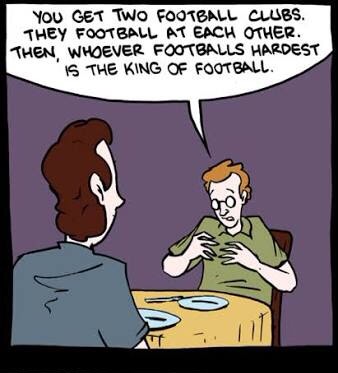
This pretty much explains my Aussie Rules expertise. (Click cartoon for source)
This Thursday is World Health Day and the spotlight for 2016 is being shone on diabetes. In the next few days, we can expect to see diabetes mentioned in the media a lot. There will be numbers describing the size of the ‘epidemic’, there will be scary pictures and there will be threats about what will happen if we don’t all act NOW.
Much of what is written will be by journalists who do not have an in depth knowledge of diabetes, so the chance of them getting it wrong – or, at least, not finessing the details – is pretty high.
What upsets me most is when people with diabetes are not represented particularly accurately. I don’t like the pity party often thrown for us – especially because once we get there, the only food served is sugar free. And carrot not in the form of cake.
Seeing myself referred to as a ‘sufferer’ or ‘victim’ infuriates me, and the assumptions and the blame and stigma associated with a diabetes diagnosis makes me even madder.
Those of us living with diabetes (or with someone with diabetes) understand just how much language matters when talking about diabetes.
There are tools available that can point journalists in the right direction when speaking about and to people with diabetes – and the issue of diabetes.
The terrific Team Novo Nordisk has made real strides with providing the media outlets covering the team with some practical tips and a ‘Guide to Communicating About Diabetes.’
And, of course, the Diabetes Australia Language Position Statement* is also a valuable resource that offers suggestions of language and words that motivate and empower people living with diabetes, highlighting how negative and inaccurate language can be harmful and discouraging.
The fact that World Health Day is focusing on diabetes is a good thing in my mind, because it means that people are talking about diabetes. And if we can, in some small way, shape the dialogue – or at least, shape the language being used when speaking about diabetes – the outcome may be a better representation of life with diabetes. We can bust myths, set the record straight and explain how paralysing diabetes-related stigma can be.
This is not only about defining the different types of diabetes, although there are times in the dialogue that would be helpful. It is about offering a fair, precise and considerate picture. And it is about remembering that even when talking about huge, scary numbers that clearly define the issue, there are people involved who are living with diabetes every single day, doing the best we can with the cards we’ve been dealt.
So, with this in mind, I am making a slight pre-emptive strike and asking that anyone writing about diabetes does so in an accurate and respectful way. I will be tweeting throughout the week using the hashtag #LanguageMatters and, when I see examples of writing that is neither accurate nor respectful, will be tweeting the journalist and source directly. I won’t be aggressive; I won’t be angry. But I will call them out.
If it’s something you are interested in, please get on board. Let us tell the real story of diabetes OUR way. #LanguageMatters 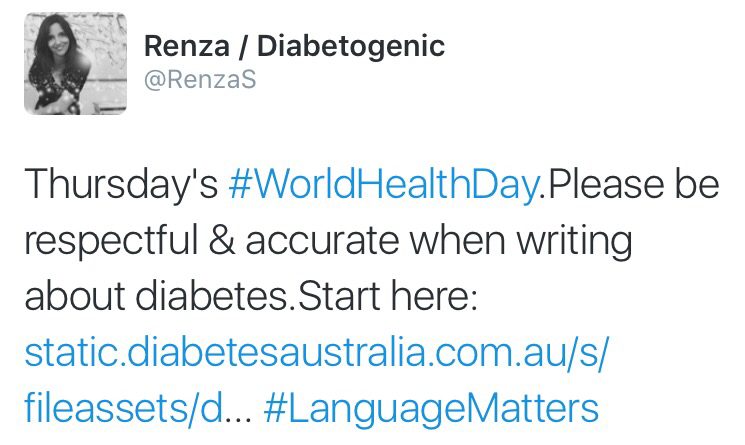
*I work for Diabetes Australia, however at the time this position statement was developed, I worked for Diabetes Victoria. During the writing of this statement, I provided some comment (from a consumer perspective) to the ACBRD team who composed the position statement. The ACBRD is a collaboration between Diabetes Victoria and Deakin University.
I speak and write about language a lot.
I will continue to do so, because I truly believe that the words that engulf us when we speak or hear about diabetes have a direct impact on how we feel about our condition. The emotion cannot be removed from it and negative or judgemental, stigmatising or blaming words make us feel…well….negative, judged, stigmatised and blamed.
I frequently point my finger at healthcare professionals for their use of judgemental language and the media for their use of poorly researched facts and sloppy language. And I note lazy jokes where my health condition is considered a punch line.
You may have read it here or heard it when I have given a talk (it will probably get an airing tomorrow!). And if you follow me on Twitter, it is highly likely you will have seen me tweet the link to the Diabetes Australia Language Position Statement to someone who hasn’t quite got it right.
But I have never ever been able to put into words how I feel about the language that some of our loved ones – or caregivers – use when speaking about diabetes and how it can – completely unintentionally – be damaging.
My dad – love him to pieces – sees my diabetes as an illness. He thinks that I am sick. I have spoken with him over and over about why that is not the way I see my diabetes and that I am actually incredibly healthy, and he absolutely means to harm when he uses the words he does. But they do affect me.
I sat in a meeting while low – managing perfectly well, but having explained the reason I was munching on glucose tabs – and my manager at the time asked if I needed a nurse. He was concerned, but I realised he also didn’t trust my ability to look after myself when I am more than capable – something I had demonstrated to him over and over again.
I am not the parent of a child with diabetes, so I don’t get to play in that space and comment. But I do have real concerns at times. I worry about the language that is used around kids and the way that the child’s diabetes is being represented.
So that is why when I woke this morning and read this piece over at A Sweet Life from Moira McCarthy Stanford, my words stopped. I couldn’t even think straight for a moment because every single thing she wrote resonated so strongly. I actually burst into tears. (I was low, so there was that too. But honestly, I just couldn’t believe how clearly and articulately she put into words my thoughts.)
Moira’s blog post should be required reading for anyone around someone with diabetes. She nails it. Perfectly. I urge you to read it. I urge you to share it. If you are part of a family support group, send it to all members of the group and discuss is amongst yourselves. You don’t need to agree with it all, but it is definitely worth having a robust and honest discussion about it.
If you are a parent (my parent!), I hope that you understand why these phrases and words have the potential to be damaging.
At no time would I ever dismiss the difficulty of having a loved one with diabetes. I can’t imagine what it takes to watch us living with it and not really be able to do something. I would never underestimate your role.
But sometimes, the words you use underestimate ours. Moira – thank you for not doing that.
My in-laws gave me a beautiful cherry tree for my birthday last year. We planted it in the middle of our garden so we could see it whenever we are in the back part of our house. A couple of weeks ago, after a particularly brutal day of blistering heat and blustery winds, all the leaves were torn from its spindly branches.
I looked out the kitchen window and saw it standing there completely naked and thought that I had killed it.
Today, it is covered with new growth and is looking gorgeous. I didn’t kill it. It just needed a little time to recover from the nasty weather and some space to regrow.
It’s autumn here, so the colours are starting to turn and as I drive home down a stunning tree-lined boulevard, golden leaves trickle down onto my car. I want to jump out and stand in the middle of the road and twirl in the leaves, which would be dangerous given that there are trams and bikes and cars. But it is so lovely.
I love watching the seasons change. I love that the red-golden-brown of autumn is just hitting here as the spring starts to hit my friends in the northern hemisphere. Friends in the UK are posting photos of daffodils and US friends are showing photos of sprouting gardens, devoid of snow. And I looked at our fireplace the other day, thinking that it wouldn’t be long before it would be crackling each evening.
We’re already over half way through March and I am pretty sure that the year will be over before I know it. And there is so much going on in the world of diabetes all the time, all over the place.
Dexcom app
Earlier this week, my US friends were all abuzz with the excitement of the updated Dexcom G5 App which, amongst other things, displayed BGL data directly to their Apple Watches, rather than the push notifications that we currently get.
I hungrily searched to find if the update had been – or was about to be – launched here in Australia, but unfortunately, it hasn’t as yet.
I am not sure when it will be here. I am not sure if it will be here. But I am bloody frustrated that it is not here now – especially considering I bought my Apple Watch in June last year for this exact purpose.
Diabetes, infertility and pregnancy loss
Kerri Sparling is a dear friend of mine and I was so pleased when she made public her exciting news last week. I couldn’t be happier for this darling girl and her family.
She bravely wrote about the infertility she had been dealing with for a couple of years and the miscarriage she experienced in the middle of 2015. I say brave because pregnancy loss and infertility is still something that is shrouded in stigma and shame. And it shouldn’t be.
When I miscarried for the first time, before the kidlet was in our life, I told no one. I was so ashamed and felt hopeless. But I decided after my second miscarriage that I would talk about it. In some cases, people were quite uncomfortable with the candour and honesty I shared. But for the most part, women were glad I had opened up and they shared with me their stories, too.
While I was certainly doing it to help with my own healing, I was also doing it because I didn’t want others to feel the same isolation and shame that I had felt.
Thanks Kerri for using your considerable reach to bring light to this issue. Infertility is terribly difficult to manage. Diabetes makes it even more so.
Diabetic Living Magazine
Check it out – I’m in there!!
Patterns
I have a love of patterns. Stripes, of course, will be my first love and rarely a day goes by when I am not wearing stripes of some sort somewhere on my body.
But I have also developed a love of many other patterns, including anything with a nautical theme, spots and gingham.
And today, I am rocking a new argyle patterned patch around my new sensor. Rockadex is an Aussie company started by a mum whose child has type 1 and offers a great selection of patches to help keep CGM sensors holding on.
Megan from Rockadex kindly reached out, offering to send me some samples of her product, but I’m a big believer in supporting small business, so I declined. And purchased some for myself. My order arrived within a couple of business days and a pile of gorgeously coloured patches tumbled from the envelope when I tore it open. Today, I’m rocking an argyle patch. Details about the product and how to order can be found here.

Rocking my Rockadex patch.
Huge world
We hear all the time that social media makes the world feel very small and how we are connected with people from around the globe at our fingertips. I say it all the time. I believe it.
Except when I don’t. This week, I am really feeling the distance between my friends in the northern hemisphere. Despite tweets and Facebook posts and even a video message, I really wish I could sit down and have a cuppa with them right now. It’s a long time until June – the next time I will be visiting the US – and even longer until September when I will be in Europe. Sometimes, distance does really suck.
For no particular reason, I wish I could feel the embrace of those friends across oceans – literally not just virtually – for a bit. I feel like I need those stores built up at the moment.
Living Well
I’m returning to my old stomping ground on Saturday, presenting at Diabetes Victoria’s first Living Well event for 2016. The event is focusing on going back to basics and there are two separate streams – one for people with type 1 diabetes and one for people with type 2 diabetes. Read all about it over at the Diabetes Victoria blog. And come along and say hi – I’m speaking on a panel in the type 1 diabetes stream!
Beautiful writing
The lovely Annie Coops always writes so, so beautifully over at her blog and this story about her diabetes diagnosis is stunning.
And more
There was an interesting piece in the New York Times over the weekend from Allison Bond, an internal medicine physician at Massachusetts General Hospital. She wrote, most eloquently, about reading patients’ obituaries gives a lot of perspective to treating doctors. There is much to love and quote from her short blog, but this particular thought caught my attention – and my breath in my throat:
‘So when patients do pass away, their obituaries are a gentle reminder that behind the illness lies a story and a unique human being. This is something that is easy to forget, but vital to remember.’
If only it didn’t take death for healthcare professionals to remember that.




 Diabetogenic