
You are currently browsing the category archive for the ‘Communication’ category.
New year, new jumble. And lots of saved links from the last few weeks to share.
#OzDOC 2.0
Did you know that after OzDOC had it’s ‘final’ tweetchat at the beginning of December last year, it’s had a reboot and is now continuing to go at a great rate. David Burren (AKA Bionic Wookiee) kicked off the chat but is looking for people to volunteer to the moderators’ roster. There’s a brand new Twitter account to follow (@OzDOC_host), but the #OzDOC hashtag continues to shine brightly.
Same #OzDOC time, same #OzDOC channel. (i.e. Tuesdays at 8.30pm AEDT)
And while we’re talking tweetchats…
…make sure you keep an eye out on the #GBDOC tweetchats, which also had a bit of a restart last year and are going absolutely brilliantly. Follow @GbdocTChost for topics and moderators.
Now is a great time for Aussies to participate in #GBDOC because with the time zone difference, the chat is on Thursday 8am AEDT…which is actually quite pleasant. (It all goes to pot and becomes more difficult when daylight saving kicks in/out in respective hemispheres in coming months, but for now, it’s certainly manageable!)
Jane’s profile
It’s no secret that I’m a huge fan of Professor Jane Speight and I make no apologies for mentioning her so frequently on this blog. She is truly a champion for and of people with diabetes and her pioneering work on diabetes and #LanguageMatters, and social stigma are changing the landscape for those of us living with diabetes.
Last week, a profile of Jane and her work was published in The Lancet. Congrats, Jane. I can’t imagine a more worthy recipient of this attention. Please keep on keeping on. I for one am very grateful to have you on our side!
Read the article here – it’s free, but you will need to register/log in to access it.

(Click photo for source)
Dear ‘patient’
I was really interested to read this BMJ Opinion piece about medical letters, with the writers suggesting that instead of addressing ‘report letters’ to referring (and other) doctors and HCPs, that they should be addressed directly to the person, CCing in the doctor who would ordinarily have been sent the letter.
I love that idea! My endo generally copies me in on anything she sends out to my other HCPs to keep me in the loop, but I think that actually writing directly to me is even better.
HCPs would need to completely reconsider the language they adopt, the terminology they use and the overall tone of the communication, and I believe that there is nothing that should be shared with another HCP about me that shouldn’t be shared directly with me.
Interesting idea. And interesting to see if it has legs…
Writing for Grumps
After writing for me a few weeks ago, I returned the favour and wrote a post for The Grumpy Pumper. (I think the deal he made was something like ‘I’ll show you mine if you show me yours’, so I had to come up with the goods.)
This is all part of Grumps’ attempts to get people with diabetes speaking about #TalkAboutComplications in an open and honest way to help reduce the shame that seem to go hand in hand with a complications diagnosis.
Get ready for Spare a Rose spam
This year’s campaign is about to kick off. And if you want to know why I support this campaign, here’s just one reason.
Hospital admissions and T1D study
Rebecca Munt from Flinders University is currently enrolled in a PhD at Flinders University and is looking for participants in her research.
The focus of her study is to explore the experiences of self-management for adults with type 1 diabetes in the hospital setting (when T1D is not the primary admission diagnosis). If you’re interested in participating in Rebecca’s study, have type 1 diabetes, are over 18 years of age and have been admitted to hospital within the last two to five years (not for diabetes), please call Rebecca on (08) 8201 5749 or email rebecca.munt@flinders.edu.au
(The project has Social Behavioural Research Ethics Committee approval from Flinders University.)
Future of medical conferences
I have been very vocal in recent years about the shortcomings of diabetes conferences, specifically the lack of involvement and engagement of people with diabetes as part of the planning, running and presenting of the conference. So this piece really resonated about why medical meetings need a revamp, and some ideas for what could be done differently.
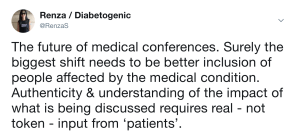
(Click for original tweet)
Because #NothingAboutUsWithoutUs.
Does the story we know and love about Banting need a rewrite?
I was fascinated to watch the short documentary shared in this story which suggests that the frequently-told story of the discovery of insulin is missing out a critical part.
It was the best of times, it was the worst of times…
This blog post by Sue Robins detailing two vastly different medical appointments is compelling – and quite heartbreaking –reading.
More D Merch
Totally true!
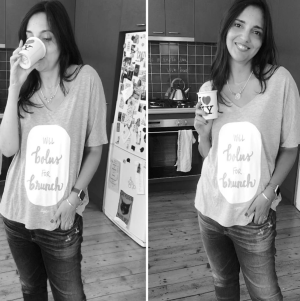
Click image to get your own!
It’s not really a great day in diabetes with news all over my SoMe feeds about a study published in Diabetologia which links high glucose levels with dementia, and a report from the Baker Heart and Diabetes Institute showing Aussies with type 2 diabetes are twice as likely to suffer sudden cardiac death.
Perspective is really important on days like today. I’m not in any way wanting to minimise the significance of the these reports – obviously we should take them seriously. But equally, I think we also need to find some positives in the diabetes space and remember that it is not all dire and critical.
Diabetes is serious and anyone who thinks otherwise doesn’t know diabetes. This weekend, a true giant in Australian diabetes died. Hal Breidahl was a pioneer who co-founded the Australian Diabetes Society. In a piece he wrote back in 1980 (and the language reflects that it was written in 1980!!!) about what people with diabetes want to know he states:
All diabetes is severe – unless adequately controlled. Patients often want to know ‘how bad is my diabetes?’ or ‘how severe is the condition?’ or ‘how high is the blood sugar?’ The notion that ‘I’ve only got a touch of sugar’ or ‘I only have mild diabetes’ should not be allowed to remain…
We get it. Diabetes is serious. Nasty things happen. We know it.
But I want to add to this. There is – there has to be – more to diabetes than the negative stories that make the news. Because in amongst those stories there are these things to remember, and I seek them out each day:
- Diabetes is serious, but it is also the condition I need to live with and find some semblance of balance as I work out how to fit it into my life.
- I need more than just the negatives, or bad news highlights. Because not offering the things I can do to live as best I can does nothing for my mental health – or for my diabetes health.
- Attention grabbing headlines that only tell part of the story do nothing to make me believe that I will be able to live well with diabetes. Also, ‘live well’ means different things to different people and it’s a moveable feast, but I know that the idea that we need to be complications-free to be living well is a flawed and dangerous idea.
- There is a lot of positive research about diabetes and we need to know about that too. Like this which reports people with type 1 diabetes are living longer.
- There is an undeniable truth that reading over and over and over again that diabetes is going to increase my risk of <insert whatever you bloody well feel like> is exhausting. I feel as though I have been kicked in the gut every time it happens even though I know that I am living the best diabetes life I possibly can.
- While diabetes may increase the risk of all sorts of things, sometimes it just doesn’t, because sometimes it’s not diabetes. If others could remember that, it would be useful so that any other affliction isn’t automatically lumped in the ‘It’s because you have diabetes’ basket, and not investigated properly.
- If you are talking about the nasty things that diabetes seems to increase the risk of, please acknowledge that the tools we have to live with this condition are not up to the task. Any failure is not mine as a person with diabetes. It is the failure of a body part that decided to not to what it is supposed to. It is a failure of the insulins currently available not being able to act fast enough. It is a failure of monitors not being accurate enough and delivery devices not delivering properly. Please remind people of that when you also mention that out of range glucose levels (AKA diabetes) means that we’re at a higher risk of not-so-great things.
- The bad stuff? It may not happen.
On a day like today when I am reading a lot about the diabetes things I really don’t want to think about, it is especially important for me to find some of that balance and search out the good news. Because otherwise diabetes tips into a really dark place where good self-care becomes almost impossible. There is light in diabetes. And sometimes, we need some help finding it. Sometimes we need to search a little harder to see it. Today is one of those days.

 I get to meet some pretty awesome people with diabetes around the globe. At EASD I caught up with Cathy Van de Moortele who has lived with diabetes for fifteen years. She lives in Belgium and, according to her Instagram feed, spends a lot of time baking and cooking. Her photos of her culinary creations look straight out of a cookbook…She really should write one!
Cathy and I were messaging last week and she told me about an awful experience she had when she was in hospital recently. While she wasn’t the target of the unpleasantness, she took it upon herself to stand up to the hospital staff, in the hope that other people would not need to go through the same thing. She has kindly written it out for me to share here. Thanks, Cathy!
______________
‘Good day sir. Unfortunately we were not able to save your toes. There’s no need to worry though. We’ll bring you back into surgery tomorrow and we’ll amputate your foot. It won’t bother you much. We’ll put some sort of prosthetic in your shoe and you’ll barely notice…’
I’m shocked. Still waking up from my own surgery, I’m in the recovery room. Between myself and my neighbour, there’s no more than a curtain on a rail separating us. I feel his pain and anxiety. He is just waking up from a surgery that couldn’t save his toes. This man, who is facing surgery again, leaving him without his foot. How is he gonna get through this day? How will he have to go on?
The nurse besides my bed, is prepping me to go back to my room. I tell him I’m shocked. He doesn’t understand. I ask him if he didn’t hear the conversation? His reaction makes me burst into tears.
‘Oh well, it’s probably one of those type 2 diabetics, who could not care less about taking care of himself.’
I’m angry, disappointed, sad and confounded. I ask him if he knows this person. Does he know his background? Did this man get the education he deserves and does he have a doctor who has the best interest in his patient? Is he being provided with the right medication? Did he have bad luck? Does he, as a nurse, have any idea how hard diabetes is?
The nurse can tell I’m angry. He takes me upstairs in silence. My eyes are wet with tears and I can only feel for this man and for anyone who is facing prejudice day in day out. I’m afraid to face him when we pass his bed. All I can see is the white sheet over his feet. Over his foot, without toes. Over his foot, that will no longer be there tomorrow. I want to wish him all the best, but no words can express how I feel.
What am I supposed to do about this? Not care? Where did respect go? How is this even possible? Why do we accept this as normal? Have we become immune for other people’s misery?
I file a complaint against the policy of this hospital. A meeting is scheduled. They don’t understand how I feel about the lack of respect for this patient. They tell me to shake if off. Am I even sure this patient overheard the conversation? Well, I heard it… it was disrespectful and totally unacceptable.
Medical staff need to get the opportunity to vent, I totally agree. They have a hard job and they face misery and pain on a daily basis. They take care of their patients and do whatever is in their power to assist when needed. They need a way to vent in order to go home and relax. I get that. This was not the right place. It was wrong and it still is wrong. This is NOT OKAY!
 A lot has already been written about the photo ban at ADA last week. For the first couple of days of the meeting, the first topic of conversation I had with everyone I met was not about what I’d seen or learnt. It was about the photo ban and the ADA’s failure to appropriate deal with the complaints. It was a debacle, an absolute shit storm that could have been addressed in many ways to make it better.
Firstly, it’s worth noting this is not new. Two years ago, I was swiftly reprimanded for tweeting a photo during one of Bill Polonsky’s talks. The ADA bot who was monitoring any flouting of the no photo rules quickly responded to anyone sharing photos on twitter or other social media platforms. The message was strong: stop doing this or your credentials will be revoked. For the record, this was the photo that got me in trouble:
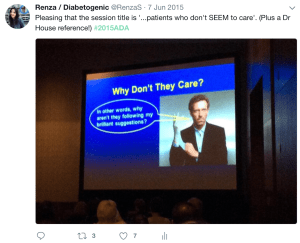
Yes – that photo of Dr House straight from the Internet was the reason that removal of my press credentials was threatened.
This year, execution of the archaic policy was increased to expert level. And people were not happy.
Many were asking why the ADA was being so strident in their enforcement of the policy or, more importantly, why the policy was there in the first place. But it’s not just the ADA. Taking photos or videos during sessions or of posters is banned at the IDF’s WDC, EASD meeting and here in Australia at the ADS-ADEA meeting. (How’s that for a sentence of alphabet soup?)
However, I have never known it to be enforced the way it was last week with a multifaceted approach of vigilant soldiers in red approaching anyone daring to photograph a slide during talks or in the Poster Hall, as well as social media (mostly Twitter) responses being fired left right and centre to anyone who then tweeted a photo.
The ridiculous thing is that anyone at the conference could tweet WORD FOR WORD what the speaker was saying (provided they are a speed Tweeter), but just couldn’t take a photo of the slides. And to be honest, a lot of the speakers were pretty much reciting WORD FOR WORD what was on the slide, so it was possible to pretty much tweet out every single thing being presented. (Also, that makes for a really boring presentation. Don’t do that!)
Suddenly, the story of #2017ADA was not new diabetes research or technology or treatment. In fact, the story wasn’t diabetes at all; it was how pissed off people were at the ridiculous ban.
People trying to follow along from home felt excluded and annoyed. Attendees of the conference felt frustrated that we couldn’t share what we were seeing with those not in the room. As is often the case at these meetings, there were two or three or more concurrent sessions I wanted to attend, but as I’m yet to learn how to be in more than one place at the one time, rely on people in the sessions I’m not at to share what they are seeing and hearing.
And me? I was irritated and exasperated at how difficult it was to follow the #2017ADA Twitter feed because of all the bloody criticism of the photo ban. (And just delicately, those people who commented on EVERY SINGLE TWEET about the ban, you were not helping. You were making it harder.)
I understand that I am very fortunate to attend diabetes conferences both here and overseas and I am conscious that not many people with diabetes are sitting in the audience. I also know – from personal experience as well as anecdotally – the people in the audience are not always the best sharers. When they return from conferences, they don’t sit with people with diabetes to share what they have learnt.
So, as a person with diabetes who likes to share and communicate, I think it’s my responsibility to share as much as I possibly can about what those of us with a registration or press badge are seeing and hearing.
Trying to stop the flow of communication in digital times is ridiculous and it demonstrates an appalling lack of understanding about harnessing digital platforms’ reach to educate, inform and support not only people with diabetes, but also healthcare professionals. It was also ludicrously naïve of the organisation to think that there would not be backlash and that they would get off without condemnation.
The control of information is really not possible in this day and age. A conference about diabetes should not be shut off from people with diabetes, and if the only way ‘in’ for most people is online, then that avenue should be thrown open as broadly as possible.
In two months’ time, the ADS ADEA conference will be in Perth, bringing together diabetes healthcare professionals from across Australia. It is our largest meeting. Currently, on the meeting website, there is this warning in their social media guidelines:
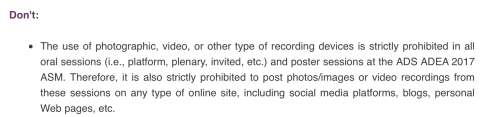
I am calling on the organisers of the ADS-ADEA conference to change this policy immediately, instead, encouraging the sharing of information far and wide. Consider those who cannot afford the time or fee to be at the conference, yet would benefit significantly from learning what is going on. Embrace social media as a way to extend reach from the few thousand attendees (or few hundred in any one session) to a far larger audience. And welcome all diabetes stakeholders to be part of the discussion online.
Just think how much better #2017ADA could have been if that had been the story.
Some excellent commentary on the photo ban at ADA.
Medscape’s piece written while the meeting was happening.
The always thoughtful Marie Ennis O’Connor’s piece for Medium.
Yesterday, I wrote a quick review of the language session at #2017ADA and my excitement as I anticipated the session.
I don’t want to sound Grinch-like, but I walked out of the session feeling less enthused than I had when I walked in. That’s not because the speakers weren’t good. They hit the mark and said all the right things.
And it’s not because I am not excited to see the ADA and AADE developing and getting ready to launch their Language Consensus Statement (it’s due out in August). I am; I am so excited!
It’s because I didn’t hear anything new, and the time has come for us to do something more with language matters. Because, #LanguageMatters.
It was six years ago that Diabetes Australia launched ‘A New Language for Diabetes’ position statement. In collaboration with the Australian Centre for Behavioural Research in Diabetes, Diabetes Australia wanted a concise, easily shareable document that could straightforwardly and succinctly explain how to communicate with and about people with diabetes. Unapologetically, it called out the words that harmed and offered replacements that were more inclusive, less judgemental, all in an attempt to use language that didn’t make us feel like we were constantly failing at life with diabetes.
Six years is a long time in diabetes. Disappointingly, there’s still a lot that’s not great about the way diabetes is discussed in the media, in healthcare settings and, unfortunately, by healthcare professionals. We haven’t reached a position of respect; we have not managed to leave all judgement at the door when speaking about diabetes; we have not even started to eliminate stigma.
When the Language Position Statement was initially launched in Australia, I saw it very much as as first and most welcome step. Was it perfect? No. It was a starting point, not the end of it all.
It was never considered as definitive document, but it certainly a great place to begin; a living resource that could evolve. As the ACBRD did more and more work in the stigma space, it became very clear that words do indeed matter, and Diabetes Australia took the evidence and continued to push the envelope and innovate in this previously unexplored space.
Perhaps that’s not actually a correct statement. Language and words had long been on the radar of people living with diabetes. Diabetes camps had stopped using words such as ‘good’ and ‘bad’ to describe glucose numbers; the debate on the word ‘diabetic’ had been going for years, and many rallied against the words used that blamed, judged and slurred people with diabetes – whether it be for developing diabetes in the first place, or how well we are managing it.
But the Language Position Statement was the first time that it was all there in one neat document, backed by evidence to support the thoughts of PWD. (Jane Speight and I gave a number of talks which started with me ranting and waving my hands around about how language and words affects those of us living with diabetes, and concluded with Jane stepping up to present the evidence. Those talks packed a punch and made it very difficult for people to ignore the issue or to keep referring to it as political correctness gone mad.)
But now, six years on, I want more. I don’t want it to just be a debate about whether or not we use the word ‘diabetic’ (although this is still an important issue). We get waylaid when that is our whole focus, and I feel that anywhere that is just now coming to the language party needs to be a step ahead of the development of a language position statement. That’s been done and has been in circulation for over half a decade. Use it, adapt it, rebrand it and make it your own, but I’m not sure there is a need to recreate the wheel and start from scratch?
Not when there is still a lot more to do.
What’s the next frontier in language and diabetes? Maybe it’s diabetes conferences.
Because, they are a mess, with many presentations still peppered with words such as ‘non-compliant, non-adherent, poor control’, or referring to participants in research as ‘subjects’, and often (and sadly) a not a great understanding of the difficulties of living with diabetes.
With a Language Positions Statement already in existence, a great (and simple!) start to remedy these shortcomings could be for conference organisers to send a copy of it to all speakers, explaining there is an expectation that slide decks and talks will be in line with the document and its recommendations. And while they’re at it, the same expectations should be in place for anyone showing in the exhibition hall at the conference, or writing about the event. Along with embargo regulations, press corps could also be sent the position statement.
We know that organisations have the capacity to be vigilant – perhaps had the ADA put effort into urging appropriate use of language at the conference instead of enforcing their archaic photo ban, they wouldn’t have been hit so hard on the socials.
It’s time for us all to expect more and to demand better. How are YOU going to do that?

It’s day three of the eighth annual #DBlogWeek, created by Karen from Bittersweet Diabetes. This is the sixth year I’ve taken part and it’s a great opportunity to not only write about some truly interesting topics, but also a chance to read some blogs you may not otherwise. Here are the links to today’s posts.

Today’s prompt: Having diabetes often makes a visit to the doctor a dreaded experience, as there is invariably bad news of one kind or another. And sometimes the way the doctor talks to you can leave you feeling like you’re at fault. Or maybe you have a fantastic healthcare team, but have experienced blame and judgement from someone else in your life – friend, loved one, complete stranger. Think about a particularly bad instance, how that person talked to you, the words they used and the conversation you had. Now, the game part. Let’s turn this around. If you could turn that person into a puppet, what would you have them say that would leave you feeling empowered and good about yourself? Let’s help teach people how to support us, rather than blame us!
I’ve written before about difficult encounters with HCPs. There was this time and this time. And this time where it wasn’t even me who the HCPs were speaking poorly about!
So, instead of doing that today, I’m going to talk (as in actually speak) about the the overall issue of blame and diabetes, and what can be said to address the blame game. (Apologies for the speed talking and hand waving.)
There are lots of ways to discuss diabetes. Some people literally talk about it – in front of roomfuls of people or in the media or record little vlogs of things that they find particularly interesting. Others write about it for different media platforms. Some, you may have heard, even blog about it…!
And then others create comics about it.
Last December, I was sent a copy of Claire Murray’s first ‘Living with It’ comic and just last week, I was sent the second. I don’t actually know Claire (other than online), but I know her dad. And like all good dads, he is (quite rightly) very proud of his kid and wants to show off her brilliant work. So he kindly popped the comics in the mail for me.
There is much to love about Claire’s comics. They are very funny – as in laugh out loud funny. I’m writing this in a local café and keep giggling as I flick through their pages. ‘Living with It’ chronicles the story of a kick-ass young woman with diabetes called Megan who just happens to have type 1 diabetes. Oh, and she’s a bona fide superhero.

A new diabetes superhero! Back cover of ‘Living with It’ #1 by Claire Murray.
Megan as a character is brilliant – the perfect mixture of snark and sass! She fights crime while managing to deal with diabetes in a most fabulous manner. I want to be friends with her so she can teach me her ways! (Plus she looks like a human, not a barbie doll, which is a nice departure from how women are usually drawn in comics.)
And you absolutely don’t need to have diabetes to get the story, which is why this is such an awesome channel for discussing diabetes. Claire hasn’t created a ‘diabetes 101’ story in a comic – this isn’t really about learning the ins and outs of diabetes. (Although the glossary at the beginning of the second comic is excellent in its straightforwardness and a perfect way to describe some of the basics of diabetes. Simple pictures, clear explanations.)

Glossary from the beginning of ‘Living with It’ #2, by Claire Murray
What Claire has done is shape a very clever and funny superhero story, and wound diabetes through it. Diabetes isn’t really the central theme – it’s just there and in the way. Kind of like diabetes in real life! She has managed to unmistakably show the disruption and irritation diabetes creates each and every day.
I love the idea of kids and teens with diabetes (and grown-ups with diabetes) reading these and sharing them with their friends. The gentle, funny and captivating tales are a terrific way to explain just how and where diabetes can get in the way of real life, yet, despite the mess of out messed up beta cells, those of us living with it just get on with things.
You can read more about Claire Murray and her work at her website, Tumblr and Instagram.
(For the record, I think Claire might be a bit of a superhero, too. I believe that she is on a panel this weekend at Supanova where she will be speaking about the Women in Comics Festival.)
I’m still getting my head around the #HealtheVoicesAU conference – there was so much that happened over the event that it’s taking time to write about it all and really nut out what I took away from each session. (Previous posts here and here.)
When I looked at the program, I was probably most excited to hear from Nick Bowditch. I knew nothing about Nick other than what the program told us: He is the only person in Asia Pacific to have worked at Facebook and Twitter; he’s an entrepreneur who helps small businesses here and across the globe shape their online presence. And his personal health story is that Nick is a mental health advocate as someone who has lived with depression for many years.
I knew Nick’s talk would have lots to offer, and title of his talk that had me excited: ‘The Art of Storytelling’.
I’ve written before about why I love story tellers and story-telling. And telling my own story. It’s reading and hearing the stories of others with diabetes that helps put in context my own experiences. Others’ perspectives shape my own and I learn so much from how others deal with the clusterfuck that diabetes can be.
The first slide Nick showed us was of the wonderful Jamaa el-Fna in Marrakech. He told us how he spent an evening captivated in the square. There amongst the snake charmers and the men walking around with monkeys on leads and the little girls selling tissues and the vendors hawking fresh orange juice, were story tellers. And although he couldn’t understand a word they were saying, he was enthralled as they animatedly told their stories.
That’s the beauty and magic of a good story teller – you don’t necessarily need to understand the detail; just getting the gist of the tale is enough.
And then, Nick gave us the snapshot of his story. In a nutshell, he told us this:

Slide from @NickBowditch
It’s easy to make assumptions and think that you know what Nick might be living with if you see that list. But you’d probably be wrong. I know I certainly was. My initial ideas of what life must be like for Nick were turned on their heads as he put into context what each of the above aspects of his life actually means to him:
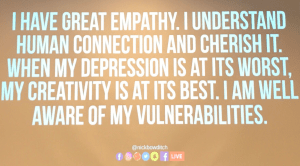
Slide from @NickBowditch
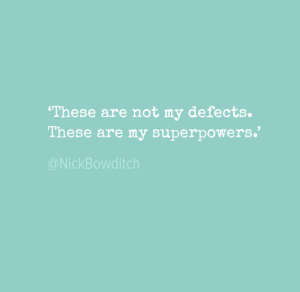
By turning our assumptions on their head and reframing how he lives with mental health conditions shows us that Nick is not ‘just coping’, he’s living. His words were: ‘These are not my defects. These are my superpowers.’ And it challenges us to reconsider our preconceived ideas. I know that those of us who speak about diabetes often challenge what others think.
The image of T1D being all about kids and needles and blood is not really what it’s about for me. And the far-too-easy idea that T2D is all about older, overweight, inactive people is wrong too.
When we tell our stories – and reframe the narrative – the truth comes out.
Possibly the most powerful thing Nick said was this: ‘Telling the truth is not brave. It’s easy. The hard thing is not being authentic.’ We’d come full circle back to the first speaker of the day who implored us to find authenticity in what we were saying. And it reminded me of why I have always been an advocate of having people with diabetes sharing their stories in any forum where people are talking diabetes: the legitimacy of lived experience cannot be found in any other way than actually having someone tell their story.
I see first-hand the power that having a person with a health condition stand alongside a healthcare professional and put into context the theory and research that they have just presented.
There is an art to storytelling. We do it every day that we tell our story. We do it every time we put words on a page for a blog post, or in a diary or in a letter, ot when we stand up and tell it like it is. Some do it far more elegantly and eloquently, but the things is; it doesn’t matter. As long as we’re authentic.
DISCLOSURE
Thanks to Janssen (the pharma arm of Johnson and Johnson) for covering my travel and accommodation costs to attend the #HealtheVoicesAU conference. There was no expectation by Janssen that I would write about the event and everything expressed here (and on Twitter Facebook and other social feeds) is mine and mine-alone! To read more, check out the conference hashtag, #HealtheVoicesAU, on the socials.
Back in 2012 when we were thinking of starting the #OzDOC weekly Twitter chat, Kim, Simon and I were committed to making sure that it was a safe place, welcoming to all who wanted to use it. We encouraged people to actively participate, lurk in the background, jump in and out as they needed.
I had always been so impressed with the non-toxic and inviting place the #DSMA chat was, welcoming people with all types of diabetes as well as a few health care professionals, and I hoped that we could replicate this environment, albeit on a smaller scale, with #OzDOC.
Pleasingly, that’s the way it started and now, it continues to be that way. While I’m no longer involved in the running of OzDOC, or moderating its weekly chats, whenever I do drop by to participate, it is clear that the safe and inclusive model that formed its foundation continues.
It has been great to see that the encouragement of healthcare professionals to join in – lurk at first to get the idea and then respectfully participate – has continued, and frequently, a DNE or dietitian or endo will pop in and contribute.
But last night, during the chat, there was an intrusion that was not respectful. In fact, I likened it to someone bursting, uninvited, into my house and yelling that they didn’t like the way we’d decorated it and then offering to fix it as long as I paid them. I bristled immediately. And felt protective of the people in the #OzDOC room who had been so candidly and honestly sharing their thoughts.
This was a particularly delicate chat. Ashley had more than expertly navigated the sometimes tricky waters of a discussion about the place diabetes fits in our lives, and ended the chat with a question about burn out. It is a testament to the space that is #OzDOC to just how candid and honest people were in their responses.
So, the idea that someone tweeted something about how so many participants were clearly living with ‘out of control’ diabetes and then linked to her fee-for-service website, was not only inappropriate, but also insensitive, thoughtless and showed a true lack of understanding of what people with diabetes are dealing with.
My mother hen instinct kicked in. I had just laid myself bare as I used words that describe burn out to me, and others had as well. This was absolutely not the moment to promote a business and, at the same time, tell people they were doing a crappy job at managing their diabetes. And there is no place for judgement in this chat, especially from someone so clearly out-of-touch.
While my response was somewhat reflexive and probably could have done with a moment away from the keyboard before hitting the ‘tweet’ button, I don’t regret that I did it. And the responses from others in the chat suggested they too were feeling uncomfortable about the intrusion to the discussion.
I was furious that someone had so aggressively and judgementally invaded the safe space that has been so carefully cultivated. ‘Out of control’ diabetes? Really? Fuck off. (Actually, that was the response I wanted to type, but kept myself nice, so maybe I wasn’t as harsh as I thought.)
My concern about this intrusion was twofold. Primarily, I would hate for any person with diabetes to feel afraid of participating in any sort of peer-based activity for fear of being judged. We get enough of that outside of the spaces we create for ourselves and certainly shouldn’t have it forced upon us in our own groups.
But also, I would hate for any HCPs to think that they are not welcome to participate. They most certainly are, however the respect, lack of judgement and kindness expected by participants is expected of everyone. If they are unable to demonstrate that, stay away.
I’m not naming and shaming the person who tweeted last night. The tweet has been removed anyway. But, I would absolutely encourage them to come back next week and the week after and the week after that to learn. Watch what goes on in these chats, listen to what people are saying, understand the real-life sensitivities of diabetes.
And then, feel free to softly, softly join in. Respectfully ask questions (after asking if it is okay to ask questions) if there is something that needs clarifying. Gently share ideas that may be of benefit. But absolutely do not try to sell something. And check your judgement at the door.
Last week, my Timehop app reminded me of this snapshot in time.
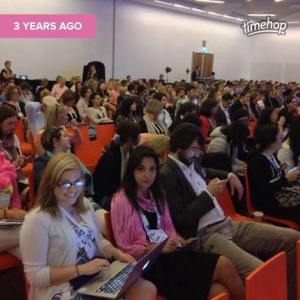
This photo was taken at the 2013 International Diabetes Federation’s World Diabetes Congress in Melbourne, and that look on my face is of pure anger. I was listening to a speaker – a doctor – referring to ‘non-compliant diabetics’ as he was telling of the ‘poor outcomes’ of ‘patients’ in his practise.
The old language chestnut came up again on the second day of the #MayoInOZ conference during the innovation showcase was held. In this session, nine speakers were each given five minutes to present how they are using social and digital tools to improve healthcare. (This is where Kim spoke about #OzDOC and how healthcare professionals use the hourly tweetchat as an opportunity to engage and learn from people with diabetes.)
The final speaker in the innovation sessions was a late addition and it was great to see diabetes again being represented. I know I am biased, but I do always get excited when I see diabetes on the program!
Andy Benson from Coffs Endocrine and Diabetes Centre presented on the project she has been working on: telling the story of diabetes in a series of documentaries to be screened on the BBC.
So, first things first. I love this idea. I am a huge fan of having diabetes out in the ‘public’ space, pulling it out from diabetes groups and diabetes-specific forums, because in most of these cases, we’re preaching to the converted. It’s one of the reasons I love writing for Mamamia Women’s Network where I know that most of the readers probably don’t already have a connection to diabetes.
If these documentaries are screened on the BBC, imagine the audience! It is so refreshing to see people thinking outside the box and looking for ways to present to a new audience – and to tell stories, real stories of real people who actually live each day with diabetes.
Andy showed two short video clips from the still-in-development documentaries. As healthcare professionals on screen spoke about diabetes, I automatically prickled, my language and stigma sensors being alerted straight away.
I wasn’t the only one. In a room with two other diabetes advocates – Kim, Melinda Seed (Once Diabetes), as well as several very vocal health advocates and activists, there was a sense of discomfort at what we were seeing.
I inhaled – maybe ‘gasped’ is a better word – when one of the HCPs used the words ‘diabetes plague’ in his introductory words. There was an undeniable sense of blaming the person with diabetes in the words being used and the sentiments being expressed.
The Twitter conversation from both people in the room and those following along was honest and candid. And, quite frankly, it was uncomfortable too. Andy had disclosed that she has type 1 diabetes, and I didn’t want to be actively criticising the work of a fellow PWD.
However, I could not keep quiet either. When Andy came over to chat after her talk, we had a very open discussion. I was probably quite blunt in my comments.
It is not okay to use language that is stigmatising. The format of the information being presented (i.e. unscripted interviews) doesn’t preclude anyone from being courteous and respectful, and I don’t believe that PWD were being treated either courteously or respectfully in the way about which we were being spoken.
I understand that there is a desire for authenticity and genuineness when interviewing documentary ‘talent’, however it is possible to be clear from the outset that language needs to be respectful at all times. Not sure where to begin with this? How about the Diabetes Australia Language Position Statement which actually provides suggestions for inclusive, non-stigmatising language?
I think it is really important to acknowledge that the road to satisfaction in the way we use language that is inclusive and non-stigmatising is a very, very long one. Also, I genuinely don’t believe that there was any malice intended on the part of the film makers or the interviewees.
We also need to acknowledge that the language used in what has been (and many would argue continues to be) a patriarchal health system is entrenched in the thinking of many – it was part of their training and is a habit that will take time to break. But by acknowledging it, we are not saying it is okay.
As I said, I love the idea that diabetes is a topic for a documentary that is being made for a non-diabetes-specific audience. However, if those people walk away thinking that my healthcare condition is a burden to society (and therefore I am too!) or that they believe it is okay to continue to use words that stigmatise, then there is the potential for this work to do more harm than good.
And finally, a call to not only the coordinators and owners of this work, but to all who are developing any sort of health information using any sort of platform: talk to people with the condition. Lots of them. It is not okay to have one token consumer representative; there should be many – as many as (if not more than) any other expert being consulted.





 Diabetogenic