
You are currently browsing the category archive for the ‘Awareness’ category.
Yesterday as I skimmed a few news sites and social media sites, I came across endless diets, weight loss fads and a downright disturbing article about ‘bikini bridges’ which, it appears, is the latest in ‘thinspiration’ trends (we’ve moved on from the thigh gap, apparently). I caught up on a piece about ‘diabulemia’ and thought about how diabetes adds an extra degree of difficulty to all things – even eating disorders.
The relationship between weight, food and diabetes is so complex and confusing. We’re told to maintain our weight to remain healthy (or prevent developing type 2 diabetes in the first place); we’re told to manage our cholesterol for heart health; we’re told that certain foods are taboo; we’re told we need to eat at certain times to prevent lows; we’re told we should eat a lot of carbs/not too many carbs (depending on who you listen to today); we’re told to cut sugar (tweet below gives you some indication to how I feel about that one!) and we’re told that our waist circumference is yet another number to think about.

Quitting sugar (or anything else for that matter) will not cure type 1 diabetes.
Now take diabetes away and we’re told a heap of other things.
There are polls about who has the ‘hottest’ body as if it is something that can be measured, and there are ‘half their size’ magazines at the supermarket. Ads for The Biggest Loser are already on our screens. Faux-concern is directed towards celebs who seem to have lost too much weight. Between fat-shaming and skinny-shaming, it appears no one is safe.
We refer to women’s bodies as ‘hot’ as if they are pieces of meat to be graded. There is no consideration for whether they also happen to be intelligent, have a strong social conscience or are good at horticulture. Or knitting or whatever it is that they are good at. Because it doesn’t matter. As long as they look hot.
Women become known as specific body parts (except Elle Macpherson who is known as ‘The Body’ which means that no one cares what’s going on in her brain). Pippa Middleton isn’t known for being Pippa Middleton. She’s known because her arse looked ‘hot’ in a white dress.
Apparently having a certain body shape makes a woman ‘authentic’. Curves, allegedly make a woman ‘real’, whereas being skinny somehow, miraculously, makes her less real. Believe me, as someone who has at times had some decent curves to hold on to and then at other times can see bones protruding, I’ve always been real.
I don’t think much about my weight. It’s never been an issue for me and I’ve never been on a diet. During periods where I’ve tried to eat better, the focus has been health, not weight loss. Also, I love Nutella too much to even contemplate cutting processed foods out of my life. Also, bacon. And cupcakes.
And yet.
Daily, I find myself struggling with how I feel about the dozens and dozens of images that I see. I’m confused at how I should feel about my own body. Today, I look in the mirror and see that I am probably the thinnest I’ve been in some time, meaning I’m closer to the ‘body ideal’ that the fad diets promise. And yet, I look at my collarbones – all sharp angles – and feel slightly ill.
Where in there is the message that to be happy with ourselves we need to – well, be happy with ourselves? Where are the messages of celebrating who we are for more than how we look in a pair of skinny jeans? In fact, can we stop referring to jeans as skinny, please?
The discussion needs to shift. We need to stop talking about weight loss and ways to look ‘hot’. No one can achieve the things being promised. In fact we’re all destined to fail. But health? Health is something we can all work towards achieving. And if each step is measured by our wellbeing – not the size of our thighs – we’re working towards something worthwhile and meaningful. Feeling better inside. And my guess is that will have far longer-reaching consequences than detoxing for a few days.
I have a significant birthday coming up. I’m turning 40 tomorrow which, when I mention it, is generally met by people either speaking in hushed tones (‘Are you okay about it?’) or high-fiving and hugging me (‘You go girl!’).
I am okay with it and in all honesty, hitting the big four-oh hasn’t been something that has freaked me out or filled me with dread. I think about how I was when I was 20 or 25 or even 30 and I know that I’m proud of the person I am now. I’m comfortable in my skin.
I also have my 15 year wedding anniversary coming up. In times when we’re told that the marriages last an average 8.7 years, it feels good to cross off this milestone.
As much as birthdays and wedding anniversaries should be celebrated (I’m a big believer in cake, cards and carats) I’m actually finding that it’s actually my diabetes anniversaries that are becoming more and more meaningful.
This year, I ticked the fifteen years with diabetes box. I look in awe at friends who have had diabetes for many more years and at Kellion medallists who have lived lifetimes with the condition. But reaching fifteen years and doing a quick check of how this condition has affected my life leaves me with mixed emotions.
There is satisfaction that my annual complications screening checks come back with favourable results. Even the six-monthly visits to the ophthalmologist have become bearable – or at least, less traumatic – because the reports from my lovely doctor have been positive. Cataracts notwithstanding, there doesn’t seem to be any significant diabetes-related damage at the back of my eyes.
The way that my hypos have changed over recent years doesn’t leave me feeling quite so confident and self-assured. I am concerned about the times I’ve needed assistance, and with the white out hypos where I have lost significant chunks of time.
And then there are the things that lurk in the back of my mind, pushed away and only allowed to come out in the middle of the night when I can’t sleep, or in moments of surprise when I’ve forgotten to keep them hidden. Things like worrying about reduced life-expectancy or becoming reliant on my family for my care. And fear that despite common sense and what I’ve been told that it really is because of diabetes that I have miscarried three times.
But mostly, there is fist pumping when I think of how diabetes hasn’t stopped me from doing things; nor has it decided how I will live my life.
So I’m planning on big celebrations for turning 40 – it should be celebrated and not with any of this ’40 is the new 30’ crap. But with acknowledgement and some pride of who I am, what I have achieved and the wonderful people I have around me who fill my life with love and happiness. I’ll celebrate the places I’ve been and look to the places I’m going. And I will also acknowledge that in over 15 of the 40 I’m celebrating, I’ve done it all despite diabetes.
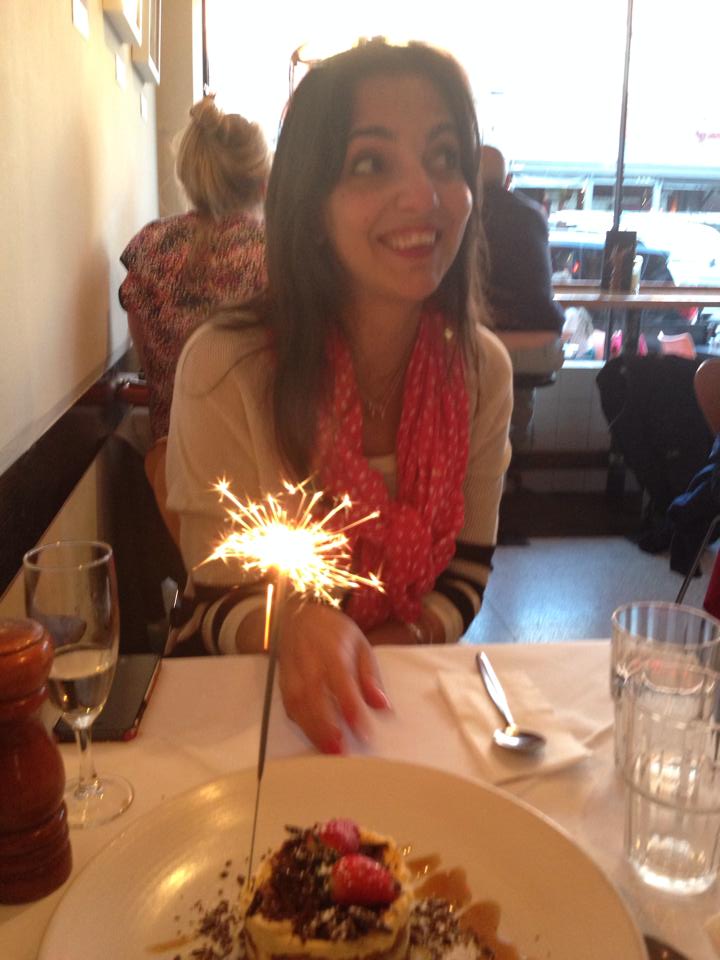
Starting birthday celebrations a couple of days earlier thanks to the waiters at our favourite cafe who surprised us with a sparkling tiramisu!
World Diabetes Day is drawing to a close across the world. The clock is about to turn over into 15 November but it seems that blue lights will burn brightly for some time to come.
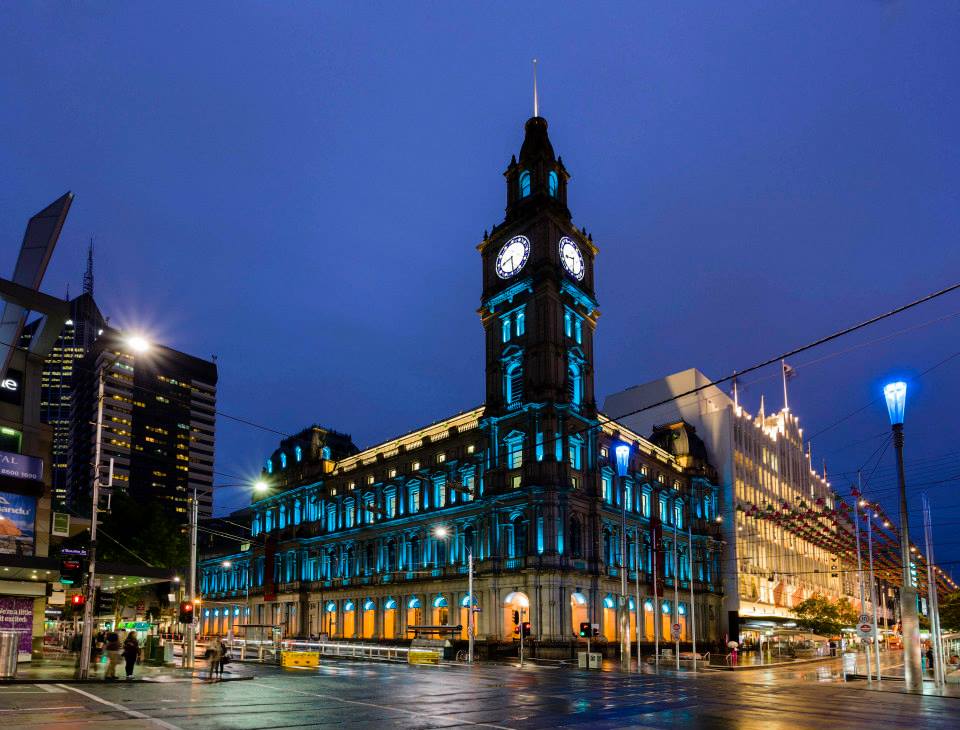
Melbourne’s iconic GPO gets its blue on for WDD13
My WDD started on its eve with an important event for diabetes research. The 2014 Diabetes Australia Research Trust awards presentation gave 22 Victorian researches grants. Many people aren’t aware of the commitment Diabetes Australia makes to research each and every year. This year alone over $3million dollars was given, including the $150,000 Type 1 Millennium Award which is specifically for research into type 1 diabetes.
After the awards, I found myself in the Melbourne drizzle wandering down to the GPO. As I approached, I saw it lit in blue. It looked splendid! Staff from Diabetes Australia – Vic and some of the Diabetes Australia Young Leaders donned blue ponchos and held all manner of lit-up blue things (I got a wand!! I’m just like Hermione!!) and stood in the glow of the GPO. This is part of the IDF’s global light up a monument campaign. You can read here for other iconic buildings and monuments that have been washed with blue. It was some fun for an important awareness-raising activity. And now, I have a blue wand!
On WDD proper, I found myself up just after 4am and on a 6am flight to Sydney to answer some questions about diabetes on a new breakfast television show. Studio 10 ended its morning with a discussion about World Diabetes Day and I was asked about life with type 1 diabetes. It was an opportunity to bust some myths which I’m up for pretty much any time! You can see the interview here.
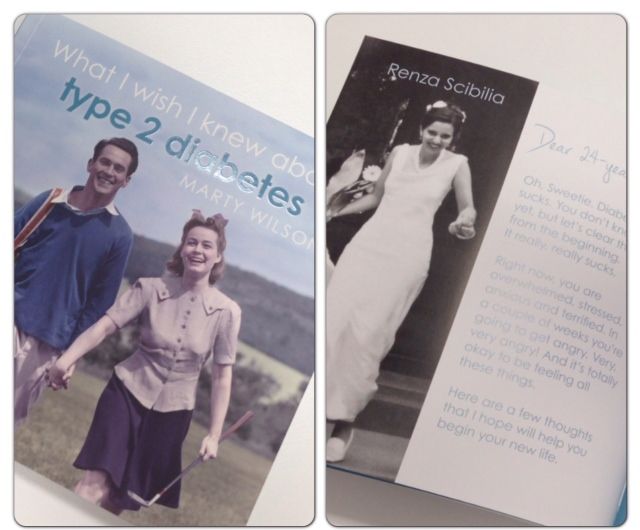
What I wish I knew…..
Next up was the launch of a new book called What I wish I knew about type 2 diabetes which is a collection of stories of people living with diabetes (all types – not just type 2 despite its title) and health professionals working with PWD. This gorgeous little book by Marty Wilson tells wonderful tales of people who have lived with diabetes for many years. It also includes one of my previous blogs. Look out for the book – it’s definitely worth a read.
World Diabetes Day is an important day for the diabetes community. It is our day to talk about diabetes and have others thinking and talking about it too. Whether it be international organisations like the IDF who yesterday released new global diabetes statistics in their Diabetes Atlas, or local and national diabetes organisations like Diabetes Tasmania who attended Government House for an event with some of their Young Leaders, or community events and activities like the global 24-hour diabetes Twitter chat, it’s a day where diabetes is front and centre. My Facebook and Twitter streams were full of blue and family and friends commented on my posts and even posted on their own pages about diabetes. (A shout-out to my sister who got TOTALLY in the WDD-spirit by wearing blue circle earrings and plastering her Facebook wall with WDD messages. Thanks, Toots!) I even pinned blue circles onto our real estate agents’ very suave suits as they came to do an open for inspection for our house sale last night. Everywhere I looked I saw blue.
Diabetes may not be understood by everyone. But yesterday was a day where we could talk about it and hopefully give people a little more understanding about what life with diabetes means.
Of course, it doesn’t end here. The WDC is in just two weeks. Let’s keep the conversation going. And don’t forget the OzDOC get together on 3 December as part of WDC!
I am very fortunate that my job allows me to do a bit of interstate and international travel. Working for a not-for-profit means that while there are some opportunities for attendance at conferences, finding sponsorship is necessary if I want to attend all the conferences and meetings that are worthwhile and beneficial to my job.
Last month, Johnson and Johnson kindly sponsored my travel to Barcelona for the EASD conference, specifically to attend its second annual European Bloggers Summit. As the only person from Diabetes Australia lucky enough to be given an opportunity to attend the conference, I knew that I would be waving the Australian flag enthusiastically as I spoke about our experiences with diabetes social media and blogging. I searched out all the relevant, social media-focussed sessions and made sure I could get to them.
The day after arriving, I attended an IDF symposium about how social media can improve the lives of people with diabetes. The symposium was on the Sunday before the Tuesday start of the EASD meeting, so unfortunately, it wasn’t as well attended as I fell it should have been.
Given my recent presentation at the ADS/ADEA conference, I was very interested to hear this session – especially the presentation by Claire Pesterfield because as well as being a PWD, she’s also a diabetes nurse. Claire made some really interesting and valid points about how difficult it is for HCPs to jump on the social-media-as-support bandwagon when in most hospitals sites such as Facebook and Twitter are blocked by the hospitals’ IT people. It’s not really all that easy to tell people about great online support networks if the ‘red screen of death’ pops up every time you try to log on to one of them. I’ve been told that this situation is mimicked here in Australia.
We also heard Paul Buchanan (moderator the GBDOC tweet chats) speak about his recent (ridiculous, crazy, lunatic) arrival in Barcelona. From Brussels. On a bicycle. Paul and his group Team Blood Glucose were part of the Mobile Health Grand Tour – made up of a group of people who forgot that there are planes, trains and automobiles available to assist in the 2,400km journey from Brussels to Barcelona. Paul spoke about how social media and new diabetes technologies were employed on the ride. Interesting stuff!
 The Euro Bloggers Summit ran on the Tuesday and Wednesday. It was a couple of days of workshops and presentations which covered how we could improve the numbers of people reading our blogs and ensure that we have the right ‘look and feel’ to them so that they were attractive to readers.
While the formal presentations were interesting and provided me with a lot to the think about, the thing that was the most valuable was the time spent speaking and networking with the other bloggers. There was a common theme in the room. While we like to think that there are people reading our blogs, it’s not really about the numbers. The real reason we all do what we do is because we are trying to connect with others who are going through the same things. We’re hoping that someone will read what we write and say ‘I thought I was the only one. But I’m not. I don’t feel so alone anymore’. We are telling our stories and sharing our fears and hopes while we look out for people who can share their stories with us.
Social media has the ability to remove all the things that get in the way of us feeling connected. We don’t worry about geography and thanks to translating software, language barriers can be broken down. Even pesky time-zones differences seem easily surmountable.
Being in the room with people who are doing the same things as me is an incredible privilege. Getting to hear about their work and their lives is an honour and I am grateful for every opportunity I get to learn from them. We need to start creating more opportunities like this in Australia. The World Diabetes Conference is the perfect chance for that to happen. Please take advantage of the fact that this significant diabetes meeting is being held in Melbourne and that there is discounted registration available to consumers. I’ll be there and I really hope to see some of you too!
Disclaimer
Johnson & Johnson covered my travel and accommodation costs so I could attend the Animas European Bloggers Summit. They were also kind enough to cover registration costs to the EASD meeting. There was no expectation that I would write about the Summit (or them). As part of this arrangement, I will be presenting for them at their booth at the World Diabetes Congress in Melbourne in December. You should come along and heckle me!
Myths to do with diabetes frustrate me as much as the next person. I want people to get it right when they are talking about diabetes; I want the media to report diabetes correctly and I want facts presented in a clear, non-threatening, easy-to-understand way. Of course, this is relevant to all types of diabetes.
What annoys me is people who are furious about one myth, but more than happy to perpetuate others.
Some people in the type 1 diabetes community are outraged if they are lumped in with people with type 2 diabetes. Campaigns and petitions have been developed to change the name of type 1 diabetes to avoid confusion between the two conditions. The thought of being thrown in with people who ‘brought this on themselves’ (that, by the way, would be another myth and completely unhelpful) results in Facebook posts, Tweets and blog after blog after blog.
Me – I couldn’t really care less. I have type 1 diabetes, I know it and I’m happy to educate anyone who has no idea about autoimmune diabetes. I’m also too tired and just plain over this discussion, so I try to avoid it. I do acknowledge that if it wasn’t for the significant number of people with type 2 diabetes, I’m pretty sure that the 120,000 of us with type 1 in Australia would get lost when it comes to funding and media attention.
But, for some it is a real issue and they get angry and do anything they can to make sure that they are seen as different from the majority of people with diabetes in Australia – the type 2 diabetes community. And that’s fine. If that’s what your thing to get angry about is, knock yourself out. (My thing changes every day. Today it was that I didn’t get a cup of coffee in me until after 11.30am.)
There are many other myths about diabetes and they annoy me more. Here are just a selection that I’ve come across in the last couple of days:
- If you use an insulin pump you have diabetes ‘really bad’ (wrong and rotten grammar!)
- If you have diabetes, you can’t eat sugar
- If you weren’t so lazy you wouldn’t have type 2 diabetes (genes anyone)
- Diabetes isn’t really serious
- Cinnamon cures diabetes (okay – it was me banging on about that, but I was just trying to justify in my own head eating an apple cinnamon muffin.)
- You can catch diabetes.
- You grow out of type 1 diabetes (blood. starts. boiling.)
I immensely admire and respect the work done by the Juvenile Diabetes Research Foundation, but using the term ‘juvenile diabetes’ just fuels the myth that this is a condition that only affects kids. Focusing on children who have diabetes is incredibly important, but those kids are going to grow up and hopefully live long, healthy, happy lives. Where is the awareness and focus on adults with diabetes? The reason the term juvenile diabetes isn’t used anymore is because it doesn’t accurately represent the broader type 1 diabetes population.
Of course I’m being somewhat self-serving. I was diagnosed as an adult and my experience of life with diabetes is through the eyes of someone who has lived with it since my mid-twenties. But during that time, I’ve needed information and services and programs that just weren’t there. Information about pregnancy, body image, parenthood, work life balance – things that are relevant to me at this stage of my life – was quite thin on the ground!
I completely agree and believe that there needs to be programs and activities developed specifically for kids with diabetes. Diabetes in day care and school settings is a critical issue to be addressed; camps for kids with diabetes are brilliant. But this is an ages and stages condition. Why is there not as much of a focus on other periods? Whilst some attention is being given to transition from adolescent to adult health care, what about for men and women with diabetes in their thirties and forties? Where is consideration of women going through menopause or for people at retirement age? Why is no organisation focusing on older adults with diabetes in aged care?
If people want to make sure that the world understands that type 1 diabetes is different to type 2 diabetes, then surely they also want to break down other myths about type 1 diabetes. This is not a condition that only affects children. Half of those diagnosed with type 1 are diagnosed as adults. The majority of people in Australia living with type 1 diabetes are adults.
Break down the myths. Educate people about what type 1 is all about. Just don’t do it at the expense of all the facts.
Is there a myth about diabetes that annoys you?
Each and every day I make dozens of diabetes decisions. I decide how many carbs I will eat and how much insulin I need to inject to cover those carbs; I decide how much glucose I need to treat a low BGL; I decide if it’s the day to change my pump line (or try to get an extra day out of it); I decide whether or not to eat something before taking a walk. All of these decisions impact on my BGL and my diabetes management.
And I prick my finger up to 10 times a day and based on the number displayed on my little machine I often decide how much of a potentially lethal drug I will inject into me.
That is the reality of life with diabetes. I say it not to be dramatic. It’s just part of what I do.
And I say it because if you ever think that the numbers displayed on that little machine are not important, think again. Close enough is not good enough.
In talks I give, I often say that how our diabetes paraphernalia looks is important and anyone who thinks that we are being shallow or vacuous because we want a pink pump or a pretty meter case doesn’t understand the monotony of life with diabetes. The fact that my meter case is pink and red and has poppies all over it and is from a Finnish design company makes me less pissed off every time I have to reach for it to stab my finger and check my BGL.
BUT! The most important thing of all is that I can trust what the meter and strips housed in that bright case tells me. Because I make regular decisions based on the number on the screen. I treat low BGLs if the number is below 3.5mmol/l; I decide if I’m happy to go to bed and sleep without any carbs if the number is at or around my bedtime target; I decide if I need to eat some carbs before I exercise; I decide if I’m happy to get behind the wheel of my car and start to drive. I decide if I am going to give myself a correction dose of insulin. All of these things have the potential to go wrong if that number isn’t accurate.
I may want my new meters to come with a gorgeous case or to have a light where the strip goes in for ease of use for night-time testing. I like the idea of meters that tell me of daily BGL patterns or those that use cartridges of strips to help avoid the inevitable strip detritus that decorates every room I’ve been in. I like that it takes only 5 seconds to give me a result and that less and less blood is needed on the strips. All of these things are great, but pointless – completely pointless – if I can’t trust the result. Accuracy. THAT’S what’s important. Most important.
Have a look at what’s going on in the USA with the fabulously named Strip Safely campaign.
 Today, things got a bit fancy with a visit to Government House for the annual Kellion Victory Medal Award Ceremony. The Kellion Medal celebrates people who have lived with diabetes for 50 plus years with awards given at 50 years, 60 years, 70 years and even 75 years. This year in Victoria, twenty-one people received 50 year medals and an additional fourteen were given their 60 year award.
I have written before that this is my favourite day of my work year and it really is! I am so honoured and privileged to be able to sit in a room with this remarkable group of people and hear their stories of long, full lives despite diabetes.
When it comes to diabetes, I am a mere teenager. With only 15 years under the hood, my Kellion medal is a long way off. But I love this day so much because I leave feeling positive and hopeful and encouraged.
If you’re looking for inspiration, this is the place to come. Interspersed with tales of boiling glass syringes and sharpening needles are the attitudes and the approaches that have seen these people not only live, but live well with diabetes.
Here are just some of the things I heard today.
Marjorie (50 year recipient) has given herself over 50,000 injections in her lifetime.
Judy (50 year recipient) says ‘I don’t feel sorry for myself, but it makes me happier if I can say sometimes that it’s crap to have diabetes’.
Kevin (60 year recipient) says he’s ‘led a good normal life’ but is frustrated there is not yet a cure.
Plus some great tips such as the one from Guy who received his 60 year medal today. ‘Never give up your sense of humour!’
Garth (60 year recipient) believes that ‘Common sense and a positive attitude are invaluable tools. The best way to treat diabetes is to lead a normal life.’
And the fabulous Peg, who is a DA-Vic Board Member and has run a support group for people with diabetes for many years says, ‘Join a local support group so you can meet others with diabetes, to exchange ideas and experiences. Never let diabetes stop you from experiencing life!’
I also learnt that even though there has been amazing progress when it comes to diabetes management tools and technology, some things never change. At diagnosis 60 years ago, Kevin was told there would be a cure in 5 years’ time. That old chestnut seems to have been around for a long, long, long time!
A bit fancy? Maybe. But if anyone deserves a special morning tea and a bit of ceremony it is people who have lived with diabetes for so long. It is people like this who we should be celebrating and throwing ticker tape parades for (and I say this not only because in 35 years I’m expecting ticker tape!). We should be looking to these people and acknowledging that surviving diabetes for such a long period does deserve awards, tributes and accolades. I want to be just like them when I grow up!
On Saturday, we hosted our latest Type 1 in the City event which covered one of the almost-taboo topics of diabetes – complications. As a diabetes organisation, we seem to at times be scared of speaking about this issue and when we do it’s in hushed tones. Despite being one of the most requested topics on our event feedback forms, we’re reluctant to put it on our ever-growing calendar of events.
As a person living with diabetes, I don’t like talking complications. In a stupidly superstitious way, I feel that if I do I’ll make them come true. (Yep – me and logic. Best friends!) But after 15 years of living with diabetes, I am, for the first time, having to face complications head on. The cataracts that have been threatening to cause vision problems are now at the point where I can no longer ignore them. At my six-monthly ophthalmologist check-up last week, I decided it was time to bite the bullet and schedule the surgery to have them removed.
I’m not okay with this and it’s more than just being a complete and utter wuss when it comes to eye things. Although it’s likely that I was going to develop cataracts, my diabetes is probably the reason why they first appeared when I was 28 year old and that I will be having surgery for them at 40.
I believe that at Diabetes Australia – Vic (where I manage Community Programs) we have a responsibility to put discussions about diabetes-related complications on the table. We should be talking about them. As soon as a topic becomes taboo, there is shame and stigma associated with it. And that shouldn’t be the case. For many living with diabetes, complications are a reality. We should be providing not only information about how to reduce the risk of developing complications, but also information about continuing to live well if complications do eventuate. And we should be doing this in a safe way that doesn’t cause shame or feelings of failure.
Maybe we need to start to rethink the way we speak about complications. Time and time again we hear that if we ‘take care of ourselves’ we won’t get complications. But we know that is not the case. It suggests failure on our part if we do get complications. Sometimes people do their very best with what they have access to, and complications still happen. If we reframe the discussion and make sure we consider the role luck or genetics may play, will that mean that people are less inclined to ‘do the right things’ because they think the result is pre-determined? Or will people actually feel better knowing that, if they do develop complications, they feel confident they’ve done the best they can with the tools available to them and the capacity they have.
My dear friend who does live with some diabetes complications is my go-to person when I want to ask questions about living with such challenges. She has some really strong and valid views about how we should be discussing diabetes complications. She says, ‘Discussions about complications shouldn’t be used as a threat. We don’t need to be showing the horror stories, but we do need to have available real, factual information about complications for those who would like to find it.
‘Also we need to make people aware that complications are not the end of the world. There are lots of people walking around with complications, living their lives. I work with others with diabetes and I don’t want to be the constant, visual reminder of what ‘can happen’. But I hope that they see that even with complications life can go on.’
One of the things that my friend mentions is that at times she doesn’t feel connected to the diabetes blogs she reads.
‘Sometimes when I read blogs like yours I think that you are doing it easy. It seems like you are doing really well with it. I don’t mean that with any disrespect, but my experiences are really different to yours. I’ve never read any blogs about people with diabetes who have had the same experiences as me.’
So what do we need when we are talking to people who have complications?
‘We need peer support – whether in a group situation or one on one or on the phone or online. While having treatment for complications, I was not given any offer of support like this and I think perhaps it would have been good for me.’
I feel incredibly lucky to have this particular friend in my life. I know that she worries that hearing about her diabetes life may scare me, it does the exact opposite. I know diabetes complications may occur – they were shown to me in all their gory detail the very day I was told I had type 1 diabetes and I was terrified. But speaking to her, watching her live a rich, full life (despite being a Collingwood supporter) doesn’t terrify me. It reassures me. It helps me understand that if complications are part of my diabetes future, they don’t signal the end. And that has given me hope. She’s pretty damn amazing!
It’s a gorgeous day in Melbourne today; my BGLs are sitting pretty and there is a nice straight line on my CGM. Sometimes, it feels easier to live in hope…..
A couple of weeks ago at the ADS ADEA conference, I spoke at one of the Symposia about how healthcare professionals can get involved with diabetes social media. Today, social media has the ability to connect people like never before and is something about which I am passionate. I speak and write regularly about the power of the diabetes online community (DOC) as a way to bring together peers; my presentation at the Doctors 2.0 and You conference in Paris back in June discussed how social media can be used to connect four of the players in healthcare – patients, healthcare professionals, healthcare organisations and industry.
I was a little nervous about discussing this topic because I know how reticent a lot of HCPs are when it comes to social media and its value to people living with diabetes. Because of its very nature, social media is unregulated. There is just so much out there; how is anyone meant to know where to direct people? And equally, what should be given a very wide berth? (For the record – anything claiming that cinnamon cures diabetes is a crock and should be ignored!)

With thanks to the clever people at Diabetes.Daily.com
But actually, that wasn’t what my talk was about. My talk was about why people with diabetes turn to social media; what (and who) we look for and what we get from an online community of peers that we can’t necessarily get from our HCPs. I then moved to discuss how HCPs can engage with the very same things we are using.
My presentation was gentle – a lot of the people in the room had never considered using Facebook as a tool to provide support and connect with others living with diabetes. Whilst there is a general understanding about the value of peer support, that view is often out-dated and focuses on a more traditional picture – face-to-face support groups.
I discussed how health professionals around the world use social media as a mechanism to connect with other health professionals and how crowdsourcing diagnoses works. I suggested the audience look up Bertalan (Berci) Meskó and consider enrolling in his online Social MEDia course.
I explained how Twitter is about far more than finding out what Kim Kardashian ate for breakfast and discussed weekly diabetes tweetchats, urging the HCPs to check in, lurk for a week or two and then take part.
Social media works for people with diabetes because it feels like a safe place. I know that idea is completely contrary to what many HCPs believe – they see it as anything but safe! But I know that I can log on to Twitter or Facebook at any time of the day or night and there will be someone there who can say to me ‘I know how you feel’. There will never be judgement; there will never be accusations of not trying hard enough. But there will be support.
And I guess that’s the crux of this. We know our community and we feel safe there. In his TED talk, Berci Meskó discusses how crowdsourcing works when you know your audience and your social media networks.
The final thing I discussed was diabetes blogs. There are two ways HCPs can use blogs. The first is for themselves; they can read them; they can take in what people are saying. Because it’s by reading the blogs of people living with diabetes that the real-life stuff comes through. It’s a way for them to get a good understanding of the things that we don’t talk about in our appointments with them, but the things that are important and impact on how we manage not only our diabetes, but our every day lives.
Also, they can use them for their patients. If ever a patient says ‘I feel so alone’, I suggested that they direct them to a well-known diabetes blog. There will probably be a post somewhere in the diabetes blogosphere that will address the same issues the PWD are experiencing.
The diabetes social media world does not need to be scary and regarded with suspicion. The role of HCPs is not under threat because PWD are using social media – that’s not what it’s for. It is just the 2.0 version of peer support.

Don’t forget – weekly #OzDOC Twitter chats are on Tuesday at 8.30pm (eastern time).
DISCLAIMER
The Can Technology Cure Healthcare’s Future symposium was sponsored by Sanofi. My travel costs were covered by Sanofi, however I did not receive any payment from them. Sanofi had no input into my presentation. Good on them for supporting such an important topic!





