
You are currently browsing the category archive for the ‘Awareness’ category.
It seems that barely a day can go by when mainstream media doesn’t report on the latest ‘thinspro’ trend – always dangerous; frequently scary and mostly downright disturbing. In this weekend’s The Age was an article about a new phenomenon – the triple zero dress size. I can’t even fathom what that would look like, but I am no longer surprised when I read these articles.
A few years ago now, I managed a project about diabetes and eating disorders. The project was funded by the NDSS and the aim was to produce a national resource that would address the issues of diabetes-related disordered eating behaviours.
As is often the case, I started off thinking I had a pretty good idea of what the project would be about and how it would end up looking, only to realise how completely off the mark I was. I had no idea just how complex diabetes can make eating disorders. In addition to ‘traditional’ eating disorders, throwing diabetes into the mix meant addressing insulin manipulation, restriction and/or omission for weight loss. Often referred to as ‘diabulimia’ (a term that I personally despise for its sensationalist leaning), this issue has been covered in mainstream as well as diabetes-related media in recent years.
As our work started, I could see the complexity of this issue. We worked with the Centre for Adolescent Health at the Royal Children’s Hospital, Melbourne and developed an anonymous online survey and, from the results, a report addressing the most significant issues. The report focussed on women with type 1 diabetes aged 18 to 35 years.
One of the startling things to come from the research was how rarely insulin omission was actually discussed with HCPs. In fact, the survey showed that 85 per cent of females with type 1 diabetes had never been asked about insulin omission, and of these women, about 50 per cent were restricting or omitting insulin with the aim of losing weight.
We heard over and over and over again how isolated people felt. Frequently, we read comments where people thought they were the only ones engaging in this behaviour and thought there was nowhere to turn. They feared they would be judged by others and that no one would be able to help them. They were scared to mention their behaviour to their healthcare team.
Following the publication of the report, I did a lot of presentations at diabetes (and other) conferences about our findings and the resource that was subsequently developed. And one of the things I always spoke about was the feeling of isolation reported by the women who completed the survey.
The response to these presentations startled me at times. In the Q & A section of one session, a dietitian stood up and said she was horrified that we were developing a resource for people living with diabetes. ‘You’re developing a how-to for people’, she told me. I, in turn, was equally horrified at her response.
I think that, given the results of the survey (which were in line with international literature) we could safely say that many people with diabetes had put two and two together to work out insulin restriction results in weight loss. (Those of us who can remember our diagnosis often talk about the rapid and sudden weight loss we experienced prior to diagnosis and commencement of insulin therapy.)
Not talking about this very serious issue sends it underground. It contributes to the feelings of isolation we heard about and it means that people engaging in these behaviours feel unable to address them.
Instead, I believe we should be discussing diabetes and eating disorders – a lot – and ensuring that people feel safe and secure talking about it with their HCP, confident in the knowledge that they will not be judged and that there is help at hand. Sweeping it under the carpet does not make it go away; it just causes a lump that we keep tripping over.
In the recently launched resource for adult endocrinology trainees, Enhancing Your Consulting Skills, there is an entire chapter dedicated to eating disorders, including offering specific words to use to ask people with diabetes if they are engaging in insulin restriction or omission for the purpose of weight loss. This is a huge step forward!
Some (many?) of the things that go with living with a chronic health condition are incredibly difficult. This is indeed one of them. But just because it is hard and not easily defined or dealt with does not mean that we should ignore it or put it in the too hard basket. In fact, I believe, we should probably give more attention to it until it becomes something that is routinely discussed and assessed.
MORE INFORMATION
Eating Disorders Foundation of Victoria
Last night I was completing an online survey about wellbeing and came to the questions that asked about my health – specifically did I feel healthy?
The answer was yes, I do feel healthy. The only time I don’t is when I am dealing with a cold or virus of some description. Then I generally feel like crap and whinge a lot.
But I do have diabetes – a chronic health condition. Yet I’ve never thought that diabetes makes me unhealthy. Does the simple fact that my beta cells have been AWOL for over 16 years now mean that I am not ‘in the pink’?
To me, health has always been about more than those nonoperational beta cells? Surely that negative gets over-ridden, or at least balanced out, by the many positives in my life.
It had me thinking about health and happiness. I wondered how healthy we can be when we are feeling unhappy. I know that in times when happiness has seemed an abstract concept, I’ve not felt healthy. But this rarely has anything to do with diabetes. My diabetes numbers can look fine, but overall, I don’t feel great, perhaps because I am ‘not looking after myself’ and eating a well-balanced diet (or not eating at all). Perhaps because I just shrink away and don’t surround myself with the things that contribute to my happiness.
The next section of the survey focussed on happiness. Did I feel happy?
My answer to that question at that very moment was also yes. I was in our warm home, dinner was about to be served up to me and I could hear the kidlet in the other room playing with the cat – of course I was happy (the cat? Maybe not so happy as she was being killed with love and kindness)! I was then asked to list the things that contribute to my happiness. That was easy.
I have a family that brings me great pleasure. My husband and daughter as my immediate family, and my (rather huge) extended family of parents, sister, in-laws, cousins, aunts and uncles may be crazy and loud (and at times frustrating) but generally are fun to be around. There is a lot of laughter and isn’t that good for the soul and our health?
I have friends here and abroad who I love. They provide much support, joy and fun.
And I have a job that is rewarding and enjoyable and one for which I feel incredible passion. I feel very fortunate that my nine-to-five isn’t mundane or boring or devoid of any real interest.
I am very lucky to be able to regularly do things that I enjoy – I see a lot of movies and live music and sit in cafés and bake and cook and feed friends and travel and read.
These things contribute to my happiness. And contribute to my sense of wellbeing. Which contribute to my feelings of health.
I do believe that there is an inextricable link between happiness and healthiness. It’s tangled and can be messy. Perhaps happiness also contributes to emotional wellbeing and that leads to good health. I don’t know the answers here. All I know is that I answered ‘yes’ to feeling both happy and healthy. I should feel (and do feel) pretty fortunate for that.
 I’ve always believed that when you’re onto a good thing, stick with it.
The other day, I was shopping with the kiddo (she is definitely my daughter – loves a good afternoon of shopping!) when I picked up a striped dress. ‘More stripes, mum?’ she said.
In my cupboard, I have no fewer than 10 striped dresses, countless striped tops and several striped skirts. There are scarves, bangles, bags, purses and even underwear with stripes. Our kitchen contains stripy cups and mugs – all the better from which to drink a morning coffee! And my phone cover is also a fabulous clash of red and hot pink stripes. Admittedly, the situation has gotten a little out of hand – I have a friend who refuses to let me buy another striped t-shirt when we are shopping together.
But I love stripes – I love the way they look and I feel good in them. I can team them with jeans for the weekend or high heels for work. Easy!
So is it a matter of ‘if it ain’t broke, don’t fix it’? Or is it more of a rut?
I’ve been feeling like I’m in a diabetes rut at the moment. The days are the same and the results pretty average, to be honest. I’m feeling unmotivated and if I’m being completely frank, I’ve been like this for almost 12 months. In fact, since I miscarried.
It’s not that I’m not ‘taking care of my diabetes’, it’s just that I’m doing as little as possible to get through the day. I have bursts of micro-managing where I step up a little and do more. I look for patterns and contemplate basal rates. I do more correction boluses and focus on post-prandial numbers. But these periods have been short lived.
My A1c hasn’t been dealt too hard a blow, and if that was how we were measuring my diabetes, then I guess no one should be complaining. But I know (and you know) it’s more than that. The average means nothing.
But for this is it a matter of if it ain’t broke don’t fix it? Is this rut a problem that I should be looking for ways to overcome, or is it enough for the moment? And what will it take for me to decide that I need to step up and do more?
One thing I recommend to people who are feeling they need some motivation, is to invest in some new tech. If it’s time for a pump upgrade, get onto it. Or call your diabetes educator and ask for a new (FREE!!) meter. I’ve always found something new tends to inject (not funny) a bit of energy into my diabetes management. Maybe that’s what I need to do.
Or, maybe I just need to accept that this is one of those times when plodding along is enough.
Or perhaps it’s as simple as getting a new purse to house my existing meter. Perhaps something with stripes…
I am all for a clever joke. Smart puns have me smiling wryly – and feeling a little envious, generally because I’m not intelligent enough to come up with them. Clever satirists and humourists are wonderful because they make us laugh and think at the same time.
But I am not for lazy, insensitive humour that adds to the stigma of diabetes (or any health condition for that matter).
A link to this showed up in my inbox yesterday:
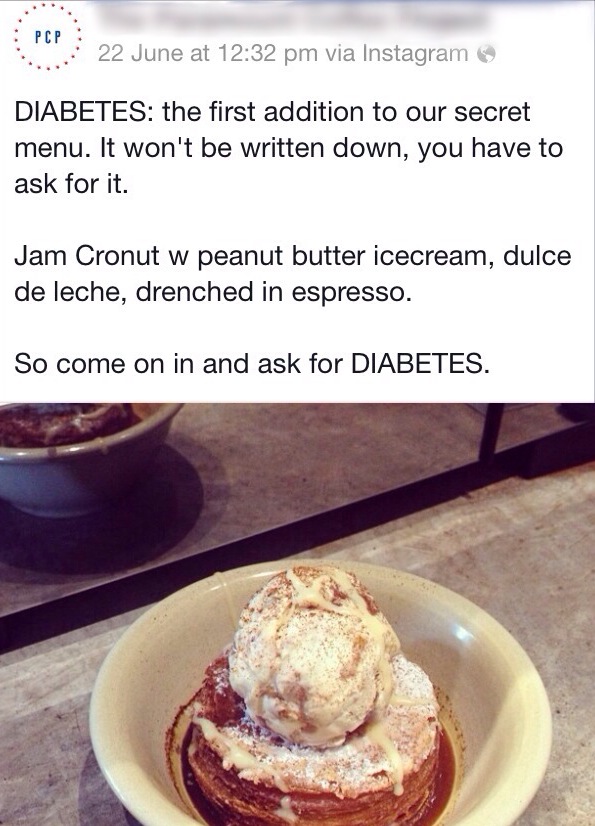
I’ve removed the name of the café, because, quite frankly, I don’t want to give them any publicity. I left a polite comment on their Facebook page suggesting that they help stop diabetes stigma rather than contribute to it and change the name of the (rather yummy-looking) dessert.
When I left my post, there were a few little comments suggesting that perhaps the name was a little insensitive. At that time (about mid-afternoon), there were 33 comments after the photo of the dessert – most of them saying how delicious it looked with a couple of detractors asking the name of the dessert be changed. There was nothing abusive – nothing rude at that point. I then tweeted the café, pointing to the offensive name of the dessert, and shared the photo on my Facebook page, suggesting that people leave a polite comment on the café’s page about why such behaviour is stigmatising to people with diabetes. By 9.00 last night, there were over 180 comments after the photo as well as many ratings and stand-alone comments – all negative.
Here’s the thing. The post was stupid. It wasn’t funny.
But neither were a lot of the comments that followed. Threatening legal action (Really? For what? Bad humour?) does us no favours at all. Also, I couldn’t help thinking ‘pot, meet kettle’ at several commenters who were claiming the café was stigmatising diabetes – only to then add further misinformation with a ‘type 2s cause it themselves….’ type remark. Sigh.
Yesterday was Social Media Day and this exercise was an outstanding example of just how effective social platforms can be at getting messages across. It wasn’t a great day for the café – they received a lot of negative comments on their page. But they have dealt with it correctly.
This morning, the café issued an apology and have renamed the dessert. Their apology was short, to the point and generally fair. It would have been more endearing promising to make a donation to a diabetes organisation, but it’s a start. (Even MORE endearing would be finding a way to send me one of those desserts, because, yes, I can eat that!)
The café’s Facebook page looks significantly different today. All negative comments from yesterday have been deleted, and the ratings function has been disabled. Should they have removed the negative comments and stopped allowing ratings on their page? Social media 101 would say no, but I guess that is up to them to decide.
So what do we, the diabetes community, do now? Acknowledging the apology is important here, and so is moving on. Many people have said ‘not enough’ and continued to be angry and abusive. I think it is enough. I don’t believe for a moment that naming a dessert ‘diabetes’ was done with any malice at all. It was stupid and careless. But there is no way that it was a personal attack on those of us living with diabetes. But there is definitely room for a discussion about why diabetes continues to be seen as fodder for bad jokes, and mindless behaviour like this. Until we get the language about diabetes right, this will continue to happen. Again. And again. And again. That is the discussion I’m interesting in having now.
For now, our point has been made; the café listened to our request that the name of the dessert be changed. Walk away; there’s nothing to see here any more.
UPDATE
Just after this blog was posted, I was interviewed by Fairfax Media journalist, Rose Powell. Her article appears here.
Following on from this post, which I believe is quite gracious in its treatment of the cafe, I was disappointed to see the site has been flooded with positive comments – many of them incredibly offensive to people living with diabetes. The cafe has, in my opinion, undone its good work by allowing these comments to remain on their Facebook page.
This week, I had conversations with two women who were embarking on something new and feeling overwhelmed. One situation was far more welcome than the other, but I couldn’t help draw parallels between the two.
Last night, we visited dear friends and their brand new baby boy. He is the picture of perfect health – tiny and round and pink. He has cheeks made to be kissed and a head of soft hair that frames his perfect, gorgeous face.
I spoke with the new mum about the delivery and her first few days with her beautiful little boy. I could hear in her voice confusion as she related stories of being told different things by different people. Who should she listen to? Was the midwife right? Or friends with kids? What about her mum?
Earlier in the week, I had a call from a woman who had recently been diagnosed with type 1 diabetes. She was about three weeks in and confused, stressed and scared. She felt that everything she was doing was wrong and was being given different advice from, it seemed, everyone she spoke with. Who should she believe? Her doctor? Her diabetes educator? Her friend who’d lived with diabetes for the last 26 years?
I listened to both these women and heard what they were saying. I had no advice for either of them – I just listened, and nodded and acknowledged the confusion. I didn’t want to add to their uncertainty by throwing my thoughts into the ring.
But I did try to reassure both of them. I wanted them to hear that they would be okay. I know that it sounds a little Pollyanna-ish to say that, but I really meant it. I pointed out that everyone makes mistakes or tries one thing and then another and then another until they find what works for them. That’s okay. And if the thing that works is different from what everyone around them suggests, that is perfectly fine.
I tried to acknowledge that their lack of confidence is understandable, but that as each day passes, and they work out their situation, they will start to feel more secure in their choices.
The thing I’ve learnt when it comes to peer support is that often, it’s not about just sharing your story. Although that’s a big part of it, the other side is listening and reassuring. People want to know that they will be okay.
Happy Friday – enjoy your weekend. Kick it off with David Sanborn. Bang Bang! (If this doesn’t get you up and dancing and clapping your hands, nothing will.)
Do you ever play that game where you change one word in a song or movie title for another? One that I find fun is changing the word ‘love’ for ‘lunch’ in old jazz standards: Love Lunch for Sale; What is This Things Called Love Lunch; I’ve Got My Love Lunch to Keep Me Warm. You get the idea. (Or for another idea, check out this Harry Potter-inspired fun!)
Today, when this ‘inspirational quote; came up in in my Facebook feed, I replaced the word ‘life’ with ‘diabetes.

I think perhaps it translates quite well. I am certain that diabetes hasn’t gotten easier for me. I’m sixteen years in – still a baby, when I think of the Kellion medallists I met recently – but even though I know a hell of a lot more about diabetes today than when I was first diagnosed, it’s not easier and it’s certainly not more forgiving. In fact, each year as I tick off another diaversary, I worry more and more about complications. Hypos have become less predictable. I still second guess myself; something that I hoped I would not do as I gained the wisdom I expected would come with diabetes longevity. I’m still waiting….
As for getting stronger and more resilient, I know that definitely is true. I’ve found that I can build up my resilience stores – it helps when things are going well and I feel that I’m top of everything.
And the strength I have found to deal with some terrible situations has surprised me. At moments where I have thought that I was beaten and broken, from somewhere I have found the strength survive. And often even thrive.
I am definitely a stronger person overall because of my diabetes. Whilst diabetes has been fairly gentle to me overall, it has certainly blindsided me at times. But despite that, I’ve coped.
I think living with diabetes means we just have to be resilient – it isn’t a choice. Giving up isn’t an option when it comes to this relentless condition.
It’s Friday! Here’s the wonderful John Pizzarelli singing ‘I like Jersey Best’.
Do a Google search of the term ‘empowered patient’ and you will be inundated with thousands and thousands of links defining the empowered patient, instructing how to be an empowered patient or advising how to deal with an empowered patient (run for the hills and refer them on to another HCP). Health conferences have sessions dedicated to patient empowerment, there are countless social media sites and blogs on the topic, and there are many journal articles – written from the perspective of both the patient and HCPs about what patient empowerment means in healthcare. It could be considered a buzz term, even though it’s been around for some time.
Health organisations for conditions from diabetes to Sjögren’s syndrome(look it up!) dedicate pages of their websites, events and resources to guiding people to become empowered and ‘own’ their condition. It’s not a new thing, and while embraced my many, is still treated with some scepticism and nervousness by some and dismissed by others.
I am what I (and most) would call an ‘empowered patient’. Whilst, I acknowledge that the term is widely understood, I’m not sure that it really is a term with which I’m comfortable. Perhaps because the empowered patient can be considered difficult and annoying – a know-it-all who is there to try to take over the expertise of their HCP. That’s absolutely not what I am trying to do with my healthcare. When it comes to diabetes, I am the first to say I know nothing about diabetes – that’s why I see an incredible endo. But MY diabetes? I am the Universe’s leading expert in that!
For me, being an empowered patient simply means that I am in the driving seat as well as being navigator of my health issues– primarily diabetes, but also other things as well. (Last year, I demanded that I have a D&C following a miscarriage despite the OB wanting to just ‘wait and see’. Waiting and seeing for me would involve horrible pain; excessive bleeding and dealing with the miscarriage whilst on a long haul flight back home from NYC. Previous experience told me that. So I made sure that my wishes were not only known, but also carried out.)
In sixteen years managing diabetes there have been very few instances where I have blindly followed medical advice without asking questions, weighing up all possibilities and talking with others about their experiences.
But I wonder how much being empowered about my health condition and active in decision making is simply because that’s the sort of person I am. When planning for anything, I am organised and informed. I seek out the right people to speak with, I consider options, I ask a lot of questions. I make decisions based on what I have learnt and what I think will be best for me. Whether it is planning a holiday, choosing a contractor or looking after my health, I empower, educate myself. It’s my personality; it’s how I roll.
So does it mean that people who are not naturally like this miss out on the choices and options afforded to people who seek them? Does it mean that if someone is unable to empower themselves (perhaps because of language or cultural barriers, their personality or a lack of understanding of, or an inability to navigate the system) they wind up with substandard care?
Being an empowered patient isn’t at the expense of the expertise and knowledge of the HCP experts we’re working with. It helps form a partnership. I honestly do believe that it is because of our empowerment – our demands and expectations – that we receive better care, better options and, possible, achieve better outcomes. We make our HCPs accountable and answerable, but more than that, we make ourselves accountable and answerable. Sharing in the decision making means we also have to take responsibility when a medical treatment doesn’t necessarily work out the way we hoped. But I’m willing to take on that responsibility.
This week in the UK, it’s Diabetes Week. I’m always interested to see the focus of campaigns for awareness weeks and this has to be one of my favourites!
Having lived first hand through diabetes weeks that have involved ticking time bombs and threats of every single diabetes complication under the sun, I wish I could give a proverbial hug to the team at Diabetes UK who have put together an empowering, positive campaign. In lieu of that, I sent a tweet.
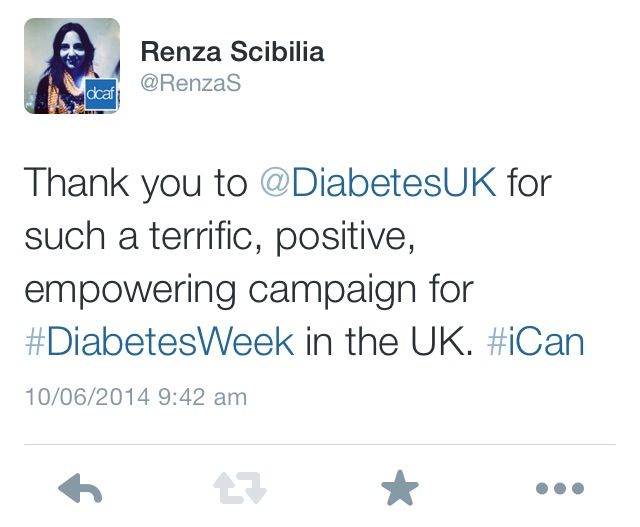
Using the slogan ‘I Can’ the campaign acknowledges the difficulties people with diabetes may experience, but wants to focus on the things that we CAN do. I love this!
I’ll be keeping an eye on this week’s campaign. I’m interested to see and hear the stories of people living with diabetes and how they have managed to face challenges.
I hope that this year’s initiative is a positive one for Diabetes UK and we see more of these kinds of campaigns in the future.
Check out the Diabetes UK Diabetes Week campaign here.
And follow the #iCan tag on Twitter.