
You are currently browsing the category archive for the ‘Advocacy’ category.
I know…it’s almost Christmas. And if you are anything like me and mine, you’ve left the run of gift buying a little late. Or you’ve wound up in lockdown. Or the thought of battling crowds is not something that you are all that keen on because there are too many un-masked bandits in the shops.
And so, here’s another little reminder that there is no need to panic because Insulin for Life is doing Secret Santa and your can absolutely buy the BEST. PRESENT. EVER. with heaps of time to spare. All without hitting pause on your Netflix binge!
It only takes $5/€5/£5 to make a real difference to a person with diabetes in an under-resourced country. That small amount will provide a week’s worth of insulin and diabetes supplies to someone who otherwise might not have them.
My family made the decision this year that in lieu of gifts for my cousins’ kids, we’d make donations instead. We absolutely adore these kids, but know that they probably won’t miss the book or book voucher we usually give them. And we also know that making a donation in their names literally means saving a life. That seems like a pretty good trade.
Without a doubt, 2020 has been horrid for many, and those doing it toughest were already likely doing it tough even before a year-long pandemic. If you are in the position to make a donation to this cause, please do. If you can share the link to the donation page with friends, colleagues and loved ones, please do.
I know that the diabetes community comes together to support our own beautifully. We’ve seen it in a million different ways. I’m hoping that in the lead up to Christmas that support will look like people making donations to Insulin for Life…and encouraging others to do the same. Please do help if you can.

I’m loathe to talk Christmas while still in November. In fact, we have rules in our house that we do not even mention the word until after my daughter’s and my birthdays which both fall in the last week of the month.
However, the other day as I was doing some supermarket shopping, I heard the strains of Silent Night and noticed glittery decorations starting to adorn the streets. Honestly, this year is so all over the shop that I have no idea what month it really is, but if Woolies wants me to believe it’s the festive season, who am I to argue?
And so, let’s talk Christmas…specifically this:

We all know how tough this year has been. We all know that there is no corner of our globe that has not been touched some way by the COVID-19 pandemic. What we should all also know is that even though COVID-19 may be global, there are some people who have been disproportionately affected, and it is always the most vulnerable people in the most vulnerable places that find themselves in that situation. Contrary to the idea that COVID doesn’t discriminate, people already doing it tough are finding things even tougher.
Which, to me, means that for those of us who can, now is as good a time as ever to step up and support anyone finding themselves in that situation.
I’ve been trying to get rid of the tradition Secret Santa or Kris Kringle (or whatever you call it in your family or workplace) for years now, instead directing those funds to a charity that supports people with diabetes living in under-resourced countries . You can read my grinch-like posts about that here and here oh, and here, where I yell that NO ONE WANTS A BATH BOMB!! It’s true. NO.ONE.WANTS.A.BATH.BOMB.
BUT! People with diabetes want insulin, diabetes supplies and education, and by ‘want’ I obviously mean ‘need’. (NO.ONE.NEEDS.A.BATH.BOMB.)
Insulin for Life Global is a charity that helps people with diabetes in need of the things that I (try really hard not to) take for granted. I have spoken and written a lot about Life for a Child (LFAC), mostly in relation to the Spare a Rose campaign. Insulin for Life Global picks up where LFAC ages out. Because, diabetes is for life, not just until you’re 26 years old.
This year, Insulin for Life is launching its new #IFLSecretSanta campaign and is asking the diabetes community to please get on board. I’m totally on board with this Secret Santa campaign because it will be more than just a novelty gift that is likely to end up in landfill.
A donation of $5 (or €5 or £5) will provide a week’s worth of insulin and diabetes supplies to a person with diabetes in one of the countries supported by the charity.
I asked around, and it seems that most office Secret Santa gifts have a limit of $10. That’s two whole weeks of diabetes supplies (including insulin) to an adult with diabetes who might otherwise not have it. If your whole workplace gets on board (or family, or friendship group, or book club…) that suddenly starts to add up to a whole lot of weeks of diabetes supplies!
As with any campaign like this, it works best when people share to help raise awareness of just how easy it is to be a part of it. AS well as making a donation, it would be terrific if as many people in the DOC could share details of the #IFLSecretSanta drive and encourage friends and family to donate.
I promise that no one is going to miss not getting a bath bomb. But people with diabetes, unable to access or afford essential diabetes meds and supplies, will be grateful if the money for that bath bomb was redirected to the charity that helps them.
Okay, DOC, now’s the time to do our thing. We do this and we do this well. While there are lots of people in this community and we certainly do not all agree, or even all like each other, it’s campaigns like this that seem like a good time to put aside differences and come together. Let’s see just what we can do to help Insulin for Life and their first #IFLSecretSanta campaign.
Donate here. (It will take you straight to PayPal to donate, and your donation will go directly to Insulin for Life.)
Hashtag away on your preferred socials: #IFLSecretSanta
This week, it’s EASD. It’s is the first year since 2012 that I have not been in Europe for the meeting. EASD was the first large diabetes professional meeting I had ever been to, and I remember being struck at that very first one in Berlin by the stark absence of people with diabetes on the program and involved in the actual meeting.
My, how things have changed.
Except, of course, they haven’t. Sure, these days you will see growing numbers of PWD wandering the conference centre and attending sessions, but that really is only because we created opportunities for PWD to attend. And once we found a way to get there, we then made sure that we were visible in different ways such as leading social media charges and holding events open to all attendees.
There has been some very well placed and relevant conversation on twitter about the lack of diversity in the EASD organising committee. Too few women; too many white faces. But when we talk about inclusion, surely, surely we need to look at other groups that are significantly and obviously absent. Where are the advocates on there? Where are the BIPOC with diabetes? Where are people living with both diabetes and disabilities? Where is there representation from the diabetes LBGTIQ community? All of these factors impact on diabetes management, so wanting to see presentations that address them makes sense. And where is the lived experience on the program to underline, and provide real relevance, to the work that is being presented by HCPs, researchers and academics?
You bet there should be more women and more BIPOC on the organising committee for EASD. But if those on the committee, those doing the research, those HCPS seeing PWD truly want to beat the ‘person-centred’ drum, PWD need to be part of the group of people putting the conference together, and then strongly represented on the stage too.
#NothingAboutUsWithoutUs seems to STILL be missing from this whole meeting – from the organisation right through to the actual delivery of information. (I suspect that there may be some PWD on the program who are HCPs. While that is terrific, it is very different from having advocates who are not HCPs up on stage.)
So, this week, if you can, please support initiatives that do highlight the people who are actually living with diabetes. Please check and double check the times. I’ve tried to work out the AEST start time for all of the events, but don’t take my word for it! (Disclosure statement at the end of this article.)
#docday° & #dedoc° voices
This is the eleventh (I think??) #docday° event and I am so proud to say that I have been involved in every single one of these events. The first one was held in the back room of an overheated and overcrowded café in Stockholm five years ago. It feels like yesterday, and a lifetime ago all at once. Organiser, Bastian Hauck, asked me to say a few words, and this is what I wrote in a blog post about the event:
‘I highlighted for me what is the most important thing when we are talking about the DOC: No one owns this community. No one is more important or more relevant or more powerful. Sure, some of us are very fortunate that we get to actually meet IRL and attend conferences, but we do it as part of our jobs – whether it be like me (through my work at a diabetes organisation mixed with my online work) or through independent consulting or other work. But regardless if you are in the room or following along on Twitter, everyone has the same right to be here and to be part of it.’
We have livestreamed #docday° events in recent years, and I have written about most of them, and done all I could to encourage as many people as possible to come along and join in. This year, it will once again be livestreamed from the #dedoc° Facebook page from Tuesday (today) 12pm CET tonight, which is 8pm AEDT.
Also, make sure you keep an eye out for all the terrific advocates who received a scholarship to attend EASD via the #dedoc° voices program. They are sharing what they are seeing at the meeting on a variety of social platforms.

SOLVABLE PROBLEMS IN DIABETES
A few hours later, diaTribe will be continuing the Solvable Problems in Diabetes events which have been regular satellite events at European diabetes meetings in recent years. During COVID times, these events have been kicked off with a community focus event, showcasing diabetes advocates, which is a brilliant (and necessary) addition to the HCP discussion that follows. I’m a huge fan of diaTribe, and have been for a long time, but it has been the addition of Cherise Shockley to their team as Community Manager that has seen a wonderful increase in representation of PWD in their activities. But, of course it has. Cherise is all about community and the way she has been able to weave her magic to make diaTribe even more relevant to PWD – and more representative – is what she does best. You’ll need to register for this event (it’s free) here, and it kicks off at Tuesday 11.30am ET, which is (gulp) Wednesday 1.30am AEDT.

SEPTEMBER SESSIONS
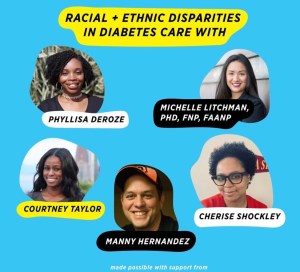
While not part of EASD, Beyond Type 1 is hosting the next in their Summer Sessions and this week it’s focusing on racial and ethnic disparities in diabetes care. There is an absolutely stellar line up in this webinar. Please do follow along if you can – this event will also be via Facebook Live over at Beyond Type 1, and is on Wednesday 8pm ET, which is Thursday 10am AEST.
DISCLOSURES
- I am ad advisor to the #dedoc° voices program. I do not receive any payment for this role.
- I am speaking at the Solvable Problems in Diabetes Community Focus Sessions. I am not receiving any payment for my involvement. I am a regular contributor to diaTribe, and I am paid for commissioned articles.
- I am on the Leadership Council for Beyond Type 1. I do not receive any payment for this role.
Diabetes conferences and scientific meetings in 2020 have looked very different than in previous years. It looked as though we were off to a flying start with a successful ATTD in Spain back in February. But not long after all the attendees returned to their corners of the globe, the world turned upside down and decided that, along with everything else, in-person meetings were done.
Major professional conferences such as those run by ADA, DUK, EASD, ISPAD, ADS & ADEA and IDF have all either happened, or will be happening, virtually, with a Zoom (or other) platform being where we meet, rather than a massive conference centre in a major city.
As ever, I search for a silver lining and if there is one it is this: the pivot to virtual conferences means that some of the main barriers in the way preventing PWD attending diabetes conferences are somewhat reduced. With travel, accommodation and a lot of the other expenses out of the way, it may be easier for advocates who would like to attend to find their way in. Let’s look at that as the disruption we needed to have to get PWD flocking to meetings in droves.
There is still the matter of registration passes, and we know that is not always the easiest thing to overcome. The registration fee is significant, and some conferences only allow HCPs and researchers in. Usually, press passes provide a way to get passed security, but they require letters of assignment (sometimes from diabetes organisations who ask PWD to act as ‘on the ground’ reporters), or other criteria be met. And, of course, there are invitations to attend satellite events extended from device and drug companies to some advocates. While there is often criticism at these methods, they have meant that there are PWD at conferences, many of whom provide information back to the community.
At ATTD, there was a new way in. Advocacy group #dedoc° launched a new program, #dedoc° voices, which you can read all about here. For the pilot of the program in Madrid, the diabetes advocates whose applications were successful had access to all parts of the meeting.
#dedoc° voices is happening again for EASD (coming up next month), and it’s not too late to apply. And as an added bonus, successful applicants will also receive registration to the ISPAD conference in October. ISPAD is the International Society for Pediatric and Adolescent Diabetes, so if you are a parent of a kid with diabetes involved in advocacy and peer support, you may be super keen to attend this one.
To apply, go here. #dedoc° voices is open to PWD now, so if you have always wanted to attend a major diabetes conference, there is nothing stopping you from applying, right now. Any one from anywhere around the world can apply – the only consideration is how you’ll manage time zone horrors if you don’t live in the same zone as the conference. (But please don’t come crying to me about that – I’ve spent the last six months settling in for hour long meetings hosted out of Europe of the US which begin long after sunset and involve perky people just waking up while I yawn and struggle not to fall asleep in my Zoom square!)
What are you waiting for? Apply now and come be a part of one of the biggest diabetes meetings in the world. I promise there will be lots of other PWD there for you to (virtually) meet up, and share ideas with. Come say hi!
Disclosure
I am an advisor to the #dedoc° voices program. I do not receive any payment for this role. 
This was one of the first things I saw when I opened my email this morning: the lead article in the latest edition of The Limbic – ‘Subsidised CGM has not improved outcomes in Australian children with T1D’.
I’m relying on the The Limbic’s commentary as the study is not open access (I have requested a copy from one of the authors), and according to the report, the focus of the study was improvements in A1C and reductions in severe hypoglycaemia.
It will come as no surprise to anyone who has read anything I have written about technology or heard me give one of my many, many talks on user experience that I found this report problematic. Screaming that a well-funded and hard-fought for program, providing much needed diabetes technology to children (and adults) is ‘underwhelming’ does not sit well with me at all, especially when the main way the program’s success has been evaluated is a highly flawed clinical measurement.
When I look at the benefits I list when it comes to using any sort of diabetes tech – or other diabetes management, whether that be a drug, an education program or even peer support – changes to my A1C is far down on the list. I understand that for some people, this is certainly a measure of success, but it is not even close to one of the first things I would consider.
My history of using diabetes technology is long and elaborate. Perhaps one of the best examples of just why A1C gives a very incomplete picture of how I measure success is my initial foray into using an insulin pump. It was almost 20 years ago, and I was only three years into living with diabetes. That story is one that could be used as an example of ‘How NOT to do pump therapy’.
I was educated (and I use that term very loosely) by a rep from the pump company. She talked at me for three hours, pressed buttons, loaded some numbers into the device and then stepped out so a dietitian could teach me all I needed to know about carb counting. She was in the room for forty-five minutes. (For context, this was my introduction to carb counting, because my first dietitian encounters were only about low GI, with a general direction of ‘Eat as much as you want of it as long as it is low GI’).
I was released from the hospital with this new device strapped to me, step by step instructions for how to do a cannula change in three days’ time, and absolutely no idea what I was doing.
But here’s what happened: I could sleep in again. I didn’t need to eat unless I really wanted to; eating by the clock became a thing of the past! I could eat brunch out with friends again, without having already had breakfast at 7am. I ate more of the foods I wanted to and stopped stressing out each time I sat down for a meal. I felt more relaxed. My life felt just a little bit more mine, rather than dictated to my a most unwelcome health condition. And sleep! Did I mention sleeping in?
My A1C was the highest it ever was. By all clinical measures, I was absolutely messing this up. But by my measures – which were based on how I was feeling, how emotionally robust I was, how burnt out I felt, how late I could sleep in on the weekend (I see a theme) – I was ticking every single box.
My endocrinologist told me that I was wasting my money (and his time) being on a pump, and nothing I could do to explain that for the first time in three years I felt like myself. Sure, I knew that I had work to do on my A1C, but I finally felt emotionally resilient enough to do that. He just shook his head and sent me on my way…and was promptly sacked.
(Luckily for me, the story ends well because about eight months later, I came across a woman called Cheryl Steele. Suddenly I could use a pump properly. My A1C came down; my quality of life remained elevated.)
My story is not uncommon. I have spoken with dozens and dozens of people who have benefited from the CGM initiate and overwhelmingly, the stories I hear are people who are grateful for the tech for what it has offered them. Interestingly, we rarely talk about those measures that HCPs and researchers seem to think are the best way to gauge the success of any sort of intervention. They talk about those same things I mentioned earlier. When the CGM initiative was first launched, parents of kids with diabetes told me they had slept for more than three hours at a time at night for the first time in years. They told me how they stopped fearing hypoglycaemia so much, because they were being alerted if their kids glucose levels were trending downwards. They told me that their kids were having sleepovers and heading off to school camp for the first time.
A1C? Maybe we would mention that somewhere down the track, but that wasn’t what got us the most excited. That wasn’t the bit we spoke about when we uttered the words ‘life changing’.
Obviously, research is important. Data is essential. It was data that provided the strong case for Diabetes Australia, JDRF, ADS, ADEA and APEG to advocate for CGM funding as part of the NDSS. But the case that was put forward also included research that looked at QoL, because the organisations know that this matters.
Research that focuses on A1C is always going to be problematic in a health condition that will never only be about that number. It’s problematic for a number of reasons – not just because it gets my shackles up before I’ve had my morning coffee. We know the pot of money that goes to supporting and funding initiatives, such as the one in this study, is very limited. Funding authorities don’t have the nuanced understanding of all the different interventions that need funding, so if a study like this comes across their desk, it could raise red flags.
I am not for a moment saying that this sort of research should not be conducted or that negative results should be buried. What I am saying is that any results need to be flagged as only ever presenting part of the issue as a whole.
I am looking forward to reading the whole study – and truly, I’m hoping that this blustering post is all a waste of time because somewhere in there, I will get to see that the researchers spent a fair bit of effort evaluation QoL as well. I’m hoping that the trumpeting heading from The Limbic is nothing more than their typical sensationalism.
My fear, however, is that there won’t be more, and that once again, PWD will have been reduced to nothing more than a flawed metric that shows only one corner of the picture of our lives with diabetes.
I’ll finish with one final thought. I advocate for PWD’s involvement in every single step of diabetes research (not just as participants of studies), and one of the reasons I do that is because when we are at the table when studies are being first mapped out, we are given the chance to remind those conducting the work that the answers they are seeking are coming from people. Real people who will always be far more than their diabetes. And somehow, that needs to be reflected in the study they are doing. It can be done. Unfortunately, this seems to have missed the mark.
Look what our community did! Here is the just released #SpareARose total for 2020. What a remarkable effort from a remarkable community!
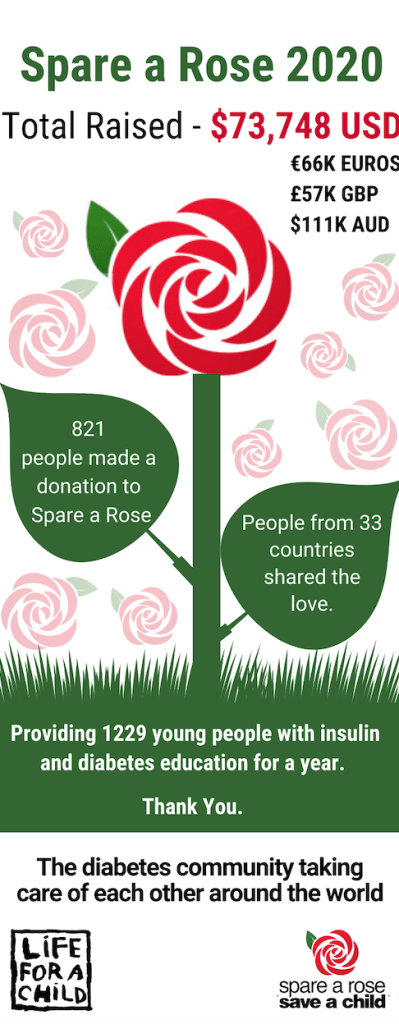
The grand total of USD$73,748 will mean that, through Life for a Child, 1229 children with diabetes in under-resourced countries will have access to insulin for the next year. Amazing!
I guess there’s nothing more to say for this year, other than thank you, thank you, THANK YOU to all who contributed – whether that be through a donation or sharing the campaign.
Spare a Rose, Spare a Child will be back next year. Each year, we promise it will be bigger and better, and I’m sure that will be the case for 2021. Just watch us all go!
‘Art is not a mirror held up to society but a hammer with which to shape it’. (A quote usually attributed to German playwright and poet, Bertolt Brecht, but actually first said by Trotsky.)
Using different artforms as advocacy platforms is not new. In my time working in diabetes (18 years), I’ve been lucky to be involved in a number of different initiatives with foundations very much in creativity and the arts. Perhaps my previous life as a musician – and being married to one for over 21 years – means that artistic approaches are always on my mind when looking at how to tell the story of diabetes.
When planning for the IDF Congress last year, a gap came up in our session on advocacy and diabetes awareness initiatives. Our Living with Diabetes stream committee wanted to look outside the box and move away from traditional awareness campaigns. ‘How about we get Appleton in?’ And that’s how we had a street artist from New York appear on the program in Busan last year in a session with the same title as this blog post!
At that time, I’d not met Appleton in person before, but I had come face-to-face with his artwork. (He’s on Insta here.) There is something quite magical when wandering the streets of NY to look up and see a bottle of insulin stuck to the wall of an old building in SoHo, or in Chelsea. I’d snapped photos and shared them to Facebook, wanting to learn more about the artist: Who is he? What is his story? What is the response to his artwork? After meeting him in Busan, and then again at a mutual friend’s place for dinner in NY, Appleton hosted me and my family in his New York studio one rainy afternoon in January and I learnt a lot about his work.
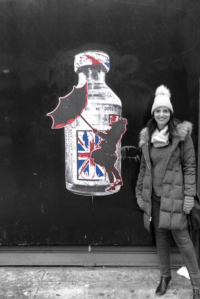
Appleton on W 23rd street.
But even before meeting Appleton, I’d seen the power of how different artforms have the potential to talk diabetes in different ways.
Australian actor and playwright, Alan Hopgood’s play ‘A Pill, a Pump and a Needle’ from a few years ago, told the story of three women living with diabetes. Chatting after a chance encounter in a café over coffee and cake, this was a quintessential Melbourne story! But it was also a great way to start a conversation with those who were lucky enough to see the play. I sat in the audience a number of times, then took to the stage to be part of the panel discussion. Mine was one of the stories that had been brought to life on stage and it was incredible to hear the number of people who watched the play and said that they could see themselves in the women’s stories. ‘Their stories are my stories are their stories,’ I would think to myself.
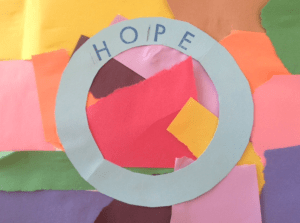
One year, my team at Diabetes Vic held an art competition for World Diabetes Day, asking children living with diabetes to submit an artwork depicting diabetes. The only requirement for submission was that the artwork needed to somehow incorporate the Blue Circle. I remember the way these pictures offered a most meaningful and impactful representation of life with diabetes – in ways that we’d not seen before. I still have one of those artworks hanging in my office. Its 14-year-old artist managed to perfectly capture the pain of diabetes balanced perfectly with the hope she felt. I’ve been looking at it a lot in the last week, breathing in deeply and letting her feelings of hope wash over me.
A number of years ago, The Diabetes Hands Foundation asked for submissions for an anthology of poems by people with diabetes. Selected poems were compiled in the book ‘No-Sugar Added Poetry’ – a copy of which sits on my bookshelf and is frequently pulled down and perused. In her introduction, Lee Ann Thill says ‘From words, carefully chosen, purposely arranged, emerges a shared experience and mutual understanding’. In other words, peer support through poetry.

And while mentioning Lee Ann… Diabetes Art Day was created by this dynamic advocate and art therapist to encourage people affected by diabetes to use whichever artform they wanted to express diabetes. I remember sitting around the kitchen table with my family, trying to show how we feel about diabetes with coloured paper, glue sticks and rubber letter stamps and ink.
Illustrator, Janina over at Miss Diabetes is absolutely brilliant in her depictions of diabetes. And, of course, comics by Claire Murray are still my favourite diabetes superhero tales. And my friend Weronika at Blue Sugar Cube, creates stunning pieces – her Spare a Rose designs were so gorgeous.
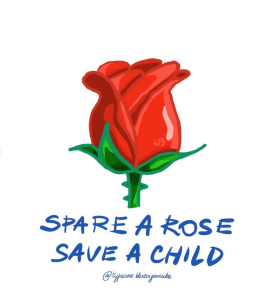
Click to be taken to Weronika’s Insta page.
Australian advocate Jenna’s artwork is nothing short of stunning. I bought one of her beautiful images earlier this year and need to get it framed so I can stare at it endlessly when I should be writing!
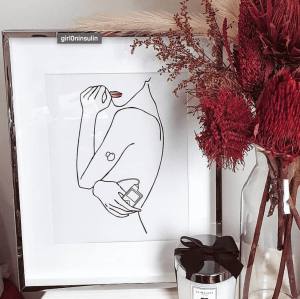
Click to be taken to Jenna’s Insta page.
Melissa Lee has combined her beautiful voice, brilliant sense of humour and story-telling powers to sing diabetes in ways that get us thinking, smiling, laughing…and crying.
As for me? Well, I create through baking and have managed to create some pretty damn fun and delicious cookies to mark important days and initiatives in the diabetes calendar.

And of course, storytelling is an artform, and I know that for me personally, that is how I have connected and felt supported by people affected by diabetes from every corner of the globe. Words have a power that can convey the very helplessness, hurt, hope and heartbreak that is real in diabetes, and as I frequently say, the stories people tell have always helped me make sense of my own diabetes.
Art has the power to reach people in ways that other, more traditional methods don’t. Health campaigns are important, but sometimes they seem just one step removed from the reality of real life. Art has the power to bridge that step and bring people together, and provide a fundamental understanding of the story being told, and the people behind those stories.
So back to the quote that opened this post: art can – and does – shape how diabetes is seen within and outside our community; it can influence how people outside the diabetes community understand diabetes, and within the community, offer different ways to think of things. It can start conversations that encourage us to consider others’ ideas; it pushes boundaries and forces us outside our comfort zones; it gives voice to people in the community who don’t necessarily want to use words to express how they feel. Advocacy using art can also cut through the white noise of health campaigns – often they all look and sound so similar that they are easy to ignore. But for me, I think the most powerful thing they give is humanity and hope to a condition that is often so misunderstood.
When I first started working for a diabetes organisation, the first big project I oversaw was the development of a booklet providing information to young people living with type 1 diabetes. After approaching a few others out in the community working with and supporting this cohort, I was promptly reprimanded by one person who told me in no uncertain terms that I (and the organisation I was working for) should butt out, because this was not our space; it was this group’s area. I was somewhat astonished at the idea of ‘owning’ a segment of the diabetes community. How did that happen? Who decided that? I was a young person with type 1 diabetes at the time (obviously, this was years ago!), and I didn’t feel especially well-represented by any one group, and I certainly objected to the idea of someone deciding that their group spoke for me and my ilk.
The diabetes community is made up of many, many voices (some louder than others), and each person has different priorities for their own diabetes, and the broader issue of diabetes in general. We see that every day with different campaigns that are driven by people in the community. Some of the most visible are movements or campaigns that employ hashtags such as #Insulin4All, (although the insulin affordability discussion encompasses more than just this hashtag), #NothingAboutUsWithoutUs and #WeAreNotWaiting, and, as we are still in February, #SpareARose. (Not too late to donate, folks!)
Actually, #SpareARose is an excellent example of this. It may have been started by a few incredible advocates, but they never felt the need to identify themselves as the ones who led or created it. They encouraged anyone and everyone to be involved in any way they could – to donate, to share, to write about it, to make vlogs. It is owned by all and by no one at the same time!
At ATTD last week, Chris ‘The Grumpy Pumper’ Aldred and I took to the stage to do a presentation on #TalkAboutComplications, which incorporates the under-discussed issue of diabetes-related complications and its intersection with #LanguageMatters. Our talk was in a session that incorporated presentations focusing on peer support and diabetes online community and technology – all very much ‘user-led’ initiatives and movements.
These campaigns are not about everyone having the same idea and perspective. People approach different issues in different ways. One person’s peer support ideal is another person’s living nightmare! And #LanguageMatters remains a topic with myriad ideas and expectations for just how embedded it should be in the hearts and minds of our community and beyond.
But it is undeniable that no one really claims ownership of any of these movements. While Grumps may have tweeted that hashtag #TalkAboutComplications first, I know that he doesn’t feel that he ‘owns’ it, or discussions around it. Rather, he used it as a rallying cry to bring people together – to find a tribe, so to speak, and to connect people with diabetes searching for information and support about the realities of living with diabetes-related complications.
I (and a couple of others) have been accused of claiming ownership of #LanguageMatters because of our frequent posts, tweets and other commentary on the issue, but anyone who has aimed that accusation at me has either never heard me speak about the topic or read this blog. Whilst I may be extraordinarily proud that I work for the organisation that developed and launched the first position statement addressing this topic, and I have been invited to speak about our work a number of times, I very clearly point out the origin story of this movement, and that is very much a story from the diabetes community.
People with, or affected by, diabetes have been speaking about how words and language impact for a long time. Older online discussion boards frequently held debates about PWD/diabetic for as long as I have been diagnosed (and I’m sure, many years before that). Parents of kids with diabetes shared how they felt judged and shamed by the words used by HCPs when their kids A1Cs were out of range, feelings echoed by adults with diabetes.
I remember one of the first articles I read in Conquest magazine (Diabetes Australia’s magazine back when I was diagnosed) was by Gordon Bunyan who eloquently wrote about how words matter. Gordon has become a good mate, and over the years I’ve turned to him regularly to talk about this issue. And I remember hearing how teenagers at camps instigated change when it came to the language used when talking about glucose levels, moving from using good and bad, to the more factual high and low. That was back before I was working for the organisation involved in those camps.
Diabetes Australia, in developing that position statement, wasn’t sticking a flag in the issue, claiming ownership – and nor have any of the people involved in its development. It was a response to something that mattered to people living with diabetes – people who told us repeatedly that the words spoken to and about them, the attitudes that those words conveyed and the feelings they had when different words were used had the ability to empower or harm.
Having organisations build programs, activities, resources and services around what people affected by diabetes are talking about unites the community. It also demonstrates a willingness to listen and acknowledge the value of lived experience. That was the thinking behind the development of DIYAPS and low carb position statements. Acknowledging PWDs’ right to choice of treatment truly does put us in the centre of the discussion.
I should say that I am not undermining that leadership that organisations and individuals show when taking on these issues. It does take people to run with the ideas and turn them into something – whether that be a position or guidance statement, or different service or resource. I admit to occasionally feeling a level of frustration that legitimacy of some of these important-to-the community issues only comes when they have been made ‘official’ by an organisation, but I also know that all stakeholders involved is important; that together we are stronger!
Last week we saw on show discussions that have their foundations very much in the community. They may have moved into the realm of HCPs and researchers, and the conference stage. But it is well worth remembering where – and why – they originated.
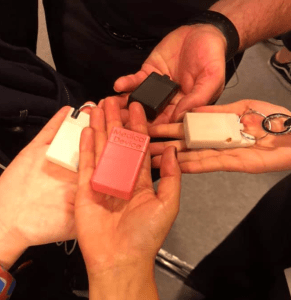
DIYAPS – started in the community and now on the program at ATTD!
DISCLOSURES
I was an invited speaker at #ATTD2020, and my registration was covered by the conference organising committee. My airfare and part of my accommodation to attend ATTD was covered by Lilly Diabetes so that I could participate in the DOCLab advisory group meeting which took place on Friday, Saturday and Sunday. Other accommodation was covered by DedocLabs (I am an advisor for the #dedoc° voices program) and Novo Nordisk (I am a member of DEEP). I have not been asked to write or speak about any of the activities I attended, or anything I have seen at the conference.
Nothing to see at diabetogenic today. All the action is over at the Spare A Rose donation page. Watch the diabetes community go, supporting this simple, yet important, campaign. For as little as AUD$7, you can provide a month of insulin to a child with diabetes in an under-resourced country. I challenge you to tell me of a better way to show your love.
Please do what you can – every single donation helps. Just click to donate and #SpareARose.






 Diabetogenic