
You are currently browsing the category archive for the ‘Advocacy’ category.
A couple of weeks ago at the ADS ADEA conference, I spoke at one of the Symposia about how healthcare professionals can get involved with diabetes social media. Today, social media has the ability to connect people like never before and is something about which I am passionate. I speak and write regularly about the power of the diabetes online community (DOC) as a way to bring together peers; my presentation at the Doctors 2.0 and You conference in Paris back in June discussed how social media can be used to connect four of the players in healthcare – patients, healthcare professionals, healthcare organisations and industry.
I was a little nervous about discussing this topic because I know how reticent a lot of HCPs are when it comes to social media and its value to people living with diabetes. Because of its very nature, social media is unregulated. There is just so much out there; how is anyone meant to know where to direct people? And equally, what should be given a very wide berth? (For the record – anything claiming that cinnamon cures diabetes is a crock and should be ignored!)

With thanks to the clever people at Diabetes.Daily.com
But actually, that wasn’t what my talk was about. My talk was about why people with diabetes turn to social media; what (and who) we look for and what we get from an online community of peers that we can’t necessarily get from our HCPs. I then moved to discuss how HCPs can engage with the very same things we are using.
My presentation was gentle – a lot of the people in the room had never considered using Facebook as a tool to provide support and connect with others living with diabetes. Whilst there is a general understanding about the value of peer support, that view is often out-dated and focuses on a more traditional picture – face-to-face support groups.
I discussed how health professionals around the world use social media as a mechanism to connect with other health professionals and how crowdsourcing diagnoses works. I suggested the audience look up Bertalan (Berci) Meskó and consider enrolling in his online Social MEDia course.
I explained how Twitter is about far more than finding out what Kim Kardashian ate for breakfast and discussed weekly diabetes tweetchats, urging the HCPs to check in, lurk for a week or two and then take part.
Social media works for people with diabetes because it feels like a safe place. I know that idea is completely contrary to what many HCPs believe – they see it as anything but safe! But I know that I can log on to Twitter or Facebook at any time of the day or night and there will be someone there who can say to me ‘I know how you feel’. There will never be judgement; there will never be accusations of not trying hard enough. But there will be support.
And I guess that’s the crux of this. We know our community and we feel safe there. In his TED talk, Berci Meskó discusses how crowdsourcing works when you know your audience and your social media networks.
The final thing I discussed was diabetes blogs. There are two ways HCPs can use blogs. The first is for themselves; they can read them; they can take in what people are saying. Because it’s by reading the blogs of people living with diabetes that the real-life stuff comes through. It’s a way for them to get a good understanding of the things that we don’t talk about in our appointments with them, but the things that are important and impact on how we manage not only our diabetes, but our every day lives.
Also, they can use them for their patients. If ever a patient says ‘I feel so alone’, I suggested that they direct them to a well-known diabetes blog. There will probably be a post somewhere in the diabetes blogosphere that will address the same issues the PWD are experiencing.
The diabetes social media world does not need to be scary and regarded with suspicion. The role of HCPs is not under threat because PWD are using social media – that’s not what it’s for. It is just the 2.0 version of peer support.

Don’t forget – weekly #OzDOC Twitter chats are on Tuesday at 8.30pm (eastern time).
DISCLAIMER
The Can Technology Cure Healthcare’s Future symposium was sponsored by Sanofi. My travel costs were covered by Sanofi, however I did not receive any payment from them. Sanofi had no input into my presentation. Good on them for supporting such an important topic!
There are times that I am dismayed at what I read on Facebook about people navigating diabetes care for themselves or their child. Today, I was asked for my comment on a situation where a child with type 1 was being threatened with the removal of her pump because her HbA1c was higher than target.
This really gets my blood boiling for a number of reasons. Let me count the ways!
- A pump is not a luxury. It is a way of delivering insulin. Let’s be clear about that. It is a tool that we use in the management of our diabetes.
- The only person who has the right to determine how their diabetes will be managed is the person with the faulty pancreas (or their parents in the case of young children).
- HCPs are there to work with us and be guided by what we need and what we are asking for. Equally, we look to them for support, education, advice and information about our diabetes management. We do not look to them to be told off or judged.
- Punishing a PWD by removing a management tool is just plain stupid. Like it or not, I need to give myself insulin and I choose to use a pump to do that. If I’m feeling a little unmotivated and don’t have the capacity to be checking my BGLs, taking away my pump is not suddenly going to give me an injection (bad, bad pun) of motivation.
- Scare tactics DO NOT WORK. I’m going to say that again. Scare tactics DO NOT WORK. Also, scare tactics DO NOT WORK.
- The person in charge at all times is the person with diabetes. Let’s be clear about that too. The PWD is up front, directing traffic. HCPs, diabetes organisations, friends and family are there to support the person in charge.
- This is going to sound crass, and I don’t mean it to, but HCPs need to remember that they are being paid to do our bidding. They are providing us with a service. And that means, if we don’t like the service, they get sacked and we find someone who will give us the service we need.
- Threatening to remove a pump is bullying behaviour and it absolves the HCP of any responsibility in the management of their patient. I will never blame my HCP if my A1c is out of range or I am not checking my BGL. I would ask that they don’t blame me and threaten me.
- Deciding to take away a pump because HbA1c is too high is placing far too much importance on the value of the HbA1c! It’s just a number that gives an average. But not much more.
- Also, by using results of an HbA1c check as a reason to threaten to remove someone’s pump is forgetting about the considerable emotional impact of diabetes. Just as an out of target A1c is not a reason to rap someone over he knuckles, an in-target A1c is not necessarily an indication that everything is A-okay.
I know that it is not always easy to be your own advocate, but it’s times like this that you really need to be able to stand up for yourself (or your child), or bring along someone who can. Being clear about what you want and need is important – and that includes being clear about what you won’t accept.
I attended the ADS/ADEA conference last week in Sydney just for one day to present at a technology and healthcare symposium (more on that soon).
It was one of those crazy days that started long before the sun rose. I can’t be chipper at 6.30am as my travel companion realised as he greeted me in a very cheery manner only to be met with a steely gaze and pronouncement of ‘I’m yet to have coffee’. It sounded like a threat!
After my presentation, I made the most of a couple of hours at the conference and caught up with as many people as possible. I’d arranged about eight ‘we’ll chat at the conference’ meetings and ended up seeing four people.
I only made it to one session apart from my Symposium and it was a debate.
I love a bit of debating. Those who know me won’t be surprised to know that I was in the debating team when I was at school (Renza nerd fact #3569). But the topic at the conference made me a little uncomfortable and that was before anyone even opened their mouths!
‘It’s our fault if our patients’ HbA1cs are too high’
I don’t like the word ‘fault’. Blaming people for being outside their diabetes targets rarely does anyone any good. As the people living with diabetes, we don’t like to be blamed or told off if we’re not meeting targets, so blaming our HCPs doesn’t make much sense to me either.
Nonetheless, I went along to see what was said.
First up for the affirmative – Cheryl Steele. Now, as far as I’m concerned, Cheryl Steele is wonderful. She was one of the first people I saw present about diabetes when I was first diagnosed with diabetes and she has inspired me ever since. She is a favourite speaker of the T1 Team at DA-Vic, not only because she does a brilliant presentation EVERY SINGLE TIME, but also because of her tell-it-like-it-is manner. And the fact that she is living with type 1 makes her even more awesome! She changed hats a few times yesterday whilst giving her presentation –sometimes speaking as a CDNE and other times as a PWD. And the confusion about anagrams was one of her points.
The affirmative team’s argument was that until HCPs stopped moving the goal posts, provided better tools for management and stopped disagreeing on what they were telling people with diabetes, then yes, they had to consider taking the blame for their patients higher than target BGLs.
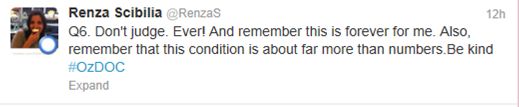
The negative said there was no way that HCPs could be blamed – and were at great pains to point out that they weren’t blaming the PWD. Except there were times that they came pretty damn close – as evidenced by this tweet:

I felt a little uncomfortable at times during the debate. Although it was very tongue in cheek and there was great spirit throughout the session, there were moments that I wondered just how much truth was in the silliness. It is a little like the ‘oh-we’re-just-joking’ comments about patients lying about filling in BGL record books.
I know that by and large the HCPs in the room are there for the PWD (I was sitting next to my endo and I know that’s definitely the case with her), but I do get a little concerned at the lack of understanding about what life with diabetes is all about when the negative team thought that dealing with a life-long chronic health condition is kinda like taking a course of antibiotics.

Was I being a little too sensitive? Possibly. Am I expecting HCPs to get it wrong? Again, possibly. But as a consumer advocate, I am on heightened alert to make sure that there is compassion, understanding and respect being directed towards PWD at all times. I’m not sure that was necessarily the case throughout the debate last week.
Next time, I’d love to see a debate between HCPs and PWD. Now THAT would be worth paying money to see!
There was an interesting post in the diabetes blogosphere this week by a paediatric endocrinologist in the US. She tells the story of a young woman whose A1c didn’t match the numbers in her meter download. It turned out that she had found a way to manipulate the meter into giving false readings that, as it turns out, were all in target. I love that this blog is incredibly sensitive in dealing with these issues and there is no judgement directed towards the young woman in the story.
One of my biggest frustrations as a – often the only – consumer representative attending scientific conferences is the constant remarks about ‘non-compliant’ patients or snide remarks about false numbers in log books. Or the complete absence of logbooks.*
I have often wondered if the questions shouldn’t be about why the patient isn’t telling the truth but rather why they feel they can’t tell the truth.
I also don’t think that we should be pointing fingers and saying people who do this deserve everything they have coming to them and if they wind up with complications it’s their own fault. Really? Let’s dissect that for a moment.
I am pretty certain that no PWD who is not being completely truthful about their numbers is ever thinking ‘I am doing this because I want to get diabetes complications’. I am sure that as each day goes by without a consideration to diabetes – no BGL checks, limited boluses, food they are told not to eat etc – the PWD is not thinking ‘Goody – I’m a day closer to diabetes complications’. I am also sure that they are dealing with guilt, confusion, feeling physically below par and incredible frustration. They probably also feel isolated and don’t know where to turn. (Well done to Shara, the endo who wrote the blog, for referring her patient to a counsellor and actually spoke about the burden of diabetes. And thanked her for being honest.)
Let’s also for a moment just remember that blaming people for developing complications is really unfair. Yes, we know that by keeping our A1c under 7% we reduce the chances of developing diabetes complications. But keeping that A1c under that magic number all the time is incredibly difficult. So many things can throw off even the finest of efforts – stress, a virus, faulty insulin, a personally or professionally difficult time are just a few reason why.
And there are people for whom complications still develop despite doing all the things they’ve been told would help reduce the risk. Sometimes, it still happens.
I have an endocrinologist who was either born without the judgement gene or has simply beaten it out of herself (or perhaps had patients beat it out of her). I never feel judged by her. And for that reason, I feel that I can be completely honest with her. I can tell her that I’m not doing great and not checking my sugars as much as either of us would ideally like me to be.
I contacted her after my recent miscarriage to let her know what happened and said I’d be in touch. I didn’t call, A week or so later, she sent me a message saying that she’d had a cancellation this week and could see me. I could have made up a million reasons as to why I couldn’t go – work, family, too busy, not available at the time. Instead I simply said that I needed some time to regroup and I’d call her when I was ready. That’s how I feel. That’s the truth. And when I see her I’ll tell her more of the truth, which is after 13 weeks of intense diabetes scrutiny, I’m taking a break. I’m not checking my BGLs 20 times a day as I was (even while wearing a CGM constantly) so I’m not doing a heap of micro bolus corrections throughout the day. Right now, diabetes is not something that I particularly care about because I am grieving and just trying to get through the day. I bolus for what I eat, I have a constantly full reservoir and I am changing my line every 3-4 days as usual. That’s all I can do. It’s enough.
Another huge frustration for me is judgement from other PWD. We are constantly rallying against judgement from HCPs or people who know nothing about diabetes. In my mind, that intolerance of diabetes judgement extends to PWD. Can anyone honestly say that they live a perfect diabetes life and always have done so?
No? Then how about you check your judgement at the door? How about we ask the question why people feel unable to tell the truth? How about we consider the emotional state of the person behaving this way and ask what help they need to be able to do what is required to live a healthy life with diabetes?
And how about we just support each other and admit that sometimes diabetes is so hard that showing up for a medical appointment deserves acknowledgement and a pat on the back.
*Here’s an exercise for anyone who has ever been judgemental about creative number-entering into log books. Get yourself a diary and for the next twelve months, write down every item of food or drink you put in your mouth including the quantity. No cheating, no exclusions, no forgetting. Every single thing, every day for a year. How hard do you think that would be? Now imagine that you have do to that and show it to someone. How would you feel having to show someone the day where your whole diet consisted of a bloody mary for breakfast and an ice-cream sandwich for dinner? Actually – the three days in a row that you did that. Now do it for life.
It’s Diabetes Blog Week and this is my Tuesday post which was first published at the Diabetes Australia – Vic blog.

It’s Diabetes Blog Week thanks to the very clever Karen Graffeo at Bitter~Sweet Diabetes. This week, over 130 diabetes bloggers from all over the world are taking part and sharing stories about their lives with diabetes. This is the second year I’ve participated and I can’t wait to read what everyone else is up to. I’m in for a lot of very late nights! So, here we go with the topic of Monday……
Often our health care team only sees us for about 15 minutes several times a year, and they might not have a sense of what our lives are really like. Today, let’s pretend our medical team is reading our blogs. What do you wish they could see about your daily life with diabetes? On the other hand, what do you hope they don’t see?
I have frequently commented on how lucky I am to have a health care team that consists of some pretty amazing people. My endo actually does read my blog and recommends it to not only other people with diabetes, but also to endos-in-training. I completely understand how unusual this is, but it makes me realise just how fortunate I am to have a HCP who has some insight into my real-life with diabetes. Or at least, the things I’m prepared to share!
So, because of that, I’m going to concentrate on the second part of today’s topic – the things we don’t want them to see.
And the truth is, there’s nothing I don’t want them to see. I could say that I’d prefer they didn’t know about the days where my meter doesn’t see the light of day as it languishes around the bottom of my bag; or the days where my CGM graph looks like a mountain range; then there are the days where I know I should do a line change, but can’t be bothered and just deal with the higher BGLs and the angrier and redder cannula site; oh, and the culinary delightful days where my total nutritional intake consists of three coffees, a jam doughnut and a piece of toast with Nutella.
But I believe that this may be called life. And it’s important that they know these days are kind of typical! I am not perfect in any aspect of my life, so why should I pretend to be when it comes to my diabetes? And why should my HCPs be presented with only the stuff I do ‘right’?
I want my HCPs to see real-life with diabetes; which is basically real life. With diabetes sprinkled on top! We all have so much more going on. Diabetes? Of course it’s a part of me, but it needs to fit in with the rest of my life. And for me, that’s one of the most difficult things about life with diabetes. How do I manage to do the things I’d like to do to feel healthy, strong and well but keep things in perspective?
Actually, perhaps that’s one of things I’d like HCPs to see and know – I’m trying. Each and every day I’m trying. And that is more than enough!
Follow Diabetes Blog Week on Twitter by searching the #DBlogWeek tag.
I am lucky when it comes to my diabetes support network. I know this and I will say it several times in this post. I also know that I am likely to come off as being ungrateful which is not the case at all. Today, I want to explore the idea of how these support people are identified, either by themselves or by people living with diabetes. Specifically, I want to talk about the term carer.
The Oxford Online Dictionary defines carer as:
a family member or paid helper who regularly looks after a child or a sick, elderly, or disabled person.
I don’t have a carer. I am the person responsible for living with my diabetes, but I do not have a disability and I certainly don’t consider myself sick. And, although I’m pushing a ‘significant age’ I am not yet elderly.
I understand and completely believe that there are people who are really and truly carers. There are people who are responsible for feeding, toileting, bathing, communicating for another who is unable to do it themselves. I am not referring to instances like this. I am referring to, I guess, diabetes.
I don’t consider my husband, who is involved in my life with diabetes to be my carer. He’s my husband, my partner.
Living with diabetes is not a solo game for most and this is a truly wonderful thing. We get support and help from people and I for one feel very fortunate to know that I have people (family, friends, healthcare professionals), I can rely on if I need them.
But I don’t consider any of them my carer. I would refer to them as my support network. In the case of my HCPs, they’re paid to help me with the things I need.
My husband would never say that ‘we’ are a family with diabetes. He would say that I (his wife) have diabetes. Not for one moment would he consider himself to be living with this condition even though he regularly is part of it. But as far as ‘ownership’ goes, it’s mine. He will step up as much or as little as I ask and in the few times it’s been necessary, he’s taken over, done what’s needed to be done and then, when safe, stepped back.
My independence and confidence in my ability to self-manage comes from being given the space from those around me to do what it is I need to do. I know there have been times when Aaron would like to sit me down and force feed me glucose because he can see that I am low. As I stand at the open fridge and in my hypo-fog state try to calculate the carbs in a cucumber (yes, I know!) he has had to just step back and let me work it out myself, stepping in if asked.
I see this like watching my daughter do something in a way that is frustrating to me. I would love to jump in, show her how to do it far more effectively (or do it myself) and then move on. But her self-confidence and her ability to trust her decision making process needs to be encouraged, not overshadowed by a parent who insists on taking over all the time which suggests that she cannot do anything herself.
To me, the term carer implies helplessness. I get that diabetes is a lifelong condition and that there are stages in a person’s life when they may need extra care. For example, children with diabetes are reliant on their parents for the day-to-day management tasks. But is that being a carer or is that called parenting albeit with an incredibly extra degree of difficulty? Or what about an adult with diabetes who is having a period of hypo unawareness and their partner is required to, at times, inject them with glucagon? Is this being a carer or is this just doing what partners do – look after each other at a time of illness or need?
What about when I am lying in bed, unable to move because my BGL is high, I have mild ketones and am vomiting? As I decide whether or not I need to take myself off to A&E, my husband is holding a bucket in one hand and my hair in the other. I don’t consider him to be my carer, any more than I considered myself to be his carer when he hurt his back and I was warming up a heat pack and giving him pain killers every four hours.
I don’t in any way want to undermine the importance, help or value of the support I receive. I don’t for a minute want to say that I don’t need it or resent it. But equally, I don’t want to be considered as being helpless. The relationships I have with people where diabetes is sometimes considered are based on incredible respect – from both parties. They respect that I am the one who is living with this and dealing with it and I respect the way they allow me to do that.
Okay, over to you. Do you consider the people in your life to be your carers when it comes to diabetes, or do you consider yourself to be the carer of someone with diabetes? Is there another term that you use or prefer?
I hate to jump on any bandwagon, but I’m jumping on this one – boots and all! Some of you may have seen the petition that is going around at the moment about changing the name of diabetes, or rather revising the names of type 1 and type 2 diabetes to better reflect the nature of the conditions.
Yesterday, I read a most thoughtful and well-considered commentary on the issue by Queen of Diabetes Art Lee Ann Thill. (I don’t know Lee Ann personally, but I adore the work she does around Diabetes Art Day and her brilliant project the VIAL Project.)
Lee Ann suggests that changing the name of type 1 diabetes to better distinguish it from type 2 diabetes is not going to do anything when it comes to public understanding of diabetes. She’s right. Stop for a minute and think back (if you can) to a time where diabetes wasn’t part of your life. How much did you truly know about the condition? Did you even know there were different types of diabetes? Could you identify the myriad ways type 1 diabetes is treated?
Did you know that there are four types of multiple sclerosis? No, neither did I until I asked Dr Google. (Although, I did know that there was one called relapsing-remitting MS because that’s what Jed Bartlet had in The West Wing, so naturally, I’m an expert on that!) And is it really important that as a person who has no connection to anyone living with MS that I have an in-depth knowledge about it? Or understand how it impacts on the life of a person with MS? Should I be expected to understand that primary-progressive MS is different to progressive-relapsing MS? My tiny little brain is already pretty full of information I need (location to closest decent coffee shop) and useless info (being able to quote Marx Bros films), so I’m not sure that I have room for minute details about living with MS or any other health condition other than the one I have to deal with daily.
I understand how frustrating it is to have people tell me that they can cure my diabetes if only I’d stand on my left foot under the full moon on a Tuesday in November and lots of other things. But I don’t think that changing the name of diabetes is going to stop people offering these gems.
What we really want to fix are the people who are being stupid and insensitive. And I’m afraid that’s just not going to happen.
Diabetes sucks – I think that’s one thing upon which we can all agree. And there are some really significant and important issues that people living with this condition face on a day-to-day basis. Such as access to healthcare and to technology; inadequate healthcare; kids being safe while at school; discrimination in the workplace; emotional wellbeing;
None of these issues will be solved or made better for people with diabetes by changing the name of the condition. More funding is needed to improve access to technology and increase the number of HCPs (especially in rural and remote areas); better education and training is needed to improve HCPs’ knowledge about diabetes and real-life with diabetes; more training – compulsory training – is needed by the people who are charged with looking after kids in school and out of school hours care; tougher penalties may stop discrimination in the workplace; regular screening is needed to identify the emotional health of people with diabetes.
Surely, but surely we should be directing our energies towards these issues. I have accepted that when it comes to diabetes I am going to spend the rest of my life dealing with ignorant, stupid and insensitive comments from people who could be described using similar adjectives. Changing the names of type 1 and type 2 diabetes won’t magically make people stop being so ignorant. It would simply add another layer to the confusion.
Yesterday, the same question was posed to me twice: ‘How would you like health professionals to deal with people living with diabetes?’
The first time was after a short presentation I gave to a team of physicians visiting Australia from Thailand. I am incredibly privileged in my role at Diabetes Australia – Vic because I get to meet some amazing people from all over the world. The visiting doctors were very interested in our program and asked some great questions about how we run things – especially around the value and importance that we place on peer support and peer networks.
The second time was as part of last night’s OzDOC tweetchat. I was moderating the hour of rapid-fire diabetes cyber-chat, but it was Kim Henshaw who had come up with the ingenious topic of swapping places with our HCPs. Kim had posed some really thoughtful questions about how we would like our HCPs to respond in certain situations. The answers were amazing.
When I was asked the question for the first time -almost as I was walking out of the room after my presentation yesterday – I didn’t hesitate to answer.
‘Without judgement,’ I said. But then I felt that I needed to qualify that with, ‘And for them to realise that I live with this 24/7 without an opportunity for a break. I am doing all I can and there are going to be times that it is just too much.’
‘Thank you,’ the doctor who asked the question said.
‘Oh, and that it’s not all about numbers,’ I added quickly. ‘My A1c, blood pressure, weight, cholesterol – all my numbers – don’t give you anything more than a snapshot of a particular metabolic thing. I am much more than that.’
‘Good – that’s great. Thanks,’ said the doctor
‘And,’ I jumped in (guessing by now he wished he hadn’t asked the question), ‘It’s about more than the clinical side of things. My emotional wellbeing is just as important and if I am feeling burnt out emotionally, it’s highly likely that I’ll be struggling to get the day-to-day physical tasks done.’
‘Right. Thank you. Our next speaker is here,’ he said.
What he didn’t realise was that the next speaker was the fantastic Professor Jane Speight from the Australian Centre for Research in Diabetes. Later on she thanked me for setting the stage for her and what she was about to talk about. I thanked her for so eloquently providing the evidence to support my rantings!
I was more than ready for that question last night at the tweetchat!
Oh VicRoads, are you trying to destroy me? Really?
With all that has been going on with the issues surrounding the new driving and diabetes guidelines; with all the inconvenience you are causing for people who are living with diabetes each and every day – all the hoops you are making us jump through; all the bureaucracy you have built in for us to simply hold a drivers’ licence, wouldn’t it be nice that just for once you could be a little – just a little – accommodating?
And yet, when I jump through each and every hoop and call you to ask you for an extension on getting my eye review form in I am told no. An extension will not be granted because my medical review form (different to the eye review form) was one day late.
I am unsure as to why I have to submit an eye medical review – I’ve never had to do that before. My eyes have been stable for years. This was clearly documented on my medical review form.
The woman I spoke with at VicRoads told me that if they did not receive my report on time, I would be issued a letter the following day telling me my licence was suspended. However, according to her, I have a two week grace period in which I can still drive. So why not simply give me an extra week so that I can get the form in on time? I have made an appointment to see my ophthalmologist, but of course, could not get a time until the day after the report is due. (He’s away at the moment as is half of Australia ‘cause it’s – you know – Summer holidays).
My driving record speaks for itself as does my diabetes record. I know more about how safe it is for me to get behind the wheel of a car than most people. I check my BGL, I make sure I travel with food in case I go low, I wear a CGMS that alarms not only if I am low, but if my BGL is dropping too quickly so I can prevent a hypo.
And never before have I been late with a review.
So – here’s some advice for everyone after the trials and tribulations I have dealt with in the last few months with Vic Roads:
- Regardless of when you have an appointment with your health professional to fill in your medical review form, call VicRoads the second you receive your letter requesting a review and tell them that you need an extension. There are dozens of reasons that this may actually occur – appointment is cancelled, doctor takes extra time to send the report, you don’t make it to the post office on time etc etc.
- If you do not get the report in by the due date, you will receive a letter from VicRoads warning you of the suspension which will take effect in two weeks. You cannot ask for an extension at this time; it’s too late. If you think you’ll need extra time, call BEFORE the due date of the original letter (usually 8 weeks from the date of the letter) and ask for the extension.
- Remember that it takes time for the medical review team to process your review. So even if you do get it in on time, there could be a delay in you getting the ‘all clear’. Obviously, this isn’t a problem if you get it in way before the due date, but if you’re just sneaking it in on time, it could result in your licence being suspended. I actually took my last review form into VicRoads and asked to speak with someone from the medical review team and pretty much demanded that they approve it that day.
- Off the top of your head, do you know the date your driver’s licence expires? No cheating – do you know? I had no idea and found out the hard way one morning when a police car pulled me over as I was driving to work. After they did a random number plate check and discovered my licence had expired I was fined $359. Great way to start the day! I had absolutely no idea my licence had expired and was 100 per cent certain I had not received a reminder letter from VicRoads (actually, being paranoid every time I get a letter from them, I was more than 100 per cent sure). I went straight down to VicRoads to renew my licence and asked if they had my correct details because I had not received a reminder about my licence. I was right – they had not issued a reminder because my licence had been suspended. Since November 2010. I nearly fainted. Long story short: apparently it was a clerical error with some smarty-pants at VicRoads indicating that I had not submitted my last review. Despite the fact that I had in my hand a letter saying it had been received and I was good to drive for two years before the next review. As I found out, reminders are not issued if your licence is suspended. (The fine was overturned, but it took a lot of time, letter writing, and sitting on the phone for this to happen!)
Having a licence is essential for many – most – of us, and whilst a pain, I completely understand why I need to have a medical review form filled in every couple of years.
But making things difficult for us only makes us angry at the process and the inconvenience of it all. Anecdotally, I’ve heard of people who simply don’t tell the licensing authorities about their diabetes to avoid the rigmarole involved in having a conditional licence. This is far more dangerous, in my opinion and puts these people at significant risk because of insurance and legal implications.
And this brings us back to the whole driving and diabetes issue and the development of the new guidelines. How is it possible for licensing authorities to have any idea of the actual process and how it impacts on people living with the condition if we are not consulted? Had Diabetes Australia been given a seat at the table when the new guidelines were being developed, this would have been considered. Had consumer reps been invited to take part, this would have been raised as a concern. It’s not good enough. Because this isn’t a simply list of guidelines on a page of a website. This is about our lives.
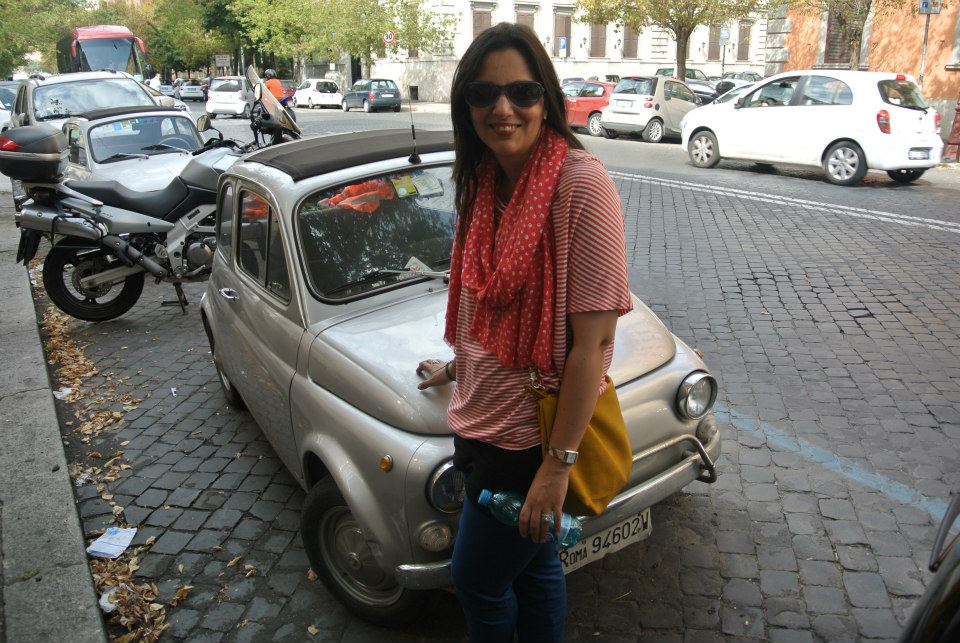
Obligatory photo of FIAT 500 that accompanies any driving posts. I may be a little obsessed. #dreamcar





 Diabetogenic