
You are currently browsing the category archive for the ‘Advocacy’ category.
If you have anything to do with diabetes and glanced at Twitter this week, it’s unlikely that you could have missed the juggernaut that was #IWishPeopleKnewThatDiabetes.
Wednesday 22 April was designated the day that the Diabetes Online Community would come together and share what we wish people knew about diabetes. We kicked it off with great force here in Australia and it took off like a runaway train from there! Late on our Wednesday night, I watched the US wake up and Twitter explode with the #IWishPeopleKnewThatDiabetes hashtag. I had to force myself to turn off my devices and go to sleep because I could quite easily have stayed up all night following.
I was amazed at the diversity of the things people were sharing. I found myself laughing out loud and wiping away tears at some of the things I read, and a lot of the time, nodding in agreement.
Critics of these sorts of activities say that they are a waste of time – that we are preaching to the converted and that it is a self-indulgent pity party. I say that’s rubbish!
Firstly, even if the majority of people who read the tweets are others with diabetes, why is that a bad thing? Building our community – coming together, supporting each other, listening to others’ stories – is how and why we become stronger. I had several people reply to my tweets telling me that they felt the same way. I did the same thing several times.
And there is absolutely nothing wrong with fist pumping and patting ourselves on the back for living with diabetes. Or saying it is tough. Diabetes does suck sometimes; it is difficult to live with; it is a shit. Acknowledging that doesn’t make us weak or pathetic. It doesn’t mean that we have given up or that we think that we have it worse than anyone else in the world. It is just saying how we feel.
I didn’t read all the #IWishPeopleKnewThatDiabetes tweets (there are over six and a half thousand of them!) but I did read a lot of them. I read tweets from people I know well and those I’ve never come across. I connected with new people and retweeted and retweeted and retweeted until I thought I was going to be sent to Twitter purgatory for a while and told to settle down!
Well done to Kelly Kunik who kicked this off last week. I don’t know that Kelly has had much sleep over the last few days. She seemed to be tweeting and retweeting pretty much around the clock! Kelly is a bit of a force of nature. I caught up with her and another DOC friend, Stacey, when I was in NY and the three of us spoke so much we forgot to eat. Seriously. We remembered to drink coffee, but somehow we didn’t remember to order lunch! Hope you’re getting some rest now, Kelly!
I couldn’t even begin to say what my favourite tweets were. Perhaps the ones that focussed on advocacy issues and dispelling myths. But every single one did resonate in some way – even if the experience was not the same as mine. I feel that I have a better insight into how diabetes affects people’s lives. I hope – and am sure – that others have walked away feeling the same way.
(To see the reach of the #IWishPeopleKnewThatDiabetes hashtag, click on this link. At the time this blog was published, it was up to almost 14,000,000 impressions.)
We added another SHAG print to our collection the other night after attending an exhibition opening at the fabulous Outré Gallery. We now have two huge artist proofs that are based on the fabulous Peter Seller’s film The Party. Dance your way into the weekend with the soundtrack here!
Let’s start with the ridiculous. This found its way to me yesterday:
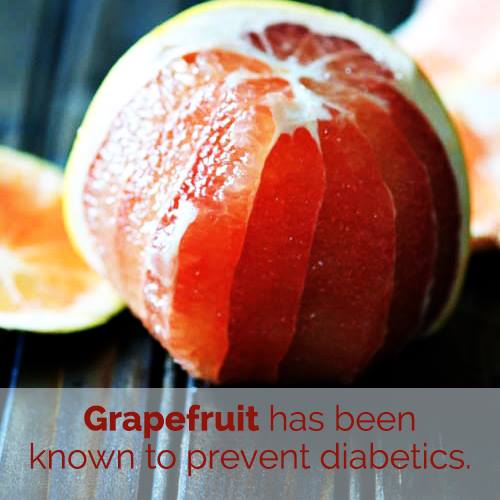
What? Grapefruit has been known to prevent ‘diabetics’ from what? If anyone can explain that to me, please do so in the comments below. (And yes, it originated in some ridiculous we-can-cure-you-of-everything site that promises the world and delivers nothing. Except bad grammar.)
Thankfully, it was balanced by this:
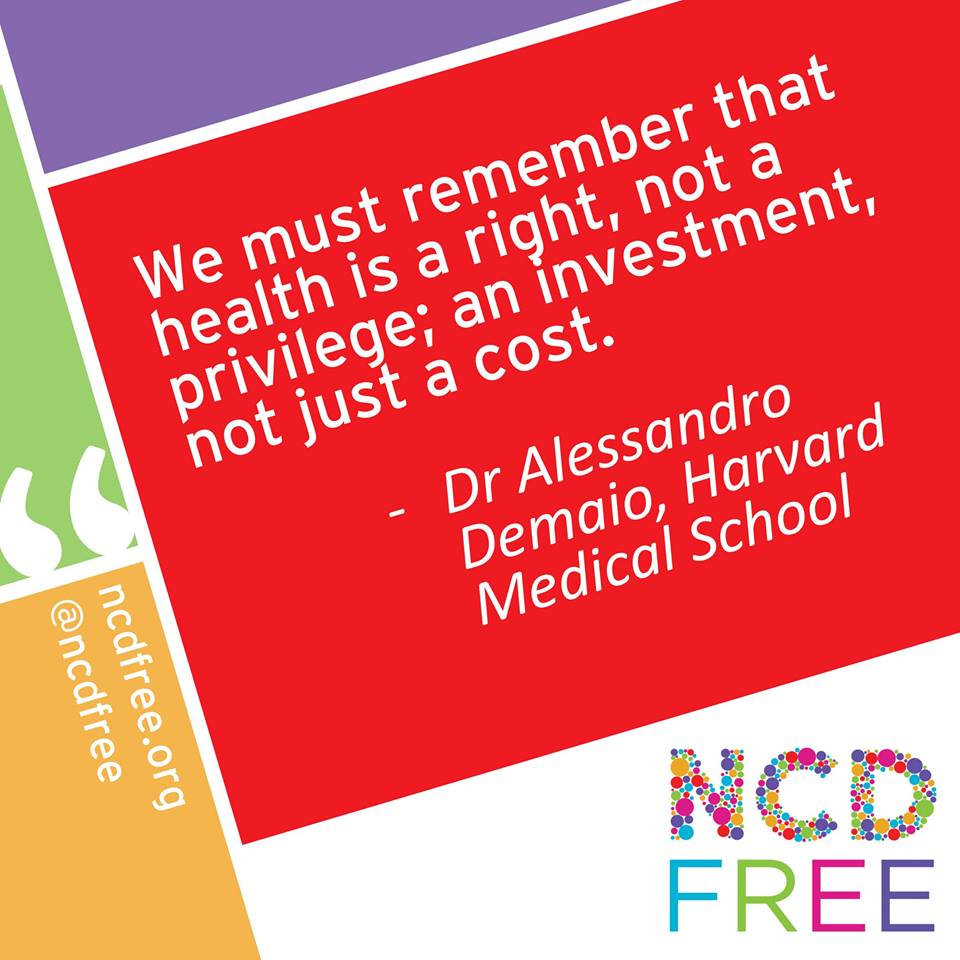
Sandro Demaio and the team from NCDFree are bright, sharp, and looking at public health in innovative ways. Check them out. (Don’t bother checking out the wellness idiots though. Grapefruit is a yummy fruit – delicious in a citrus salad, great mixed with vodka and blood orange juice. But it won’t prevent anything.)
I read this piece by Mike Hoskins (mate, fellow coffee addict, all ‘round good guy) over at Diabetes Mine yesterday where he looked at the use of the word ‘diabetic’. The piece is actually from December last year, but I missed it in the excitement that was New York in December.
I don’t use it. I don’t refer to myself as ‘diabetic’ or ‘a diabetic’. I am a person with diabetes. As far as economy of language goes, it’s a pain, especially when you only have 140 characters to play with. But PWD seems to be pretty widely recognised in my circles.
Perhaps it’s been drummed into me at work, perhaps it’s political correctness gone mad. Regardless, you will not read or hear me use the word diabetic as a label for myself or others with diabetes.
Mike’s article was quite timely as last week I had a little incident that got me more than a little heated.
I was on the phone with VicRoads. This was not an enjoyable experience by any means. I was cut off four times; the four people who answered my call(s) gave me incorrect information and then, when I asked to speak with a medical review case worker, I had someone return my call who was incredibly rude, aggressive and disrespectful. She constantly interrupted me and refused to answer my questions. And gave me the wrong information.
(For context – I was trying to get some clarification as to why I was required to submit an eye exam report along with my medical review.)
‘I was wondering why I am required to submit an eye exam report,’ I explained as the reason for my call.
‘Insulin-dependent diabetics have to must submit a biennial eye exam,’ was the response.
I asked where this is stated in the Guidelines. She would not (could not?) answer this question. She just kept saying (very aggressively) ‘It is a requirement for all insulin-dependent diabetics.’
Now, I am willing to concede that I was pissed off and that if I didn’t have my back up I probably would have let things slide and been happy to continue the discussion about our differing interpretations of the Guidelines.
But I was pissed off. I was annoyed that the medical officer was being rude and patronising and not being helpful. And I was annoyed that she was giving out false information – information that if people didn’t know better could cost a lot of time and (potentially) money for no reason.
So I stopped her.
‘Excuse me,’ I said (and I promise I was being polite and not patronising). ‘Please don’t use the term diabetic. I don’t like it. I would prefer if you used person with diabetes.’
Yes, okay. I know how prissy this sounds. I know how pedantic and, quite frankly, nit-picky I was being. I really do.
But she was being rude and she was spitting out the word as though it was something dirty – that there was something wrong with me.
Without missing a beat, she replied with ‘But you are. You are a diabetic.’ She almost yelled it at me.
The conversation didn’t get any better.
I have diabetes. I own it. I am out, loud and proud about it. But it’s my diabetes and my rules. And my rules include how people speak about me and about my diabetes. They do it with respect, they do it politely and they show courtesy. None of these things were demonstrated. The word ‘diabetic’ was being used here spitefully, and as a label that I felt diminished me.
I don’t care if people with diabetes refer to themselves as (a) diabetic. And I don’t even really mind when other people with diabetes refer to me as (a) diabetic. But it is never done with any judgement. It never pigeon holes someone. And it is never done disrespectfully.
Words matter. I say it all the time and I realise it more and more each day. While it’s a highly personal choice as to the words we each use to describe our ‘diabetes-selves’, using language that is accepted by everyone – and doesn’t have the potential to insult – is clearly a better way.
And here it is. Again. The Diabetes Australia Language Position Statement. And yes, I sent a copy of this to VicRoads as soon as I got off the phone.
Things I know to be true:
- It’s February already.
- Melbourne seems to have misplaced its Summer.
- As much as I loved being in New York and had the best holiday ever, it’s always swell to come home.
- And having Melbourne coffee running through my veins is making me a happy chicken.
- Being at work is not the worst thing, especially when there is a year of really exciting things on the horizon.
- I am confused that my computer does not recognise the word Nutella and wants to correct it to Nigella. Which is equally awesome and sexy.
Also – the internet never disappoints.
Frocking brilliant
Sometimes it’s tough for a dame to find a place for her insulin pump. Bra? Good in theory, but what if you’re not wearing a bra? Or your bra is being uncooperative? Thigh strap? Again, great idea, but not great if the thigh strap comes loose and starts rolling down your leg and you end up in the Ministry of Silly Walks. Also, it can look like you are packing heat. Or you end up using ugly (although effective) Tubigrip. Pocket? Usually produces an unsightly bulge that may have people searching for a matching Adam’s apple.
What’s the solution?
Read here about some clever folk who have come up with a rather dashing frock with a secret little place to hide a pump.
And who doesn’t love a LBD? Can’t wait to get my hands on – and body into – one of them! Available soon – keep an eye out here.
Two spreads in one
There are many tough decisions in life. Lennon or McCartney? Coffee or tea? Jaffas or Malteasers? (Both, obviously.)
And the most difficult: peanut butter or Nutella? Can’t decide? Then have both! In domestic goddess mode on Sunday (full skirt, frilly apron, high heels and tiara) I made these.

And they are were good. And totally bolus worthy!
Here’s the recipe. (And here’s a tip. When freezing the Nutella before making the biscuits, do half on one baking sheet and half on another. Take out one baking sheet, make half the biscuits. THEN take our the second baking sheet and make the second half. Otherwise the Nutella starts to melt and ends up all messy and all over your fingers and you have to lick it off your fingers and then freeze more.)
Oh, and while we’re talking Nutella, let me introduce you to my happy place:

Support DA-Vic and enjoy the Melbourne Food and Wine Festival (WIN WIN!!)
This year, Diabetes Australia – Vic (disclaimer: my place of employment, but I am writing about this because I want to, not because I was asked. Also it is about food. And wine. So there’s that too.) is the charity partner for the Melbourne Food and Wine Festival. Some people may think that this is an odd partnership, but actually, the messages of both DA-Vic and MFWF are strongly aligned. It’s all about people taking an active role in managing their health – regardless of if they are living with diabetes or not. And having a good understanding of the food we choose to eat is part of this.
It’s also a great opportunity to raise awareness of diabetes, reaching people we may otherwise not reach.
Now, everyone knows that I am not really an exercise fan. However, I can definitely get on board this. It’s literally a moveable – well moving – feast where participants take a walk around the Tan, stopping at stations for a delicious five course brekkie. And better yet, 5 per cent of ticket/registration fees will be donated to DA-Vic.
Noteworthy connections
Many of you may not know that in a former life I was a classically-trained musician. That ship sailed a long time ago and I no longer play music. However, my husband is a musician and music is a huge part of my family’s life.
I have always been interested in the link between music and health. The Greek God, Apollo, was God of both healing and music, so the connection has been around for a long time!
Music has been used as therapy in a variety of medical conditions from Parkinson’s Disease to recovery from stroke. I am not going to say the healing powers of music can cure diabetes (although I’m pretty sure some fool will tell you that). But, music can be a stress reliever. And for me, reduced stress means less erratic BGLs.
There are also strong links between music having positive effects on mental health as discussed in this information sheet from ReachOut.
I love this so much
I’ve shared this blog before here, but this post from Annabel over at The Understudy Pancreas is one of the most beautiful pieces of writing. Full stop.
I can’t begin to imagine what parenting a child with diabetes would be like, but Annie does such a wonderful job of explaining how her family do it.
The thing that I probably admire most is how Annie never, ever makes her daughter’s (Pumplette) diabetes about herself. She supports her daughter in the best ways possible, encouraging her independence, and being there for her – with what Pumplette needs. Great parenting advice all ‘round, really.
I wish I could reach into my computer and give you a huge hug, Annie. Your darling girl is so great.
Radio Deluxe
When we were in New York, we spent a very pleasant evening at Birdland listening to John Pizzarelli and Jessica Molaskey perform. It was a gorgeous gig, made even more wonderful when they dedicated a song to the ‘family from Australia’.
Each week, John and Jessica have a syndicated radio show (they claim it is ‘live from high above Lexington Avenue in the Deluxe Living Room’, and while I suspect it is actually recorded in a studio, I like to think of them in their living room at home, gazing out over the New York skyline, casually chatting into a couple of vintage microphones) and it is an absolute treat to listen to.
Check it out here. It makes a great soundtrack to the workday!
What do ‘patients’ really think? (Maybe stop using the word ‘patient’ to begin with…..)
British medical journal The BMJ has started a fascinating new series called Do you know what your patient is thinking? This is part of their patient partnership strategy and will hopefully help HCPs better understand all aspects of life with a chronic health condition – not just what …..
The first in the series, Why there’s no point telling me to lose weight, can be read here. New submissions will be published monthly.
Living Vertical
Steve Richert has lived with diabetes for 17 years. A couple of years ago, Steve wanted to show that diabetes hasn’t stopped him from doing what he wants, so he and his wife, Stefanie, travelled across North America and climbed for 365 consecutive days. Just like with diabetes, there were no days off.
I absolutely love the catalyst for this project. This is what Steve writes on the Glu website:
‘In 2011, I had lived for almost 13 years with type 1 diabetes, and despite the normal ups and downs, seasoned with occasional close calls, it had never stopped me from being me. In fact, it made me who I was. When I was on a trip to visit friends, Stefanie and I drove past a billboard aimed at fundraising for diabetes research. It made my blood boil.
It was a smattering of grim statistics and stock imagery geared to promote the idea that life with diabetes was no life at all—that we are weak and helpless victims of this condition. Before this point it hadn’t ever occurred to me that the message of being empowered had any place in diabetes. I didn’t know anyone else with type 1 diabetes and I assumed everyone just came to terms with it as I did. Seeing this billboard made me aware for the first time of how we are portrayed—and how that can impact someone.’
A film has been made of Steve and Stefanie’s adventure. You can read about and watch Living Vertical: Project 365 here.
Save a child…..
Thinking about Valentine’s Day? Don’t forget to Spare a Rose, Save a Child.
No four words sum up this campaign better than this ‘Flowers die. Children shouldn’t’.
Please donate. Remember the equation: One rose = insulin for one month. Multiply as many times as you can.
That’s all for now, folks. Happy Tuesday.
I’m back at work today (pretty sure you can feel my delight in just those five little words). I know I am back at work because I am wearing a pencil skirt, tights and black high-heeled pumps instead of jeans, boots, a scarf, a hat, gloves and a puffer jacket with some sort of fur lining. Today I look like I am ready for work rather than ready for a day of wandering around New York.
But all is not lost. It’s been six weeks and I have a wonderful holiday of nothing but great memories and a photo album of nothing but gorgeous photos. So, onwards and upwards and all that.
Yesterday, as I sped around the supermarket, the onslaught of the next commercial opportunity hit me fair and square in the face. No, I’m not talking about Easter (I could act all outraged that there are Hot Cross Buns in Woolies, but we bought some and have been eating them, so that would be kind of hypocritical). I am talking about the festival of love – Valentine’s Day.
Valentine’s Day can go one of three ways for people. It can be a day of overt love declarations involving flowers, cards, poems, sky writing, gorilla-grams, stripper-grams (don’t judge), candle light, champagne, walks on the beach; it can be a day of sadness and misery and feeling left out; or it can be a day of complete oblivion where one is confused why there are so many people carrying bunches of balloons with ‘I wuv you, Shnookums’ written on them in glitter.
This year, I say screw that. This year, I say how about you do something that is meaningful that will not only help others, but also make you feel great. This year, it doesn’t matter if you have a Valentine or not. Everyone can play.
I am, of course, speaking of the Spare a Rose Save a Child campaign.

Now, if you have diabetes and/or any links to the diabetes word, you have probably seen and heard about this campaign before. I’ve even written about it here. The general gist is that instead of sending a dozen roses to your Valentine, send eleven instead and with the money that would have bought the extra one (about $6 in Aussie money) make a donation to Life for a Child. Those five bucks will provide insulin to a kid in a developing country for a whole month. Or, give your Valentine ten roses and donate $12.
All good, right?
But I have a little challenge for you.
This is a brilliant campaign because it is so simple. It’s easy to explain and it’s really easy to get involved. So my challenge is this. Let’s get this moving way out of the diabetes world. Let’s get this into the hands and hearts of our friends and family who may not really consider this as an idea for Valentine’s Day. Let’s tell our workplace HR teams and see if they can encourage it as a work-place wide giving program (there’s even a tool kit to get you started!). Pop in to visit your neighbours and ask them to get involved. Next time you are going for a walk in your local shopping centre, drop in to some of the small businesses and ask them to get involved. Ask your kids if they would like to donate some of their pocket money.
Roses and diamonds and jewellery and books and CDs and vouchers for massages and guitars and DVDs of favourite movies are all lovely and fun for Valentine’s Day and I am not suggesting you complete give up on the idea of sharing gifts. But how about sharing the love a little this year? I know that I certainly will be making a donation and have already strongly suggested to my Valentine that he do the same. (And check out this and this cute card to attach to your gift, telling your Valentine how you’ve shared the love this year.)
So, how about making sure a child has life-saving insulin available to them by donating just a few dollars in your loved one’s – or your – name. Because THAT is a gift of love and I honestly can’t think of anything I would like more this Valentine’s Day.
‘Okay, so I’ll deal with the diabetic who’s just been brought in. She’s been in here four times in the last couple of months. Completely non-compliant.’
Whoa!
I was walking through the rabbit-warren-like corridors of the Epworth Hospital and passed a nurses’ station at the exact moment those words were spoken, stopping me dead in my tracks. If I was in a Warner Bros cartoon, there would have been a dust and smoke cloud around me as I screeched to a halt.
‘Move on, Renz,’ said the first voice in my head.
‘Not freaking likely,’ said the louder voice.
I turned to the nurses who hadn’t noticed me yet.
‘Hi,’ I said. I was trying for sweet and polite, but could already hear the patronising tone in my voice.
They turned and looked at me.
‘Um. I just wanted to say a couple of things. Calling someone a ‘diabetic’ isn’t helpful for anyone. It labels them as their condition and I’m pretty sure that the person you are referring to is a lot more than her insulin problems. Secondly, non-compliant is a really nasty term. I’m guessing that you’ve no idea what else is going on in her life – I have no idea either – but I am pretty sure that there is a reason that she is not managing her diabetes as well as she’d probably be hoping to. Non-compliant suggests that it is a deliberate ploy to make herself unwell – which it may be and if that is the case, then that is something that needs to be addressed.’
At this point, the nurses were just looking at me with a mix of surprise, suspicion, annoyance and interest.
‘Also, to be compliant means following a defined set of rules or guidelines. Diabetes has a funny way of mocking such an idea. The rules keep changing – without notice.
‘Now, I am hoping that you wouldn’t use this language around the person you’ve been referring to when you are actually in the same room as them, but here’s the thing. You’re saying those words now, and that means that somewhere deep inside (or, probably just on the surface) that’s how you really feel.
‘No one wants to have diabetes. No one wants to be in hospital. No one wants to be so overwhelmed by diabetes that they don’t – for whatever reason – manage their condition the best way possible. But sometimes, it gets like that. The never-ending relentlessness of diabetes can be so debilitating that all self-care stops. And then, sometimes, you wind up in hospital. Four times in a month, sometimes.
‘I have diabetes. I’ve been that person you are speaking about. But I wasn’t being non-compliant. I just couldn’t cope. And I felt really bad and guilty that I couldn’t cope. So on top of feeling crap about my diabetes, I also felt crap about not looking after my diabetes.
‘So. Maybe think about what else is going on in her life. She is more than diabetes (that’s why calling her a ‘diabetic’ isn’t a great idea) and I bet she is going to respond a lot better to some kindness and concern and perhaps a suggestion she see a psychologist if she’s not already doing so. Because the judgement and judgemental language is not helping at all.’
I looked at both nurses. I was still using a really calm, level voice, but I could tell that they were a little annoyed. And more than a little stunned. I smiled at them.
‘Okay then. Bye.’ I started to walk off, but stopped and turned back around. ‘Oh – can you tell me how to get to room 18A please?’
Right-oh. Next up on the holiday playlist is James Taylor. Have Yourself a Merry Little Christmas.
There was a piece in the Huff Post the other day about things to not ask someone living with a chronic health condition – specifically ‘Have you tried….’
You get the idea:
Have you tried not eating after 6pm to help your blood sugars?
Have you tried to quit sugar? Completely?
Have you tried the drug they were talking about on A Current Affair the other night?
Have you tried giving up coffee? (While I don’t advocate violence, it is perfectly acceptable to respond to the fool asking this question with a sharp slap to the back of the head.)
Sometimes the ‘have you tried’ suggestions are just plain ridiculous. In last week’s OzDOC tweet chat, moderator Ms Kim came up with this beauty, asking for us to tweet how we would respond.
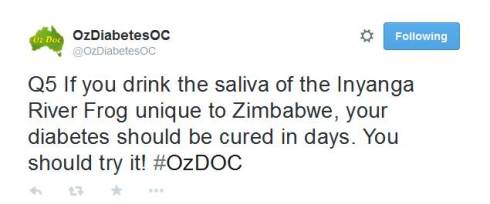 My take on comments like this is to roll my eyes and try to change the subject. I don’t believe there is any malice in someone making these suggestions; they really are trying to help. They want to help.
It’s what it represents that pisses me off a little. My diabetes management is not for up public tender. I manage it in a way that I see fit. I will ask if I need help. Actually, I’m not great at asking if I need help, but that’s not the point.
It is as though having a chronic health condition is a ticket for everyone to offer their ideas and suggestions. I’m fairly certain I’ve never asked people to workshop my diabetes management and I certainly haven’t sought to crowd source ideas for helping me out. And yet, it feels like it’s a public free-for-all at times!
I am sure that this is the same for people living with conditions other than diabetes. But with diabetes, perhaps because there is the link with food, and food is in the public domain all the time that people think they can weigh in. It doesn’t help that there are twits like the frequently-mentioned-in-this-blog-because-she-infuriates-me-so-much-and-is-a-dangerous-tool, Sarah Wilson, and the equally-derided Pete Evans who have mega-huge megaphones that reach a lot of people and feel that their pseudo-science programs are a good way to treat chronic health conditions. (Spoiler alert – they are not.)
For some people, the most difficult thing about living with diabetes, is the way that the public perceives the condition. While I seem to not get too hot under the collar about the public’s perception, I do understand how tiring some people get at the constant comments about diabetes, the misconceptions and how others want to get involved.
Diabetes seems to be rather unique in this sense. That public ownership of a condition that is a significant public health burden is certainly annoying at times. It’s similar to people commenting on the size of a pregnant woman’s belly (or overall pregnant body). Because it’s a bit ‘out there’ some think it’s okay to offer comment or offer suggestions. When I was pregnant, I was standing at the counter of a juice bar at the Queen Victoria Market and a man I am quite certain I’ve never met before, put his hand on my belly and told me that I was ‘a good size.’ I asked him to remove his hand and suggested that he mind his own business. Or at least buy me my pineapple juice if he wanted to get involved.
Finding ways to deflect comments without appearing ungrateful or rude can be tough. I know people want to help. But there is no curing diabetes and there is no magic potion that is going to make it better. It is sometimes a little insulting when people suggest things – especially things that are clearly straight off the snake oil shelf. Most who know me should realise that I am pretty linked in with what’s going on in the diabetes world. Do they really think that I could have missed that cure?
I (hope I) have a long life ahead of me and as it stands, that life is going to be shared with type 1 diabetes (well, at least for the next five years). I accept this and know that it is my lot in life. It would certainly be easier if people just didn’t think that it was public property and they had a free pass to comment.
I really hope I don’t sound ungrateful. Or rude…
By the way, this is how I responded to the OzDOC zinger from last week: 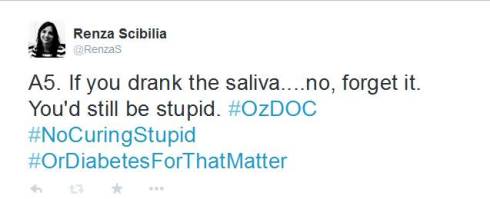
Because it’s so true. There ain’t no curing stupid!
Okay folks, it’s December. And my treat to you for the next couple of weeks is to provide you with fabulous Holiday songs. (I say Holiday not because I don’t want to say Christmas, but because they may not all be Christmas Carols.) Hold on – you’re in for a ride. Our Holiday album collection is certainly eclectic!
So, today, I’m starting with one of my all-time favourite musicians, John Pizzarelli singing Let it Snow.
I was driving to pick up my daughter from school last Friday afternoon, and could feel the pressure of the previous week lifting. World Diabetes Day was all but over. There was, of course, the matter of a 24 hour tweetathon organised by the clever Cherise from DCAF, but that would be fun and interactive. The official things were over. Done and dusted for another year.
The thought of picking up the kidlet and chatting about her day, and things we had planned for the weekend made me smile. I’d been distracted with the craziness of the week and we’d not had our usual long, meandering conversations. I was looking forward to hearing what she’d been up to and NOT talking about WDD.
She ran out of her classroom to greet me, a big smile on her face, her bag hanging from her back and her latest book in her arms. And off she went filling me in on the day she’d had.
After telling me who she’d played with and what she had done in PE and reminding me that on Monday her Italian Choir was rehearsing for an upcoming concert at a neighbouring school and that she would really like to go cherry picking soon and how Sooty would like a run in the park, she said, ‘I told Mr D that it was World Diabetes Day today. I wrote it up on the board at the beginning of the day.’
I looked at her, surprised at the direction her stream of consciousness conversation had just taken.
‘What’s that, darling?’ I asked.
‘This morning. When I got to school. I told Mr D that it was World Diabetes Day and he said I could write it up on the board. Then we had a discussion about it.’
‘Really? What did you talk about?’
‘Mr D wanted to know if there was anyone who knew someone with diabetes. Of course, I said I did. And so did A.’ She was referring to my beautiful neighbour Jo’s gorgeous boy who is in the same class. ‘And S – her grandmother has diabetes. Type 2 diabetes. She checks her blood sugar like you do.’
‘I was surprised that Mr D knows so much about diabetes. But then he said that one of his friends has type 1 – that’s why he knows about it. We spoke about the different sorts of diabetes. A and I were saying that type 1 is because the body stops making insulin. And we talked about pumps. Hey mum – can we go get iced chocolates for afternoon tea?’
Subject changed, we headed to our local café, sat outside and enjoyed the sunshine.
I looked across the table at my nine year old as she slurped at her iced chocolate. World Diabetes Day is about raising awareness of diabetes to people in the community. In her own little way, she had done that in her classroom. Just because she could. Just because mum has diabetes. I had a little advocate on my hands. And I couldn’t have been prouder.

The kidlet and her side kick.
It’s World Diabetes Day and everyone is talking diabetes. Or so it seems.
Do we need another awareness-raising day?
Yep. We do.
We know the numbers. We know that diabetes is serious. We know that prevention is the key – prevention of type 2 diabetes (where possible) and of complications in those already living with diabetes. I could write how World Diabetes Day can draw attention to these facts.
But instead, I’ll tell you why I – a person living with diabetes – need World Diabetes Day.
I need today because it gives an opportunity to talk about real life with diabetes.
On Wednesday, (also known as ‘I hate diabetes day’) I spoke at the Austin Hospital’s Grand Rounds. Most hospitals have Grand Rounds – it is a learning opportunity for doctors and other healthcare professionals to hear presentations and ask questions about different medical conditions – sometimes outside their area of specialty.
Wednesday’s session had a World Diabetes Day focus – the lecture theatre was adorned in blue balloons and just about everyone in the room was wearing an item of blue clothing.
I gave my talk which consisted a discussion of the consumer-focused program we run at Diabetes Australia – Vic; how healthcare professionals can use social media to interact with people with diabetes and how PWD use social media to connect.
At the end of my planned talk, I looked around the room. I think my talk had been well received – I know that I am certainly different to the usual healthcare professional presenting and I also knew that the next speaker – the wonderful Professor Joe Proietto – was giving a talk on type 2 diabetes medication.
‘Just before I go, I want to say something,’ I said. I took a deep breath. ‘I hope you have enjoyed my talk. I hope that it has given you a better idea of some of the programs and activities available to be people with diabetes. I hope you are thinking about what your Twitter handle is going to be because I really want to see ALL of you in the Twittersphere next week!! But I just want to add something.’
I moved away from the lectern and stood in the middle of the stage.
‘I look okay today, right?’ I saw heads nodding around the room. ‘My dress is neat, my hair is clean. I have make up on and I know I have matching shoes on – I checked before I left the house. My lipstick is on straight. I just gave you a twenty minute talk, and I think it all made sense….I think? The words did form coherent sentences, right?’ More nods from the people in the theatre.
‘I look okay.’ I paused again.
‘But let me tell you how I am feeling. I had a terrifying hypo overnight and was awake for a good part of the night. I needed help to deal with it, and my daughter, when she woke up this morning, had to see me feeling pretty damn crap. My dad is sitting over in the corner there because I was just too tired to drive here from Brunswick, and he kindly offered to chauffeur me so I wouldn’t need to take a cab.’ I looked over at my dad and smiled. And then kept going.
‘Why did this happen? Well, I guess if we want to find a reason, we could say it was because before I went to bed last night, I didn’t check my blood sugar. You see, I just couldn’t be bothered. Now, before you think ‘how stupid’ or ‘serves her right’ or start to judge me, know that I had already checked my BGL about 15 times throughout the day and the thought of doing another BGL check was just too much for me. And I thought that I was okay based on the previous check and knowing that I had no insulin on board.
‘But you know what? It doesn’t matter why it happened and if I wasn’t telling you this now, you would never know. You wouldn’t know that I really would like to curl up under one of the seats and fall asleep; you wouldn’t know that I am still dealing with the hypo-rebound and my BGL is sitting somewhere in the mid-teens. You wouldn’t know that my arms and legs are heavy from being post-hypo-exhausted. You wouldn’t know that I kind of want to cry because today, my diabetes is other people’s problems. Not just my own.
‘Now, I’m not telling you this because I want you to feel sorry for me. I’m not telling you this because I want you to pity me because I have diabetes. It’s crap and that’s all there is to it. I’m telling you this because I want you to remember this story next time you are sitting opposite one of your patients who is living with diabetes – or any other medical condition for that matter – and they look all great. Don’t assume. Don’t ever assume that everything is all fine. Because I can tell you for sure that while I will be blogging about this to share with other people with diabetes, I certainly won’t be sitting in my next appointment telling my endo about it.’
I stopped again. The room was silent – no one moved.
‘Thank you so much for having me here today. And happy World Diabetes Day for Friday.’
I walked off the stage.
I love Joni Mitchell. And I love this song – Blue – which is, of course, perfect for today.
My Facebook and Twitter feeds are full of diabetes awareness campaigns and it is only going to get busier in the next few days. World Diabetes Day is a global event, and around the world there is much going on to help get people talking and thinking about diabetes.
My favourite campaigns are those that strive to shoot down diabetes myths and one that is getting some well-deserved traction this week is Walk With D.
The aim of Walk with D is to help people without diabetes understand what life with diabetes is all about. But more than that, it hopes to address the misconceptions within the diabetes community too.
Diabetes myths are rife. Every day, I hear things that are simply not right about what diabetes is all about. It frustrates me; it angers me; it infuriates me – never more so than when it is coming from within our own community.
I am filled with despair when I see people with type 1 diabetes perpetuating myths about type 2 diabetes with incredibly destructive ‘type 2 bashing’. I don’t know how many times I’ve said the words ‘No one asks to get ANY kind of diabetes’, but believe me when I say if I had a dollar every time I’d uttered that sentence, I’d be wearing a new pair of Manolos almost every week!
‘Even within the diabetes community, there are levels of misunderstanding, misrepresentation, and mistaken messaging, often creating a divide where there should be a bridge.’ – Walk With D website
Help stop the stigma!
As with any successful social media campaign, it’s easy to get involved with the Walk With D campaign. Share your story and use the #WalkWithD hashtag. Make it personal and make it real. Visit the Tagboard on the Walk With D website to see what others are saying about their real life with diabetes. And share. Share. Share.
And if you need more of an incentive to get on board, Lifescan Inc will donate 100 BGL strips to Life for a Child every time the #WalkWithD hashtag is used during November. Get tagging, good people!
Everyone’s diabetes story is going to be different – the diversity of our community is actually one of its strengths! But we can surely unite in our aim to have diabetes spoken about respectfully and with courtesy. Surely we can bond over the fact that diabetes just plain sucks. Surely we can walk together with diabetes, united, with our heads held high and our arms linked.





 Diabetogenic