
You are currently browsing the category archive for the ‘Advocacy’ category.
I have written (frequently) before about T1 International and I am going to do it again this Diabetes Awareness Month.
Because the team at T1International have a new initiative: they are urging people to sign their Type 1 Diabetes Access Charter which outlines five rights that all people with diabetes should have:
- The right to insulin
- The right to manage your blood sugar
- The right to diabetes education
- The right to healthcare
- The right to live free from discrimination
None of these things are luxuries. These are basic human rights that should be afforded to every single person diagnosed with diabetes – not just those of us lucky to be born in a country such as Australia. Insulin is not a new-fangled, fancy drug. It has been around for 95 years. When talking about the right to the tools required to manage bloody sugar, we are not talking latest technology such as continuous or flash glucose monitoring or hybrid-closed loop systems that are entering the market. We are talking about basic blood glucose meters and strips.
The reality is that around the world, many people cannot access or afford insulin or diabetes supplies. Education is sporadic at best. People with diabetes are being forced to choose between buying insulin and buying food or other essentials. How do you make the decision between putting food on the table or buying the life-saving drug you – or your loved one – needs to stay alive? It’s a decision that most of us in Australia never have to even contemplate, but it is a reality for many, many people around the world.
I messaged T1 International founder, Elizabeth Rowley, yesterday to let her know I would be writing about the charter today, but I also wanted to comment on a Facebook post she had just shared.
Elizabeth had used the JDRF diabetes stats calculator (as discussed in yesterday’s post) and shared her results. She had a very different take to how many others responded.
She reminded us that she is the one of the lucky ones because in her almost 25 years as a PWD, she has been able to access whatever she has needed to manage her condition.
When I did my diabetes numbers, I looked at the terrifying number of BGL checks I have done over the last 18 years: 34,749 (although Aaron did suggest that during pregnancy alone I would have done that many!). Not once have I ever had to wonder from where I would be getting my next box of strips. Not once have I thought about rationing strips or pump consumables for fear that I could not afford more when I ran out. Not once have I had to consider taking less insulin that I need.
The scary thing about the numbers generated by the JDRF calculator is not the huge numbers many of us are seeing tallied up. In fact, it is actually the small numbers in those people with diabetes who can’t access what they need to manage their diabetes.
T1 International is doing some amazing things – just as they have done since they started a yea few years ago. Please check out their website, click below to sign the charter and get your friends and family to sign too, and if you can, make a donation to this really important cause.

I am very fortunate to have a job that I truly love. But it could not be described as a particularly sexy job. At least, not the regular-day-to-day-this-is-what-I-do-when-I-am-in-the-office side of things.
I worked in recruitment for a while and the constant buzz and thrill of the game was intense. We had an old-fashioned bell in the office that would be rung when we made a particularly lucrative placement. Working on commission meant that there were dollar signs in front my eyes all the time, and I measured success in thousand dollar increments. It was sexy because it was quick, constant and there were constant wins.
Now I have a job that is what I refer to as a slow burn. Things take time, advocacy efforts are often long and drawn out, and the wins are rare. But jeez are they meaningful and worthwhile when they happen! They shoot an injection of momentum right when and where we need it, and it means we very quickly acknowledge the win and then focus on the next issue.
Sometimes people don’t realise just how long things take. When the pre-election announcements about CGM subsidies were made, a number of people commented that we’d had a busy few months to make it happen. I couldn’t help but laugh. And correct them. That particular win had been over four years of hard work.
But we take the wins were we can and this week, we’ve had a win!
The revised Assessing Fitness to Drive guidelines have been released by AustRoads and the National Transport Commission, and it’s a good news story for people with diabetes.
You may recall that there were some real issues with the previous guidelines after the completely misinformed and confusing inclusion of a definition of ‘satisfactory control of diabetes’. An HbA1c of over 9% was defined as ‘unsatisfactory control. Whilst the Commission stated that the A1c value was intended as nothing more than a guide and a trigger to seek professional care, the reality is that many people with diabetes had their licences suspended with their HCPs taking the value as a cut-off point.
As Diabetes Australia consistently argued, there is no evidence to suggest that an elevated A1c makes a person with diabetes more dangerous on the roads. In fact, this focus on an elevated A1c was actually detracting from hypoglycaemia, which is something that does need to be considered.
In the new guidelines, the number has been removed which is an excellent outcome for PWDs. And added to the document is far more focus on impaired hypoglycaemia awareness and keeping safe on the roads.
This change didn’t happen because we asked nicely. In fact, it took four years – from when the last guidelines were launched and we started to hear of people with diabetes having troubles – for the change to be made.
It took a lot of advocacy: letter writing, speaking with people who had been negatively impacted, meetings and teleconferences, and revising documents.
This is what I mean when I say that my job is unsexy. All of the work that was done behind the scenes – the slow burn – is decidedly unsexy! But it has to be done to get the wins.
I’ll admit to doing a very quick victory dance when I heard about this particular win. But the celebrating didn’t last long.
Because there is so much more unsexy work to do. Until people with diabetes are no longer discriminated against; until diabetes stigma is something we only speak about in the past tense; until kids with diabetes in schools are freely given all the same opportunities as their peers who make their own insulin; until access – to drugs, technology, healthcare – is available to all, the unsexy stuff will keep happening. You probably won’t hear about it until there is good news, but the wheels keep turning and the fire keeps burning slowly. As I said in this post here, it’s the reason I do what I do.
The new Assessing Fitness to Drive guidelines can be downloaded here.

Four years ago in Rome, I made Aaron take a photo of me with just about every old Fiat Cinquecento we saw. There are a lot of photos of me with tiny cars!
Disclosure
I was a representative on the Diabetes Working Group revising the diabetes chapter of the new Guidelines. This was part of my role at Diabetes Australia.
If you have not caught up with what happened in the opioid session at MedX this week, please do. ePatient, Britt Johnson, who blogs at Hurt Blogger wrote this outstanding piece about her experience on the panel in a session titled ‘The Opioid Crisis’ where she was pretty much ignored by the moderator of the panel. I read her piece in dismay because Britt’s experience is all too common.
As I wrote on Facebook yesterday, it is these twelve words of Britt’s post that are, for me, most telling:
‘The plan had been to feature me in the final five minutes.’
This was the response from the moderator of the panel when she was challenged as to why Britt has been ignored whilst on stage.
The final five minutes.
That’s right. After the healthcare professional experts got to say what they wanted; after the moderator directed the discussion in a direction to get what she wanted; after everyone but the patient was given an opportunity to speak. Then, and only then, would Britt have been given the opportunity to say what she wanted.
The final five minutes.
It’s the equivalent of being given a completed resource, almost ready to go to print and being asked to provide feedback. It’s the same as being a perfunctory consumer on an advisory board, often added at the last minute to tick a box.
This token and downright insulting attitude about where ‘patients’ fit into the healthcare puzzle is toxic.
We have become accustomed and too accepting of the status quo. We feel humbled when we are added to a panel discussion when, really, we should be the main event. We are honoured to be asked to provide feedback on an already developed service that we are meant to use because we mistakenly believe our opinion is being sought and matters even though it’s too late for our feedback to be taken on board. We believe we are doing well when a consumer is added to an advisory board made up predominantly of clinicians and researchers because, hey, it’s a start.
A start is not good enough anymore.
I am angry. I am so angry about this. I am angry about what happened to Britt at MedX. I am angry that there was not a single person with diabetes on the program at this year’s ADS ADEA conference. I am angry that it is 2016 and we still have to beg for a place at the table, on the panel, on the Board. I am angry that conversations ABOUT us are happening AROUND us. I am angry because there’s never a hesitation then it comes to convening a clinical advisory group, but a struggle with how and where to engage and appoint a consumer advisory group. I am angry because too many think ‘focus testing’ means engaging at the end, and that it is enough.
But mostly, I am angry at myself. I am angry for this post I wrote last year where I pathetically felt grateful because people with diabetes were quoted at a conference – not actually handed a microphone, not actually invited to sit on a panel, not given an opportunity to lead the discussion. We were quoted and I thought that was enough.
It was our final five minutes. And, actually, it wasn’t enough.
We are more than the final five minutes.
We are more than that; we are so, so very much more.
Apparently, I went to Munich. I was away for 6 days, and 60 hours of those days were spent in transit. I believe that, (as I deal with jet lag, hypoglycaemia, and mainlining caffeine), it is fair and accurate to say that I am too old for this shit.
I am also incapable of forming paragraphs. But dot points are fun! Here are some observations and a few silly thoughts from last week. (I’ll write some sensible things when my brain is back in the same country as the rest of me.)
- I am told by people Munich is a lovely city. I will have to take these people’s word for it, ‘cause I saw very little of the city.
- I did not buy a dirndl and for this, I will be eternally sorry. As will my husband.
- The EASD conference itself was, as predicted, very rats and mice-y. I sat in a number of sessions and wished I was a mouse (while wishing my diabetes away). Alas, I am not a mouse. And I still have diabetes. Damn.
- I did not get sick of laughing at the fact that one of the halls at ICM Messe München is called Langerhan Hall. Also, I did not get sick of saying ‘I wonder if my islet cells are in there’ – to everyone within earshot. Even if I didn’t know them.
- Obviously, Grumps was not as amused by this as me.
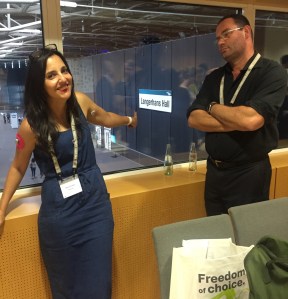
- As was the case at ADA, my arm is more recognisable and famous than me. A barista at one of the exhibition hall stands said, as making me a decent coffee, ‘Oh – I know you. I saw your arm the other day near the station.’ I am a walking billboard for Rockadex! (I am not sponsored by Rockadex and purchase my own patches.)
- Dr Kevin Lee from Queensland is a tweeting machine! In fact, I think the thing I was proudest of at EASD was seeing him tweet! (Actually, probably should say that Professor Mark Cooper’s giving the Claude Bernard Lecture was also a moment of national pride, but Kevin’s tweeting was on another level!)
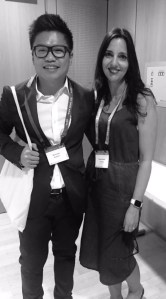
- One of my favourite talks was about diabetes, cardiac health and exercise (go on, laugh….), but that was mostly because presenter Dr Nikolaus Marx, finished up with a discussion about passive exercise and cardiovascular events during the World Cup. If you were in the room, it was me who cheered when he mentioned the increase of cardiac events after Italy beat Germany. (#VivaItalia!). For clarification, I was cheering at Gli Azzuri’s victory, not the number of Germans having heart attacks. (By the way, this was a real study. Published here.)
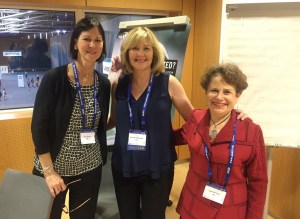
- A HUGE shout out to these three women. AADE presidents elect, past and present, Nancy D’Hondt, Deb Greenwood and Hope Warsaw are absolute advocates for and champions of people with daibetes, and peer support. This is them at the docday blogger and advocate event. This level of commitment by HCPs to consumer engagement is enlightening, and a lot could be learnt from their example here. Thank you. Thank you. Thank you!
- It was wonderful to see quite a lot of discussion about AP. Anytime someone wants to actually get these into market and into the hands of people with diabetes, that would be just great! Thank you.
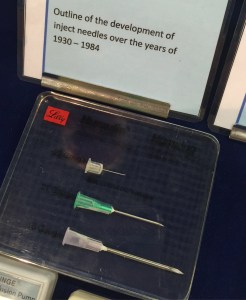
- I may have screamed a little when I wandered through the Association Village to the excellent historical display of diabetes by the German diabetes Association. Terrifying might be the word for these needles. I said a little prayer of thanks to the diabetes angels for modern day tech, and for being diagnosed in 1998.
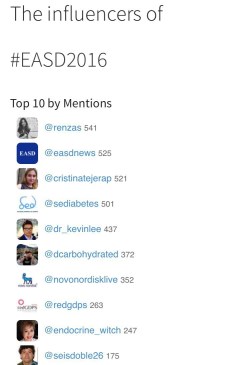
- I need to take a break from twitter. This was the state of play when I said good bye to the conference.
And finally, a word about language, because I am unable to attend a conference and not talk and write about it. (I think it’s actually become a law somewhere.) This probably deserves a post of its own and that may happen, but here we go anyway.
This is the fifth EASD conference I have attended, and going in, I know that it is going to be challenging, language-wise. There often appears to be very little consideration that there could be PWD in the room listening in to how HCPs are speaking of us. In the opening ceremony, I tweeted this at EASD president, Professor Juleen Zierath:
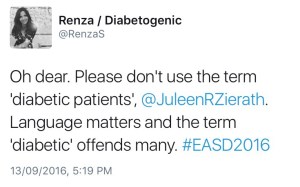
I was a little disappointed at Professor Mark Cooper’s constant use of ‘diabetic’, but it was by no means any more than most of the other speakers. I suppose I just hold Australian speakers to higher account given the work we have been doing here around language and diabetes.
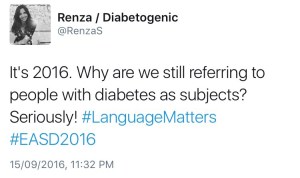
This tweet generated quite a lot of discussion, and came about after I was exhausted and annoyed and mostly frustrated by the way speakers were referring to people with diabetes.
 Perhaps the best response was from Nick Oliver:
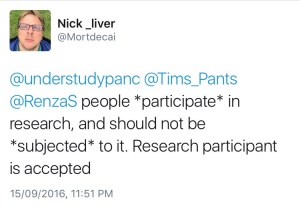
Here’s the thing – and it is something I spoke about during my talk at the DOCDAY event. Language DOES matter. We all know that. It’s completely and utterly disingenuous to say it doesn’t. For some people, it doesn’t bother them and that’s terrific. For others, though, it really does. So why would anyone do something that may offend when it is so easy to avoid that?
DISCLOSE DISCLOSE DISCLOSE
My (economy fare) flights and accommodation expenses were covered by AMSL and J&J. I was attending the EASD conference mainly to attend the J&J DOC exchange meeting which I was involved in preparing and presenting. No one ever expects me to write anything. These are my words and observations only. (And seriously, have you seen what I have just written? No one wants to be associated with that!)
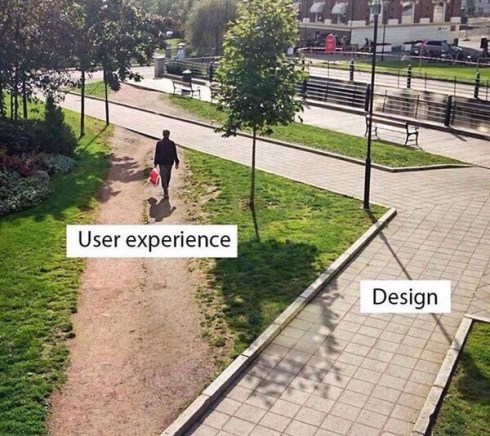
This photo* sums up why I do what I do, and why many people think I sound like a broken record, with a vocabulary of a mere seven words. Specifically, these seven words: ‘Have you spoken to people with diabetes?’
Because so often, the answer is ‘No’. Or ‘No – we’ll be doing that after we have had some meetings.‘ Or ‘Yes – we spoke to you‘ at which point I remind them that I pointed out when they did indeed speak to me that they should find other people with diabetes to speak with. Because I am but one person and speak for no one other than me. (Or, perhaps, another woman in her 40s who loves Nutella, boots, coffee, lives in inner-Melbourne, waves her hands around madly while speaking reallyreallyreallyreally fast, can recite Marx Bros movies from start to end, has what some would call an irrational fear of birds (and butterflies), can sing (badly) pretty much any song from the 1980s, has over 25 striped t-shirts in her cupboard and is battling an eleven year old daughter who has decided that she too loves stripes and wants to borrow all her mother’s clothes.)
Most people are not like that. (Fortunately.)
Anyway, this picture also demonstrates that those who have the privilege of designing services, activities, programs, settings for people with diabetes often miss the point – perhaps not by much, but nonetheless, they miss it. It’s usually because they forgot to ask us, or asked as too late, or didn’t keep coming back and asking and checking in. And then, when we don’t use what they design, we are branded ‘non-compliant’ or ‘disengaged‘ or ‘not interested in our health’, when the truth of the matter is that their design (without our input) just doesn’t fit our needs.
I have given so many talks and written so many pieces about this. But perhaps all I need is this on a t-shirt, tattooed to my arm (forehead?) and on the back of my business cards. Don’t design before speaking to the user. It’s actually really easy!
(*I don’t know the source of this photo, but if anyone does, please let me know so I can credit appropriately.)
I’m back home after three days on the Gold Coast for part of this year’s Australia Diabetes Society – Australian Diabetes Educators Association conference. More to come next week, when I’ll try to pull together my very messy notes.
For today, here are some pictures!

As I took the stage to chair one of two sessions at the Roche Educators Day in Tuesday, I realised I had already been up for seven hours. It was only 11am. Sentences were difficult until my fourth coffee of the day kicked in!

On the job. Professor Steven Boyages’ talk: A connected ecosystem for healthcare professionals & their patients’ was full of practical tips about using technology to support people with diabetes.
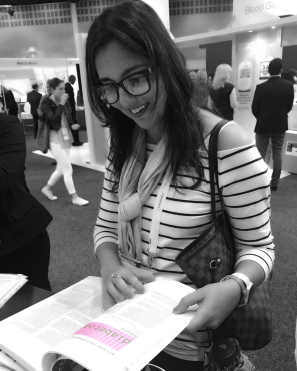
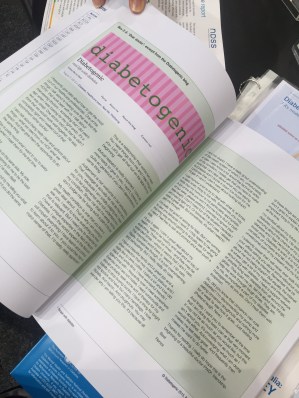
This was the moment I opened the new NDSS Diabetes and Emotional Health Handbook (for health professionals supporting people with diabetes) and I saw Diabetogenic on page 24! Thanks for capturing, Professor Jane Speight!
Proud moment!
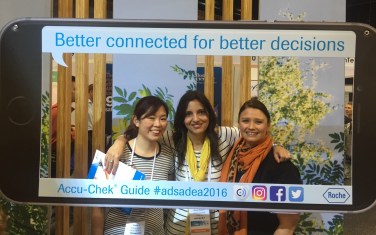
Advocates running amok. We actually behaved ourselves quite well. Mostly.

Although, we were mighty busy! Three of the top four influencers at the conference happen to be consumer advocates, sharing information from the conference specifically with the intention of reaching other PWD who could not be in the room.
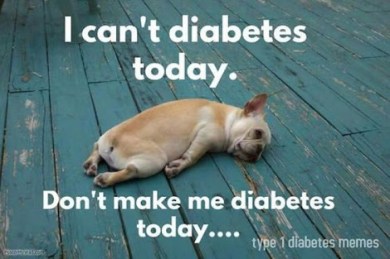
Martha Funnell used this in her talk on day one. Sums up many, many days!
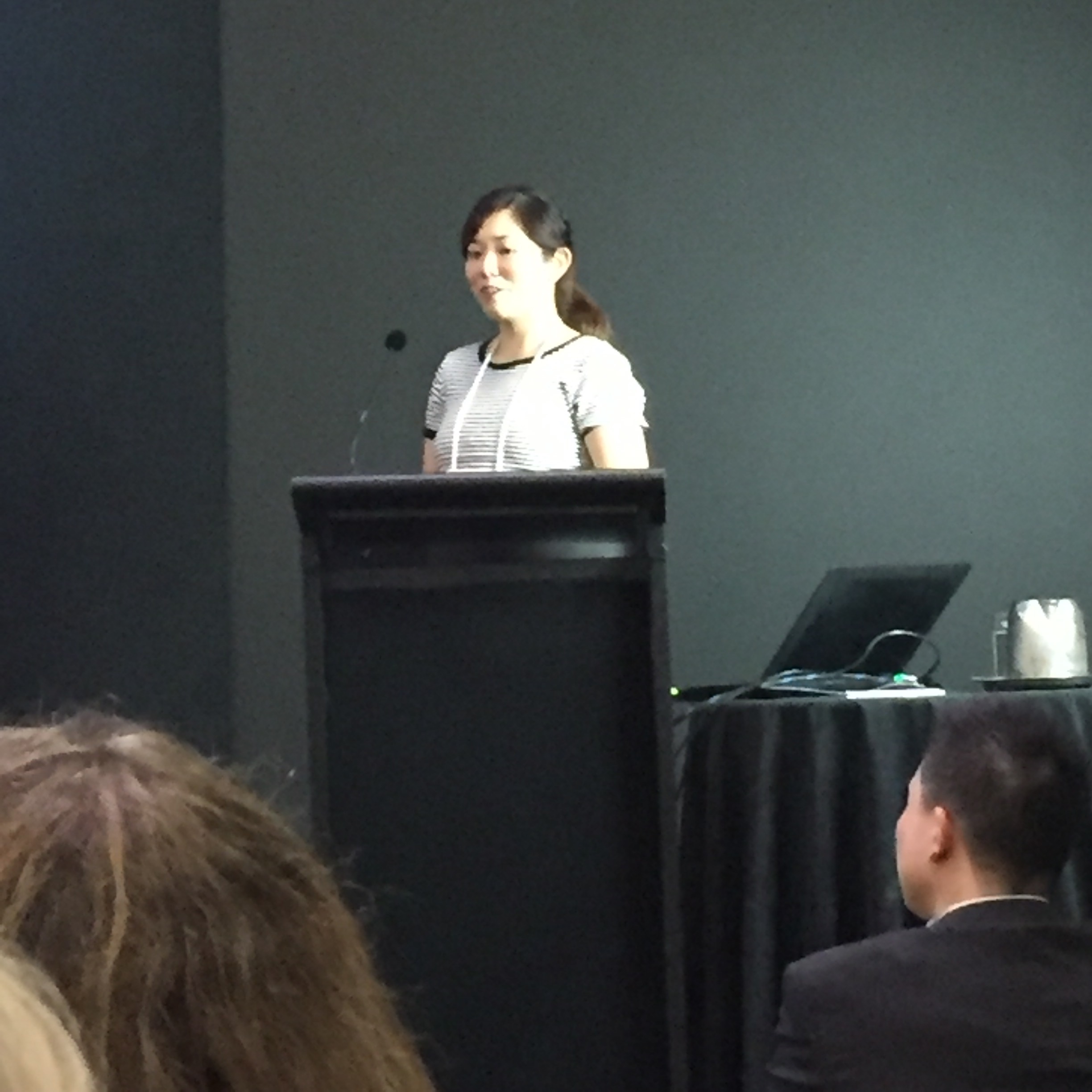
Rather proud of this special young lass. Here’s Ashley presenting on her work focussing on the needs of young people with type 1 diabetes.
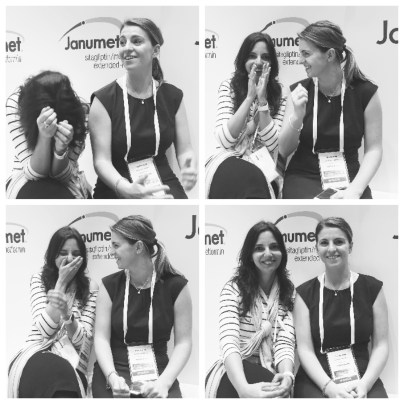
This is a combination of jet lag and exhaustion. (Jet lag belonged to Harriet.)

The NDSS stand looked very bright thanks to these beautiful resources from the Young People with Diabetes Program.
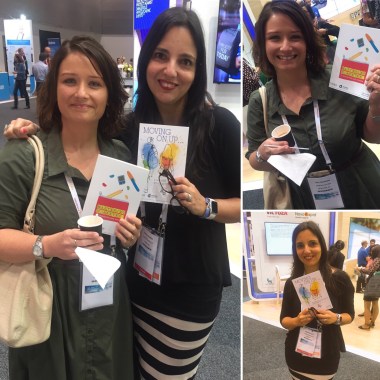
And another proud moment. Kim’s outstanding work on the national roll out of Mastering Diabetes means this resource is in the hands of those who need it most: children with type 1 diabetes, their families and schools. Well done, Kim! (And I’m holding Moving on Up which I am equally proud of!)
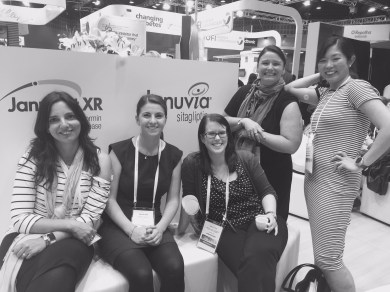
Spot the diabetes devices….

Gold Coast.
Proper wrap up coming next week. Enjoy your weekend. I know I certainly will! (But you can play catch up by checking out all the #ADSADEA2016 tweets.)
This morning, I sat in a restaurant in New Orleans with three of my favourite people and diabetes advocates. If anyone could bottle the tenacity, passion, determination, guts and cheekiness of these three women, they would make a fortune and be able to solve all the problems of the world.
I listened to Anna, Christel and Melissa – who I am lucky enough to call friends – talk about their work and we discussed the US health system which made me shake my head in disbelief and confusion. I don’t understand it; I doubt I ever will. But these three not only navigate the system themselves, they are doing it for others as well as they trying to improve things.
All week I have been around people who are involved in important and life-changing work in diabetes care. From those who are developing smarter devices, using data better, improving access and doing reseach, the dedication and commitment to improving the lives of people with diabetes has been very visibly on show at this conference.
And I have been reminded that at a conference where there are ground breaking announcements made and new and exciting tools launched, it is not the flashy conference centre and the lights of the Exhibit Hall that tell any of the story. It is years and years and years of work, of people plugging away and just doing what needs to be done, until the excitement of telling the world.
This morning, I walked around New Orleans with a delicious, embargoed secret in my head that I was bursting to shout from the rooftops. Some of the exciting work I have been involved in over the last few years has started seeing results and today’s announcement from ALP health spokesperson, Catherine King (no longer under embargo, hence me writing about it….and shouting it from the rooftops) is an example of what happens when people do the hard yards.
Australians now have bipartisan support for CGM funding. The ALP pledge goes further than the Coalition’s, with access under its scheme being based on clinical need – not just age. This mirrors the submission made by Diabetes Australia, JDRF, ADS, ADEA and APEG in our joint proposal. (Disclosure: I worked on the this submission as an employee of (initally Diabetes Victoria and) Diabetes Australia and am acting as spokesperson for Diabetes Australia in any media.)
Today, there will be press and a media launch and lights and excitement as there should be. This is worth celebrating! And as I sit in my hotel room 33 levels above Canal Street in New Orleans, speaking with Australian news radio staff about the announcmenet and I am incredibly proud of what we have managed to achieve in Australia. This is a slow burn. It takes time, it takes commitment and it takes dedication. I love being surrounded by people who have it in spades.
More?
I have been closely watching how our US DOC friends are responding to the situation with United Healthcare insurance limiting the choice of insulin pumps to Medtronic devices only. They have effectively removed the ability for the person with diabetes to select the pump that best works for their diabetes management (at least without a flight through – what I imagine would be – a terribly arduous appeals process).
My knowledge of the US health system is rudimentary, but I do frequently read about how treatment choices are dictated by health insurers. This is absolutely shocking to me – the idea that my health insurer gets a say in what insulin I pump into my body, which strips I use to check my BGL or the device I use to administer insulin is terrifying.
While I am appalled at the insurer for their complete and utter lack of concern for the person living with diabetes, I am not really surprised. I have never felt that an insurer is on the side of the insured.
But I am very concerned at how Medtronic has behaved here, because despite any rhetoric, this is not the best outcome for, or in the best interest of, the person living with diabetes. For a company that has often shown they are genuinely interested in listening to the consumer, this flies in the face of any consumer-centric attitude and reeks of nothing more than greed.
The commentary from US DOC folks has been swift, consistent and damning, and I continue to read and learn with much interest as they eloquently and passionately plead the case for choice. I am, as I often am, inspired and motivated by the way the community comes together to fight the good fight.
But I am dismayed that there is a need for so much fighting. Living with diabetes is hard enough without having to battle red tape, bureaucracy and corporate hacks who are so out of touch with what living with a chronic condition is about.
And I also watch with fear, because I know that as much as we have freedom of choice in Australia (for now), we shouldn’t take it for granted. We know our insurers are always looking for ways to cut costs, increase profits and raise premiums.
We have already seen some insurers here take measures to make it harder to claim for a pump. There are stories of insurers insisting a higher level of cover for insulin pump rebates, instead of the basic hospital cover that was once the norm; longer qualifying periods have been introduced before a claim for a pump can be made; the number of years between upgrades are sneakily being increased in policies.
Whatever the change, it is clear the outcome for people with diabetes is that we are being screwed. We shouldn’t be too smug here in Australia as we watch from afar, because I fear it is just a matter of time before these sorts of measures are introduced here.
Here are some responses from the US DOC:
Kerri from Six Until Me (also. happy 11th blogaversary!)
Bennet from Your Diabetes May Vary
Kelly from Diabetesaliciousness
Round up from Diabetes Mine and this Storey
Marina from The Betes Organization
And finally, keep an eye on DPAC for update.
#AccessMatters
#MyPumpMyChoice
#PatientsOverProfits
On this day in 1923, insulin became commercially available.

Fast forward 75 years to 1998, and on this day, I was given a shot of insulin as I sat in the offices of an endocrinologist. That morning, I was diagnosed with type 1 diabetes.
As I watched the doctor quickly and proficiently inject my arm, I had no idea just how precious, effective and dangerous this magic elixir could be. And I had no idea just how lucky I was.
I am not lucky because I have diabetes. Despite being one of those eternal (and annoying) glass-half-full types, I struggle to see the positives in being diagnosed with diabetes.
But I am lucky that if I have to have diabetes, it is here in Australia where I am afforded the luxury and ease of access. Getting insulin is as simple as asking a doctor for a prescription, calling the pharmacy to order it in and the next day picking up a couple of months’ supply for the grand cost of $40, after which I take it home, leave it in my refrigerator and use it as I need.
I have been doing this now for 18 years. My diabetes has come of age. It can drive, vote and drink (three things I should definitely not do if my glucose level is low.)
Diabetes is not a blessing. I don’t think I have ever hated something more and doubt I ever will. I despise the way it has intruded into my life and has eaten away at things I once took for granted. I detest that my loved ones have had to become experts, and are now fluent in the language of ‘diabetese’. I loathe the fear and terror that it has caused me at times.
On this day in 2016, I am thinking about having lived with diabetes for a significant part of my adult life. I am thinking of how it has shaped me, the times it has forced my hand, the way it has influenced the direction my life has taken. I see how it has made me think certain ways, re-evaluate aspects of my short- and long-term decision making and made me advocate for something in which I once had no knowledge (or interest).
But mostly, I am thinking about how I get to celebrate my diaversary as a day of success and triumph. And that many do not. My privilege is starkly obvious as I celebrate with a piece of cake, and, coincidentally, pick up a waiting insulin prescription from the pharmacy up the road.
So, today, I am making a donation to T1International to commemorate this day and those far less fortunate when it comes to living life with diabetes. If you have a spare few dollars – perhaps even just 18 of them – maybe you could, too.
This Thursday is World Health Day and the spotlight for 2016 is being shone on diabetes. In the next few days, we can expect to see diabetes mentioned in the media a lot. There will be numbers describing the size of the ‘epidemic’, there will be scary pictures and there will be threats about what will happen if we don’t all act NOW.
Much of what is written will be by journalists who do not have an in depth knowledge of diabetes, so the chance of them getting it wrong – or, at least, not finessing the details – is pretty high.
What upsets me most is when people with diabetes are not represented particularly accurately. I don’t like the pity party often thrown for us – especially because once we get there, the only food served is sugar free. And carrot not in the form of cake.
Seeing myself referred to as a ‘sufferer’ or ‘victim’ infuriates me, and the assumptions and the blame and stigma associated with a diabetes diagnosis makes me even madder.
Those of us living with diabetes (or with someone with diabetes) understand just how much language matters when talking about diabetes.
There are tools available that can point journalists in the right direction when speaking about and to people with diabetes – and the issue of diabetes.
The terrific Team Novo Nordisk has made real strides with providing the media outlets covering the team with some practical tips and a ‘Guide to Communicating About Diabetes.’
And, of course, the Diabetes Australia Language Position Statement* is also a valuable resource that offers suggestions of language and words that motivate and empower people living with diabetes, highlighting how negative and inaccurate language can be harmful and discouraging.
The fact that World Health Day is focusing on diabetes is a good thing in my mind, because it means that people are talking about diabetes. And if we can, in some small way, shape the dialogue – or at least, shape the language being used when speaking about diabetes – the outcome may be a better representation of life with diabetes. We can bust myths, set the record straight and explain how paralysing diabetes-related stigma can be.
This is not only about defining the different types of diabetes, although there are times in the dialogue that would be helpful. It is about offering a fair, precise and considerate picture. And it is about remembering that even when talking about huge, scary numbers that clearly define the issue, there are people involved who are living with diabetes every single day, doing the best we can with the cards we’ve been dealt.
So, with this in mind, I am making a slight pre-emptive strike and asking that anyone writing about diabetes does so in an accurate and respectful way. I will be tweeting throughout the week using the hashtag #LanguageMatters and, when I see examples of writing that is neither accurate nor respectful, will be tweeting the journalist and source directly. I won’t be aggressive; I won’t be angry. But I will call them out.
If it’s something you are interested in, please get on board. Let us tell the real story of diabetes OUR way. #LanguageMatters 
*I work for Diabetes Australia, however at the time this position statement was developed, I worked for Diabetes Victoria. During the writing of this statement, I provided some comment (from a consumer perspective) to the ACBRD team who composed the position statement. The ACBRD is a collaboration between Diabetes Victoria and Deakin University.





 Diabetogenic
