
You are currently browsing the monthly archive for March 2018.
The three most important women in my life are forces of nature: My mother, president of union, has instilled in me a desire to do work that helps others. My sister, the fiercest, feistiest, smartest person I know, who constantly challenges me to think outside my comfort zone. And my daughter – my amazing, miracle kid, (and kids like her) – is why I feel that the world is actually going to be okay.
The supporting cast of close family – mother-in-law who just happens to be an Australian aviation pioneer, my sister-in-law, aunts, cousins – and friends means that I am constantly surrounded by brilliant women doing brilliant things. I am astounded, daily, at the challenges they overcome, their triumphs, the lives they change, the impact they are making.
And in my diabetes life it is women – the incredible women – who keep me going and keep me motivated. My diabetes healthcare team is made up exclusively of women who truly breathe the whole person-centred care belief system, building me up and then supporting me as I do the best I can with diabetes. The women I have worked with, and continue to work with, in diabetes organisations who champion those who would otherwise be forgotten have become friends, mentors and daily cheerleaders.
It is people like Cherise Shockley, founder of DSMA; Dana Lewis, creator of Open APS; Susan Alberti, philanthropist; Jane Speight, diabetes language forerunner; Taryn Black, Diabetes Australia policy director and champion for having the voice of PWD heard; Riva Greenburg, journalist, changing the way we see people living with diabetes; Annie Astle, advocate and speaker, and the person I am most grateful to have come to know because of diabetes; Monique Hanley, cycling legend; Christel Marchand Aprigliano, advocate leader; Cheryl Steele, CDE extraordinaire and leader in diabetes technology education; Kerri Sparling, author, blogger and incredible advocate; Anna Norton, Sarah Mart and Karen Graffeo, the women behind Diabetes Sisters; Melissa Lee, incredible communicator, singer, former leader of DHF and now at Bigfoot Biomedical; Kelly Close, founder of diaTribe and Close Concerns; Georgie Peters, speaker, blogger, diabetes and eating disorders advocate…
And you know what? I haven’t even scratched the surface. The diabetes world is shaped by women, built by women, sustained by women. Advocacy efforts are often the brainchild and then led through the blood sweat and tears of women. And how lucky the world is!
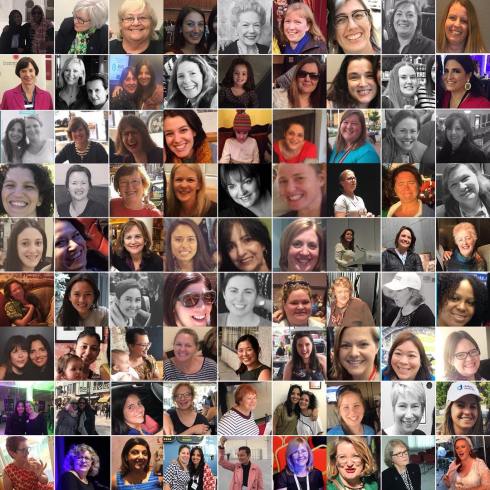
I celebrate these women today and every day!
More writing about women and diabetes, and women’s health.
This is what Diabetes Privilege Looks Like
One Foot in Front of the Other
About a month ago, we needed a new Netflix series to binge on and Aaron suggested we have a look at ‘The Good Place’. I’m so glad he did. It was fucking forking brilliant.
I adored all the characters and one if my favourites was definitely the name-dropping, poor-little-rich-girl Tahani, played by the exquisite Jameela Jamil.
The other day, while trawling through Twitter for Oscars updates, I came across her extraordinary #IWeigh initiative and have become a little obsessed. Jamil started this all with a blog post following a truly horrendous – as in ‘what the fuck fork were they thinking’ horrendous – photo of the women in the Kardashian family with their weights superimposed over the top of them. The photo was shared on an Instagram account claiming to be about ‘fashion, beauty, lifestyle’ which apparently is code for ‘Your-life-is-not-good-enough-you-piece-of-shit.’. Who knew?!
Anyway clearly Jamil was unimpressed by this photo – not only that these poor women had been labelled by their weigh in kilograms, but then there was a discussion afterwards that included posters doubting the truth of the numbers given. Awesome, not only were these women being judged about the number they see on the scales, they were also being called out as liars.
I looked at the photo and I stopped seeing the faces of the Kardahsians (I’ll be honest – I wasn’t all that upset) and started seeing them as bathroom scales. Oh – the insta post got better: it asked followers to share how much they weigh, because that’s a metric that we are ALL comfortable sharing with an Instagram audience. (Hashtag fitspo/thinspo/any-other-damaging-spo.)
Jamil’s impassioned post called out the bullshit and begging that we stop defining a woman’s worth by her weight, posting a photo of how she weighs her worth:

This resulted in a rush on women listing how they ‘weigh’ themselves.
While I think many women could relate to what was going on here, add diabetes to the mix and we have it tenfold! In diabetes, we get judged by more than just our weight. We become defined in the eyes of some HCPs by all the numbers associated with our condition whether it be the snapshot BGL check we do in front of them, our A1c, our blood pressure, our CGM trace or even our time in range. The measure of who we are is in those numbers, as if a number can define who we are.
But just like women cannot be measured by their weight (stop it! No, seriously – stop it!) people with diabetes cannot be measured by any of our numbers. Because of course, we are always, always, always about much more than that average number.
I measure my weight as a person not in kilograms or pounds, but in the things that make me who I am. Some of those things weigh me down, others lighten me. But together, they define me and make me who I am.

I’m not sure if it is age, acceptance, or perhaps even an admission of defeat, but these days when I look at my body, I have come to own that it is broken.
I actually say this with a feeling of achievement – I don’t really feel sad about it anymore. I don’t look at it and wish the brokenness away. I don’t want to cry and dream of a day when it will be ‘all better’.
I don’t even really hate what it is anymore, and that is a huge shift from a few years ago.
I have also come to understand – and accept – a lot of those feelings of hopelessness and helplessness were tied up with my fertility, but it has always been more than that.
It has also been about feeling that I am not enough and that my body is not enough. I’m acutely aware of how limiting diabetes can be some days, even if I am the only one who truly knows it. And often, I am the only one who truly knows it. Because my diabetes, by its very nature, has been easy to conceal.
The invisibility of diabetes doesn’t really make sense when it is your body it’s hiding away in. While my diabetes may be shrouded in a cloak of invisibility to everyone else, to me it may as well be covered in glitter, lit by neon and be accompanied by a marching band. There are days it’s all I ever see and all I ever feel.
The confusing thing is that while it has always been so obvious to me, I’ve tried to hide it away from everyone else. Clearly, I don’t mean I’ve tried to hide away the fact that I live with diabetes (exhibits A – Z: this blog/my job/talking endlessly about living with diabetes to anyone who will listen and those who won’t… etc.), but I certainly have frequently tried to hide away how it impacts my daily life.
Some periods in the last (almost) 20 years, diabetes has been harder to hide. Other times, it’s easier. It certainly has been easier since I’ve been Looping because overall, living with diabetes has been easier.
So when something happens that reminds me of just how difficult it can be, it is like a bolt of lightning.
A dodgy sensor on Saturday meant that I wasn’t Looping for most of the day, and that, combined with a shitty chest infection, resulted in some horridly high glucose levels – the highest I’ve seen in over six months. It hit me for six as the limitation of diabetes reared its ugly head. I tried to hide it until the waves of nausea started crashing over me and I took myself home and lay on the couch waiting for it to subside.
But as I dealt with it, I did something I wouldn’t have done in the past. Instead of denying there was anything wrong, or trying to blame anything else I could point my fingers at, I admitted just what it was: it was diabetes.
My broken body is my diabetes body. And it’s all I have. I can’t have one without the other. I may be lucky enough to be able to say that by and large I can manage to keep it in a place I’m happy with. But it is undeniable that there are times I cannot. We can’t always fix what is broken, but we can work around the brokenness. That’s what I do. Every single day.

Broken denim on my broken body.
Since my talk last at ADATS year about my journey to Loop, I have had many HCPs want to talk to me about my experience using a DIY system. When I was ATTD two weeks ago, several Aussie HCPs also at the conference cornered me, and, in almost hushed tones, asked if they could pick my brains about the whole DIY thing.
I have to keep reminding people that all I can talk about is my own experience – I’m certainly not an expert, my involvement has been following the brilliantly clear step-by-step how to guides developed by a brains trusts of brains far, far smarter than mine could ever hope to be. But I am always happy to talk about my own decision to try Loop, and experiences since.
DIY is not going anywhere and I’m pleased to say that over the next few month I’m giving a number of talks at HCP conferences where I have been asked to speak about how my diabetes management – and attitude to diabetes – has changed since I started Looping. It great to see this on the agenda of diabetes HCP meetings (including the ADEA Victorian Branch conference later this month and the ADS ADEA ASM – or whatever it’s being called now – in August this year. I hope that ADATS will give it more airtime when that come around in October.)
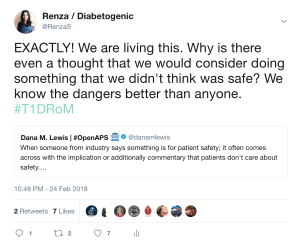
Naturally, and I suppose somewhat reassuringly, the first part of any conversation about Loop is about how safe it is, or rather, questions including varieties of: ‘But the safety! There’s no regulation! There are no RCTs! Where’s the evidence?’ These are often the same things held up by device companies when talking about their products: ‘We are ALL about safety! We have jumped through all the regulatory hoops and come out the other end with flying colours! Here are our RCTs! Here is the evidence!’
When I began reading up about Loop, the thing that would make me close my computer, shake my head and pack all thoughts of it away, was not that I didn’t think it safe. It was that I didn’t think I had the technical aptitude to make it happen.
From the very first reading of the documents and listening to others speaking about it, I realised that this was something that had been built from the foundations of safety. Unlike the health condition that moved in almost 20 years ago.
Type 1 diabetes is not no-risk. At the point of diagnosis, we are handed a supply of a potentially lethal drug. I know I don’t like to think of it in those terms– insulin is my lifeline – but anyone who has even an ounce of knowledge about the treatment of type 1 diabetes knows how potent insulin is.
We know that too much insulin – even a tiny bit too much – can be problematic. And that problem spectrum can be from ‘Shit, I need jelly beans’ to … well, to death. We are faced with this reality every day. I have enough insulin in my pump at any time for it to be extraordinarily problematic if overdosed.
With this knowledge on board – alongside that theoretically lethal drug on board – we mitigate risks with every single thing we do. We over treat lows; we err on the side of caution when we bolus – under dosing for fear of overdosing.
We live safety, we breathe safety – all the time – because if we don’t the risks are high. All too terrifyingly high.
I say this without an ounce of disrespect, but when a device company or HCP implies – intentionally or otherwise – that those of us using a DIY system are being reckless and being unsafe, I find it insulting, and a little disingenuous, because any conceivable hazard is highest to those of us who have the devices stuck to our bodies, and using an algorithm that decides how much insulin to push into our bodies.
I feel much safer Looping that I did pre-Loop. Scary hypos are a thing of the past. My glucose levels sit in a straight, tight line for most of the day instead of the rollercoaster I was used to that would send my mind into a permanent state of fuzziness. I am not running low overnight, only finding out for just how long when I finally wake in the morning and see my Dex trace below the red line for hours and hours and hours without my knowledge. My A1c is in the range that means (allegedly) I am least at risk for developing diabetes complications.
I honestly don’t know how I can be any safer while living with a health condition that throws so many unsafe things at me!





 Diabetogenic